Introduction
The Charpy impact test, also known as the Charpy V-notch test, is a standardized mechanical test used to determine the amount of energy a material absorbs when it fractures under impact. This energy measure is a direct indicator of a material’s toughness and its ability to resist sudden forces without breaking.
This simple yet powerful test is widely used in industries such as construction, automotive, aerospace, manufacturing, and metallurgy because it helps engineers and designers select materials that won’t fail unexpectedly under sudden loads or in extreme environments.
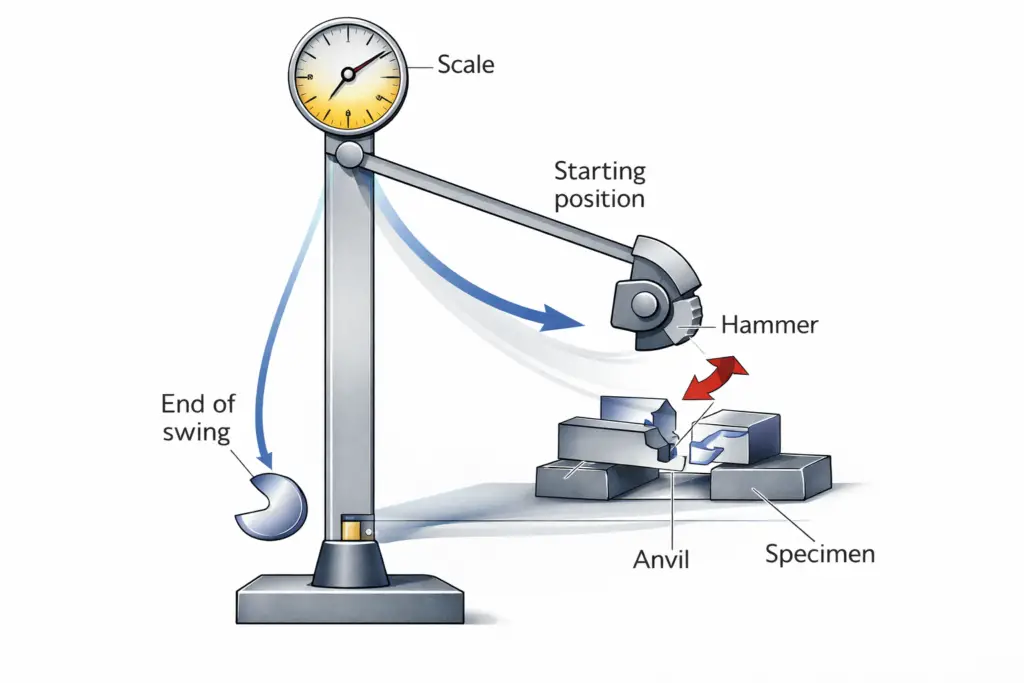
What the Test Measures
At its core, the Charpy impact test measures impact energy absorption — the amount of energy a notched specimen absorbs before it fractures when struck by a swinging pendulum hammer. The higher the energy absorbed, the tougher and more impact-resistant the material. Toughness itself is the ability of a material to absorb energy and deform plastically before fracturing.
History and Development
The test was developed in the early 1900s by French metallurgist Georges Charpy, building on earlier concepts by S. B. Russell. Charpy’s innovations standardized the test and made it practical and repeatable for materials engineering.
Test Specimen and Setup
The standard Charpy specimen is:
- 55 mm long
- 10 mm × 10 mm cross-section
- V-notch machined into the center
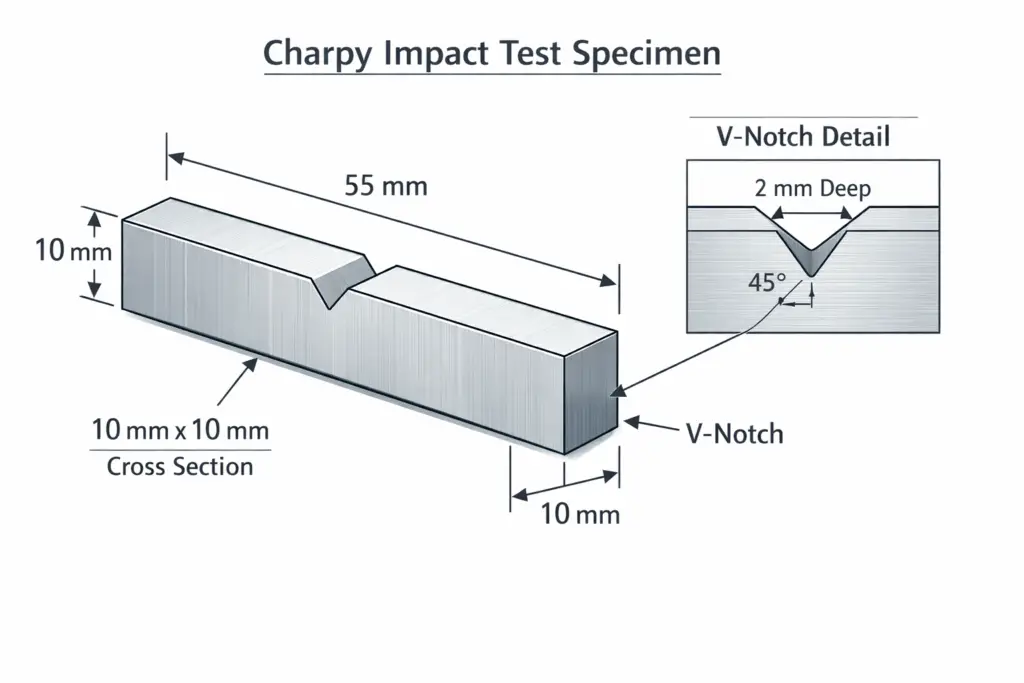
The notch is crucial because it creates a stress concentration that encourages fracture to initiate at a defined point, helping differentiate how materials behave under impact conditions.
Equipment and Procedure
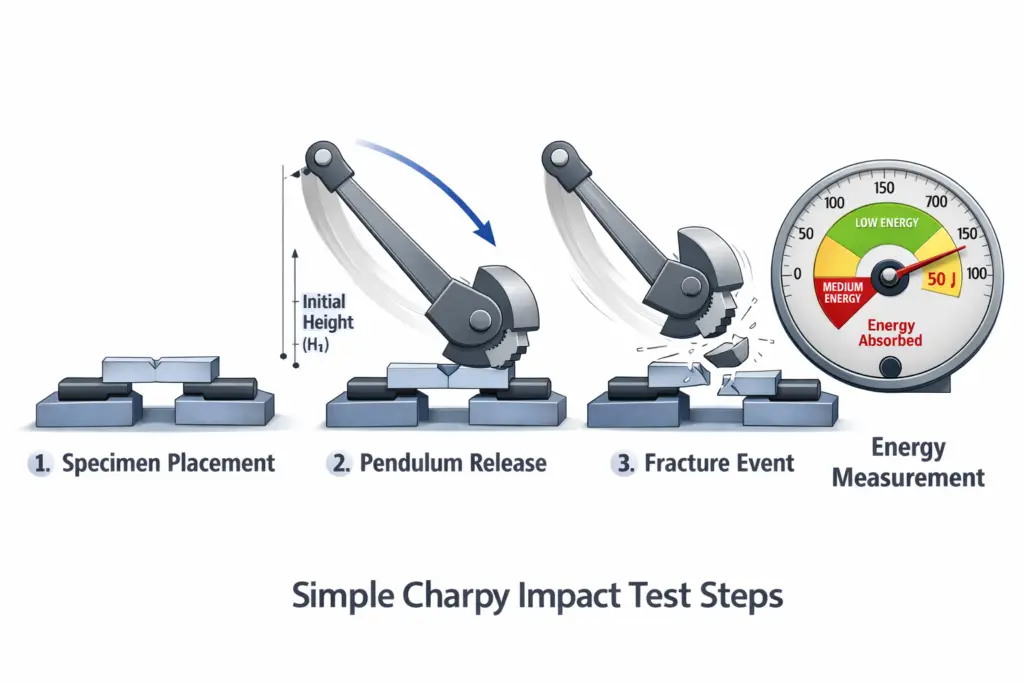
A typical Charpy impact testing machine has a heavy pendulum hammer that swings from a fixed height with known potential energy. The steps are:
- Position the notched specimen horizontally on two supports in the machine.
- Release the pendulum from a known initial height (H₁).
- The pendulum strikes the specimen opposite the notch, causing it to break.
- The pendulum continues swinging to a new height (H₂).
- The difference in height indicates the energy absorbed (impact energy).
The absorbed energy is usually displayed directly on a dial and expressed in Joules (J).
Analysis of Results
The fracture surface offers qualitative insights:
- Ductile fracture: jagged, shear-deformed surface — indicates good toughness
- Brittle fracture: flat, cleavage-like surface — indicates poor toughness
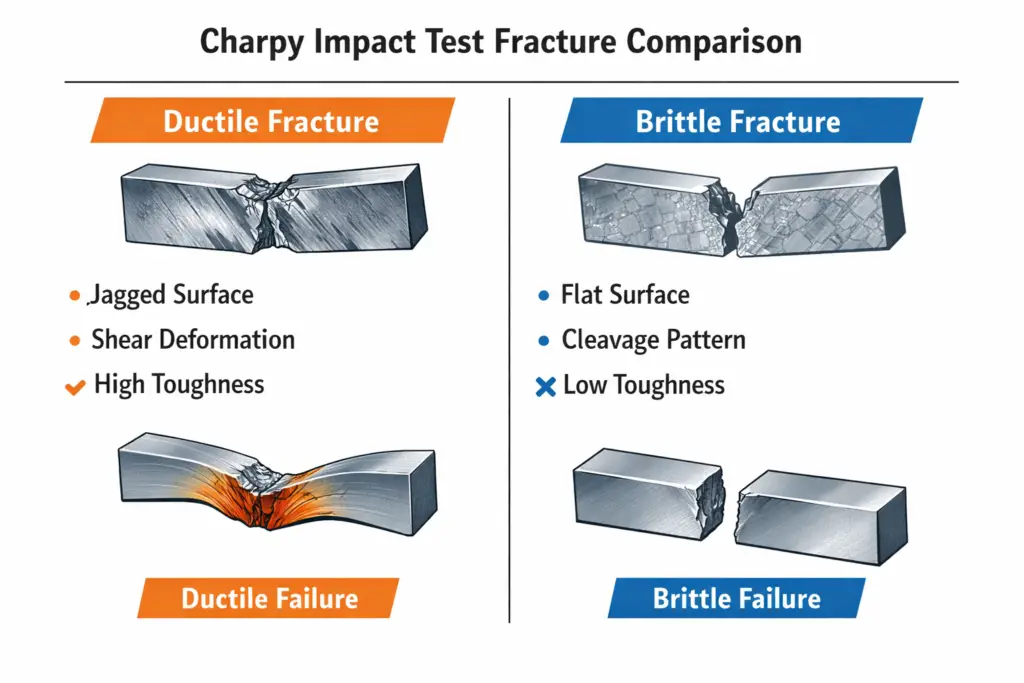
Impact energy values indicate whether a material can safely absorb sudden forces or should be avoided in certain applications.
Importance of the Charpy Impact Test
1. Evaluating Toughness and Safety
Toughness is a vital property for materials expected to bear dynamic loads, such as in bridges, automotive parts, and heavy machinery. The Charpy test helps ensure materials have enough energy absorption capacity to prevent catastrophic failure.
2. Temperature and the Ductile-Brittle Transition
Many materials, especially steels, become brittle at lower temperatures. The Charpy test can be conducted at different temperatures to determine the ductile-to-brittle transition region (DBTT) — crucial for structures in cold climates.

3. Material Selection and Quality Control
Manufacturers use Charpy impact testing to:
- Compare toughness between materials
- Assess whether production batches meet specifications
- Guide material selection for specific applications
This helps prevent failures in service and enhances product reliability.
4. Standardization and Comparability
The test is standardized globally (e.g., ASTM E23, ISO 148-1), meaning results from different labs or countries are comparable. This is critical for global engineering projects and material certification.
Applications in Real-World Engineering
- Construction: evaluating steel beams and components for buildings or bridges.
- Automotive: assessing crash performance materials.
- Aerospace: ensuring materials resist sudden aerodynamic loads.
- Manufacturing and quality assurance: routine testing of new alloy batches.
Conclusion
The Charpy impact test remains a cornerstone of mechanical testing. Simple, economical, and reliable, it provides essential data on how materials behave under sudden loads — making it indispensable in ensuring safety, performance, and reliability in engineering applications.