Manual, Semi-Automatic,
Machine & Automatic Welding
Not all welding is the same — and neither are the people who do it. This guide precisely defines Manual, Semi-Automatic, Machine, and Automatic welding as codified in ASME BPVC Section IX, AWS 3.0, and BS 499-1, explains why the distinction matters for welder qualification, and shows exactly which processes fall into each category.
Welder vs. Welding Operator — What’s the Difference?
Before diving into welding types, it is essential to understand the two roles that ASME Section IX recognizes and qualifies separately. The category a person falls into depends entirely on the method of welding being used — and that classification has direct implications for how they must be performance-qualified.
One who performs manual or semi-automatic welding. The welder directly manipulates the arc, torch, or electrode to create the weld joint.
- Manual skill and technique are the primary quality variables
- Qualified through Welder Performance Qualification (WPQ)
- Qualification is personal — tied to the individual, not the equipment
- Test: Weld a coupon; coupon is examined for soundness
One who operates machine or automatic welding equipment. The operator sets up and controls the machine but does not manually guide the arc.
- Ability to correctly set up and monitor equipment is the quality variable
- Qualified through Welding Operator Performance Qualification (WOPQ)
- Qualification is tied to the equipment type and process
- Test: Demonstrate ability to produce sound welds using the equipment
Why does this distinction matter? The essential variables for welder and welding operator qualifications are different under ASME Section IX. A welder qualification tests manual dexterity and skill. A welding operator qualification tests equipment operation capability. Mixing these up during a project audit is a common — and serious — quality non-conformance. Read our full guide on WPQ qualification ranges to understand the scope of each.
Purpose of Performance Qualification
🧑🏭 Welder Performance Qualification
- Determines whether the individual can produce a sound weld joint using manual or semi-automatic technique
- Covers specific process, base metal P-number, filler metal F-number, position, and thickness range
- Qualification is personal — cannot be transferred to another welder
- Lapse of welding activity beyond 6 months requires re-qualification
- Reference: ASME Section IX QW-300
🤖 Welding Operator Performance Qualification
- Determines whether the individual can correctly set up and operate welding equipment to produce a sound weld
- Covers the specific machine type, process, welding program, and setup procedures
- Qualification may be more broadly applicable across equipment of the same type
- Focus is on equipment operation, not personal arc skill
- Reference: ASME Section IX QW-380
The Four Welding Method Categories — Fully Explained
The fundamental difference between these four categories lies in who (or what) controls the key welding variables — arc guidance, filler metal feed, and travel speed. Understanding this progression from fully manual to fully automatic is critical not only for qualification purposes but also for quality planning and inspection.
Manual Welding
In manual welding, every aspect of the weld operation is controlled by the welder — the arc initiation and maintenance, electrode or torch manipulation, travel speed, arc length, and any filler metal addition are all done by hand. No mechanical or electronic device assists in guiding the torch, feeding wire, or controlling travel.
This is the most operator-skill-dependent category. Weld quality is directly a function of the individual welder’s proficiency, experience, and consistency. This is why welder performance qualification under ASME Section IX is structured to test personal skill through a physical weld test coupon.
Defining characteristic: The welder holds and manipulates the electrode holder, torch, and any additional filler by hand throughout the entire welding operation.
Manual welding still dominates in field construction, repair welding, complex geometry joints, and root pass welding in pipelines — situations where human judgment and adaptability are irreplaceable.
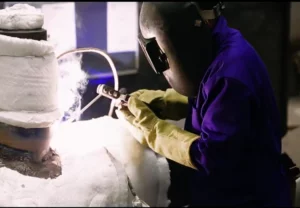
Welder holds and manipulates electrode holder
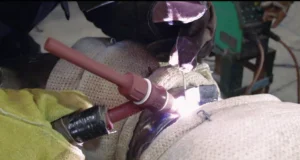
Torch in one hand; filler rod fed manually
Semi-Automatic Welding
Semi-automatic welding is the midpoint between full manual and machine welding. The key distinction: the equipment automatically controls the delivery of filler metal (wire feeding), but the welder manually controls the torch direction and travel throughout the weld.
A wire feeder is connected to the welding apparatus and continuously delivers consumable wire through the welding torch or gun at a set feed rate. The welder holds the gun, aims it, and drives the travel across the joint — just as in manual welding — but does not need to simultaneously feed a separate filler rod or replace stick electrodes.
Defining characteristic: Equipment manages filler metal delivery; welder manages torch direction and weld progression.
Because the welder still controls torch travel and direction in semi-automatic welding, this still qualifies as a welder role under ASME Section IX — not a welding operator. The welder’s skill remains the primary quality variable. Learn more about welding consumable nomenclature for GMAW and FCAW wires.
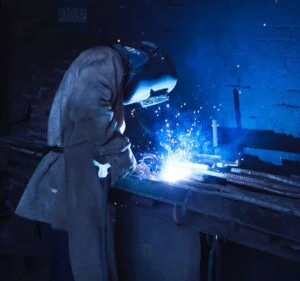
Wire fed automatically; welder guides the gun
Machine Welding
Machine welding (also called mechanized welding) goes one step further: a mechanical or electronic device holds the welding torch, gun, or electrode holder — the welder no longer holds it by hand. All primary welding operations are regulated by mechanical or electronic control systems.
However, the welding operator is present and can actively adjust parameters — such as current, voltage, travel speed, or wire feed rate — in response to changing conditions observed during welding. This real-time human intervention capability is the key feature that distinguishes machine welding from fully automatic welding.
Think of it as the operator “supervising and fine-tuning” a machine that is doing the physical work. SAW column-and-boom setups and orbital GTAW for pipe are classic machine welding configurations.
Defining characteristic: Torch is mechanically held; welding operator can manually adjust parameters as required during the weld.
Machine welding typically offers significantly higher deposition rates and consistency than manual or semi-automatic welding. Submerged Arc Welding (SAW) is one of the most common and productive machine welding processes — used extensively in pressure vessel and pipeline fabrication.
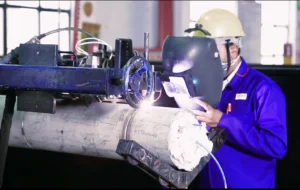
Torch mechanically held; operator adjusts settings
Automatic Welding
Automatic welding is the highest level of automation: the equipment performs the entire weld without any manual control adjustments by the operator during the welding process. All welding parameters — current, voltage, travel speed, wire feed rate, shielding gas flow, weld sequence — are pre-programmed before the weld begins and executed automatically.
The welding operator’s role is limited to setting up the equipment, loading the work, initiating the pre-stored program, and monitoring the process (and stopping it if a safety issue arises). The operator does not make real-time parameter adjustments — that is the machine’s job.
Robotic welding is the most widely recognized example: a welding program is taught or uploaded to the robot, and the robot executes precise, repeatable welds with no human intervention per cycle.
Defining characteristic: Welding operations are conducted by pre-programmed equipment without manual control adjustments during the process. The operator may or may not need to load/unload workpieces.
Automatic welding is increasingly common in high-volume manufacturing. Collaborative robots (cobots) are expanding automation even in small shops. See our article on The Rise of Collaborative Cobots in Welding for the latest developments in welding automation.
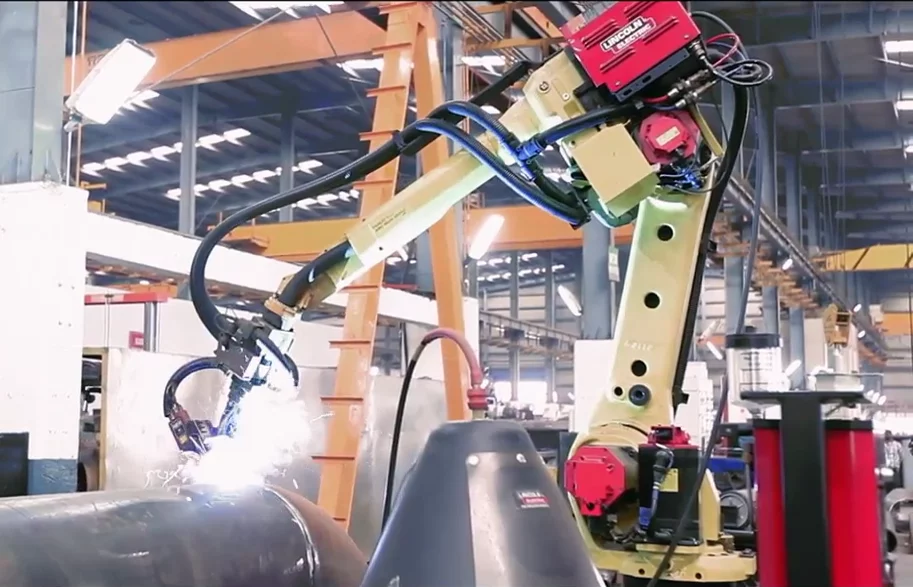
Pre-programmed robot; no operator adjustment during weld
Side-by-Side Comparison of All Four Welding Methods
| Feature | Manual | Semi-Automatic | Machine | Automatic |
|---|---|---|---|---|
| Arc / torch guided by | Welder (by hand) | Welder (by hand) | Mechanical device | Machine / robot |
| Filler metal feed | Manual (stick or rod) | Automatic (wire feeder) | Automatic | Automatic |
| Travel speed control | Welder | Welder | Mechanical device | Pre-programmed |
| Parameter adjustment during weld | Welder | Welder | ✔ Operator can adjust | ✘ Not permitted / not needed |
| Operator type (ASME IX) | Welder | Welder | Welding Operator | Welding Operator |
| Qualification standard | WPQ (QW-300) | WPQ (QW-300) | WOPQ (QW-380) | WOPQ (QW-380) |
| Primary quality variable | Welder skill & technique | Welder skill & technique | Equipment setup & monitoring | Program quality & setup |
| Productivity / deposition rate | Lower | Medium | High | Very High |
| Flexibility / complex geometry | ✔✔ Excellent | ✔✔ Good | ◑ Moderate | ✘ Limited without reprogramming |
| Typical applications | Field work, repair, complex joints | General fabrication, structural | Pressure vessels, pipelines, plate | High-volume manufacturing, automotive |
| Code references | ASME BPVC Section IX · AWS 3.0 · BS 499-1 | |||
Qualification Implications Under ASME Section IX
Understanding welding method categories is not just academic — it has direct, practical implications for how personnel are qualified, what essential variables apply to their qualifications, and what records must be maintained on your project.
Core Rule
If the welding technique is Manual or Semi-Automatic → the person is a Welder → qualified per QW-300
If the welding technique is Machine or Automatic → the person is a Welding Operator → qualified per QW-380
The essential variables that can cause a qualification to lapse or require re-qualification are different for welders and welding operators. For example, a change in base metal P-number or filler metal F-number may require a new WPQ — but for a welding operator, the key variables relate more to the equipment type, process, and machine settings.
Which Position Qualifications Apply?
For welders (manual and semi-automatic), position is an essential variable — a welder qualified in one position has a defined scope of other positions they may weld. For welding operators (machine and automatic), position is generally not an essential variable since the machine controls travel, and the operator does not physically manipulate the torch position. See our complete guide on welding positions and qualification ranges for the full picture.
Key Welding Processes — Deep Dive Articles
Each of the four welding method categories is associated with specific welding processes. Use the links below to go deeper on the processes most relevant to your work or interview preparation.
🎯 Test Your ASME Section IX Knowledge
Free practice quizzes for welder and welding operator qualification — covering essential variables, position ranges, and procedure requirements.
Why This Distinction Matters in Practice
In real fabrication projects — particularly in oil & gas, power, and pressure vessel work — the welder/welding operator distinction comes up during documentation audits, third-party inspection, and regulatory compliance reviews. Here’s where it matters most:
1. During ITP and Quality Plan Review
Your Inspection and Test Plan (ITP) and Welding Inspection Checklist must correctly identify whether personnel performing welding are qualified as welders or welding operators. Inspectors from client or third-party TPI bodies (like Lloyd’s, Bureau Veritas, TÜV) will check this during document review.
2. During Weld Map and Record Review
Each weld on a weld map must be traceable to a qualified individual. If a semi-automatic GMAW weld is attributed to a “welding operator qualification” rather than a “welder qualification,” this is a non-conformance against ASME Section IX.
3. When Changing Welding Method on an Existing WPS
A change from semi-automatic to machine welding (or vice versa) is an essential variable change under ASME Section IX — it requires a new PQR qualification test because the nature of the operation fundamentally changes. Do not assume that a WPS covering “GMAW” automatically covers both semi-automatic and machine GMAW.
Common audit finding: Projects where SAW (a machine welding process) operators are listed under “welder qualification” records, or where GMAW welders qualified for semi-automatic work are assigned to machine GMAW rigs without separate WOPQ verification. This is one of the most frequently cited non-conformances during third-party welding quality audits.
Code References
The definitions in this article are sourced from:
• ASME BPVC Section IX — Article I (General Requirements) and Article III (Welding Performance Qualifications)
• AWS 3.0 — Standard Welding Terms and Definitions
• BS 499-1 — Welding Terms and Symbols
Always refer to the current edition of the applicable standard for qualification activities on your project.