Welder Performance Qualification (WPQ) as per ASME Section IX — Complete Technical Guide
Welder Performance Qualification (WPQ) is the formal process by which a manufacturer or contractor establishes that a welder or welding operator possesses the manual skill and technique to produce sound welds in production. Under any ASME construction code — whether ASME B31.1, ASME B31.3, or ASME Section VIII Division 1 — ASME Boiler and Pressure Vessel Code (BPVC) Section IX, Article III governs this qualification. A welder who has not been qualified in accordance with Section IX must not be assigned to production welding covered by these codes, regardless of experience or prior certifications from other standards.
It is important to understand from the outset that WPQ is fundamentally different from Welding Procedure Qualification (WPQ/PQR). The procedure qualification (PQR) establishes that a specific welding procedure can produce a weld joint meeting the required mechanical properties for the service application. The welder performance qualification, by contrast, is solely a test of the individual’s skill — their ability to deposit sound weld metal under defined conditions. As a result, the WPQ test coupon does not need to meet the mechanical property requirements of the PQR, and many of the essential variables are entirely different.
This guide covers the complete WPQ requirements per ASME Section IX: who requires qualification, what test methods are permitted, how essential variables govern the scope of qualification, how thickness and diameter ranges are calculated, the validity and continuity rules that keep qualifications current, and the mandatory contents of the QW-484A certificate. Reference clauses are provided throughout so that you can verify each requirement directly in the code.
1. Purpose and Scope of WPQ
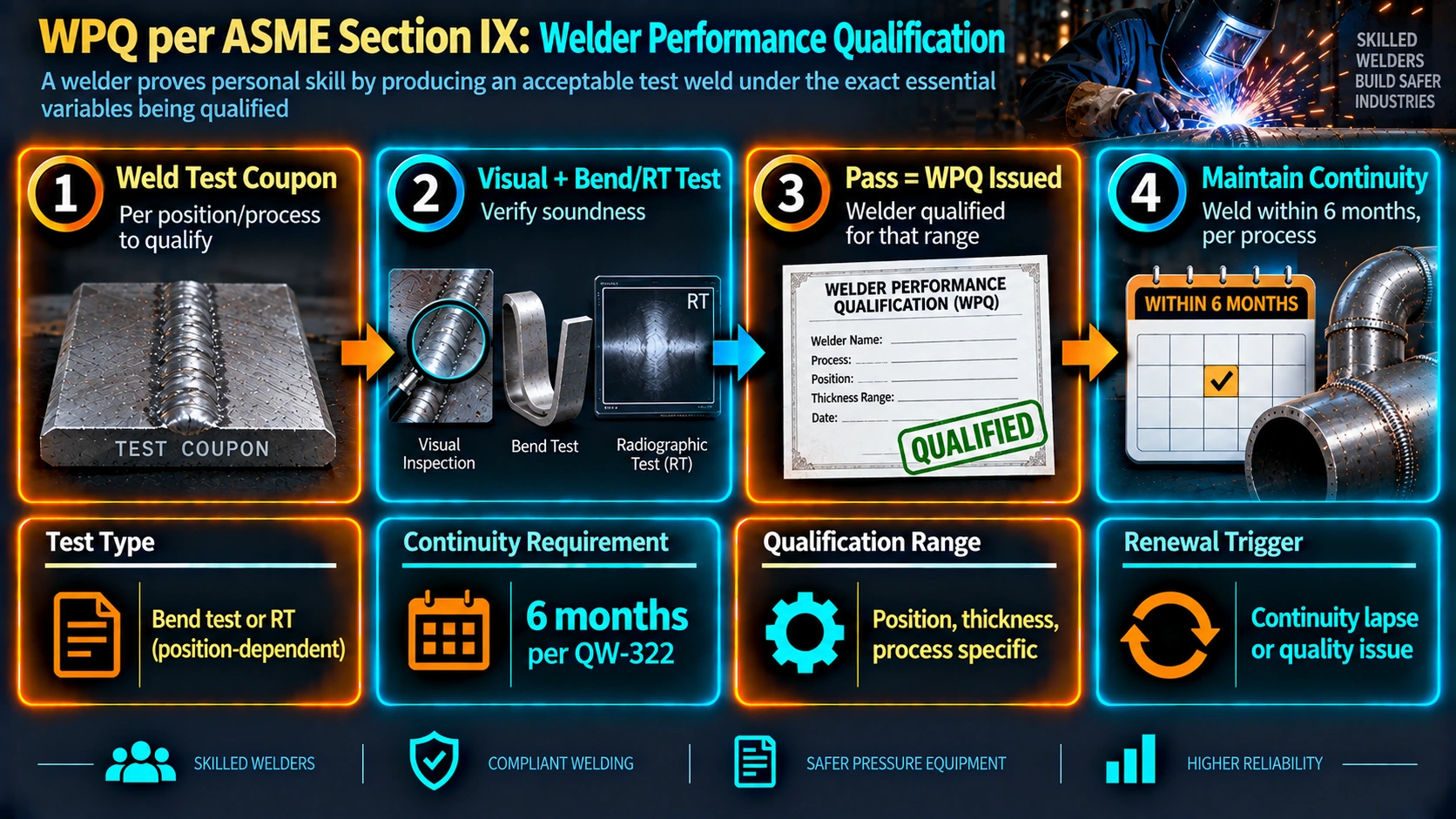
The purpose of the performance qualification test, as stated in ASME Section IX, is to determine the ability of the welder or welding operator to produce sound welds. The WPQ record documents the evidence that this ability has been demonstrated for a defined set of welding variables. Critically, the WPQ says nothing about the suitability of the procedure — that is the domain of the PQR. What it confirms is that this specific individual, working under the stated conditions, can deposit weld metal that is free from injurious defects detectable by the specified examination method.
Every manufacturer or contractor is responsible for qualifying the welders and welding operators they employ for production welding. Qualifications conducted by one organisation are not transferable to another; if a welder changes employer, re-qualification with the new employer is required unless a specific provision exists under the applicable construction code.
1.1 Welder vs. Welding Operator
Understanding the distinction between these two roles is essential before reviewing qualification requirements, because separate essential variable tables, test records, and in some cases separate test coupons apply to each.
- Welder: Manually controls the welding equipment and directly manipulates the arc or flame. Uses manual or semi-automatic welding modes. The qualification record format is QW-484A.
- Welding Operator: Controls machine or automatic welding equipment. Does not directly manipulate the arc. The qualification record format is QW-484B. A welder cannot be used as a welding operator without a separate qualification test, even in the same welding process.
2. Test Requirements (QW-301)
For every WPQ, the test coupon must be welded in strict accordance with a qualified Welding Procedure Specification (WPS) or a Standard Welding Procedure Specification (SWPS). The organisation must have a valid, qualified WPS in hand before the welder performance test can be conducted. This is a hard requirement — you cannot test a welder against an unqualified or draft WPS.
2.1 Preheat and PWHT
Even if the reference WPS specifies preheat and/or post-weld heat treatment (PWHT), these are not required to be applied when preparing the WPQ test coupon (QW-301.2). The reasoning is that preheat and PWHT are procedure controls that protect the material’s metallurgical integrity — they are not a test of individual welder skill. In practice, however, welding engineers often choose to include preheat when all production welds on the contract are performed with preheat, recognising that the skill required to weld at elevated interpass temperatures is itself relevant.
2.2 Record Requirements (QW-301.4)
Each manufacturer or contractor must maintain a complete record of all welder and welding operator performance qualifications. At a minimum, the record must capture: the essential variables used in the test, the ranges qualified (particularly thickness per QW-452 and diameter per QW-452.3), the type and results of each examination or test performed, and the welder’s identity details. The non-mandatory suggested format QW-484A covers all of these fields and is widely used in industry.
3. Examination Methods
ASME Section IX permits two primary routes for demonstrating welder skill. The choice of method determines which joint types and materials are covered, and each method has distinct restrictions and acceptance criteria.
3.1 Qualification by Mechanical Testing
Mechanical testing is the most broadly applicable examination route. The type and number of test specimens required is specified in QW-452. Mechanical testing can be used to qualify a welder for any base material P-Number and any thickness of weld deposit.
The principal test types are:
- Face Bend Test (QW-160): The face of the weld is placed in tension. Used for thinner coupons.
- Root Bend Test (QW-160): The root of the weld is placed in tension. Also used for thinner coupons.
- Side Bend Test (QW-160): A cross-section of the weld is bent edgewise. Used for coupons 10 mm (3/8 in.) and thicker. Tests the full weld cross-section.
- Fillet Weld Fracture Test (QW-181.2): Required when qualifying specifically for fillet welds on plate. The fillet weld is fractured and the exposed surface examined for discontinuities.
- Macro Examination (QW-184): Used for fillet weld qualification; the cross-section is examined for weld profile and fusion.
3.2 Qualification by Volumetric NDE (QW-304, QW-305)
Volumetric NDE — radiographic testing (RT) or ultrasonic testing (UT) — may be used as an alternative to mechanical testing for groove weld qualification when permitted by the applicable Section. However, its use is subject to significant restrictions:
- Only applicable to groove welds; volumetric NDE cannot be used to qualify a welder for fillet welds.
- Applicable only to the following processes or combinations: SMAW, SAW, GTAW, PAW, and GMAW (except short-circuit transfer mode when using RT).
- Not permitted for P-No. 21 through P-No. 26, P-No. 51 through P-No. 53, or P-No. 61 through P-No. 62 base metals, except that GTAW groove welds on P-No. 21 to 26 and P-No. 51 to 53 materials may be qualified by volumetric NDE per QW-191.
- Ultrasonic examination (UT) is only acceptable for coupons with thickness 6 mm (1/4 in.) and above; RT has no minimum thickness restriction.
Minimum Examination Length
When qualifying by volumetric NDE, the minimum weld length to be examined is 150 mm (6 in.) and must encompass the entire weld circumference. If the pipe outside diameter is too small to provide 150 mm of weld length in a single test coupon, up to four test coupons may be welded and the lengths combined to reach the minimum (QW-304.1). For qualification of a welding operator over a production weld, the minimum examination length increases to 1 metre (3 ft).
| Feature | Mechanical Testing | Volumetric NDE (RT) | Volumetric NDE (UT) |
|---|---|---|---|
| Applicable joint types | Groove and fillet | Groove only | Groove only |
| Thickness restriction | None | None | Min. 6 mm |
| P-Number restrictions | None | Yes — see QW-304 | Yes — see QW-305 |
| Process restrictions | None | SMAW, SAW, GTAW, PAW, GMAW (no SCGMAW) | Same as RT |
| Min. examination length | N/A | 150 mm | 150 mm |
| Fillet weld qualification | Yes (QW-181.2) | No | No |
4. Essential Variables for WPQ
Essential variables are those welding variables for which a change beyond the limits qualified in the test coupon requires a new WPQ test. They are process-specific and are listed in QW-352 through QW-357. The concept is that certain variables directly impact the skill or technique required from the welder. A change that demands a fundamentally different skill set invalidates the original qualification.
Note that unlike the PQR, there are no supplementary essential variables or non-essential variables in WPQ — every listed variable is essential.
4.1 Common Essential Variables Across Processes
| Variable | Code Reference | Effect of Change |
|---|---|---|
| Welding process | QW-350 series | Change of process (e.g., SMAW to GTAW) requires new qualification; each process must be individually qualified. |
| Backing | QW-350 series | Deletion of backing (changing from welding with backing to without backing) is an essential variable. The open-root technique is more demanding and cannot be assumed from a backed joint qualification. |
| Base metal P-Number | QW-423 | Governs the range of base materials the welder is qualified to weld. Generally, qualification on a higher P-Number group covers lower groups within the same grouping per the table in QW-423. |
| Filler metal F-Number | QW-433 | F-Numbers group electrodes by usability characteristics. A welder qualified with an F-4 electrode (e.g., E7018) cannot automatically weld with an F-5 electrode (e.g., E308) without re-qualification. |
| Pipe diameter | QW-452.3 | Qualification on a larger-diameter pipe qualifies downward to limits in QW-452.3. A welder qualified on 6-inch pipe cannot weld 2-inch pipe. |
| Weld deposit thickness | QW-452 | The thickness of weld metal deposited by the welder determines the production thickness range. Depositing ≥13 mm with a minimum of three layers qualifies the welder for unlimited thickness. |
| Welding position | QW-461.9 | Qualification in one position does not automatically qualify all positions. A 6G qualification (or combined 2G + 5G) qualifies all positions. See our detailed guide on welding positions and qualification scope. |
5. Thickness and Diameter Qualification Ranges
The qualification range for weld metal deposit thickness and pipe diameter are among the most frequently misapplied aspects of WPQ. Engineers and quality engineers must determine the correct production ranges from the test coupon variables — not from the base metal thickness of the coupon, which is the parameter used in PQR thickness qualification.
5.1 Weld Deposit Thickness (QW-452)
The critical measurement is the thickness of weld metal deposited by the welder during the test, not the thickness of the base metal plate or pipe. For groove welds, the ranges are as follows per Table QW-452.1(b):
- If the weld deposit thickness (t) is less than 3 mm: the welder is qualified only for that specific deposit thickness.
- If t is between 3 mm and 19 mm: the qualified range is from 3 mm to 2t (twice the deposit thickness).
- If t exceeds 19 mm: the welder is qualified from 3 mm to unlimited thickness.
- Special rule: A weld deposit of 13 mm or more, laid down in a minimum of three layers, qualifies the welder for unlimited thickness regardless of whether the deposit reached 19 mm.
For combination test coupons where more than one welder, welding process, or set of essential variables contributes weld metal, the deposit thickness attributed to each individual welder is determined separately and the qualification ranges applied individually.
5.2 Pipe Outside Diameter (QW-452.3)
Diameter qualification governs what minimum pipe size the welder can produce in production. The pipe outside diameter (OD) of the test coupon determines the range. Welding a plate coupon qualifies the welder only for pipe OD greater than 73 mm — it does not cover small-bore piping.
5.3 Fillet Welds
A welder who passes the required tests for a groove weld test coupon is automatically qualified to make fillet welds on all base metal thicknesses and all pipe diameters and fillet weld sizes. This is an important and often under-appreciated scope expansion: a groove-weld-qualified welder does not need a separate fillet weld test coupon, provided the joint type is fillet. However, a welder qualified only on a plate-to-plate fillet weld test coupon (without a groove weld) has limitations on production fillet sizes as noted in the table at QW-452.5.
6. Welding Position Qualification Scope
Welding position is an essential variable for WPQ. The scope of positions qualified from a given test coupon position is governed by QW-461.9. The most significant point for pressure pipe fabrication is the 6G position: qualifying on a fixed pipe in the inclined position (axis at 45 degrees to horizontal) qualifies the welder for all other pipe and plate welding positions without exception.
For welders who cannot or do not test in 6G, the alternative is to weld one test coupon in 2G (pipe axis vertical, welding circumferentially in a horizontal plane) and one in 5G (pipe axis horizontal, fixed, welding all around). Together, 2G + 5G covers all positions just as 6G does. Explore the full position qualification scope matrix in our welding positions guide.
7. Certificate Validity and Continuity (QW-322)
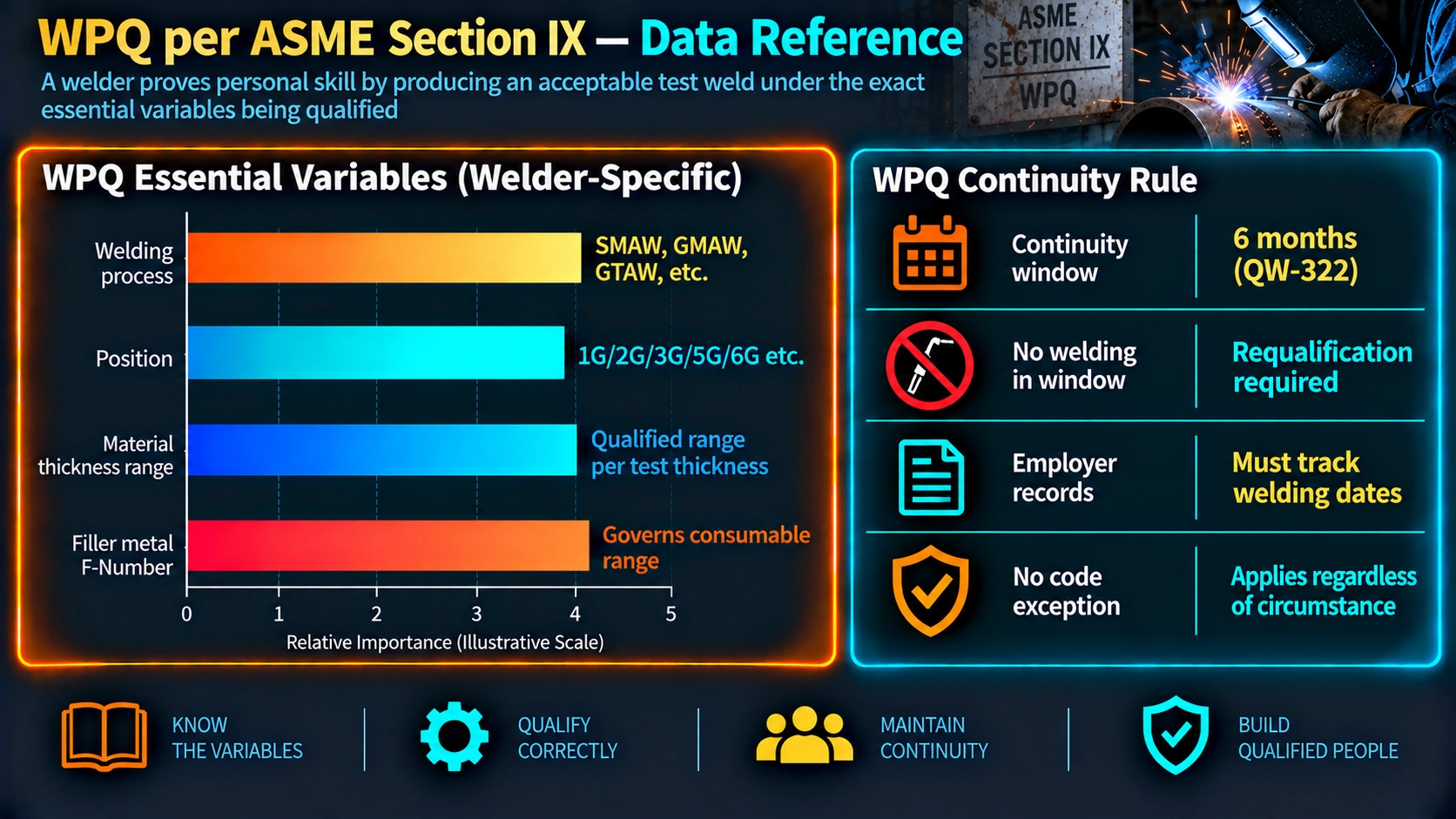
A WPQ does not remain valid indefinitely. Two conditions control the ongoing validity of a welder’s qualification:
- Six-month continuity rule: The welder must use the qualified welding process in production welding within any 6-month period. If 6 months elapse without production use of the process, the qualification for that process expires and the welder must re-qualify before being assigned to production work in that process.
- Revocation for cause: If at any time there is a specific reason to question a welder’s ability to produce acceptable welds — for example, a demonstrable pattern of weld defects — the employing organisation may revoke the qualification, regardless of the time elapsed.
The organisation’s records must allow verification of the continuity of each welder’s qualifications. Practically, this means maintaining a log that records the date of last production use of each qualified process for each welder. Many fabricators use a simple spreadsheet or CMMS module to track this, with automated alerts when a welder approaches the 6-month boundary.
8. The WPQ Certificate — QW-484A Format
ASME Section IX Appendix B provides a non-mandatory suggested format for the welder performance qualification record: Form QW-484A. While any format may be used provided it captures all required content (QW-301.4), QW-484A is universally accepted and understood by clients, third-party inspectors, and notified bodies worldwide.
8.1 Mandatory Content
Regardless of the format used, the following information is mandatory on every WPQ certificate:
- Welder name and identification number / stamp
- WPS or SWPS number used for the qualification test
- All essential variables and their actual values as tested
- Qualified ranges — particularly thickness (QW-452) and diameter (QW-452.3)
- Type and result of each test (bend test, fracture test, RT, UT, visual, etc.)
- Date of welding and date of testing
- Name and signature of the responsible supervisor
- Approval stamp of the certifying organisation
8.2 The “Range Qualified” Column
A notable and sometimes confusing aspect of QW-301.4 is that it states the ranges qualified to be recorded under the “range qualified” column of QW-484A are only those per QW-452 (thickness and diameter). Other essential variable qualification limits — such as backing, F-Number, and P-Number — must also be recorded elsewhere on the form, but the formal “range qualified” statement relates specifically to dimensional limits. This has been reinforced in QG-104 of the 2021 edition.
Recommended Reading: ASME Section IX and Welding Quality
The following references are widely used by welding engineers, quality engineers, and inspection professionals working with ASME codes. Each title covers topics directly relevant to WPQ and welding procedure qualification.
ASME BPVC Section IX — Official Code
The primary reference. Contains all QW clauses, tables, and non-mandatory appendices including QW-484A. Essential for engineers and QC personnel.
View on AmazonWelding Inspection Technology — AWS
Comprehensive guide to weld inspection covering WPS, PQR and WPQ records, bend test evaluation, and NDE methods for welder qualification.
View on AmazonWelding Metallurgy — Sindo Kou
Authoritative textbook on welding metallurgy. Explains why heat input, preheat, and interpass temperature matter — the science behind the code requirements.
View on AmazonPractical Guide to ASME B31.3 — Ellenberger
Clear, practical commentary on process piping code requirements including how Section IX WPQ interacts with B31.3 fabrication and examination obligations.
View on AmazonDisclosure: WeldFabWorld participates in the Amazon Associates programme (StoreID: neha0fe8-21). If you purchase through these links, we may earn a small commission at no extra cost to you. This helps support free technical content on this site.
9. How WPQ Relates to WPS and PQR
The three qualification documents — WPS, PQR, and WPQ — serve distinct but interlocking purposes. Understanding how they interrelate prevents common errors in qualification programme management.
| Document | What It Qualifies | Who Performs It | What It Proves |
|---|---|---|---|
| WPS — Welding Procedure Specification | The welding procedure | Organisation | Instruction document listing all required welding parameters for production. |
| PQR — Procedure Qualification Record | The welding procedure | Organisation (test weld) | The procedure produces weld joints meeting the required mechanical properties for the service application. |
| WPQ — Welder Performance Qualification | The individual welder or welding operator | Individual welder | The welder has the skill to produce sound weld metal (free of injurious defects) under the stated conditions. |
A common error is assuming that if a welder personally welded the PQR test coupon, they are automatically qualified via the WPQ route. This is incorrect. The PQR test may serve as a WPQ test only if the required WPQ tests (mechanical or NDE) are performed in addition to the PQR mechanical tests, and the results are recorded on the WPQ certificate accordingly. For a deep dive into preparing WPS and PQR documents, see our guide on how to prepare a WPS and PQR.
9.1 P-Number Qualification Range for Welders (QW-423)
Unlike the PQR, where P-Number qualification ranges can be complex (particularly with dissimilar metals), the WPQ P-Number rules are relatively straightforward. A welder qualified on a base material belonging to a given P-Number group is qualified to weld all base materials in lower P-Number groups within the same P-Number series, per the matrix in QW-423. This is because the skill required to weld on tougher alloy materials encompasses the skill needed for more straightforward carbon steels. For a comprehensive reference on P-Numbers, F-Numbers, and A-Numbers, see our P-Number, Group Number, F-Number and A-Number guide.
10. Welder Qualification Records Management
Beyond the technical content of the WPQ itself, managing welder qualification records in an active fabrication environment requires a systematic approach. Large fabricators may have hundreds of welders qualified in multiple processes across multiple positions — tracking continuity, expiry, and scope for each individual is a significant quality management task.
10.1 Key Records Management Requirements
- All WPQ records must be retained and accessible for audit by the Authorised Inspection Agency (AIA) or notified body throughout the project and, under most construction codes, for a defined period after completion.
- The records system must allow rapid determination of each welder’s current qualification scope — which processes, positions, materials, thicknesses, and diameters they are qualified for on any given date.
- Continuity records (log of production weld dates by process) must be maintained separately from the WPQ certificate itself, as the certificate records only the test event, not ongoing continuity.
For welders working under ASME Section VIII pressure vessel codes, welder stamp identification is mandatory on each weld. The stamp must appear on the joint or in the weld traveller record, providing traceability from every production weld back to the individual welder’s current WPQ. This traceability supports the ASME Section IX qualification and inspection process.
Frequently Asked Questions: WPQ per ASME Section IX
What is the difference between a welder and a welding operator under ASME Section IX?
A welder is a person who manually controls the torch or electrode holder and directly manipulates the weld pool. A welding operator controls machine or automatic welding equipment and does not directly manipulate the arc. ASME Section IX provides separate essential variable tables and separate qualification record formats — QW-484A for welders and QW-484B for welding operators. A welder cannot weld as a welding operator, even in the same welding process, without a separate operator qualification test.
What testing methods are permitted for WPQ under ASME Section IX?
ASME Section IX permits two primary testing routes: (1) Mechanical testing — bend tests (face, root, or side) and fillet weld fracture or macro tests per QW-452; and (2) Volumetric NDE — radiographic examination for any thickness, or ultrasonic examination for thicknesses of 6 mm and above. Volumetric NDE is limited to groove welds made with SMAW, SAW, GTAW, PAW, or GMAW (excluding short-circuit transfer for RT), and cannot be used for fillet weld qualification.
How long is a welder performance qualification valid?
A WPQ remains valid provided no more than 6 months have elapsed since the welder last used the qualified welding process in production. If the welder has not used the process within 6 months, the qualification for that process lapses and re-qualification is required. In addition, if there is a specific reason to question a welder’s ability — such as a demonstrable pattern of rejectable welds — the qualification may be revoked by the organisation regardless of the 6-month continuity rule.
What are the essential variables for WPQ per ASME Section IX?
Essential variables for WPQ are process-specific and are listed in QW-352 through QW-357 of ASME Section IX. Common essential variables across most processes include: welding process, backing (deletion of backing is an essential variable), pipe outside diameter range (QW-452.3), P-Number of base metal (QW-423), F-Number of filler metal (QW-433), thickness of weld metal deposited (QW-452), and welding position (QW-461.9). A change in any essential variable beyond the qualified range requires the welder to be re-qualified for that variable.
What is the pipe diameter qualification range for WPQ?
The pipe diameter qualification range is governed by QW-452.3. A welder qualified on a pipe with outside diameter (OD) greater than 73 mm is qualified for all diameters above 25 mm. A welder qualified on OD between 25 mm and 73 mm is qualified down to a minimum OD of 25 mm. A welder qualified on pipe OD less than 25 mm is qualified only for that specific diameter. A welder qualified on plate is qualified only for pipe OD greater than 73 mm — plate qualification does not cover small-bore piping.
Can preheat and PWHT be omitted from the WPQ test coupon?
Yes. ASME Section IX QW-301.2 explicitly permits preheat and PWHT specified in the reference WPS or SWPS to be omitted when preparing a WPQ test coupon, since these thermal treatments are procedure controls rather than tests of welder skill. However, the welding engineer may choose to include preheat at their discretion — for example, when all production welding on the contract is carried out with significant preheat and demonstrating skill under those conditions is considered important to the quality programme.
What is the minimum examination length for volumetric NDE welder qualification?
When qualifying a welder or welding operator using volumetric NDE (RT or UT), the minimum examination length is 150 mm and must include the full weld circumference. If the pipe diameter is too small to achieve 150 mm in a single test coupon, up to four test coupons may be welded and their lengths combined to reach the minimum. For qualification of a welding operator over a production weld (rather than a test coupon), the minimum examined length is 1 metre.
What must a WPQ certificate (QW-484A) contain?
Per QW-301.4 and the suggested format QW-484A, a welder performance qualification record must include: welder identification details and stamp number; the WPS or SWPS number used; all essential variables and their actual test values; the qualified ranges for thickness (QW-452) and diameter (QW-452.3); the type and results of all mechanical or NDE tests performed; date of welding and testing; name and signature of the responsible supervisor; and the approval stamp of the certifying organisation.
Related Technical Articles on WeldFabWorld
Continue building your knowledge across welding procedures, materials, and codes with these related guides.