ASME B31.1 Clause 127.2.1 — Filler Wire and Electrode Selection for Power Piping
Filler metal selection is one of the most consequential decisions in power piping fabrication. The wrong consumable can produce weld metal that is weaker than the base material, incompatible in chemistry with the parent alloy, or structurally unsuitable for the service environment — all of which can result in in-service failure. ASME B31.1 Power Piping Code addresses this directly in Clause 127.2.1, which establishes a clear, hierarchical set of requirements that every fabricator, erector, and welding engineer must understand and follow.
This article provides a clause-by-clause technical breakdown of all seven requirements in ASME B31.1 Clause 127.2.1, with worked examples, applicable filler metal references from ASME Section II Part C, and practical guidance on how each requirement is implemented in power plant piping fabrication. Cross-references to ASME Section IX qualification requirements are included where relevant.
The Governing Code Text — Clause 127.2.1 Opening Statement
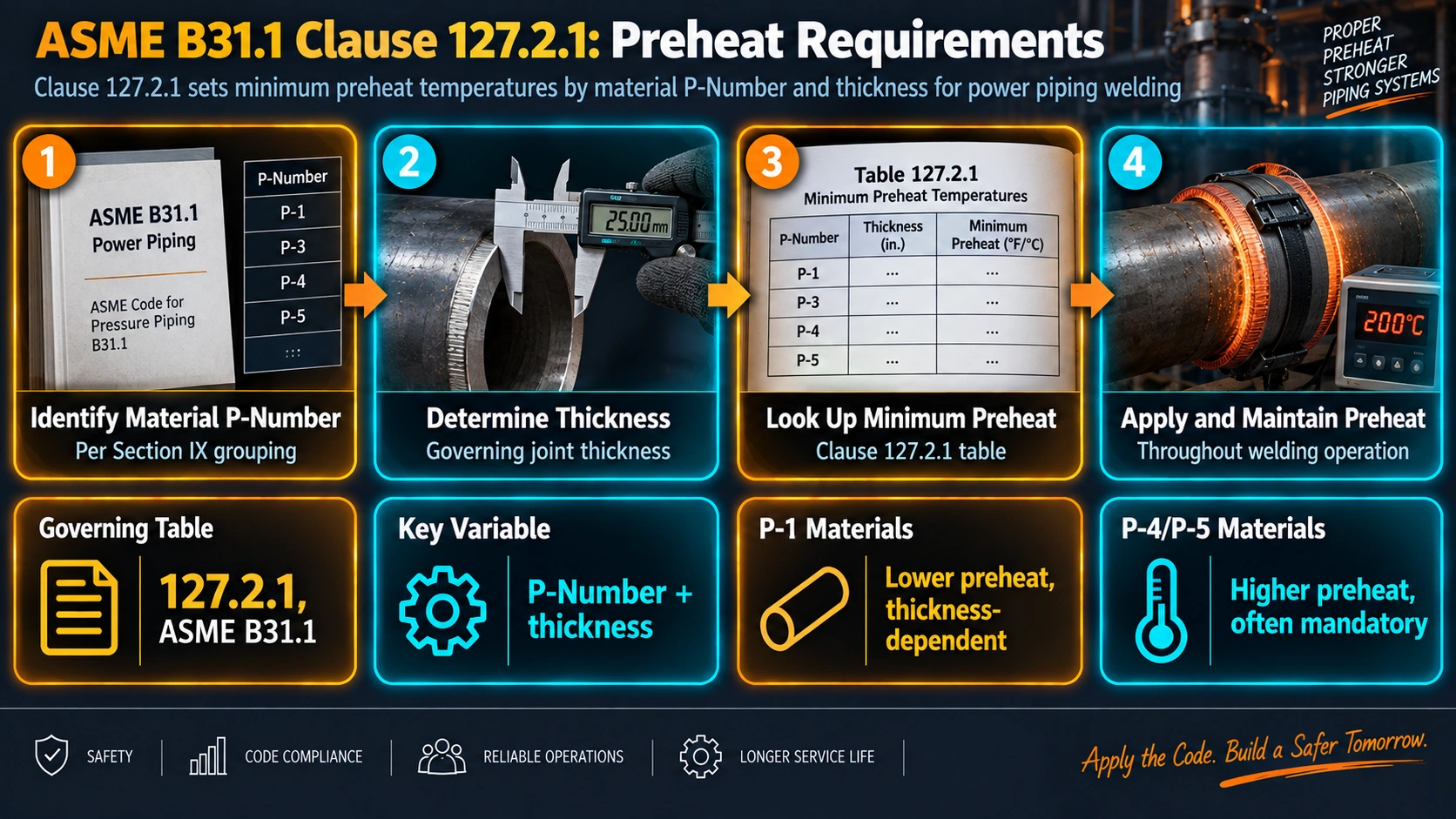
Before addressing the individual requirements (a) through (g), Clause 127.2.1 establishes two foundational rules that govern all filler metal use in ASME B31.1 power piping:
This requirement means all filler metals used in B31.1 work must be listed in, and conform to, the relevant SFA specification in Section II Part C. The SFA specifications are the ASME adoption of AWS filler metal classifications — for example, SFA-5.1 (carbon steel covered electrodes), SFA-5.9 (stainless steel bare wires), SFA-5.28 (low-alloy bare wires for GMAW/GTAW). Each SFA specification defines the required chemical composition, mechanical properties, packaging, and marking requirements that the manufacturer must satisfy.
Where a project requires a filler metal not covered by Section II Part C — such as a proprietary superalloy, an experimental high-strength filler, or a non-standard combination — the code permits its use only if the WPS specifically requires that filler and qualified welders have demonstrated acceptable results with it under ASME Section IX testing. This provision requires documented procedure qualification testing (PQR), not just a manufacturer’s data sheet.
Clause 127.2.1 — Requirements (a) Through (g)
Unless the designer specifies otherwise, filler metals used in B31.1 power piping shall produce weld metal complying with all applicable sub-requirements listed below. These are sequential and hierarchical — each requirement addresses a specific aspect of metallurgical compatibility between the filler metal and the base metals being joined.
This is the primary strength requirement. The weld metal must be at least as strong as the base material. For a joint in A106 Gr. B carbon steel pipe (minimum UTS = 415 MPa / 60 ksi), the filler metal must deposit weld metal with a nominal tensile strength of at least 415 MPa / 60 ksi. Using a lower-strength filler would make the weld the weakest element in the joint, violating the fundamental principle that the weld should not be the limiting factor in the piping system’s pressure-carrying capacity.
The use of filler metals with substantially higher strength than the base metal is generally permissible under this clause but must be considered in the context of requirements (c) and the overall stress analysis, particularly where PWHT may be required.
This clause applies when two base metals with different strength grades are joined at a transition weld — for example, a P-No. 1 Group 1 carbon steel pipe (60 ksi) butting to a P-No. 5A Cr-Mo pipe (70 ksi). The weld metal need only match the weaker material (60 ksi) rather than the stronger. This is a critical provision that prevents over-engineering the weld: using a 70 ksi filler when only 60 ksi is required adds no benefit and may introduce unnecessary hardness, hydrogen cracking susceptibility, or PWHT complications.
Base Metal A (A106 Gr. B): Min. UTS = 415 MPa (60 ksi)
Base Metal B (A335 P22): Min. UTS = 415 MPa (60 ksi) — similar
Base Metal C (A335 P91): Min. UTS = 585 MPa (85 ksi)
A + C joint: Weld metal must be ≥ 415 MPa (60 ksi) — match the weaker
Correct filler: ER70S-B2 (60 ksi class) or similar — NOT required to be 85 ksi
Chemical composition matching is required for several interconnected reasons: corrosion resistance (an alloy steel weld in a stainless body would corrode preferentially), mechanical property compatibility after PWHT (the tempering response of the weld metal must match the base metal to achieve uniform hardness), high-temperature creep resistance, and thermal expansion compatibility. The code specifically calls out major alloying elements (e.g., Cr, Mo) and essential minor elements (e.g., V, Nb, W in advanced creep-resistant steels).
| Base Metal | Grade | Key Elements | Required Filler (SFA / AWS) |
|---|---|---|---|
| Carbon Steel | A106 Gr. B / A333 Gr. 6 | C-Mn | SFA-5.1 E7016/E7018; SFA-5.18 ER70S-6 |
| 1.25Cr-0.5Mo | A335 P11 | Cr, Mo | SFA-5.5 E8016-B2; SFA-5.28 ER80S-B2 |
| 2.25Cr-1Mo | A335 P22 | Cr, Mo | SFA-5.5 E9016-B3; SFA-5.28 ER90S-B3 |
| 9Cr-1Mo-V (P91) | A335 P91 | Cr, Mo, V, Nb, N | SFA-5.5 E9015-B9; SFA-5.28 ER90S-B9 |
| 304/316L Stainless | A312 | Cr, Ni, Mo | SFA-5.9 ER308L, ER316L; SFA-5.4 E308L-16 |
| 9% Ni Steel | A333 Gr. 8 | Ni | SFA-5.14 ERNiCrMo-3 (ENiCrMo-3) |
When two alloys of different chemical composition are welded together, the filler metal may match either parent material or have an intermediate composition — but it is not required to exactly match either one. The choice of approach depends on the specific alloys involved, the service environment, and the applicable PWHT. Using an intermediate composition ensures that both fusion boundaries experience a gradual alloy gradient, reducing the risk of carbon migration (decarburisation/carburisation) across the bond line, which is the primary long-term degradation mechanism at dissimilar ferritic-to-ferritic transition welds.
| Joint | Base Metal A | Base Metal B | Acceptable Filler Options | Preferred Choice |
|---|---|---|---|---|
| P11 to P22 | 1.25Cr-0.5Mo | 2.25Cr-1Mo | EB2 (match A), EB3 (match B), or intermediate | EB2 (match weaker) |
| P22 to P91 | 2.25Cr-1Mo | 9Cr-1Mo-V | EB3 (match A), B9 (match B), or Ni-based intermediate | Ni-base (intermediate) |
| Carbon to P11 | C-Mn steel | 1.25Cr-0.5Mo | E7018 (match C-steel), EB2 (match P11) | EB2 or E8018-B2 |
This is an absolute requirement with no exceptions under (d). When an austenitic stainless steel (e.g., 316L, 321) is welded to a ferritic or low-alloy steel (e.g., P22, P91, carbon steel), the weld metal must be austenitic. This requirement exists because austenitic weld metal provides the ductility and toughness necessary to accommodate the significant difference in thermal expansion coefficient between austenitic stainless (approximately 17 × 10−6/°C) and ferritic steel (approximately 12 × 10−6/°C). A ferritic or martensitic weld metal at this interface would experience high cyclic thermal stresses and would likely fail by thermal fatigue cracking over time.
| Austenitic Side | Ferritic Side | Recommended Filler | SFA Classification | Notes |
|---|---|---|---|---|
| 304 / 304L SS | Carbon steel / P11 | ER309L | SFA-5.9 | High Cr for dilution tolerance |
| 316 / 316L SS | Carbon steel / P22 | ER309LMo or ER309L | SFA-5.9 | Mo variant preferred for 316 |
| 321 / 347 SS | P91 / P22 | ERNiCr-3 (Alloy 82) | SFA-5.14 | Ni-base eliminates PWHT conflict |
| Incoloy 800H | P91 | ENiCrFe-2 (Alloy 182) | SFA-5.11 | High-temp service; Ni-base preferred |
Nonferrous metals — copper alloys, aluminium, nickel alloys, titanium, and cobalt alloys — have highly specific filler metal requirements that cannot be addressed by the simple strength-and-chemistry rules of sub-clauses (a) through (e). For copper alloys, the weld metal must match the deoxidation state and alloying of the base metal. For aluminium, the filler selection is governed by the specific alloy combination and the required post-weld properties. For nickel alloys, the manufacturer’s documentation and organisations such as the Nickel Institute, CDA (Copper Development Association), and AWS specifications provide the definitive guidance.
In power piping, the most common nonferrous applications involve copper nickel (90/10 CuNi or 70/30 CuNi) in feedwater heater tubing and seawater cooling systems, and nickel alloy cladding or overlay in corrosive service. Always confirm the recommended filler directly against the base metal heat certificate and the applicable SFA specification.
This provision recognises that real-world power piping projects can present metallurgical challenges that the standard rules of (a) through (f) do not resolve cleanly. The code lists specific examples of conditions where (g) may apply, but explicitly states the list is not exhaustive:
- Unusual materials or combinations: Novel alloys, proprietary materials, or combinations for which no standard filler is commercially available
- Highly corrosive service environments: Cases where the standard matching filler would be susceptible to a specific corrosion mechanism (e.g., intergranular attack, pitting) and a more electrochemically noble or resistant weld metal is required
- Dissimilar material welds: Cases beyond those covered by (d) and (e), such as ferritic-to-nickel alloy transitions
- Different mechanical properties desired: Design intent to create a deliberately softer or harder weld zone — for example, a soft interlayer in a crack-arrester design, or a hard-surfaced overlay on a valve seat
Filler Metal Selection Decision Guide
Step-by-Step Selection Process
Common Filler Metal Selections for B31.1 Power Piping
| Base Material | P-No. | Service | SMAW Electrode | GTAW Wire | FCAW Wire |
|---|---|---|---|---|---|
| A106 Gr. B / A53 | P-1 | Steam, water, general | E7016 / E7018 | ER70S-2 / ER70S-6 | E71T-1 |
| A335 P11 (1.25Cr-0.5Mo) | P-4 | High-temperature steam | E8016-B2 | ER80S-B2 | E81T1-B2 |
| A335 P22 (2.25Cr-1Mo) | P-5A | High-temperature steam | E9016-B3 | ER90S-B3 | E91T1-B3 |
| A335 P91 (9Cr-1Mo-V) | P-5B | USC steam plant | E9015-B9 | ER90S-B9 | E91T1-B9 |
| A312 TP304L | P-8 | Corrosion service | E308L-16 | ER308L | E308LT-1 |
| A312 TP316L | P-8 | Chloride environments | E316L-16 | ER316L | E316LT-1 |
| A312 TP321 / TP347 | P-8 | High-temp sensitisation | E347-16 | ER347 | E347T-1 |
| A333 Gr. 6 (low temp) | P-1 | −46°C LT service | E7016 / E7018 (low H2) | ER70S-6 | E71T-1 (rated) |
| A333 Gr. 8 (9% Ni) | P-11A | Cryogenic (−196°C) | ENiCrMo-3 | ERNiCrMo-3 | N/A (no Ni FCAW std) |
Key Takeaways — Clause 127.2.1 in Summary
Recommended Technical References
Frequently Asked Questions
What does ASME B31.1 Clause 127.2.1 require for filler metal selection?
Clause 127.2.1 requires that all welding electrodes and filler metals, including consumable inserts, shall conform to ASME BPVC Section II, Part C. Unless the designer specifies otherwise, the filler metal must satisfy all of the following requirements: (a) produce weld metal tensile strength equal to or exceeding the base metal; (b) for dissimilar-strength base metals, match the weaker material; (c) have chemical composition similar to the base metal; (d) for dissimilar alloys, match either base metal or use an intermediate composition; (e) produce austenitic weld metal for austenitic-to-ferritic joints; and (f) follow manufacturer or industry recommendations for nonferrous metals.
Clause (g) provides a limited exception allowing acceptance by agreement between fabricator and designer where the standard rules cannot be met, subject to full WPS/PQR qualification per ASME Section IX.
Can a filler metal be used if it does not conform to ASME Section II Part C?
Yes, under specific conditions. A non-conforming filler metal may be used provided: the WPS specifically requires it; the welders and welding operators have been qualified following that WPS per ASME BPVC Section IX; and this is documented. The qualification burden falls entirely on the fabricator/erector to demonstrate through mechanical testing (tensile, bend, impact as applicable) that the non-standard filler produces acceptable weld properties. A manufacturer data sheet alone is not sufficient.
When welding two base metals of different tensile strengths, which strength must the weld metal match?
Per Clause 127.2.1(b), the weld metal must equal or exceed the tensile strength of the weaker of the two base metals. For example, if a 70 ksi pipe is joined to a 50 ksi pipe, the weld metal only needs to be at least 50 ksi. Using a higher-strength filler is not prohibited but may introduce unnecessary hardness or PWHT complications. The code makes it clear that over-matching is not mandated.
What filler metal is required when welding austenitic stainless steel to ferritic steel?
Clause 127.2.1(e) requires that the weld metal have an austenitic structure when austenitic steels are joined to ferritic steels. In practice, this means using ER309L, ER309LMo, ERNiCr-3, or similar austenitic or nickel-based filler metals. The specific choice depends on the base material combination, service temperature, and whether PWHT is required on the ferritic side. For high-temperature applications (e.g., austenitic SS to P91), nickel-based fillers such as ERNiCrMo-3 are preferred because they require no PWHT, avoiding the thermal treatment conflict between the ferritic and austenitic sides.
What does ‘similar chemical composition’ mean in Clause 127.2.1(c)?
The clause requires that the nominal chemical analysis of the weld metal shall be similar to that of the base metal, considering both major alloying elements (Cr, Mo, Ni, etc.) and essential minor elements (V, Nb, W, N in advanced alloys). The code gives the example that 2.25% Cr, 1% Mo steels should be welded with 2.25% Cr, 1% Mo filler — not a plain carbon steel filler and not a 9Cr-1Mo filler.
Composition matching is required because it ensures consistent corrosion resistance, appropriate tempering response after PWHT, and compatible thermal expansion. Mismatching the alloy chemistry can cause selective corrosion, carbon migration across the fusion boundary, and premature creep failure at high temperatures.
Under what circumstances can Clause 127.2.1(g) be invoked?
Clause (g) may be invoked when a filler metal not meeting requirements (a) through (f) is needed due to special conditions including: unusual materials or material combinations not covered by standard SFA specifications; highly corrosive service environments requiring a more electrochemically noble weld metal; welding of dissimilar materials beyond those covered by Clauses (d) and (e); and intentional use of a weld metal with different mechanical properties from the base material (e.g., a soft interlayer).
Invocation of (g) requires documented written agreement between the fabricator/erector and the designer, a qualified WPS specifically identifying the non-standard filler, and full qualification testing per ASME Section IX. It is not a waiver — it is a controlled exception with a clear technical justification.
What is the significance of ASME Section II Part C in B31.1 Clause 127.2.1?
ASME BPVC Section II, Part C contains the SFA specifications for all welding rods, electrodes, and filler metals recognised by the ASME code system. The SFA specifications are the ASME adoptions of AWS filler metal classifications and define controlled requirements for chemical composition, mechanical properties, marking, and testing of each filler metal class. By requiring conformance to Section II Part C, Clause 127.2.1 ensures that only fully characterised, independently tested, and code-traceable consumables are used in power piping fabrication.
Does Clause 127.2.1 apply to consumable inserts used in power piping root passes?
Yes. The opening statement of Clause 127.2.1 explicitly includes consumable inserts alongside welding electrodes and filler metals. Consumable inserts — typically used to ensure complete root fusion in single-sided GTAW root passes on small-bore high-pressure piping — must conform to ASME Section II Part C (SFA-5.30 for steel inserts). They are also subject to the same tensile strength and chemical composition matching requirements as conventional filler metals.