Welding Repair Procedure Qualification (Per ASME IX)
Welding repair procedure qualification under ASME Section IX governs one of the most operationally important, and most frequently mishandled, aspects of pressure equipment and piping fabrication: making sure that when a defect is excavated and re-welded, the WPS used for that repair is actually qualified for the geometry, thickness, and thermal cycle the repair represents, not simply assumed to be covered because “it’s the same material and process as the original weld.”
Section IX itself does not create a separate qualification category labeled “repair welding.” A repair weld must be supported by a PQR qualified under the same clauses that apply to any groove or fillet weld. What makes repair qualification distinct in practice is that repair geometry is often very different from the original production joint: a shallow excavation is not a full-thickness groove, a local PWHT cycle is not the same thermal history as a furnace PWHT, and a repair may combine welding processes differently than the original weld did. Getting these essential variables right is the difference between a repair that is genuinely code-compliant and one that only looks compliant on paper.
This guide walks through exactly how repair welding fits into the Section IX qualification framework: which essential variables matter most for repairs, how qualified thickness range is determined for shallow excavations, how process combinations and PWHT variables apply, and which construction codes and post-construction standards add further repair-specific requirements on top of the base Section IX qualification.
Scope note: This article assumes familiarity with the basic PQR/WPS qualification process. If you need a refresher first, see our ASME Section IX Simplified overview and our detailed PQR — What It Is and How to Fill It guide.
Does Section IX Have a Repair-Specific Qualification Category?
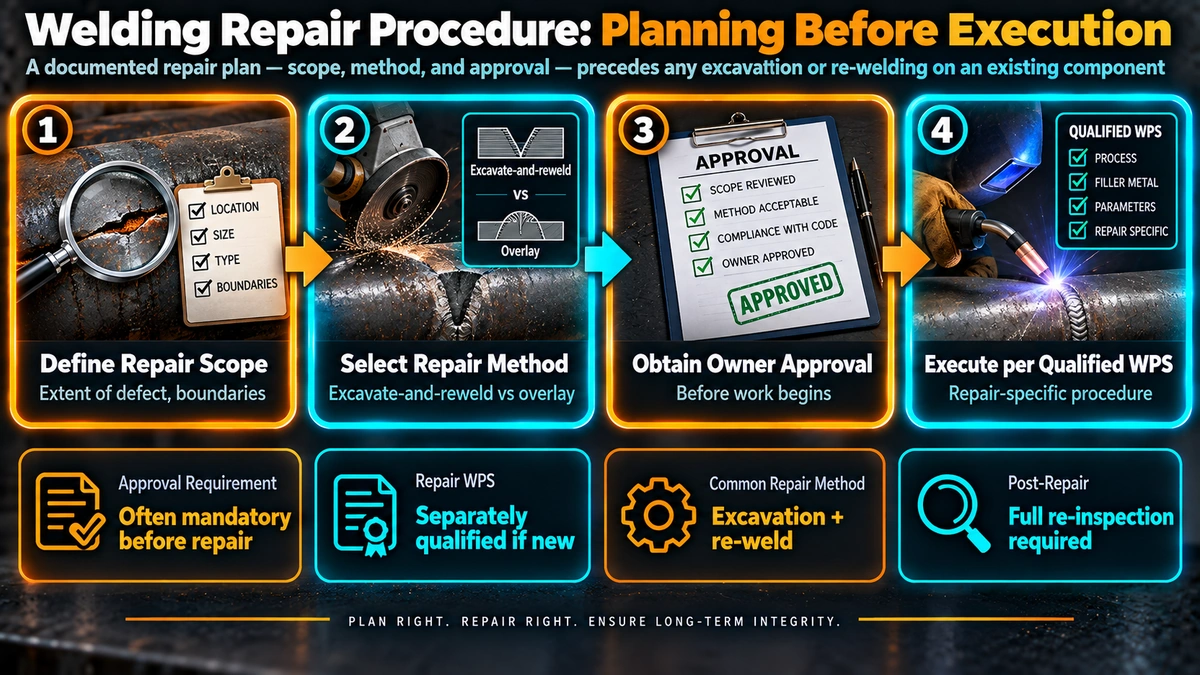
No. Every weld made under an ASME construction code — original fabrication or repair — must be made with a WPS supported by a qualified PQR under the same QW clauses. There is no lower qualification bar for repair welding. What changes is which essential variables become operationally critical, and which construction or post-construction code layers additional requirements on top of the Section IX qualification itself.
Key principle: A repair weld is not automatically covered by the WPS used for the original production joint just because the material, process, and filler metal are nominally the same. The repair configuration — excavation depth, PWHT method, process combination — must fall within the essential variable ranges actually qualified on the supporting PQR.
Why Repair Geometry Challenges Standard PQR Qualification
Shallow Excavation vs Full-Thickness Groove
Production PQRs are typically qualified on a full-thickness groove weld test coupon representing the complete joint. A repair, however, is frequently a shallow excavation removing only a portion of the wall thickness — a few millimetres to remove a surface-breaking indication, for example — followed by re-welding of just that cavity. The Section IX thickness qualification rules in Table QW-451.1, covered in depth in our PQR and WPQ thickness qualification range guide, calculate the qualified thickness range from the actual test coupon thickness, T. If the qualified PQR coupon is a full-thickness groove weld, its qualified minimum thickness may still be well above the shallow excavation depth being repaired in the field, which means the production WPS does not actually cover the repair unless a dedicated repair PQR is qualified with a coupon that reflects realistic excavation depths.
Non-Standard Repair Profiles
Repair cavities are frequently irregular in shape — following the contour of the excavated defect rather than a clean, symmetric groove — and may transition from a deep central region to a shallow feathered edge. While Section IX does not require the PQR test coupon to replicate every possible field excavation shape, the qualifying engineer must ensure the essential variables that do control (thickness range, position, process) realistically bound the range of repair configurations expected in production.
Key Essential Variables for Repair Welding
| Variable | Why It Matters for Repair | Section IX Reference |
|---|---|---|
| Base metal P-Number / Group Number | Must match the component being repaired; dissimilar repair filler requires separate qualification | QW-403, Table QW-422 |
| Qualified thickness range | Must bound the actual excavation depth, not just the nominal component thickness | QW-403, Table QW-451.1 |
| Welding process / process combination | Repair sequence often differs from original (for example GTAW root fill in a small cavity) | QW-200.4 |
| Preheat | Repair excavations in thick or crack-sensitive material may need higher local preheat than the original joint | QW-406 |
| PWHT method and cycle | Local PWHT (induction, resistance) is metallurgically different from furnace PWHT used on original PQR | QW-407 |
| Position | Repair location may force an out-of-position weld not covered by the original PQR/WPQ | QW-405 |
Caution: A change in PWHT method — for example substituting local induction PWHT for the furnace PWHT used to qualify the original production PQR — is treated as a change in an essential/supplementary essential variable in most applications and typically requires its own supporting PQR. Do not assume local PWHT is metallurgically equivalent to furnace PWHT without qualification data confirming it.
Process Combinations in Repair Welding (QW-200.4)
QW-200.4 permits a single WPS to reference more than one qualified welding procedure for different portions of a joint. This clause is especially relevant to repair welding because the repair sequence frequently differs from the original: a small, precise GTAW root fill may be used to establish sound metal at the base of a shallow excavation, followed by SMAW or GMAW to build up the remaining volume more efficiently. Each process segment used in this combination must itself be backed by a qualified PQR covering that specific process, and the overall combined sequence must also be represented in the governing repair WPS.
The Repair Qualification and Execution Sequence
Construction and Post-Construction Code Layers
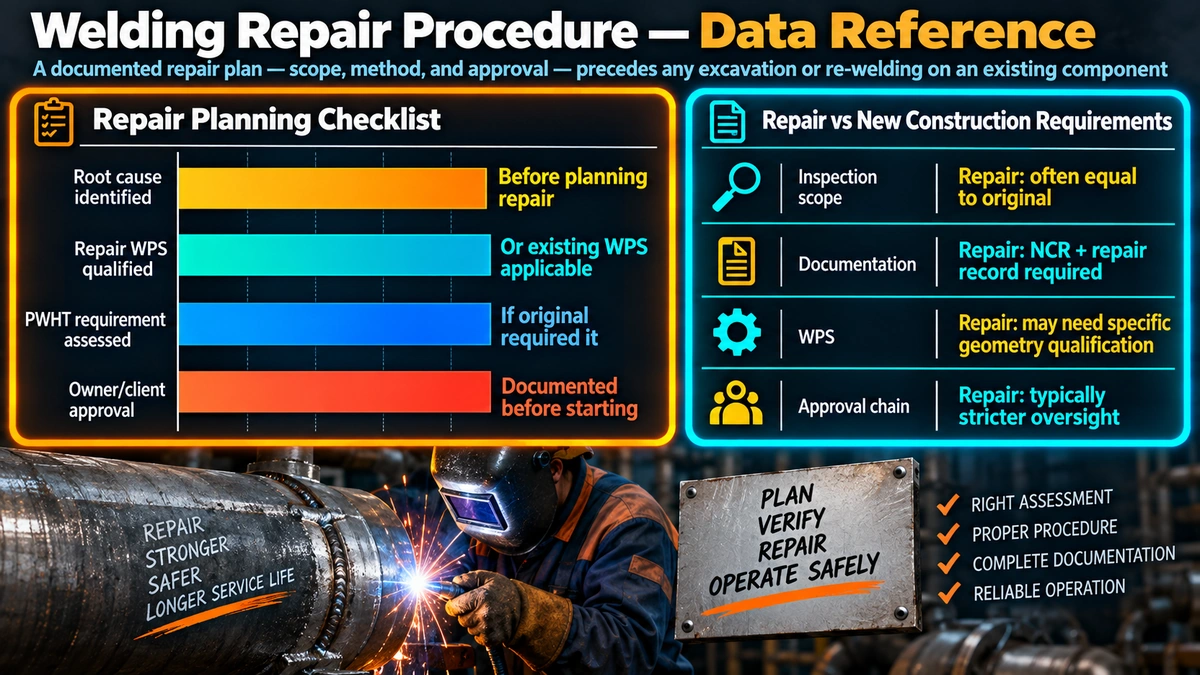
| Code / Standard | Repair-Relevant Content |
|---|---|
| ASME Section IX | Base WPS/PQR qualification framework applicable to any weld, including repairs |
| ASME Section VIII Division 1 | Repair requirements during original fabrication before code stamping (see UW and UCS repair paragraphs) |
| ASME B31.1 / B31.3 | Repair welding provisions for power and process piping, including examination requirements |
| National Board Inspection Code (NBIC) | Post-construction repairs and alterations to already-stamped, in-service equipment; requires “R” stamp accreditation |
| ASME PCC-2 | Repair of pressure equipment and piping — widely referenced industry guidance for repair methods and techniques |
Authorized Inspector role: For code-stamped equipment, the Authorized Inspector must review and accept the repair procedure, NDE plan, and PWHT method before repair work proceeds, in addition to the organization’s own qualification records, consistent with the AI’s oversight role described in our ASME Section VIII Division 1 overview.
Practical Notes for Welding Engineers
Practical tip: When writing repair WPSs, deliberately qualify the supporting PQR test coupon at the shallowest realistic excavation depth expected in production, not just at full component thickness. This avoids repeatedly discovering, mid-repair, that the WPS does not actually cover the shallow cavity being welded.
Documentation note: Repair WPS numbers, the supporting PQR references, and the specific NDE and PWHT records for each individual repair should be cross-referenced in the final weld map or repair log, particularly for code-stamped equipment where the Authorized Inspector will expect full traceability from the repair location back to its qualifying documentation.
Frequently Asked Questions
Does ASME Section IX have a separate qualification category for repair welding?
No. Section IX does not define a distinct repair procedure qualification category separate from ordinary WPS/PQR qualification; a repair weld must be made using a WPS supported by a PQR qualified under the same QW clauses that apply to any other weld. What changes for repair work is not the qualification mechanism itself but which essential variables become critical in practice, such as the qualified thickness range relative to a shallow excavation depth, and which construction code (ASME Section VIII, B31.1, B31.3, or NBIC) imposes additional repair-specific requirements on top of the base Section IX qualification.
Can a repair weld use the same WPS qualified for the original production joint?
Often yes, provided the repair falls within the essential variable ranges already qualified on the production PQR, including base metal P-Number and Group Number, filler metal F-Number, process, thickness range, position, and preheat/PWHT variables. The most common reason a separate repair WPS becomes necessary is that the excavation depth for a shallow repair is thinner than the minimum qualified thickness on the production PQR, or the repair geometry (a partial-depth cavity rather than a full-penetration groove) is not represented by the qualified test coupon, requiring a dedicated repair PQR with a coupon that reflects the actual repair configuration.
What thickness governs the qualified range for a shallow excavation repair?
For repair welding, the relevant thickness is the depth of the excavation being filled, not the full nominal thickness of the component. If the qualified test coupon used to develop the repair PQR is thin, the minimum and maximum qualified thickness range calculated from ASME Section IX Table QW-451.1 will be correspondingly limited, and a repair excavation deeper than that qualified maximum would fall outside the WPS. Engineers writing repair WPSs specifically for shallow excavations should qualify the PQR with a test coupon that reflects the shallowest and deepest excavation depths expected in the field.
Is a separate PWHT qualification required for repair welds?
PWHT is a Section IX essential (or supplementary essential) variable, and if the repair will receive a different PWHT thermal cycle than the one used to qualify the original PQR – for example, a local induction or resistance PWHT applied only to the repair area rather than a full furnace cycle – the WPS supporting that repair must be qualified with a PQR reflecting that same PWHT method and cycle. Local PWHT in particular can produce different heating and cooling rates than furnace PWHT, which is why many repair specifications require a dedicated PQR for local PWHT rather than assuming equivalence to the original furnace-PWHT qualification.
What is QW-200.4 and why does it matter for repair welding?
QW-200.4 in ASME Section IX addresses the combination of welding procedures, allowing a single WPS to reference more than one qualified procedure for different portions of a joint, such as a GTAW root pass followed by SMAW fill and cap passes. This is directly relevant to repair welding because many repair excavations are welded with a different process combination than the original production weld, for example using GTAW for a small, precise root fill in a shallow excavation followed by SMAW for the remaining volume. Each process combination used on the repair must trace back to a qualified PQR covering that specific combination and sequence.
Who approves the repair procedure before repair welding can begin on code-stamped equipment?
For code-stamped pressure equipment, the Authorized Inspector must review and accept the repair welding procedure and the associated NDE and PWHT plan before repair work begins, in addition to the manufacturer’s or repair organization’s own qualification records. Where the equipment falls under National Board jurisdiction for post-construction repairs and alterations, the National Board Inspection Code (NBIC) imposes its own procedural requirements on top of the base ASME Section IX qualification, and the organization performing the repair must hold the appropriate NBIC or jurisdictional accreditation (such as an “R” stamp) to perform the work legally.
Does repair welding require a different NDE plan than the original weld?
The repair area must generally be examined by at least the same NDE methods required for the original weld, and often by an additional surface method such as PT or MT specifically applied to the excavation before re-welding to confirm the original defect has been fully removed. Our welding inspection checklist and B31.1 visual examination guide both describe this excavate-confirm-reweld-reinspect sequence, which applies whether the repair is on new fabrication or an in-service component under NBIC jurisdiction.
Recommended Reference Books
ASME BPVC Section IX (Current Edition)
The primary reference for all WPS/PQR/WPQ qualification rules, including the essential variables governing repair welding.
View on AmazonASME PCC-2 Repair of Pressure Equipment and Piping
Industry-standard guidance on repair methods, techniques, and procedures for pressure equipment and piping.
View on AmazonNational Board Inspection Code (NBIC)
Governing standard for post-construction repairs and alterations to in-service pressure-retaining equipment.
View on AmazonWelding Inspection Handbook (AWS)
Covers WPS, PQR, and repair welding inspection practice including NDE and documentation requirements.
View on AmazonDisclosure: WeldFabWorld participates in the Amazon Associates programme (StoreID: neha0fe8-21). If you purchase through these links, we may earn a small commission at no extra cost to you. This helps support free technical content on this site.