Globally Recognized Quality Certifications: The Complete Professional Guide
In manufacturing, fabrication, oil and gas, aerospace, and every other sector where product integrity and process control are non-negotiable, quality certifications are the professional currency that separates credible practitioners from the rest. Whether you are a quality engineer managing non-conformances on an ASME-stamped pressure vessel line, a quality manager overseeing an ISO 9001 certification audit, or a process improvement specialist deploying Six Sigma tools on a fabrication shop floor, the right certification validates your expertise in a language that employers, clients, and regulators understand anywhere in the world.
This guide covers every major globally recognised quality certification: the bodies that issue them, the technical scope they address, the eligibility and examination requirements, and the career value each credential delivers. It also includes a practical framework for choosing the right certification at each stage of your career, with specific guidance for professionals in the welding, fabrication, and pressure equipment sectors.
Quality credentials do not exist in isolation from technical expertise. The most effective quality professionals combine a strong foundation in the relevant engineering or manufacturing discipline — including familiarity with codes such as ASME certification requirements and standards such as ISO 3834 for welding quality — with the systematic quality management and auditing skills that certifications from bodies like ASQ, CQI, and IRCA provide.
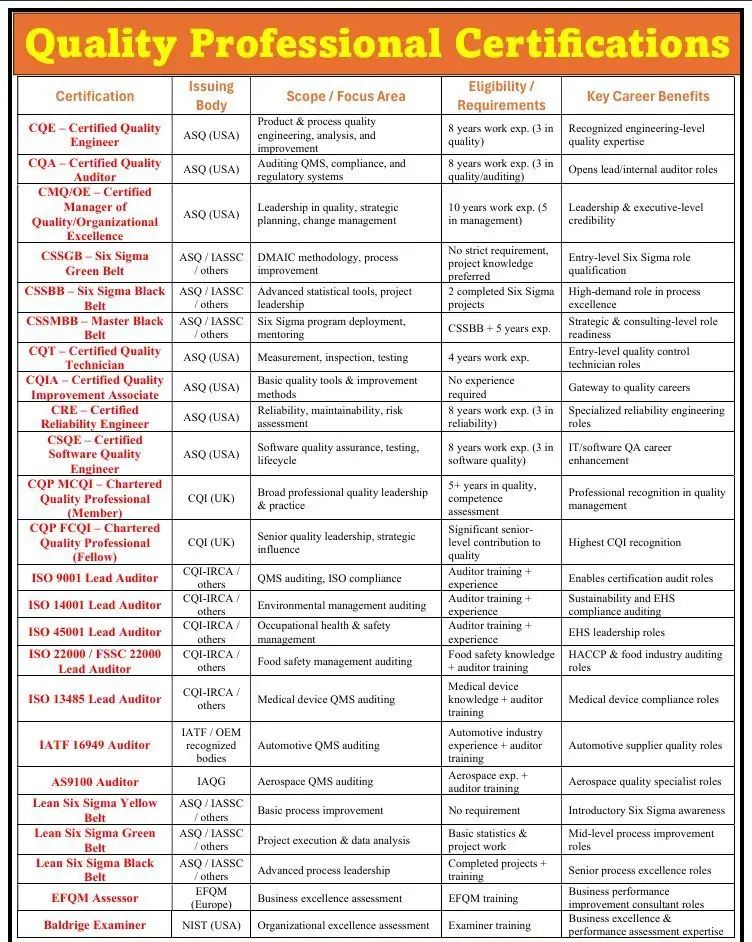
The Four Major Quality Certification Ecosystems
The global quality certification landscape is organised around four primary ecosystems, each with a distinct geographic origin, philosophical approach, and industry recognition profile. Understanding where each body fits helps you target the most valuable credential for your sector and location.
American Society for Quality
USA — globally recognised in manufacturing and engineering
Chartered Quality Institute
UK — professional chartered status pathway
International Register of Certificated Auditors
Global — ISO management system auditor registration
Lean Six Sigma Organisations
Global — process improvement methodology belts
Quality Certification Landscape: Career Level and Technical Scope
ASQ Certifications — American Society for Quality
The ASQ certification programme is the most comprehensive examination-based quality credential system available globally. All ASQ certifications require demonstrated professional experience alongside passing a proctored closed-book examination. The table below covers every current ASQ certification with its scope, eligibility, and examination details.
| Certification | Full Name | Core Focus | Experience Required | Exam Format | Renewal |
|---|---|---|---|---|---|
| CQIA | Certified Quality Improvement Associate | Basic quality concepts, team tools, PDCA cycle | None required | 65 questions, 90 min | 3 years / 18 RUs |
| CQT | Certified Quality Technician | Measurement, inspection, testing, basic stats, quality costs | 4 years (1 in quality) | 110 questions, 4 hrs | 3 years / 18 RUs |
| CQE | Certified Quality Engineer | QMS, product quality planning, SPC, reliability, measurement systems, problem-solving | 8 years (3 in quality engineering) | 160 questions, 5 hrs | 3 years / 18 RUs |
| CQA | Certified Quality Auditor | Audit principles, planning, execution, reporting, corrective action management | 8 years (3 in quality auditing) | 150 questions, 4.5 hrs | 3 years / 18 RUs |
| CMQ/OE | Certified Manager of Quality / Organizational Excellence | Strategic planning, change management, customer focus, leadership, supply chain quality | 10 years (5 in management) | 165 questions, 5 hrs | 3 years / 18 RUs |
| CRE | Certified Reliability Engineer | Reliability modelling, FMEA, FMECA, fault tree analysis, maintainability, risk analysis | 8 years (3 in reliability engineering) | 150 questions, 4.5 hrs | 3 years / 18 RUs |
| CSQE | Certified Software Quality Engineer | Software quality assurance, testing lifecycle, configuration management, defect management | >8 years (3 in software quality) | 155 questions, 4.5 hrs | 3 years / 18 RUs |
| CSSGB | Certified Six Sigma Green Belt | DMAIC, basic statistics, project management, process capability, control charts | 3 years in Six Sigma or equivalent | 110 questions, 4 hrs | 3 years / 18 RUs |
| CSSBB | Certified Six Sigma Black Belt | Advanced DMAIC, DOE, ANOVA, regression, hypothesis testing, change management | 8 years (3 in Six Sigma); 2 completed projects | 150 questions, 4.5 hrs | 3 years / 18 RUs |
| CSSMBB | Certified Six Sigma Master Black Belt | Enterprise Six Sigma deployment, coaching Black Belts, programme governance | 10 years; CSSBB + 5 years post-BB; 10 projects | Essay-based portfolio and oral review | 3 years / 18 RUs |
ASQ CQE — The Benchmark Technical Quality Credential
The Certified Quality Engineer (CQE) is the flagship ASQ certification and the most respected technical quality credential in manufacturing industries worldwide. Its Body of Knowledge covers eight major domains: quality management systems, product and process design, product and process control, reliability and risk management, problem-solving and quality improvement, quantitative methods and tools, quality cost, and management of the quality function.
For professionals working in welding fabrication, pressure vessel manufacturing, or oil and gas equipment, the CQE examination is particularly relevant because it covers statistical process control (SPC) methods used to monitor welding parameters, measurement system analysis (MSA) applicable to NDE equipment calibration, failure mode and effects analysis (FMEA) used in risk-based inspection approaches, and acceptance sampling plans used in goods inwards inspection of welding consumables and base materials. Understanding the mechanical testing methods required by ASME and AWS is directly applicable to the product and process control domain of the CQE Body of Knowledge.
ASQ CRE — Reliability Engineering for High-Integrity Equipment
The Certified Reliability Engineer (CRE) is particularly valuable for quality professionals working in sectors where equipment failure has severe safety or financial consequences — oil and gas, nuclear, chemical processing, and defence. The CRE Body of Knowledge covers reliability modelling and prediction, accelerated testing, design for reliability, failure analysis techniques (including FMEA, FMECA, and fault tree analysis), maintainability engineering, and risk management. These tools are directly applicable to the risk-based inspection (RBI) programmes that govern inspection frequency and method selection for pressure vessels and piping under frameworks like API 580 and API 581.
CQI Certifications — Chartered Quality Institute (UK)
The Chartered Quality Institute represents a fundamentally different model from ASQ. Rather than examination-based certifications, the CQI awards chartered status based on demonstrated competence against a structured framework. This approach aligns more closely with other UK chartered professional bodies and emphasises long-term professional development over point-in-time examination performance.
| Grade | Designation | Requirements | Career Level | Key Distinction |
|---|---|---|---|---|
| PCQI | Practitioner CQI | Quality-related qualification + 2 years experience | Early career | Foundation membership grade |
| MCQI | Member CQI | Quality qualification + 5 years experience + competence assessment | Mid-career professional | Demonstrates ongoing professional practice |
| CQP MCQI | Chartered Quality Professional (Member) | MCQI + successful Chartered Status Assessment | Senior practitioner | Highest professional recognition for practitioners |
| CQP FCQI | Chartered Quality Professional (Fellow) | CQP MCQI + significant senior contribution to the quality profession | Senior leader / distinguished contributor | Highest CQI recognition; equivalent to fellowship grade |
The CQI also operates a formal qualifications framework through its qualifications programmes, which provide route into membership for professionals who do not hold a prior quality-related qualification. These qualifications range from Level 3 (Award in Quality) through Level 7 (Diploma in Quality Management) and are particularly useful for practitioners in the UK and Middle East markets where the CQI qualification pathway is well recognised by employers and procurement bodies.
IRCA Lead Auditor Certifications
IRCA (now part of the CQI family) maintains the world’s most widely recognised registration scheme for management system auditors. The IRCA Lead Auditor designation is the standard qualification accepted by ISO certification bodies worldwide for individuals conducting third-party certification audits. It is also widely specified in supplier auditing frameworks used by major oil and gas, chemical, and manufacturing companies.
| Certification | Standard | Scope | Training Requirement | Key Industry Application |
|---|---|---|---|---|
| ISO 9001 LA | ISO 9001:2015 | Quality Management Systems — all industries | 5-day IRCA-accredited course + auditing experience | Universal |
| ISO 14001 LA | ISO 14001:2015 | Environmental Management Systems | 5-day IRCA-accredited course + auditing experience | EHS, Sustainability |
| ISO 45001 LA | ISO 45001:2018 | Occupational Health & Safety Management Systems | 5-day IRCA-accredited course + auditing experience | HSE, Construction, Manufacturing |
| ISO 13485 LA | ISO 13485:2016 | Medical Devices Quality Management | 5-day course with medical device knowledge | Medical Devices |
| ISO 22000 LA | ISO 22000 / FSSC 22000 | Food Safety Management Systems / HACCP | 5-day course with food safety knowledge | Food, Dairy, Pharma |
| ISO 27001 LA | ISO 27001:2022 | Information Security Management Systems | 5-day course with IT/IS knowledge | IT, Defence, Finance |
Lean Six Sigma Certifications — Belt Level Guide
Lean Six Sigma is a data-driven improvement methodology that combines Lean manufacturing principles (waste elimination, flow improvement) with Six Sigma’s statistical rigour (DMAIC cycle, variation reduction). The belt hierarchy provides a clear progression path from team member to deployment leader, and LSS credentials are among the most commercially valued quality certifications in manufacturing and process industries.
| Belt Level | Primary Role | Key Tools | Project Requirement | ASQ Exam (if applicable) | Typical Salary Premium |
|---|---|---|---|---|---|
| Yellow Belt | Team participant; supports Green Belt projects | SIPOC, process mapping, fishbone, 5-Why, basic control charts | None (most providers) | No ASQ exam at this level | Entry to quality roles |
| Green Belt | Part-time project leader; improvement team member | FMEA, Minitab, hypothesis testing, Cpk, control plans, MSA | 1 completed project (ASQ: 3 years experience) | ASQ CSSGB: 110 Q / 4 hrs | 10–20% above non-certified peers |
| Black Belt | Full-time project leader; coaches Green Belts | DOE, regression, ANOVA, advanced control charts, simulation, change management | 2 completed projects (ASQ); significant financial impact evidence | ASQ CSSBB: 150 Q / 4.5 hrs | 25–40% above non-certified peers |
| Master Black Belt | Programme architect; coaches Black Belts; drives enterprise deployment | Full Six Sigma toolkit + training design, statistical consulting, programme metrics | 10 completed projects; 5 years post-BB experience | ASQ CSSMBB: portfolio & oral review | Consulting / senior leadership level |
Industry-Specific Quality Certifications
Beyond the general quality management certifications, several industries operate sector-specific QMS standards with their own auditor and practitioner certification requirements. These are mandatory or strongly preferred qualifications for quality professionals working in those sectors.
| Certification | Standard | Industry | Issued By / Governing Body | Key Requirements |
|---|---|---|---|---|
| IATF 16949 Lead Auditor | IATF 16949:2016 | Automotive | IATF-approved certification bodies | ISO 9001 LA prerequisite; IATF 16949 training; automotive manufacturing knowledge; core tools (APQP, PPAP, FMEA, MSA, SPC) |
| AS9100 Lead Auditor | AS9100 Rev D | Aerospace & Defence | IAQG / OASIS-registered CBs | ISO 9001 LA + AS9100 training; aerospace manufacturing knowledge; IAQG OASIS database registration |
| ISO 3834 Quality Coordinator / Inspector | ISO 3834 Parts 1–4 | Welding Fabrication | IIW-authorised National Bodies (TWI, SLV, etc.) | Welding coordination qualification (IWE/IWT/IWS) + QMS knowledge; inspection of welding quality requirements |
| NQA-1 Auditor | ASME NQA-1 | Nuclear | ASME; nuclear regulatory authorities | ISO 9001 auditing experience; NQA-1 training; nuclear technology knowledge; nuclear authority oversight |
| HACCP Practitioner / Auditor | Codex Alimentarius / ISO 22000 | Food Safety | RSPH, Highfield, IRCA-approved providers | Food science/technology background; HACCP principles training; Level 3 or Level 4 award |
| API ICP (Inspector Certification Programme) | API 510, 570, 653, 580 | Oil & Gas / Pressure Equipment | American Petroleum Institute (API) | Engineering or inspection background; technical examination specific to each code; typically requires 1–3 years relevant experience |
Quality Professional Career Path: Certifications at Each Stage
How to Choose the Right Quality Certification
With over 20 distinct quality certifications available across the major bodies, choosing where to invest your preparation time and examination fees requires a structured approach. The decision framework below addresses the four most important selection dimensions.
By Industry Sector
- Oil & gas / pressure equipment: ISO 9001 LA, ASQ CQE, ASQ CRE, API ICP
- Welding fabrication: ISO 3834, ISO 9001 LA, ASQ CQA
- Automotive: IATF 16949 LA, ASQ CSSBB (core tools focus)
- Aerospace / defence: AS9100 LA, ASQ CRE
- Nuclear: NQA-1 Auditor, ISO 9001 LA
- Food / pharma: HACCP, ISO 22000 LA, ISO 13485 LA
- General manufacturing: ASQ CQE, ISO 9001 LA, LSS Black Belt
By Career Role
- Quality engineer: ASQ CQE (primary), ASQ CRE (reliability)
- Quality auditor (internal): ISO 9001 Internal Auditor, ASQ CQA
- Quality auditor (third party): ISO 9001 LA (IRCA)
- Improvement specialist: LSS Black Belt, ASQ CSSBB
- Quality manager: ASQ CMQ/OE or CQP MCQI (CQI)
- Software quality: ASQ CSQE
- Supplier quality: ASQ CQA, IATF 16949 LA
By Career Stage
- No experience: CQIA, Yellow Belt, ISO 9001 Internal Auditor
- 1–3 years: CQT, Green Belt (CSSGB), ISO 9001 Lead Auditor
- 3–8 years: CQE, CQA, CRE, CSSBB
- 8+ years: CMQ/OE, CQP MCQI, Master Black Belt
- Senior leader: CQP FCQI, CSSMBB
By Career Goal
- Technical depth: ASQ CQE, CRE, CSQE
- Audit career: ISO 9001 LA (IRCA), ASQ CQA, IATF 16949 LA
- Process improvement: LSS Green Belt, Black Belt, CSSBB
- Quality leadership: CMQ/OE, CQP MCQI, Master Black Belt
- Maximum credibility (combination): CQE + ISO 9001 LA + CSSBB
Quality Certifications Specific to Welding and Fabrication Professionals
For professionals working specifically in the welding, fabrication, and pressure equipment sector, quality certifications are most valuable when combined with technical welding expertise. The following credentials are the most relevant intersection of quality management and welding technology:
| Certification | Body | Relevance to Welding/Fabrication | Complements |
|---|---|---|---|
| ISO 9001 Lead Auditor | IRCA | Auditing the QMS of welding fabrication shops; verifying WPS/PQR control, welder qualification records, consumable traceability | CSWIP 3.1, AWS CWI, ISO 3834 |
| ASQ CQE | ASQ | Statistical control of weld dimension, hardness, impact energy data; measurement system analysis for NDE equipment; FMEA for weld joint risk assessment | Mechanical testing knowledge, ASME codes |
| ASQ CQA | ASQ | Internal auditing of fabrication QMS; second-party supplier audits for welding consumables and sub-contracted welding | ISO 9001, ASME Section VIII, ISO 3834 |
| ASQ CRE | ASQ | FMEA/FMECA for pressure vessel and piping systems; reliability analysis supporting RBI programmes; failure mode analysis after weld failures | API 580, ASME Section VIII, API ICP |
| LSS Black Belt | ASQ / IASSC | Reducing weld defect rates; improving first-time inspection pass rates; optimising welding parameter settings using DOE | Welding process knowledge, SPC |
| IATF 16949 LA | IATF CBs | Auditing automotive-sector welding suppliers; APQP for welded assemblies; PPAP for weld process qualification | ISO 9001 LA, AIAG core tools |
Frequently Asked Questions
What is the best quality certification for a new engineer entering the field?
For engineers with little or no quality experience, the best starting points are the ASQ Certified Quality Improvement Associate (CQIA), which requires no prior experience, or the Lean Six Sigma Yellow Belt, which is offered by multiple providers without experience prerequisites. An ISO 9001 Internal Auditor course is another accessible entry point that provides immediately applicable workplace skills. Once you have three or more years of relevant experience, you can progress to the ASQ Certified Quality Engineer (CQE) or the ISO 9001 Lead Auditor certification through IRCA. For welding and fabrication professionals specifically, pairing a quality certification with a welding inspection credential such as CSWIP 3.1 or AWS CWI creates a particularly strong career profile valued in oil and gas, petrochemical, and structural fabrication sectors.
How does the ASQ CQE differ from the ASQ CQA?
The ASQ Certified Quality Engineer (CQE) focuses on the technical and engineering aspects of quality: statistical methods, process control, measurement systems analysis, product design for quality, and failure analysis. It is aimed at engineers who design quality into products and processes. The ASQ Certified Quality Auditor (CQA) focuses on the auditing process: planning and conducting audits of quality management systems, evaluating conformance to standards such as ISO 9001, writing audit reports, and managing corrective action processes. Both require eight years of work experience with at least three in a quality function. A professional working in a manufacturing quality department might hold both credentials — the CQE for technical depth and the CQA for auditing capability. The CQE examination covers more quantitative methods and engineering tools; the CQA examination goes deeper into audit methodology, audit evidence, and audit programme management.
What is the difference between an ISO 9001 internal auditor and an ISO 9001 lead auditor?
An ISO 9001 internal auditor is trained to conduct audits within their own organisation as part of the internal audit programme required by ISO 9001 Clause 9.2. Internal auditor training typically covers two to three days and does not require registration with an external body. An ISO 9001 Lead Auditor is qualified to lead third-party certification audits on behalf of a certification body, or to lead supplier audits on behalf of a client organisation. Lead Auditor certification through IRCA requires completion of an accredited five-day training course, demonstrated auditing experience, and registration with the IRCA scheme. The Lead Auditor designation is formally recognised across the certification and supply chain auditing industry worldwide and is required for individuals who wish to audit organisations for ISO 9001 certification or who conduct formal second-party supplier audits in major supply chains.
Is the Lean Six Sigma Black Belt from IASSC equivalent to the ASQ CSSBB?
Both certifications cover Lean Six Sigma methodology at the Black Belt level, but they differ in emphasis and recognition. The ASQ Certified Six Sigma Black Belt (CSSBB) requires documented proof of completed Six Sigma projects and eight years of work experience (three in Six Sigma), in addition to passing the examination. It is widely regarded as the more rigorous and industry-respected credential. The IASSC Black Belt is a purely examination-based credential with no experience or project requirement, making it more accessible but generally considered less authoritative by employers who distinguish between the two. For manufacturing and engineering environments where Six Sigma is applied to real process problems — such as reducing weld defect rates, improving dimensional control, or optimising inspection yield — the ASQ CSSBB with its project evidence requirement is the credibility standard.
What quality certifications are most relevant for welding and pressure vessel fabrication?
For professionals working specifically in welding, pressure vessel fabrication, and related industries, the most strategically valuable quality certifications are: (1) ISO 9001 Lead Auditor (IRCA) — essential for quality managers responsible for maintaining QMS certification; (2) ASQ Certified Quality Engineer (CQE) — for quality engineers performing SPC, FMEA, and process capability studies on welding processes; (3) ASQ Certified Quality Auditor (CQA) — for individuals conducting second-party supplier audits or internal QMS audits; (4) IATF 16949 Lead Auditor — if the organisation supplies the automotive sector; (5) ASQ Certified Reliability Engineer (CRE) — valuable in oil and gas equipment manufacturing where FMEA and reliability analysis are required. These should be complemented by welding-specific credentials and familiarity with codes such as ASME certification standards and ASME Section IX qualification requirements.
How often do ASQ certifications need to be renewed?
ASQ certifications are valid for three years from the date of certification. Recertification requires earning 18 Recertification Units (RUs) over the three-year cycle. RUs are earned through professional development activities including attending quality conferences, completing continuing education courses, publishing quality-related articles, presenting at professional events, or retaking and passing the certification examination. ASQ does not require continuing employment in a specific quality role, but the recertification system is designed to ensure certified professionals maintain current knowledge. Failure to recertify within the three-year window results in the certification lapsing, though it can typically be reinstated within a further year by completing the outstanding RU requirements or retaking the examination.
What is the CQI Chartered Quality Professional and how does it compare to ASQ certifications?
The CQI Chartered Quality Professional (CQP) designation is the UK’s premier quality professional credential, equivalent in prestige to chartered status in engineering or finance. It is awarded based on demonstrated competence against the CQI Competency Framework, covering quality leadership, technical skills, and professional behaviours — through portfolio submission and professional review rather than examination alone. The Member grade (CQP MCQI) requires approximately five years of quality experience; the Fellow grade (CQP FCQI) is awarded to senior practitioners who have made distinguished contributions to the quality profession. In the UK and Commonwealth countries, the CQP designation carries significant professional weight and is recognised in procurement specifications for quality management services. In US, Indian, and Southeast Asian manufacturing markets, ASQ certifications tend to be better recognised by engineering and manufacturing employers.
What does the AS9100 Lead Auditor certification cover and who needs it?
AS9100 is the Quality Management System standard for the Aviation, Space, and Defence industries. It builds on ISO 9001 and adds specific requirements for aviation and defence manufacturing — including risk management, configuration management, first article inspection, control of non-conforming outputs, and human factors. An AS9100 Lead Auditor is qualified to audit aerospace and defence suppliers against this standard on behalf of certification bodies or OEMs. The certification is essential for quality professionals working for aerospace suppliers, Tier 1 and Tier 2 component manufacturers, MRO organisations, and defence contractors. IAQG (International Aerospace Quality Group) oversight through the OASIS database ensures global consistency in AS9100 certification across the aerospace supply chain.
Recommended Reading: Quality Management and Certification Preparation
These references are recommended for quality professionals preparing for ASQ examinations, building knowledge of ISO standards, or developing a Lean Six Sigma practice.
Disclosure: WeldFabWorld participates in the Amazon Associates programme (StoreID: neha0fe8-21). If you purchase through these links, we may earn a small commission at no extra cost to you. This helps support free technical content on this site.