Welding Cables, Connectors & Earthing — Complete Guide
Welding cables, connectors, and earthing are among the most underestimated components in any welding setup. Every ampere of welding current flows through this circuit — from the power source, through the electrode cable, across the arc, and back through the work return cable to the machine. Get this circuit wrong and you face arc instability, weld defects, overheated cables, equipment damage, and — most seriously — electric shock hazards. This guide covers everything a welder, welding engineer, or inspector needs to know: cable construction and sizing, connector types, earthing clamp selection and placement, voltage drop calculations, and full compliance with OSHA and IEC safety standards.
Whether you are setting up a new SMAW (stick welding) workstation, a MIG/GMAW production bay, or a multi-station TIG welding setup, the principles governing cable selection and earthing remain the same. A properly designed welding circuit is the foundation of repeatable weld quality and a safe working environment.
The Welding Circuit: How Current Flows
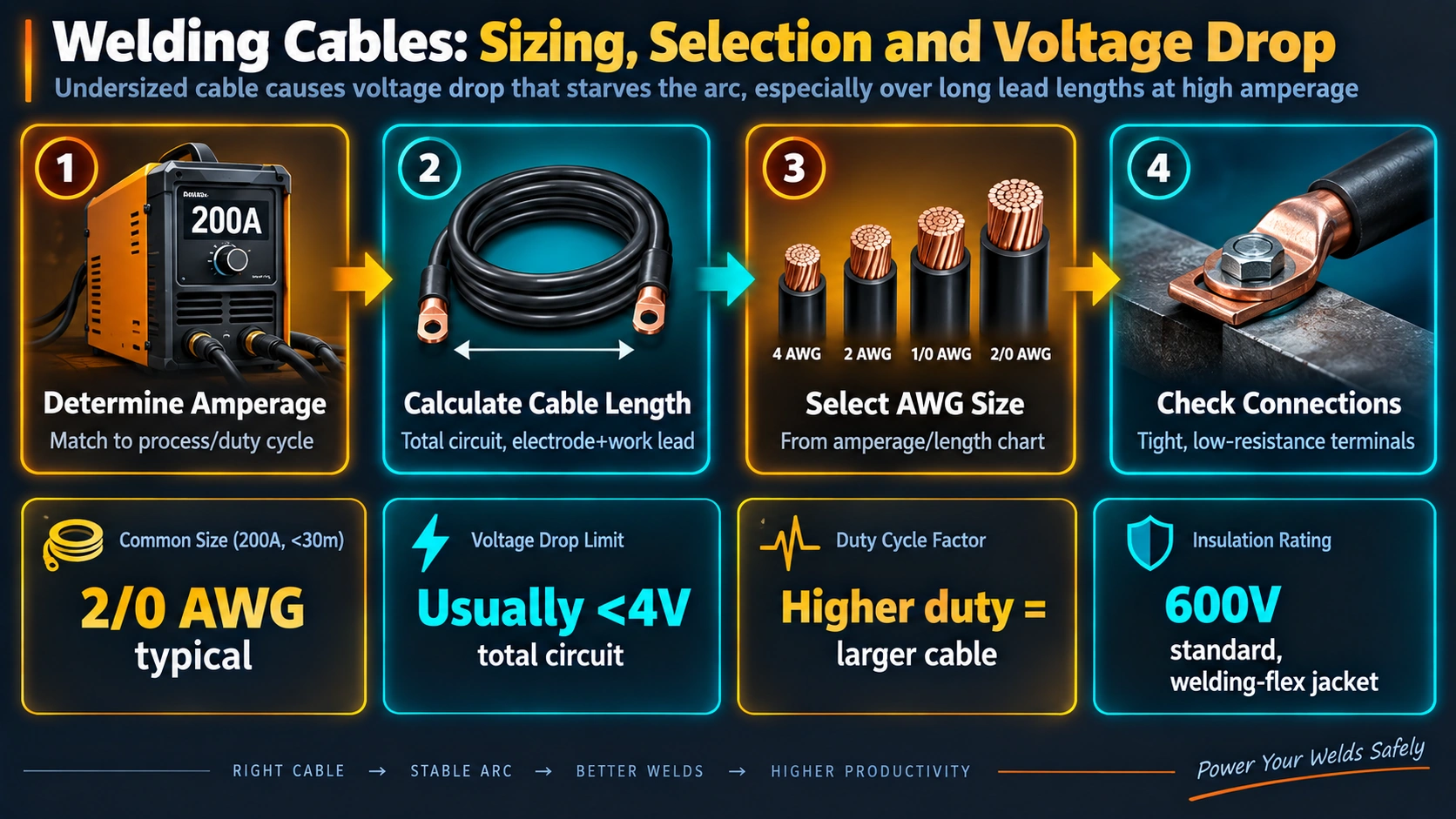
The welding circuit is a simple series loop. Current leaves the welding machine’s output terminal, travels through the electrode cable to the electrode holder (SMAW), gun (MIG), or torch (TIG), jumps the arc to the workpiece, flows through the workpiece to the earth/work return cable, and returns to the machine’s other output terminal. Both cables are equally critical — a poor connection or undersized cable anywhere in this loop degrades weld quality and creates heat.
A key point that beginners often miss: the work return cable carries exactly the same current as the electrode cable. It is not a safety earth — it is a live power conductor. Sizing it smaller than the electrode cable, or leaving the earthing clamp loose, is one of the most common causes of poor arc performance and cable overheating on fabrication shops.
Welding Cable Construction and Types
Welding cable is not ordinary electrical cable. The continuous flexing as a welder moves around a job demands a conductor design radically different from fixed-installation wiring. Understanding cable construction helps you choose the right product and identify deterioration during inspection.
Conductor Construction
Welding cable conductors are built from a very large number of fine copper strands — typically Class 5 or Class 6 per IEC 60228, meaning individual strand diameters of 0.16–0.25 mm. A 35 mm² welding cable may contain over 500 individual strands; a 95 mm² cable can exceed 1,500 strands. This gives the cable its characteristic limpness and resistance to bending fatigue.
The copper must be electrolytic grade (99.9% minimum purity, per ASTM B33 or EN 13602). Some manufacturers offer tinned copper conductors, which resist oxidation and are easier to terminate with crimped lugs.
Insulation Materials
Three insulation compounds dominate the welding cable market:
| Insulation Type | Temp. Rating | Key Properties | Typical Use |
|---|---|---|---|
| Neoprene (CR) | 90°C | Excellent oil, UV, and flame resistance; moderate cold-weather flex | General fabrication, outdoor use |
| EPDM Rubber | 90°C / 105°C | Superior low-temperature flexibility (−40°C), excellent abrasion resistance, lighter weight | Cold climates, pipeline construction, offshore |
| Natural Rubber (NR) | 60°C | Very flexible, low cost; poor oil and UV resistance | Light-duty indoor use only |
| Thermoplastic (PVC) | 70°C | Low cost; stiffens badly in cold weather; poor bending fatigue life | Not Recommended for welding leads |
Cable Jacket Colour Conventions
There is no universal mandatory colour coding for welding cables, but common conventions exist. Red or orange is typically used for the electrode (hot) lead; black or blue for the work return cable. In the EU, yellow/green is strictly reserved for protective earth conductors and must never be used for welding leads. Following a consistent colour convention on your site reduces connection errors, especially on large multi-welder setups.
Welding Cable Sizing: Ampacity and Voltage Drop
Correct cable sizing is determined by two criteria working together: ampacity (the cable’s ability to carry current without exceeding its temperature rating) and voltage drop (the resistance of the cable run, which reduces available arc voltage). Both must be checked — a cable that passes the ampacity check may still fail the voltage drop check on a long run.
Duty Cycle and RMS Current
Welding power sources are rated at a specific duty cycle — the percentage of a 10-minute period at which the machine operates at its rated current. A 300 A machine at 60% duty cycle delivers 300 A for 6 minutes out of every 10. Cable ampacity ratings from manufacturers are generally given at 100% duty cycle in free air at 40°C ambient. For lower duty cycles, the cable can carry a higher peak current.
Example: 300 A @ 60% duty cycle I_rms = 300 × √(60/100) = 300 × 0.775 = 232 A A cable rated 250 A continuous (100% DC) is adequate for this case Select cable whose continuous ampacity ≥ I_rms at actual ambient temperature
Voltage Drop Calculation
Cable resistance creates a voltage drop that subtracts from the available arc voltage. Industry practice limits voltage drop to 4 V per cable at the maximum welding current. The resistance budget for each cable is therefore:
Cable Resistance R_cable = (ρ × L) / A ρ = resistivity of copper = 0.0172 Ω·mm²/m at 20°C (increases ~0.39%/°C) L = cable length in metres (one-way run length) A = conductor cross-section in mm²
Example: 200 A, 20 m run, 35 mm² cable R = (0.0172 × 20) / 35 = 0.344 / 35 = 0.00983 Ω V_drop = I × R = 200 × 0.00983 = 1.97 V Result: 1.97 V < 4 V limit. 35 mm² is adequate for this run.
Same run at 400 A (heavy SMAW): V_drop = 400 × 0.00983 = 3.93 V Marginally within limit, but upsize to 50 mm² is recommended for headroom
Cable Sizing Selection Table
The table below summarises recommended cable cross-sections for common welding current levels and cable run lengths. Values assume copper conductor at 75°C conductor temperature, free-air installation, and a maximum voltage drop of 4 V per cable.
| Max Welding Current (A) | Duty Cycle | Run ≤ 10 m | Run 10–20 m | Run 20–30 m | Run 30–45 m |
|---|---|---|---|---|---|
| Up to 100 A | 60% | 16 mm² (6 AWG) | 16 mm² (6 AWG) | 25 mm² (4 AWG) | 35 mm² (2 AWG) |
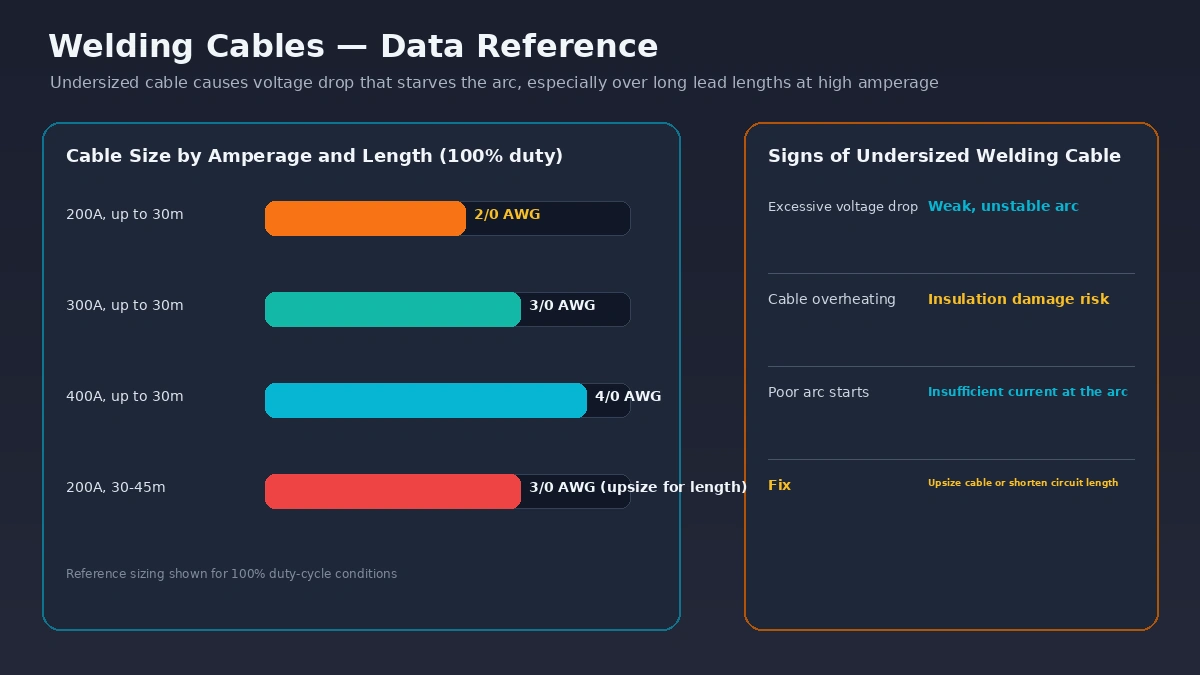
| Up to 200 A | 60% | 25 mm² (4 AWG) | 35 mm² (2 AWG) | 50 mm² (1/0 AWG) | 70 mm² (2/0 AWG) |
| Up to 300 A | 60% | 35 mm² (2 AWG) | 50 mm² (1/0 AWG) | 70 mm² (2/0 AWG) | 95 mm² (3/0 AWG) |
| Up to 400 A | 60% | 50 mm² (1/0 AWG) | 70 mm² (2/0 AWG) | 95 mm² (3/0 AWG) | 120 mm² (4/0 AWG) |
| Up to 500 A | 60% | 70 mm² (2/0 AWG) | 95 mm² (3/0 AWG) | 120 mm² (4/0 AWG) | 150 mm² |
| Up to 600 A | 100% | 95 mm² (3/0 AWG) | 120 mm² (4/0 AWG) | 150 mm² | 2 × 95 mm² |
Welding Connectors: Types, Standards, and Selection
Welding connectors allow the electrode cable and work return cable to be quickly attached to and removed from the welding machine and accessories. A good connector maintains a low-resistance, vibration-resistant contact at high current levels. Poor connector design or a loose connection creates localised resistance, heating, and arcing inside the connector body, causing rapid deterioration and a fire hazard.
Dinse Connectors
Dinse connectors (sometimes called DIN connectors or Euro connectors) use a pin-and-socket bayonet design. The plug inserts and locks with a quarter-turn. They are the dominant standard on European and Asian welding machines and are available in sizes rated for 10–95 mm² cable, with current ratings from 200 A to 600 A (Dinse 10–25, 25–35, 35–50, 50–70, and 70–95 designations refer to cable cross-section range). The pin diameter determines compatibility — always verify the pin size before mixing connectors from different manufacturers.
Tweco Connectors
Tweco connectors use a threaded clamp ring to lock the plug. They are the North American standard (used on Lincoln Electric, Miller, ESAB, and Hobart machines sold in the USA/Canada). Tweco No.1 through No.4 designations cover cables from 4 AWG up to 4/0 AWG. Tweco connectors are mechanically robust and resist vibration loosening well, but the threaded ring can become difficult to operate with gloved hands over time.
Cambric (Crimped Lug) Connections
For permanent or semi-permanent installations — such as the connection between the cable and a machine’s output stud, or the cable-to-earth-clamp termination — a hydraulically crimped copper lug is the gold standard. A properly crimped lug achieves the lowest contact resistance of any termination method (typically below 0.1 mΩ), does not loosen with vibration, and does not degrade with repeated thermal cycling. Always use a hex die crimp tool matched to the lug and cable cross-section; wheel-type crimpers leave gaps in the crimp that allow moisture ingress and corrosion.
Lenco-Style Cam-Lock Connectors
Cam-lock connectors (originally marketed under the Lenco brand, now widely copied) use a spring-loaded cam lever to lock the plug into the socket without tools. They are popular on large construction sites where cables are frequently reconfigured. They are rated to 600 A in the largest sizes. The trade-off is slightly higher contact resistance than a good crimped lug, and the cam mechanism requires periodic cleaning to prevent jamming from spatter and debris.
Electrode Holders and Torch Connections
The electrode holder (stinger) for SMAW must grip the electrode securely, insulate the welder from the live conductor, and present minimal resistance at the electrode-to-holder contact. Holders are rated in amperes: 200 A, 300 A, 400 A, and 600 A are the standard sizes. Using a 200 A holder on a 350 A job is a common cause of holder overheating, insulation melting, and burn injuries.
For MIG/GMAW, the cable terminates at the wire feeder; the welding gun connects to the feeder via a Eurotorch (or similar) quick-disconnect. Gun cable assemblies include the shielding gas hose, the wire liner, the power conductor, and the trigger leads in a single sheath. The power conductor in the gun cable must match the machine’s output current — a 200 A gun on a 350 A machine will overheat the cable in the gun neck, a common failure point.
For TIG/GTAW, the cable assembly also carries the shielding gas hose and, on high-frequency machines, the HF ignition signal. TIG torch cables are particularly sensitive to damage from spatter because the gas hose is incorporated; inspect them carefully for pin holes that would allow gas leakage.
Earthing Clamps: Selection, Placement, and Common Errors
The earthing clamp (also called the work clamp, ground clamp, or return clamp) is the point at which the return current path transitions from the copper cable conductor to the workpiece itself. It is one of the most abused components in a welding setup — often thrown into a corner, clamped to a painted surface, or connected to the wrong part of the structure. Getting earthing right is the single most effective step a welder can take to improve arc stability and weld quality.
Clamp Types
Three main designs are in common use:
| Clamp Type | Current Rating | Best For | Limitations |
|---|---|---|---|
| Spring-Loaded C-Clamp | Up to 300 A | Light fabrication, pipe tacking, structural | Spring force decreases over time; copper contact pads wear; difficult on thick sections |
| Screw-Tightening Clamp | Up to 500 A | Heavy fabrication, shipbuilding, pressure vessel work | Slower to attach/remove; requires periodic contact cleaning |
| Magnetic Earth | Up to 600 A | Flat plate work, positioning on clean structural steel | Does not work on non-magnetic materials (austenitic SS, aluminium, copper); loses holding strength above ~80°C |
| Direct Lug-Bolted | Unlimited | Permanent welding tables, positioner chucks, fixed workstations | Not portable; requires clean bolt face contact |
Earthing Clamp Placement Rules
The position of the earth clamp relative to the weld joint has a direct effect on arc blow (arc deflection caused by magnetic field imbalance) and on stray current paths. Follow these rules:
- Place the clamp as close to the weld as practicable, ideally within 300–500 mm of the joint. This minimises the length of the current path through the workpiece, reducing the voltage dropped in the base metal and the magnetic field imbalance that causes arc blow.
- Connect directly to the base material, not to the welding table (unless the workpiece is firmly bolted or welded to the table with full metal-to-metal contact across the entire joint face).
- Clean the contact area to bare metal. Paint, mill scale, rust, or coatings under the clamp introduce resistance that can exceed 0.1 Ω — more than the entire cable resistance — causing localised heating at the clamp contact and arc instability.
- Do not clamp across a bearing, gear, or seal. The welding current will use the bearing races as a conductor, pitting the race surfaces and causing premature bearing failure. This is particularly critical when welding on rotating equipment or vessels with internal components.
- On pipe welds, connect the earth clamp to the pipe being welded, not to a pipe stand or structural support that contacts the pipe through a small surface area. For long spool pieces, use two earth connections, one each side of the weld bevel.
Welding Cable Connections: Correct Termination Methods
A welding circuit is only as good as its worst connection. Every joint between cable and connector, and between cable and terminal, represents a resistance that adds voltage drop and generates heat. There are three acceptable termination methods for welding cables.
Hydraulic Hex Crimp
This is the preferred method for permanent and semi-permanent connections. A copper lug matched to the cable cross-section is positioned over the stripped cable end and crimped using a hydraulic or ratchet crimp tool with the correct die set. A properly executed crimp cold-welds the copper strands to the lug barrel, creating a joint resistance below 0.1 mΩ that does not degrade over thousands of thermal cycles. Always use copper lugs for copper cable — aluminium lugs on copper cable will corrode at the interface (galvanic corrosion) within months if moisture is present.
Mechanical Screw Clamp (Set-Screw Terminals)
Quick-fit connector bodies (Dinse, Tweco) typically use a brass set-screw or hex-head clamping screw inside the connector body to grip the stripped cable end. These are adequate when properly tightened (check the manufacturer’s torque specification — typically 4–8 N·m for sizes up to 50 mm²). The key failure mode is undertorquing: the connection works initially but gradually loosens as the fine copper strands compact under vibration and thermal cycling, increasing resistance until arcing inside the connector body begins. Retorque set-screw connections monthly in production environments.
Brazed or Soldered Connections
Soldering welding cable lugs is acceptable only for light-duty (below 150 A, below 40% duty cycle) applications. Solder melts at temperatures (183°C for 60/40 tin-lead) that can be reached at the lug when the cable is overloaded or when the clamp contact resistance is high. In heavy-duty welding, soldered terminations will fail. Brazing at 600°C+ is reliable but requires specialised equipment and is rarely used in the field. For any current above 150 A, specify crimped terminations only.
Safety: Electric Shock, OSHA Compliance, and Inspection
Arc welding presents two distinct electric shock hazards: primary voltage shock (from the mains power supply — 230 V or 415 V) and secondary voltage shock (from the welding output circuit — typically 20–80 V OCV). While primary voltage is more likely to be immediately fatal, secondary voltage shock is responsible for more incidents because workers are in direct contact with the output circuit for extended periods.
Open-Circuit Voltage (OCV) Hazard
When the welder lifts the electrode off the work between passes, the machine returns to its open-circuit voltage — the output voltage with no arc current flowing. For SMAW DC machines, OCV is typically 60–80 V. Some older transformer-based AC machines have OCV above 100 V. IEC 60974-1 requires that for work in restricted conductive environments (confined spaces, pipe interiors, vessel heads), a Voltage Reduction Device (VRD) must reduce OCV to below 35 V (DC) or 48 V (AC RMS) when the arc is not struck. Many modern inverter machines include VRD as standard.
OSHA Requirements (29 CFR 1910.254)
Key OSHA requirements for arc welding cable and earthing:
- Electrode holders must be designed for the ampere rating of the welding circuit and must be fully insulated — no exposed live metal parts within reach of the welder’s hands.
- Welding cables must be completely insulated, flexible, and capable of handling the maximum short-circuit current of the welding source without overheating.
- Cables must not be repaired with electrical tape in the middle of a run for lengths exceeding 150 mm. Short tape repairs over minor surface abrasion are tolerated, but any cable with a cut or crack exposing the conductor must be replaced or properly repaired with a rated cable splice connector.
- The frame of the welding machine must be connected to the facility protective earth (PE) through the supply cable. Do not defeat or bypass the earth pin of the supply plug.
- Coiled cables generate significant inductance and can overheat even at currents below the cable’s rated ampacity due to skin-effect concentration of current. Always unroll the full cable length before welding at high currents.
Cable Inspection Checklist
Perform the following inspection before each shift:
- Examine the full length of both cables for cuts, cracks, abrasion, or heat discolouration of the insulation jacket.
- Check that connector ferrules and cable entry points show no sign of arcing or carbonisation (a black sooty deposit indicates internal arcing from a poor connection).
- Verify that all set-screw terminals and lug bolts are tight — wiggle-test each connector while it is live and under load is unsafe; instead, use a thermal camera or infrared thermometer to identify hot connectors during operation.
- Inspect the earth clamp contact pads. Replace clamps where the copper contact pads are worn down to the base metal or where the spring tension has relaxed and the clamp no longer grips firmly.
- Confirm that the machine supply cable protective earth conductor is intact and that the supply plug’s earth pin is not bent or broken.
Multi-Welder and Automated Welding Cable Arrangements
Large fabrication shops, shipyards, and process plant construction sites often run multiple welding stations from a single welding generator or from a busbar distribution system. These setups introduce additional considerations for cable sizing and earthing that do not apply to single-machine setups.
Busbar Distribution Systems
In heavy fabrication, a copper or aluminium busbar mounted along the fabrication bay distributes welding power to multiple tap-off points. Individual welders connect their electrode and return cables to these tap-off points. The busbar must be sized for the maximum simultaneous load — not the sum of all connected machine ratings, but the realistic concurrent load, accounting for the fact that not all welders operate simultaneously at full current. A diversity factor of 0.6–0.75 is typically applied in sizing busbar systems for manual arc welding.
Orbital and Automated Welding
Orbital TIG welding and other automated processes often use permanently installed cable trays. The cables must be protected from weld spatter and mechanical damage by the workpiece handling equipment. Cable trays should be non-ferrous (aluminium preferred) to avoid eddy current heating from the pulsed welding current. Earthing on automated lines is typically a direct copper strap bolted to the workpiece chuck or fixture — the use of flexible clamps that can be disturbed by the automation is avoided.
Generator-Powered Site Welding
Diesel generator welding sets used on pipeline and offshore construction require particular attention to the protective earth arrangement. The generator frame, the welding machine frame, and the workpiece must all be connected to a common reference earth to prevent floating potentials that create shock hazards. On water-surrounded structures (offshore, ship hulls in drydock), the earthing arrangements must comply with the relevant classification society or project-specific electrical safety plan.
Welding Cable Maintenance and Storage
Welding cables represent a significant capital investment, and their useful life can be extended considerably by correct handling and storage. The leading causes of premature cable failure are mechanical abuse (kinking, running over cables with equipment, yanking at connectors), thermal abuse (draping cables over hot workpieces, coiling during high-current welding), and chemical attack (oil, acid, and solvent contamination of the jacket).
- Never drag cables by the connector — the stress concentration at the connector-to-cable junction causes insulation cracking and conductor fatigue over time. Carry cables looped over your shoulder, or use a cable reel.
- Uncoil fully before high-current welding. A 30 m cable coiled into a 1 m reel when passing 400 A will run significantly hotter than the same cable fully extended.
- Clean connectors periodically with a wire brush on the contact surfaces and a dry cloth on the insulated body. Never use lubricants on electrical contact faces unless specified by the manufacturer.
- Store cables on reels or hung in large-radius loops — minimum 10× the cable diameter — when not in use. Do not leave cables coiled tightly or looped around an obstruction for extended periods; this sets permanent kinks in the insulation.
- Tag and remove any cable showing exposed copper, cracked insulation, or discoloured connector bodies immediately. Tag it “DEFECTIVE — DO NOT USE” and route it for repair or scrapping. Do not leave damaged cables accessible in the workshop where they might be used inadvertently.
Recommended Books on Welding Electrical Safety and Equipment
Disclosure: WeldFabWorld participates in the Amazon Associates programme (StoreID: neha0fe8-21). If you purchase through these links, we may earn a small commission at no extra cost to you. This helps support free technical content on this site.