Cast Iron Welding: Practical Guide, SFA-5.15 Electrode Selection, and Repair Techniques
Cast iron welding is one of the most demanding challenges in fabrication and maintenance engineering. With a carbon content of 2–4% — far exceeding the 0.3% that already makes a steel “difficult to weld” — cast iron has almost no ductility to absorb the thermal stresses generated by arc welding. The consequence is predictable: uncontrolled welding produces cracks, hard and unmachinable heat-affected zones, and welds that fail in service. Yet cast iron components are everywhere: engine blocks, pump housings, valve bodies, press frames, machine tool beds, and pipe fittings. Knowing how to weld them correctly is an essential skill for any welding engineer or qualified inspector.
This guide covers everything you need: the metallurgy that makes cast iron behave the way it does, the four main families of cast iron and how their weldability differs, the full range of electrode classifications under ASME SFA-5.15 / AWS A5.15, preheat and interpass temperature requirements, hot and cold welding techniques, post-weld slow-cooling procedures, joint preparation, and practical repair sequences used in the field. Internal links throughout direct you to related WeldFabWorld resources on filler metal nomenclature, mechanical testing, and P-number and F-number classification.
Metallurgy of Cast Iron: Why It Cracks
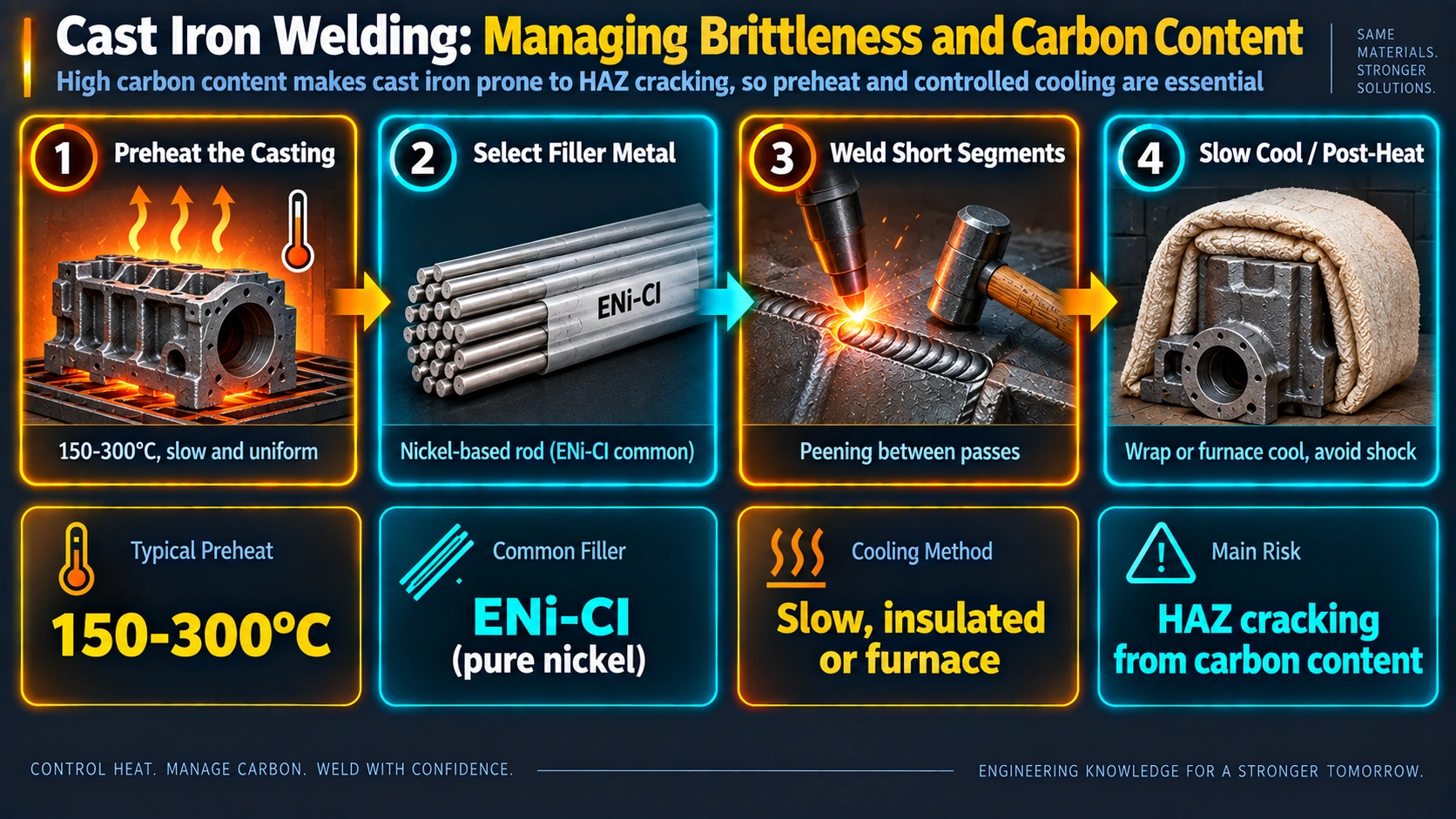
To weld cast iron successfully you first need to understand why it fails. Cast iron is not a single material — it is a family of iron–carbon alloys united by a carbon content above approximately 2.0% (the boundary with steel). At these carbon levels, the iron–carbon phase diagram makes it impossible to hold all carbon in solid solution; it must precipitate, and the form it takes determines whether the material is grey, white, ductile, or malleable iron.
Grey Cast Iron
Grey cast iron is the most common grade. Carbon precipitates as graphite flakes during solidification, giving the material its grey fractured appearance. The flakes act as stress concentrators, which is why grey iron is brittle in tension but excellent in compression. Tensile strength typically ranges from 150 to 400 MPa depending on grade (ASTM A48 / ISO 185 classes). The flake graphite also serves as a self-lubricant, making grey iron excellent for sliding surfaces such as machine slides and pump liners.
Ductile (Nodular) Iron
Ductile iron, also called nodular or spheroidal graphite (SG) iron, is produced by adding magnesium or cerium to the melt just before pouring. These inoculants cause carbon to precipitate as spheres rather than flakes, eliminating the stress concentration effect. The result is tensile strengths of 400–900 MPa with elongations of 2–18% — close to mild steel in many respects, and far more weldable than grey iron if appropriate preheat is applied.
Malleable Iron
Malleable iron starts life as white iron (see below) and then undergoes a two-stage annealing heat treatment. The first stage converts cementite (Fe3C) to temper carbon rosettes; the second stage (in ferritic malleable iron) decarburises the matrix. The result is a cast iron with reasonable ductility (elongations of 5–10%) and very good machinability. Welding malleable iron is tricky because the high-temperature HAZ can revert to white iron, destroying the properties conferred by the original annealing treatment.
White Cast Iron
White cast iron solidifies so rapidly that carbon remains trapped as iron carbide (cementite, Fe3C) rather than precipitating as graphite. The material is extremely hard (HRC 50+) and almost completely unweldable in a conventional sense. Hardfacing electrodes and braze welding are the only practical repair options. White iron is used where severe abrasion resistance is needed — crusher liners, mill hammers, and slurry pump wear plates.
Compacted Graphite Iron (CGI)
CGI is an intermediate morphology where graphite precipitates in a worm-like or “vermicular” form. Thermal conductivity and damping are superior to ductile iron, making CGI popular for diesel engine cylinder heads. Weldability is similar to ductile iron and the same SFA-5.15 nickel-alloy electrodes apply.
ASME SFA-5.15 / AWS A5.15: Electrode Classification System
ASME SFA-5.15 is the ASME Boiler and Pressure Vessel Code (Section II Part C) adoption of AWS A5.15, Specification for Welding Electrodes and Rods for Cast Iron. Both documents carry identical technical requirements. The standard classifies three types of filler metals: covered electrodes for SMAW, bare wire electrodes and rods for gas welding (OAW) and the gas tungsten arc process (GTAW), and copper-alloy electrodes cross-referenced from other A5-series specifications.
Classification Code Structure
The designation system for SFA-5.15 electrodes is read as follows:
E = Electrode (covered SMAW type) Ni = Primary alloying element in deposit (Nickel) Fe = Secondary alloying element (Iron) — omitted when pure Ni Mn = Tertiary element (Manganese) — present in ENiFeMn-CI class –CI = Suffix: Cast Iron application
Bare rod prefix: R (e.g. RCI, RCI-A for gas welding rods)
Electrodes may additionally carry a suffix -A denoting a modification to the basic classification — typically a tightened chemistry range or a flux coating variation. Understanding the welding consumable nomenclature system helps decode these designations quickly.
Covered Electrode Classifications (SMAW)
| Classification | Ni % | Fe % | C % max | Mn % max | Primary Application | Weld Metal Character |
|---|---|---|---|---|---|---|
| ENi-CI | ≥85 | Bal. | 2.0 | 2.5 | Grey iron repair; machined surfaces | Soft / Machinable |
| ENi-CI-A | ≥85 | Bal. | 2.0 | 2.5 | Grey / ductile; modified coating | Soft / Machinable |
| ENiFe-CI | 45–60 | Bal. | 2.0 | 4.0 | Grey, ductile, malleable; restrained welds | Moderate hardness |
| ENiFe-CI-A | 45–60 | Bal. | 2.0 | 4.0 | High-phosphorus castings; dissimilar joints | Moderate hardness |
| ENiFeMn-CI | 25–45 | Bal. | 2.0 | 12–20 | Grey and ductile; cost-sensitive repairs | Work hardens |
| ESt | — | Bal. | 0.35 | 1.20 | Non-critical fills where machinability not needed | Hard; not machinable |
| Values from AWS A5.15 / ASME SFA-5.15 Table 1A. Bal. = balance to 100%. Check current standard for full compositional limits including Si, S, P. | ||||||
Gas Welding Rod Classifications (OAW)
| Classification | Deposit Type | Hardness (approx.) | Key Application |
|---|---|---|---|
| RCI | Grey cast iron matching | 170–200 HB | General grey iron gas welding; filling, building up worn castings |
| RCI-A | Alloy cast iron (Mo + Ni addition) | ~230 HB | Alloy or high-strength grey iron; more fluid molten metal than RCI |
| RCI-B | Ni-Cu cast iron rod | ~160–200 HB | Ductile iron joining; good colour match to nodular iron |
| RCI-series rods are used with oxyacetylene and require full preheating of the casting (hot welding technique). OAW produces the lowest residual stresses of any cast iron welding process when done correctly. | |||
Electrode Selection Guide: Which SFA-5.15 Grade for Your Job?
Selecting the correct electrode from the SFA-5.15 range is the single most important decision in cast iron welding. The wrong choice — particularly using an ESt (steel) electrode on grey iron expecting a machinable result — is responsible for more failed repairs than any technique error.
ENi-CI: The Machinable Choice
ENi-CI uses a pure nickel core (minimum 85% Ni) with a graphitic coating. Nickel is an austenite stabiliser: it keeps the weld deposit in a face-centred cubic (FCC) austenitic state at room temperature, which is soft, ductile, and fully machinable. Carbon from the cast iron base metal that migrates into the weld pool is absorbed into the austenitic matrix without forming brittle carbides. ENi-CI is the first choice when the repair will subsequently be finish-machined, ground, or returned to a close-tolerance running surface.
- Best for: grey iron repair on bearing housings, engine cylinder heads, and machined bores
- Preheat: 150 °C (300 °F) minimum for sections over 12 mm; minimal or no preheat for thin sections under 6 mm with cold technique
- Polarity: DC-EP (electrode positive) or AC
- Limitation: higher electrode cost; lower tensile strength than ENiFe-CI; not preferred for high-phosphorus castings
ENiFe-CI: The Structural Choice
ENiFe-CI deposits a nickel-iron alloy with 45–60% Ni, balance iron. The higher iron content increases tensile strength (typically 380–480 MPa deposit UTS versus 280–350 MPa for ENi-CI) while still maintaining an austenitic matrix sufficient to absorb carbon dilution. ENiFe-CI handles restrained weldments, thick sections, and castings with elevated phosphorus content better than pure-nickel electrodes, because the iron reduces the thermal expansion mismatch between weld metal and cast iron base material.
- Best for: structural repairs on ductile iron, highly restrained grey iron, dissimilar metal joints (cast iron to steel)
- Preheat: 175 °C (350 °F) minimum for most applications; up to 315 °C for heavy sections and ductile iron
- Polarity: DC-EP preferred
- Post-weld: slow cool under insulating blanket; peening each bead while still hot
ENiFeMn-CI: The Economy Choice
By substituting 12–20% manganese for a portion of the expensive nickel, ENiFeMn-CI electrodes reduce consumable cost while retaining adequate austenite stability. The manganese also promotes work hardening, which can be advantageous in wear applications. Deposit machinability is moderate — softer than steel but harder than ENi-CI, and dependent on the dilution level. ENiFeMn-CI is suitable for large volume fills on non-critical grey iron castings where cost matters more than post-weld machining quality.
ESt: When Not to Use It
ESt is a low-carbon steel electrode sometimes used on cast iron as a low-cost option. The deposit is ferritic with minimal austenite, so diluted carbon from the cast iron base forms brittle martensite and carbides in the HAZ and at the fusion boundary. The result is a hard, unmachinable, crack-susceptible weld. ESt should only be used for non-critical structural tacking or temporary holding repairs that will not be machined and are under minimal service stress.
Preheat and Interpass Temperature Requirements
Preheat is the most effective tool available for preventing HAZ cracking in cast iron welding. By raising the starting temperature of the casting, preheat reduces the thermal gradient between the weld pool and the surrounding metal, slows the cooling rate through the martensite transformation range, and allows residual thermal stresses to partially self-relieve by plastic deformation rather than by cracking.
| Cast Iron Type | Cold Weld (no preheat) | Minimum Preheat (°C) | Hot Weld Preheat (°C) | Max Interpass (°C) | Notes |
|---|---|---|---|---|---|
| Grey Iron | Possible | 150–175 | 315–650 | 315 | Most forgiving; slow cool mandatory |
| Ductile Iron | Not recommended | 200–315 | 370–650 | 315 | Higher residual stress than grey; preheat critical |
| Malleable Iron | Possible | 100–175 | 315–540 | 260 | Avoid exceeding 800 °C (reverts to WI) |
| White Iron | Not recommended | 315+ | 600+ | N/A | Braze welding preferred; very limited arc repair |
| Compacted Graphite | Possible | 175–250 | 350–600 | 315 | Similar procedure to ductile iron |
| Do not exceed 750 °C (1400 °F) for any cast iron type — this risks distortion and entry into the critical temperature range. Preheat the entire casting uniformly; never preheat locally at the weld area only. | |||||
Hot Welding vs Cold Welding: When to Use Each
Two fundamentally different approaches exist for welding cast iron. The choice between them is driven by the casting size, service criticality, available equipment, and post-weld machining requirements.
Hot Welding (Preheated Method)
Hot welding involves raising the entire casting to 315–650 °C before starting and maintaining that temperature throughout. The casting is then welded without interruption using either oxyacetylene (OAW) with RCI-series rods, or SMAW with nickel-alloy or cast iron electrodes. After welding, the casting is placed in a furnace or embedded in dry sand, vermiculite, or an insulating box and allowed to cool at less than 50 °C per hour — typically overnight. Hot welding produces the best mechanical properties and the most machinable weld metal. The HAZ is substantially converted back toward a graphitic structure rather than forming martensite, and residual stresses are minimal.
Hot welding is the preferred method when:
- The casting can be removed from service and transported to a workshop
- Machining to close tolerances is required after repair
- Section thickness exceeds 25 mm
- The repair is on a highly stressed or fatigue-loaded component (pump housings, gear boxes)
- A colour and property match to the base iron is required (OAW with RCI rod gives an excellent match)
Cold Welding (Short-Bead Method)
Cold welding is performed at or near room temperature (the casting may be warmed to 40–60 °C to drive off surface moisture, but not preheated in the true sense). The technique relies on depositing very short beads — 25 mm maximum — and allowing each bead to cool to hand-touch temperature before depositing the next. Peening each bead immediately after deposition is critical to relieve residual tensile stresses.
Cold welding is used when:
- The casting is too large or assembled into a machine to allow furnace preheating
- Heat distortion is a concern (thin-walled sections)
- Only minor surface repairs or cosmetic fills are needed
- ENi-CI or ENiFe-CI electrodes are available to tolerate dilution without forming brittle structures
Joint Preparation for Cast Iron Welding
Proper joint preparation is essential — arguably more important for cast iron than for any other material, because surface contamination and poor fusion are the two most common causes of repair failure. Cast iron is porous and absorbs oil, coolant, and cutting fluid deeply into its structure over years of service. Simply grinding the surface clean is not sufficient for heavily impregnated castings.
Identifying the Crack
- Clean the area with solvent and allow to dry. Apply dye penetrant (PT) or magnetic particle inspection (MT) to identify crack length and confirm all branches. A visual inspection alone will miss subsurface cracks.
- Mark the crack tips clearly. Drill stop holes 5–8 mm in diameter at each crack tip, positioned 3–5 mm beyond the visible end of the crack. Stop holes prevent propagation during heating and welding.
- Grind or gouge out the crack to a V-groove with at least 60° included angle (90° preferred for deep cracks). The root must be fully accessible.
- Remove all surface scale, paint, rust, and contamination from a 25 mm band either side of the groove using a disc grinder or wire brush. Do not use cutting fluids during grinding.
Degreasing Oil-Impregnated Castings
For castings that have been in oil service (engine blocks, gearboxes, pump bodies), baking is required before welding. Heat the casting uniformly in an oven to 370–540 °C (700–1000 °F) for 1–2 hours or until no more smoke or flame appears from the joint area. This drives off absorbed oil and prevents porosity and carbon contamination of the weld pool. Allow to cool to the preheat temperature before welding.
Welding Technique: Step-by-Step Repair Sequence
The following procedure covers a structural repair weld on a grey cast iron component using SMAW with ENiFe-CI electrodes, hot welding technique.
- Pre-weld inspection: PT or MT to confirm crack limits. Drill stop holes. Groove to 90° V, clean to bare metal, degrease.
- Preheat: Apply heat evenly to the entire casting using propane torch or furnace. Target 250–350 °C for grey iron, confirmed by Tempilstik. Do not apply direct flame to the weld area.
- Machine setup: DC-EP polarity. Set amperage to the low end of the electrode manufacturer’s range (3.2 mm ENiFe-CI typically 90–110 A). Lower current = lower heat input = less dilution and smaller HAZ.
- Root pass: Deposit a full root pass without stopping. Maintain stringer bead technique — no weaving. Keep arc short to minimise heat input.
- Peen while hot: Immediately after depositing each bead, peen the bead lightly with a ball-peen hammer while still above 650 °C. This plastically deforms the austenitic weld metal under low yield stress, relieving tensile residual stress before the casting cools.
- Interpass check: Do not allow interpass temperature to exceed 315 °C. Check with contact pyrometer or Tempilstik between passes. If the casting has cooled below 200 °C, re-apply preheat before the next pass.
- Fill passes: Continue pass-by-pass with cleaning (slag removal) and peening between each layer. Keep run lengths short in the first two layers for cold sections; longer runs are acceptable once the groove is partially filled and heat is distributed.
- Cap pass: Final cap pass should be slightly convex and of consistent width. Do not grind at this stage.
- Post-weld slow cool: Immediately after the final pass, embed the casting in dry sand, cover with mineral wool insulating blanket, or return to furnace at the welding temperature. Cool at 50 °C per hour maximum. Remove from the insulation once below 50 °C.
- Post-cool inspection: After full cooling, perform PT or MT to check for surface-connected cracks. Grind flush and re-check.
Heat-Affected Zone Management
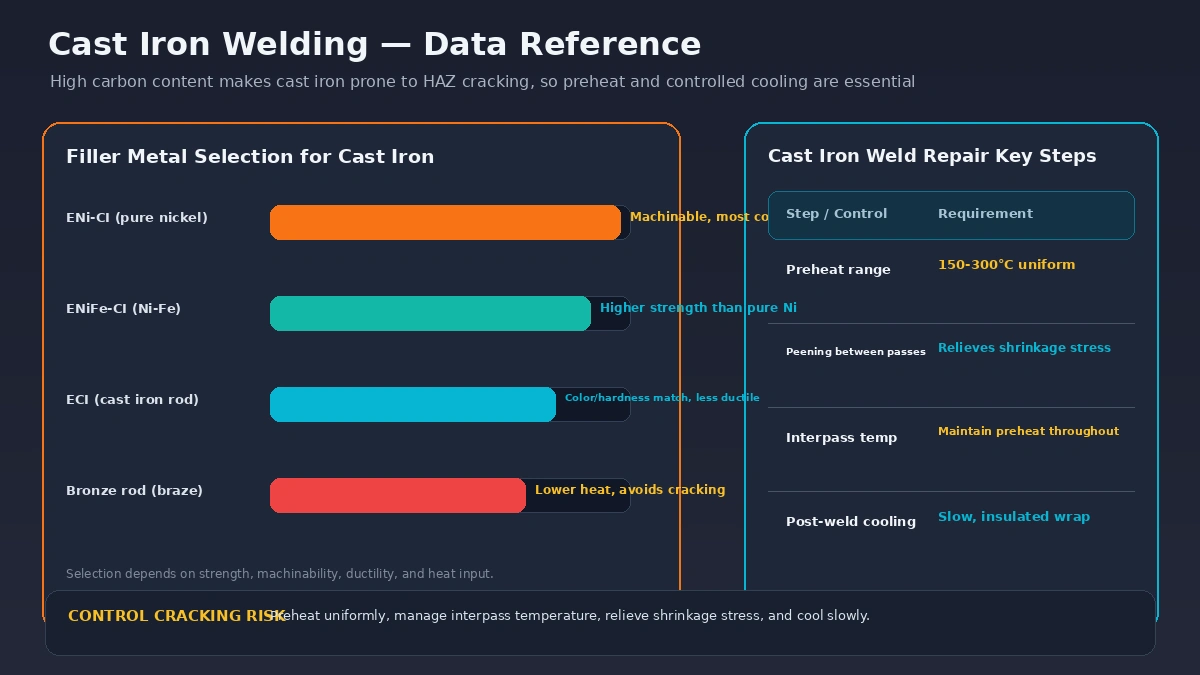
The heat-affected zone (HAZ) in cast iron welding is the critical failure region. When any zone of the casting is heated above approximately 760 °C and then cooled rapidly, the graphite carbon in that zone dissolves back into the austenite matrix. On cooling, instead of re-precipitating as graphite (which requires slow cooling), it transforms to martensite and carbides — both hard, brittle phases. The resulting HAZ is harder than the surrounding base metal, has zero ductility, and cracks under the residual thermal stress of welding.
HAZ Width and Its Determinants
HAZ width in cast iron is proportional to heat input. High-current, wide-weave beads produce wider, more severely transformed HAZs. This is why SMAW of cast iron should always use the smallest electrode diameter appropriate for the joint and the lowest practicable current. For ENi-CI electrodes, the SMAW process running 3.2 mm electrode at 90–110 A is typical; 4.0 mm electrodes should be reserved for groove fill in thick sections only.
Why Nickel Electrodes Help
Even when an unavoidable white iron zone forms in the HAZ adjacent to the fusion boundary, the austenitic nickel-iron weld deposit of ENi-CI or ENiFe-CI provides a ductile transition layer. The weld metal itself remains soft, machinable, and capable of absorbing some deformation. Carbon diffusing from the base metal is diluted into the large austenitic matrix of the high-nickel deposit rather than forming iron carbides at grain boundaries. This is the fundamental mechanism that makes SFA-5.15 nickel electrodes the correct choice for cast iron welding.
Braze Welding Cast Iron
Braze welding is an alternative to fusion welding that is particularly effective for joining or repairing cast iron with minimal distortion and without the risk of HAZ white iron formation. It uses a copper-zinc filler metal (typically RCuZn-C per AWS A5.8) applied with an oxyacetylene torch and a flux. The base metal is heated only to the brazing temperature range (approximately 870–930 °C) — hot enough to wet the joint by capillary action but below the cast iron’s melting point. No dilution of the filler metal with base metal occurs.
Braze welding produces deposits that are soft, machinable, and have reasonable tensile strength (200–350 MPa joint efficiency depending on joint design). The process is well-suited for thin-walled sections, cosmetic repair work, and joining dissimilar metals. It is the primary repair method for white iron components where fusion arc welding is not viable. On malleable iron, braze welding is often preferred over arc processes because it avoids the HAZ reversion to white iron that arc heat inevitably causes.
Common Defects and How to Prevent Them
| Defect | Root Cause | Prevention | Relevant SFA-5.15 Action |
|---|---|---|---|
| HAZ cracking | Rapid cooling through martensite range; insufficient preheat | Preheat to spec; slow-cool in sand; use nickel electrodes | Upgrade to ENi-CI or ENiFe-CI from ESt |
| Porosity | Oil/moisture contamination of base metal; wet electrodes | Bake casting before welding; use dry-stored electrodes | Verify coating condition; bake ENi-CI at 150 °C/1 hr |
| Underbead cracking | Brittle white iron HAZ unable to accommodate contraction stress | Reduce heat input; increase preheat; peen beads | Switch to smaller diameter electrode (3.2 mm vs 4.0 mm) |
| Hard unmachineable deposit | High base-metal dilution; wrong electrode type | Use short arc length; low current; buttering technique | Replace ESt or mild steel electrode with ENi-CI |
| Delayed cracking | High residual stress; cooling too fast post-weld | Post-weld slow cool; stress-relief anneal at 540–600 °C | Follow interpass and PWHT protocol for ductile iron |
| Lack of fusion | Casting too cold; arc extinguished on cold iron | Verify preheat before each pass; maintain short arc | Check that preheat is above minimum before re-striking |
Dissimilar Metal Welding: Cast Iron to Steel
Joining cast iron to carbon steel or stainless steel is common in repair situations: a cast iron pump body bolted to a fabricated steel pipe spool, or a grey iron valve body welded to a carbon steel fitting. ENiFe-CI is the preferred filler metal for this application. The nickel-iron deposit is metallurgically compatible with both the cast iron base (absorbing carbon dilution) and the steel side (matching thermal expansion better than pure nickel). The cast iron side should be buttered with ENi-CI or ENiFe-CI first, ground flush, and then a full groove weld deposited using ENiFe-CI for the fill and cap passes.
When welding cast iron to stainless steel, ENiFe-CI is again preferred over pure Ni electrodes because the higher iron content reduces the risk of hot cracking at the interface with austenitic stainless. For guidance on welding dissimilar joints involving stainless steel and heat-resistant alloys, the stainless steel weld decay guide and the duplex stainless steel welding guide on WeldFabWorld provide related background.
Post-Weld Heat Treatment (PWHT) Considerations
Stress-relief PWHT after cast iron welding is not always required but is strongly recommended for highly restrained weldments and for components that will return to cyclic load or thermal cycling service. The recommended stress-relief temperature for cast iron is 540–600 °C, held for 1 hour per 25 mm of section thickness, followed by furnace cooling at 50 °C per hour maximum to below 260 °C, then still-air cooling.
Full annealing at 800–900 °C can be applied to grey iron welds where the HAZ white iron must be converted back to graphitic iron to restore machinability and ductility. However, this temperature range causes re-austenitisation and requires a very slow, controlled cool at typically 10–20 °C per hour through the eutectoid range (680–750 °C). This is furnace work — not shop-floor torch annealing.
Recommended Books — Amazon Associates
Disclosure: WeldFabWorld participates in the Amazon Associates programme (StoreID: neha0fe8-21). If you purchase through these links, we may earn a small commission at no extra cost to you. This helps support free technical content on this site.