P-Number, Group Number, F-Number & A-Number in Welding
ASME BPVC Section IX assigns classification numbers to base metals and filler metals specifically to reduce the number of welding procedure and performance qualifications a fabricator has to maintain. This guide explains P-Numbers, Group Numbers, F-Numbers, and A-Numbers — what each one means, where each is found in the code, and how they govern WPS/PQR qualification scope, with the base metal ranges checked and corrected against Table QW-422, QW-432, and QW-442.
Overview: Why ASME Uses These Numbers
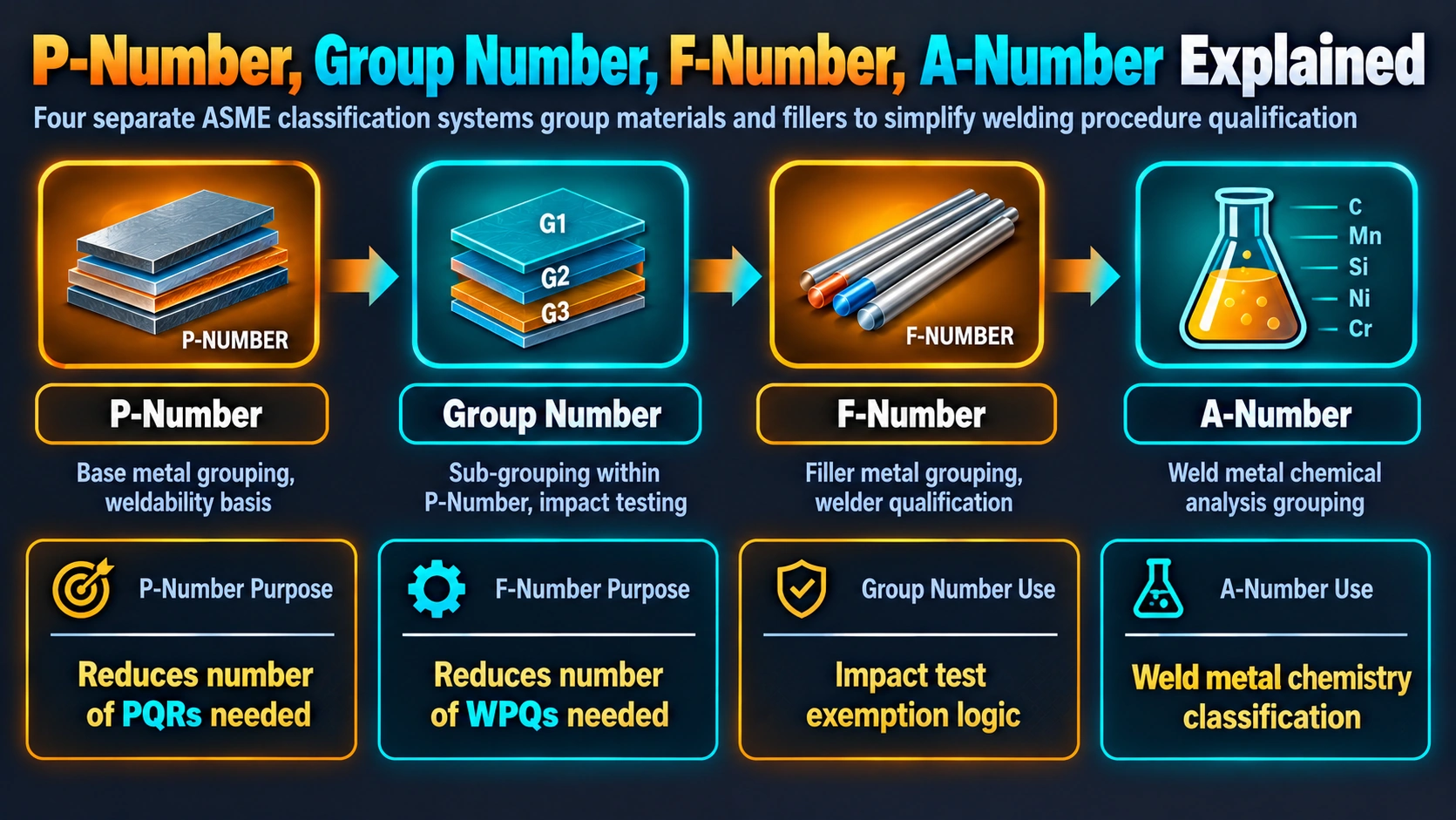
One of Section IX’s most useful tools is this system of assigned numbers, which categorizes base metals, filler metals, and weld metal compositions into groups sharing comparable characteristics. The purpose is to avoid qualifying a separate procedure for every individual material grade — a single PQR can cover an entire group of materials sharing the same P-Number, rather than one PQR per grade.
P-Number — Base Metal Classification
To reduce the number of procedure qualifications required, ASME Section IX assigns a P-Number to base metals based on comparable composition, weldability, and mechanical properties. Where practical, base metals with similar characteristics share the same P-Number.
Ferrous (Steel) P-Numbers — P-1 through P-15F
| P-Number | Material Category | Typical Grades |
|---|---|---|
| P-1 | Carbon steel | SA-106 Gr.B, SA-516 Gr.60/65/70, SA-333 Gr.6, SA-234 WPB |
| P-3 | Low alloy steel (C-Mo, 1/2Cr-1/2Mo class) | SA-387 Gr.2, SA-335 P2 |
| P-4 | 1-1/4Cr-1/2Mo class alloy steel | SA-387 Gr.12, SA-335 P12 |
| P-5A | 2-1/4Cr-1Mo, 3Cr-1Mo | SA-387 Gr.22, SA-335 P22 |
| P-5B | 5Cr-1/2Mo, 7Cr-1/2Mo, 9Cr-1Mo | SA-335 P5, P7, P9 |
| P-6 | Martensitic stainless steel | Types 410, 420, 431 |
| P-7 | Ferritic stainless steel | Types 409, 430, 446 |
| P-8 | Austenitic stainless steel | SA-312 TP304, TP316, TP321 |
| P-9 | Nickel alloy (2.5-9% Ni) cryogenic steel | SA-203, SA-353 (distinct from P-41 to P-46 non-ferrous nickel alloys) |
| P-10 (various subgroups) | Specialty and proprietary high-alloy steels, including some duplex stainless grades | Varies by subgroup — confirm against current QW-422 |
| P-11 (A/B) | High-strength quenched & tempered alloy steel | 9% Ni plate (SA-353, SA-522), SA-508, SA-533, SA-543 |
| P-15E | 9Cr-1Mo-V (Grade 91) | SA-335 P91, SA-213 T91, SA-182 F91 |
| P-15F | 9Cr-2W (Grade 92) and related CSEF steels | SA-335 P92, SA-213 T92 |
Non-Ferrous P-Numbers
| P-Number Range | Material Category | Typical Grades / Alloys |
|---|---|---|
| P-21, 22, 23, 25, 26 | Aluminum and aluminum alloys | 1xxx pure Al, 3xxx Al-Mn, 5xxx Al-Mg, 6xxx Al-Mg-Si, castings (no P-24) |
| P-31 to P-35 | Copper and copper alloys | Pure copper, brass, bronze, copper-nickel |
| P-41 to P-46 | Nickel and nickel alloys | Monel, Inconel, Hastelloy, Incoloy |
| P-51 to P-54 | Titanium and titanium alloys | Grade 1-2 (unalloyed), alpha-beta and other Ti alloys |
| P-61, P-62 | Zirconium and zirconium alloys | Reactor-grade and industrial zirconium |
| P-81 | Cobalt-base alloys | Various proprietary cobalt alloys |
Practical Example
A PQR qualified on SA-106 Gr.B (P-No.1) to SA-106 Gr.B (P-No.1) also qualifies welding of SA-333 Gr.6, SA-234 WPB, and SA-516 Gr.60/65/70 — all of which carry P-No.1. It does not qualify for SA-312 TP304 (P-No.8, austenitic stainless steel), which requires a separate PQR.
Group Number — Toughness Sub-Grouping
Group Numbers sub-classify P-Numbers, used specifically when a Supplementary Essential Variable requires toughness (impact) testing for WPS qualification, as mandated by other Code Sections such as ASME Section VIII Division 1 UG-84. There are four Group Numbers (1 through 4) for ferrous P-Numbers, generally ordered from lowest tensile strength (Group 1) to highest (Group 4), though the exact grade-to-group assignment for any specific material must be checked against the current edition of Table QW-422.
F-Number — Filler Metal Grouping
F-Numbers group electrodes and welding rods in Table QW-432 based on usability characteristics — attributes affecting a welder’s ability to produce a satisfactory weld with a given filler metal. This grouping applies to both procedure qualification (WPS/PQR) and welder performance qualification (WPQ). If a welder demonstrates they can produce satisfactory welds with one filler metal in an F-Number group, ASME considers them qualified for all other filler metals in that same group.
| F-Number | Category | Typical Electrodes |
|---|---|---|
| F-1 | Iron powder, heavy drag technique — high deposition | EXX24, EXX27 |
| F-2 | Rutile, fill-freeze — general purpose | EXX12, EXX13, EXX14 |
| F-3 | Cellulosic, fast-freeze — deep penetration, all-position | EXX10, EXX11 |
| F-4 | Low-hydrogen — all-position | EXX15, EXX16, EXX18, EXX28 |
| F-5 | Austenitic stainless steel SMAW electrodes | E308, E316 |
| F-6 | Bare wire and cored wire (SAW, GMAW, GTAW, PAW, FCAW) | ER70S-series and similar |
A-Number — Weld Metal Chemical Composition
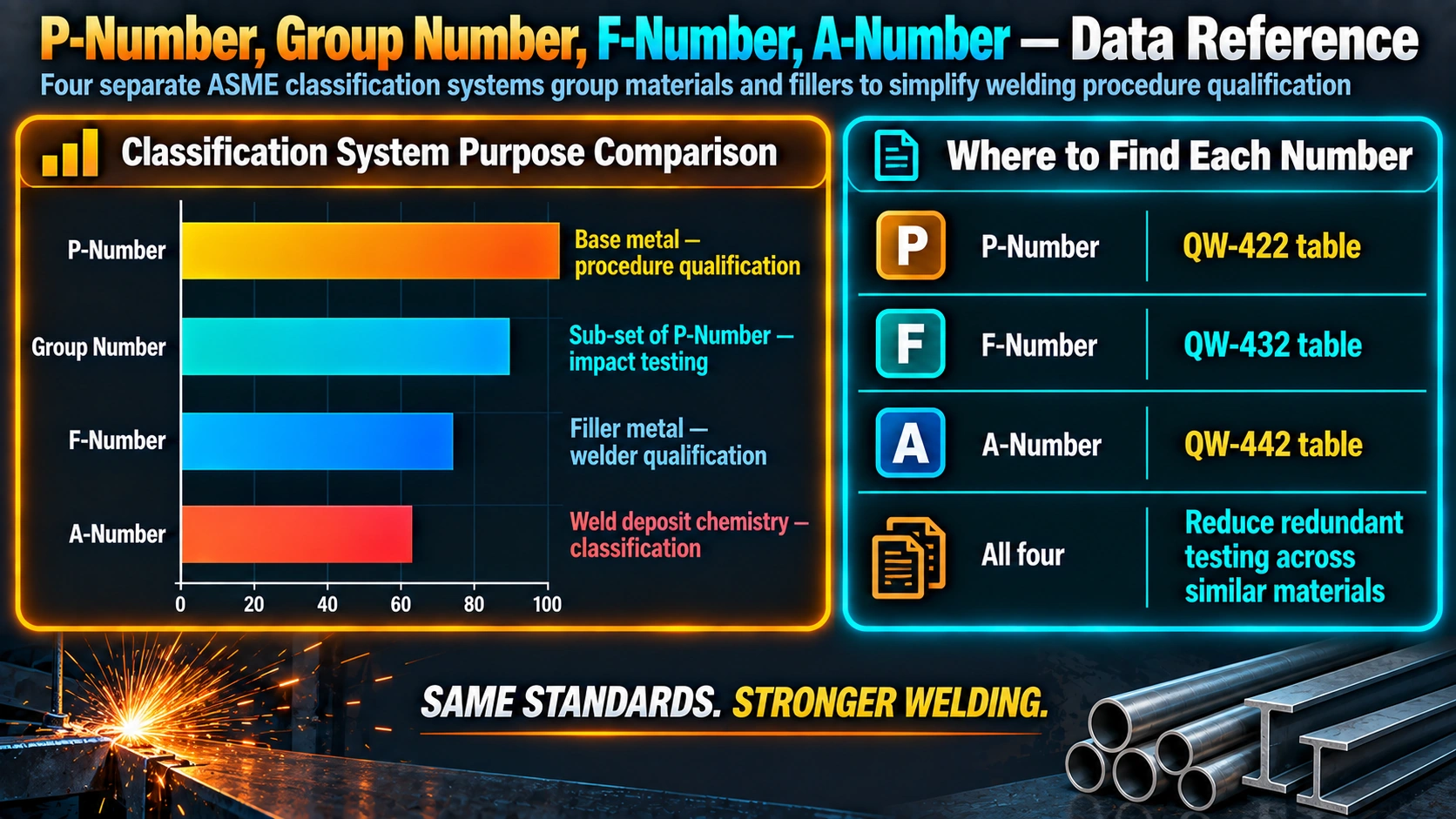
The A-Number identifies the chemical composition of the deposited weld metal and is recorded on both the PQR and WPS, found in Table QW-442. A change in A-Number is an essential variable requiring WPS requalification.
| A-Number | Composition Type | Cr % | Mo % | Ni % |
|---|---|---|---|---|
| A-1 | Carbon steel | — | — | — |
| A-2 | Carbon-molybdenum | — | 0.40-0.65 | — |
| A-3 | Chrome-moly (1-2% Cr) | 1.00-2.00 | 0.40-0.65 | — |
| A-4 | Chrome-moly (2-6% Cr) | 2.00-6.00 | 0.40-1.50 | — |
| A-5 | Chrome-moly (6-10.5% Cr) | 6.00-10.50 | 0.40-1.50 | — |
| A-6 | Martensitic chrome steel | 11.00-15.00 | 0.70 max | 4.00 max |
| A-7 | Ferritic chrome steel | 11.00-30.00 | — | — |
| A-8 | Austenitic chrome-nickel | 14.50-30.00 | — | 7.50-15.00 |
| A-9 | Austenitic chrome-nickel-moly | 14.50-30.00 | 1.00-4.00 | 7.50-15.00 |
| A-10 | Nickel-chrome-moly | — | — | >15.00 |
| A-11 | Manganese-molybdenum | — | 0.25-0.75 | — |
Summary Comparison
| Number Type | Applies To | Table | Basis for Grouping | Essential Variable? |
|---|---|---|---|---|
| P-Number | Base metals | QW-422 / QB-422 | Composition, weldability, mechanical properties | Yes |
| Group Number | Base metals (sub-group) | QW-422 / QB-422 | Toughness / impact testing | Yes, when toughness required (Supp. EV) |
| F-Number | Filler metals / electrodes | QW-432 | Usability characteristics | Yes |
| A-Number | Deposited weld metal | QW-442 | Chemical composition | Yes |
Frequently Asked Questions
What P-Number is Grade 91 (9Cr-1Mo-V) steel assigned?
Grade 91 (SA-335 P91 pipe, SA-213 T91 tube, SA-182 F91 forgings) is assigned P-Number 15E, not P-5B despite being a 9% chromium steel similar in bulk composition to Grade 9. ASME separated it into its own P-Number because its vanadium-modified, creep-strength-enhanced ferritic microstructure behaves differently enough from conventional Cr-Mo steel to need its own, more restrictive qualification requirements — a WPS qualified on P-5B material does not automatically qualify P-15E material, and vice versa.
What P-Number covers copper and copper alloys?
Copper and copper alloys are covered by P-Numbers 31 through 35 (P-31 pure copper, through P-35 copper-aluminum bronze) under the welding qualification table QW-422. This is a completely different range from P-11, which is reserved for certain high-strength quenched and tempered alloy steels. Brazing qualification (QB-422) for copper uses its own separate numbering system starting around P-101, distinct from the welding P-Numbers entirely.
What P-Number covers titanium and titanium alloys?
Titanium and titanium alloys are covered by P-Numbers 51 through 54. P-15E, which is sometimes confused with titanium because of the similar-looking number, is actually assigned to Grade 91 (9Cr-1Mo-V) steel — a completely unrelated ferrous material. Nickel and nickel alloys sit in the P-41 to P-46 range, and zirconium alloys are P-61 and P-62, following the same general non-ferrous numbering pattern as titanium.
What is the difference between P-6, P-7, and P-10 stainless steel classifications?
P-6 covers martensitic stainless steel (Types 410, 420, 431), P-7 covers ferritic stainless steel (Types 409, 430, 446), and P-8 covers austenitic stainless steel (304, 316, 321). P-10 is reserved for various specialty and proprietary high-alloy steels, including certain duplex stainless steel grades, and should not be confused with the general martensitic stainless steel category, which is P-6.
Does a PQR qualified on one P-Number material cover all materials with that same P-Number?
Generally yes, for essential variable purposes — a PQR qualified using P-1 base metal qualifies WPS use across all P-1 graded materials. However, the responsible welding engineer still needs to separately evaluate metallurgical compatibility, PWHT requirements, and toughness (Group Number) requirements before applying that qualification broadly, since P-Number coverage alone does not guarantee every practical aspect of the joint is addressed.
When does Group Number become an essential variable in WPS qualification?
Group Number becomes a Supplementary Essential Variable specifically when the governing Code Section requires WPS qualification by impact (toughness) testing, such as under ASME Section VIII Division 1 UG-84. In that situation, a change in Group Number — even within the same P-Number — requires WPS requalification with toughness testing at the applicable test temperature. Where toughness testing is not required, Group Number generally does not affect qualification scope.
What is an F-Number and how does it differ from a P-Number?
P-Numbers classify base metals by composition, weldability, and mechanical properties. F-Numbers classify filler metals — electrodes, wire, and rod — by usability characteristics that affect a welder’s ability to produce a sound weld, found in Table QW-432. The two systems serve related but distinct purposes: P-Number governs which base metals a qualified WPS covers, while F-Number governs which filler metals a qualified welder (WPQ) is permitted to use.
What happens if deposited weld metal composition does not match any listed A-Number?
If the weld metal’s actual chemical composition does not correspond to any A-Number listed in Table QW-442, the complete chemical composition must be recorded directly on both the PQR and the WPS rather than referencing an A-Number. A-Number itself remains an essential variable regardless — any change in A-Number (or, where no A-Number applies, any change in the recorded full composition) requires WPS requalification.
Recommended Reading
ASME Section IX (Latest Edition)
The definitive source for Table QW-422, QW-432, and QW-442 — always verify P-Number, F-Number, and A-Number assignments against the current edition.
View on AmazonWelding Inspection Handbook (AWS)
Covers P-Number, F-Number, and A-Number application in day-to-day WPS/PQR review for CWIs.
View on AmazonPressure Vessel Design Manual (Moss)
Practical reference connecting material classification systems to real pressure vessel design and fabrication decisions.
View on AmazonWelding Metallurgy and Weldability (Lippold)
Explains why Grade 91 and other CSEF steels need separate qualification treatment from conventional Cr-Mo grades.
View on AmazonDisclosure: WeldFabWorld participates in the Amazon Associates programme (StoreID: neha0fe8-21). If you purchase through these links, we may earn a small commission at no extra cost to you. This helps support free technical content on this site.