ASME B16.5 Flange Pressure–Temperature Rating Calculator: Class 150 to 2500
Selecting the correct ASME B16.5 flange class for a piping system is one of the most fundamental decisions in process plant design. Get it wrong and you face chronic joint leakage, gasket blowout, or — in the worst case — a pressure-boundary failure that endangers personnel. This page provides an interactive pressure–temperature (P–T) calculator that instantly identifies the minimum required flange class for your design conditions, followed by a thorough technical guide covering material groups, the three-step class selection process, worked examples, and the code provisions engineers must understand from ASME B16.5 and its companion standard ASME B16.47.
ASME B16.5 Flange P–T Rating Calculator
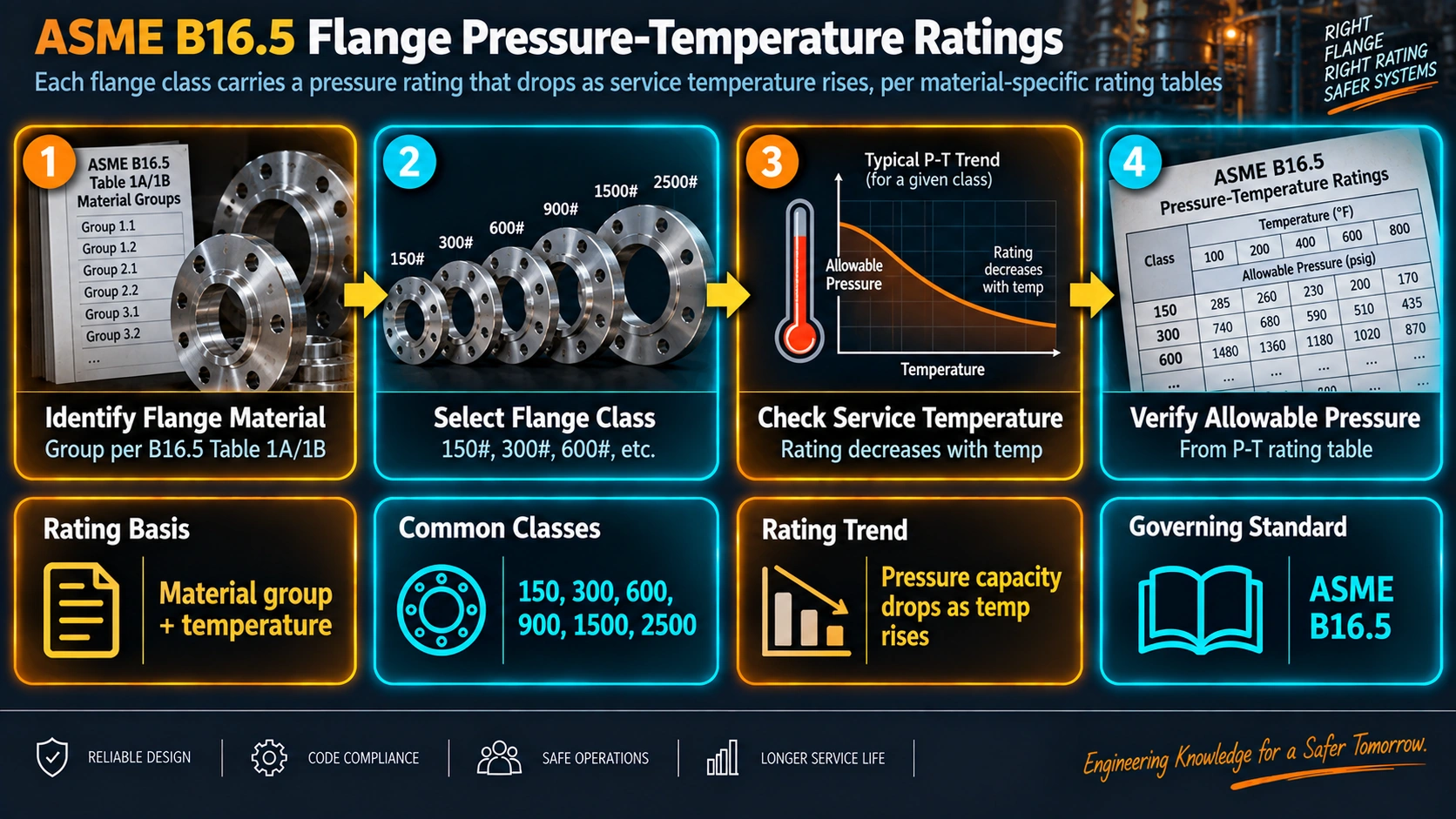
Enter design pressure and temperature — the calculator identifies the minimum required class using tabulated ASME B16.5 P–T data.
| Class | Rated Pressure (bar) | Rated Pressure (psi) | Status |
|---|
The following sections explain how ASME B16.5 pressure–temperature ratings work, how to read the standard’s tables, and how to avoid the common selection errors that cause field problems.
What ASME B16.5 Governs
ASME B16.5 — Pipe Flanges and Flanged Fittings: NPS ½ through NPS 24 — is the primary standard governing dimensional and pressure–temperature requirements for steel pipe flanges in most industrial piping codes worldwide, including ASME B31.1 (Power Piping), ASME B31.3 (Process Piping), and API 570. Section 303 of ASME B31.3 explicitly states that flanges manufactured to ASME B16.5 are deemed suitable for the pressure–temperature limits specified in the standard, eliminating the need for separate pressure calculations if the correct class is selected.
The standard covers seven pressure rating designations (Classes): 150, 300, 400, 600, 900, 1500, and 2500. These class numbers are dimensionless — they are not pressures in psi or any other unit. The actual allowable working pressure for a given class depends on the flange material group and the operating temperature, as defined in the P–T rating tables of ASME B16.5.
Flange Types Covered
ASME B16.5 defines seven flange facing and hub configurations, all sharing the same P–T rating for a given class and material group. The primary types used in oil and gas and petrochemical service are listed below.
| Abbreviation | Flange Type | Weld Type to Pipe | Typical Application |
|---|---|---|---|
| WNRF | Weld Neck Raised Face | Full penetration butt weld | High-pressure, cyclic, critical service |
| SORF | Slip-On Raised Face | Two fillet welds | Low-to-medium pressure utility service |
| SWRF | Socket Weld Raised Face | Fillet weld (small bore) | NPS ≤ 3 in high-pressure service |
| TNRF | Threaded (Screwed) RF | Threaded engagement | Non-hazardous, low-temperature utilities |
| LJRF | Lap Joint RF | Stub end + loose flange | Frequent disassembly, lined pipe systems |
| BLRF | Blind Raised Face | None (blanks nozzle) | Vessel/equipment nozzle blinding |
ASME B16.5 Material Groups Explained
The single most important concept in ASME B16.5 pressure rating selection is the material group. The standard organises every acceptable flange material into groups based on their mechanical properties at elevated temperatures. Flanges in the same group carry identical P–T ratings; flanges in different groups have different ratings even at the same class. Table 1A of ASME B16.5 maps each ASTM material specification to its group number.
There are three broad categories: Groups 1.1 through 1.18 cover carbon and low-alloy steels; Groups 2.1 through 2.12 cover chrome-nickel (austenitic) stainless steels; Groups 3.1 through 3.19 cover non-ferrous alloys including copper alloys, nickel alloys, and titanium. Most general process plant engineering involves Groups 1.1, 1.2, 2.1, and 2.3, which are the four groups built into the calculator on this page.
| Group | Material Type | Typical ASTM Forgings | Typical ASTM Castings | Class 150 Rating at 38 °C (bar) |
|---|---|---|---|---|
| 1.1 | Carbon Steel | A105, A350 LF2, A350 LF3 | A216 WCB, A352 LCB | 19.6 |
| 1.2 | Carbon & Low-Alloy Steel (higher strength) | A350 LF6 Cl.1, A350 LF6 Cl.2 | A216 WCC, A352 LCC | 19.6 |
| 1.5 | Cr-Mo Alloy Steel (5Cr-0.5Mo) | A182 F5, A182 F5a | A217 C5 | 19.6 |
| 1.7 | Cr-Mo Alloy Steel (9Cr-1Mo) | A182 F9 | A217 C12 | 20.7 |
| 2.1 | Austenitic SS 304/304H | A182 F304, A182 F304H | A351 CF8, A351 CF8H | 15.1 |
| 2.2 | Austenitic SS 316/316H | A182 F316, A182 F316H | A351 CF8M | 15.1 |
| 2.3 | Austenitic SS 316L/317L/304L | A182 F316L, A182 F304L | A351 CF3, A351 CF3M | 13.8 |
| 3.1 | Nickel alloy (Ni 200/201) | B160, B162 | — | 13.8 |
How Pressure–Temperature Ratings Work
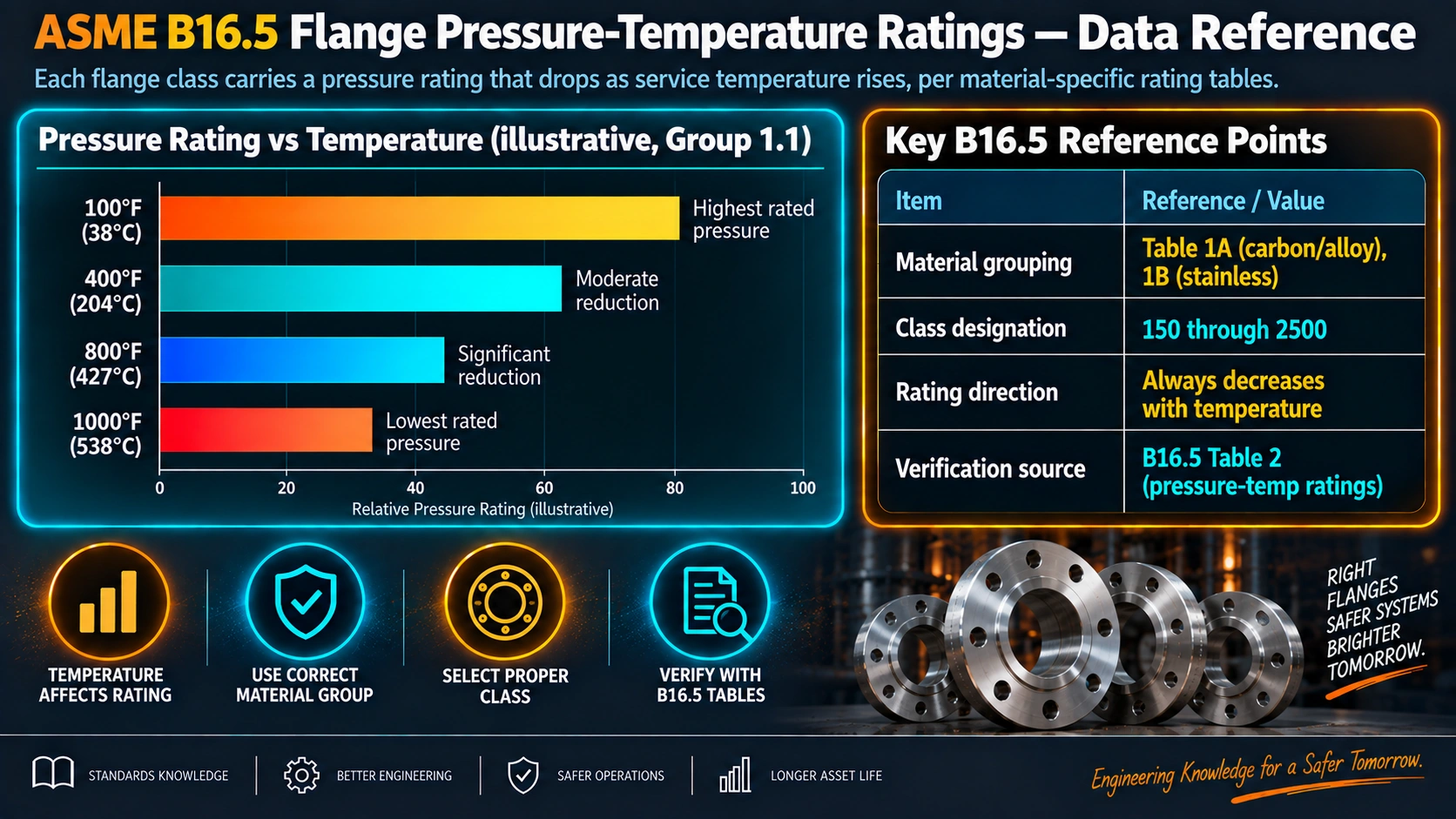
The maximum allowable working pressure (MAWP) for an ASME B16.5 flange is not a single number. It is a function of both temperature and material group. As temperature rises, all steels experience a reduction in yield strength and, at temperatures above approximately 370 °C for carbon steels, creep becomes a controlling failure mode. ASME B16.5 accounts for this by tabulating the allowable pressure at defined temperature increments for each material group and class.
The Derating Mechanism
For Class 300 and higher, the rated pressure at any temperature is calculated from the following relationship defined in Appendix A of ASME B16.5:
P_t = (C1 × S1 × P_r) / 8750
Where:
P_t = Rated pressure at temperature t (bar or psi)
C1 = Stress multiplier for material group (dimensionless)
S1 = Allowable stress at temperature t (MPa or ksi) per ASME Section II Part D
P_r = Pressure-temperature rating designation (e.g. 300, 600, 900…)
8750 = Normalisation constant (psi-based)
For Class 150:
P_t = (C1 × S1) / 140
Class 150 uses a separate formula with a smaller denominator reflecting its special dimensional basis.
In practice, engineers never need to apply these formulas directly. The standard presents the results in ready-to-use tabular form (Tables 2-1.1 through 2-3.19 in the SI appendix and Tables II-2-1.1 through II-2-3.19 in the US customary appendix). Linear interpolation between listed temperature values is permitted; interpolation between class designations is not permitted.
Three-Step Class Selection Process
ASME B16.5 class selection follows a logical three-step procedure. This process is systematic and leaves no room for assumption or approximation between classes.
Step 1 — Confirm Design Pressure and Design Temperature
Use the design pressure and temperature, not the normal operating values. Design conditions must represent the most severe credible combination of pressure and temperature that the system could experience simultaneously, including upsets, startups, shutdowns, and transient events such as blocked-in heating. Many field joint failures trace back to using operating conditions when selecting flange class, then encountering a thermal trip or overpressure transient that the flange cannot handle.
Step 2 — Identify the Material Group from Table 1A
Open ASME B16.5 Table 1A and find the ASTM material specification for your flange. The table lists the material group in the first column and the applicable P–T rating table number in the third column. Do not rely on memory or generic references for this step — the material group determines everything about your ratings, and the standard has been revised several times.
Step 3 — Read the P–T Table and Select the Minimum Sufficient Class
In the P–T rating table for your material group, locate your design temperature in the left column. Read across the row. Start from Class 150 and move right until you find the first class whose rated pressure equals or exceeds your design pressure. That is your minimum required class. If your design pressure exceeds the Class 2500 rating at the design temperature, the material is unsuitable for this service at that temperature and a higher-strength material group or a different design approach is required.
Reference P–T Tables: Groups 1.1, 2.1, and 2.3
The following tables reproduce indicative rated pressures (bar gauge) at key temperatures for the three most common material groups in process plant engineering. These values are for orientation; always verify against the current edition of ASME B16.5 for actual design work.
Group 1.1 — Carbon Steel (ASTM A105, A216 WCB, A350 LF2)
| Temp (°C) | Class 150 | Class 300 | Class 600 | Class 900 | Class 1500 | Class 2500 |
|---|---|---|---|---|---|---|
| 38 | 19.6 | 51.1 | 102.1 | 153.2 | 255.3 | 425.5 |
| 50 | 19.2 | 50.1 | 100.2 | 150.3 | 250.5 | 417.5 |
| 100 | 17.7 | 46.6 | 93.2 | 139.8 | 232.9 | 388.2 |
| 150 | 15.8 | 45.1 | 90.2 | 135.3 | 225.4 | 375.7 |
| 200 | 13.8 | 45.1 | 90.2 | 135.3 | 225.4 | 375.7 |
| 250 | 12.1 | 43.4 | 86.9 | 130.3 | 217.2 | 361.9 |
| 300 | 10.2 | 40.8 | 81.6 | 122.4 | 204.1 | 340.1 |
| 350 | 9.3 | 37.1 | 74.1 | 111.2 | 185.3 | 308.8 |
| 400 | 8.1 | 31.6 | 63.2 | 94.8 | 157.9 | 263.2 |
| 425 | 6.5 | 26.8 | 53.5 | 80.3 | 133.8 | 223.0 |
Group 2.1 — Austenitic Stainless 304/304H (A182 F304, A351 CF8)
| Temp (°C) | Class 150 | Class 300 | Class 600 | Class 900 | Class 1500 | Class 2500 |
|---|---|---|---|---|---|---|
| 38 | 15.1 | 39.8 | 79.5 | 119.3 | 198.8 | 331.4 |
| 100 | 13.8 | 36.3 | 72.6 | 108.9 | 181.4 | 302.4 |
| 150 | 12.9 | 34.0 | 68.0 | 102.0 | 170.1 | 283.4 |
| 200 | 12.4 | 32.5 | 65.1 | 97.6 | 162.7 | 271.2 |
| 300 | 11.8 | 31.1 | 62.2 | 93.3 | 155.4 | 259.0 |
| 400 | 11.5 | 30.3 | 60.5 | 90.8 | 151.3 | 252.2 |
| 500 | 11.1 | 29.3 | 58.6 | 87.9 | 146.4 | 244.0 |
| 538 | 10.8 | 28.5 | 57.0 | 85.5 | 142.5 | 237.5 |
Group 2.3 — Austenitic SS 316L / 304L (A182 F316L, A351 CF3)
| Temp (°C) | Class 150 | Class 300 | Class 600 | Class 900 | Class 1500 | Class 2500 |
|---|---|---|---|---|---|---|
| 38 | 13.8 | 36.2 | 72.4 | 108.6 | 181.0 | 301.6 |
| 100 | 12.5 | 32.9 | 65.8 | 98.7 | 164.5 | 274.2 |
| 200 | 11.3 | 29.8 | 59.6 | 89.5 | 149.1 | 248.5 |
| 300 | 10.7 | 28.1 | 56.3 | 84.4 | 140.7 | 234.5 |
| 400 | 10.2 | 26.9 | 53.8 | 80.8 | 134.6 | 224.3 |
| 454 | 9.6 | 25.3 | 50.6 | 75.9 | 126.5 | 210.8 |
Worked Examples: Selecting Flange Class
Example 1 — Carbon Steel, Steam Service
A process steam line requires a flange in ASTM A105 carbon steel. The design pressure is 50 bar(g) and the design temperature is 250 °C.
Material: ASTM A105 → Group 1.1 (Table 1A of ASME B16.5)
Design pressure (P_d): 50 bar(g)
Design temperature (T_d): 250 °C
Step 1 — Check Class 150 at 250 °C:
P_rated (Cl.150, 250°C) = 12.1 bar
12.1 bar < 50 bar — INSUFFICIENT
Step 2 — Check Class 300 at 250 °C:
P_rated (Cl.300, 250°C) = 43.4 bar
43.4 bar < 50 bar — INSUFFICIENT
Step 3 — Check Class 600 at 250 °C:
P_rated (Cl.600, 250°C) = 86.9 bar
86.9 bar > 50 bar — SUFFICIENT
Result: Minimum required class = Class 600
Pressure margin = (86.9 – 50) / 50 × 100 = 73.8 % above design
Example 2 — Stainless Steel, Chemical Service
A corrosive chemical service requires A182 F316L flanges. Design conditions are 25 bar(g) at 200 °C. Confirm the required class with a 1.25 safety factor.
Material: A182 F316L → Group 2.3
Design pressure (P_d): 25 bar(g)
Safety factor: 1.25
Effective design pressure = 25 × 1.25 = 31.25 bar
Check Class 150 at 200 °C (Group 2.3):
P_rated = 11.3 bar < 31.25 bar — INSUFFICIENT
Check Class 300 at 200 °C (Group 2.3):
P_rated = 29.8 bar < 31.25 bar — INSUFFICIENT
Check Class 600 at 200 °C (Group 2.3):
P_rated = 59.6 bar > 31.25 bar — SUFFICIENT
Result: Minimum required class = Class 600
Note: Without the safety factor, Class 300 (29.8 bar) would appear to be sufficient at 25 bar. Applying the 1.25 SF correctly reveals that Class 600 is required.
Class 400: The Obsolete Rating
Class 400 is included in ASME B16.5 for historical reasons but is rarely used in modern piping system design. Its rated pressure is approximately 4/3 times that of Class 300 at any given temperature and material group. In practice, most current operating company piping specifications and engineering standards do not recognise Class 400, jumping directly from Class 300 to Class 600. Sourcing Class 400 flanges and valves can be extremely difficult, and procurement lead times are typically very long. Unless a specific legacy system or operating company standard requires it, Class 400 should be avoided.
ASME B16.5 vs ASME B16.47: Large Diameter Flanges
For flanges above NPS 24, engineers turn to ASME B16.47. This standard covers two series of large diameter flanges from NPS 26 through NPS 60 and is limited to Class 900 maximum. Series A (derived from API 605) and Series B (derived from MSS SP-44) carry the same class pressure ratings as B16.5 but have different dimensional requirements for the same class and size. A Class 600 flange under B16.5 and B16.47 has the same MAWP, but the bolt circles, flange thicknesses, and raised face dimensions differ — they are not interchangeable in the field.
Gasket Selection and Its Interaction with Flange Class
The flange class determines the bolting pattern and the seating stress available at the flange face, which in turn controls gasket selection. Higher-class flanges provide more bolt load, enabling the use of harder, thinner, more temperature-resistant gaskets such as spiral-wound metallic or ring-type joint (RTJ) gaskets. Lower-class flanges with less bolt load may require softer, more compressible gaskets such as full-face elastomeric types, which are unsuitable for elevated temperatures and aggressive chemicals.
For critical service above Class 600, ring-type joint (RTJ) facings are often preferred over raised face because RTJ gaskets provide a metal-to-metal seal with very high seating stresses, reducing sensitivity to bolt relaxation. Understanding this relationship between flange class, facing type, gasket selection, and bolt-up procedure is essential for engineers involved in joint integrity management.
| Service Condition | Typical Flange Classes | Gasket Type | Facing |
|---|---|---|---|
| Low-pressure utilities (<10 bar, <120 °C) | 150 | Full-face elastomeric (EPDM, NBR) | FF |
| General process service | 150, 300 | Spiral-wound (316SS + graphite) | RF |
| High-pressure / high-temperature | 600, 900 | Spiral-wound with inner ring | RF or RTJ |
| Critical hydrocarbon, toxic service | 900, 1500 | Spiral-wound ASME B16.20 or KammproØfile | RF or RTJ |
| Extreme pressure service | 1500, 2500 | Ring-type joint (RTJ) octagonal | RTJ |
Common Flange Selection Mistakes in Fabrication
Flange specification errors are among the most common causes of piping system integrity failures in operating plants. The following are the most frequently encountered mistakes in fabrication shops and on construction sites.
Mistake 1 — Assuming Class Number Equals Pressure in psi
A Class 150 flange does not mean the flange is limited to 150 psi. At ambient temperature in carbon steel (Group 1.1), Class 150 is rated to approximately 285 psi (19.6 bar). The class number is a dimensionless designation. This misconception has caused engineers to over-specify flanges (wasting cost) and, more dangerously, to under-specify them by misreading tables in customary units. Use the correct material group table from the standard for every selection.
Mistake 2 — Using Operating Conditions Instead of Design Conditions
As demonstrated in Example 1 above, a seemingly adequate selection based on normal operating pressure and temperature can fail dangerously under transient conditions. Design conditions are defined by the responsible process engineer in the process datasheet and line list — do not substitute your own assessment of what the line “normally” sees.
Mistake 3 — Ignoring Material Group for Stainless Flanges
Group 2.3 (316L, 304L) has lower allowable stresses than Group 2.2 (316, 316H) at elevated temperatures. An engineer who selects a Class 300 flange using Group 2.2 tables and then receives a Group 2.3 flange from procurement has under-rated the assembly. Material test reports (MTRs) must be verified against the specified material group before installation.
Mistake 4 — Mismatching Classes Across a Joint
Both flanges in a bolted joint must be the same class and compatible facing type. A Class 150 flange bolted to a Class 300 flange is non-compliant — the bolt circles are different and the flange thicknesses are mismatched. This mismatch scenario occurs when piping modifications or tie-ins are made without checking the existing flange class on the other side of the joint. Always verify both sides before issuing a material requisition. See the mechanical testing guide for inspection approaches used to verify material identity on existing flanges.
PN vs Class: European vs ASME Flanges
Engineers working on international projects regularly encounter European EN 1092-1 flanges rated in PN (Pression Nominale) alongside ASME B16.5 class-rated flanges. The two systems are not directly equivalent, and flanges of similar nominal ratings from the two standards are not interchangeable without detailed dimension and material verification.
The approximate equivalences most commonly referenced are: Class 150 ≈ PN 20, Class 300 ≈ PN 50, Class 600 ≈ PN 100, Class 900 ≈ PN 150, Class 1500 ≈ PN 250, and Class 2500 ≈ PN 420. These are rough guideline values only. Bolt circles, flange thicknesses, gasket contact areas, and facing dimensions all differ between standards. For duplex stainless steel flanges in offshore service in particular, verifying the standard, dimensional series, and pressure rating is critical because mixing ASME and EN flanges at the same joint is a known source of leakage.
Flange Class Selection for Sour and Hydrogen Service
For services containing H2S (hydrogen sulphide) above threshold concentrations defined by NACE MR0175 / ISO 15156, carbon steel flanges must additionally comply with hardness limits and heat treatment requirements. ASTM A105 forgings are acceptable for sour service provided the hardness is controlled to 22 HRC maximum and the equipment is PWHT’d in accordance with the applicable code. This hardness restriction does not change the pressure class selection logic, but it does constrain the acceptable heat number and sometimes the acceptable material specification. Refer to the sour service guide for detailed material requirements.
Recommended Technical References
The following texts are used by piping engineers, inspection personnel, and CSWIP/IWE candidates when studying flange selection, piping codes, and pressure system design.