Zirconium Welding: The Complete Reactive Metals Guide
Zirconium welding sits at the demanding intersection of metallurgical sensitivity, atmospheric contamination control, and precision GTAW technique. Zirconium and its alloys are chosen for applications where titanium or high-alloy stainless steels cannot provide adequate corrosion resistance — particularly in concentrated hydrochloric acid, sulphuric acid, and organic acid service environments found throughout chemical processing, pharmaceutical, and nuclear industries. Getting the weld right requires understanding not just the process parameters, but the fundamental reactivity of the metal itself above 200°C.
This guide covers everything a welding engineer, inspector, or fabricator needs to know: zirconium alloy grades and their weldability, shielding gas selection and purity requirements, joint preparation protocols, GTAW parameter ranges, weld colour interpretation, post-weld examination, and the applicable ASME and AWS code requirements. Whether you are qualifying a new WPS under ASME Section IX P-Number 61 or troubleshooting contamination on a heat exchanger tube sheet, this reference provides the technical depth you need.
Zirconium is substantially more difficult to weld than stainless steel and shares many of the shielding requirements of titanium welding — but with additional complications due to its higher reactivity with nitrogen and its lower tolerance for contamination at elevated temperature. Failure to control the welding atmosphere even briefly results in brittle, embrittled welds that fail inspection and, in service, can cause catastrophic equipment failures. The investment in proper tooling, gas purity, and procedural discipline pays back in reliable, defect-free welds.
Zirconium: Properties and Why Reactivity Matters
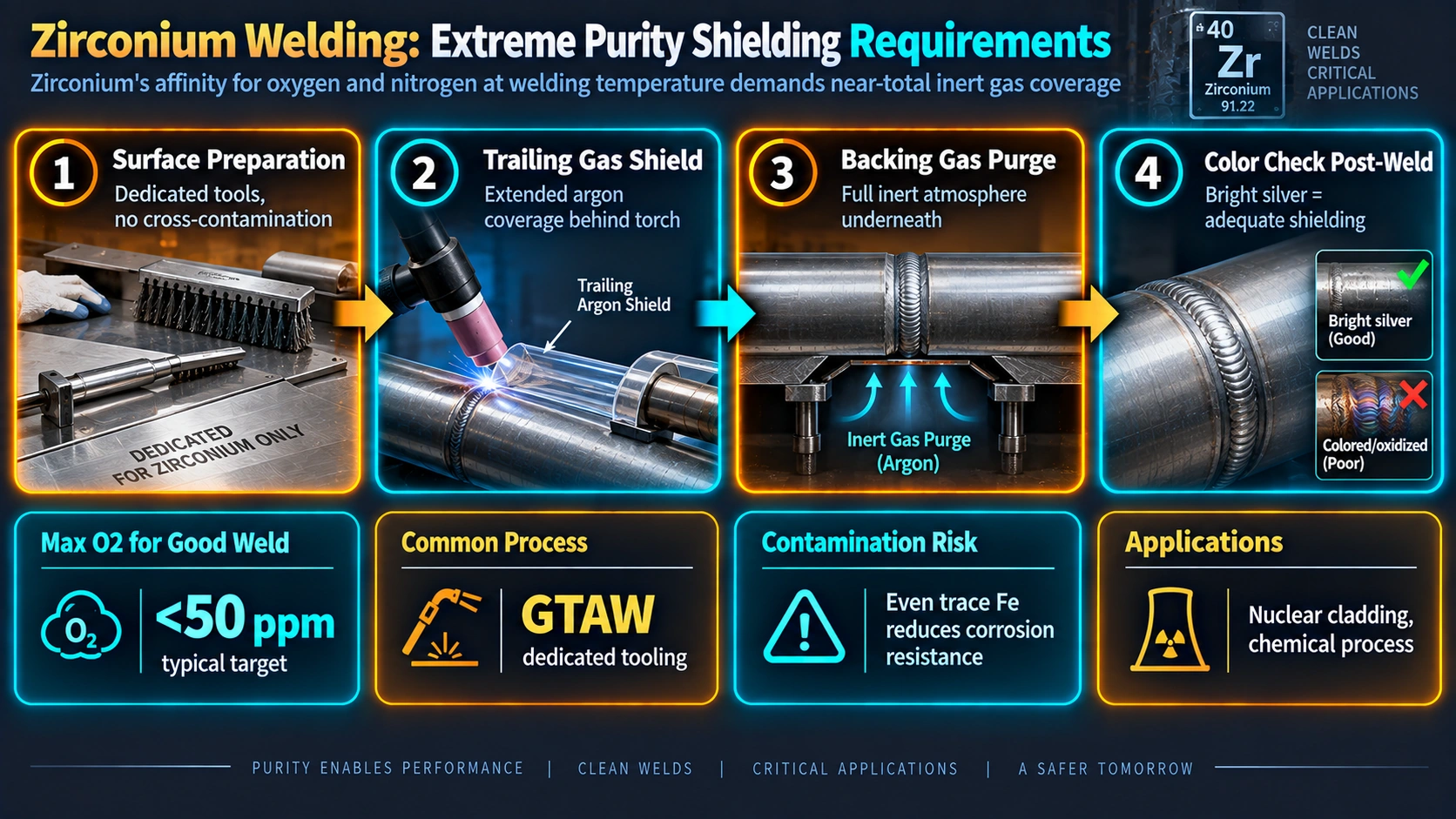
Zirconium (Zr, atomic number 40) is a lustrous, greyish-white transition metal with a density of 6.51 g/cm³ and a melting point of 1855°C. These physical properties make it attractive for high-temperature and corrosive service, but the metal’s defining characteristic — and the primary challenge for welders — is its extreme chemical reactivity above 200°C.
Below 200°C, zirconium is protected by a dense, adherent ZrO&sub2; oxide film that provides outstanding corrosion resistance. Above that threshold, this passivation breaks down and the bare metal absorbs oxygen, nitrogen, and hydrogen at a rate that increases dramatically with temperature. At welding temperatures (well above 1000°C in the arc zone), absorption is almost instantaneous. The dissolved gases occupy interstitial sites in the HCP crystal lattice, impeding dislocation movement and causing a rapid, severe increase in hardness and a corresponding collapse in ductility and impact toughness.
Mechanical and Physical Properties of Welding-Grade Zirconium Alloys
| Property | Zr702 (UNS R60702) | Zr705 (UNS R60705) | Zr706 (UNS R60706) |
|---|---|---|---|
| Min. Tensile Strength | 379 MPa (55 ksi) | 552 MPa (80 ksi) | 510 MPa (74 ksi) |
| Min. Yield Strength (0.2%) | 207 MPa (30 ksi) | 379 MPa (55 ksi) | 345 MPa (50 ksi) |
| Min. Elongation (%) | 16% | 16% | 20% |
| Zr + Hf content (min.) | 99.2% | 95.5% | 95.5% |
| Nb content | — | 2.0–3.0% | 2.0–3.0% |
| Thermal conductivity (W/m·K) | 22.7 | 18 | 18 |
| Coefficient of Thermal Expansion | 5.89 ×10&sup6;/°C | 5.89 ×10&sup6;/°C | 5.89 ×10&sup6;/°C |
| Weldability | Excellent | Good | Good |
| Primary Use | Chemical processing | Pressure vessels, piping | Tube/pipe (annealed) |
Zr702 is by far the most commonly welded grade. Its high zirconium content (minimum 99.2% Zr+Hf) delivers exceptional resistance to hydrochloric acid at all concentrations, sulphuric acid below 70% concentration, and most organic acids. Zr705’s niobium addition raises strength by approximately 50% compared to Zr702, making it the grade of choice where higher mechanical loads are combined with corrosive duty. The welding procedures for both grades are essentially identical in terms of atmosphere control — the metallurgical differences affect joint design and heat input but not shielding requirements.
Applicable Codes and Standards
The engineer qualifying a zirconium welding procedure must navigate several interlocking standards. Understanding which standard governs each element of the qualification and fabrication process prevents scope gaps and inspection failures.
| Standard | Scope | Key Requirement |
|---|---|---|
| ASME Section IX | WPS / PQR / WPQ qualification | P-Number 61 base metal; F-Number 61 filler |
| AWS A5.24 | Zirconium filler metal classification | ERZr2, ERZr3, ERZr4 electrode/rod classes |
| ASME SB-551 | Zr/Zr-alloy strip, sheet, plate | Chemical and mechanical property limits |
| ASME SB-523 | Zr/Zr-alloy seamless tubing | Dimensional and hydrostatic requirements |
| ASME SB-752 | Zr/Zr-alloy welded pipe | Radiographic exam of seam |
| ASME SB-550 | Zr/Zr-alloy bar and billet | Forging/machined component stock |
| ASTM B493 | Zr flanges | Forged flange dimensions and examination |
| ASME Section VIII Div. 1 | Pressure vessel design | Allowable stresses, UW rules for welded joints |
Welding Processes: What Works and What Does Not
Gas Tungsten Arc Welding (GTAW) — The Primary Process
GTAW (TIG welding) is the overwhelmingly preferred process for zirconium welding. Its characteristics make it uniquely suited to the metal’s demands: the low heat input is controllable, the arc is stable with pure argon shielding, and the process can be executed autogenously (without filler) for thin sections. The GTAW process is used for essentially all precision zirconium fabrication including heat exchanger tube-to-tubesheet joints, pipe butt welds, vessel nozzles, and sheet metal fabrication.
Orbital GTAW is extensively used in pharmaceutical and semiconductor-grade zirconium piping where consistency and repeatability are critical. Computer-controlled orbital welding heads maintain precise travel speed, current, and wire feed, reducing operator variability and enabling 100% inert atmosphere enclosure via chamber-type welding systems.
Plasma Arc Welding (PAW)
Plasma Arc Welding can be applied to zirconium in the keyhole mode for full-penetration welds in one pass on material up to 6mm thick. The advantage is higher travel speed and a narrow HAZ. However, PAW equipment is more complex and costly, and atmosphere control remains equally demanding. PAW is used in specialised applications where throughput is critical.
Electron Beam Welding (EBW) and Laser Beam Welding (LBW)
Electron beam welding is performed in high vacuum, which provides the ultimate solution to atmospheric contamination — there is no atmosphere to contaminate the weld. EBW of zirconium produces extremely narrow, deep welds with minimal HAZ and is used in nuclear fuel element fabrication and precision aerospace components. Laser beam welding (LBW) with local argon shielding chambers has also been successfully applied to zirconium, particularly for thin-walled components.
Processes Not Suitable for Zirconium
Shielding Gas: Purity and Application
Shielding gas selection and delivery is the single most critical variable in zirconium welding. Unlike stainless steel, where gas mixtures and even minor impurities are tolerable, zirconium has essentially zero tolerance for oxidising or nitriding contaminants in the shielding stream during welding.
Minimum Gas Purity Requirements
| Gas | Minimum Purity | Dew Point | Application |
|---|---|---|---|
| Argon (primary shield) | 99.999% (Grade 5.0) | < −50°C | Torch/cup shielding |
| Argon (trailing shield) | 99.999% (Grade 5.0) | < −50°C | Cooling weld & HAZ protection |
| Argon (backing/purge) | 99.999% (Grade 5.0) | < −50°C | Weld root protection |
| Helium (alternative) | 99.999% | < −50°C | Higher heat input applications |
Three Shielding Zones — All Mandatory
Unlike carbon or stainless steel GTAW where only the primary cup shielding is used routinely, zirconium welding requires simultaneous control of three distinct gas zones:
For complex assemblies such as heat exchanger tube sheets, glove box-type welding enclosures are used that purge the entire work zone with argon, allowing the welder to operate in a fully inert atmosphere. This approach is essential for multi-pass welds on thick sections where trailing shield geometry alone cannot protect all exposed hot surfaces.
Joint Preparation and Surface Cleanliness
Surface contamination before welding is as dangerous as atmospheric contamination during welding. Any organic or metallic contamination on or near the joint can diffuse into the weld metal during the thermal cycle, causing porosity, inclusions, or embrittlement. The preparation protocol for zirconium is therefore more stringent than for any common structural alloy.
Step-by-Step Joint Preparation Protocol
- Mechanical cleaning: Machine or grind joint faces using dedicated zirconium-only tools. Never use grinding wheels, files, or wire brushes that have been used on steel, stainless steel, copper, or titanium. Cross-contamination embeds foreign metal particles that cannot be removed by chemical cleaning alone.
- Degreasing: Wipe all joint surfaces and adjacent areas with acetone or methyl ethyl ketone (MEK) using clean, lint-free cloths. Work from the joint outward to avoid dragging contamination into the weld zone. Allow full solvent evaporation before proceeding.
- Chemical etching (optional but recommended): For critical applications, etch joint surfaces with a solution of 35% HNO&sub3; + 5% HF (balance water) for 30–60 seconds, then immediately rinse with clean deionised water and dry with dry nitrogen or argon. This removes the existing oxide film and surface contamination, exposing clean metal. Handle HF solutions only with appropriate PPE and trained personnel.
- Final rinse and dry: Rinse with reagent-grade acetone and blow dry with clean argon or dry nitrogen. Do not use compressed air, which introduces moisture and oil contamination.
- Glove handling only: After preparation, handle all surfaces with clean nylon or polyethylene gloves. Never touch joint surfaces with bare hands — skin oils and salt deposits cause porosity and discolouration.
Filler Wire Preparation
Filler wire must be degreased immediately before use with acetone, wiped with clean cloth, and stored in sealed, inert gas-purged containers between uses. Wire left exposed to shop atmosphere, even for a few hours, can absorb sufficient surface contamination to cause porosity. Never use wire that shows any discolouration or oxide film — remove and discard the affected portion. Filler wire should be cut from certified stock conforming to AWS A5.24.
GTAW Parameters for Zirconium
Tungsten Electrode Selection
Pure tungsten (EWP) electrodes are used for GTAW of zirconium when welding with AC. For DCEN (straight polarity) — which is used for most zirconium GTAW — 2% thoriated tungsten (EWTh-2) or 2% ceriated tungsten (EWCe-2) provides good arc stability, longer electrode life, and better current-carrying capacity. Ceriated tungsten is increasingly preferred to avoid the mild radioactivity associated with thorium.
Electrode diameter, geometry, and current range selection follows the same principles as for standard GTAW, adjusted for zirconium’s lower thermal conductivity compared to austenitic stainless steel. This means heat builds up more slowly initially but is retained longer in the HAZ — a consideration when setting interpass temperature limits.
GTAW Parameter Reference Table
| Material Thickness | Tungsten Dia. | Filler Rod Dia. | Current (DCEN) | Arc Voltage | Argon Flow (Cup) | Travel Speed |
|---|---|---|---|---|---|---|
| 0.5 mm | 1.0 mm | Autogenous | 10–25 A | 10–12 V | 8–10 L/min | 150–200 mm/min |
| 1.0 mm | 1.6 mm | 1.0–1.6 mm | 30–60 A | 11–13 V | 10–12 L/min | 120–180 mm/min |
| 2.0 mm | 1.6–2.4 mm | 1.6–2.4 mm | 60–100 A | 11–14 V | 12–15 L/min | 100–150 mm/min |
| 3.0 mm | 2.4 mm | 2.4 mm | 90–140 A | 12–15 V | 12–16 L/min | 80–130 mm/min |
| 6.0 mm | 3.2 mm | 2.4–3.2 mm | 150–220 A | 13–16 V | 15–20 L/min | 60–100 mm/min |
| 10.0 mm | 3.2–4.0 mm | 3.2 mm | 200–280 A | 14–17 V | 16–22 L/min | 50–80 mm/min |
Filler Metal Classification (AWS A5.24)
| AWS Classification | Composition | Matches Base Metal | Use |
|---|---|---|---|
| ERZr2 | Zr702 (99.2% Zr+Hf) | Zr702 | Chemical process equipment |
| ERZr3 | Zr704 (1.0–2.0% Sn) | Zr704 | Largely obsolete — legacy use |
| ERZr4 | Zr705 (2.0–3.0% Nb) | Zr705, Zr706 | Higher-strength applications |
When welding dissimilar zirconium grades (e.g., a Zr705 pipe to a Zr702 fitting), select the filler metal matching the lower-strength alloy to maintain ductility in the weld zone. Always confirm filler metal selection is within the approved essential variables of the qualified WPS per ASME P-Number and F-Number rules.
Weld Colour Chart: Interpreting Shielding Quality
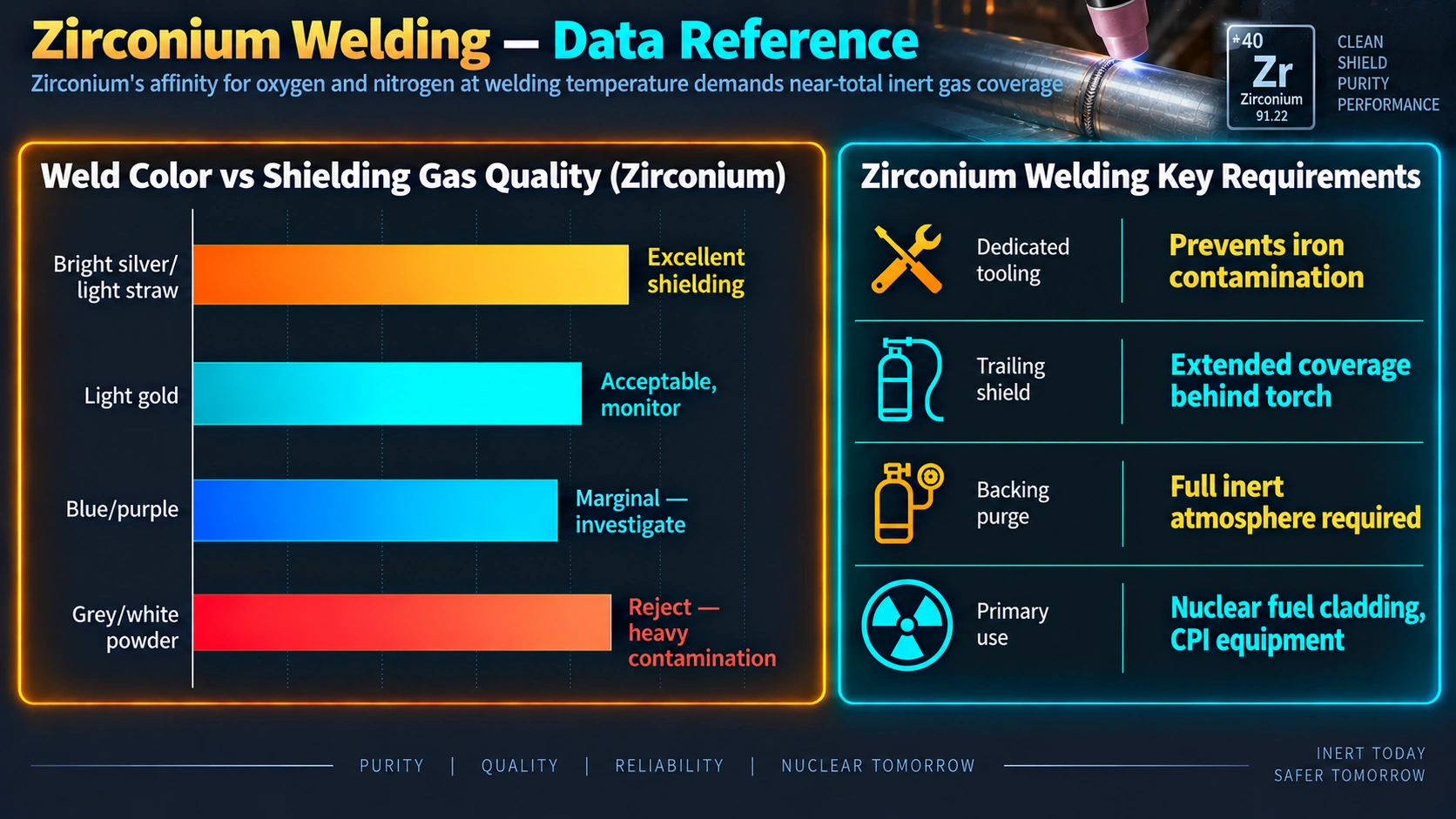
Visual examination of weld colour immediately after welding is the fastest and most reliable field indicator of shielding gas effectiveness. The oxide film thickness — controlled entirely by the degree of atmospheric contamination — produces characteristic interference colours. Every welder and inspector working on zirconium must be able to interpret these colours correctly and make the accept/reject decision confidently.
| Weld Colour | Oxide Condition | Contamination Level | Acceptance | Action Required |
|---|---|---|---|---|
| Silver / Bright | Minimal ZrO&sub2; film | Nil | ACCEPT | None — ideal result |
| Light Straw / Yellow | Thin oxide film | Very low | CONDITIONAL | Engineer review; may accept for non-critical duty |
| Gold / Dark Straw | Moderate oxide | Low–moderate | REJECT | Remove weld; investigate shielding system |
| Blue | Heavy oxide film | Significant O&sub2;/N&sub2; | REJECT | Remove weld; full shielding system review |
| Purple / Violet | Thick oxide + nitride | Heavy | REJECT | Remove weld; investigate gas supply and fittings |
| Dark Grey | Heavy ZrO&sub2; + ZrN | Very heavy | REJECT | Remove weld; complete system shutdown and re-qualification |
| White / Powdery | Bulk oxide / burning | Catastrophic | REJECT | Remove weld; re-qualify welder and all equipment |
Heat Input Calculation and Control
Heat input must be calculated and recorded for each pass as part of the WPS documentation and production weld records. For GTAW of zirconium, the standard heat input formula applies:
HI = (V × I × 60) / (TS × 1000)
Where:
HI = Heat Input (kJ/mm)
V = Arc Voltage (V)
I = Welding Current (A)
TS = Travel Speed (mm/min)
WORKED EXAMPLE — 3mm Zr702 Plate, Single-Pass Butt Weld:
V = 14 V, I = 120 A, TS = 120 mm/min
HI = (14 × 120 × 60) / (120 × 1000)
HI = 100,800 / 120,000
HI = 0.84 kJ/mm
Typical acceptable range for zirconium: 0.3 – 1.5 kJ/mm
Higher values increase HAZ width and shielding demand.
The TIG welding settings calculator on WeldFabWorld can help estimate starting parameters for a given material thickness. Note that zirconium’s lower thermal conductivity versus stainless steel means the heat builds up faster in thinner material — reduce current by approximately 10–15% compared to equivalent-thickness austenitic stainless starting parameters.
Zirconium vs. Titanium Welding: Key Differences
Both zirconium and titanium are reactive metals requiring identical principles of atmospheric exclusion. Engineers and inspectors experienced with titanium GTAW can adapt their skills to zirconium, but must understand the following critical differences:
| Parameter | Titanium (Gr. 2) | Zirconium (Zr702) | Implication |
|---|---|---|---|
| Reactivity with N&sub2; | High | Very High | Zr is more susceptible to nitrogen embrittlement |
| Melting point | 1670°C | 1855°C | Zr requires higher arc energy; longer cooling time |
| Thermal conductivity | 21.9 W/m·K | 22.7 W/m·K | Very similar — comparable heat distribution |
| Density | 4.51 g/cm³ | 6.51 g/cm³ | Zr is 44% heavier — affects support and distortion control |
| Colour chart (accept) | Silver/bright | Silver/bright only | Titanium accepts straw; zirconium is stricter |
| Code P-Number | P-51 (Ti) | P-61 (Zr) | Separate WPS qualification required for each |
| Primary corrosion advantage | Oxidising acids | Reducing acids (HCl, dilute H&sub2;SO&sub4;) | Different material selection criteria apply |
Weld Procedure Qualification (WPS/PQR)
Welding procedure qualification for zirconium follows ASME Section IX requirements with zirconium assigned to P-Number 61. A qualified WPS for P-61 does not qualify welding on titanium (P-51), tantalum, or other reactive metals. The following essential variables apply specifically to zirconium under ASME IX:
- Base metal P-Number (P-61 to P-61 only in most cases)
- Filler metal F-Number (F-61) and AWS classification
- Welding process (GTAW is typically process-specific)
- Shielding gas type, purity, and flow rate range
- Backing gas type and purity
- Current type and polarity (DCEN for zirconium GTAW)
- Heat input range (kJ/mm, or individual V × A × TS ranges)
- Joint design and groove geometry
- Position qualification (1G/2G/5G/6G as applicable)
The PQR test assembly must undergo the standard mechanical testing battery: tensile test, guided bend test (face and root), and for pressure-containing applications, Charpy impact testing where required by the design code. Weld metal hardness testing is often added as a supplementary requirement to confirm the absence of embrittlement from contamination.
Post-Weld Examination and Testing
Visual and Colour Examination
Every zirconium weld must receive a 100% visual examination immediately after welding, before any cleaning or further processing. The colour chart criteria described earlier apply. Any weld showing gold, blue, purple, grey, or white colouration must be rejected, removed, and re-welded after the shielding system defect is identified and corrected.
Liquid Penetrant Testing (PT)
Liquid penetrant testing is the standard surface examination method for zirconium welds. PT is highly effective for detecting surface-breaking cracks, porosity, and lack of fusion. Use only PT systems formulated for compatibility with zirconium — some penetrant chemicals can leave halogen (chloride, fluoride) residues that cause stress corrosion cracking in service. Water-washable or solvent-removable PT systems with low-halogen content are specified. Confirm residual halogen content meets the application limit (typically <200 ppm Cl, <100 ppm F for chemical service).
Radiographic Testing (RT)
Full-penetration butt welds in pressure-containing zirconium components are typically subjected to radiographic testing as specified by ASME Section VIII or the applicable piping code. RT is effective for detecting internal porosity, lack of fusion, inclusions, and cracking. Zirconium’s high density (6.51 g/cm³) requires higher-energy X-ray sources or iridium-192 gamma sources for adequate penetration compared to aluminium, but is similar to or easier than steel of comparable thickness.
Ultrasonic Testing (UT)
Ultrasonic testing can be applied to thicker zirconium sections and welds. Calibration blocks of the same alloy and heat treatment condition are required because zirconium’s acoustic velocity and attenuation differ from common calibration block materials. PAUT (Phased Array UT) has been applied successfully to zirconium pressure vessel welds where RT is impractical.
Common Defects and Troubleshooting
| Defect / Symptom | Probable Cause | Corrective Action |
|---|---|---|
| Blue/purple weld colour | Insufficient trailing shield coverage; gas leak in hose or fitting | Check all fittings for leaks; extend trailing shield length; increase trailing shield flow |
| White powdery weld | Complete shielding failure; gas contamination (wrong gas, wet gas) | Verify gas supply, replace hoses, re-qualify equipment; check dew point |
| Porosity (fine) | Surface contamination (oil, moisture); hydrogen in base metal or filler | Increase degreasing rigor; etch joint faces; use fresh, dry filler wire |
| Porosity (coarse) | Moisture in shielding gas; contaminated backing purge | Check gas cylinder dew point; purge all lines; replace supply hoses |
| Cracking (HAZ) | Contamination embrittlement; excessive heat input; high restraint | Verify shielding quality; reduce heat input; use pre-heat or stress relief |
| Lack of fusion | Oxide film not broken; current too low; wrong joint prep | Increase current; check arc length; verify joint cleanliness |
| Tungsten inclusions | Tungsten electrode contact with weld pool; current too high for electrode dia. | Dress electrode; reduce current or increase electrode size; check arc length |
Zirconium in Chemical Process Equipment: Application Context
The primary commercial driver for zirconium fabrication is its unmatched resistance to reducing acid environments. This makes it the material of first choice in the following chemical process industries:
- Acetic acid production: Zirconium heat exchangers and distillation column internals resist acetic acid at all concentrations and elevated temperatures where stainless steels suffer crevice and pitting corrosion. Corrosion rates measured in microns per year compared to millimetres per year for 316L SS.
- Hydrochloric acid handling: Zirconium is resistant to HCl at all concentrations below 50°C, and to dilute HCl at elevated temperatures. Used in HCl absorbers, heat exchangers, and piping in chlor-alkali and pharmaceutical plants.
- Sulphuric acid service: Resistant to H&sub2;SO&sub4; up to approximately 70% concentration across a wide temperature range. Used in heat exchangers and piping where titanium would absorb hydrogen.
- Nuclear industry: Zircaloy fuel rod cladding exploits both the corrosion resistance and the extremely low neutron absorption cross-section of zirconium (0.18 barns vs. 2.4 barns for stainless steel).
- Pharmaceutical: Ultrahigh-purity zirconium piping systems where product contamination from metallic ions must be eliminated.
Recommended Books on Zirconium and Reactive Metal Welding
Disclosure: WeldFabWorld participates in the Amazon Associates programme (StoreID: neha0fe8-21). If you purchase through these links, we may earn a small commission at no extra cost to you. This helps support free technical content on this site.
Safety Considerations in Zirconium Welding
Zirconium presents specific safety hazards that welders and supervisors must address in the risk assessment and method statement before commencing work:
Zirconium Dust and Fume Fire Risk
Zirconium metal fines, swarf, and fine dust are classified as flammable and in certain particle sizes can be pyrophoric (self-igniting in air). Grinding or machining operations must be performed with adequate ventilation and using wet methods where possible. Do not allow zirconium grinding dust to accumulate on work surfaces or in ventilation systems. Zirconium fume from welding is generally considered lower risk than some other heavy metals, but local exhaust ventilation should be used as standard practice to comply with occupational exposure limits.
HF Acid Handling (Etching)
If hydrofluoric acid is used for surface preparation, it must be handled strictly in accordance with COSHH assessments and appropriate emergency response plans. HF causes deep tissue burns that are not immediately painful due to localised nerve damage, making them particularly dangerous. Calcium gluconate antidote gel must be on hand whenever HF is used. Many fabricators substitute mechanical and solvent cleaning procedures to eliminate HF handling entirely.
Argon Asphyxiation Hazard
The large argon gas flows used for primary shielding, trailing shields, and purge systems in confined spaces can displace oxygen to dangerously low levels without any visible or olfactory warning. Before entering any vessel or confined space where argon purging has been used, verify oxygen levels with a calibrated gas monitor. Maintain continuous monitoring and ventilation during confined space entry. Purge gas must not be allowed to accumulate in enclosed spaces or trenches.
Frequently Asked Questions
Why must zirconium be welded in an inert atmosphere?
Above 200°C, zirconium reacts aggressively with oxygen, nitrogen, and hydrogen present in air. These gases dissolve interstitially into the metal lattice, causing severe embrittlement. Oxygen and nitrogen form hard, brittle oxide and nitride phases that drastically reduce ductility and toughness. Even small contamination levels — parts per million — can cause weld cracking and field failures. Full inert gas shielding of the weld pool, hot zone, and weld root is therefore mandatory, not optional.
What shielding gas is used for welding zirconium?
Only pure argon (99.999% minimum purity, Grade 5.0) or helium is acceptable for welding zirconium. Argon is most common due to cost and availability. Helium produces a hotter arc and is used where deeper penetration or higher travel speed is required. Gas mixtures containing CO&sub2;, oxygen, or nitrogen — widely used for carbon and stainless steel — are completely prohibited and will cause catastrophic contamination. Trailing shields and backing purge systems must also use the same purity argon.
How do you interpret zirconium weld colours after GTAW?
Weld colour is the primary field indicator of shielding quality. Silver-bright or shiny grey indicates excellent shielding and an acceptable weld. A light straw or gold tint indicates borderline shielding — the weld may be acceptable depending on application. Blue, purple, grey-blue, or dark colours indicate contamination from oxygen or nitrogen and the weld must be rejected and removed. White powdery deposits confirm heavy oxidation and represent complete shielding failure. The colour chart parallels that used for titanium but the contamination thresholds for zirconium are similarly strict.
Can you use the same equipment for welding zirconium and stainless steel?
No. Dedicated, segregated tooling and equipment must be used for zirconium. Grinding wheels, wire brushes, files, and clamps previously used on stainless steel or carbon steel can embed iron, chromium, or nickel particles into zirconium surfaces, causing galvanic corrosion and weld defects. Stainless steel wire brushes are absolutely prohibited — only clean zirconium or titanium-specific brushes are permitted. Equipment cross-contamination is one of the most common causes of zirconium weld failure in shop environments.
Which ASME codes and AWS standards apply to zirconium welding?
ASME Section IX governs welding procedure and welder performance qualification for zirconium, with the base metal assigned to P-Number 61. Filler metals fall under AWS A5.24 (Zirconium and Zirconium Alloy Bare Welding Rods and Electrodes). ASME SB-551 covers zirconium and zirconium alloy strip, sheet and plate, while SB-523 covers seamless tubes. For pressure equipment, ASME Section VIII Division 1 and Division 2 apply. Nuclear applications are governed by ASTM B811 and ASTM B353 alongside NRC regulations.
What is the difference between Zr702 and Zr705 for welding purposes?
Zr702 is commercially pure zirconium (99.2% Zr minimum) offering the best corrosion resistance and excellent weldability. It is the most commonly welded grade in chemical processing equipment. Zr705 is a niobium-alloyed grade (2–3% Nb) that offers roughly 50% higher strength than Zr702, allowing thinner wall sections for equivalent pressure ratings. Zr705 is slightly more difficult to weld due to higher alloy content but remains readily weldable with GTAW. Both grades require the same stringent shielding protocols. Zr704 (1.0–2.0% Sn) is now largely obsolete in new construction.
Is post-weld heat treatment required for zirconium welds?
Post-weld heat treatment (PWHT) of zirconium is not routinely required for most chemical process applications. However, stress relief annealing may be specified for highly restrained joints or where dimensional stability is critical. When performed, annealing is typically carried out at 540–620°C in a vacuum furnace or under very high-purity inert gas atmosphere. Conventional open-air furnace heat treatment is not acceptable as it would cause severe oxidation. Some nuclear cladding applications specify recrystallisation annealing to restore ductility and corrosion resistance in the HAZ.
What non-destructive testing methods are used for zirconium welds?
Liquid penetrant testing (PT) is the primary surface examination method for zirconium welds and is effective for detecting surface cracks, porosity, and lack of fusion. Radiographic testing (RT) is used for volumetric examination of butt welds in pressure-containing components. Ultrasonic testing (UT) can be applied but requires zirconium-specific calibration blocks due to the different acoustic properties of the material. Magnetic particle testing (MT) is not applicable as zirconium is non-magnetic. Visual examination with attention to weld colour remains the most critical first-line quality check on any zirconium weld.