Lockout Tagout (LOTO) Procedure for Welding Operations
Lockout tagout for welding operations gets less daily attention than fire watch or PPE, largely because most routine manual welding never touches a locked-out machine. That changes the moment welding intersects with equipment maintenance: robotic welding cells, resistance welders, positioners and manipulators, and any piping system that might still hold residual pressure or hazardous material. In these situations, LOTO is not a general industrial safety topic borrowed from another trade, it is a direct precondition for the welding work being safe to perform at all.
This guide focuses specifically on how lockout tagout applies inside welding and fabrication environments: what energy sources typically need isolating on welding-related equipment, how the LOTO sequence runs in practice, how group lockout works on extended shutdown jobs, and the non-conformances that show up most often when this overlaps with hot work. It complements our Hot Work Permit System guide and Confined Space Welding Safety Guide, since these three controls frequently apply to the same job simultaneously.
Why LOTO Matters in Welding-Adjacent Work
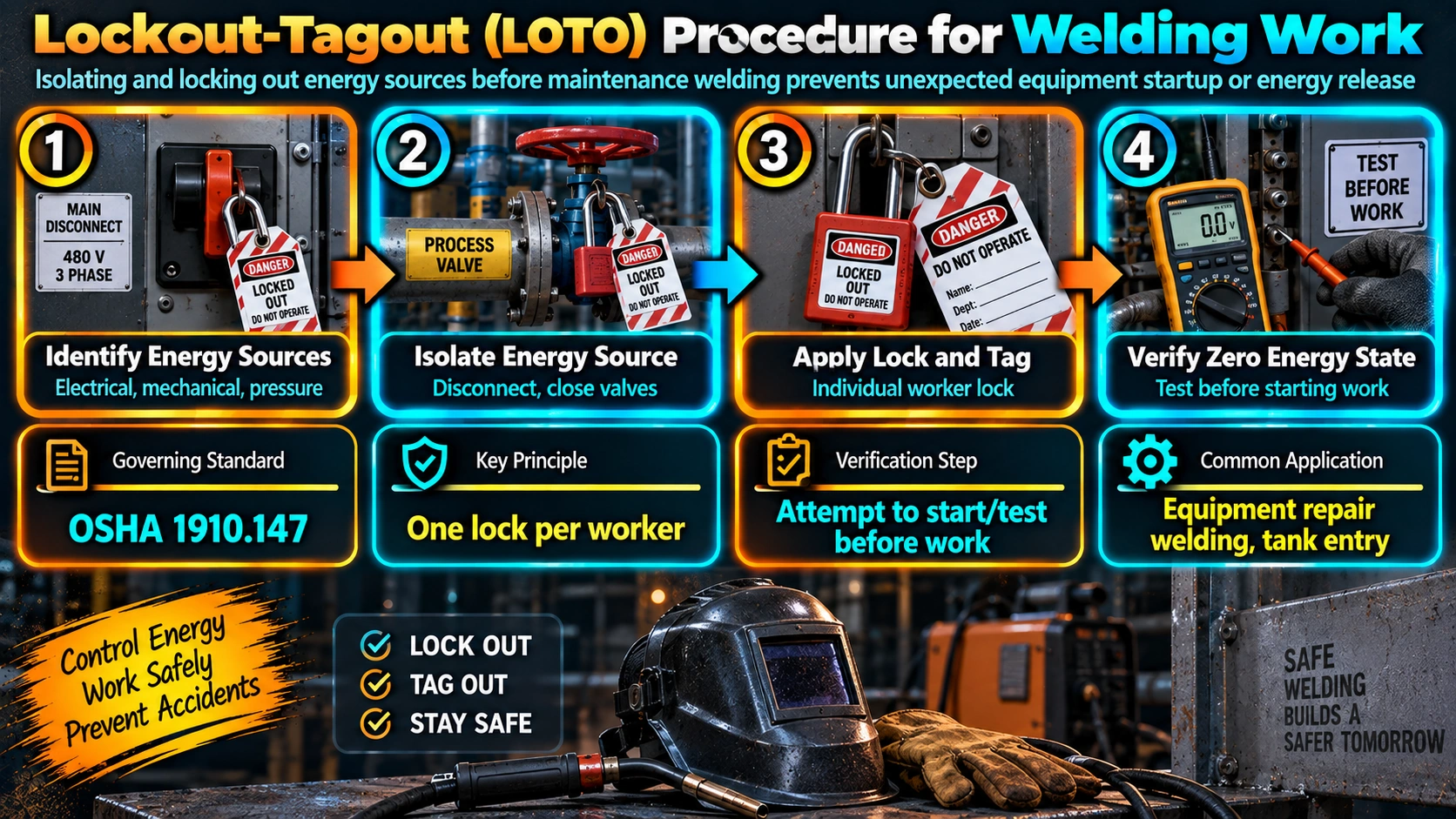
Welding is often thought of as a manual, standalone task, but a large share of industrial welding happens directly on or near machinery: robotic welding cells being serviced, resistance spot welders undergoing maintenance, positioners and manipulators being repaired, and piping systems being repaired in place. Each of these carries hazardous energy that has nothing to do with the welding arc itself, electrical, pneumatic, hydraulic, or mechanical, and that energy must be controlled independently of any welding-specific safety measure.
The Core LOTO Sequence Applied to Welding Equipment
| Step | Action | Welding-Specific Note |
|---|---|---|
| 1 | Prepare and notify affected employees | Includes welders and helpers working nearby, not just the technician doing the isolation |
| 2 | Shut down equipment using normal stopping procedure | Robot controllers, resistance welder control panels, positioner drive systems |
| 3 | Isolate all energy sources | Electrical disconnect, compressed air shutoff, hydraulic isolation valve |
| 4 | Apply lockout devices and individual locks | Each authorised worker applies their own lock; no shared or borrowed locks |
| 5 | Release or block stored/residual energy | Bleed trapped air pressure, block elevated positioner arms, drain piping |
| 6 | Verify zero-energy state | Attempt normal start controls with lock in place to confirm no response |
Energy Sources Specific to Welding Equipment
| Equipment Type | Typical Energy Sources |
|---|---|
| Robotic welding cell | Electrical (robot controller, welding power source), pneumatic (grippers, fixtures), hydraulic (positioners), mechanical (gravity-loaded arms) |
| Resistance spot / seam welder | Electrical supply, hydraulic or pneumatic ram pressure, stored spring energy in older mechanical designs |
| Positioners and manipulators | Electrical drive motors, hydraulic or pneumatic actuation, gravitational energy from elevated or tilted loads |
| Piping and process equipment | Residual pressure, trapped hazardous fluid or gas, thermal energy from process heat, electrical instrumentation |
| Manual welding power sources | Primary electrical supply; typically simpler but still requires disconnect verification for internal maintenance |
Welding on Piping and Process Equipment
Welding repairs on piping systems introduce a particular hazard: the pipe itself may still contain residual pressure, hazardous chemicals, or trapped gas even after upstream valves are closed. This scenario requires isolation of the relevant valves, draining or venting of residual material, and verification of a genuine zero-energy state before a hot work permit is issued for any welding or cutting on that line.
- Positive isolation, such as a spade blank or physical disconnection, is generally preferred over a closed valve alone, since valves can leak or be reopened inadvertently.
- Confirm the line has actually been drained and vented, not just isolated, before assuming it is safe for hot work.
- Where the piping also sits inside a confined space, both LOTO and confined space entry controls apply together; see our Confined Space Welding Safety Guide for the atmospheric testing side of that overlap.
Group Lockout for Extended Welding Shutdowns
Multi-day shutdown work, common in turnaround maintenance involving welding repairs on process piping or vessels, often involves several workers and shifts on the same isolated equipment. Rather than each individual applying a personal lock directly onto the isolating device, a group lockbox or hasp is used: the isolating device is locked with a single lock controlled by the group lockbox, and every individual worker then applies their own personal lock to that box.
Zero-Energy Verification
Who Can Remove a Lock
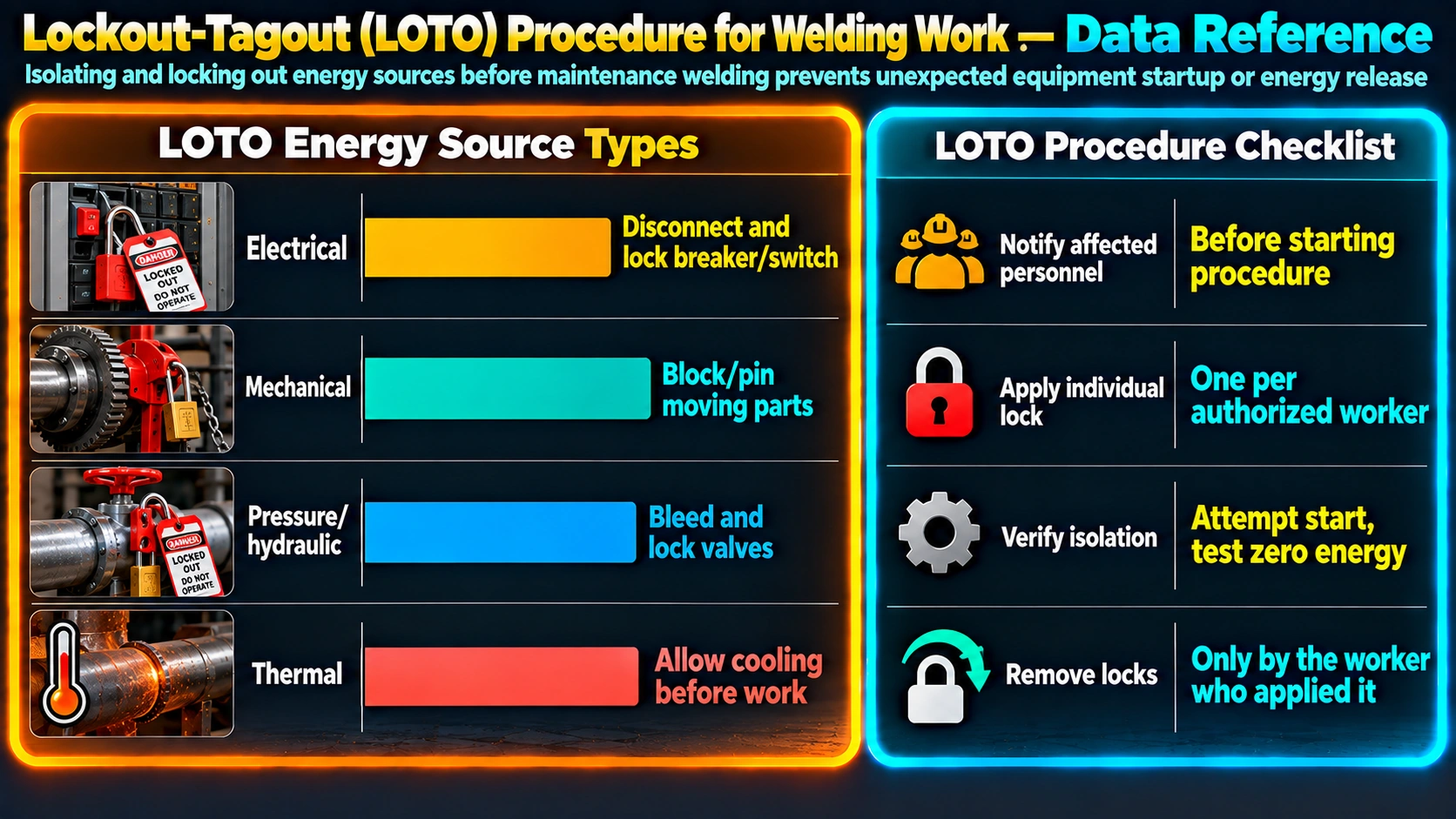
As a firm general rule, only the worker who applied a personal lock and tag may remove it. If that person is genuinely unavailable, for example at the end of a shift without handover, a specific, documented procedure for third-party lock removal applies, requiring verification that the original worker is not still exposed and explicit supervisor authorisation. This is not a shortcut for convenience; it exists specifically for the rare case where the normal process cannot be followed, and it must be treated as an exception, not a routine practice.
Training: Authorised vs. Affected Employees
| Role | Training Requirement |
|---|---|
| Authorised employee | Trained to identify energy sources, apply and remove locks, and verify zero-energy state Full LOTO training |
| Affected employee | Trained to recognise lockout devices and understand that locked equipment must never be operated Awareness-level training |
| Welder working nearby (not applying locks) | Affected-employee training at minimum; must know to report a missing tag or discrepancy immediately Mandatory even if not applying locks |
Common Non-Conformances in Welding-Related LOTO
- Electrical disconnect locked out, but hydraulic or pneumatic energy left uncontrolled on the same machine.
- A lock applied to a hasp that was never actually connected to a functioning isolating device.
- Zero-energy verification skipped entirely, relying on the lock being present as sufficient proof of isolation.
- Group lockbox lock removed by a supervisor without confirming every individual worker’s lock was already off.
- Welding hot work permit issued on piping without confirming positive isolation and full drain of residual material.
Amazon Picks for LOTO and Welding Safety Programs
Lockout Tagout Padlock and Hasp Set
A colour-coded personal lockout padlock and hasp kit suited to isolating multiple energy points on welding and fabrication equipment.
View on AmazonGroup Lockbox for Shutdown Work
A group lockout box used to manage multiple personal locks during extended shutdown or turnaround maintenance jobs.
View on AmazonControl of Hazardous Energy Reference Guide
A practical reference on building and auditing a hazardous energy control program for industrial maintenance and fabrication sites.
View on AmazonPressure Gauge for Isolation Verification
A calibrated gauge useful for confirming zero residual pressure on piping and hydraulic systems before hot work begins.
View on AmazonDisclosure: WeldFabWorld participates in the Amazon Associates programme (StoreID: neha0fe8-21). If you purchase through these links, we may earn a small commission at no extra cost to you. This helps support free technical content on this site.
Frequently Asked Questions
Why does lockout tagout apply to welding equipment specifically?
Welding equipment stores or transmits multiple forms of hazardous energy beyond the electrical supply, including compressed shielding gas, hydraulic or pneumatic pressure in positioners, and stored mechanical energy in resistance welders and robotic cells. Whenever a worker needs to work on this equipment in a state where unexpected startup or energy release could cause injury, lockout tagout applies the same way it would to any other industrial machine.
What energy sources need to be isolated on a robotic welding cell?
A typical robotic welding cell has several energy sources requiring isolation: electrical power to the controller and welding power source, compressed air supplying grippers or positioners, hydraulic pressure for hydraulic positioners, and stored mechanical energy in spring-loaded or gravity-loaded fixtures. Each needs its own isolating device identified, locked, and verified before anyone enters the cell for maintenance.
Does lockout tagout apply to welding on live or energized piping systems?
Yes, and this is one of the more hazardous applications of LOTO in welding work. Welding on piping that may still contain residual pressure or hazardous material requires isolation of the relevant valves, draining or venting of residual material, and verification of a zero-energy state before any hot work permit is issued, in addition to standard electrical lockout on the welding equipment itself.
What is group lockout and when is it used in welding operations?
Group lockout is used when multiple workers need to work on the same isolated equipment over an extended period, such as a multi-day shutdown involving welding repairs. A group lockbox or hasp is used, and each worker applies their own personal lock to the box, ensuring energy cannot be restored until every individual lock has been removed.
Who is authorised to remove a lockout tagout device applied by another worker?
As a general rule, only the worker who applied a personal lock and tag may remove it. If unavailable, a documented, site-approved procedure for third-party lock removal can be used, requiring verification that the original worker is safe and a specific supervisor authorisation. Removing someone else’s lock without this procedure is a serious safety violation regardless of urgency.
How is a zero-energy state verified before welding work begins?
Verification typically involves attempting to start the equipment using its normal controls after lockout devices are applied, confirming no response, then returning the controls to neutral. For stored energy, verification also includes checking gauges read zero and confirming components are physically blocked or lowered to a safe position, not just relying on the isolating device being locked.
Does a welder need LOTO training even if they never personally apply a lock?
Yes. Any worker who could be affected by lockout tagout activity, including a welder working near equipment being serviced by someone else, needs training on recognising lockout devices and understanding that locked equipment must never be operated. Only workers who apply and remove locks themselves need the fuller authorised-employee training, but affected-employee training is mandatory for everyone working nearby.