Coating Application Weather Restrictions and Limitations
Coating application weather restrictions are not a formality on a project specification — they are the single largest controllable variable standing between a coating system that lasts its full design life and one that fails within months. Temperature, humidity, wind, and precipitation each act directly on the wet film during application and through the early hours of cure, and a specification-critical coating applied outside its rated environmental window will often look perfectly acceptable at handover while already carrying the seeds of premature failure.
This guide sets out the full framework of environmental restrictions that govern coating application in industrial, marine, and structural steel work: minimum and maximum application temperatures by coating chemistry, wind speed limits for spray and blast operations, rain and precipitation protocols, and the forecast-based go/no-go decision process referenced in specifications built around SSPC-PA 1 and ISO 12944-7. Dew point and relative humidity calculation is covered in depth in WeldFabWorld’s dedicated painting environmental calculation guide — this article focuses on the broader restriction framework around that single check.
If you are responsible for scheduling, supervising, or inspecting coating work — whether as a QA/QC engineer, coating inspector, or site supervisor — the goal is the same: know which conditions stop work before the shift starts, not after a defect shows up in service.
Why Weather Governs Coating Performance
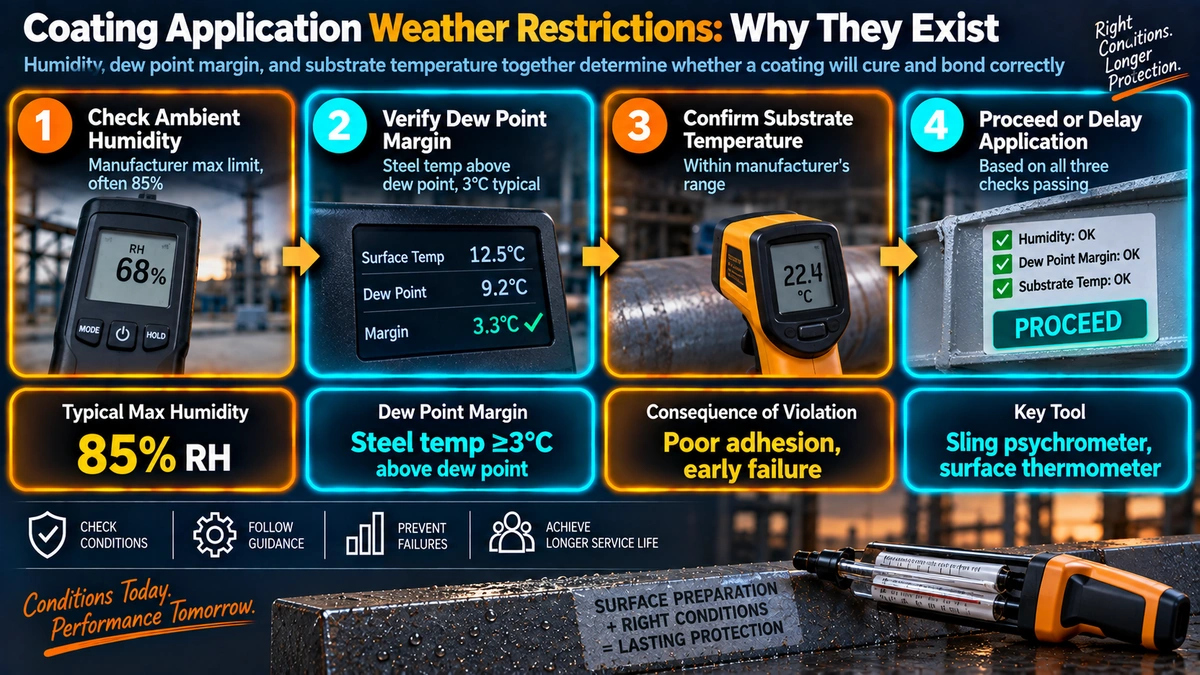
Every coating cures through a chemical or physical process that is directly sensitive to ambient conditions. Two-component epoxies and polyurethanes cure through a crosslinking reaction between resin and hardener that is temperature-dependent — the reaction slows as temperature falls and can effectively stall below the product’s rated minimum. Water-based acrylics cure by solvent (water) evaporation, which is suppressed by high humidity and halted entirely by freezing. Moisture-cure urethanes and inorganic zinc silicates work in the opposite direction, consuming atmospheric moisture as part of the cure reaction, so unusually dry air can be just as much a problem as excess humidity.
Layered on top of the cure chemistry is the physical risk of condensation. Whenever the temperature of the steel substrate falls to or below the dew point of the surrounding air, moisture condenses on the surface. This is invisible in its early stages, forms even on freshly blasted steel, and prevents proper wetting and adhesion of the primer coat regardless of how clean the surface appeared moments before.
Temperature Windows by Coating Chemistry
The single most common cause of premature coating failure traced back to weather is application below the manufacturer’s minimum rated temperature. Every coating chemistry behaves differently, and treating “cold weather” as a single universal rule is one of the most frequent mistakes on multi-coat systems that combine, for example, an inorganic zinc primer with an epoxy intermediate and a polyurethane topcoat.
| Coating Chemistry | Typical Min. Temp. | Typical Max. Temp. | Humidity Behaviour | Notes |
|---|---|---|---|---|
| Epoxy (solvent-based, standard) | 10°C (50°F) | 40°C (104°F) | Sensitive | Amine blush risk above 85% RH; slow cure below minimum |
| Epoxy (high-solids / low-temp cure) | 4-5°C (40°F) | 40°C (104°F) | Sensitive | Confirm exact rating on current PDS — varies by curing agent |
| Aliphatic polyurethane topcoat | 10°C (50°F) | 35°C (95°F) | Sensitive | Isocyanate reacts with atmospheric moisture; avoid high RH |
| Inorganic zinc silicate | 5°C (41°F) | 40°C (104°F) | Needs moisture | Moisture-cure; will not cure properly below ~30-40% RH |
| Moisture-cure urethane | 0 to 5°C (32-41°F) | 35°C (95°F) | Needs moisture | Cure rate depends directly on ambient humidity level |
| Acrylic (water-based) | 10°C (50°F) | 35°C (95°F) | Sensitive | Flash-freeze risk if temp drops below ~5°C within 4 hrs of application |
| Alkyd (solvent-based enamel) | 10°C (50°F) | 40°C (104°F) | Tolerant | Less humidity-sensitive but rain protection still required |
| Powder coating (thermoset) | Ambient not critical | N/A | Tolerant | Cured in oven; substrate must be dry before application |
These figures are typical industry ranges, not universal constants. Always confirm the current product data sheet (PDS) for the specific batch and manufacturer being used, since low-temperature-cure variants, accelerated hardeners, and regional formulations can shift the minimum by several degrees in either direction. Where a multi-coat system mixes chemistries — a common configuration on structural steel and piping — the controlling restriction is always the most conservative one across all coats in the system, not just the primer or the topcoat in isolation.
Substrate Temperature vs. Ambient Air Temperature
Substrate (steel surface) temperature and ambient air temperature are not the same reading and frequently diverge — a steel plate in direct sun can run 15-20°C above shaded ambient air, while overnight-exposed steel can sit well below the surrounding air temperature during a cold morning shift. Coating specifications require both readings, taken independently with a contact or infrared surface thermometer for the steel and a calibrated air thermometer or combined psychrometer for ambient conditions. It is the substrate temperature, not ambient air, that determines the dew point margin check described in the next section.
Relative Humidity and Dew Point Margin
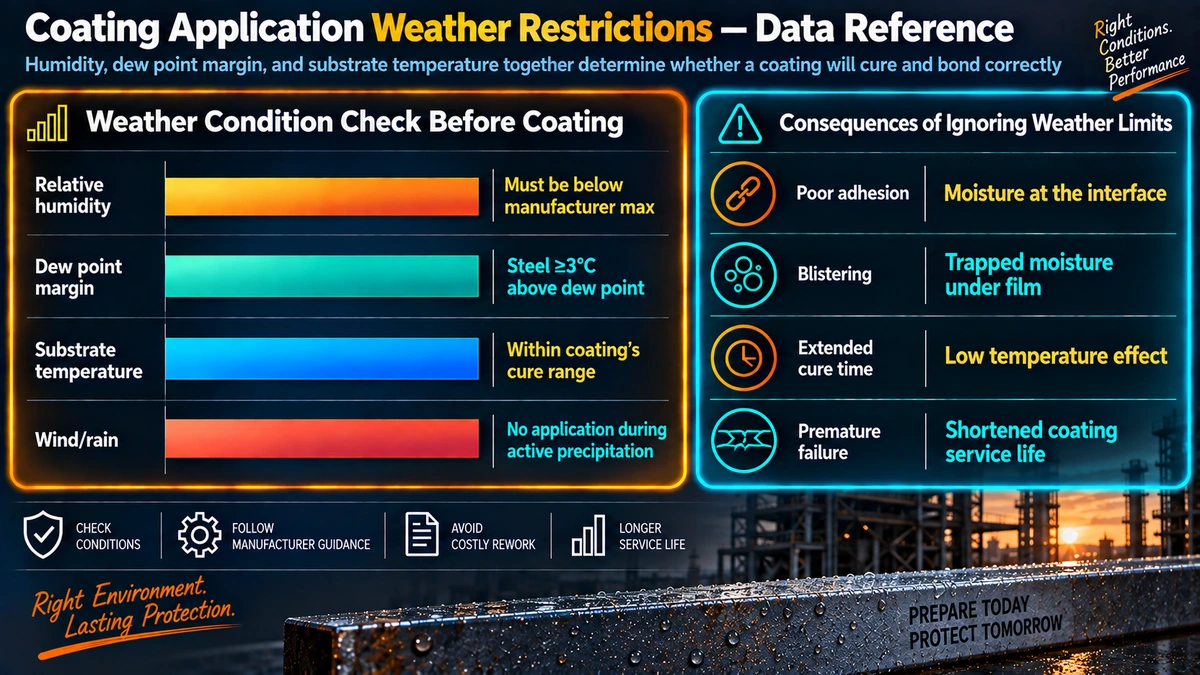
Relative humidity above roughly 85% is prohibited under most industrial coating specifications, primarily because it slows solvent evaporation from the wet film and increases the likelihood that the steel surface will sit close to or below the dew point at some point during the application and cure window. The controlling check used in the field is the dew point margin: substrate temperature must remain at least 3°C (5°F) above the calculated dew point throughout application and the specified early cure period.
T_steel ≥ T_dewpoint + 3°C (5°F) // minimum required margin per ISO 8502-4 / SSPC guidance
Step 2 — Worked example
Air temperature = 22°C, Relative Humidity = 78% → Dew point ≈ 17.8°C
Minimum acceptable steel temperature = 17.8 + 3 = 20.8°C
Measured steel surface temperature = 19.5°C
Result: DO NOT COAT — steel is 1.3°C below the required margin
Step 3 — Corrective options
Wait for ambient conditions to change, or heat the steel surface (induction, forced air) until the margin is restored, then re-verify before starting.
For the full psychrometric derivation, wet/dry bulb method, and an interactive calculation tool, see WeldFabWorld’s dedicated dew point and humidity calculation article for painting operations — this article treats the dew point margin as one input into the broader weather restriction framework rather than deriving the calculation from first principles again here.
Wind Speed Limits for Spray and Blast Operations
Wind affects coating and surface preparation work in two distinct ways: it degrades the quality and control of the operation itself, and it creates an environmental and safety hazard through overspray drift or airborne abrasive and dust. Both effects are addressed separately in most specifications, and the applicable limit depends on the specific operation and whether it is shielded.
| Operation | Typical Max. Wind Speed (Open Air) | Primary Concern | Shielded / Tented |
|---|---|---|---|
| Conventional air spray | ~15-20 km/h (10-12 mph) | Overspray drift, uneven build | Higher limits possible with wind screens |
| Airless spray | ~20-24 km/h (12-15 mph) | Atomized drift, dry spray | Higher limits possible inside enclosures |
| Abrasive blast cleaning | ~24-32 km/h (15-20 mph) | Dust/abrasive carry, visibility, safety | Full containment removes most restriction |
| Brush / roller application | Not typically wind-restricted | Minimal drift risk | N/A |
Rain and Precipitation Protocols
Rain is treated as an absolute stop condition in essentially every coating specification, both during application and for a defined period afterward while the film is still curing. The practical protocol breaks into three distinct situations, each with a different response.
Before Application: Blasted Surface Exposure
A freshly abrasive-blasted surface has no protective oxide layer and will begin to flash rust on contact with any moisture — rain, fog, or dew. If rain reaches an uncoated blasted surface, the area must be re-inspected against the applicable flash rust visual standard and re-blasted or otherwise re-cleaned if any rust bloom is present, regardless of how long ago the rain occurred or how the surface looks from a distance.
During Application: Immediate Stop
Coating application stops immediately if rain begins, and equipment and freshly coated surfaces should be protected with tarpaulins or tenting wherever unexpected showers are a realistic risk, particularly on exterior structural steel and pipeline work. A wet film struck by rain before it has developed skin-over resistance will show washout, pinholing, gloss loss, or in severe cases complete removal of the coating from the substrate.
After Application: Minimum Cure-Before-Rain Window
Most product data sheets specify a minimum period the film must cure before it can tolerate rain contact without damage — commonly in the range of 4 to 8 hours depending on the chemistry and ambient temperature, though this window extends significantly in cold conditions. Forecast-based scheduling should treat this window as a hard constraint: if rain is forecast within the minimum cure-before-rain period, application should not begin.
Seasonal and Specification-Driven Shutdown Criteria
Beyond day-to-day environmental checks, many projects — particularly in temperate and continental climates — define a formal seasonal coating shutdown period during which exterior coating work is suspended entirely, resuming only once average daily temperatures reliably clear the coating system’s minimum rating. This is common on structural steel erection projects that span a full construction season and is typically built into the project schedule rather than decided shift by shift.
| Standard / Reference | What It Covers |
|---|---|
| SSPC-PA 1 | Shop, field, and maintenance painting of steel — application methods and environmental practice |
| ISO 12944-7 | Execution and supervision of paint work, including environmental condition control during application |
| ISO 8502-4 | Assessment of the probability of condensation prior to paint application (dew point method) |
| ASTM D3276 | Standard guide for painting inspectors covering environmental monitoring practice |
| NACE / AMPP SP0178 | Fabrication details, surface finish, and coating requirements for tanks and vessels in immersion service |
Cold-weather work is sometimes still performed outside the general shutdown window using heated enclosures, temporary tenting, or forced-air heating to bring the local substrate and air temperature into the acceptable range. These measures do not change the coating’s rated minimum temperature — they change the ambient conditions the coating actually experiences, and the same instrument readings and dew point margin check still apply inside the enclosure.
Failure Modes Traced to Weather Violations
Understanding which defect corresponds to which weather violation helps an inspector diagnose root cause quickly during a failure investigation, and helps a supervisor recognise early warning signs during application itself.
| Defect | Most Likely Weather Cause | Typical Detection Method |
|---|---|---|
| Blistering | Application near/below dew point; high humidity trapping solvent | Visual + holiday testing |
| Pinholing | High humidity, rapid solvent flash-off in heat, or rain strike | Pinhole/holiday detector |
| Amine blush (epoxy) | High humidity combined with low curing temperature | Visual (waxy surface film), solvent wipe test |
| Flash rust on substrate | Rain or condensation on freshly blasted steel before priming | Visual per SSPC-VIS 4 / NACE VIS 8 |
| Soft, under-cured film | Application below minimum rated temperature | Pull-off adhesion test, solvent rub |
| Poor intercoat adhesion | Recoat applied outside the recoat window in cold conditions | Pull-off adhesion test (ASTM D4541) |
Field Go/No-Go Checklist
- Ambient air temperature and steel surface temperature both above the coating’s rated minimum, using calibrated instruments
- Steel surface temperature at least 3°C (5°F) above the calculated dew point
- Relative humidity within the product’s rated maximum (commonly <85%, but confirm on the PDS)
- Wind speed within the operation’s applicable limit, checking gust behaviour as well as sustained average
- No rain falling, and no meaningful rain risk within the coating’s minimum cure-before-rain window
- Temperature trend steady or rising, not falling, through the expected duration of the shift
- Readings logged with time, instrument used, and result — repeated at least every four hours or on any visible weather change
Recommended Reference Books
Good Painting Practice (SSPC Painting Manual, Vol. 1)
The standard reference for surface preparation, environmental condition control, and application practice used across the protective coatings industry.
View on AmazonCorrosion Control Through Organic Coatings
Covers coating chemistry, cure mechanisms, and the environmental sensitivities of epoxy, polyurethane, and zinc-rich systems in depth.
View on AmazonProtective Coatings: Fundamentals of Chemistry and Composition
A widely used technical reference for coating inspectors covering formulation, application variables, and defect diagnosis.
View on AmazonISO 12944 Corrosion Protection of Steel Structures by Paint Systems
The international standard governing coating system selection, execution, and environmental supervision during application.
View on AmazonDisclosure: WeldFabWorld participates in the Amazon Associates programme (StoreID: neha0fe8-21). If you purchase through these links, we may earn a small commission at no extra cost to you. This helps support free technical content on this site.
Frequently Asked Questions
What is the minimum temperature for applying epoxy or polyurethane coatings?
Most conventional two-component epoxies and polyurethanes are formulated for a minimum substrate and ambient temperature of 10°C (50°F), with some high-solids and low-temperature-cure variants rated down to 4-5°C (40°F). Below the rated minimum, the crosslinking reaction between resin and hardener slows dramatically or stalls, producing a soft, under-cured film with poor solvent and chemical resistance. Always confirm the exact minimum on the current product data sheet, since formulations vary by manufacturer and batch.
Can I apply coatings when rain is forecast?
No coating should be applied if rain is falling, and most specifications also restrict application when rain is forecast within the minimum recoat or initial cure window, typically 4-8 hours depending on the product. Rain striking an uncured film washes out solvents and resin, causing pinholing, gloss loss, and in severe cases complete film removal. Freshly blasted steel is equally vulnerable, since any rain contact before primer application causes flash rust and requires re-blasting.
What is the maximum wind speed for spray painting?
Many industrial and marine specifications cap spray application at around 20-24 km/h (12-15 mph) sustained wind speed, though the exact figure depends on the specification, the application method, and whether the work is shielded (inside a tent, building, or wind screen). Above this range, overspray drift, uneven film build, and dry spray from atomization become difficult to control. Abrasive blasting is typically restricted at a similar or slightly higher threshold because of dust and abrasive carry, and both operations should stop earlier in gusty, unsteady wind even if the average reading is within limits.
Why do coating specifications restrict application above 85% relative humidity?
Relative humidity above roughly 85% is commonly prohibited because it slows solvent evaporation in the wet film, allowing entrapped solvent to cause blistering, pinholing, and poor intercoat adhesion, and because high humidity air is close to its saturation point, raising the risk that the steel surface temperature will fall below the dew point during the shift. For dew point and psychrometric calculation, see the dedicated dew point and humidity calculation guide on WeldFabWorld.
How long after rain can freshly blasted steel be coated?
There is no fixed universal time; the surface must be re-inspected for flash rust and re-blasted or re-cleaned if any rust bloom, staining, or visible moisture is present, regardless of how much time has passed. In dry, low-humidity conditions, a blasted surface may hold its profile for several hours, but in humid or coastal environments, flash rust can appear within thirty to sixty minutes of exposure to any moisture. The surface is judged ready by visual standard (such as SSPC-VIS 4 / NACE VIS 8 flash rust grades) and instrument readings, not by the clock.
Do all coating types have the same weather restrictions?
No. Water-based acrylics are the most temperature-sensitive at the low end and are also vulnerable to flash-freeze damage for several hours after application if the temperature drops below about 5°C (41°F). Moisture-cure urethanes and inorganic zinc silicates behave in the opposite direction: they need a minimum amount of atmospheric humidity to cure at all, so very dry conditions can be a problem rather than a benefit. Powder coatings are cured in an oven and are largely insulated from ambient weather, though the substrate must still be dry and within handling temperature before coating.
What should be recorded in a coating inspection log for environmental conditions?
A typical environmental log entry includes ambient air temperature, relative humidity, steel surface temperature, calculated dew point and margin above it, wind speed, and general weather description, each taken with a calibrated instrument at the start of the shift and re-checked at least every four hours or whenever conditions visibly change. These readings are compared against the coating manufacturer’s product data sheet and the project specification before work proceeds, and the record is retained as part of the coating inspection dossier alongside surface preparation and film thickness data.
What happens if a coating is applied outside its rated weather window?
Coating applied outside its rated temperature, humidity, or dew point margin typically shows one or more of the following: extended or incomplete cure, poor intercoat adhesion leading to delamination, blistering from trapped solvent or moisture, pinholing, amine blush on epoxy topcoats, or in cold conditions a soft film that never reaches full hardness. These defects are often not visible immediately and may only appear weeks or months later in service, which is why environmental readings are logged at the time of application rather than assessed only by visual inspection afterward.