Burst Pressure Calculator — Barlow's Formula for Pipes and Tubes
The burst pressure of a pipe determines the internal pressure at which the pipe wall stress reaches the material's yield or ultimate strength — a fundamental calculation in pressure piping design, pipeline engineering, and pressure vessel fabrication. Barlow's Formula provides a simple, code-recognised method for calculating the theoretical burst pressure and the maximum allowable working pressure (MAWP) of any cylindrical pipe or tube, given the outside diameter, wall thickness, and material strength. Whether you are sizing new piping under ASME B31.3, verifying an existing pipeline under API 5L, or preparing for an inspection or engineering review, this calculator and guide gives you everything you need.
Burst Pressure Calculator — Barlow's Formula
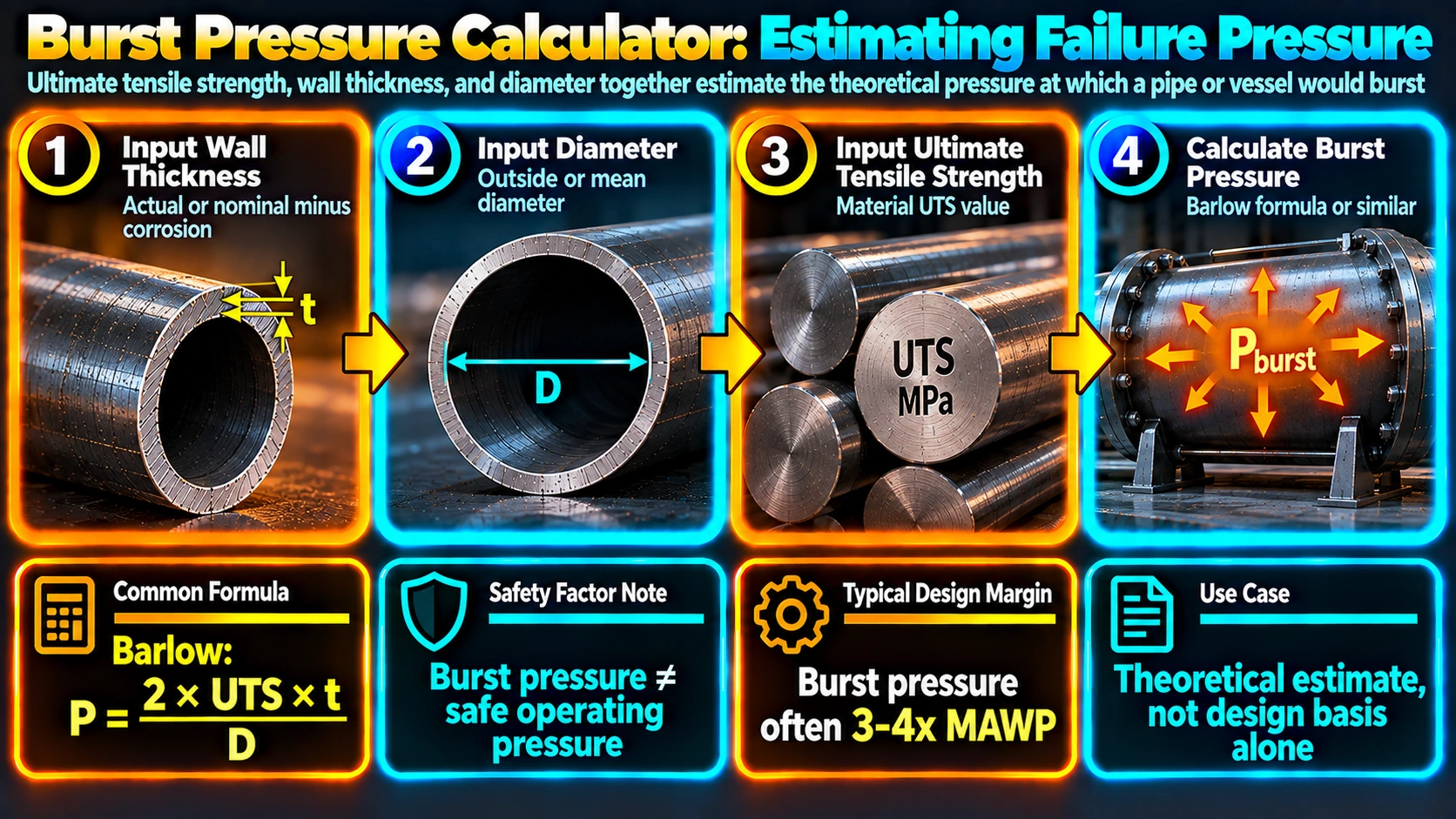
What Is Barlow's Formula?
Barlow's Formula is a fundamental equation in pressure piping engineering that relates the internal pressure a pipe can sustain to the material's tensile strength, the pipe's outside diameter, and its wall thickness. Named after the 19th-century English mathematician Peter Barlow, the formula is derived from the theory of hoop (circumferential) stress in thin-walled pressure vessels and has been adopted by ASME, API, and virtually every major piping code as the basis for pipe pressure rating calculations.
The formula exists in two principal forms depending on the diameter basis used:
P = (2 × S × t) / OD
Barlow's Formula (Inside Diameter basis — less common):
P = (2 × S × t) / ID
Where:
P = Internal pressure (MPa or psi)
S = Material tensile strength (SMYS for yield pressure, UTS for burst pressure) [MPa or psi]
t = Pipe wall thickness (mm or inches)
OD = Outside diameter of the pipe (mm or inches)
ID = Inside diameter of the pipe (mm or inches)
In practice, the outside diameter (OD) basis is universally preferred because OD is the controlled dimension in pipe manufacturing. The outside diameter of a pipe does not change with schedule; only the wall thickness varies. This makes the OD-based Barlow's Formula the natural choice for all practical pipe pressure calculations.
Deriving Barlow's Formula from First Principles
Understanding the derivation of Barlow's Formula gives engineers a physical picture of why it works and where its limitations lie. The derivation begins with a free-body diagram of a half-section of pipe under uniform internal pressure.
Free Body Diagram Approach
Consider a unit length (L = 1) of pipe with inside radius r under internal gauge pressure P. The bursting force trying to split the pipe along a longitudinal plane is:
F_burst = P × ID × L = P × ID × 1 = P × ID
Step 2 — Resisting force in the two cut walls (each of area t × L):
F_resist = 2 × S × t × L = 2 × S × t
Step 3 — Equilibrium (F_burst = F_resist):
P × ID = 2 × S × t
P = (2 × S × t) / ID
Step 4 — Convert to OD basis (ID = OD − 2t), approximation for thin walls:
P ≈ (2 × S × t) / OD
This approximation is valid when t/OD < 0.1 (i.e. D/t > 10).
For thick walls (D/t < 10), use Lamé's thick-wall cylinder equations.
ASME B31.3 Modified Barlow's Formula
ASME B31.3 Clause 304.1.2 presents the wall thickness design equation, which can be rearranged to give the allowable internal pressure for an existing pipe:
P = (2 × S_E × t) / (D − 2 × y × t)
Where:
S_E = Allowable stress × joint efficiency (MPa or psi)
D = Outside diameter (mm or in)
t = Nominal wall thickness minus mill tolerance and corrosion allowance (mm or in)
y = Coefficient from ASME B31.3 Table 304.1.1 (typically 0.4 for ferritic steels at ≤480°C)
For y = 0 (basic Barlow approximation):
P = (2 × S_E × t) / D
This recovers the standard Barlow's Formula with S replaced by S_E.
Burst Pressure, Yield Pressure, and MAWP Explained
Three distinct pressure levels emerge from Barlow's Formula depending on which material strength value is used. Understanding the difference is critical for safe piping system design.
| Pressure Level | Strength Used in Formula | Meaning | Typical Use |
|---|---|---|---|
| Yield Pressure (P_y) | SMYS (Specified Minimum Yield Strength) | Pressure at which pipe wall first yields permanently | Hydrostatic test basis; design limit for pipelines |
| Burst Pressure (P_b) | UTS (Ultimate Tensile Strength) | Theoretical pressure causing catastrophic wall rupture | Safety factor denominator; hose and tube ratings |
| MAWP / Design Pressure | Code allowable stress (S_E) | Maximum pressure permitted in service with safety factors applied | Operating pressure limit on P&IDs, data sheets |
| Hydrostatic Test Pressure | 1.5 × MAWP (typical, ASME B31.3) | Proof-test pressure applied at ambient temperature to verify integrity | Pre-commissioning testing; regulatory compliance |
Worked Example — Step-by-Step Calculation
The following example shows a complete Barlow's Formula calculation for a typical process piping scenario, demonstrating how to derive burst pressure, yield pressure, and MAWP.
Material: ASTM A106 Grade B seamless carbon steel
SMYS = 241 MPa, UTS = 414 MPa
Allowable stress at 38°C (100°F) per ASME B31.3 = 137.9 MPa
Joint factor E = 1.00 (seamless), Safety factor = 4.0 (burst/MAWP ratio check)
OD = 168.3 mm
t = 10.97 mm (Sch 80 nominal wall)
SMYS = 241 MPa | UTS = 414 MPa
Allowable stress S_A = 137.9 MPa
E = 1.00 (seamless) | SF = 4.0
Step 1 — Yield Pressure (using SMYS):
P_yield = (2 × 241 × 10.97) / 168.3
P_yield = 5,287.54 / 168.3
P_yield = 31.4 MPa (4,556 psi)
Step 2 — Burst Pressure (using UTS):
P_burst = (2 × 414 × 10.97) / 168.3
P_burst = 9,083.16 / 168.3
P_burst = 54.0 MPa (7,831 psi)
Step 3 — MAWP (using code allowable stress S_A × E):
MAWP = (2 × 137.9 × 1.00 × 10.97) / 168.3
MAWP = 3,025.63 / 168.3
MAWP = 17.98 MPa (2,608 psi)
Step 4 — Safety Factor Check (Burst / MAWP):
Actual SF = 54.0 / 17.98 = 3.00
Note: The ratio of UTS to allowable stress for A106 Gr B at 38°C is 414/137.9 ≈ 3.0
ASME codes target a minimum of 3:1 burst-to-MAWP ratio for process piping.
Step 5 — Hydrostatic Test Pressure (ASME B31.3, Clause 345.4.2):
P_test = 1.5 × MAWP = 1.5 × 17.98
P_test = 26.97 MPa (3,911 psi)
Common Pipe Material Strength Values for Barlow's Formula
The accuracy of a Barlow's Formula calculation depends entirely on using the correct material strength value. The following table lists SMYS and UTS values for commonly used pipe materials under relevant material standards. For design calculations, always use the temperature-derated allowable stress from the appropriate ASME code table rather than room-temperature SMYS.
| Material | Standard | Grade | SMYS (MPa) | UTS (MPa) | Typical Application |
|---|---|---|---|---|---|
| Carbon Steel | ASTM A106 | Grade A | 207 | 331 | Low-pressure steam, water |
| Carbon Steel | ASTM A106 | Grade B Most Common | 241 | 414 | General process, steam, hydrocarbons |
| Carbon Steel | ASTM A106 | Grade C | 276 | 483 | High-pressure process |
| Carbon Steel (Pipeline) | API 5L | Gr B / X42 | 241–290 | 414–414 | Onshore oil and gas transmission |
| Carbon Steel (Pipeline) | API 5L | X52 / X65 High Strength | 359–448 | 455–530 | High-pressure transmission pipelines |
| Low-Alloy Steel | ASTM A335 | P11 (Cr-Mo) | 205 | 415 | High-temp service up to 593°C |
| Low-Alloy Steel (P91) | ASTM A335 | P91 (9Cr-1Mo-V) | 415 | 585 | Power plant, HRSG, high-temp steam |
| Stainless Steel | ASTM A312 | TP304 / 316L Austenitic | 205–170 | 515–485 | Corrosive service, food, pharma |
| Duplex Stainless | ASTM A790 | UNS S31803 (2205) | 448 | 620 | Offshore, sour service, chloride environments |
| Nickel Alloy | ASTM B622 | Hastelloy C-276 | 283 | 690 | Highly corrosive chemical service |
Burst Pressure by Pipe Schedule — Reference Table
The table below gives calculated burst pressures (using SMYS = 241 MPa for ASTM A106 Gr B) for common nominal pipe sizes (NPS) and schedules. These values are theoretical; always apply the appropriate design factor and joint efficiency for MAWP calculations. Use our pipe weight calculator to determine the weight impact of different wall thicknesses.
| NPS (in) | OD (mm) | Sch 40 t (mm) | Sch 40 Yield P (MPa) | Sch 80 t (mm) | Sch 80 Yield P (MPa) | Sch 160 t (mm) | Sch 160 Yield P (MPa) |
|---|---|---|---|---|---|---|---|
| 2" | 60.3 | 3.91 | 31.3 | 5.54 | 44.3 | 8.74 | 69.8 |
| 3" | 88.9 | 5.49 | 29.8 | 7.62 | 41.3 | 11.13 | 60.4 |
| 4" | 114.3 | 6.02 | 25.4 | 8.56 | 36.1 | 13.49 | 56.9 |
| 6" | 168.3 | 7.11 | 20.4 | 10.97 | 31.4 | 18.26 | 52.3 |
| 8" | 219.1 | 8.18 | 18.0 | 12.70 | 27.9 | 23.01 | 50.6 |
| 10" | 273.1 | 9.27 | 16.4 | 15.09 | 26.6 | 28.58 | 50.4 |
| 12" | 323.9 | 9.53 | 14.2 | 17.48 | 26.0 | 33.32 | 49.6 |
All values based on SMYS = 241 MPa (ASTM A106 Gr B) using Barlow's Formula (OD basis). Apply appropriate safety factors for operating pressure limits.
Design Factors and Safety Factors by Piping Code
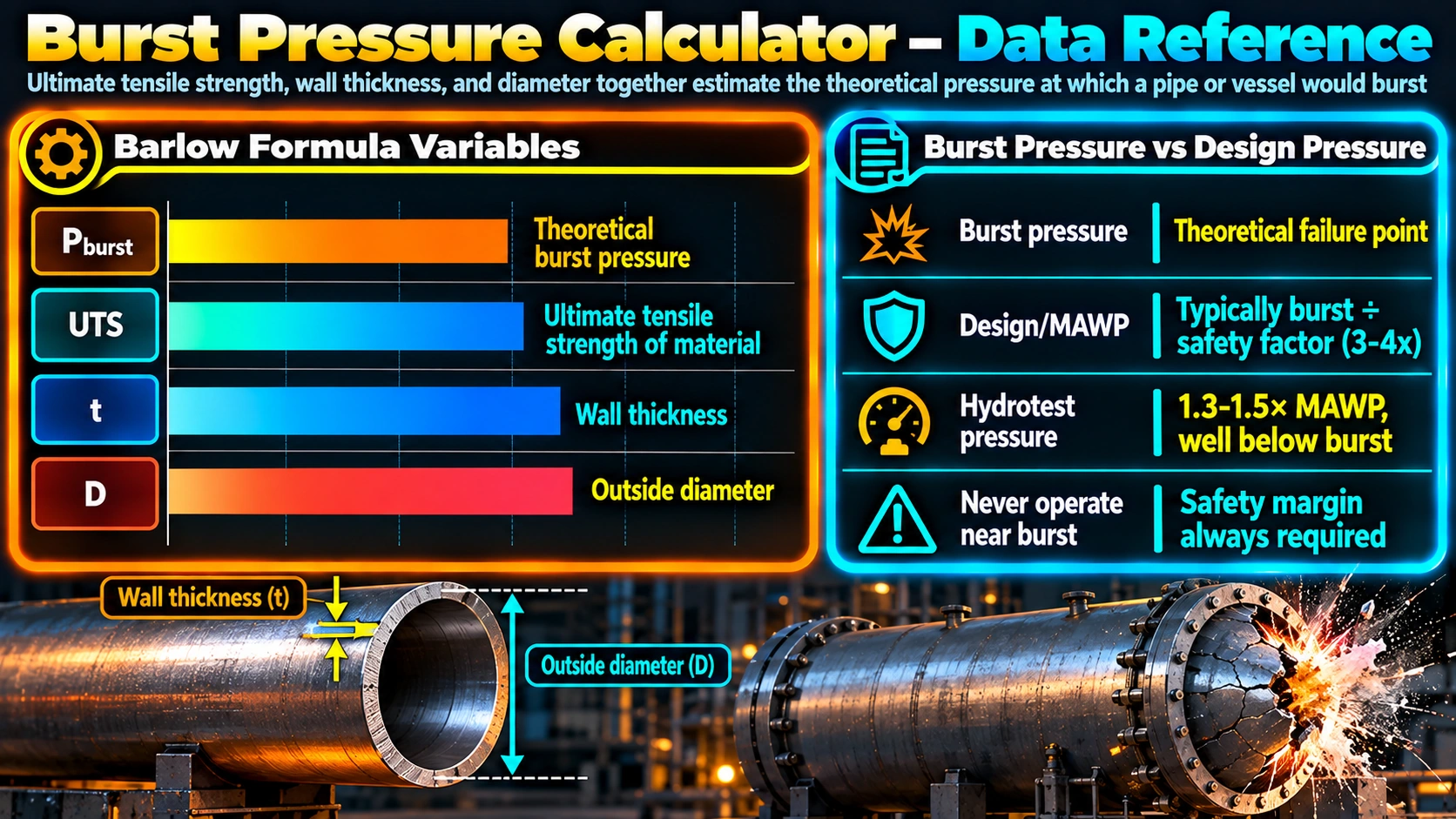
The MAWP derived from Barlow's Formula must be reduced by a design factor that reflects operating uncertainties, cyclic loading, and the consequences of failure. Different codes specify different design factors based on service criticality, fluid hazard level, and population proximity.
| Piping Code | Fluid Service | Design Factor / Allowable Stress | Notes |
|---|---|---|---|
| ASME B31.3 | Normal process fluid | S_A = SMYS / 3 (at low temp) | Factor applied via allowable stress tables, not explicitly as DF |
| ASME B31.3 | Category D (low-risk) Lower Req. | S_A = SMYS / 3 with reduced testing | Non-flammable, non-toxic, ≤1.035 MPa, ≥−29°C |
| ASME B31.1 | Power plant steam/water | S_A = SMYS / 4 (traditional) | Historical factor; current tables may yield >SMYS/4 |
| ASME B31.8 | Gas transmission (Class 1, Div 2) | DF = 0.72 × SMYS | DF = 0.72 for rural, 0.60 suburban, 0.50 Class 3, 0.40 Class 4 |
| API 570 | In-service pipeline inspection | Uses Barlow directly for retirement thickness | Minimum remaining thickness = P×D / (2×S_E) |
| ASME Section VIII | Pressure vessel nozzle necks | S_A = SMYS / 3.5 (Div 1, historical 4:1) | Per 2019 edition, general primary membrane stress = S |
| PED (EU) | European pressure equipment | DF = σ_y / 1.5 at temperature | EN 13480 for industrial piping; factors similar to B31.3 |
Joint Efficiency (E) and Its Effect on Pressure Rating
When pipe is manufactured with a longitudinal weld seam — as in ERW, LSAW (longitudinally submerged arc welded), or DSAW (double-submerged arc welded) pipe — the weld seam represents a zone of reduced toughness and potential discontinuity compared to the parent metal. The joint efficiency factor (E) accounts for this reduction in the MAWP calculation.
For seamless pipe, E = 1.00. For submerged arc welded (SAW) line pipe, E is typically 0.80–0.85. When sizing welded pipe, the effective allowable stress becomes:
MAWP = (2 × S_A × E × t) / OD
Example — ERW vs Seamless (6" Sch 80, A106 Gr B, S_A = 137.9 MPa):
Seamless (E = 1.00):
MAWP = (2 × 137.9 × 1.00 × 10.97) / 168.3 = 17.98 MPa
ERW (E = 0.85):
MAWP = (2 × 137.9 × 0.85 × 10.97) / 168.3 = 15.28 MPa
Pressure capacity reduction for ERW vs seamless: ~15%
Practical Applications of Barlow's Formula in Industry
1. New Piping System Design
During pipe spool fabrication and system design, Barlow's Formula is used in reverse to determine the minimum required wall thickness for a given design pressure and material. The calculated minimum thickness is then increased by corrosion allowance and mill tolerance before selecting the nearest standard schedule. Our pipe weight calculator can help you evaluate the weight implications of different schedules.
2. In-Service Fitness-for-Service Assessment
When corrosion or erosion reduces the wall thickness of an in-service pipe, Barlow's Formula is used under API 570 and API 579 to calculate the remaining pressure capacity of the thinned pipe. If the calculated MAWP drops below the system design pressure, the pipe must be repaired or the operating pressure reduced.
3. Hydrostatic and Pneumatic Test Pressure Setting
Test pressures under ASME B31.3 (1.5 × MAWP) and ASME B31.8 (1.25 × MOP) are derived from Barlow's-based MAWP values. Setting the test pressure requires knowing the yield pressure to ensure that the pipe does not plastically deform during testing — the test pressure must remain below the yield pressure at the test temperature. This is particularly important when the test fluid is water at ambient temperature but the pipe will operate at elevated temperature with derated material properties.
4. Pipeline Burst Disc and Relief Device Sizing
Burst discs and pressure relief valves are set to protect piping below the MAWP. The burst pressure of the weakest component in a piping system (often a fitting, branch connection, or vessel nozzle rather than the straight pipe) determines the maximum relief device set pressure. Barlow's Formula applied to each component identifies the weakest link. See our weld consumable calculator for joint design considerations.
5. Sour Service and Lethal Service Pressure Rating
For H2S sour service piping under NACE MR0175 / ISO 15156, material strength must be capped to control hardness and prevent hydrogen-induced cracking (HIC). SMYS values used in Barlow's Formula are limited (e.g., carbon steel SMYS limited to 358 MPa effective) to ensure compliance with hardness limits. This directly reduces the theoretical MAWP compared to non-sour service.
Recommended References for Piping Pressure Design
Limitations of Barlow's Formula — When to Use Lamé's Equation
Barlow's Formula assumes a thin-walled cylinder where the stress is uniform across the wall thickness. This assumption holds reasonably well when the diameter-to-thickness ratio (D/t or Do/t) is greater than 10. When D/t falls below 10 — as is common in very high-pressure hydraulic tubing, reactor pressure vessel nozzles, or very thick-wall line pipe — the stress distribution across the wall becomes non-uniform and the thin-wall assumption introduces significant unconservative error.
For thick-walled cylinders (D/t < 10), Lamé's thick-wall equation should be used:
P = S × [(r_o² − r_i²) / (r_o² + r_i²)]
Or equivalently in terms of OD and ID:
P = S × [(OD² − ID²) / (OD² + ID²)]
Comparison (D/t = 5, t = OD/5 = heavy wall):
Barlow overestimates allowable pressure by up to 30% vs Lamé at D/t = 5.
At D/t = 10, error is approximately 5–8% (borderline acceptable).
At D/t > 20, Barlow and Lamé agree to within 2%.