Digital (Inverter) Welding Machines vs Transformer Welding Machines — Complete Equipment Selection Guide
Choosing between a digital inverter welding machine and a conventional transformer welding machine is one of the most consequential equipment decisions a fabrication shop, welding inspector, or field maintenance team will make. The technology underpinning each type is fundamentally different, and those differences cascade into practical outcomes that affect arc quality, energy consumption, portability, process flexibility, and long-term operating cost. This guide provides a rigorous, side-by-side technical analysis of both machine types, covering operating principles, electrical characteristics, process compatibility, maintenance demands, and the specific scenarios where each technology excels.
The welding industry has used transformer-based machines for more than a century. Their rugged simplicity and long service life made them the default choice for structural steel, pressure vessel fabrication, and pipeline construction. Digital inverter machines, which began entering fabrication shops in significant numbers in the 1990s and have matured rapidly since, offer compelling advantages in efficiency, weight, and arc control flexibility. Understanding precisely how each type works — and where the trade-offs lie — equips engineers and buyers to make decisions grounded in technical reality rather than marketing claims.
Whether you are specifying equipment for an ASME Section VIII pressure vessel shop, equipping a mobile maintenance crew, or setting up a general fabrication workshop that handles multiple base materials, the sections below will give you the technical foundation to make the right call. Key topics include: operating frequency and power conversion, efficiency and duty cycle, arc quality and digital control features, process compatibility across SMAW, GTAW, and GMAW, weight and portability, maintenance requirements, and a structured selection matrix for common applications.
How Each Machine Type Works
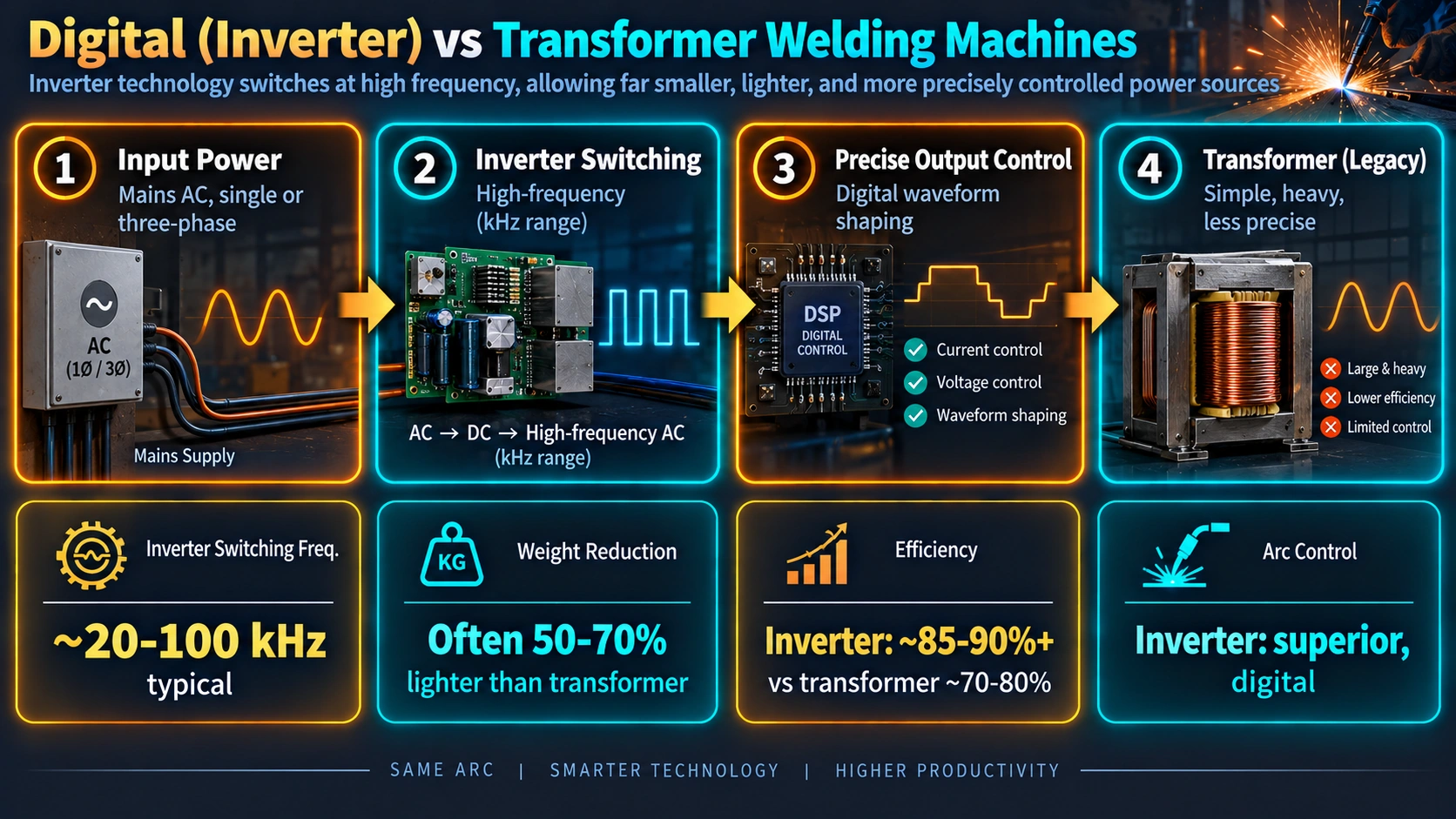
The Transformer Welding Machine
A conventional transformer welding machine is built around a large laminated iron-core step-down transformer. Mains alternating current — typically 230 V or 415 V at 50 Hz in India, 60 Hz in North America — is applied to the primary winding. The transformer steps this down to the low-voltage (typically 20–80 V open-circuit), high-current output required to sustain a welding arc. The turns ratio of the primary and secondary windings determines the transformation ratio, and output current is typically adjusted by varying the number of secondary turns in circuit (tap switching) or by mechanically adjusting the magnetic leakage path using a moving shunt or coil.
The output of a pure transformer machine is alternating current at the same frequency as the mains supply. For many welding applications — particularly SMAW with AC-compatible electrodes — this AC output is directly usable. For DC welding, a bridge rectifier (set of power diodes) is added to convert the AC output to direct current, creating what is called a transformer-rectifier (TR) machine. A smoothing choke (inductor) further reduces ripple in the DC output and helps stabilise the arc. TR machines are the most common configuration in industrial code shops.
The Digital (Inverter) Welding Machine
An inverter welding machine is fundamentally different in its power conversion topology. Rather than relying on a single large mains-frequency transformer, it uses a multi-stage conversion chain based on high-frequency power electronics. The process proceeds as follows:
- Stage 1 — Rectification: Mains AC (50/60 Hz) is first rectified to DC using a full-wave bridge rectifier, producing a high-voltage DC bus (typically 300–400 V DC from 230 V AC input).
- Stage 2 — High-Frequency Inversion: Power transistors — modern machines use Insulated Gate Bipolar Transistors (IGBTs) — switch the DC bus at very high frequency, typically 20,000 to 100,000 Hz, producing a high-frequency alternating current.
- Stage 3 — High-Frequency Transformation: This high-frequency AC is applied to a compact, lightweight transformer. Because power transformer size is inversely proportional to operating frequency, a transformer at 50,000 Hz can be dramatically smaller than one operating at 50 Hz for equivalent power throughput.
- Stage 4 — Output Rectification and Filtering: The high-frequency AC output of the small transformer is rectified again and filtered to produce the smooth DC (or controlled AC) welding output.
The IGBT switching stage is fully controlled by a microprocessor-based control circuit that monitors output voltage and current thousands of times per second, continuously adjusting switching duty cycle to maintain the programmed welding parameters. This closed-loop digital control is what gives inverter machines their superior arc stability and their ability to implement advanced features such as pulsed output, waveform shaping, and synergic MIG control.
Electrical Characteristics Compared
| Parameter | Transformer Machine (TR) | Digital Inverter Machine |
|---|---|---|
| Operating Frequency | Mains: 50 / 60 Hz | 20,000 – 100,000 Hz |
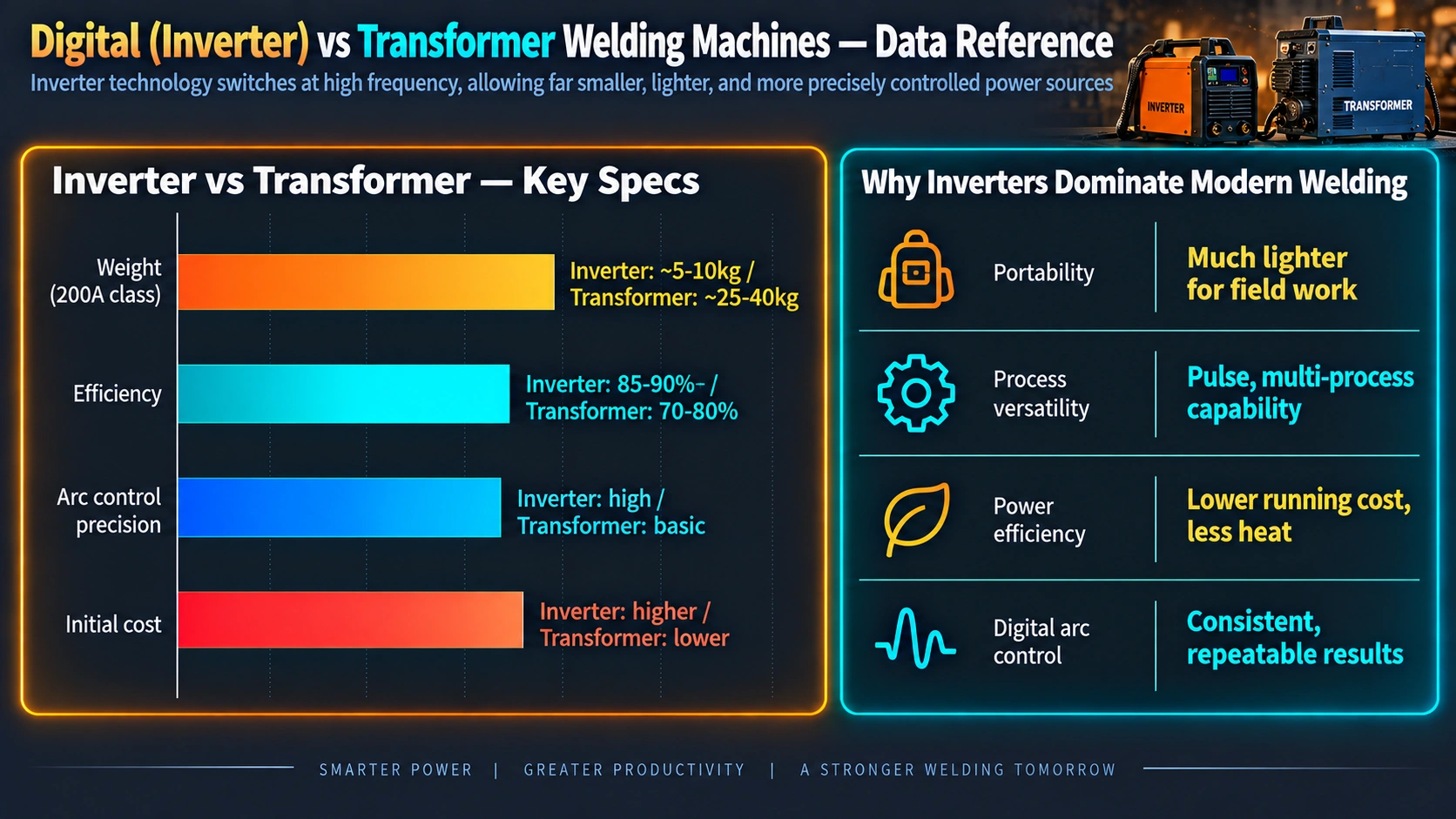
| Power Conversion Efficiency | 50–65% | 80–92% |
| Typical Weight (200 A class) | 50–100 kg | 5–12 kg |
| Power Factor | 0.5–0.7 (lagging) | 0.85–0.99 (with PFC) |
| Input Voltage Tolerance | Narrow (±10%) | Wide (±20–30% with PFC) |
| Arc Response Time | Slower (choke-limited) | Very fast (<0.1 ms) |
| Output Current Type | AC or DC (via rectifier) | DC, pulsed DC, controlled AC |
| Minimum Stable Current | ~30–50 A (practical) | 1–5 A (process-dependent) |
| No-Load Power Draw | High (core magnetising current) | Very low (<50 W typical) |
| Open-Circuit Voltage (OCV) | 50–80 V AC | 60–113 V DC (with OCV limiting) |
Understanding Power Efficiency in Practice
The efficiency difference between inverter and transformer machines has a direct impact on running costs and on the electrical infrastructure required in a fabrication shop. At 200 A welding output, a transformer machine drawing at 60% efficiency requires approximately 13–15 kVA from the supply. An equivalent inverter machine at 85% efficiency draws approximately 9–10 kVA. Over a production shift of 8 hours at 40% arc-on time, the daily energy saving from using an inverter machine amounts to several kilowatt-hours — a difference that accumulates meaningfully over months of production, particularly at Indian industrial electricity tariffs.
Arc Quality and Digital Control Features
Arc quality is the outcome that matters most to the fabricator and welding engineer. Machine type determines not just arc stability, but also the range of control functions available to optimise weld quality for a given base material, joint geometry, and welding position.
Arc Stability
Both machine types are capable of producing stable, production-quality arcs for routine SMAW on carbon and low-alloy steel. The difference becomes more pronounced at low currents, on difficult-to-strike electrodes (such as cellulosic E6010/E6011 or low-hydrogen E7018), and when welding thin sections where heat input control is critical.
The inverter’s microprocessor feedback loop monitors arc voltage and current thousands of times per second and adjusts IGBT switching duty cycle in real time to compensate for arc length variation. This produces a notably smoother, more forgiving arc. The transformer machine’s arc stability depends primarily on the inductance of the welding circuit (the smoothing choke) and the volt-ampere characteristic set by the transformer design, which is fixed for a given current range.
Digital Control Functions — Inverter Machines
Modern IGBT inverter machines offer a range of programmable arc control parameters that have no equivalent on transformer machines. Key features include:
- Hot Start: Momentary current boost (10–100% above set current) at arc ignition to assist electrode strike and prevent sticking, particularly useful for low-hydrogen E7018 and cellulosic electrodes.
- Arc Force (Arc Control): Dynamic current boost when the arc length shortens towards a short circuit, preventing electrode sticking and stubbing during SMAW on root passes and in tight joint configurations.
- Pulsed TIG (GTAW): Alternates between a high peak current (for penetration) and a low background current (for cooling) at programmable frequency, enabling precise heat input control on thin sections and dissimilar metals. See our GTAW welding guide for full coverage of pulsed TIG parameters.
- AC Waveform Control (TIG): Advanced inverter TIG machines for aluminium welding allow the selection of AC waveform shape (square, triangular, soft), AC frequency (20–200 Hz), and AC balance (percentage of DCEP for oxide cleaning vs DCEN for penetration) — none of which is available on transformer machines.
- Synergic MIG Control: Automatically sets wire feed speed, voltage, and inductance based on wire type, diameter, and material, simplifying setup for operators and reducing setup-induced weld defects.
- Crater Fill and Downslope: Programmable current ramp-down at weld end to fill the crater and reduce crater cracking — mandatory for certain code applications.
- Pre-flow and Post-flow Gas Control: Programmable shielding gas flow before arc start and after arc stop to prevent contamination in GTAW root passes on stainless steel and titanium.
Process Compatibility
Transformer / TR Machine
- SMAW (Stick) — full range of electrodes on AC; E6013, E7018 on DC TR
- Basic GTAW (DC output only, no pulsed or AC waveform)
- SAW (Submerged Arc) at high currents — transformer SAW heads remain common for heavy plate
- Not suitable for GMAW/MIG or FCAW (requires controlled wire feed interface)
- Not suitable for aluminium TIG (requires AC with variable balance/frequency)
Digital Inverter Machine
- SMAW — superior arc control, hot start, arc force across all electrode types
- GTAW — pulsed DC, AC with waveform/balance/frequency control, pre/post-flow
- GMAW/MIG — synergic control, pulsed MIG, double-pulsed MIG
- FCAW — controlled voltage output with adjustable inductance
- Plasma cutting — some multi-process inverter platforms include plasma
- Multi-process capability: SMAW + GTAW + GMAW in one unit
| Welding Process | Transformer TR | Inverter Machine | Notes |
|---|---|---|---|
| SMAW — Carbon Steel | Excellent | Excellent | Both suitable; inverter offers better arc control |
| SMAW — Low-Hydrogen Electrodes | Good | Excellent | Hot start on inverter aids E7018 ignition |
| SMAW — Cellulosic (E6010) | Good | Excellent | Inverter arc force prevents stubbing on downhill passes |
| GTAW — Carbon/Stainless Steel (DC) | Good | Excellent | Pulsed TIG on inverter gives superior thin-section control |
| GTAW — Aluminium (AC) | Limited | Excellent | AC waveform control is inverter-only; fixed sine on TR |
| GMAW (MIG) — Short-Circuit | Not Suitable | Excellent | Wire feed requires constant voltage output — inverter only |
| GMAW (MIG) — Pulse/Spray | Not Suitable | Excellent | Pulsed MIG is exclusively an inverter feature |
| FCAW | Not Suitable | Excellent | CV mode with adjustable inductance required |
| SAW (Submerged Arc) | Excellent | Good | High-current SAW (600–1200 A) more common with TR/rectifier heads |
Weight, Portability, and Duty Cycle
Weight and Physical Size
The weight difference between machine types is dramatic. A 200 A transformer-rectifier machine weighs 60–120 kg and occupies significant floor space. An equivalent 200 A IGBT inverter machine typically weighs 6–12 kg and can be carried in one hand. This has profound practical implications for:
- Field Maintenance and Construction: Inverter machines that can be carried by a single person to elevated platforms, inside vessels, or into confined spaces have essentially replaced transformer machines for field SMAW and GTAW work.
- Shop Floor Efficiency: Inverter machines can be moved between work bays easily, reducing the number of machines required in a production shop.
- Generator-Powered Sites: The lower input power demand of inverters means a smaller, more economical generator is sufficient for equivalent welding output.
Duty Cycle Considerations
Duty cycle — the percentage of a 10-minute period during which the machine can weld at rated current without triggering thermal overload protection — is often misunderstood. Transformer machines typically carry duty cycles of 60–100% at rated output because the large thermal mass of the core and windings buffers heat effectively. Industrial-grade IGBT inverter machines designed for production use achieve 100% duty cycle at rated output, but budget and light-industrial inverters may be rated at only 20–35% at peak current. When specifying inverter machines for production SMAW (continuous deposition) or SAW-equivalent duty, verify the duty cycle carefully against your actual arc-on time requirements.
Durability, Maintenance, and Service Life
Transformer Machines — Inherent Robustness
The design simplicity of a transformer machine — essentially copper windings on a laminated iron core, plus a diode bridge and choke — gives it inherent robustness against the harsh conditions common in fabrication environments: power supply fluctuations, voltage spikes, vibration, dust, moisture, and rough handling. There are very few components that can fail catastrophically. The diodes in the rectifier bridge can fail from overcurrent, and windings can be damaged by severe overheating, but otherwise transformer machines are exceptionally long-lived. Many shops continue operating TR machines that have been in service for 30 or more years.
Maintenance of transformer machines is correspondingly straightforward: periodic cleaning, inspection of cable connections, and occasional rectifier diode testing. There are no firmware updates, no control boards to replace, and no IGBTs to fail.
Inverter Machines — Modern Reliability with Conditions
Early MOSFET-based inverter machines of the 1990s and early 2000s had reliability problems: the MOSFETs could not handle voltage transients well, and failures were common in sites with poor power quality. Modern IGBT-based inverters are significantly more robust. High-quality industrial inverter machines include thermal protection, over-voltage protection, under-voltage protection, and electronic duty cycle limiting, which collectively protect the IGBTs and control circuits from the most common failure modes.
However, inverter machines remain more sensitive than transformer machines to:
- Power quality: Severe voltage spikes (common in sites sharing supply with large motors or arc furnaces) can damage IGBT devices. A line conditioner or surge protector is advisable on poor-quality supplies.
- Dust and moisture ingress: The electronic control boards and IGBT modules in inverters are susceptible to conductive contamination. Machines used in grinding, plasma cutting, or wet environments should have IP54 or higher ingress protection ratings.
- Repair complexity: When an inverter fails, repair typically requires access to manufacturer-specific control boards or IGBT modules. In remote sites far from service support, a failed inverter may take longer to repair than a simple transformer machine diode replacement.
Cost of Ownership Analysis
Initial Purchase Price
Transformer-rectifier machines carry a lower upfront purchase price than equivalent inverter machines. A quality 200 A TR machine from a reputable Indian or international manufacturer costs approximately INR 15,000–30,000. A 200 A industrial-grade IGBT inverter SMAW machine from a comparable manufacturer costs INR 25,000–60,000, and a multi-process inverter capable of SMAW, GTAW, and GMAW may cost INR 60,000–1,50,000 or more depending on features and brand.
Operating Cost Over 5 Years
The higher purchase cost of an inverter machine can be offset by energy savings. As shown in the worked example above, a single 200 A machine in regular production use may save 8–10 kWh per shift in energy consumption. At INR 8/kWh, this amounts to approximately INR 1,500–2,000 per month per machine. Over a 5-year service life with 250 working days per year, the cumulative energy saving from one inverter machine compared to an equivalent transformer machine may reach INR 75,000–1,00,000 — substantially recovering or exceeding the initial price premium.
| Cost Component | Transformer TR Machine | Inverter Machine |
|---|---|---|
| Initial Purchase (200 A class) | INR 15,000–30,000 | INR 25,000–60,000 |
| Energy Cost / Shift (8 hr, 40% arc-on) | ~INR 55–70 | ~INR 39–49 |
| Annual Energy Saving (250 shifts/yr) | Baseline | INR 4,000–7,500 saving |
| 5-Year Energy Saving | Baseline | INR 20,000–37,500 saving |
| Typical Service Life | 20–40 years | 10–20 years (industrial grade) |
| Maintenance Complexity | Low — simple components | Moderate — electronic boards |
| Generator Requirement (for same output) | Larger (higher kVA demand) | Smaller (lower kVA demand) |
Equipment Selection Guide — Which Machine for Which Application?
| Application / Scenario | Recommended Type | Rationale |
|---|---|---|
| SMAW of carbon steel structural work (fixed shop) | TR Machine | Cost-effective, robust, adequate arc quality for routine structural SMAW |
| SMAW field maintenance (access restricted, elevated) | Inverter | Portability is essential; inverter machines carry easily to point of use |
| GTAW root passes on stainless steel piping (ASME B31.3) | Inverter | Pulsed TIG, pre/post-flow gas control, precise low-current arc essential |
| GTAW of aluminium heat exchangers or pressure vessels | Inverter (AC/DC) | AC waveform control and variable balance/frequency are inverter-only features |
| GMAW/MIG or FCAW — all applications | Inverter | Transformer machines cannot provide constant voltage wire feed output |
| High-current SAW (600+ A) on heavy plate | TR / Rectifier Head | Large TR or SCR rectifier units dominate high-amperage SAW applications |
| P91 Cr-Mo piping SMAW + GTAW combo | Inverter (multi-process) | Tight heat input control, hot start/arc force for SMAW, pulsed GTAW root |
| Remote site with generator power, poor power quality | TR with PFC Inverter | TR is more tolerant of poor power quality; modern inverters with wide-range PFC also acceptable |
| Multi-process shop (SMAW + GTAW + GMAW) — limited floor space | Inverter (multi-process) | Single multi-process inverter replaces three separate TR machines |
| Training facility — student budget equipment | TR Machine | Lower cost, durable, simple to operate, excellent for basic SMAW training |
Weld Quality Implications for Code Work
For fabrication governed by ASME Section IX, ASME Section VIII Division 1, or ASME B31.3, machine type is not specified by the code — the code addresses the weld procedure specification (WPS) and qualification records (PQR), not the power source used. However, machine capability directly affects the practical ability to achieve and maintain the essential variables specified in the WPS.
When a WPS specifies pulsed GTAW for a root pass on P-No. 8 stainless steel, or an AC TIG process for aluminium, a transformer machine is simply unable to execute the process. When a WPS requires precise heat input limits for P91 (Cr-Mo welding) or duplex stainless steel (duplex stainless guide), the arc control capabilities of an inverter machine — particularly pulsed parameters and precise low-heat-input operation — give it a significant advantage in achieving consistent, repeatable results across multiple welders and shifts.
Regarding P-Number and F-Number groupings for procedure qualification, the qualification is process- and filler-metal-specific, not machine-specific. A WPS qualified with an inverter machine may be executed with any machine capable of producing the same essential variable ranges (current, voltage, travel speed, heat input). However, if the WPS was qualified using a pulsed GTAW parameter set achievable only with an inverter, that process cannot be replicated on a transformer machine.
Environmental Considerations
The higher energy efficiency of inverter machines directly translates to a lower carbon footprint per unit of welding output. In India, where a significant portion of grid electricity is generated from coal-fired thermal plants, reducing electrical consumption in industrial processes has a meaningful environmental impact. A fabrication shop transitioning from transformer to inverter machines for SMAW and GTAW operations can reduce electricity-related emissions from welding by 25–40% for equivalent production output.
From a materials perspective, transformer machines contain a large quantity of copper and iron — both recyclable at end of life. Inverter machines contain a smaller quantity of these materials but include electronic components (circuit boards, IGBTs, capacitors) that require responsible end-of-life handling under e-waste regulations. Neither machine type presents insurmountable environmental concerns.
Recommended Technical References
These books are widely used by welding engineers, QC coordinators, and fabrication professionals working with welding equipment selection and arc welding processes.
Disclosure: WeldFabWorld participates in the Amazon Associates programme (StoreID: neha0fe8-21). If you purchase through these links, we may earn a small commission at no extra cost to you. This helps support free technical content on this site.
Quick Decision Checklist
Use this checklist to narrow down your machine selection before consulting your equipment supplier:
| Question | If YES → Lean Toward | If NO → Either Type |
|---|---|---|
| Do you require GMAW (MIG) or FCAW welding? | Inverter — essential | Either |
| Do you weld aluminium with GTAW? | Inverter AC/DC | Either |
| Do you require pulsed TIG for thin materials or exotic alloys? | Inverter | Either |
| Is portability (field work, elevated access) a priority? | Inverter | Either |
| Is the budget tightly constrained for basic SMAW only? | Transformer TR | Either |
| Is the machine to be used in a harsh outdoor environment with poor power quality? | TR preferred | Wide-input inverter acceptable |
| Are energy savings over 3–5 years important to the business case? | Inverter | Either |
| Will the machine be used for high-current SAW (>600 A)? | TR / SCR Rectifier | Either |
Frequently Asked Questions
What is the main difference between a digital inverter welder and a transformer welder?
Are inverter welding machines more energy-efficient than transformer machines?
Which machine type produces a better welding arc?
Are transformer welding machines more durable than inverter machines?
Can I use a digital inverter welder on a generator?
Which welding machine type is best for ASME-code pressure vessel fabrication shops?
What does duty cycle mean and does it differ between inverter and transformer machines?
Is it worth spending more on a digital inverter welder for a small fabrication workshop?
Summary and Final Recommendations
The debate between digital inverter and transformer welding machines is not about which technology is universally superior — it is about matching the right tool to the job. Transformer-rectifier machines remain valuable, cost-effective, and highly durable for demanding SMAW applications on carbon and low-alloy steel, particularly in fixed shop settings or where power quality is variable and maintenance resources are limited. Their simplicity is a genuine asset in environments where electronic failure would be costly.
For the majority of modern fabrication applications — especially those involving GTAW precision work, aluminium welding, MIG/FCAW processes, multi-material capability, or field portability — the IGBT inverter machine is the correct choice. Its energy efficiency, arc control versatility, low weight, and multi-process capability represent a compelling value proposition that typically recovers the initial cost premium within a few years of production use.
For code shops working to ASME Section VIII, ASME B31.3, or API standards, the selection should start from the welding procedures (WPS/PQR) in use. Identify which processes and essential variables are required, then select machine types that can reliably achieve and repeat those parameters throughout production. Where pulsed GTAW, AC TIG, or synergic MIG processes are specified in the WPS, an inverter machine is not optional — it is required. For more on procedure qualification essentials, visit our ASME Section IX resource hub and mechanical testing guide.