Hot Work Permit System — Requirements and Procedure
A hot work permit system is the formal control that stands between routine welding and cutting activity and one of the most common causes of industrial fires. Anywhere sparks, open flame, or concentrated heat could reach combustible material outside a purpose-built, fire-safe shop, a written permit is what forces a documented check of the area, a named fire watch, and a defined shutdown and monitoring period before the job is allowed to start. On EPC sites and operating plants, this is one of the most frequently audited permit types, and it is also one of the most commonly found deficient, usually not because the paperwork is missing but because the fire watch or post-work monitoring was not actually maintained.
This guide sets out what a compliant hot work permit system looks like in practice: when a permit is required, who has the authority to issue and cancel one, how the work area should be prepared, what the fire watch is actually responsible for, and how hot work permits interact with other permits such as confined space entry. It draws on the framework common to NFPA 51B and equivalent facility hot work programs, alongside practical inspection experience from plant and EPC environments.
What Counts as Hot Work
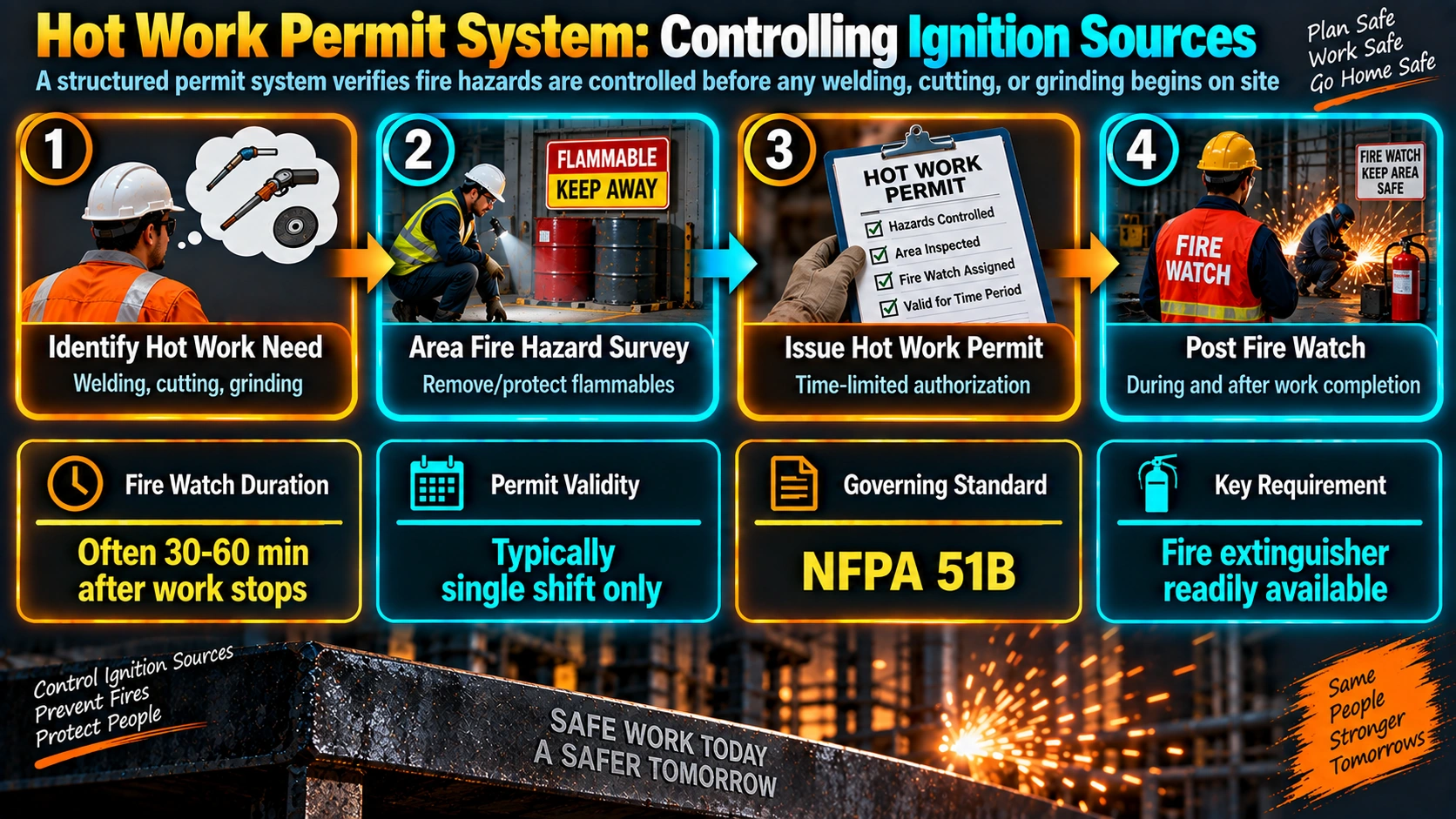
Hot work is any operation capable of producing sparks, open flame, or heat sufficient to ignite nearby combustible material. In practice this covers welding, oxy-fuel cutting, brazing, soldering, grinding, and the use of any spark-producing power tool. The common thread across all of these is an ignition source that can persist or travel beyond the immediate work point, which is exactly why grinding is included alongside arc welding even though it feels like a lower-risk task.
Who Issues, Authorises, and Cancels the Permit
A designated, trained permit issuer, commonly a shift supervisor, area safety officer, or a person specifically appointed under the site’s permit-to-work program, is responsible for inspecting the proposed work location, confirming that hazards have been controlled, and signing the permit before work begins. This same authority retains the right to suspend or cancel the permit at any point if conditions in the area change, such as a nearby process upset introducing flammable vapour, or a shift change leaving the fire watch role unfilled.
- The permit issuer is distinct from the person performing the hot work; self-authorisation is not an acceptable practice.
- On sites running parallel permits, such as a confined space entry combined with hot work, the two permits should be cross-checked for consistency rather than issued independently by different people unaware of each other.
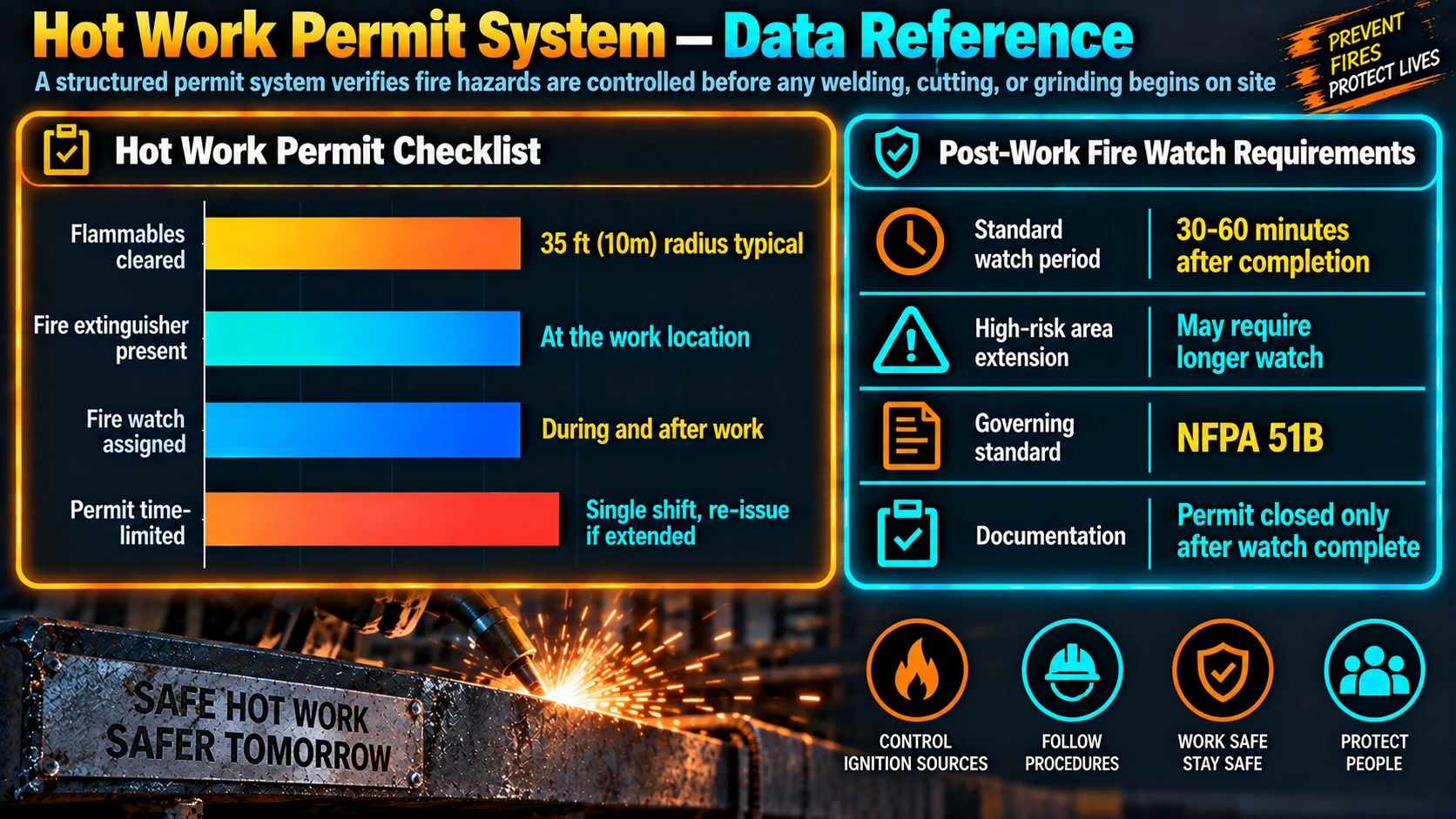
- Permit validity should be limited to a single shift or a defined time window, with re-inspection required if the job extends beyond that window.
Preparing the Work Area
Combustible Clearance
A widely used reference clearance is 35 feet (approximately 11 metres) in every direction from the hot work location, including overhead and below-floor spaces where sparks could travel or fall through gratings, cable trays, or floor penetrations. Within that radius:
- Flammable liquids, dust, lint, and oily deposits should be removed.
- Combustible floor coverings should be removed, wetted down, or covered with fire-resistant material.
- Wall or floor openings and penetrations should be sealed or covered so sparks cannot pass to an adjacent level or compartment.
- Where combustibles cannot be moved, fire-resistant blankets or shields should be used to isolate them from the work.
Equipment and Conflict Checks
- Confirm welding, cutting, and grinding equipment is in good working condition, with appropriate PPE and a suitable fire extinguisher immediately available; see our detailed PPE for Welding guide.
- Check for conflicting simultaneous operations nearby, such as painting, coating application, or solvent cleaning, which can introduce flammable vapour into an otherwise controlled area.
- Confirm that any impaired fire protection system in the area (a sprinkler system out of service, for example) has been addressed through a compensating measure before the permit is signed.
The Fire Watch Role
The fire watch is a dedicated person whose sole responsibility during the work, and for a defined period afterward, is watching for sparks, smoke, or smouldering material within and beyond the cleared radius. A fire watch should never be assigned other duties during this period, since divided attention defeats the entire purpose of the role.
| Fire Watch Duty | Detail |
|---|---|
| Continuous observation | Watches the work area and adjacent spaces for ignition throughout the hot work Mandatory |
| Extinguisher access | Has a suitable, charged fire extinguisher immediately at hand Mandatory |
| Alarm capability | Has a working means to raise the alarm without leaving the area unattended Mandatory |
| Post-work monitoring | Remains after work stops for the period defined on the permit Time-bound |
| No other duties | Is not assigned concurrent tasks during watch periods Common violation |
Why Monitoring Continues After the Torch Is Off
Hot work fires do not always ignite immediately. A significant share of hot work fires begin well after the welder has finished and left the area, once smouldering material inside insulation, wall cavities, or debris finally reaches ignition. This is the entire justification for a defined post-work monitoring period rather than treating permit close-out as automatic the moment the arc stops.
| Facility Risk Level | Typical Post-Work Monitoring Duration | Notes |
|---|---|---|
| Standard shop or site work | 30 minutes minimum | Common baseline referenced across many hot work programs |
| Elevated risk areas | 60 minutes | Used where combustible loading or concealed spaces are present |
| High-hazard or process areas | Several hours (site-defined) | Some facility programs specify extended monitoring, such as three hours, in high-risk zones |
Hot Work Permits and Confined Space Entry Together
When welding or cutting takes place inside a tank, vessel, or other permit-required confined space, both a hot work permit and a confined space entry permit are required at the same time, because they control different hazards. The confined space permit governs atmospheric testing, ventilation, and rescue arrangements; the hot work permit governs ignition source control, combustible clearance, and fire watch duties. For the atmospheric testing sequence, ventilation requirements, and rescue planning specific to enclosed spaces, see our Confined Space Welding Safety Guide.
Hot Work in Classified Hazardous Areas
Hot work in an area classified as hazardous for flammable atmospheres under area classification standards requires precautions well beyond a standard permit. This typically includes gas testing before and continuously during the work, positive isolation of the flammable source, and sign-off by process safety or operations personnel in addition to the standard permit issuer. Treat any request for hot work in or near a classified zone as an escalation, not a routine permit.
Common Non-Conformances Found in Hot Work Permit Audits
- A fire watch assigned but pulled away to help with unrelated tasks partway through the work.
- Post-work monitoring cut short because the crew wanted to close out the permit and move to the next job.
- Combustible clearance verified at the work point itself but not checked on the level below or behind an adjacent wall.
- A hot work permit issued without checking whether a confined space entry permit was also active for the same location.
- Permits reused or extended across multiple shifts without re-inspection of the area.
Amazon Picks for Hot Work Safety Programs
Fire Prevention During Welding Reference
A practical reference on fire prevention principles for welding, cutting, and other hot work, useful for building or auditing a site permit program.
View on AmazonFire-Resistant Welding Blanket
A heavy-duty welding blanket used to shield combustible surfaces and equipment within the hot work clearance radius.
View on AmazonABC Fire Extinguisher
A multi-purpose extinguisher suited to fire watch duty, sized appropriately for the combustible loading typical of a hot work area.
View on AmazonPortable Gas Detector
A calibrated gas detector for pre-work and continuous testing where hot work is planned near classified or previously flammable areas.
View on AmazonDisclosure: WeldFabWorld participates in the Amazon Associates programme (StoreID: neha0fe8-21). If you purchase through these links, we may earn a small commission at no extra cost to you. This helps support free technical content on this site.
Frequently Asked Questions
What activities require a hot work permit?
Any task that produces sparks, open flame, or sufficient heat to ignite nearby combustible material requires a hot work permit when performed outside a designated fire-safe hot work area. This commonly includes welding, cutting, brazing, soldering, grinding, and torch-applied work. Routine work confined to a permanently designated welding shop cleared of combustibles typically does not need a fresh permit each time, but any hot work performed elsewhere on site does.
Who is authorised to issue a hot work permit?
A designated, trained authorising person, usually a supervisor or safety officer appointed under the site’s permit-to-work system, issues the hot work permit. They inspect the work area, confirm combustibles have been cleared or shielded, verify fire protection equipment is available, and name a fire watch before signing. This authority can also suspend or cancel the permit if conditions change during the work.
How far must combustible materials be cleared from a hot work area?
A widely used reference clearance distance is 35 feet, or approximately 11 metres, in all directions from the hot work location, including areas above and below the work. Within that radius, flammable liquids, dust, and combustible floor coverings should be removed or protected, and openings or penetrations should be sealed so sparks cannot pass through to an adjacent area.
How long must the fire watch remain after hot work is finished?
A minimum fire watch period after hot work stops is commonly set at 30 minutes, though many site programs extend this to 60 minutes, and higher-risk facilities may require monitoring for several hours, since a significant share of hot work fires ignite well after the welder has left the area. The exact duration should be defined in the site’s own procedure and stated on the permit.
Is a hot work permit still needed if the space is also under a confined space entry permit?
Yes. A confined space entry permit and a hot work permit address different hazards and are both required when welding or cutting occurs inside a permit-required confined space. The confined space permit governs atmospheric testing, ventilation, and rescue arrangements, while the hot work permit governs ignition source control and fire watch duties; the two must be checked for consistency rather than issued independently.
What should a fire watch actually do during hot work?
A fire watch is a dedicated, trained person whose only job during the work is to observe for sparks, smoke, or smouldering material within and beyond the cleared radius, with a means of raising an alarm and a suitable fire extinguisher immediately at hand. The fire watch should not be assigned other tasks during the work or the post-work monitoring period.
Can a hot work permit be issued for work in a hazardous area classified for flammable atmospheres?
Hot work in a classified hazardous area requires precautions well beyond a standard permit, typically including gas testing before and during the work, isolation of the flammable source, and stricter review by process safety personnel. Many facilities require these classified-area permits to be co-signed by a process safety or operations authority in addition to the standard hot work permit issuer.