TIG Filler Rod Selection Guide and Size Chart
TIG filler rod selection is one of two setup decisions, alongside tungsten electrode choice, that determine whether a GTAW weld turns out strong and clean or porous and undersized. Picking the wrong alloy can leave you with a weld that looks fine but fails a bend test, and picking the wrong diameter can chill the puddle or overload it long before the arc settings are even part of the problem.
This guide walks through how to match filler rod alloy to base metal using the AWS “ER” classification system, how to size the rod diameter against material thickness and joint type, and how filler rod size connects to tungsten size, cup size, gas flow, amperage, and travel speed. Full settings charts are included for stainless steel, mild steel, aluminum, and titanium, along with a calculator that generates a complete starting setup from your material and thickness.
If you have not yet selected your tungsten electrode, it pairs directly with filler rod choice and is worth reviewing alongside the full GTAW welding process guide before you finalize your procedure.
TIG Filler Rod & Settings Calculator
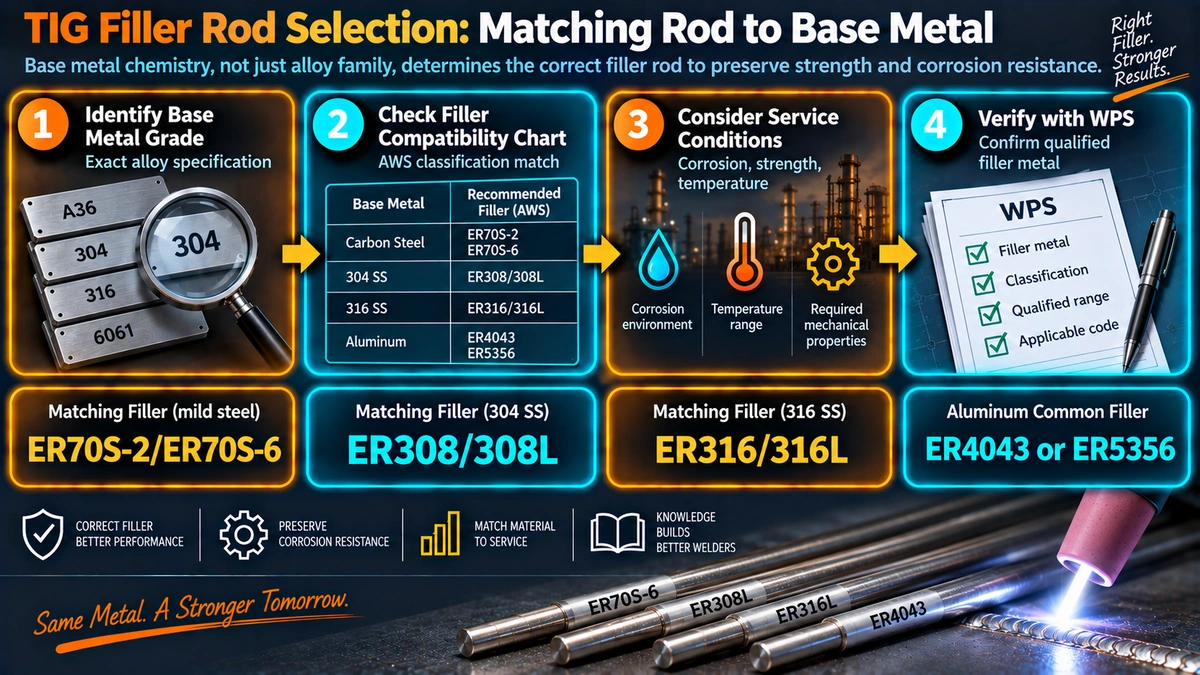
Select your base metal, material thickness, and joint type to get a recommended filler rod diameter, tungsten size, cup size, gas flow, and amperage range.
Quick rule of thumb: use a filler rod diameter equal to or slightly less than the base metal thickness up to about 1/8 inch, then step up roughly one rod size for every additional 1/16 inch of thickness. On thin stainless sheet, go one rod size smaller than you would for the same thickness in carbon steel.
Do You Need a Filler Rod?
Most GTAW welds use a filler rod, but autogenous fusion welding without one is possible under specific conditions: the butt joint has no gap, the base metal is roughly 1/8 inch or thicker, extra heat input is acceptable, and weld strength is not a primary requirement. Fusion welds without filler tend to run hotter to achieve fusion, which increases the risk of burn-through, and they are generally weaker than a properly filled joint, so they are most often used for tack welds rather than finished structural welds.
For the overwhelming majority of production TIG work, including anything load-bearing or pressure-retaining, a filler rod is the correct approach, and matching its alloy and diameter correctly is what this guide focuses on.
Filler Rod Basics
TIG filler material is a metal alloy engineered to withstand arc heat and fuse with the base metal as a composite weld bead. Standard filler rods are sold as straight lengths, typically around 36 inches (3 feet), packed in 10 or 50 pound boxes or tubes. Diameters commonly range from 1/16 inch up to 1/4 inch, covering everything from thin sheet metal to heavy plate.
Because TIG and MIG processes often call for the same base alloy chemistry, some MIG wire is also sold pre-cut into TIG-length rods, usually labeled as “TIG cut length” wire. This is common with ER70S-6 and ER308L, where the underlying wire chemistry is identical between the spooled MIG product and the cut-length TIG product.
AWS Filler Metal Classification (ER Numbers)
The American Welding Society assigns “ER” classification numbers to filler metal alloys to standardize selection across manufacturers. The “E” indicates the material can be used as an electrode in some processes, and the “R” indicates it can be used as a filler rod. The digits and letters that follow describe tensile strength, base metal family, and chemistry adjustments such as low carbon content or specific deoxidizer packages.
Code reference: filler metal classifications referenced in this guide follow AWS A5.18 (carbon steel), AWS A5.9 (stainless steel), AWS A5.10 (aluminum), and AWS A5.16 (titanium). Always confirm the exact classification required against your governing WPS, since a qualified procedure may restrict you to a narrower list than the general guidelines below.
Steel Filler Rods
ER70S-6 is the most widely used general-purpose filler rod for mild and low carbon steel because its silicon and manganese deoxidizer package tolerates light surface rust and mill scale better than leaner alloys, producing a cleaner, more fluid bead. ER70S-2 is a triple-deoxidized alternative often preferred on clean base metal or where lower residual silicon is desired. Several other ER70S variants exist to address specific cleanliness or joint conditions; consult the manufacturer’s chart if your application falls outside standard clean mild steel.
Stainless Steel Filler Rods
Three filler families cover most stainless steel TIG work:
- ER308 / ER308L: the default choice for austenitic 300-series stainless steel such as 304, and also used on many 200-series grades. The “L” variant carries extra-low carbon for improved resistance to sensitization.
- ER309 / ER309L: used for dissimilar metal joints, most often stainless steel welded to carbon or low alloy steel, and tolerates higher heat input than ER308L.
- ER316 / ER316L: the standard choice for pressure vessels, valves, chemical process equipment, and marine applications where molybdenum-bearing corrosion resistance is required. The “L” variant keeps carbon below 0.08 percent for improved corrosion performance in the weld zone.
These three families cover the large majority of stainless TIG work, but the full roster of stainless base metals is far larger, so always check the base metal’s PMI or material certificate against the manufacturer’s filler metal chart for less common grades.
Aluminum Filler Rods
ER4043 is the general-purpose aluminum filler rod for most wrought and cast aluminum alloys, offering good fluidity and crack resistance, but it is not recommended for 2xxx or 7xxx series aluminum due to compatibility and cracking concerns. ER5356 is the preferred filler for 5xxx series aluminum and is generally specified when the finished part will be anodized, since ER4043’s silicon content can leave a visible gray streak through clear anodize that ER5356 does not produce.
Chrome-Moly Tubing Filler Rods
4130 chrome-moly tubing, common in aerospace and motorsport fabrication, is typically welded with ER70S-2 for general applications. Where higher strength and lower ductility in the weld is acceptable, ER80S-D2 is the alternative. If the finished assembly will be heat-treated to reach a specific target strength, neither rod is appropriate; instead, select a filler metal whose chemistry matches the tubing itself so the heat treatment response is consistent across base metal and weld metal.
Titanium Filler Rods
Titanium filler selection generally follows a match-the-base-metal rule rather than a one-size-fits-most approach:
- ERTi-2: matches Grade 2 titanium, the most common commercially pure grade.
- ERTi-3: matches Grade 3 titanium.
- ERTi-5: matches Grade 5 titanium (Ti-6Al-4V), a common alpha-beta alloy.
- ERTi-7: mechanically equivalent to ERTi-2 with added palladium for improved crevice and under-deposit corrosion resistance; usable on Grade 2 or Grade 16 where ERTi-2 is insufficient.
- ERTi-9 / ERTi-9ELI: matches Grade 9 titanium.
- ERTi-23: matches Grade 23 titanium, the extra-low-interstitial variant of Grade 5.
| Base Metal | Filler Rod | Typical Application | Notes |
|---|---|---|---|
| Mild / Carbon Steel | ER70S-6 | General fabrication, structural | Standard Tolerates light scale/rust |
| Mild / Carbon Steel | ER70S-2 | Clean base metal, precision work | Alternative Triple deoxidized |
| Stainless 304/300-series | ER308 / ER308L | Food, pharma, general stainless | Standard Low carbon “L” reduces sensitization |
| Dissimilar metals | ER309 / ER309L | Stainless to carbon steel joints | Special Higher Cr/Ni for dilution buffer |
| Pressure equipment, marine | ER316 / ER316L | Vessels, valves, chemical plant | Standard Mo-bearing, better corrosion resistance |
| Aluminum (most alloys) | ER4043 | General aluminum fabrication | Standard Avoid on 2xxx/7xxx series |
| Aluminum 5xxx series | ER5356 | Anodized or structural aluminum | Alternative Better anodize color match |
| 4130 Chrome-Moly | ER70S-2 / ER80S-D2 | Aerospace, motorsport tubing | Special Match chemistry if heat treating |
| Titanium Grade 2/5/9/23 | ERTi-2 / -5 / -9 / -23 | Aerospace, marine, chemical | Special Match grade to base metal |
Filler Rod Diameter Selection
Filler rod diameter is driven primarily by base metal thickness, with secondary adjustments for base metal type and amperage. The general guideline is to use a rod diameter equal to or slightly less than the metal thickness for thin material, and to size up roughly one increment for every additional 1/16 inch of thickness on thicker sections.
- For material under 1/8 inch thick, use a rod diameter slightly thinner than the base metal thickness.
- On stainless steel sheet, use one rod size smaller than you would select for the same thickness in carbon steel, since stainless is usually welded at lower amperage and an oversized rod chills the puddle and produces an irregular bead.
- On aluminum, the same sizing logic as steel sheet generally applies; 1/16 inch (1.6 mm) rod can be used down to roughly 0.040 inch sheet thickness.
- If a filler rod balls up before reaching the puddle on thicker aluminum, first try a tighter arc length and reduced torch angle; if that does not resolve it, step up one rod diameter.
| Metal Thickness | Recommended Filler Rod Diameter |
|---|---|
| 1/16 in (1.6 mm) | 0.045 in or 1/16 in |
| 3/32 in (2.4 mm) | 1/16 in or 3/32 in |
| 1/8 in (3.2 mm) | 1/16 in or 3/32 in |
| 3/16 in (4.8 mm) | 1/8 in |
| 1/4 in (6.4 mm) | 3/16 in |
| 1/2 in (12.7 mm) | 1/4 in |
Joint Type
Filler rod alloy and diameter selection is generally the same for butt and fillet joints on identical base metal and thickness, but fillet joints typically require somewhat higher amperage because heat is drawn into two intersecting plates rather than a single flat plane. Travel speed is usually reduced slightly on fillet welds to maintain adequate fusion at the root, as reflected in the settings tables below.
Additional Considerations
Use bare, uncoated rods only. Never substitute a shielded metal arc welding (SMAW) stick electrode for TIG filler rod. SMAW electrodes carry a flux coating designed to generate shielding gas and slag through combustion, which is fundamentally incompatible with the inert gas shielding used in GTAW and will contaminate the weld.
Filler Rod Size and TIG Welder Settings
Once the correct alloy and diameter are identified, the rest of the welder setup, amperage, gas flow, cup size, and travel speed, needs to be dialed in together. The tables below provide validated starting points by metal gauge and joint type; treat them as a starting setup to fine-tune for your specific machine, technique, and base metal condition.
Stainless Steel Settings
| Metal Gauge | Joint | Tungsten Size | Filler Rod | Cup Size | Gas Flow (CFH) | Amps | Travel Speed (IPM) |
|---|---|---|---|---|---|---|---|
| 1/16 in (1.6 mm) | Butt | 1.6 mm | 1.6 mm | 4, 5, 6 | 11 | 80-100 | 12 |
| 1/16 in (1.6 mm) | Fillet | 1.6 mm | 1.6 mm | 4, 5, 6 | 11 | 90-100 | 10 |
| 1/8 in (3.2 mm) | Butt | 1.6 mm | 2.4 mm | 4, 5, 6 | 11 | 120-140 | 12 |
| 1/8 in (3.2 mm) | Fillet | 1.6 mm | 2.4 mm | 4, 5, 6 | 11 | 130-150 | 10 |
| 3/16 in (4.8 mm) | Butt | 2.4 mm | 3.2 mm | 5, 6, 7 | 13 | 200-250 | 12 |
| 3/16 in (4.8 mm) | Fillet | 2.4-3.2 mm | 3.2 mm | 5, 6, 7 | 13 | 225-275 | 10 |
| 1/4 in (6.4 mm) | Butt | 3.2 mm | 4.8 mm | 8, 10 | 13 | 275-350 | 10 |
| 1/4 in (6.4 mm) | Fillet | 3.2 mm | 4.8 mm | 8, 10 | 13 | 300-375 | 8 |
Low and Mild Carbon Steel Settings
| Metal Gauge | Joint | Tungsten Size | Filler Rod | Cup Size | Gas Flow (CFH) | Amps | Travel Speed (IPM) |
|---|---|---|---|---|---|---|---|
| 1/16 in (1.6 mm) | Butt / Fillet | 1.6 mm | 1.6 mm | 4, 5, 6 | 15 | 95-135 | 15 |
| 1/8 in (3.2 mm) | Butt / Fillet | 1.6-2.4 mm | 2.4 mm | 4, 5, 6 | 15 | 145-205 | 11 |
| 3/16 in (4.8 mm) | Butt / Fillet | 2.4 mm | 3.2 mm | 7, 8 | 16 | 210-260 | 10 |
| 1/4 in (6.4 mm) | Butt / Fillet | 3.2 mm | 4.0 mm | 8, 10 | 18 | 240-300 | 10 |
Aluminum Settings
| Metal Gauge | Joint | Tungsten Size | Filler Rod | Cup Size | Gas Flow (CFH) | Amps | Travel Speed (IPM) |
|---|---|---|---|---|---|---|---|
| 1/16 in (1.6 mm) | Butt | 1.6 mm | 1.6 mm | 4, 5, 6 | 15 | 60-80 | 12 |
| 1/16 in (1.6 mm) | Fillet | 1.6 mm | 1.6 mm | 4, 5, 6 | 15 | 70-90 | 10 |
| 1/8 in (3.2 mm) | Butt | 2.4 mm | 2.4-3.2 mm | 6, 7 | 17 | 125-145 | 12 |
| 1/8 in (3.2 mm) | Fillet | 2.4 mm | 1.6-2.4 mm | 6, 7 | 17 | 140-160 | 10 |
| 3/16 in (4.8 mm) | Butt | 3.2 mm | 3.2 mm | 7, 8 | 21 | 195-220 | 11 |
| 3/16 in (4.8 mm) | Fillet | 3.2 mm | 3.2 mm | 7, 8 | 21 | 210-240 | 9 |
| 1/4 in (6.4 mm) | Butt | 4.8 mm | 3.2 mm | 8, 10 | 25 | 260-300 | 10 |
| 1/4 in (6.4 mm) | Fillet | 4.8 mm | 3.2 mm | 8, 10 | 25 | 280-320 | 8 |
Titanium Settings
| Metal Gauge | Joint | Tungsten Size | Filler Rod | Cup Size | Gas Flow (CFH) | Amps | Travel Speed (IPM) |
|---|---|---|---|---|---|---|---|
| 1/16 in (1.6 mm) | Butt | 1.6 mm | None (autogenous) | 4, 5, 6 | 15 | 90-110 | 10 |
| 1/16 in (1.6 mm) | Fillet | 1.6 mm | None (autogenous) | 4, 5, 6 | 15 | 110-150 | 8 |
| 1/8 in (3.2 mm) | Butt | 2.4 mm | 1.6 mm | 5, 6, 7 | 17 | 190-220 | 9 |
| 1/8 in (3.2 mm) | Fillet | 2.4 mm | 1.6 mm | 5, 6, 7 | 17 | 210-250 | 7 |
| 3/16 in (4.8 mm) | Butt | 2.4 mm | 3.2 mm | 6, 7, 8 | 21 | 220-250 | 8 |
| 3/16 in (4.8 mm) | Fillet | 2.4 mm | 3.2 mm | 6, 7, 8 | 21 | 240-280 | 7 |
| 1/4 in (6.4 mm) | Butt | 3.2 mm | 3.2 mm | 8, 10 | 25 | 275-310 | 8 |
| 1/4 in (6.4 mm) | Fillet | 3.2 mm | 3.2 mm | 8, 10 | 25 | 290-340 | 7 |
Note on titanium: these settings assume adequate trailing shield and backside (purge) gas coverage, since titanium remains chemically reactive well above its melting point and will absorb atmospheric oxygen and nitrogen if shielding coverage is lost, even after the visible weld pool has solidified. Inadequate purge typically shows up as a straw, blue, or gray discoloration on the weld and surrounding heat-affected zone rather than as porosity.
Worked Example: Sizing a Filler Rod for 3/16 Inch Stainless Plate
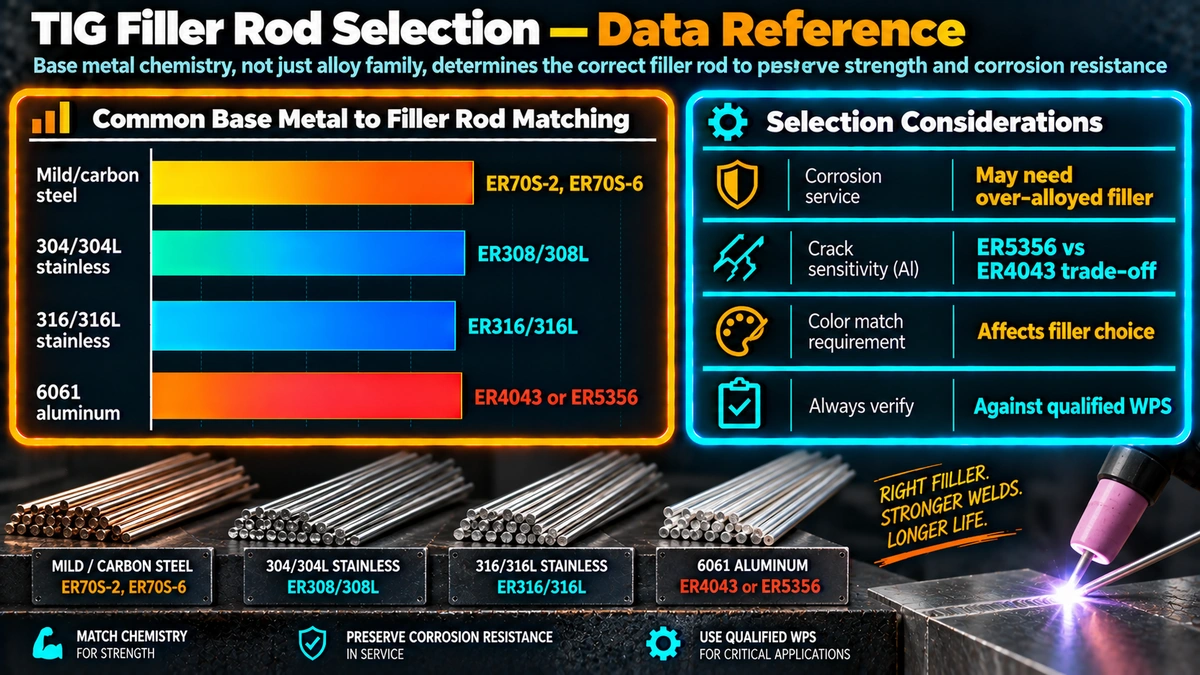
How AWS Filler Families Map to Base Metal
Cross-reference: if your job involves dissimilar metals or P-Number transitions, review the P-Number and F-Number guide alongside this filler rod chart, since filler metal selection and procedure qualification rules interact closely on dissimilar joints.
Conclusion
Choosing the right TIG filler rod comes down to three variables working together: base metal composition, joint type, and stock thickness, with surface cleanliness as a secondary factor that can shift you toward a more forgiving alloy. Use the AWS ER classification system to narrow down the alloy family, the thickness-based diameter guidelines to size the rod, and the settings tables to dial in tungsten size, gas flow, amperage, and travel speed together rather than in isolation.
With practice, filler rod selection becomes close to automatic for the materials you weld regularly. Until then, the charts in this guide and the calculator above give you a validated starting point for nearly any combination of base metal, thickness, and joint type you are likely to encounter.
Frequently Asked Questions
Do I always need a filler rod for TIG welding?
No, fusion welds without filler rod are possible on gap-free butt joints in metal around 1/8 inch or thicker, but they run hotter, risk burn-through, and are weaker, so they are mainly used for tacking rather than structural welds. Most production TIG welding uses a filler rod to control bead profile and build adequate weld strength.
What filler rod do I use for mild steel TIG welding?
ER70S-6 is the standard general-purpose filler rod for mild and low carbon steel TIG welding because its higher deoxidizer content tolerates light mill scale and rust better than other ER70S variants. ER70S-2 is a common alternative for cleaner base metal or where a triple deoxidized rod is preferred. See the GTAW process guide for related setup details.
What is the difference between ER308L and ER309L stainless filler rod?
ER308L is matched to 200-series and 300-series austenitic stainless steels such as 304 and is the default choice for same-grade stainless welding. ER309L has a higher chromium and nickel content and is used for welding dissimilar metal joints, most commonly stainless steel to mild or low alloy steel, and it tolerates higher heat input than ER308L.
How do I choose the correct TIG filler rod diameter?
As a starting guideline, use a filler rod diameter equal to or slightly less than the base metal thickness for material under 1/8 inch, and step up roughly one size per 1/16 inch of additional thickness beyond that. On thin stainless sheet, drop one rod size below what you would use on equivalent carbon steel, since stainless is usually welded at lower amperage and an oversized rod chills the puddle.
Can I use ER4043 for all aluminum alloys?
ER4043 is a good general-purpose filler for most wrought and cast aluminum alloys, but it is not recommended for 2xxx or 7xxx series aluminum due to cracking risk and poor compatibility. ER5356 is the better choice for 5xxx series aluminum and is preferred when the finished part will be anodized, since ER4043 can leave a visible gray streak after anodizing.
Why does my aluminum filler rod ball up before reaching the puddle?
This usually happens on thicker aluminum sections where heat radiating from the arc melts the rod tip before you can feed it into the puddle. Try tightening the arc length and reducing torch angle first, and if the rod still balls, step up one filler rod diameter so it has more thermal mass to resist premature melting.
Can I use a stick welding electrode as TIG filler rod?
No. SMAW stick electrodes are coated with flux that produces slag and shielding gas through combustion, and that coating is incompatible with the inert gas shielding used in GTAW. Always use bare, uncoated rods specifically designated as TIG or GTAW filler material, identified by an ER classification number. Review the SMAW guide to see how the two consumable types differ.
Does joint type change the filler rod or amperage I should use?
The filler rod alloy and diameter generally stay the same for a butt joint and a fillet joint on the same material and thickness, but fillet joints typically need somewhat higher amperage because the joint pulls heat into two intersecting plates instead of one continuous plane. Travel speed is usually reduced slightly on fillet welds to maintain adequate fusion at the root. See the welding joint types guide for more on how geometry affects heat input.
Recommended Reading
TIG Welding Filler Rod Assortment
Multi-diameter ER70S-6, ER308L, and ER4043 filler rod sets suitable for general steel, stainless, and aluminum TIG work.
View on AmazonGTAW / TIG Welding Handbook
A practical reference covering filler metal selection, tungsten preparation, and machine setup for gas tungsten arc welding.
View on AmazonAWS Filler Metal Specification Reference
A technical reference covering AWS A5 series filler metal classifications across steel, stainless, aluminum, and titanium.
View on AmazonTungsten Electrode Assortment for GTAW
Mixed tungsten electrode set covering common sizes used alongside the filler rod selections in this guide.
View on AmazonDisclosure: WeldFabWorld participates in the Amazon Associates programme (StoreID: neha0fe8-21). If you purchase through these links, we may earn a small commission at no extra cost to you. This helps support free technical content on this site.