MIG Welding Gas Flow Rate Settings: The Complete CFH Guide
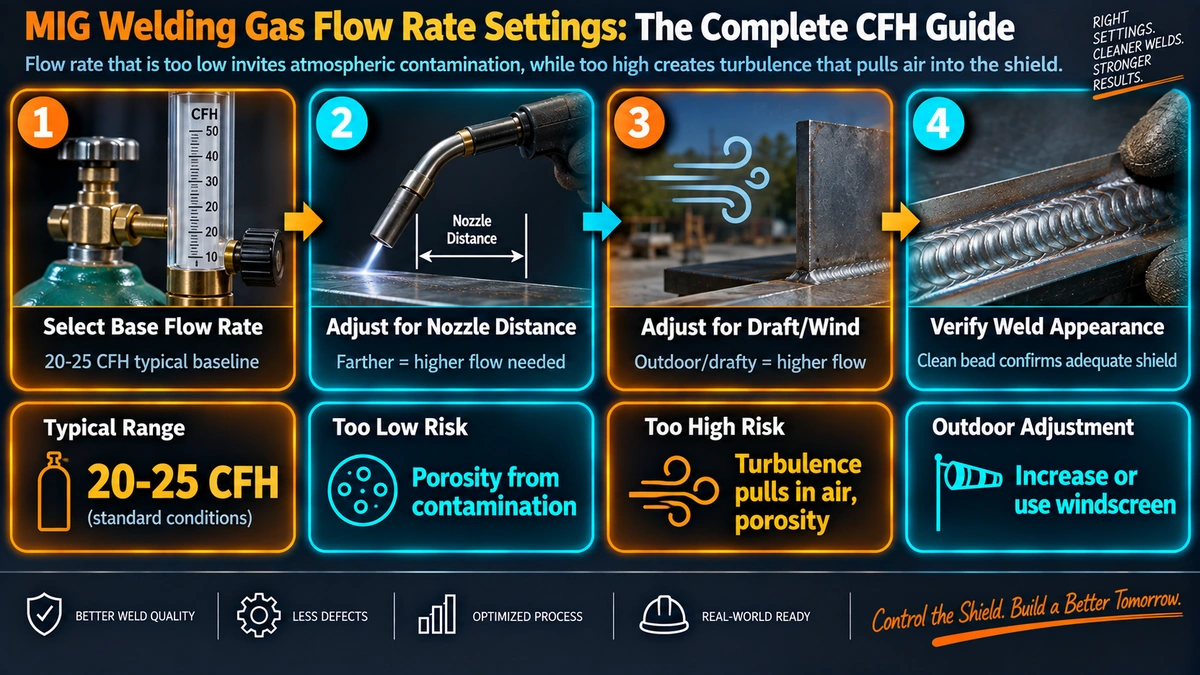
MIG welding gas flow rate is one of the most underestimated settings on a welding machine. Too little shielding gas leaves the weld pool exposed to the atmosphere, and too much gas does almost the same thing through a different mechanism. Getting the gas flow rate right, in CFH or liters per minute, is what separates a clean, sound weld bead from one riddled with porosity and weak fusion at the toes.
This guide walks through the correct shielding gas flow rate for mild steel, stainless steel, and aluminum using the gas metal arc welding (GMAW) process, explains why nozzle diameter and welding location change the target flow rate, and shows how to read a standard two-gauge regulator versus a ball-type flow meter. A free calculator below lets you generate a starting flow rate for your material and gas combination and estimate how long a gas cylinder will last at that setting.
If you are still selecting wire feed speed, voltage, and polarity for the job, it helps to work through the fundamentals of the GMAW welding process alongside this article, since gas flow rate interacts directly with travel speed and wire feed speed.
MIG Shielding Gas Flow Rate & Cylinder Duration Calculator
Select your material, gas type, nozzle size, and welding environment to get a starting flow rate range, then estimate cylinder run time.
Quick rule of thumb: for indoor MIG welding of mild steel with a 1/2 inch nozzle, start at 20 to 30 CFH (9 to 14 L/min). For stainless steel, start at 20 to 25 CFH. For aluminum with pure argon, start at 25 to 35 CFH. Adjust upward only if you see porosity, and never increase flow rate as a substitute for shielding the joint from wind.
Why Shielding Gas Flow Rate Matters
Shielding gas in MIG welding has one job: keep atmospheric nitrogen, oxygen, and water vapor away from the molten weld pool and the cooling weld metal until it solidifies enough to resist contamination. When that gas envelope is interrupted, even briefly, the result is porosity, oxide inclusions, and in some cases hydrogen-related cracking depending on the base metal.
Most welders assume more gas always means better protection, but that is only true up to a point. Shielding gas flow rate behaves like a balance, not a one-directional dial. Below the minimum, the gas envelope is too thin and too short to fully cover the weld pool and the surrounding heat-affected zone before it cools. Above the maximum for a given nozzle size, the gas stream becomes turbulent as it exits the nozzle, and that turbulence actively pulls outside air into the shielding envelope instead of keeping it out.
The Venturi Effect and Excess Flow
The venturi effect explains why running shielding gas too high produces the same defects as running it too low. As gas exits the nozzle at high velocity, it creates a low-pressure zone at the nozzle edge. Surrounding air gets drawn into that low-pressure zone and mixes directly into the gas stream, contaminating the very envelope that is supposed to keep air out. The practical result is that doubling your flow rate past the recommended maximum does not give you double the protection — past a certain point it actively works against you.
Common mistake: opening the gas valve wider after seeing porosity, without checking nozzle condition, stick-out, or drafts first. If spatter has built up inside the nozzle or the contact tip stick-out is excessive, more gas flow will not fix the coverage problem and may push you into the turbulent, venturi-affected range instead.
Recommended Flow Rate by Base Metal
Mild and Carbon Steel
Mild steel is the most forgiving material to shield. For indoor work using pure CO2 or a 75/25 argon/CO2 blend through a standard 1/2 inch nozzle, 10 to 15 CFH is often enough in calm, draft-free conditions, with most welders settling on 20 to 30 CFH as a more reliable working range once any porosity shows up. Faster travel speed and higher wire feed speed both widen the molten pool and shorten the time available for the gas envelope to do its job, so flow rate should trend toward the higher end of the range as travel speed increases.
If you are running a nozzle larger than 1/2 inch on heavier fabrication work, the shielding gas range typically shifts up to 22 to 55 CFH, since the larger gas column needs more volume to maintain the same gas velocity and coverage diameter over the joint.
Stainless Steel
Stainless steel adds metallurgical sensitivity on top of the same shielding requirements. A starting point of 20 to 25 CFH works for most 1/2 inch nozzle setups, increasing toward 30 CFH if porosity appears at the weld toes. Many stainless WPSs call for a tri-mix gas of roughly 90 percent helium, 7.5 percent argon, and 2.5 percent CO2, or similar ratios, to improve heat input and bead wetting.
Because helium is far less dense than argon or CO2, increasing flow rate on a helium-rich mix increases the proportion of helium reaching the arc relative to argon, which can concentrate heat input faster than expected. Combined with poor heat management, that can push thin stainless sheet toward warping or, in austenitic grades, toward sensitization and carbide precipitation in the heat-affected zone if interpass temperatures run high. If your work involves duplex stainless steel welding, heat input control through both amperage and gas selection becomes even more critical because of the austenite-to-ferrite balance in the weld metal.
Aluminum
Aluminum’s high thermal conductivity forces faster travel speeds to avoid excessive heat buildup, and faster travel speed always demands a correspondingly higher shielding gas flow rate to keep the envelope intact over a faster-moving arc. Pure argon at 25 to 35 CFH is the standard starting point for most aluminum MIG work.
On thicker aluminum sections, helium is sometimes blended into the argon to improve arc penetration and travel speed further, since helium transfers heat more efficiently than argon. A blend of roughly 75 percent helium and 25 percent argon can require flow rates as high as 50 CFH because of helium’s low density, compared to a pure argon flow rate on the same joint.
| Base Metal | Typical Gas | Flow Rate (CFH) | Flow Rate (L/min) | Notes |
|---|---|---|---|---|
| Mild Steel | Pure CO2 | 15-25 | 7-12 | Standard Economical, more spatter |
| Mild Steel | 75/25 Ar/CO2 | 20-30 | 9-14 | Standard Cleaner arc, less spatter |
| Stainless Steel | 98/2 Ar/CO2 | 20-30 | 9-14 | Standard Short circuit / spray transfer |
| Stainless Steel | Tri-mix Ar/He/CO2 | 20-25 | 9-12 | Caution Watch heat input on thin sheet |
| Aluminum | Pure Argon | 25-35 | 12-16.5 | Standard Thin to medium section |
| Aluminum | 75% He / 25% Ar | 35-50 | 16.5-23.6 | High flow Thick section, high penetration |
Flow Rate by Nozzle Diameter
Nozzle diameter directly sets the cross-sectional area the gas has to fill, so flow rate must scale with it. A smaller nozzle needs less gas to maintain proper coverage velocity, while a larger nozzle needs proportionally more.
| Nozzle Diameter | Indoor Flow Rate (CFH) | Light Draft (CFH) | Outdoor / Open Bay (CFH) |
|---|---|---|---|
| 3/8 in (9.5 mm) | 15-20 | 18-24 | 22-28 |
| 1/2 in (12.7 mm) | 20-30 | 24-35 | 30-40 |
| 5/8 in (15.9 mm) | 25-35 | 30-40 | 35-45 |
| 3/4 in (19 mm) and larger | 30-40 | 35-48 | 40-55 |
Practical note: these ranges are general engineering starting points, not a substitute for the flow rate recorded on a qualified WPS. If you are welding to a code such as ASME Section IX or AWS D1.1, follow the flow rate range specified in the qualified procedure, and reproduce production conditions, including nozzle size and stick-out, as closely as possible to those used during procedure qualification.
Reading a Gas Regulator vs a Flow Meter
There are two common ways to set and read shielding gas flow rate on a MIG welding gas bottle, and understanding the difference matters because they fail differently over time.
A standard regulator has two gauges. One shows cylinder pressure in PSI, and the second uses a spring-loaded needle to estimate outgoing flow rate in CFH. A ball-type flow meter instead pairs a single pressure gauge with a vertical graduated tube; gas flowing through the tube lifts a small ball to a height proportional to the flow rate, and you read the flow rate at the ball’s resting position.
Both designs work well when new. The difference shows up over time: spring-and-needle gauges can drift or stick as the mechanism wears, while a gravity-based flow meter has no spring to fatigue, so its reading tends to stay accurate for longer with the same usage.
CFH or Liters Per Minute
Cubic feet per hour is the standard unit for shielding gas flow rate in most welding literature and most regulators sold for MIG and TIG work. Some regulators, particularly metric-market models, display liters per minute instead. The conversion is straightforward: multiply CFH by 0.4719 to get L/min, or divide L/min by 0.4719 to get CFH.
Matching the Regulator to the Gas
Different shielding gases have different densities, and a flow meter calibrated for one gas will read incorrectly on another. An argon-calibrated flow meter, for example, will not give an accurate CFH reading if connected to a pure helium cylinder, because helium is far less dense and moves through the metering orifice differently. This matters less between CO2 and argon, which are reasonably close in density, but it matters a great deal once helium-rich blends are involved.
Pure CO2 and Regulator Freezing
Pure CO2 expands rapidly as it leaves the cylinder, and that rapid expansion absorbs heat from the regulator body, sometimes enough to cause frost buildup on the regulator during extended welding sessions. A regulator specifically rated for CO2 service reduces this risk. It also helps to know that CO2 cylinders use a CGA-320 connector, while argon, argon blends, and helium cylinders use the CGA-580 connector; an adapter is required to connect a standard Ar/CO2-rated regulator to a CO2-only cylinder fitted with a CGA-320 outlet.
Minimum and Maximum Flow Rate Limits
The minimum usable flow rate depends on the base metal, the joint geometry, and how much air movement is present around the weld. Aluminum generally should not run below about 20 CFH because of its higher travel speed requirement, while mild steel can work acceptably as low as 10 CFH in still air with a tight, narrow joint. As a general floor, most welders avoid going below 10 to 15 CFH on any material, since wide joints, high wire feed speed, and fast travel speed all increase the gas demand even when the base metal itself is forgiving.
The maximum flow rate is set by the venturi effect described earlier. Once flow rate exceeds what a given nozzle diameter can deliver as a stable, laminar column, the gas stream becomes turbulent at the nozzle exit and begins drawing in surrounding air instead of excluding it. That ceiling rises with nozzle diameter, which is why Table 2 shows higher maximum values for larger nozzles.
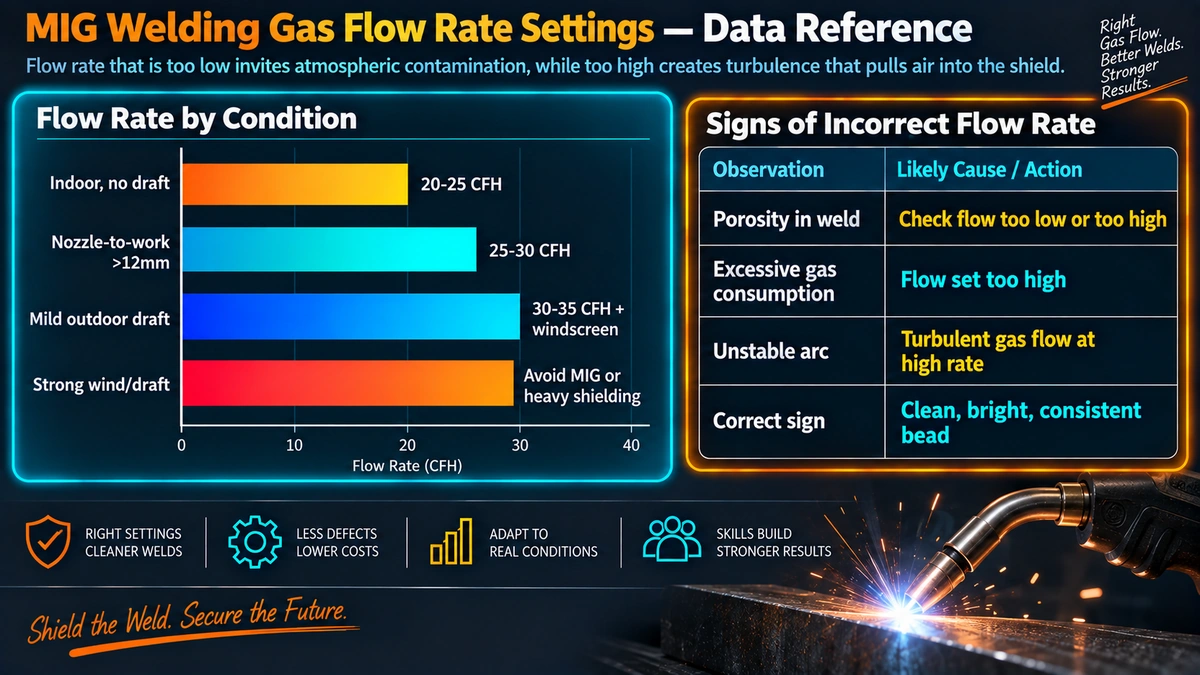
Field tip: if you suspect your flow rate is too high rather than too low, look at the porosity pattern. Porosity from insufficient flow tends to cluster at the start of the weld and along the toes where coverage is thinnest. Porosity from excessive, turbulent flow tends to appear more randomly along the weld length, including in the middle of straight runs where coverage should otherwise be solid.
Worked Example: Setting Flow Rate and Estimating Cylinder Life
How Welding Parameters Change Gas Demand
Flow rate does not work in isolation from your other MIG settings. A few interactions are worth knowing before you adjust the gas valve:
- Travel speed: faster travel speed shortens the dwell time of the gas envelope over any given point on the weld pool, pushing flow rate requirements toward the higher end of the range.
- Wire feed speed: higher wire feed speed widens the molten pool and increases deposition rate, both of which increase the area that needs shielding at any instant.
- Stick-out and nozzle-to-work distance: excessive stick-out increases the distance the gas has to travel before reaching the weld pool, weakening coverage even at a correct CFH setting.
- Drafts and ventilation fans: any air movement across the weld disrupts the gas envelope directly, which is why outdoor and fan-cooled environments need a meaningfully higher flow rate than a still indoor shop.
If you are still finalizing wire feed speed and voltage for the joint, cross-check those values against a MIG welding settings calculator before locking in your gas flow rate, since the two settings are tuned together rather than independently.
Shielding Gas Selection at a Glance
| Gas / Blend | Typical Composition | Best For | Notes |
|---|---|---|---|
| Pure CO2 | 100% CO2 | Mild steel, structural work | Economical More spatter, deeper penetration |
| 75/25 Ar/CO2 | 75% Ar, 25% CO2 | Mild steel, general fabrication | Balanced Smoother arc, less spatter |
| 98/2 Ar/CO2 | 98% Ar, 2% CO2 | Stainless steel, spray transfer | Standard Good bead wetting |
| Tri-mix (Ar/He/CO2) | ~90% He, 7.5% Ar, 2.5% CO2 | Stainless steel, higher productivity | Caution Manage heat input carefully |
| Pure Argon | 100% Ar | Aluminum, thin to medium section | Standard Fully inert, required for Al |
| Ar/He blends | Up to 75% He | Thick aluminum sections | High flow Improves penetration and speed |
Cross-reference: if you are also documenting weldability for a mixed-material job, the carbon equivalent calculator and P-Number / F-Number guide are useful companions to this gas flow rate guide when finalizing a complete WPS package.
Troubleshooting Porosity Related to Gas Flow
| Symptom | Likely Cause | Corrective Action |
|---|---|---|
| Porosity at weld start and toes | Flow rate too low for joint width / nozzle size | Increase flow within Table 1 / Table 2 range |
| Random porosity along straight runs | Flow rate too high, turbulent / venturi entrainment | Reduce flow rate, check nozzle diameter match |
| Porosity only in windy / fan-cooled areas | Draft disrupting gas envelope | Shield the joint with screens, raise flow per Table 2 |
| Porosity despite correct CFH reading | Spatter buildup inside nozzle, or excessive stick-out | Clean nozzle, reduce stick-out, check diffuser holes |
| Sudden porosity mid-job, flow steady | Cylinder running low, pressure drop affecting flow | Check cylinder pressure gauge, replace cylinder |
Frequently Asked Questions
What is the best gas flow rate for MIG welding mild steel?
For indoor work with a 1/2 inch nozzle, 20 to 30 CFH (9 to 14 L/min) of either pure CO2 or a 75/25 argon/CO2 blend is the usual starting range for mild steel. Drop to 15 to 20 CFH for short-circuit work on thin sheet, and raise it toward 30 to 35 CFH if there is any air movement around the joint. See the full GMAW process guide for related parameter settings.
How many CFH do I need for MIG welding aluminum?
Aluminum typically needs 25 to 35 CFH (12 to 16.5 L/min) of pure argon because the higher thermal conductivity of aluminum demands faster travel speed and a wider, more stable gas envelope. If helium is blended in to improve penetration on thicker sections, flow rate often has to increase to 35 to 50 CFH since helium is far less dense than argon.
What happens if shielding gas flow rate is too high?
Excess flow rate creates turbulence at the nozzle exit. Through the venturi effect, that turbulence pulls surrounding atmospheric air into the shielding gas envelope instead of keeping it out, which produces the same porosity and nitrogen contamination you would get from too little gas. Running gas needlessly high also wastes cylinder gas and increases cost per weld.
What is the difference between a gas regulator and a flow meter?
A standard two-gauge regulator shows cylinder pressure on one gauge and an estimated flow rate on a second spring-and-needle gauge. A ball-type flow meter shows only cylinder pressure on one gauge and uses a vertical graduated glass or plastic tube with a free-floating ball to display the actual outgoing flow rate by gravity, which tends to stay accurate for longer since it has no spring mechanism to fatigue.
How do I convert CFH to liters per minute?
Multiply the CFH value by 0.4719 to get liters per minute, or divide the L/min value by 0.4719 to get CFH. As a quick reference, 20 CFH is approximately 9.4 L/min, and 30 CFH is approximately 14.2 L/min.
Why does my CO2 regulator freeze during MIG welding?
Pure CO2 expands rapidly as it leaves the cylinder and absorbs heat from the regulator body in the process, which can frost the regulator and, in extended use, slow or stop gas flow. Using a regulator specifically rated for CO2, and a CGA-320 to CGA-580 adapter where required, reduces the chance of icing during long welding runs.
Does shielding gas flow rate change with nozzle size?
Yes. A larger nozzle diameter needs a higher flow rate to maintain the same gas velocity and coverage area over the weld pool. A 3/8 inch nozzle typically runs 15 to 20 CFH, while a 3/4 inch or larger nozzle may need 30 to 55 CFH for equivalent shielding.
Is shielding gas flow rate an essential variable in welding procedure qualification?
Under ASME Section IX, the type and composition of shielding gas is generally a more significant qualification variable than the exact flow rate, though the flow rate used during qualification should still be recorded on the WPS and PQR and reproduced within a reasonable tolerance in production. Always check the applicable code edition and the specific WPS for the governing requirement, and review related parameters in the welding joint types guide when finalizing a procedure.
Recommended Reading
MIG / GMAW Welding Handbook
A practical reference covering shielding gas selection, transfer modes, and machine setup for gas metal arc welding.
View on AmazonWelding Gas Regulator with Flow Meter
A dual-gauge or ball-type flow meter regulator suitable for argon, CO2, and Ar/CO2 blends used in MIG welding.
View on AmazonShielding Gas and Welding Atmosphere Reference
A technical guide to shielding gas chemistry, mixtures, and their effect on arc behavior and weld metallurgy.
View on AmazonAWS Welding Handbook Reference Set
Industry-standard reference material covering welding processes, procedures, and shielding gas requirements across processes.
View on AmazonDisclosure: WeldFabWorld participates in the Amazon Associates programme (StoreID: neha0fe8-21). If you purchase through these links, we may earn a small commission at no extra cost to you. This helps support free technical content on this site.