ASME Section IX
Article II — Welding Procedure Qualifications
Complete single-page training guide covering WPS, PQR, variable types, Article IV definitions, P/F/A Numbers, heat input formula, compliance — with a 20-question timed quiz at the end.
What You Will Learn
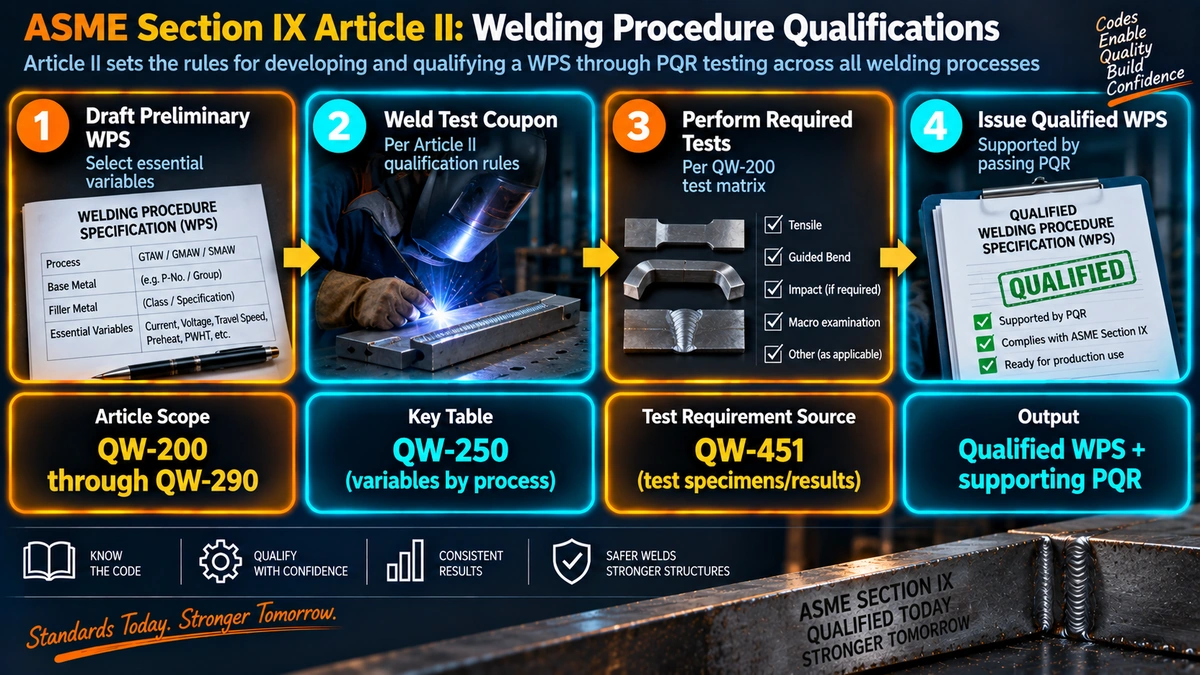
This training covers all of ASME BPVC Section IX Article II — Welding Procedure Qualifications — with complete Article IV variable definitions. No Code book required; all relevant content is included here. Work through each section in order, then test yourself with the timed quiz.
- ①Understand WPS & PQR purpose, format, and content requirements per QW-200
- ②Classify every variable as Essential, Supplementary Essential, or Nonessential
- ③Know when WPS requalification is required vs. documentation only
- ④Apply Article IV definitions to variable paragraphs QW-402 to QW-410
- ⑤Master P-Numbers, F-Numbers, A-Numbers and the QW-409.1 heat input formula
- ⑥Identify non-compliant WPS/PQR documents in audits and peer reviews
| M1 | Art.II & Art.IV — The Code Bridge |
| M2 | QW-200.1 WPS Contents, Changes & Format |
| M3 | QW-200.2 PQR Contents, Certification & Combinations |
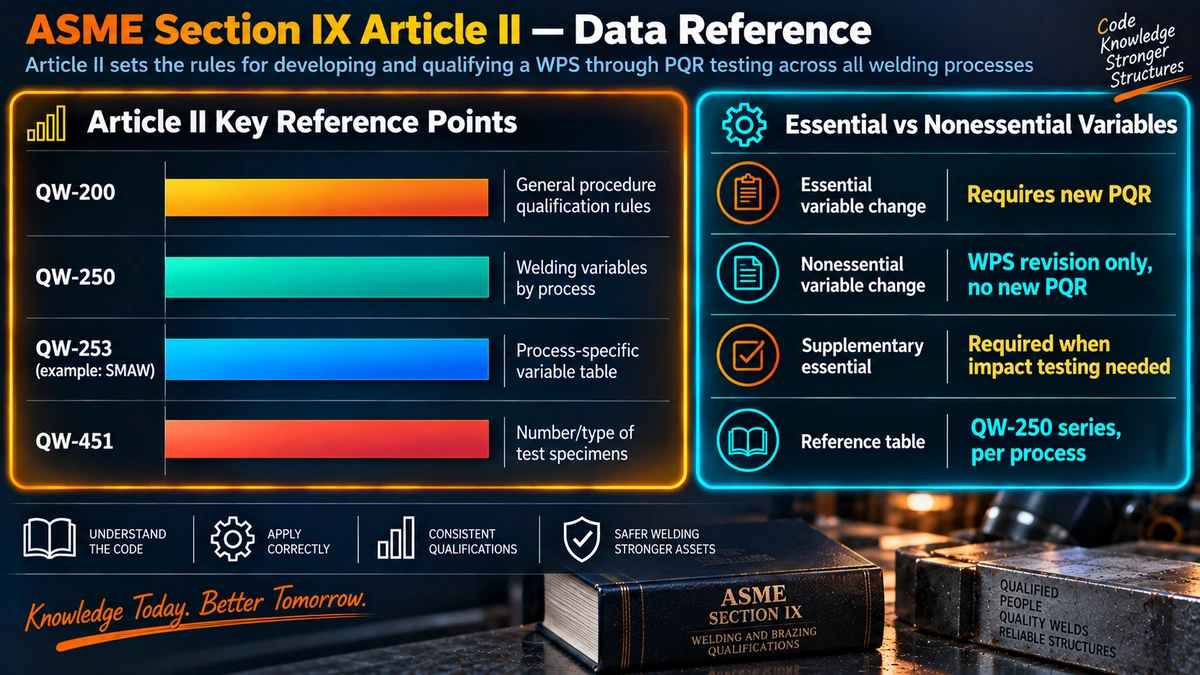
| M4 | QW-251 Three Variable Types |
| M5 | Article IV Groups QW-402 to QW-410 |
| M6 | P-Numbers, F-Numbers & A-Numbers |
| M7 | QW-409.1 Heat Input Formula |
| M8 | QW-202 Tests + QW-250 Table Reference |
| M9 | Special Processes + Compliance Checklist |
Article II & Article IV — The Essential Code Bridge
Article II and Article IV are inseparable. Understanding this relationship is the single most important concept in Section IX — Article II lists the variables; Article IV defines them.
ARTICLE II
QW-200 to QW-290
- Lists variables per process in QW-250 tables (brief references)
- Specifies required tests, positions, coupon dimensions
- Sets acceptance criteria for tension, bend, toughness
- Contains forms QW-482 & QW-483 (guide only)
- Defines the WHAT and HOW MUCH to test
ARTICLE IV
QW-400 to QW-416
- Provides COMPLETE DEFINITIONS for every variable in QW-250
- QW-402 Joints through QW-410 Technique — nine variable groups
- Exact quantitative thresholds and legal scope of each variable
- Applies to ALL welding processes — one definition, universal
- The authoritative legal definition for Code compliance
THE RESULT
Qualified WPS + PQR
- WPS: written instruction document for production welding
- PQR: certified test coupon evidence record
- Both documents cite specific Article IV paragraph numbers
- Organisation authorised to commence production welding
- Any change checked against Article IV for requalification
QW-200.1 — Welding Procedure Specification (WPS)
The WPS is the written production welding instruction. Understanding its required contents, what may change without requalification, and what cannot, is fundamental to Code compliance.
A WPS is a written qualified welding procedure providing direction for production welds to Code requirements. The WPS or other documents may be used to provide direction to the welder or welding operator to assure compliance with Code requirements.
Must describe ALL variables for EACH welding process used:
- Essential variables — defined in Article IV
- Nonessential variables — defined in Article IV
- Supplementary essential variables — when toughness testing is required
Must REFERENCE the supporting PQR number(s) per QW-200.2. May include any other information helpful for making the weld joint.
NONESSENTIAL variables:
→ Change WITHOUT requalification — document by WPS amendment or new revision
ESSENTIAL or SUPPLEMENTARY ESSENTIAL variables:
→ Changes REQUIRE WPS requalification
→ New or additional PQR(s) must be obtained
→ Even ONE essential variable change = new or additional PQR needed
• Any written or tabular format is acceptable
• Form QW-482 (Appendix B) = GUIDE ONLY — not mandatory
• Custom formats valid if all QW-250 variables for each process are addressed
• One WPS may cover multiple welding processes if all variables are fully included
“Variables listed in QW-250 are DEFINED in Article IV, Welding Data.“
• QW-250 = brief reference (paragraph number + one-line description)
• Article IV = complete legal definition with exact quantitative thresholds
→ ALWAYS look up Article IV before making any WPS change decision
QW-200.2 — Procedure Qualification Record (PQR)
The PQR is the evidence record — it records exactly what happened during test coupon welding. Understanding PQR rules, permitted changes, and the relationship between multiple WPSs and PQRs is essential.
Record of variables ACTUALLY USED during welding of the test coupon — plus all test results. Actual variables fall within a small range — NOT the full intended production range of the WPS. The PQR is EVIDENCE — not instruction.
Must document:
- ALL essential variables (per QW-250)
- ALL supplementary essential variables (when required)
- Nonessential variables = optional to record
- ACTUAL values used — not planned values
- Certified by the ORGANISATION only
Changes NOT permitted EXCEPT:
1. Editorial corrections (wrong P-No., F-No., A-No.)
2. Addenda required by Code changes
All changes require RECERTIFICATION with updated signature and date.
Format: Form QW-483 = guide only; any format acceptable. Must include every essential + supplementary essential variable and list type, number, and results of all required tests.
Availability: Must be available for REVIEW by Authorised Inspector. Need NOT be given to welder or welding operator.
Many WPSs from ONE PQR: Several WPSs may be supported by a single PQR within its qualified variable range. A 1G plate PQR can support WPSs for all positions AND plate AND pipe.
One WPS from MULTIPLE PQRs: A single WPS may cover multiple thickness ranges if a supporting PQR exists for each range.
CRITICAL: PQR coupon thickness ≠ qualified production range — always apply QW-451.
QW-251 — Three WPS Variable Types
Every welding variable in every QW-250 process table belongs to one of three types. Correctly classifying any variable is the most important skill in Article II — get it wrong and the WPS becomes non-compliant.
Essential Variables
QW-251.2
→ New or additional PQR(s) needed
- QW-403.1: change from one P-No. to another
- QW-404.4: change from one F-No. to another
- QW-406.1: preheat decrease >100°F (55°C)
- QW-407.1: PWHT applied/removed/changed
- QW-409.1: increase in heat input
Supplementary Essential
QW-251.2 §2
→ Treated same as essential variables
- QW-403.5: Group No. change within P-No.
- QW-403.6: min base metal thickness
- QW-407.2: PWHT temp. & time range
- QW-409.1: increase in heat input
- QW-409.30: current/polarity change
Nonessential Variables
QW-251.3
→ Document by WPS amendment or new revision
- QW-402.1: change in groove type
- QW-402.10: change in root opening
- QW-404.6: change in electrode diameter
- QW-405.1: addition of welding positions
- QW-410.1: stringer to weave bead
Article IV — Nine Variable Group Definitions QW-402 to QW-410
Article IV contains COMPLETE definitions for every variable paragraph referenced by QW-250. Never rely on the QW-250 one-line brief — always go to Article IV for the exact quantitative threshold.
Groove type — V, U, bevel, square. Backing — addition or deletion. Root opening and root face. Retainers / lap joint configuration.
P-Number — base metal grouping. Group Number — toughness sub-grouping. Qualified thickness T (from QW-451). Pipe diameter / tube wall thickness.
F-Number — usability family. A-Number — weld deposit chemistry. Electrode diameter / wire size. Classification and product form.
Addition of welding positions beyond those tested. Vertical welding direction change (uphill ↔ downhill).
Decrease >100°F (55°C) from qualified preheat. Preheat maintenance requirements. Interpass temperature increase above qualified.
PWHT applied, removed, or condition changed. PWHT temperature and holding time range.
Shielding gas type and composition. Gas flow rate changes. Backing gas — addition or deletion.
Heat input increase (formula — see next section). Current type and polarity change. Amperage and voltage ranges.
⭐ QW-409.1 = most commonly triggered SE variable
String bead vs. weave bead change. Multiple passes → single pass change. Back-gouge method change or addition. Manual, semiauto, machine, or automatic.
P-Numbers, F-Numbers & A-Numbers — Classification Systems
These three numbering systems are the backbone of welding procedure qualification. Each groups materials or consumables for a different reason. Confusing them is a common and serious error in practice.
Base Metal Grouping Number
QW-403 / Table QW/QB-422
Key Points
- Group Numbers sub-classify metals for TOUGHNESS qualification (change = Supplementary Essential)
- P-No. 11 quenched & tempered: impact tests ALWAYS mandatory regardless of Code invocation
- P-Number grouping ≠ free metallurgical interchangeability — check design, PWHT, service separately
- P-No.1 covers SA-516 Gr.60/65/70 — one PQR may support WPSs for all three grades
Filler Metal Family Number
QW-404.4 / Table QW-432
Key Points
- F-1/F-2: EXX20/22 | F-3: EXX10/11 cellulosic (DCEP) | F-4: EXX15/16/18 low hydrogen
- F-5: austenitic stainless steel covered electrodes (EXX-15, -16, -17 types)
- F-6: bare solid/metal-cored filler metals for GTAW, GMAW, SAW
- F-3 → F-4 change = full requalification — different arc behaviour and technique
Weld Metal Chemistry Analysis
QW-404.5 / Table QW-442
Key Points
- A-1: mild steel (C ≤0.15%, Mn ≤1.60%, Si ≤0.80% — e.g. E6013, E7018)
- A-2: carbon-molybdenum steel weld deposit (Mo 0.40–0.65%)
- A-8: austenitic stainless steel deposit (Cr 17–26%, Ni 8–15%)
- Qualification by chemical analysis of actual weld deposit — not electrode certificate alone
QW-409.1 — Heat Input Formula
The heat input variable is the most commonly triggered Supplementary Essential Variable in toughness-required applications. Every welding engineer must know this formula by heart.
Increasing amperage increases heat input. Higher current deposits more energy per unit length of weld. Even small amperage increases can trigger SE requalification.
Increasing voltage increases heat input. Higher arc voltage means more energy per unit length of weld. Voltage changes are common during field operations.
Decreasing travel speed increases heat input. Slower travel = more energy delivered per inch of weld. Common when changing from automatic to manual welding.
Any combination that INCREASES the calculated J/in value from the PQR triggers requalification when toughness is required.
PQR parameters: 120A, 22V, travel speed 8 in./min
PQR Heat Input = (120 × 22 × 60) / 8 = 19,800 J/in
Proposed production parameters: 130A, 24V, travel speed 7 in./min
New Heat Input = (130 × 24 × 60) / 7 = 26,743 J/in → INCREASE → SE Variable triggered when toughness required
Action required: New or additional PQR at the higher heat input parameters if toughness testing is invoked by the referencing Code.
QW-202 Tests Required + QW-250 Master Variable Table
Understanding how to read QW-250 variable tables and how QW-202 determines the required tests is essential for writing and reviewing welding procedures.
Qualifies thickness of BOTH base metal AND deposited weld metal. Required specimens: TENSION + GUIDED-BEND (+ toughness when required). Thickness ‘t’ in QW-451 EXCLUDES weld reinforcement.
Qualified by groove weld test coupons per (a) or (b). Qualifies ALL thicknesses, ALL fillet sizes, ALL pipe diameters. Alternate: dedicated fillet weld test per QW-180.
Unless specifically required by QW-250: qualification in ANY position qualifies for ALL positions. Process and electrodes must be suitable for all permitted positions.
QW-250 Table Reading Guide — SMAW (QW-253) with Article IV Links
| Art.IV Para. | Brief (Art.II) | Type | Article IV — Complete Definition |
|---|---|---|---|
| QW-402.4 | −Backing | EV | Deletion of backing in single-welded groove welds = Essential. Double-welded grooves = WITH backing — not triggered. |
| QW-403.8 | ϕT Qualified | EV | Base metal thickness beyond QW-451 range = Essential. Apply QW-202.4(b) for dissimilar thickness exceptions. |
| QW-403.5 | ϕGroup No. | S.E. | Toughness: Group Number change within same P-Number = Supplementary Essential. |
| QW-404.4 | ϕF-Number | EV | Change from one filler family (Table QW-432) to any other = Essential. e.g. E7018 (F-4) to ER70S-6 (F-6) = requalify. |
| QW-404.5 | ϕA-Number | EV | Change in weld deposit composition group (Table QW-442) = Essential. A-1 and A-2 are interchangeable. |
| QW-406.1 | Dec >100°F | EV | Decrease >100°F (55°C) in minimum preheat = Essential. Minimum preheat must be specified on the WPS. |
| QW-407.1 | ϕPWHT | EV | Change between PWHT conditions = Essential. Separate PQR for each condition. |
| QW-409.1 | >Heat Input | S.E. | Toughness: Increase in heat input = Supplementary Essential. Formula: V × A × 60 ÷ travel speed (in./min). |
| QW-410.1 | ϕBead Type | NE | Change from stringer to weave bead = Nonessential. Document change in WPS only. No requalification needed. |
Special Processes, Compliance Checklist & Key Takeaways
Before applying Article II in practice, understand the special rules for overlay processes and be able to confidently audit any WPS/PQR package against the Code.
• Essential variables for overlay are FEWER and DIFFERENT from groove weld variables
• QW-381.2 (2025): Plate coupon min 6″×6″; overlay min 1½” wide; side-bend specimens PERPENDICULAR to welding direction
• QW-382 HFO: macro section 5×, LP exam at WPS min thickness
More than one WPS in a single production joint = ALLOWED.
• Use QW-451 to determine each process’s qualified thickness range INDEPENDENTLY
• One WPS may reference multiple PQRs (QW-200.4b)
• All PQRs must be of approved processes, coupons ≥½” thick
• Root layers up to 2t; fill layers up to max qualified thickness
✓ WPS/PQR Compliance Audit Checklist
[QW-200.1(b)][QW-200.1(b)][QW-200.2(b)][QW-200.2(b)][QW-200.1(c)][QW-200.3][QW-251.4][QW-200.1(b)]Five Golden Rules — Article II Mastery
Article II — 20-Question Timed Quiz
Test your understanding of all nine modules. Each question has a 20-second countdown timer. Unanswered questions are marked incorrect automatically when time expires. Explanations are shown after each answer.
Article II Knowledge Assessment
20 questions · 20 seconds per question · Explanations after each answer