Welding Hazards and Safety Precautions — A Complete Guide
Welding hazards are present in every welding and fabrication environment, from a small workshop to a major offshore construction site, and understanding them is the first step towards preventing injury, illness, and fatality. Welding is an essential trade that underpins the construction of buildings, bridges, ships, pressure vessels, and pipelines — but it is also one of the more hazardous occupations when safety controls are ignored or inadequate. The arc, the heat, the fumes, the electricity, the noise, and the radiation produced during welding are all capable of causing serious harm, some of it acute and immediately obvious, and some of it chronic and insidious — building up over a career of unprotected exposure.
This guide covers every major category of welding hazard in technical detail: the mechanisms by which harm occurs, the specific agents involved, the applicable exposure limits and standards, and the hierarchy of controls — from elimination and engineering controls through to personal protective equipment — that employers and welders must apply. Whether you are a welder preparing for work, a safety officer conducting a risk assessment, or a student studying for a welding certification, this article will give you the knowledge to recognise hazards and take informed, effective action.
Welding Hazard Overview
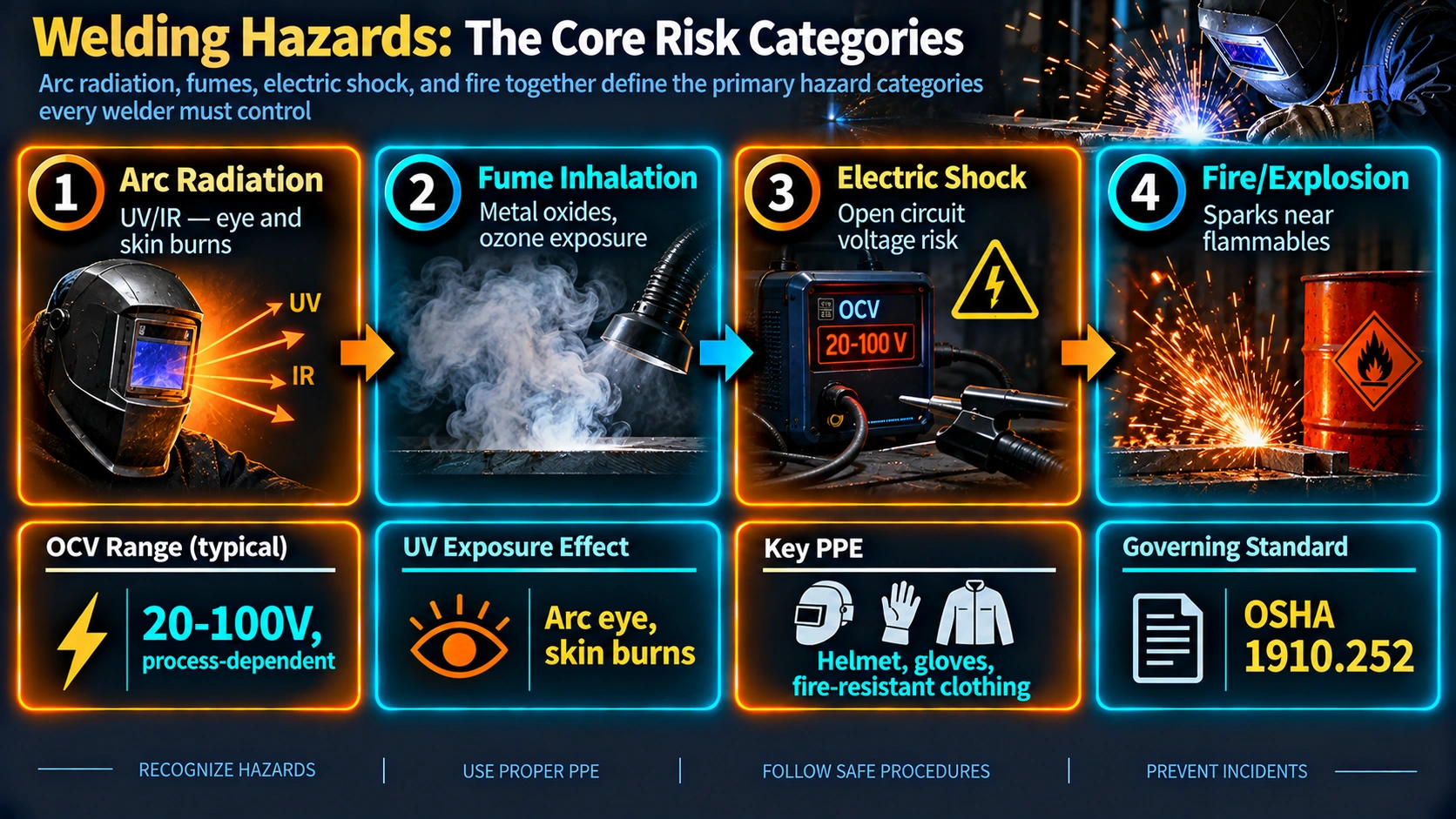
The table below summarises the six primary hazard categories, their severity classification, and the primary health or safety consequence. Detailed guidance for each follows in the sections below.
Hazard 1 — Welding Fumes and Gases
Exposure to welding fumes is the most widespread chronic health hazard in the welding industry. The welding arc vaporises base metal, filler metal, and coatings at temperatures exceeding 6,000 °C. These vapours rapidly oxidise and condense into fine metallic oxide particles — typically in the respirable range of 0.01 to 1 micrometre — which penetrate deep into the lung alveoli and cannot be cleared by normal mucociliary action.
In 2017, the International Agency for Research on Cancer (IARC) upgraded welding fume to Group 1 — confirmed human carcinogen, primarily associated with lung cancer and potentially kidney cancer. As a consequence, regulatory bodies worldwide have tightened permissible exposure limits and enforcement requirements. There is now no recognised minimum safe exposure level for welding fume as a whole.
Composition of Welding Fume by Base Material
| Base / Filler Material | Primary Fume Components | Key Health Hazard | Risk Level |
|---|---|---|---|
| Mild / carbon steel | Iron oxide, manganese oxide | Siderosis, manganism (neurological), lung cancer | High |
| Stainless steel (300 series) | Chromium (VI) oxide, nickel oxide, manganese | Lung/nasal cancer, occupational asthma, sensitisation | Critical |
| Galvanised / zinc-coated steel | Zinc oxide, lead (in old coatings) | Metal fume fever, lead poisoning | Critical |
| Aluminium | Aluminium oxide, ozone (from UV arc) | Respiratory irritation, aluminium lung (aluminosis) | High |
| Copper / copper alloys | Copper oxide, zinc oxide (brass) | Metal fume fever, irritation | High |
| Nickel alloys | Nickel carbonyl risk, nickel oxide | Lung cancer, sensitisation, nasal cancer | Critical |
| Painted / coated surfaces | Lead, cadmium, isocyanates (depending on coating) | Lead poisoning, cadmium lung, isocyanate asthma | Critical |
Welding Gases
In addition to particulate fume, welding processes generate and displace several hazardous gases:
- Carbon monoxide (CO) — Produced by incomplete combustion, particularly in oxyacetylene and SMAW processes. Colourless, odourless, and highly toxic. At concentrations above 200 ppm CO causes headache; above 1,000 ppm, rapidly fatal.
- Nitrogen oxides (NO, NO2) — Generated by high-temperature arc reactions with atmospheric nitrogen. NO2 is a potent lung irritant and can cause delayed pulmonary oedema hours after exposure.
- Ozone (O3) — Formed by UV radiation acting on atmospheric oxygen, particularly with GMAW on aluminium and GTAW. Causes respiratory irritation and is an occupational asthma agent.
- Phosgene (COCl2) — Generated when welding near chlorinated solvents (e.g., parts cleaned with TCE). Extremely toxic; causes delayed pulmonary oedema.
- Shielding gas displacement — Argon and CO2 used as shielding gases are heavier than air and will displace oxygen in confined or low-lying areas, creating asphyxiation risk without warning.
Illnesses Caused by Welding Fumes and Gases
- Pneumonia — Regular fume exposure predisposes to lung infections that can develop into serious or fatal pneumonia.
- Occupational asthma — Chromium oxides and nickel oxides from stainless steel and nickel alloy welding are both recognised asthmagens. Once sensitised, even low exposures trigger asthmatic episodes.
- Lung and nasal cancer — Confirmed IARC Group 1 carcinogen. Hexavalent chromium Cr(VI) from stainless steel welding is particularly implicated.
- Metal fume fever — Flu-like syndrome (chills, fever, muscle aches) caused by inhalation of freshly formed zinc oxide fumes. Typically self-limiting within 24–48 hours. Note: drinking milk before welding does not prevent metal fume fever — this is a persistent myth with no scientific basis.
- Siderosis — Benign deposition of iron oxide particles in lung tissue. Not disabling by itself but indicates ongoing uncontrolled fume exposure.
- Manganism — Neurological condition resembling Parkinson’s disease, caused by chronic manganese overexposure from high-manganese filler metals.
- Upper respiratory irritation — Throat dryness, coughing, tight chest, conjunctivitis from chronic low-level exposure.
Controls for Welding Fumes
Hazard 2 — Electric Shock
Electric shock is the most immediately life-threatening hazard in arc welding. The welding power source maintains a no-load (open circuit) voltage (OCV) between the electrode and the workpiece whenever the machine is switched on but not actively welding. For SMAW, OCV typically ranges from 50–80 V DC or up to 100 V AC; for GTAW and GMAW, OCV is typically 10–40 V. While these voltages may seem modest, the risk is determined not by voltage alone but by current through the body, path through vital organs, duration, and body resistance — which is dramatically reduced by moisture, sweat, or skin damage.
Even 50 mA passing through the chest for one second can cause ventricular fibrillation and cardiac arrest. The secondary hazard of electric shock — falling from height after a non-fatal shock — is responsible for a significant proportion of welding fatalities in construction and maintenance environments.
High-Risk Conditions for Electric Shock
| Condition | Why Elevated Risk | Key Precaution |
|---|---|---|
| Wet or damp conditions | Moisture reduces skin resistance from ~100 kΩ (dry) to <1 kΩ (wet), multiplying shock current dramatically | Ensure dry gloves and clothing. Do not weld in standing water or rain. |
| Metal flooring or structures | Welder is effectively grounded — any contact with live circuit completes a path through the body | Use rubber insulating mats. Verify equipment grounding/earthing. |
| Cramped confined spaces | Welder forced to lean or lie against workpiece; arm or body contact with electrode holder likely | Use reduced-voltage devices (RVD/VRD). Wear dry FR clothing. Use insulated electrode holders only. |
| Damaged or worn cables | Exposed conductors present direct contact hazard | Inspect cables before every shift. Remove from service any cable with visible damage. |
| AC power supplies | AC is 3–5x more likely than DC to cause cardiac fibrillation at the same current level | Use DC machines where possible. Consider voltage-reduction devices on AC supplies. |
Prevention of Electric Shock
- Keep all welding cables, electrode holders, and connectors in good condition. Inspect before each use and take damaged equipment out of service immediately.
- Ensure the welding machine and workpiece are correctly earthed/grounded per the manufacturer’s instructions and applicable electrical codes.
- Never change electrodes or touch the electrode with bare hands or wet gloves. Always use dry, undamaged welding gloves.
- Use voltage-reduction devices (VRD) on AC welding machines, particularly in confined spaces or elevated locations.
- When working at height, be aware that a non-fatal shock can cause an involuntary fall. Use fall arrest systems independently of the electrical risk.
- Never use the workpiece or structural steelwork as a return conductor — always provide a dedicated welding return lead connected as close to the work as practicable.
- Do not drape welding cables over the shoulder or around the body — if a shock occurs the cable path can direct current through the chest.
Hazard 3 — UV and IR Radiation (Arc Eye and Skin Burns)
The welding arc emits intense electromagnetic radiation across ultraviolet (UV: 100–400 nm), visible (400–700 nm), and infrared (IR: 700 nm–1 mm) wavelengths. All three bands cause injury; the UV component is the primary cause of arc eye and skin burns, while IR contributes to thermal lens and corneal damage with chronic exposure.
Arc Eye (Photokeratitis / Welder’s Flash)
Arc eye is the most common acute eye injury in welding. UV radiation at 270–290 nm causes photokeratitis — a sunburn of the corneal epithelium. Symptoms characteristically appear 6–12 hours after exposure (not immediately), and include severe eye pain, intense tearing, photophobia, and the sensation of grit or sand in the eyes. Mild cases resolve within 24–48 hours. Repeated episodes increase the risk of chronic conjunctivitis and accelerate cataract formation.
A single unshielded glance at a nearby arc — even for a fraction of a second — is sufficient to cause arc eye. Bystanders are equally at risk as the welder. Welding screens and curtains must be positioned to protect all persons in the vicinity, not just the welder.
Lens Shade Selection Guide
| Process | Current Range (A) | Minimum Shade | Recommended Shade |
|---|---|---|---|
| SMAW (Stick) | <60 | 7 | 10 |
| SMAW (Stick) | 60–160 | 8 | 10 |
| SMAW (Stick) | 160–250 | 10 | 12 |
| SMAW (Stick) | 250–550 | 11 | 14 |
| GTAW / TIG | <50 | 8 | 10 |
| GTAW / TIG | 50–150 | 8 | 10–12 |
| GTAW / TIG | 150–500 | 10 | 12–14 |
| GMAW / MIG-MAG | 60–160 | 7 | 10–11 |
| GMAW / MIG-MAG | 160–250 | 10 | 12 |
| GMAW / MIG-MAG | 250–500 | 10 | 13–14 |
| Air Arc Gouging | <500 | 10 | 12 |
| Plasma Cutting | <20 | 4 | 6–8 |
| Plasma Cutting | 20–400 | 8 | 10–12 |
| Oxyacetylene Cutting | — | 3 | 4–6 |
Skin Protection from UV Radiation
UV radiation from the welding arc causes a condition effectively identical to severe sunburn on exposed skin. All skin must be covered by flame-resistant clothing during welding. Particular attention to wrist and neck coverage is important, as these areas are often inadvertently left exposed. Skin burns from the arc can occur within seconds of unprotected exposure and do not require direct line-of-sight — reflected UV from nearby surfaces is sufficient to cause injury.
Hazard 4 — Fire and Explosion
Sparks and spatter from arc welding can travel up to 10 metres from the work area and remain at ignition temperature for several seconds. A single spark landing on flammable material — sawdust, paper, fabric, insulation, or pools of oil — is capable of starting a fire that may not become visible until minutes or hours later (smouldering fire). History shows that a significant proportion of welding-related fires start not during the work but after the welder has left the area.
Common Ignition Sources in Welding
- Spatter and sparks landing on combustible materials, lagging, or cable runs
- Conduction of heat along metalwork into concealed voids containing insulation or other combustibles
- Radiation from the arc or flame igniting nearby surfaces
- Fuel gas leaks (acetylene, LPG, propane) from damaged hoses, fittings, or cylinders
- Welding on or near containers that previously held flammable liquids — vapour pockets can remain long after a vessel appears empty and cleaned
Pre-Work Fire Prevention Measures
- Remove all combustible and flammable materials within at least 11 metres (35 feet) of the work area. Where removal is not possible, protect with non-combustible covers or guards.
- Inspect for concealed combustibles in wall cavities, above ceilings, and below floors if welding on structural steel or pipework.
- Purge any container, pipe, or vessel that previously held flammable material using inert gas or steam, and test with a combustible gas detector before commencing work. Never rely on visual or smell checks alone.
- Check all gas hose connections and regulators for leaks using soapy water or an approved detector before lighting up. Never use a naked flame to check for leaks.
- Ensure appropriate fire extinguishers are immediately to hand (CO2 or dry powder for electrical fires; foam for liquid fires). The correct class of extinguisher depends on the fuel types present.
- Obtain a hot work permit where required by site safety management systems. The permit system forces pre-work checks and post-work fire watch requirements.
- Post a fire watch during work and for a minimum of 30–60 minutes after completion. A fire watch cannot leave the area or engage in other tasks during this period.
Hazard 5 — Noise and Hearing Damage
Noise-induced hearing loss (NIHL) is permanent, progressive, and entirely preventable. The cochlea, which converts sound vibrations to nerve signals, contains hair cells that are destroyed by excessive noise energy and do not regenerate. Once damaged, the hearing loss is irreversible. The insidious nature of noise hazard is that individual exposures often feel tolerable — the pain response that warns us of heat or impact is absent — yet cumulative damage accumulates over years and decades of working life.
Noise Levels of Common Welding Operations
Green = below 80 dB(A) — low risk. Amber = action level (~85 dB(A)). Orange = mandatory hearing protection zone. Red = critical — limit exposure time and use maximum-rated hearing protection.
Hearing Protection Controls
- Wear hearing protection (rated earplugs or earmuffs) in any area where noise levels are at or above 85 dB(A). For air arc gouging and plasma cutting, use earmuffs rated for high-frequency noise.
- Implement engineering controls where practicable: acoustic enclosures around gouging operations, water tables under plasma cutting beds, remote operation of gouging arcs.
- Establish and enforce hearing protection zones with clear signage. Restrict access during high-noise operations.
- Rotate workers through high-noise tasks to limit daily noise dose. The noise exposure is additive — 8 hours at 85 dB equals the same dose as 4 hours at 88 dB.
- Conduct baseline and periodic audiometric testing for workers regularly exposed above the action level. Early identification of hearing threshold shift allows intervention before significant loss occurs.
Hazard 6 — Physical and Ergonomic Hazards
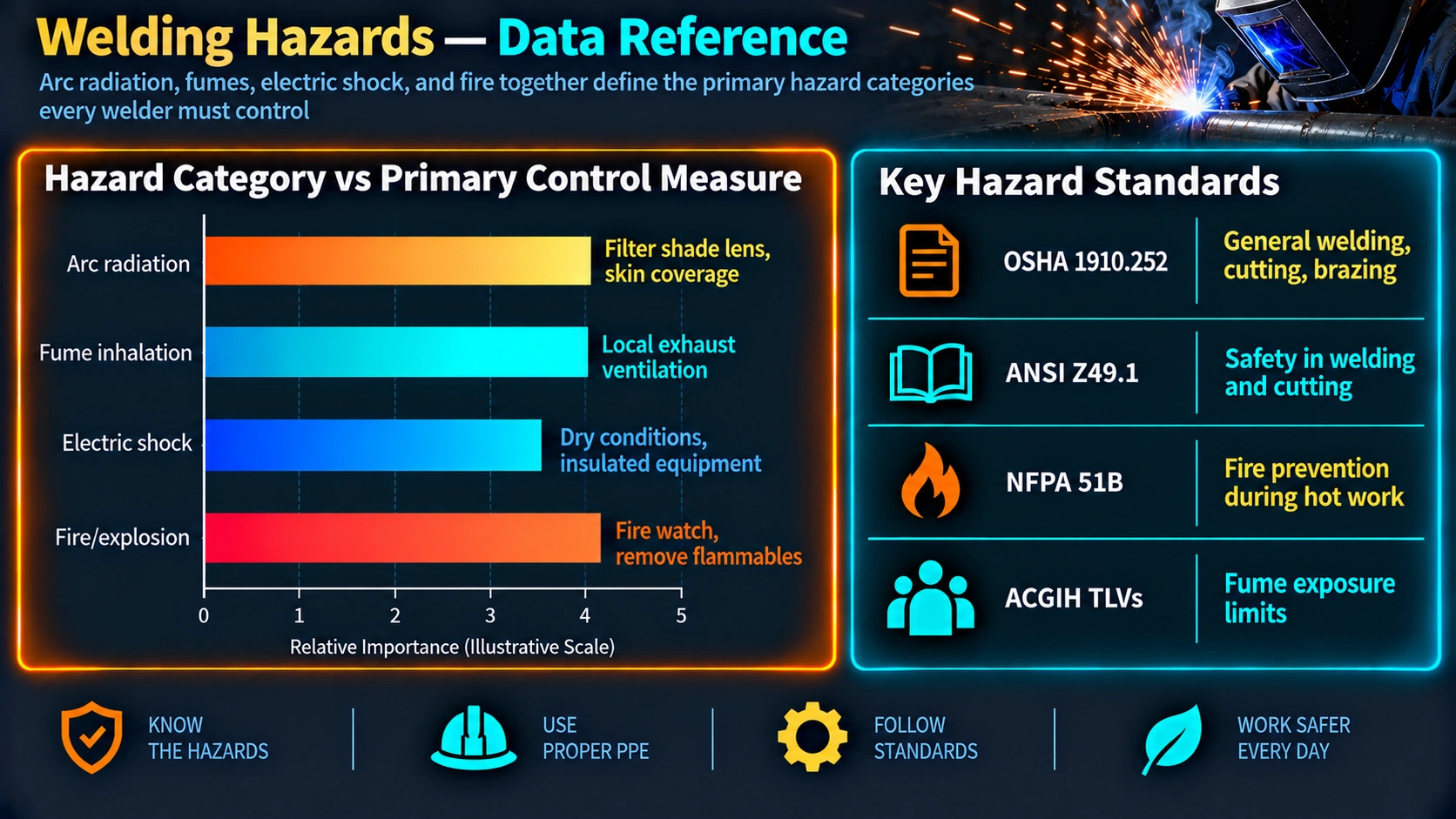
Physical hazards in welding are immediate in their consequences: burns from hot metal, spatter, or arc radiation; cuts from sharp plate edges; crush injuries from heavy component handling; and eye injuries from flying particles during grinding or chipping. Ergonomic hazards are slower in onset but equally damaging: musculoskeletal disorders (MSDs) from sustained awkward postures, repetitive motion, or manual handling of heavy workpieces are a leading cause of long-term disability among fabricators.
Burns
Three types of burns occur in welding: contact burns from hot metal (which can remain hot for hours after welding without visible indication), spatter burns from ejected molten droplets, and radiation burns from UV arc exposure. All skin must be covered by flame-resistant (FR) clothing. Leather gloves protect from spatter but must be supplemented by FR sleeves and jacket. Never assume a weld or cut component is cool — probe with the back of a hand at a distance rather than touching directly, or use a pyrometer.
Eye Protection from Foreign Bodies and Grinding
Grinding, chipping, and wire brushing adjacent to welding operations generate high-velocity metallic particles. Safety spectacles (impact-rated to ANSI Z87.1 or EN 166) must be worn under the welding helmet at all times, not just when the helmet is raised. Many arc eye and foreign body injuries occur during the few seconds when the welder lifts the helmet to examine the weld and particles are present in the air from nearby grinding.
Manual Handling and Ergonomics
- Use mechanical handling aids — cranes, hoists, roller beds, positioners — for components above safe manual handling limits. Train crane operators formally; do not allow informal use of lifting equipment by unqualified personnel.
- Implement 5S housekeeping practices to eliminate tripping hazards, debris, and congestion in fabrication bays. Clear walkways and properly marked exclusion zones reduce physical collision injuries significantly.
- Adjust workpiece positioning to minimise time spent welding in overhead, forced kneeling, or bent-back positions. Where positional welding cannot be avoided, take regular breaks and rotate tasks.
- Vibration from grinding and chipping tools contributes to hand-arm vibration syndrome (HAVS) — a progressive and irreversible condition affecting the nerves and blood vessels of the hands. Use anti-vibration tools where available, rotate tasks, and monitor daily vibration exposure.
Hazard 7 — Confined Space and Special Environments
Welding in a confined space or on elevated platforms multiplies every hazard described above. Fumes accumulate where natural ventilation is absent; shielding gas displaces oxygen without warning; escape routes in the event of fire or electric shock are restricted; and rescue in an emergency is substantially more difficult and time-consuming than in open environments.
Recommended Books on Welding Safety and Health
Disclosure: WeldFabWorld participates in the Amazon Associates programme (StoreID: neha0fe8-21). If you purchase through these links, we may earn a small commission at no extra cost to you. This helps support free technical content on this site.
Welding Hazard Quick-Reference Summary
| Hazard | Primary Harm | Key Engineering Control | Minimum PPE | Relevant Standard |
|---|---|---|---|---|
| Fumes and gases | Lung cancer, asthma, MFF | Local exhaust ventilation (LEV) | Half-face P100+OV respirator | OSHA 29 CFR 1910.252; ISO 15012 |
| Electric shock | Cardiac arrest, burns, falls | VRD on AC machines, earthing | Dry leather gloves, FR clothing | NFPA 70E; IEC 60974 |
| UV / IR radiation | Arc eye, skin burns, cataracts | Welding screens / curtains | Correctly shaded welding helmet + safety spectacles | ANSI Z87.1; EN 175 |
| Fire and explosion | Burns, fatalities, property loss | Clearance of combustibles, hot work permit | FR clothing, no synthetic fibres | NFPA 51B; OSHA 1910.252(a) |
| Noise | Permanent hearing loss (NIHL) | Acoustic barriers, remote gouging | Earplugs / earmuffs >85 dB(A) | OSHA 1910.95; ISO 9612 |
| Physical / ergonomic | Burns, cuts, MSD, HAVS | Mechanical handling aids, 5S housekeeping | Steel-toe boots, FR clothing, face shield for grinding | Manual Handling Regulations; ISO 45001 |
| Confined space | Asphyxiation, all of above amplified | Forced ventilation, atmospheric monitoring | Full PPE + supplied-air where required | OSHA 1910.146; EN 1127 |