Phased Array Ultrasonic Testing (PAUT) — Complete Technical Guide
Phased Array Ultrasonic Testing (PAUT) is the most significant advancement in volumetric weld inspection technology since the introduction of industrial radiography nearly a century ago. Where conventional radiography requires radiation sources, film processing, strict personnel exclusion zones, and logistically complex field operations — and where single-element UT requires skilled manual probe manipulation across multiple passes — PAUT achieves full volumetric weld coverage in a single automated or semi-automated scan pass, in real time, with no radiation hazard, and with immediate digital imaging capability that conventional RT film cannot match for defect characterisation or sizing accuracy.
The industry shift from radiography to PAUT is well established and accelerating. ASME Section V, ASME Section VIII, ASME B31.3, AWS D1.1, and DNV standards all explicitly recognise PAUT as a qualified alternative to radiography for volumetric weld examination. Regulatory authorities in jurisdictions including the UK (HSE), Europe (PED/ATEX), and Australia (AS 3788) have progressively accepted PAUT equivalence. Major Owner company specifications — Shell DEP, BP GIS, Saudi Aramco SAES — now routinely specify PAUT as the primary volumetric examination method for critical piping welds, replacing RT where scheduling, safety, or geometric constraints previously made RT impractical.
This guide provides a complete technical reference to PAUT: its operating principles, focal law design, scan types, probe selection, calibration, code requirements, comparison with radiography, and defect sizing methodology. Whether you are a welding inspector, NDT Level II/III practitioner, piping engineer, or quality engineer specifying NDE requirements on a capital project, this article gives you the technical depth to apply PAUT correctly and confidently.
How Phased Array UT Works — Fundamental Principles
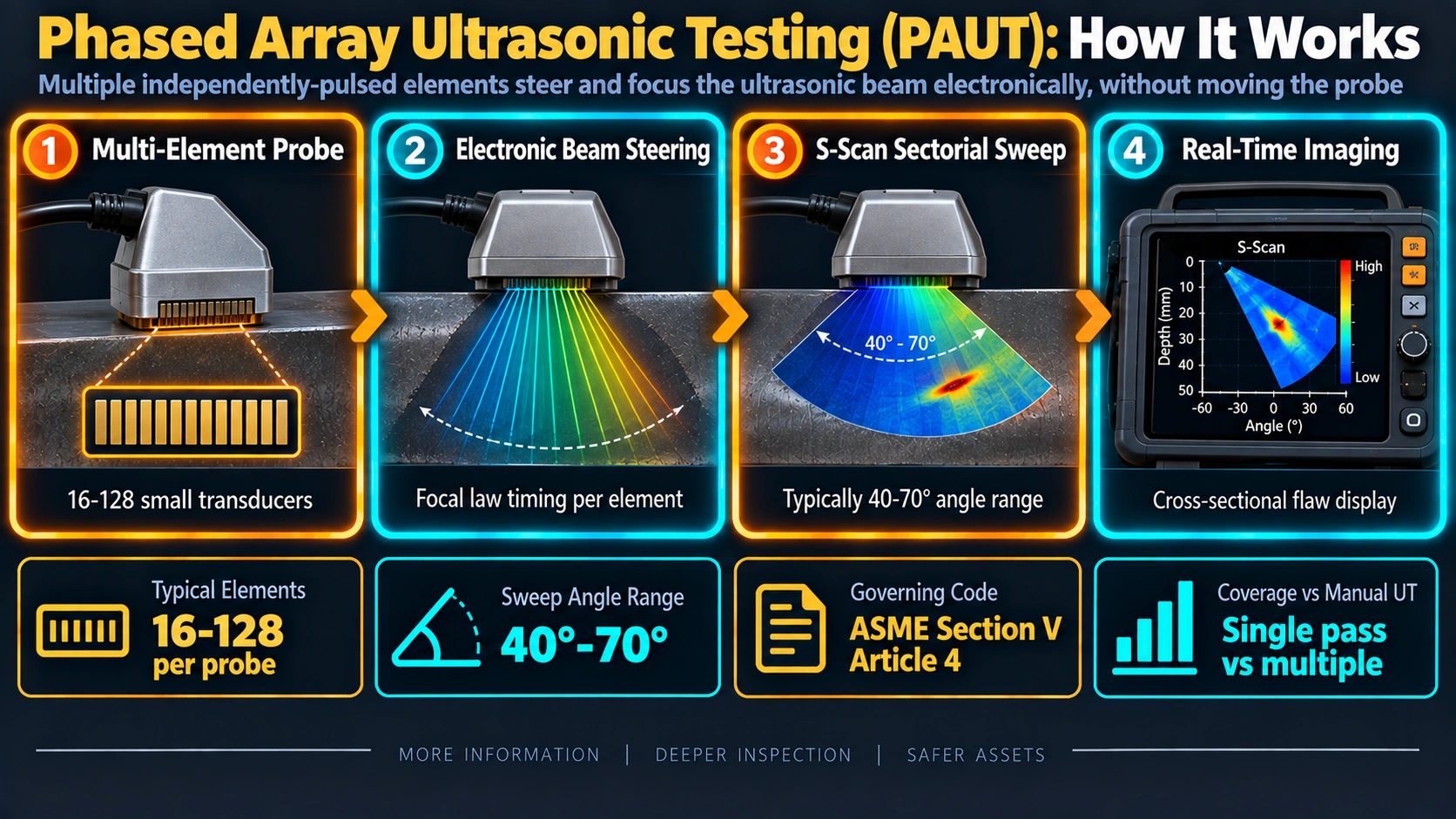
To understand PAUT, it is first necessary to understand how conventional single-element ultrasonic testing works, and where its fundamental limitation lies.
Conventional Single-Element UT
In conventional pulse-echo UT, a single piezoelectric element generates an ultrasonic beam at a fixed angle and frequency. The beam propagates into the test material, reflects from discontinuities or the back wall, and returns to the same element (pulse-echo) or a separate receiving element (pitch-catch). The inspector physically manipulates the probe across the test surface to achieve coverage at different angles, recording A-scan amplitude and time-of-flight data. Coverage of the full weld volume requires multiple passes with probes at different angles — typically 45, 60, and 70 degrees for a butt weld — and relies heavily on the inspector’s technique and experience. The fundamental limitation is that each probe produces only one beam at a time, at one fixed angle.
The Phased Array Principle — Multiple Elements, Controlled Timing
A phased array probe contains an array of individual piezoelectric elements — typically 16, 32, 64, or 128 elements — arranged in a linear (1D) or matrix (2D) configuration. Each element can be pulsed independently, and critically, the time delay between the firing of each element can be precisely programmed. This is the phasing that gives phased array its name.
When elements are fired with a progressive time delay across the array — element 1 first, then element 2 a few nanoseconds later, element 3 slightly after that, and so on — the individual wavefronts from each element combine constructively (interfere constructively) along a specific direction. The resulting combined wavefront propagates as a single coherent beam at a well-defined angle and focal depth that is determined entirely by the time delay pattern applied. By changing the delay pattern, the beam angle and focal depth can be steered and focused electronically, in milliseconds, without physically moving the probe.
Key Physical Principles
The physics underlying PAUT are governed by Huygens’ principle of wave superposition. Each element in the array acts as an independent point source of ultrasonic energy. The transmitted wavefronts from adjacent elements, when delayed by the appropriate time increment, produce constructive interference along the steered beam axis and destructive interference in all other directions. The mathematical relationship governing the beam angle for a linear array is:
sin(θ) = (v × Δt) / p
Where:
θ = Steered beam angle in the medium (degrees)
v = Acoustic velocity in the medium (m/s) — e.g. 5,900 m/s for longitudinal in steel
Δt = Inter-element time delay (seconds)
p = Element pitch (centre-to-centre spacing, metres)
Focal depth for a given aperture:
F = (N × p)² × f / v
N = number of active elements, f = probe frequency (Hz)
Both steering angle and focal depth are set by the focal law — the computed delay table loaded into the phased array instrument.
Focal Laws — Beam Steering and Focusing
A focal law is a single computed set of time delays — one delay value for each element in the active aperture — that produces a specific beam angle and focal depth. The complete set of focal laws loaded into a PAUT instrument for a given inspection is called the focal law set or the beam set. For a typical weld inspection S-scan covering 40 to 70 degrees in 1-degree steps, there are 31 individual focal laws, each producing a separate A-scan that is simultaneously displayed as a colour-coded fan-shaped image.
Focal Law Calculation Parameters
Focal law calculation requires the following input parameters, which must be documented in the written PAUT procedure:
- Probe parameters: Number of elements, element pitch (mm), element width (mm), probe frequency (MHz), element kerf (gap between elements)
- Wedge parameters: Wedge angle, wedge material velocity, wedge height at the first element
- Material parameters: Acoustic velocity in the test material (longitudinal and shear), material thickness
- Scan parameters: Aperture (number of active elements per focal law), start angle, end angle, angular resolution (step), focal depth range
These parameters are entered into the PAUT instrument’s focal law calculator (or a dedicated offline software tool such as EXTENDE CIVA, Olympus TomoView, or GE Inspector) to generate the delay tables. The focal law set is then validated experimentally against calibration reflectors before production inspection commences.
Aperture and Resolution
The aperture — the number of simultaneously active elements contributing to each focal law — directly affects beam width (lateral resolution) and sensitivity. A larger aperture produces a narrower, more focused beam with better lateral resolution but requires more elements. The relationship between aperture size and near-field distance (N0) determines the depth at which the beam is optimally focused:
N0 = (A² × f) / (4 × v)
Where:
N0 = Near-field distance (mm) — beam is not yet well-defined above this depth
A = Active aperture size (mm) = N_active × p
f = Probe frequency (Hz)
v = Acoustic velocity (m/s)
Typical example: 64-element probe, pitch 0.6 mm, 10 MHz, shear wave in steel
A (using 16 active elements) = 16 × 0.6 = 9.6 mm
N0 = (9.6² × 10×10&sup6;) / (4 × 3,230) = ~71 mm
This means optimal focusing and best resolution occur near 71 mm depth for this configuration.
Scan Types: S-scan, E-scan, B-scan, C-scan, D-scan
PAUT instruments produce multiple types of display that present the inspection data in fundamentally different ways. Understanding which display type is appropriate for a given inspection task is essential for correct interpretation and reporting.
A-scan
The fundamental ultrasonic display — amplitude (vertical axis) vs. time of flight (horizontal axis) for a single beam. In PAUT, each focal law produces its own A-scan simultaneously. A-scans are the basis for all amplitude-based sizing and distance measurements.
S-scan (Sectorial / Azimuthal Scan)
Steers the beam through a range of angles (e.g. 40–70 deg) using the same active aperture. Produces a fan-shaped cross-sectional image showing the weld in real time. The most commonly used PAUT display for weld inspection. Each colour pixel represents the amplitude of the signal at that angle and depth.
E-scan (Electronic / Linear Scan)
Fixes the beam angle and shifts the active aperture electronically along the array length, producing coverage equivalent to translating a conventional UT probe along the probe body. Used for corrosion mapping and broad-area coverage at a single angle. Faster than mechanical scanning.
B-scan
A side-view cross-sectional image generated as the probe is moved along the scan axis. Each column of the B-scan image represents one A-scan at one physical probe position. Together, the columns form a 2D cross-section of the inspected volume along the scan direction — very useful for tracking defect length along the weld.
C-scan
A top-view (plan view) image of the inspection area, showing defect indications as a 2D map projected onto the scan plane. C-scans are generated by plotting the peak amplitude at each (x, y) scan position. Used for corrosion mapping, disbond detection, and composite inspection where areal coverage is the primary deliverable.
D-scan
An end-view image showing the cross-section perpendicular to the scan direction at a given position along the weld. Complements the B-scan and is used for accurate defect positioning in the through-wall dimension and for verifying defect orientation (planar vs. volumetric).
Phased Array Probes and Wedges
Probe Construction and Element Configuration
A phased array probe is built around an array of piezoelectric elements — typically lead zirconate titanate (PZT) or a high-performance composite piezo material — each individually wired to the instrument’s pulser/receiver circuitry. The elements are separated by thin kerfs of acoustically absorbing material to prevent cross-coupling. The probe housing is designed to match the wedge interface geometry and maintain consistent coupling across all elements.
| Parameter | Typical Range | Effect on Inspection |
|---|---|---|
| Number of elements | 16, 32, 64, 128 | More elements = larger aperture possible, finer angular resolution, higher cost |
| Element pitch (p) | 0.3 – 1.0 mm | Smaller pitch = finer spatial resolution; pitch must be < half-wavelength for grating lobe control |
| Probe frequency | 2.25, 5, 7.5, 10, 15 MHz | Higher frequency = better resolution but more attenuation in coarse-grained materials |
| Active aperture | N_active × p (typically 6–20 mm) | Larger aperture = narrower beam, better lateral resolution, deeper optimal focus |
| Array configuration | Linear (1D), matrix (2D), annular, segmented annular | Linear 1D most common for weld inspection; 2D matrix enables 3D beam steering for complex geometries |
Wedges
Most PAUT weld inspections use a plastic wedge (Rexolite, PVDF, or similar low-acoustic-impedance material) between the probe and the test surface. The wedge serves two purposes: it converts the probe’s nominal longitudinal wave beam into a refracted shear wave at the required inspection angle in the steel (via Snell’s Law at the wedge-steel interface), and it physically separates the probe from the steel surface to create a usable near-surface inspection zone. Wedges are designed with specific angles (e.g. 35-degree, 55-degree skew angle) to achieve the desired shear wave refraction range in the target material when combined with the probe’s electronic steering range. For inspection of curved surfaces (small-diameter pipes), curved wedges are required to maintain consistent coupling across the probe aperture.
Time-of-Flight Diffraction (TOFD)
Time-of-Flight Diffraction is a distinct ultrasonic technique that is frequently deployed alongside PAUT to provide complementary defect detection and sizing capability. While PAUT operates on pulse-echo (reflected signal) principles, TOFD uses tip diffraction — the small amount of energy scattered from the tips of a defect when a wavefront strikes it — to detect and precisely size defects.
TOFD Principle of Operation
Two probes are positioned symmetrically on either side of the weld, with the weld axis running between them perpendicular to the probe-pair axis. The transmitting probe generates a divergent longitudinal wave beam that illuminates the full weld cross-section. In a defect-free weld, the receiver detects two signals: the lateral wave (travelling along the surface directly from transmitter to receiver) and the backwall echo (reflected from the far surface of the plate). When a defect is present, additional diffracted signals from the upper and lower tips of the defect appear in the TOFD B-scan image, at time-of-flight positions between the lateral wave and the backwall echo.
TOFD Defect Height Sizing Formula
d_upper = (v/2) × √(t_upper² – t_LW²/4 × (t_upper²/S²))
Simplified for near-centre-beam defects:
d_upper ≈ (v/2) × √( t_upper² – (S/v)² )
d_lower ≈ (v/2) × √( t_lower² – (S/v)² )
Defect height:
h = d_lower – d_upper
Where:
v = Longitudinal wave velocity in material (m/s)
t_upper = Time of flight of upper tip signal (s)
t_lower = Time of flight of lower tip signal (s)
S = Half probe separation (centre of T to centre of R divided by 2)
TOFD provides defect height accuracy of typically ±1 mm, far superior to amplitude-based UT sizing methods.
TOFD Advantages and Limitations
| Aspect | TOFD Advantage | TOFD Limitation |
|---|---|---|
| Defect height sizing | Excellent — direct measurement from tip time-of-flight; typically ±1 mm accuracy | Requires clearly resolved upper and lower tip signals; may not resolve very thin cracks |
| Near-surface coverage | Good sensitivity to mid-wall and deep defects | Near-surface dead zone (lateral wave masks defects within ~2–3 mm of top surface) |
| Scan speed | Single pass covers full volume; very fast for long welds | Fixed probe separation must suit wall thickness; may need multiple passes for thick walls |
| Defect characterisation | Good differentiation between volumetric and planar defects from signal phase analysis | No colour amplitude map — experienced interpreter needed; less intuitive than PAUT S-scan |
| Code acceptance | Accepted in ASME Section V, EN ISO 10863, AWS D1.1 Annex S | Fewer standalone code procedures than PAUT; usually combined with PAUT in practice |
Calibration and Sensitivity Setting
Calibration in PAUT establishes the relationship between signal amplitude, time of flight, and the physical location and size of reflectors in the test material. It is the foundation of a defensible, code-compliant PAUT inspection. Every PAUT procedure must specify the calibration block type, reference reflector size, the calibration sequence, and the recording threshold in terms of the reference reflector amplitude.
Calibration Blocks
ASME Section V Articles 4 and 14 require calibration blocks that are:
- Made from material with the same nominal composition and acoustic properties as the test material (same P-Number group, or demonstrated equivalent velocity and attenuation)
- Manufactured to dimensional tolerances that ensure reference reflector position accuracy
- Containing reference reflectors appropriate to the technique — Side-Drilled Holes (SDHs) for angular beam inspection, flat-bottom holes (FBHs) for normal beam, or notches for surface-breaking crack simulation
- Clearly identified with the material specification, heat number, and serial number for traceability
Side-Drilled Holes (SDH) — The Standard PAUT Calibration Reflector
SDHs are the primary calibration reflectors for angle-beam PAUT weld inspection per ASME Section V. The standard SDH diameter specified in ASME Section V Article 4 is 1/16 inch (1.5 mm) or 1/8 inch (3 mm) depending on the application. SDHs are drilled through the calibration block thickness at specified depths to bracket the inspection depth range — typically at 1/4T, 1/2T, and 3/4T for full-wall-thickness weld inspection.
Time-Corrected Gain (TCG) and Distance Amplitude Correction (DAC)
Because ultrasonic signal amplitude decreases with depth due to beam spreading and material attenuation, a direct amplitude comparison between near-surface and deep reflectors of the same size would give misleading results without compensation. Two methods are used:
Gain at depth d: G(d) = G_base + Correction(d)
TCG applies a depth-dependent gain increase to each A-scan so that identical reflectors
at any depth produce the same amplitude on the screen. The TCG curve is established
by scanning SDHs at 1/4T, 1/2T, and 3/4T depths and programming the instrument
to normalise all three to the same screen amplitude (typically 80% FSH).
Recording threshold:
Record all indications ≥ 20% FSH (DAC) or ≥ recording level set in procedure
Indications exceeding 100% FSH (reference level) are subject to evaluation and disposition per the applicable acceptance criteria.
Code and Standard Requirements for PAUT
PAUT is explicitly recognised in all major international construction and inspection codes. The applicable code determines the written procedure requirements, personnel qualification, calibration standards, and acceptance criteria. Understanding which code governs the inspection and what it specifically requires is essential for procedure development and AI (Authorised Inspector) approval.
| Code / Standard | Relevant Section | Key PAUT Requirements | Acceptance Criteria Basis |
|---|---|---|---|
| ASME Section V | Articles 4 and 14 | Written procedure; personnel qualification per SNT-TC-1A or CP-189; SDH calibration; procedure demonstration on mock-up; scanning increment ≤25% beam width | Referencing code (Section VIII, B31.3) specifies reject levels |
| ASME Section VIII Div. 1 | Appendix 4; UW-51; UW-53 | PAUT as alternative to RT for full volumetric examination; procedure per Section V Article 14; personnel qualification Level II minimum | Amplitude-based: indications > reference level evaluated; length-based limits per UW-51(b) |
| ASME Section VIII Div. 2 | Part 7.5 | UT (including PAUT) acceptable for volumetric examination; procedure qualification mandatory; defect sizing for ECA required | ECA per Annex E or amplitude/length criteria; more rigorous than Div. 1 |
| ASME B31.3 | Para. 344.6 and Appendix A | PAUT acceptable as alternative to RT; Cat. M service: 100% PAUT of butt welds; procedure per Section V | Section V / applicable Owner specification; amplitude-based per DAC/TCG |
| AWS D1.1 | Annex S | Dedicated PAUT provisions for structural steel; Table S1 criteria; specific probe and calibration requirements; personnel qualification Level II | Table S2: amplitude + length-based rejection criteria for different weld joint categories |
| EN ISO 13588 | Full standard | European standard for PAUT of welds; procedure qualification including procedure validation (mock-up); personnel per EN ISO 9712 Level 2 UT + PAUT endorsement | Referencing product standard (EN 13480, EN 13445); acceptance levels per ISO 11666 |
| DNV-ST-F101 / RP-F118 | Section 10 | PAUT and TOFD for pipeline girth welds; AUT (automated PAUT) widely used offshore; detailed procedure qualification and performance demonstration (POD study) requirements | ECA-based (fracture mechanics); acceptance tables in Annex A/B; defect height the critical parameter |
Procedure Qualification and Demonstration
ASME Section V Article 14 and most Owner-level specifications require that a new PAUT procedure be demonstrated on a representative mock-up before production use. The mock-up must:
- Be fabricated from representative material (same P-Number, wall thickness, and heat treatment condition as production welds)
- Contain implanted or artificially created defects that are representative of the defect types, sizes, and orientations expected in production welds — typically lack of fusion, porosity clusters, and cracks at the root, sidewall, and cap regions
- Demonstrate that the procedure can detect and characterise all implanted defects above the minimum detectable size specified in the applicable acceptance criteria
- Be reviewed and approved by the Level III UT practitioner responsible for the procedure, and witnessed by the Owner’s Authorised Inspector
PAUT vs Radiography — Detailed Comparison
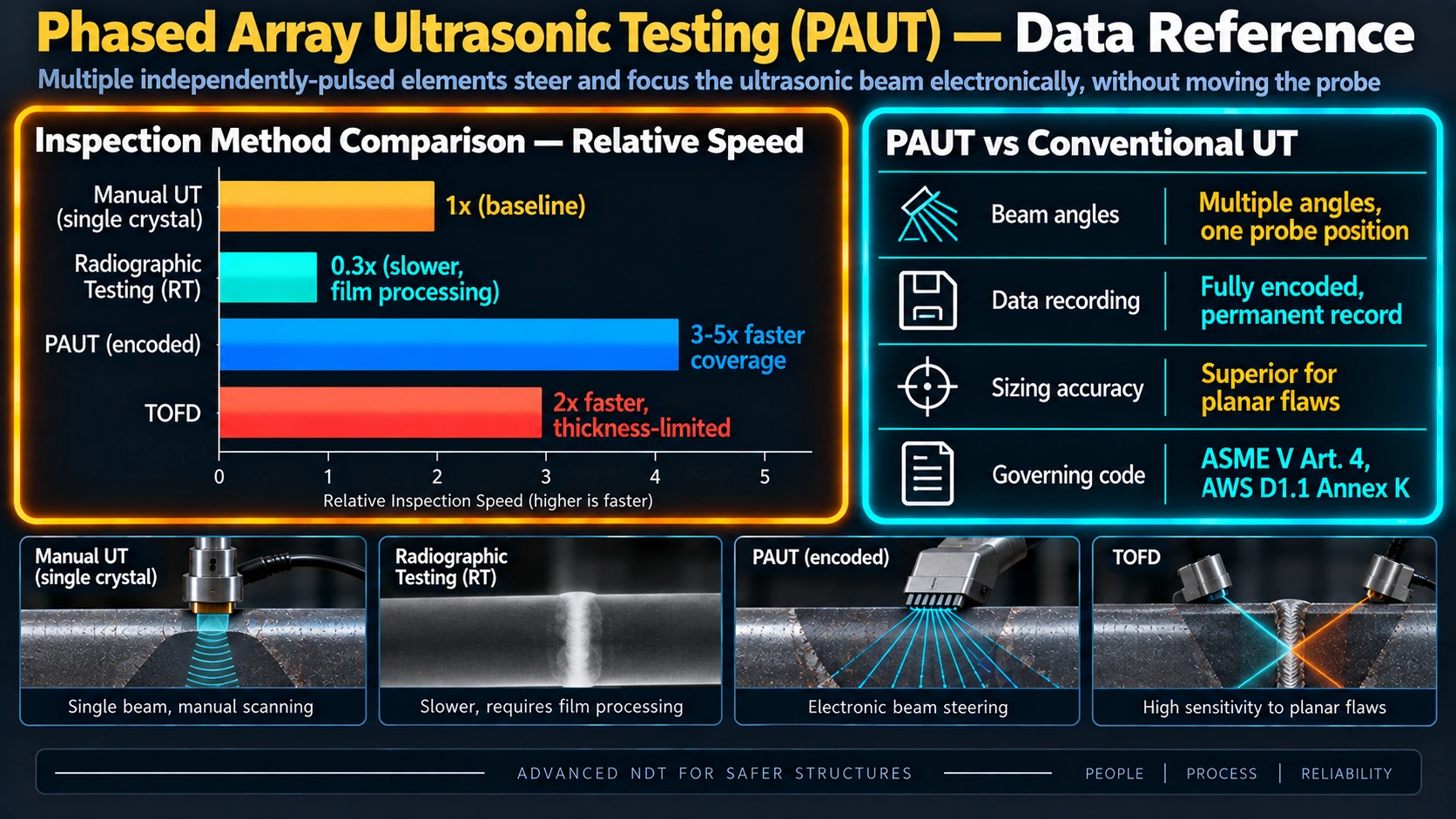
The comparison between PAUT and conventional radiographic testing (RT) is one of the most frequently debated topics in industrial NDT. The answer is not that one technique is universally superior — each has genuine detection strengths that the other lacks — but PAUT’s overall advantages in safety, speed, defect sizing, and digital data management make it the preferred primary volumetric examination technique for most new construction inspection.
Industrial Applications of PAUT
PAUT has been adopted across virtually every sector of heavy industry that performs pressure-boundary welding. The following summarises the most significant application areas and the specific PAUT techniques used in each.
Oil and Gas — Refinery and Process Plant Piping
PAUT is the dominant volumetric examination technique for new construction and in-service inspection of refinery process piping in Category M hydrogen service, sour service, high-pressure steam, and other critical fluid categories. Automated PAUT using encoded rigs provides 100% volumetric coverage of butt welds with full position-recorded digital data, satisfying ASME B31.3 Category M requirements. In-service PAUT inspection of corroded or potentially cracked pipework uses PAUT for thickness mapping (C-scan), corrosion pitting characterisation, and crack depth sizing for fitness-for-service assessment per API 579.
Power Generation — Pressure Vessels and Steam Piping
PAUT is used for fabrication inspection of steam drums, feedwater heaters, and boiler pressure parts, and for in-service inspection of high-energy steam piping welds in power plants. The combination of TOFD + PAUT is standard for in-service inspection of P91 chrome-moly steam lines, where accurate crack height measurement is required for fracture mechanics fitness-for-service assessment — data that RT cannot provide. Creep damage assessment in high-temperature components uses PAUT and TOFD in conjunction with other techniques including microstructural replication.
Offshore — Pipeline Girth Welds
Automated Ultrasonic Testing (AUT) — which is large-diameter pipe girth weld inspection using mechanised PAUT and TOFD combined — is the standard inspection method for offshore pipeline construction (DNVGL-ST-F101). AUT systems scan the full weld volume in a single circumferential pass at 100 to 250 mm/min, providing complete volumetric data with position encoding. ECA-based acceptance criteria per BS 7910 are applied to TOFD-sized defects, enabling acceptance of defects that would be rejected under workmanship-based criteria but are shown to be structurally acceptable — a significant economic benefit in deepwater pipeline projects.
Nuclear — Reactor Pressure Boundaries
Nuclear applications of PAUT are among the most demanding in terms of procedure qualification, personnel certification, and quality assurance requirements. ASME Code Case N-659-2 and N-696 govern PAUT of reactor pressure vessel welds and nozzle-to-shell welds. The Electric Power Research Institute (EPRI) Performance Demonstration Initiative (PDI) requires that PAUT procedures for nuclear applications undergo a blind round-robin demonstration on a qualification body containing actual or representative flaws before the procedure is qualified for production use.
Structural Steel — Heavy Industrial and Infrastructure
AWS D1.1 Annex S provides specific PAUT provisions for structural steel weld inspection, covering groove welds in T, butt, and corner joint configurations. PAUT is increasingly specified for major civil infrastructure welds — bridge main girder welds, offshore jacket welds, and crane runway welds — where RT would require traffic or crane downtime for film exposure and processing, and where PAUT’s ability to inspect from one side only is a practical advantage for double-sided welds in fabricated beams.
Corrosion Mapping and Thickness Scanning
E-scan PAUT (and conventional UT scanning) is widely used for automated corrosion mapping of tanks, vessels, and piping. A normal-incidence PAUT probe electronically raster-scans across the inspection area, generating a C-scan colour map of wall thickness. This is far faster than point-by-point manual UT thickness measurement and provides a continuous spatial record of corrosion distribution that is directly usable for retirement-from-service calculations.
Defect Sizing and Acceptance Criteria
Defect Length Sizing
Defect length along the weld axis is measured from the encoded scan position data. The standard methods are:
- 6 dB drop method: The defect length is taken as the distance between the probe positions where the signal amplitude drops to 50% (6 dB below) the peak amplitude from the indication. This is the most commonly specified method in ASME procedures.
- End-of-indication method: The defect length is measured between the positions where the signal first exceeds and last exceeds the recording threshold amplitude (e.g. 20% FSH). This method tends to give longer reported lengths than the 6 dB drop method.
- Absolute threshold method: Length is measured as the extent of the indication above the reference level (100% FSH / TCG reference), directly corresponding to the rejectable length. Used in some Owner company specifications.
Defect Height Sizing
Defect through-wall height is the critical parameter for fracture mechanics assessment. The primary methods are:
- TOFD tip diffraction: The most accurate method — typically ±1 mm. Used wherever TOFD is deployed alongside PAUT.
- PAUT tip echo sizing (-6 dB on tip signal): Uses the focused phased array beam to detect diffracted signals from the upper and lower tips of the defect, then applies time-of-flight calculation. Less accurate than TOFD but usable when TOFD is not deployed.
- Amplitude-based sizing (correlation curves): Compares signal amplitude to the calibration SDH amplitude and correlates to defect height using empirical curves. This method is inherently less accurate and is increasingly displaced by tip-diffraction methods in critical applications.
ASME Section VIII Div. 1 Acceptance Criteria (Appendix 4)
Reject if indication amplitude exceeds reference level AND:
(a) Indication length > 6 mm (1/4 in) for t ≤ 19 mm
(b) Indication length > t/3 for 19 mm < t ≤ 57 mm
(c) Indication length > 19 mm (3/4 in) for t > 57 mm
(d) Any indication characterised as a crack, lack of fusion, or incomplete penetration
regardless of amplitude or length
Note: These criteria are workmanship-based. For fracture mechanics ECA, refer to API 579-1 / ASME FFS-1 or BS 7910.
Personnel Qualification for PAUT
PAUT personnel qualification is governed by the applicable code and Owner specification. The following certification schemes are most widely recognised:
| Scheme | Relevant Certification | Applicable Region / Code | PAUT-Specific Requirement |
|---|---|---|---|
| ASNT SNT-TC-1A | UT Level II / Level III | USA; ASME codes | Employer-based; Written Practice must include PAUT training hours and practical exam; Level III endorsement for PAUT often required by Owner specs |
| ASNT CP-189 | UT Level II / Level III (central exam) | USA; ASME codes; many international projects | Third-party examination; more rigorous than SNT-TC-1A; PAUT-specific exam available |
| PCN (BINDT) | UT Level 2 + PA (Phased Array) endorsement | UK; Europe; offshore; international projects | Separate PAUT examination (UT5-PA) required beyond UT Level 2; widely required for offshore and nuclear |
| CSWIP (TWI) | CSWIP 3.4 — Phased Array UT Operator | UK; offshore; international | Dedicated PAUT operator certification; widely specified for offshore pipeline AUT inspection |
| EN ISO 9712 | UT Level 2 (EN) + PAUT sector-specific | Europe; EN-governed projects | Basic EN ISO 9712 UT Level 2 covers general UT; PAUT requires additional sector/technique qualification |
| EPRI PDI (Nuclear) | PDI-qualified procedure and personnel | Nuclear ASME Code (USA) | Blind demonstration on qualification body with actual flaws; site-specific qualification required |
Practical Engineering Notes
Step-by-Step PAUT Weld Inspection Workflow
- Procedure Development Define probe parameters, wedge, focal law set, scan pattern, calibration block, recording threshold, and acceptance criteria. Have the procedure reviewed and approved by a Level III UT practitioner.
- Calibration Block Fabrication Fabricate or procure a calibration block from material matching the production weld (same P-Number, nominal thickness). Machine SDHs at 1/4T, 1/2T, and 3/4T. Verify SDH dimensions before use.
- Equipment Setup and Focal Law Loading Configure the PAUT instrument: load focal law file, set probe and wedge parameters, set scan axis resolution (encoder increment). Verify wedge coupling using water couplant at calibration temperature.
- Calibration (TCG / DAC Setup) Scan each SDH in the calibration block. Set TCG so all SDHs read at 80% FSH. Set recording threshold at 20% FSH (or as specified in procedure). Document calibration data and instrument screen capture.
- Surface Preparation and Access Clean weld surface: remove spatter, scale, and loose coatings to within the scan zone. Weld cap must be flush or the scan procedure must account for the weld cap geometry. Verify couplant availability.
- Production Scan Scan the weld using the encoded scanner or manual encoded probe holder. Maintain consistent couplant and encoder contact. Monitor coupling signal (lateral wave or backwall) throughout the scan. Scan both sides of the weld where required.
- Data Review and Interpretation Review all collected scan data: S-scan, B-scan, and TOFD B-scan (if applicable). Identify and characterise all recorded indications. Apply acceptance criteria. Issue PAUT report with position-encoded indication maps.
- Post-Inspection Calibration Check Verify calibration at end of shift or end of job. Document that calibration remained within tolerance. If drift exceeded limits, re-inspect affected welds.
Common Mistakes and How to Avoid Them
Cross-Reference to Related Guides
PAUT is one component of a comprehensive NDT and mechanical testing programme. For Charpy impact testing requirements that complement NDT data in fitness-for-service assessments, see our guide to UG-84 Charpy impact test requirements under ASME Section VIII. For the corrosion assessment that PAUT data feeds into, see our corrosion types and mechanisms guide. For hydrogen service equipment where PAUT is the primary inspection technique, see our comprehensive hydrogen service materials and welding guide. For the ASME Section IX welding procedure qualification that governs the welds being inspected by PAUT, see our P-Number, F-Number, and A-Number guide.
Recommended Reference Books
These references are widely used by PAUT practitioners, NDT Level III engineers, and inspection engineers specifying ultrasonic examination requirements.
Disclosure: WeldFabWorld participates in the Amazon Associates programme (StoreID: neha0fe8-21). If you purchase through these links, we may earn a small commission at no extra cost to you. This helps support free technical content on this site.