Concentric & Eccentric Cone Reducer Calculator — Flat Pattern, Slant Height & Arc Dimensions
- Introduction — Fabricated Cone Reducers in Pressure Equipment
- Cone Reducer Calculator — Flat Pattern & Element Heights
- Concentric Cone Geometry — Exact Flat Pattern
- Flat Pattern Derivation Step by Step
- Eccentric Cone Geometry — Triangulation Method
- ASME VIII UG-32 Minimum Thickness for Pressure Cones
- Welding Sequence for Fabricated Cones
- Distortion Control and Fixturing
- Rolling and Forming the Cone Blank
- Dimensional Inspection of Finished Cones
- Frequently Asked Questions
This cone reducer calculator covers both concentric reducers (right circular cone frustums, symmetric axis) and eccentric reducers (oblique frustums with offset centrelines). For the concentric cone it returns the exact flat-pattern arc radii R and r, the arc angle, arc lengths at each end, plate area, and estimated weight. For the eccentric cone it returns the slant heights at every 15° around the cone using the triangulation element method — the data needed to lay out the developing line pattern. Both tabs include an optional ASME VIII UG-32 minimum thickness check for pressure service.
This article goes beyond what other calculators provide by covering the welding sequence and distortion control for fabricated cones — the engineering context that fabricators need alongside the geometry numbers. A badly sequenced weld on a large cone reducer can pull the large end out-of-round by 5 to 10 mm, requiring expensive flame-straightening or outright rejection. The correct tacking pattern, backstep technique, and balanced welding sequence prevent this and are explained step by step in the sections below.
Cone Reducer Calculator
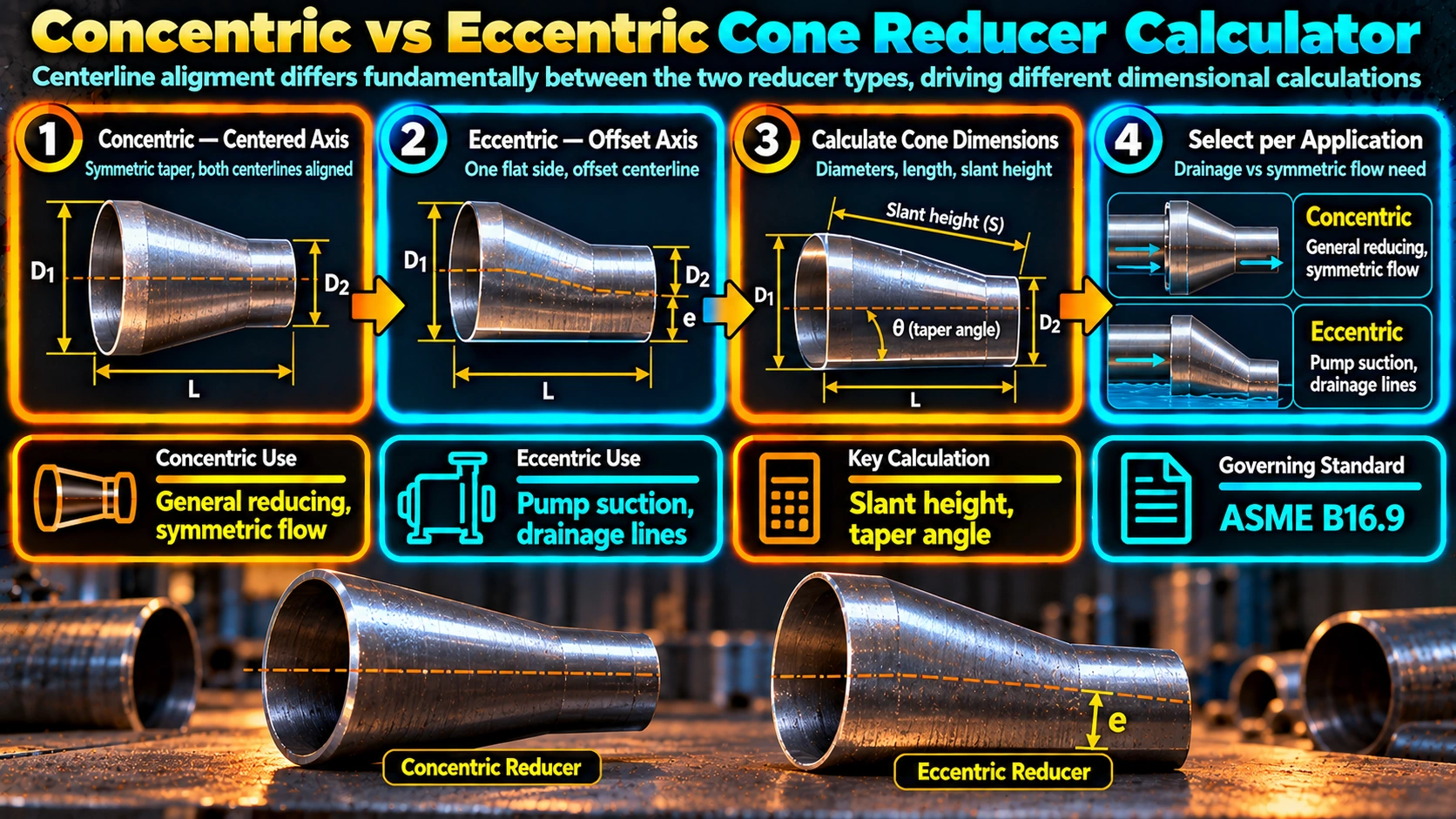
Concentric: Flat Pattern R, r, Arc Angle • Eccentric: Element Heights at 15° Intervals • ASME Thickness
Concentric Cone Geometry
A concentric reducer is the frustum of a right circular cone — both end circles share the same axis. Every straight line on the cone surface (a generator line) makes the same angle with the axis. When the cone surface is unrolled flat, it forms a sector of an annulus (a ring-shaped sector): two concentric arcs connected by two straight radial lines. This is the cleanest possible flat pattern for any transition piece.
Half-Cone Angle α (degrees): α = arctan(ΔR / L) = arctan((R_L − R_S) / L) Angle between cone surface and cone axis. ASME UG-33: reinforcement required if α > 30°
Flat Pattern Derivation Step by Step
The flat pattern derivation uses similar triangles. Imagine extending the cone to its apex: the full cone has a slant height H_full from apex to the large-end edge. By similar triangles, the ratio of the large-end radius to the small-end radius equals the ratio of their respective slant heights from the apex.
Arc Angle θ (degrees, from circumference preservation): θ = 360° × ΔR / S = 360° × (R_L − R_S) / S Derived from: outer arc length must equal large end circumference 2πR_L Check: (θ/360) × 2π × R_pattern = 2π × R_L ✓
Arc Lengths (large end and small end circumferences): Arc_outer = π × D_L (large end circumference) Arc_inner = π × D_S (small end circumference)
Plate Area (lateral surface area of frustum): A = π × S × (R_L + R_S) Also equals: (θ/360) × π × (R_pattern² − r_pattern²) — both give the same result
Eccentric Cone Geometry — Triangulation Method
An eccentric reducer has its small-end centre offset from the large-end centre by a distance e (the eccentricity). For a fully eccentric reducer, e = (D_L − D_S)/2, making one side of the cone perfectly vertical (the generator line on the flat side is parallel to the pipe axis). Unlike a concentric cone, an eccentric cone cannot be developed from a single clean sector — the surface is an oblique cone whose development requires the triangulation method.
φ = angle around cone (0° = flat side, 180° = steep side)
ΔR = R_L − R_S, e = eccentricity (mm), L = cone height (mm)
Fully Eccentric Cone (e = ΔR) simplified: h(φ) = √(2ΔR²(1 − cos φ) + L²) At φ = 0° (flat side): h = L (vertical generator, no slope) At φ = 180° (steep side): h = √(4ΔR² + L²) = S_steep (maximum slant)
Flat-Side and Steep-Side Slant Heights: S_flat = L (shortest element, flat side, at φ = 0° for fully eccentric) S_steep = √(L² + (D_L − D_S)²) (longest element, steep side)
ASME VIII UG-32 Minimum Thickness for Pressure Cones
For a conical section under internal pressure, ASME VIII Division 1 paragraph UG-32(g) specifies the minimum required thickness. The half-cone angle α enters the formula directly via the cos(α) term — steeper cones (larger α) require greater wall thickness for the same pressure.
P = design gauge pressure (MPa) | R_L = large end inside radius (mm)
S = allowable stress from ASME II Part D (MPa) | E = weld joint efficiency
α = half-cone angle (degrees) = arctan((R_L − R_S) / L)
Required nominal thickness (adding allowances): t_nominal ≥ t_min + CA + mill_undertolerance CA = corrosion allowance (from process datasheets) Mill undertolerance = 0.125 × t_nominal for ASTM A516 plate per ASME SA-480
UG-33 Large-End Junction Reinforcement: If α > 30°: a knuckle or additional reinforcement ring is required at the large-end junction. This calculator flags when α exceeds 30° so the engineer knows to apply UG-33.
| Half-Cone Angle α | cos(α) | UG-32 Implication | Large-End Reinforcement (UG-33) |
|---|---|---|---|
| ≤ 10° | ≥ 0.985 | Minimal effect | Not required |
| 10°–20° | 0.940–0.985 | Low impact | Not required |
| 20°–30° | 0.866–0.940 | Moderate — wall increases 6–15% | Not required |
| > 30° | < 0.866 | Significant — wall increases >15% | Required (UG-33) |
Welding Sequence for Fabricated Cones
A fabricated cone has two types of welds: the longitudinal seam (the straight radial edge where the flat pattern is joined) and the circumferential end welds (joining the cone large end and small end to mating pipe, vessel shell, or flanges). Getting the sequence wrong concentrates heat on one side of the cone and pulls it out-of-round.
Longitudinal Seam Sequence
The longitudinal seam on a cone runs along a straight line from the small-end edge to the large-end edge. Unlike a cylinder seam, the cone seam converges — the distance between the two edges decreases from large end to small end, and shrinkage on the large end is greater in absolute terms. The recommended sequence is:
Tack weld the seam at equal intervals starting from the midpoint, alternating toward each end (not starting from one end and working continuously to the other). Place tacks at approximately 200 mm intervals. After tacking, apply the root pass using backstep welding in 150–200 mm segments, working from mid-seam toward the large end first, then mid-seam toward the small end. Fill and cap passes follow the same alternating pattern.
Circumferential End Weld Sequence
After the longitudinal seam is complete and the cone is checked for roundness, the circumferential welds are made. Always complete the longitudinal seam and verify roundness before making any circumferential weld — circumferential welds lock in the cone shape and any out-of-round condition will be permanent. The circumferential weld sequence uses the quadrant method:
Divide the circumference into four equal quadrants (0°–90°, 90°–180°, 180°–270°, 270°–360°). Weld quadrant 1, then quadrant 3 (diametrically opposite), then quadrant 2, then quadrant 4. This balanced approach prevents the cone from drawing toward one side. For large cones (>600 mm OD), use two welders simultaneously welding diametrically opposite positions.
Distortion Control and Fixturing
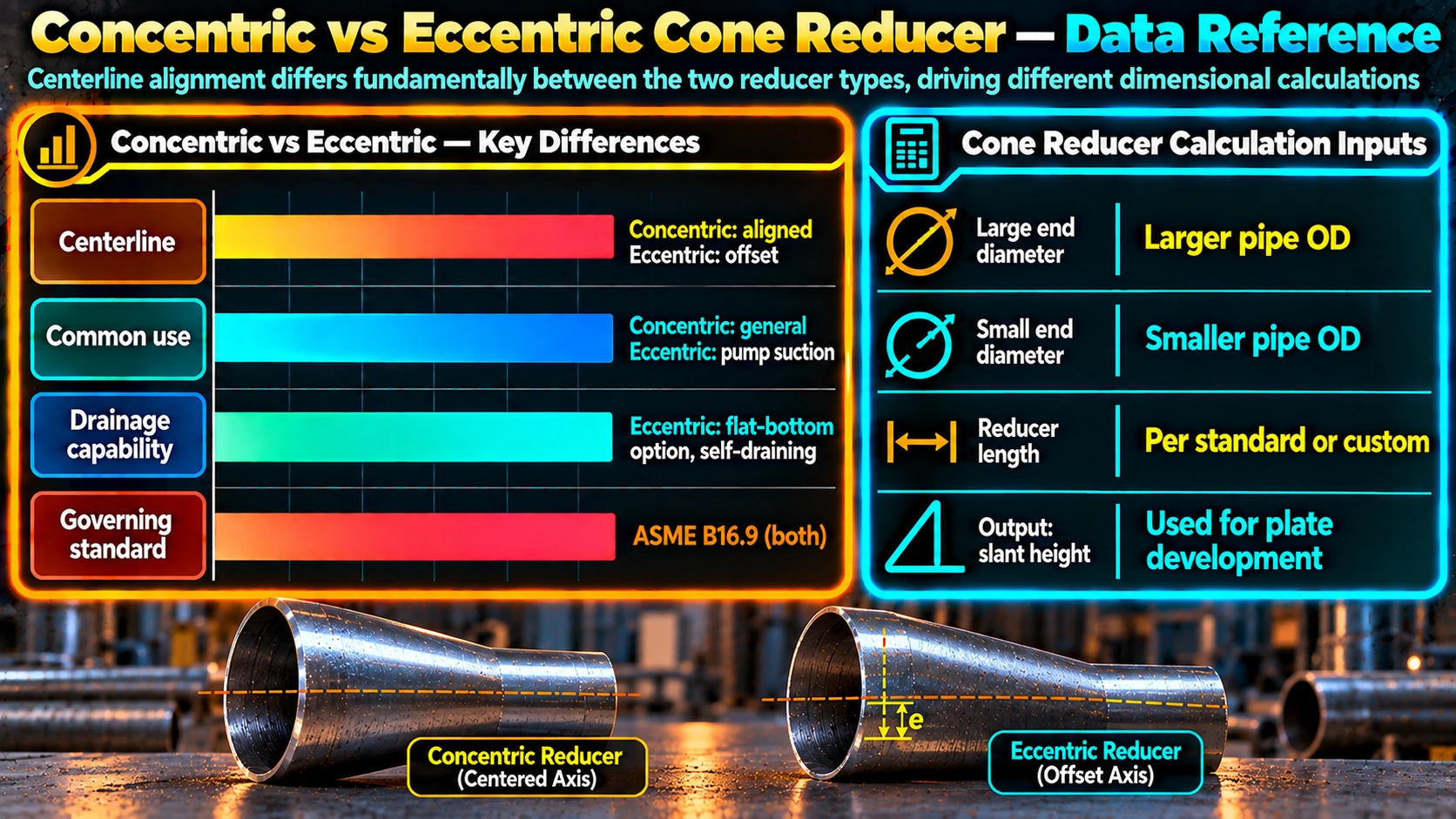
Cone reducers are particularly susceptible to distortion because: the flat pattern is a tapered sector, not a rectangle, so rolling forces are applied unequally across the width; and the longitudinal seam weld has greater shrinkage at the large end than the small end, which tends to open the small end and close it on the seam side.
Fixturing Techniques
Three practical fixturing methods are used for cone fabrication. The strongback method attaches longitudinal bars of flat bar or angle iron on opposite sides of the seam before welding, keeping the seam edges in alignment and preventing the plate from springing open. The bars are removed after the root pass cools. The end ring method uses machined ring gauges at both ends of the cone during circumferential welding to maintain the correct diameter at each end. The rotating positioner method mounts the cone on a welding positioner and rotates it during circumferential welding at a constant speed matched to the welding travel speed, ensuring consistent heat input around the circumference.
Rolling and Forming the Cone Blank
After the flat blank is cut to the calculated sector shape, it must be rolled into the cone frustum. Cone rolling on a three- or four-roll plate bending machine requires progressive adjustment of the roll gap from one edge to the other, since the two straight edges of the sector must converge to different curvatures (the small-end arc has tighter curvature than the large end). On a conventional three-roll machine, this is achieved by offsetting the workpiece diagonally through the rolls and making repeated passes while gradually changing the roll geometry.
CNC plate rolling machines can follow a programmed path to roll a cone in a single continuous pass. For manual rolling, the rule of thumb is: set the rolls for the large-end radius first, roll one complete pass, then progressively tighten the rolls while advancing the plate to achieve the small-end radius at the small-end edge. Check the curvature with a radius gauge after each pass. The seam weld allowance edge should be the leading edge into the rolls to ensure the seam area receives the last (tightest) rolling pass.
Common Concentric Reducer Flat Pattern Reference
The table below gives pre-calculated flat-pattern dimensions for common pipe-to-pipe concentric reducers at a 300 mm cone height. Use the calculator above for any non-standard combination.
| D_L (mm) | D_S (mm) | L (mm) | Slant S (mm) | R_pattern (mm) | r_pattern (mm) | θ (deg) | α (°) |
|---|---|---|---|---|---|---|---|
| 323.9 (NPS 12) | 219.1 (NPS 8) | 300 | 305.2 | 937.6 | 634.2 | 17.0 | 9.9 |
| 323.9 (NPS 12) | 168.3 (NPS 6) | 300 | 309.9 | 645.1 | 335.2 | 25.1 | 14.5 |
| 273.1 (NPS 10) | 168.3 (NPS 6) | 250 | 264.5 | 683.1 | 419.9 | 19.6 | 11.8 |
| 219.1 (NPS 8) | 114.3 (NPS 4) | 250 | 260.9 | 540.8 | 281.7 | 24.5 | 13.7 |
| 168.3 (NPS 6) | 88.9 (NPS 3) | 200 | 211.0 | 447.3 | 237.0 | 23.9 | 12.3 |
| 508.0 (NPS 20) | 323.9 (NPS 12) | 450 | 462.0 | 1196.4 | 762.3 | 19.9 | 11.6 |
Dimensional Inspection of Finished Cones
A finished fabricated cone reducer must be dimensionally inspected against the drawing and code tolerances before assembly welding to a vessel or piping system. The key inspection measurements are:
| Measurement | Method | ASME VIII Tolerance | Acceptance Criteria |
|---|---|---|---|
| Large-end OD | Circumferential tape or pi tape | UG-80: ≤1% ovality | Within drawing tolerance ±1.6 mm typical |
| Small-end OD | Circumferential tape or caliper | UG-80: ≤1% ovality | Within drawing tolerance ±1.6 mm typical |
| Cone height L | Steel rule along axis | Not specified by code | Drawing tolerance, typically ±3 mm |
| Squareness of ends | Square and feeler gauge | Not specified by code | ≤1 mm deviation across diameter |
| Wall thickness | UT gauge or micrometer | ASME SA-480: −0.3 mm or −6% | t_actual ≥ t_min (UG-32 required) |
| Weld visual | VT per ASME V | UW-35 weld reinforcement | No undercut >0.8 mm; reinforcement ≤3 mm |
Frequently Asked Questions
How do you calculate the flat pattern dimensions for a concentric cone reducer?
What is slant height and how does it differ from cone height?
What is the difference between a concentric and eccentric cone reducer?
How is the arc angle of a concentric cone flat pattern calculated?
How do you lay out a flat pattern for an eccentric reducer?
What is the ASME VIII UG-32 minimum thickness formula for a cone?
What welding sequence minimises distortion in a fabricated cone reducer?
How do you calculate the plate area and weight of a cone reducer?
What plate thickness should be specified for a fabricated cone reducer?
Recommended Reference Books
Disclosure: WeldFabWorld participates in the Amazon Associates programme (StoreID: neha0fe8-21). If you purchase through these links, we may earn a small commission at no extra cost to you.