Nozzle Reinforcement Calculator — ASME Section VIII Div 1 UG-37 Area Replacement Method
- Introduction — Why Nozzle Reinforcement Matters
- Nozzle Reinforcement Calculator
- The ASME UG-37 Area Replacement Method
- Area Required — Calculating A
- Area Available — A1, A2, A3, A41, A43
- The Reinforcement Zone — Limits and Boundaries
- Worked Example — Step by Step
- Reinforcing Pad Sizing
- F-Factor and Nozzle Orientation
- Nozzle Types and Weld Details
- Strength Ratios f r1, f r2, f r3, f r4
- Practical Engineering Notes
- Frequently Asked Questions
The nozzle reinforcement calculator on this page performs the area replacement calculation per ASME Section VIII Division 1, paragraph UG-37 — the standard method for determining whether a nozzle opening in a pressure vessel shell or head has adequate reinforcement. Every time a hole is cut in a pressure vessel shell to accommodate a nozzle, pipe connection, or manway, load-carrying metal is removed. ASME requires that an equal area of metal be provided within a defined reinforcement zone around the opening. This calculator computes the required area A, each component of available area (A1 through A43), the deficit that must be supplied by a reinforcing pad (A5), and the minimum pad outer diameter.
Nozzle reinforcement is one of the most frequently performed calculations in pressure vessel engineering, appearing on every vessel data sheet and design calculation package. Getting it right determines whether a vessel passes the Authorised Inspector’s review — and whether the connecting piping loads can be accepted at the nozzle. This article explains every term in the UG-37 calculation from first principles, provides a complete worked example with all intermediate steps, and covers pad sizing, weld area contributions, strength ratio adjustments for dissimilar materials, and the limits of the reinforcement zone.
Nozzle Reinforcement Calculator
ASME Section VIII Division 1 — UG-37 Area Replacement Method
The ASME UG-37 Area Replacement Method
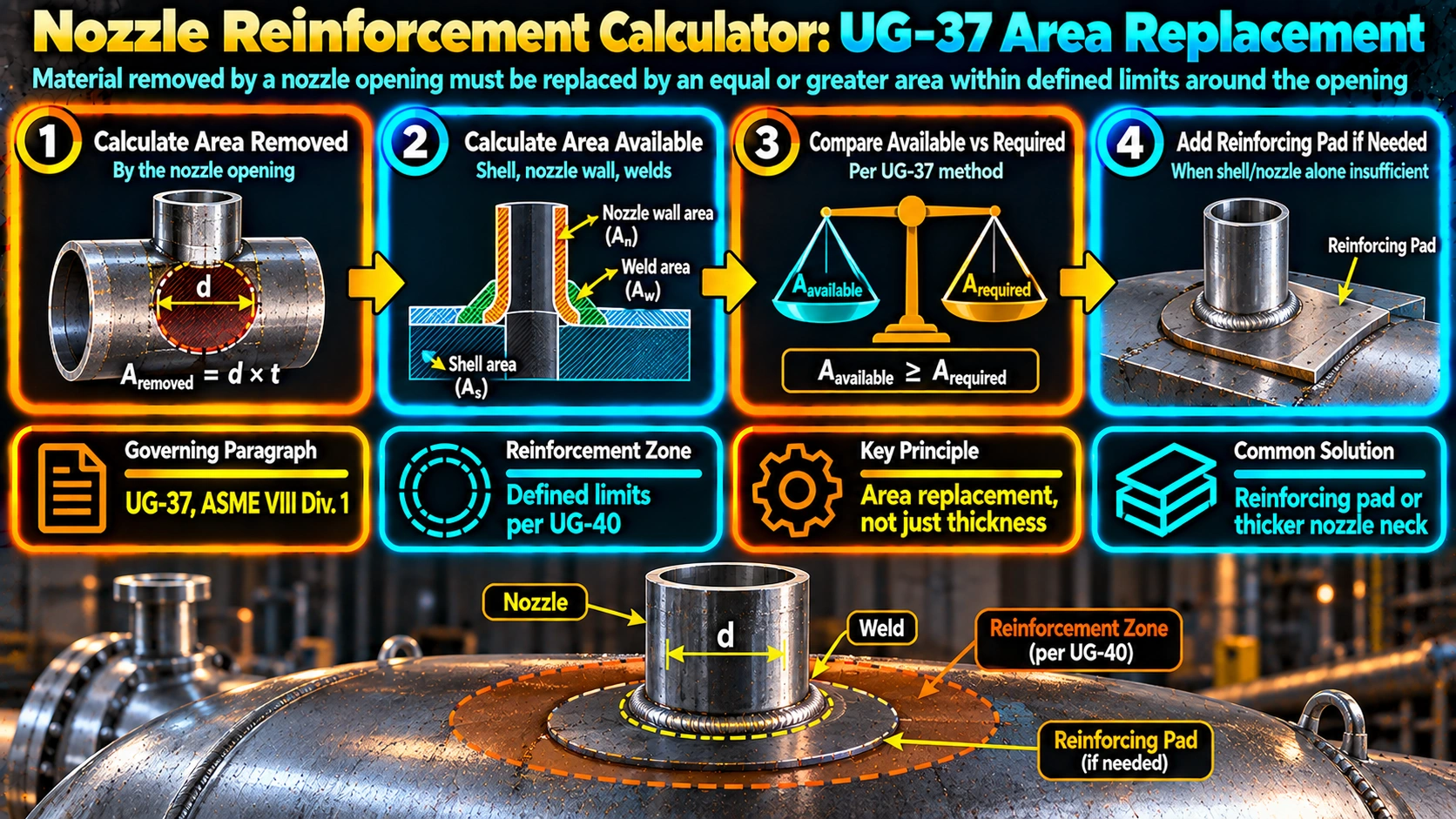
When a nozzle is installed in a pressure vessel shell, a circular or elliptical hole is cut in the shell plate to pass the nozzle neck through. This hole removes a cross-sectional area of load-carrying metal from the shell wall. If not compensated, the opening would create a stress concentration and reduce the burst pressure of the vessel below the design value. ASME Section VIII Division 1, paragraph UG-37, requires that the removed area be replaced with an equivalent area of metal placed within a defined reinforcement zone centred on the opening.
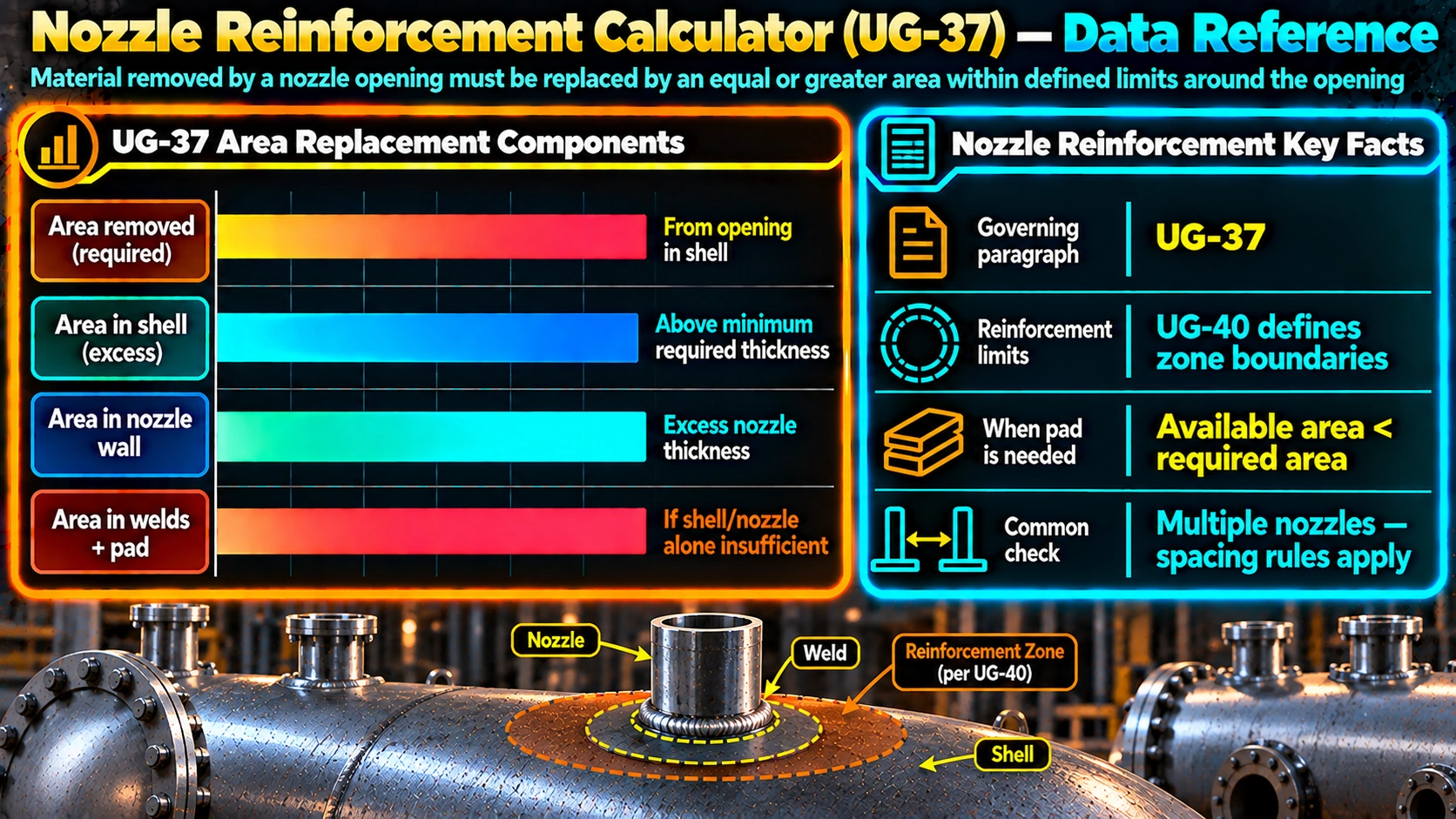
The philosophy is simple: the area of shell plate removed equals the area that must be restored. The metal used for replacement may come from several sources — excess shell wall thickness above the minimum required, excess nozzle neck wall thickness, the inward projection of the nozzle into the vessel bore, weld metal at the nozzle-to-shell junction, and a reinforcing pad if the other sources are insufficient. The calculation is a straightforward area balance: total available area must equal or exceed the required area.
The Area Balance Equation
A1 + A2 + A3 + A41 + A43 + A5 ≥ A
Where:
A = total cross-sectional area required to replace the opening
A1 = area available in the shell (excess shell wall within reinforcement zone)
A2 = area available in the nozzle wall (excess nozzle wall within reinforcement zone)
A3 = area available from inward nozzle projection (if any)
A41= area of outer nozzle-to-shell weld (triangular cross-section)
A43= area of inner nozzle-to-shell weld (if applicable)
A5 = area required from reinforcing pad (= A − A1 − A2 − A3 − A41 − A43, if positive)
Area Required — Calculating A
The required reinforcement area A is the product of the finished diameter of the opening in the shell and the minimum required thickness of the shell at that location, modified by the F-factor for nozzle orientation:
Where: d = finished diameter of the opening = nozzle ID = nozzle OD − 2×t_n
t_r = minimum required shell thickness from UG-27 (without corrosion allowance)
F = correction factor for nozzle orientation (1.0 for radial nozzles; see UG-37 Fig.)
For a nozzle in a cylindrical shell, d equals: d = nozzle OD − 2 × t_n The result A is in mm² (metric) or in² (imperial)
Area Available — A1, A2, A3, A41, A43
A1 — Excess Area in the Shell
A1 is the area within the reinforcement zone contributed by the shell wall thickness in excess of the minimum required. It rewards the engineer for specifying a thicker-than-minimum shell — a shell ordered thicker for corrosion allowance or mill tolerance provides useful reinforcement credit at nozzle locations.
Simplified for standard radial nozzles where d_eff = d: A1 = d × (t − F × t_r) This is the most common form used in practice for radial nozzles on cylindrical shells
A2 — Excess Area in the Nozzle Wall
A2 credits the nozzle neck wall thickness above the minimum required for pressure. A thicker nozzle neck — whether from pipe schedule selection or deliberate over-sizing — provides useful reinforcement within the limits of the reinforcement zone height.
Where: t_n = nozzle nominal wall thickness, t_rn = nozzle minimum required thickness,
f_r1 = strength ratio = (nozzle allowable stress) / (shell allowable stress)
The factor 2 counts both sides of the nozzle, but only up to the height limit min(2.5t, 2.5t_n)
A3 — Inward Nozzle Projection
When the nozzle neck projects inward into the vessel bore (an intruding nozzle), the inward portion also provides reinforcement area. A3 is typically zero for flush or projecting-outward-only nozzles, which is the most common configuration in process vessels.
Where h = actual inward projection length of nozzle inside the vessel
h is limited to min(h, 2.5t_n) for reinforcement credit purposes
A3 = 0 when nozzle does not project into the vessel interior (most common case)
A41 and A43 — Weld Areas
The triangular cross-sectional area of the fillet welds at the nozzle junction contributes to the total available area. A41 is the outer fillet weld area (nozzle-to-shell outside surface weld), and A43 is the inner fillet weld area at the shell inside surface, if any. For full-penetration groove welds, the weld area credit is taken differently and the effective area depends on the groove geometry.
A43 — Inner Fillet Weld Area (if nozzle projects inward): A43 = (w3)² × f_r1 Where w3 = inner fillet weld leg size; A43 = 0 if no inner weld
The Reinforcement Zone — Limits and Boundaries
Only metal within the reinforcement zone counts toward the available area. The zone is a rectangle in cross-section centred on the nozzle axis, with the following boundaries:
| Direction | Limit | Formula | Governs When |
|---|---|---|---|
| Radial (width in shell plane), each side | Larger of d or (R_n + t_n + t) | d_eff = max(d, R_n + t_n + t) | d_eff > d when nozzle wall is thick relative to shell |
| Height above shell OD surface | Smaller of 2.5t or 2.5t_n | h_limit = min(2.5t, 2.5t_n) | 2.5t_n governs when nozzle is thinner than shell |
| Depth below shell ID surface (inward) | Smaller of 2.5t_n or the actual inward projection h | h3_limit = min(h, 2.5t_n) | Only applies when nozzle protrudes into vessel |
| Pad outer diameter | Must remain within radial zone (d_eff each side) | D_p/2 ≤ nozzle CL + d_eff | Pad cannot extend beyond reinforcement zone |
Worked Example — Step by Step
Step 2 — Required Reinforcement Area A: A = d × t_r × F = 202.74 × 14.5 × 1.0 A = 2,939.7 mm²
Step 3 — Reinforcement Zone Limits: Zone width each side: d_eff = max(d, R_n + t_n + t) R_n = d/2 = 101.37 mm; R_n + t_n + t = 101.37 + 8.18 + 20 = 129.55 mm d_eff = max(202.74, 129.55) = 202.74 mm → zone width = d Zone height above shell: min(2.5×20, 2.5×8.18) = min(50, 20.45) = 20.45 mm
Step 4 — Area A1 (Shell excess): A1 = d × (t − F×t_r) = 202.74 × (20 − 1.0×14.5) A1 = 202.74 × 5.5 A1 = 1,115.1 mm²
Step 5 — Area A2 (Nozzle wall excess): A2 = 2×(t_n − t_rn) × min(2.5t, 2.5t_n) × f_r1 A2 = 2×(8.18 − 5.20) × 20.45 × 1.0 A2 = 2 × 2.98 × 20.45 A2 = 121.9 mm²
Step 6 — Area A3 (Inward projection): A3 = 0 (no inward projection)
Step 7 — Weld Areas: A41 = (w1)² × f_r1 = (12)² × 1.0 = 144 mm² A43 = 0 (no inner weld)
Step 8 — Total Available (without pad): A_avail = A1 + A2 + A3 + A41 + A43 = 1115.1 + 121.9 + 0 + 144 + 0 A_avail = 1,381.0 mm²
Step 9 — Area deficit requiring pad: A5 = A − A_avail = 2,939.7 − 1,381.0 A5 required = 1,558.7 mm² → Reinforcing pad REQUIRED
Step 10 — Minimum Pad OD (set pad thickness t_p = shell t = 20 mm, f_r2 = 1.0): A5 = (D_p − d − 2t_n) × t_p × f_r2 1558.7 = (D_p − 202.74 − 2×8.18) × 20 × 1.0 D_p = (1558.7 / 20) + 202.74 + 16.36 = 77.94 + 219.1 D_p minimum = 297.0 mm → specify 300 mm OD pad (round up to nearest 25 mm: 325 mm)
Reinforcing Pad Sizing
When the available area from the shell, nozzle, and welds is insufficient, a reinforcing pad is welded around the nozzle neck on the outside surface of the shell. The pad is a flat ring of plate, centred on the nozzle, with an inner hole matching the nozzle OD and an outer diameter sized to provide the required area A5.
Where: D_p = pad OD, d = nozzle bore, t_n = nozzle wall, t_p = pad thickness, f_r2 = pad/shell stress ratio
Solving for minimum pad OD D_p: D_p = d + 2×t_n + A5 / (t_p × f_r2)
Constraint — pad must stay within reinforcement zone: D_p ≤ d + 2×d_eff = 3×d (approximately, for radial nozzles where d_eff = d) If the required D_p would exceed the zone limit, increase pad thickness t_p instead
F-Factor and Nozzle Orientation
The F-factor in the UG-37 area formula modifies the required area based on the direction of the nozzle axis relative to the shell principal stress directions. For a radial nozzle in a cylindrical shell (the normal case), the nozzle axis is perpendicular to the shell axis and the opening is perpendicular to the maximum hoop stress direction — F = 1.0. For a hillside nozzle where the nozzle axis is tilted, or for nozzles whose axis lies along the cylinder axis, the opening is oriented more favourably with respect to the hoop stress and F may be less than 1.0, reducing the required area.
| Nozzle Configuration | Shell Type | F-Factor | Notes |
|---|---|---|---|
| Radial nozzle, axis perpendicular to shell axis | Cylindrical | 1.0 | Most common case — no reduction |
| Nozzle axis parallel to shell axis (axial) | Cylindrical | 0.5 | Opening axis aligned with lower longitudinal stress |
| Hillside nozzle at angle θ to radial | Cylindrical | Per UG-37 Fig. | F between 0.5 and 1.0 depending on angle |
| Nozzle in spherical zone of head | Ellipsoidal/Spherical | 1.0 | Biaxial stress state; F = 1.0 per UG-37(a) |
| Nozzle in conical section | Cone/Transition | 1.0 | Hoop stress governs; conservative to use 1.0 |
Nozzle Types and Weld Details
The weld configuration at the nozzle-to-shell junction affects both the weld area credit in the reinforcement calculation and the weld procedure requirements. ASME VIII Div 1 UW-16 specifies minimum weld sizes for nozzle attachments. The most common nozzle weld types are:
| Nozzle Type | Weld Detail | A41 Credit | Typical Use |
|---|---|---|---|
| Set-in (Insert) nozzle | Full penetration butt weld through shell; optional outside fillet | w1² × f_r1 | High-pressure, code-critical nozzles |
| Set-on (Pad-type) | Fillet weld at shell OD; nozzle does not penetrate shell | w1² × f_r1 | Lower-pressure attachments, instrument nozzles |
| Insert with internal projection | Nozzle passes through shell and protrudes inward; inner fillet weld | A41 + A43 | Heavy-wall vessels; maximises total weld area |
| Self-reinforcing (integrally reinforced) | Forged nozzle with integral reinforcement; no separate pad | Per UG-37 integrally reinforced nozzle rules | High-pressure, small-bore, eliminates pad |
Strength Ratios f r1, f r2, f r3, f r4
When the nozzle, reinforcing pad, or shell materials have different allowable stresses, the area contributions of each element are scaled by the strength ratio — the ratio of the element’s allowable stress to the shell allowable stress. This ensures that weaker materials provide proportionally less credit toward the reinforcement area.
| Symbol | Definition | Applied To | Value When Same Material |
|---|---|---|---|
| f_r1 | S_nozzle / S_shell | A2, A3, A41, A43 | 1.0 |
| f_r2 | S_pad / S_shell | A5 (pad area) | 1.0 |
| f_r3 | min(S_nozzle, S_pad) / S_shell | Weld areas connecting both nozzle and pad | 1.0 |
| f_r4 | S_pad / S_shell | Outer fillet weld between pad and shell | 1.0 |
Practical Engineering Notes
Connection to Shell Thickness
The t_r value used in the reinforcement area calculation comes directly from the pressure vessel shell thickness calculator (UG-27). The larger the t_r (higher design pressure, larger vessel, lower allowable stress), the larger the required area A — meaning high-pressure vessels have more demanding nozzle reinforcement requirements. A thicker ordered shell (larger t) reduces the pad requirement by increasing A1, the most efficient source of reinforcement area.
Multiple Nozzles and Overlapping Zones
When two nozzle reinforcement zones overlap — when the outer edge of one zone falls within the zone of an adjacent nozzle — the UG-42 rules for multiple openings apply. In this case, the reinforcement for each opening must account for the fact that some shell material is shared between the two zones and cannot be double-counted. Close nozzle spacing is common on vessels with multiple instrumentation connections in a short spool, and requires careful engineering review to confirm that sufficient reinforcement area remains for each opening.
Nozzle Loads and Pad Size
The reinforcing pad calculated here is sized for pressure design per UG-37 only. Where the connecting piping imposes significant nozzle loads (forces and moments from thermal expansion, dead weight, seismic, or wind), the pad may need to be larger and thicker to distribute these loads into the shell without overstressing the nozzle-to-shell junction. For critical nozzles on large vessels in oil and gas facilities, a WRC-107/WRC-537 local stress analysis is typically performed to check the shell stress at the nozzle junction under combined pressure and piping loads. This analysis is beyond the scope of UG-37 but is required by most pressure vessel design codes for nozzles with significant piping loads.
Frequently Asked Questions
What is the area replacement method for nozzle reinforcement per ASME UG-37?
How is the reinforcement zone defined in ASME UG-37?
What is area A1 in the ASME UG-37 nozzle reinforcement calculation?
When is a reinforcing pad required for a nozzle?
What is the F-factor in the ASME UG-37 nozzle reinforcement formula?
Can the excess nozzle wall thickness contribute to reinforcement area?
What size should a nozzle reinforcing pad be?
What is the difference between a set-in and a set-on nozzle for reinforcement?
Does UG-37 apply to nozzles in dished ends as well as cylindrical shells?
Recommended Reference Books
Disclosure: WeldFabWorld participates in the Amazon Associates programme (StoreID: neha0fe8-21). If you purchase through these links, we may earn a small commission at no extra cost to you. This helps support free technical content on this site.