Stainless Steel Classification and Alloy Evolution Pathways: From Type 304 to Every Major Grade
Every stainless steel grade in existence — from the ubiquitous 304 sheet in your kitchen to the hyper-duplex S32707 in a subsea manifold — is the product of a deliberate compositional decision made against a metallurgical backdrop. The diagram above makes this visible: it shows how a single baseline alloy (Type 304, the so-called “18–8”) has been systematically modified over eight decades of alloy development to create the five principal stainless families and dozens of engineering grades within them. This article decodes every branch of that evolution — what was added, what it changed, and what welding and fabrication implications follow — in the detail that practising engineers, welding inspectors, and materials engineers need.
Key Takeaways for Fabricators
- All stainless steel families originate from the same Fe–Cr–Ni system. Compositional changes alter phase stability, and phase stability dictates microstructure, properties, and weldability.
- Type 304 (18%Cr–8%Ni) is the baseline. Every modification — lowering carbon, adding Mo, adjusting Cr/Ni ratio — creates a new family with a defined property objective.
- PREN (Pitting Resistance Equivalent Number) = %Cr + 3.3×%Mo + 16×%N is the primary corrosion ranking tool. Higher PREN = better chloride resistance. Know it for every grade you specify.
- Ferritic grades cannot be hardened by heat treatment; martensitic grades can. Austenitic grades are hardened only by cold work. Duplex and PH grades are hardened by precipitation ageing.
- Under ASME Section IX, the five stainless families span P-Numbers 6, 7, 8, 10H, and 45 — each requiring separate WPS/PQR qualification.
- Weld decay (sensitisation) risk is highest in standard grades (304, 316). Low-carbon L-grades (304L, 316L) and stabilised grades (321, 347) exist specifically to eliminate this risk.
Why Type 304 Is the Starting Point for Everything
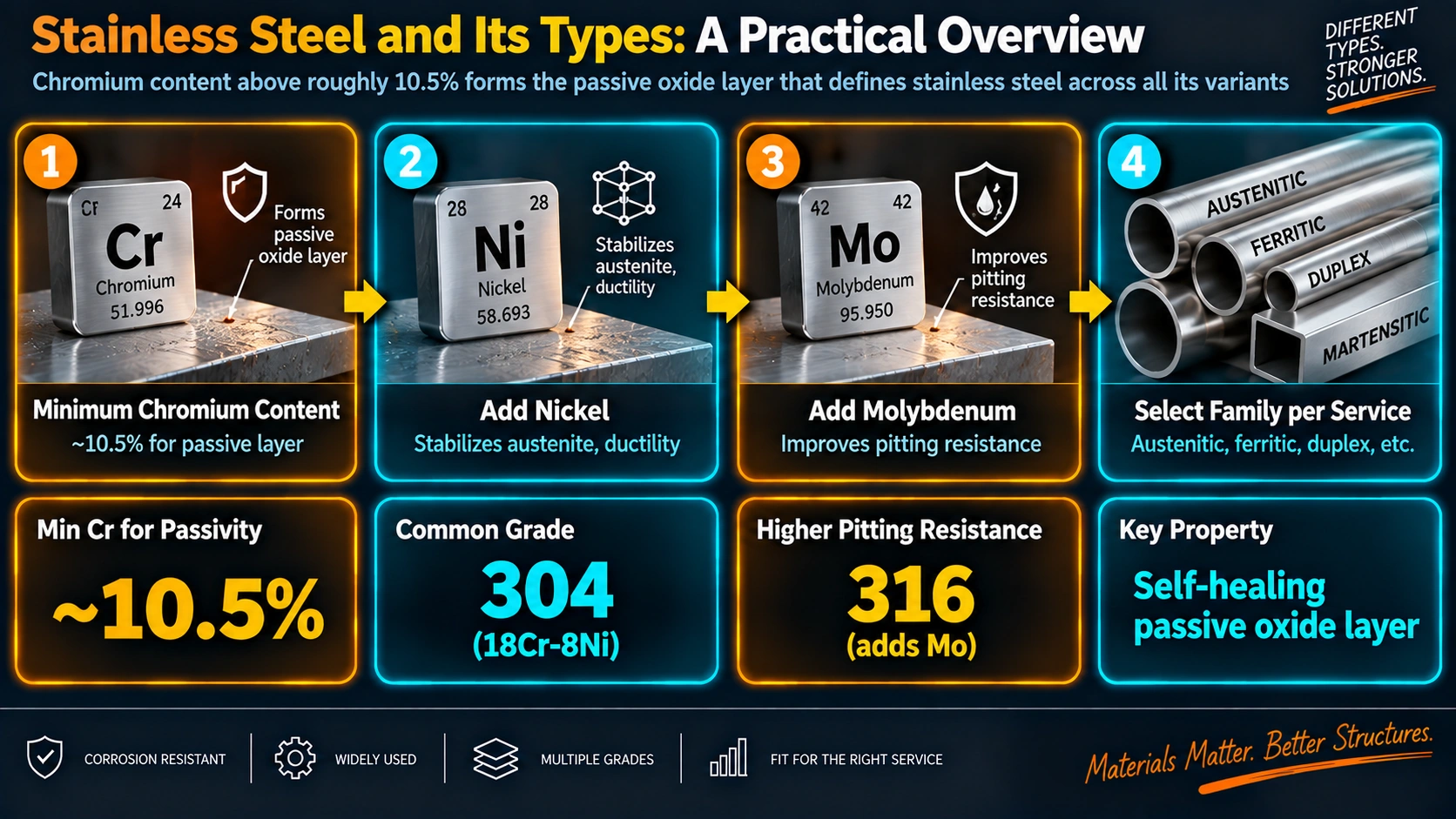
Type 304 — formally 18%Cr–8%Ni with a maximum of 0.08%C — earns its place as the baseline because it sits at a thermodynamic sweet spot. Chromium provides the passive film. Nickel stabilises the face-centred cubic (FCC) austenitic structure at room temperature, preventing the ferritic BCC transformation that would occur at 18%Cr alone. The result is a fully austenitic microstructure with no magnetic response, reasonable strength (~515 MPa UTS), good ductility (~40% elongation), and corrosion resistance sufficient for most non-chloride service. It is the most produced stainless steel grade in the world, estimated at 60–65% of total stainless tonnage.
The fundamental limitation of 304 is equally instructive: it has a PREN of approximately 18–20, making it susceptible to pitting in chloride environments with concentrations above roughly 200 ppm Cl− at elevated temperatures. Every single grade in the diagram above was developed to address a specific limitation of this baseline — whether corrosion resistance, strength, high-temperature stability, cost, machinability, or some combination of these.
The Austenitic Branch: Extending Performance from the 304 Core
The austenitic family is the largest and most varied branch of the stainless steel tree. All austenitic grades maintain the FCC crystal structure at room temperature, giving them their characteristic non-magnetic behaviour, excellent formability, and good low-temperature toughness. Every grade in this family descends from 304 through one or more compositional modifications, each targeting a specific engineering limitation.
The 304–316–317 Pitting Resistance Axis
The single most important upgrade from 304 is the addition of molybdenum. Mo dramatically improves resistance to localised pitting corrosion in chloride environments by stabilising the passive film and raising the critical pitting temperature (CPT). This creates the 316/317 series:
Type 316 is the workhorse for marine, pharmaceutical, food processing, and chemical plant applications. Grade 317 and the more advanced 317LMN are used where higher Mo content (3–4%) and nitrogen addition are needed for more aggressive process environments. Grade 317LMN is particularly specified in flue gas desulphurisation (FGD) systems where concentrated sulphuric acid and chloride combinations are encountered. For welding, 316 is qualified as P-No. 8 and is welded with E316L-16 or ER316L filler to keep the weld metal carbon low and prevent sensitisation.
Sensitisation and the L-Grade / Stabilised Grade Solution
Sensitisation — the formation of chromium carbide (Cr23C6) at grain boundaries when heated between 425–850°C — is one of the most practically important metallurgical phenomena in stainless steel fabrication. In a sensitised zone, the adjacent chromium-depleted region drops below the ~12% Cr threshold required to maintain the passive film, creating a narrow anodic band at every grain boundary that is susceptible to intergranular corrosion attack. Welding creates this sensitisation zone in the HAZ of every standard-carbon grade.
The industry solved this with two parallel approaches, both visible in the diagram:
High-Temperature Austenitic Grades: 309, 310, and 314
As service temperatures increase above 600°C, the scaling resistance of 304 and 316 becomes inadequate. Chromium content must increase substantially to form a stable Cr2O3 oxide layer at elevated temperature. This drives the 309/310 series:
Grade 309S is the standard filler metal for welding carbon steel to stainless steel (dissimilar metal welds) because the high Cr and Ni provide a “buttering” layer that can accommodate the dilution from the carbon steel side without losing its austenitic structure or sensitising. Type 310 is used in furnace components, radiant tubes, and kiln furniture where exceptional oxidation resistance is required.
High-Nitrogen and High-Manganese Austenitic Grades: 200-Series
Nitrogen is a powerful austenite stabiliser (approximately 30 times more effective than nickel on a molar basis) and a strong solid-solution strengthener. Adding nitrogen allows nickel content to be reduced substantially while maintaining the FCC austenitic structure, giving rise to the 200-series grades developed originally for nickel conservation during post-war shortages:
These grades have lower corrosion resistance than 304 (PREN ~16–18) due to reduced nickel and the absence of molybdenum, but their lower cost and good formability make them suitable for architectural, cookware, and general-purpose applications not exposed to aggressive corrosive environments. In welding, 200-series grades are treated similarly to P-No. 8 austenitic grades but with the recognition that their lower corrosion performance means they are not interchangeable with 304 in corrosion-critical service.
The Ferritic Branch: Eliminating Nickel, Controlling BCC Structure
Ferritic stainless steels are the second-largest production family. By reducing or eliminating nickel, the alloy composition falls outside the austenite stability field, and the FCC austenite phase reverts to the BCC ferritic structure. Ferritic grades offer several engineering advantages over austenitic: immunity to chloride stress corrosion cracking (SCC), lower cost (no nickel), better thermal conductivity, and lower thermal expansion coefficient. Their disadvantages are limited toughness at low temperatures and inability to be hardened by heat treatment.
Standard Ferritic Grades: 409, 430, 439
The ferritic family starts at 409 (10.5–11.7% Cr, used for automotive exhaust systems) and builds to 430 (16–18% Cr, the standard ferritic grade) and 439/441 (18% Cr + Ti or Nb stabilisation for improved weldability):
High-Chromium Superferritic Grades: 444 and 446
Increasing chromium above 25% while maintaining ultra-low carbon and nitrogen (both interstitials being reduced to <150 ppm combined in the best superferritic grades) produces grades with outstanding pitting and crevice corrosion resistance approaching or exceeding that of 316L, while retaining the SCC immunity of all ferritic grades:
Grades such as 26Cr-1Mo (ASTM S44626), 29Cr-4Mo (S44700), and 29Cr-4Mo-2Ni (S44800) are used in desalination heat exchangers, seawater service piping, and chemical plant handling dilute sulphuric acid. Grade 446 (25–27% Cr) is used specifically for high-temperature oxidation resistance in furnace applications where SCC is also a concern. Welding ferritic grades requires attention to grain growth in the HAZ (ferritic grades do not undergo austenite transformation on reheating, so grains cannot be refined by normalising), and very low heat input — typically <0.5 kJ/mm — is recommended to limit HAZ embrittlement.
The Martensitic Branch: Hardness by Quench and Temper
Martensitic stainless steels are the only stainless family that responds to quench-and-temper heat treatment in the same way as alloy steels. By increasing carbon content (typically 0.10–1.20%C) while maintaining chromium in the 11.5–18% range, and eliminating or drastically reducing nickel, the alloy develops sufficient hardenability for martensitic transformation on air or oil quenching from the austenitising temperature (950–1050°C). The higher the carbon content, the higher the achievable hardness — but at the cost of reduced corrosion resistance and weldability.
The 410–420–440 Carbon Escalation
The High-Hardness Group: 403, 416, 420
Grade 416 introduces sulphur (0.15% min) or selenium to grade 410 to improve free-machining characteristics, at a modest cost in corrosion resistance and toughness. Grades 403 and 410 are the standard structural martensitic grades used in steam turbine blades, compressor blades, pump shafts, and fasteners. The as-quenched hardness scales directly with carbon content:
Approximate as-quenched hardness (fully martensitic structure):
  HRC_max ≈ 20 + 60 × %C    (simplified Koistinen–Marburger relationship)

  410 (0.12%C): HRC ≈ 27
  420 (0.30%C): HRC ≈ 38
  440A (0.68%C): HRC ≈ 61
  440C (1.08%C): HRC ≈ 65+

Weldability of martensitic grades:
  Carbon Equivalent CE(IIW) = %C + %Mn/6 + (%Cr+%Mo+%V)/5 + (%Ni+%Cu)/15

  410: CE ≈ 0.12 + 12/5 = ~2.5 → High preheat required (150–250°C)
  440C: CE >> 4.0 → Generally considered unweldable in production
The Duplex Branch: Balancing Two Phases for Maximum Performance
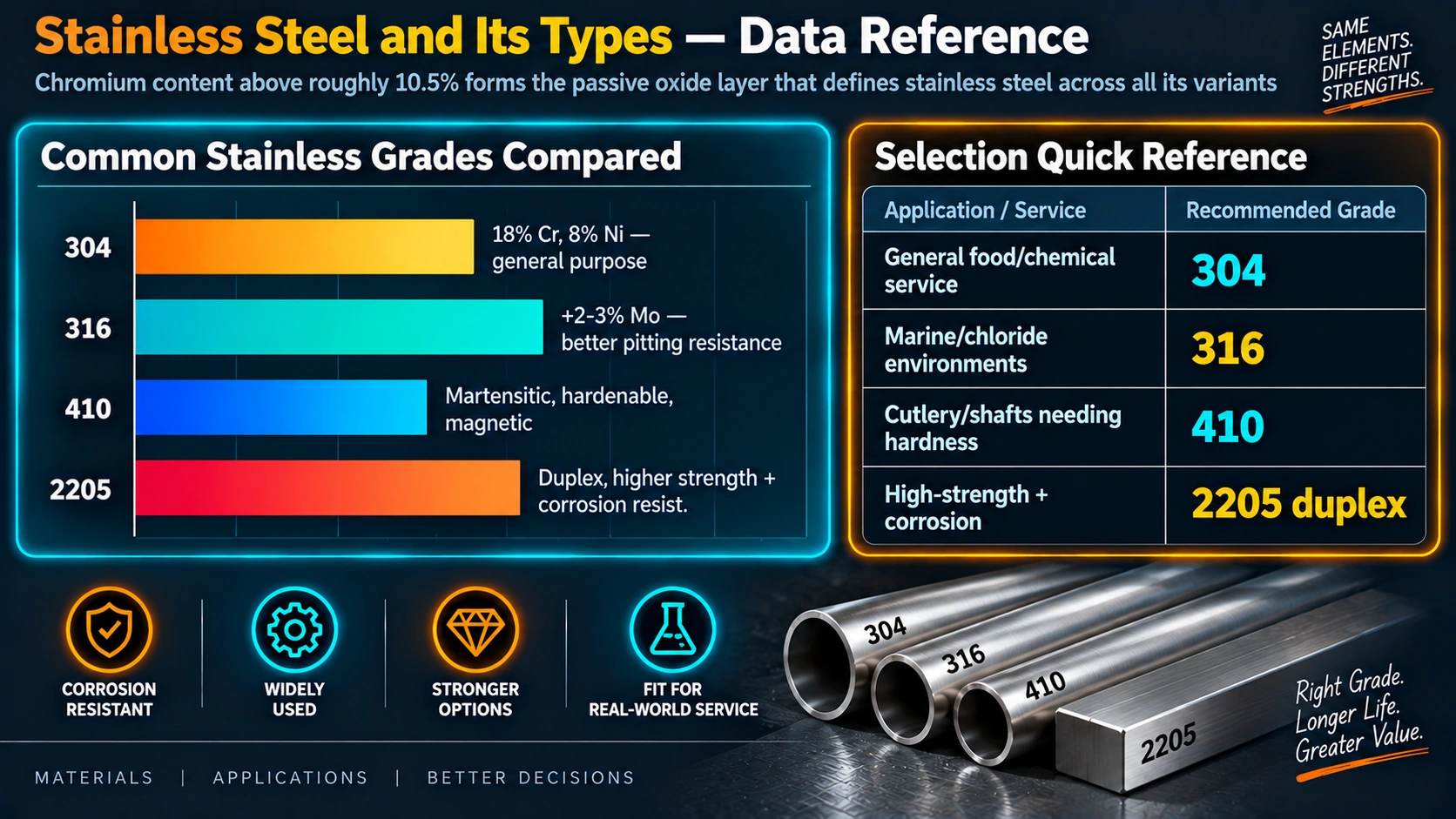
The duplex family achieves what neither austenite nor ferrite alone can: a combination of the high yield strength of ferrite (~690 MPa SMYS for 2205) with the chloride SCC immunity of ferrite and the corrosion resistance approaching that of 316L or better. The microstructure is deliberately maintained at approximately 40–60% austenite and 40–60% ferrite by balancing the austenite-forming elements (Ni, N, Mn, C) against the ferrite-forming elements (Cr, Mo, Si). Nitrogen plays a dual role in duplex grades: it stabilises austenite to replace some nickel cost, and it powerfully raises pitting resistance (PREN contribution: 16×%N).
The Duplex Hierarchy: Lean → Standard → Super → Hyper
The PREN value is the primary ranking tool within the duplex family. A minimum PREN of 35 is generally considered necessary for offshore seawater service and aggressive chloride environments:
| Grade | UNS | Cr (%) | Ni (%) | Mo (%) | N (%) | PREN | SMYS (MPa) | Key Application |
|---|---|---|---|---|---|---|---|---|
| Lean 2101 | S32101 | 21.0–22.0 | 1.35–1.70 | 0.10–0.80 | 0.20–0.25 | ~26 | 450 | Cost-sensitive construction, tanks |
| Standard 2205 | S31803/S32205 | 21.0–23.0 | 4.5–6.5 | 2.5–3.5 | 0.08–0.20 | ~35 | 450–480 | Oil & gas, chemical processing, offshore |
| Super Duplex S32750 | S32750 | 24.0–26.0 | 6.0–8.0 | 3.0–5.0 | 0.24–0.32 | ~43 | 550 | Seawater systems, FGD, subsea |
| S32760 (Zeron 100) | S32760 | 24.0–26.0 | 6.0–8.0 | 3.0–4.0 | 0.20–0.30 | ~41 | 550 | Offshore pipework, pump casings |
| Hyper Duplex S32707 | S32707 | 26.0–28.0 | 6.0–8.0 | 4.0–5.0 | 0.30–0.50 | ~49 | 700 | Extreme chloride, hot seawater, deep subsea |
For welding duplex grades, the critical requirement is maintaining the ferrite–austenite balance in the weld metal and HAZ — both excessive ferrite (>70%) and excessive austenite shift the properties away from the design optimum. This requires: controlled heat input (0.5–2.0 kJ/mm for standard 2205, 0.5–1.5 kJ/mm for super duplex), interpass temperature ≤150°C, use of nickel-enriched filler metal (E2209 or E2594) to over-alley the weld metal and compensate for nitrogen loss to the arc, and back purging with argon to prevent oxidation of the root pass. For a complete treatment of duplex welding, see the WeldFabWorld guide: Complete Guide to Welding Duplex Stainless Steels (P No. 10H).
The Precipitation-Hardening Branch: Combining Strength with Corrosion Resistance
Precipitation-hardening (PH) stainless steels achieve tensile strengths of 1000–1400 MPa — far beyond what cold work alone can provide in austenitic grades — while retaining the corrosion resistance of 17% Cr stainless. This is accomplished by adding precipitation-hardening elements (copper, aluminium, titanium, niobium) that form coherent intermetallic particles (ε-Cu precipitates in 17-4PH, Ni3Al in 17-7PH) within the matrix on low-temperature ageing.
The Three PH Sub-Classes
PH grades are categorised by the matrix phase present after solution treatment but before ageing:
Martensitic PH
Semi-Austenitic PH
Austenitic PH
Welding PH grades requires particular attention because the high-strength condition is achieved by the combination of martensitic transformation and precipitation. A-condition (annealed) material is welded using E630 filler for 17-4PH or matching composition filler where available, with preheat of 15–30°C (minimum) and full PWHT (re-solution treat and re-age) of the joint after welding wherever possible to restore full properties. Where PWHT is not possible, weld deposits in 17-4PH will be in a partially degraded condition; the engineering assessment must account for this.
The Nuclear Grades: Controlled Chemistry for Radiation Stability
The diagram identifies a small but important sub-family of nuclear-service austenitic grades (308, 316, 316L, 316LN, 317L) with controlled cobalt and tantalum content. In nuclear reactor environments, cobalt is highly undesirable because 59Co activates to 60Co on neutron bombardment, producing penetrating gamma radiation that dramatically increases post-maintenance dose rates. Nuclear-grade stainless steel specifications therefore impose maximum cobalt limits of 0.05–0.20% depending on application — far below the residual cobalt levels of standard commercial grades.
Grade 316LN is a variant of 316L with controlled nitrogen addition (typically 0.10–0.16% N), which raises the yield strength to approximately 240–260 MPa minimum (vs ~170 MPa for 316L) through solid-solution strengthening, while maintaining the very low carbon required for sensitisation immunity. It is the standard grade for reactor coolant piping and primary circuit components in PWR and BWR reactors. ASME Section III, NCA, NB, and NC codes govern the complete qualification and traceability requirements for nuclear-grade stainless.
ASME P-Number Classification and Welding Qualification Implications
For every fabricator working to ASME codes (Section VIII pressure vessels, B31.3 process piping, B31.1 power piping), the P-Number classification of a stainless steel grade directly determines which WPS can be applied, which filler metals are qualified, and whether a new PQR is required. Understanding the P-Number structure for stainless steels prevents the all-too-common error of attempting to use a P-No. 8 WPS to weld a P-No. 10H duplex component.
| ASME P-Number | Steel Family | Representative Grades | PWHT Required? | Key Welding Note |
|---|---|---|---|---|
| P-No. 8, Group 1 | Austenitic SS | 304, 304L, 316, 316L, 321, 347, 309, 310 | No (typically) | Use L-grade filler; back purge for root |
| P-No. 8, Group 2 | High-alloy austenitic | 317L, 317LMN, Alloy 20 | No | Higher Mo/N; use matching or over-alloyed filler |
| P-No. 7 | Ferritic SS (16–26%Cr) | 405, 409, 429, 430, 434, 439, 444, 446 | Recommended for heavy thickness | Control heat input; avoid grain growth; low interpass T |
| P-No. 6 | Martensitic SS | 403, 410, 410S, 420, 501, 502 | Yes (temper 650–750°C) | Preheat 200–300°C; H2 controlled filler |
| P-No. 10H | Duplex SS | 2205, 2304, 2507, S32750, S32760, S32101 | Solution anneal if thick | 0.5–2.0 kJ/mm; ≤150°C interpass; Ni-enriched filler |
| P-No. 45 | Precipitation-hardening SS | 17-4PH, 15-5PH, 17-7PH, Custom 450 | Re-solution treat + re-age when possible | Weld in annealed (A) condition; use matching filler |
PREN: The Corrosion Selection Metric Fabricators Need to Know
The Pitting Resistance Equivalent Number (PREN) is the single most useful cross-family comparison tool for corrosion engineers and fabricators selecting stainless steel grades for aggressive service. It quantifies the combined effect of chromium, molybdenum, and nitrogen on resistance to localised (pitting) corrosion in chloride environments:
PREN = %Cr + 3.3 × %Mo + 16 × %N

Examples:
  304:          18 + 0 + 0                  = 18
  316L:         17 + 3.3×2.1 + 0            ≈ 24
  317LMN:       18 + 3.3×3.5 + 16×0.16     ≈ 32
  2205 (duplex): 22 + 3.3×3.0 + 16×0.17   ≈ 35
  S32750 (SD):  25 + 3.3×4.0 + 16×0.27    ≈ 43
  S32707 (HD):  27 + 3.3×4.5 + 16×0.40    ≈ 49

Service guidelines:
  PREN 18–24:  Atmospheric and low-chloride service (fresh water, mild chemical)
  PREN 25–35:  Moderate chloride, seawater splash, coastal atmosphere
  PREN > 35:   Continuous seawater immersion, process chlorides at temperature
  PREN > 40:   Severe seawater, hot brines, aggressive acid chloride service

Nitrogen coefficient note:
  Some specifications use PREN = Cr + 3.3Mo + 30N (for tungsten-bearing grades)
  NORSOK M-601 (offshore) requires PREN ≥ 35 for all welded components exposed
  to seawater in production systems
Common Fabrication Errors When Mixing Grade Families
The most persistent quality issues in stainless steel fabrication arise from misapplying the properties and procedures of one family to another. Here are the failures that appear most frequently in fabrication shops: