Welding Stainless Steel, Aluminum and Copper Alloys: Metallurgical Considerations
Welding stainless steel, aluminum, and copper alloys each presents a distinct set of metallurgical challenges that do not exist in conventional carbon steel fabrication. While carbon steel dominates welding education, a large and growing proportion of industrial welded fabrication involves these three material families — in chemical process plant, offshore structures, food and pharmaceutical equipment, heat exchangers, and power generation systems. The inspector or engineer who understands only carbon steel metallurgy is under-equipped for a significant portion of real-world fabrication work.
Unlike carbon steels, where the primary concerns centre on hardenability, hydrogen cracking, and PWHT, these three material families introduce entirely different phenomena: sensitisation and intergranular corrosion in austenitic stainless steel; a tenacious refractory oxide film that must be physically removed before welding aluminum; and the destruction of cold-worked strength properties in copper alloys by the welding thermal cycle. Each material demands specific process selection, filler metal matching, and procedure controls that cannot be extrapolated from carbon steel practice.
This guide covers the metallurgical mechanisms underlying each challenge — sensitisation, carbide precipitation, delta ferrite control, hot cracking, oxide film removal, alloy series identification, and thermal conductivity effects — and the practical measures used to manage them. Filler metal selection, code references, and inspector monitoring guidance are included throughout. For background on the iron-carbon system and solid-state transformations, refer to the martensite, bainite and pearlite guide in the WeldFabWorld metallurgy series.
Part 1: Stainless Steels
Definition and the Passive Film
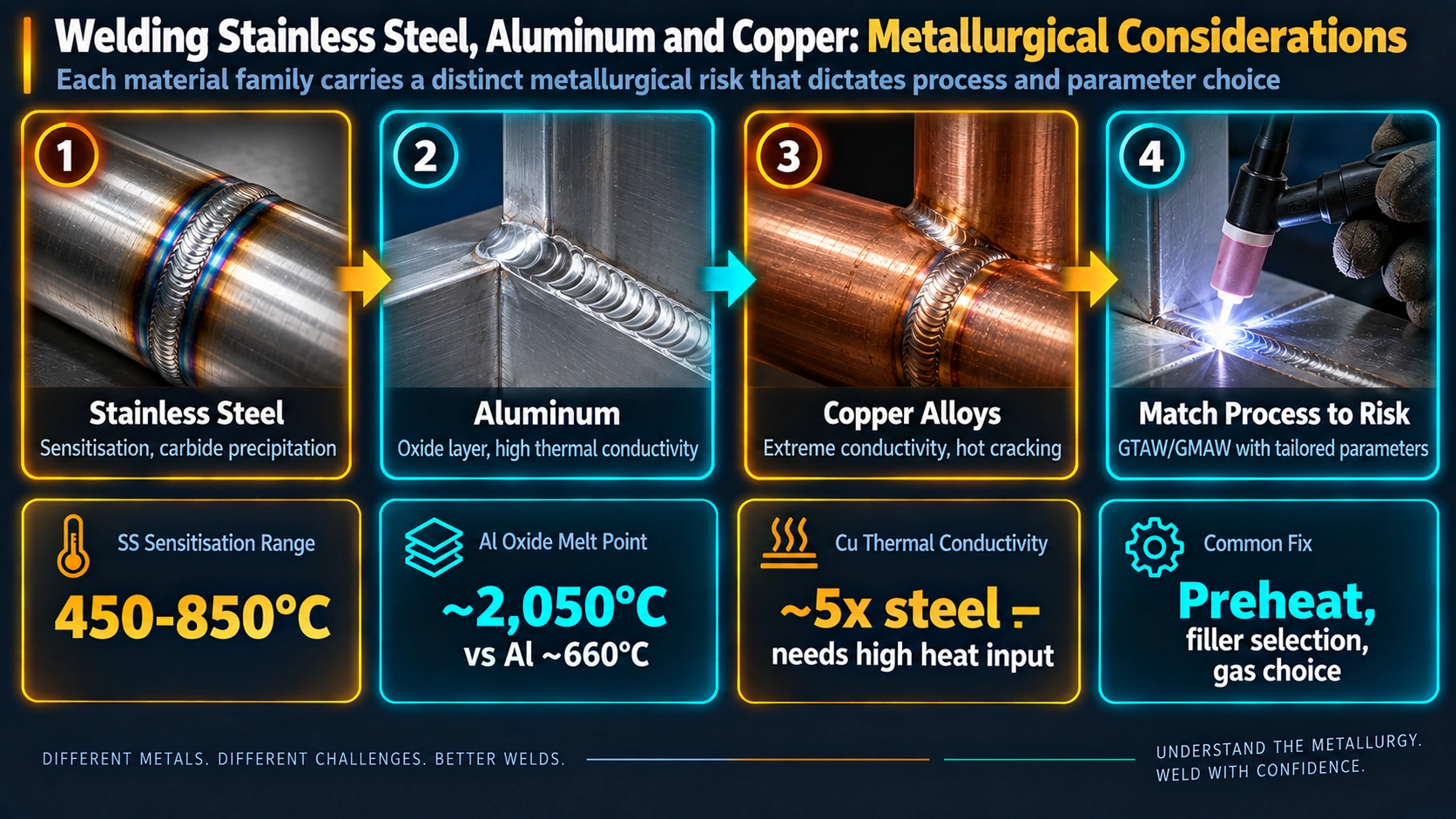
Stainless steels are defined as iron-based alloys containing a minimum of 10.5–12% chromium by mass. The chromium reacts spontaneously with atmospheric oxygen to form a thin, adherent, self-repairing chromium oxide (Cr₂O₃) layer — the “passive film” — typically only 2–5 nanometres thick. This invisible film is what provides the corrosion resistance for which stainless steels are valued. If the chromium content in any localised region falls below approximately 12%, the passive film cannot sustain itself and the material corrodes as ordinary iron would. This mechanism is central to understanding the most important welding problem in austenitic stainless steel: sensitisation.
Despite the “stainless” descriptor, these alloys can and do corrode under sufficiently aggressive conditions. The Pitting Resistance Equivalent Number (PREN) — PREN = %Cr + 3.3 × %Mo + 16 × %N — is a widely used index of resistance to localised (pitting) corrosion. When welding stainless steel, it is important to verify that the weld deposit PREN is not substantially lower than that of the base material, since dilution and element burn-off can reduce local corrosion resistance at the weld.
Classification of Stainless Steels
The five main classes of stainless steel are differentiated by their room-temperature microstructure, which in turn is controlled by the balance of austenite-forming (Ni, N, Mn, C) and ferrite-forming (Cr, Mo, Si, Nb, Ti) elements.
| Class | Typical Grades | Microstructure | P-No. (ASME IX) | Weldability |
|---|---|---|---|---|
| Austenitic | 304, 304L, 316, 316L, 321, 347 | FCC austenite | P-No. 8 | Excellent |
| Ferritic | 409, 430, 444 | BCC ferrite | P-No. 7 | Good — proper fillers required |
| Martensitic | 410, 416, 420, 431 | BCT martensite | P-No. 6 | Requires preheat & PWHT |
| Duplex | 2205 (UNS S31803), 2507, LDX2101 | ~50% austenite / ~50% ferrite | P-No. 10H | Weldable; ferrite control critical |
| Precipitation Hardening | 17-4 PH (630), 15-5 PH | Martensitic or semi-austenitic | P-No. 6 / 8 | PWHT mandatory to restore properties |
Austenitic Stainless Steels: Sensitisation and Carbide Precipitation
Austenitic stainless steels (the 200 and 300 series, including the widely used 304 and 316) are generally considered the most weldable of the stainless families. They are not hardenable by quenching, they do not transform to martensite during welding (in properly balanced compositions), and they require neither preheat nor PWHT for structural integrity purposes. However, they are susceptible to a specific and critically important metallurgical degradation mechanism called sensitisation — also referred to as carbide precipitation or weld decay when the resulting corrosion occurs in service.
The Mechanism of Sensitisation
During welding, the HAZ is heated through a range of temperatures. In the specific range of approximately 427–871 °C (800–1600 °F), both chromium and carbon dissolved in the austenite matrix have sufficient atomic mobility to diffuse to grain boundaries and combine. The compound formed is primarily chromium carbide — Cr₃₂C₆ — which precipitates as a discontinuous network along austenite grain boundaries. The most active temperature for this reaction is approximately 677 °C (1250 °F).
As carbide precipitates at the grain boundary, the chromium required to form it is drawn from the immediately adjacent matrix. Because solid-state diffusion is slow at these temperatures, the chromium-depleted zone cannot replenish itself from the bulk. The result is a narrow band on either side of each grain boundary where chromium content may drop below 12% — below the threshold required for passive film formation. This phenomenon is called chromium depletion.
Three Methods to Prevent Sensitisation
- Extra Low Carbon (ELC / “L” grades) — 304L, 316L: Limiting carbon to a maximum of 0.03% (versus 0.08% for standard grades) dramatically reduces the amount of carbon available to combine with chromium. Less carbon means less Cr₃₂C₆ can form, and the chromium depletion is insufficient to cause loss of passivity. The trade-off is a modest reduction in elevated-temperature mechanical properties. For ambient and moderate-temperature service this is usually acceptable.
- Stabilised Grades — 321 (Ti-stabilised) and 347 (Nb-stabilised): Titanium and niobium have a stronger thermodynamic affinity for carbon than chromium does. In these grades, the carbon combines preferentially with Ti or Nb to form stable, dispersed carbide particles (TiC, NbC), consuming the carbon before it can form Cr₃₂C₆. The chromium remains in solid solution and the passive film is maintained throughout the weld thermal cycle. Stabilised grades are preferred for applications operating continuously at 425–870 °C (such as boiler superheaters and heat exchangers).
- Post-Weld Solution Annealing: Heating to 1050–1100 °C and holding sufficiently long to re-dissolve all chromium carbides back into solid solution, followed by rapid water quench to suppress re-precipitation. This fully restores corrosion resistance but often causes severe distortion of complex weldments and is impractical for large structures or assembled equipment. It is most commonly used for small, simple components or critical pressure-retaining parts.
Hot Short Cracking (Solidification Cracking) in Austenitic Stainless Steel
The second major welding problem for austenitic stainless steels is solidification cracking, commonly called hot short cracking or hot cracking. This occurs during or immediately after solidification of the weld pool. The mechanism involves low-melting-point impurity films — enriched in sulphur, phosphorus, and silicon — that persist as liquid films along solidifying grain boundaries when the weld metal bulk has already solidified. As the weld metal contracts on cooling, these liquid films cannot accommodate the thermal strain, and they tear open as cracks along grain boundaries.
Delta Ferrite as the Solution
The proven solution is to control weld metal composition such that a small fraction of delta ferrite (δ-ferrite) — a BCC iron phase — is present in the as-solidified weld bead. Delta ferrite provides several benefits:
- Delta ferrite has significantly higher solubility for sulphur and phosphorus than austenite, absorbing these impurities and preventing them from forming liquid films at grain boundaries
- The delta ferrite-austenite grain boundaries created during solidification interrupt the continuous grain boundary network through which hot cracks would otherwise propagate
- The solidification mode shifts from a purely austenitic path (crack-susceptible) to a ferritic-austenitic path (crack-resistant) when delta ferrite is present
| Base Metal Grade | Standard Filler | Alternate Filler | Target FN | Key Concern |
|---|---|---|---|---|
| 304 / 304L | ER308 / ER308L | ER308LSi | 4–10 FN | Sensitisation (use L-grade) |
| 316 / 316L | ER316 / ER316L | ER316LSi | 4–10 FN | Pitting resistance (Mo content) |
| 321 (Ti-stabilised) | ER347 (Nb-stabilised) | ER321 | 4–10 FN | Ti lost to arc — use 347 filler |
| 347 (Nb-stabilised) | ER347 | ER308L | 4–10 FN | High-temperature service stability |
| 310 (High-Si, high-Cr) | ER310 | ERNiCr-3 | 0 FN (fully austenitic) | Hot cracking risk — control S, P |
| 2205 Duplex | ER2209 | ERNiCrMo-3 | 30–55 FN (duplex) | See duplex stainless guide |
Ferritic Stainless Steels
Ferritic stainless steels (grades 409, 430, 444) maintain a BCC ferritic structure at all temperatures — they cannot be hardened by quenching. Their weldability is generally good, but several specific issues require attention:
- Grain coarsening: Ferritic stainless steels have no austenite-to-ferrite transformation during cooling to refine the grain structure (unlike carbon steels). The weld HAZ grains grow rapidly and remain coarse, significantly reducing impact toughness. Keeping heat input low is essential.
- 475 °C Embrittlement: Extended exposure at 370–540 °C causes precipitation of a chromium-rich alpha-prime phase that dramatically reduces toughness and ductility. Slow cooling through this range during PWHT must be avoided.
- Filler metal selection: Using an austenitic filler (e.g. ER309L) rather than a matching ferritic filler can improve weld metal toughness by depositing a ductile austenitic or duplex weld metal, though this introduces a dissimilar interface that may behave differently in service.
Martensitic Stainless Steels
Martensitic grades (410, 416, 420, 431) are the most challenging of the stainless steels to weld. They have significant hardenability and transform from austenite to brittle martensite in the HAZ during the welding thermal cycle, in direct analogy with hardenable carbon steels. Grade 410, for example, can develop HAZ hardness exceeding 400 HV — well into the range susceptible to hydrogen-induced cold cracking.
Preheat: 150–260 °C (higher for sections >25 mm or carbon >0.10%).
Maximum interpass temperature: 315 °C.
Process: GTAW or low-hydrogen SMAW (E410 or E309/309L filler if toughness is primary).
PWHT: Temper at 650–760 °C for 1 hour per 25 mm minimum, then slow cool. Required to temper HAZ martensite and restore toughness. Do not PWHT in the range 370–565 °C (temper embrittlement risk).
Code reference: ASME Section IX P-No. 6; ASME B31.3 para 331.2.
Part 2: Aluminum and Its Alloys
The Aluminum Oxide Film Challenge
Aluminum is one of the most reactive structural metals in air. When bare aluminum is exposed, a coherent aluminum oxide film (Al₂O₃) forms on the surface within seconds. This oxide film is an exceptional engineering advantage in service — it provides outstanding corrosion resistance even in marine environments — but it creates a severe problem for welding:
If not removed before and during welding, the oxide film will prevent fusion between the filler metal and base metal, create oxide inclusions in the weld pool, and produce a “cold lap” defect where the weld metal sits on top of an unfused oxide layer rather than truly fusing into the joint. Mechanical pre-cleaning (stainless steel wire brushing, solvent degreasing) is essential before welding, but mechanical cleaning cannot maintain a clean surface during the welding arc — oxide reforms too quickly.
AC GTAW and the Cathodic Cleaning Action
The solution used in GTAW (TIG welding) of aluminum is alternating current (AC). The AC cycle alternates between two half-cycles that serve complementary purposes:
- Electrode-positive (EP) half-cycle: When current flows from workpiece to electrode, electrons bombard the oxide film surface, breaking it up and dispersing it — the “cathodic cleaning action.” This removes the oxide in real time from ahead of the advancing weld pool.
- Electrode-negative (EN) half-cycle: When current flows from electrode to workpiece, the arc energy is concentrated at the workpiece, generating the heat needed to melt the base metal and filler. This half-cycle provides the primary fusion energy.
The result is a distinctive “cleaning band” visible either side of the weld bead — a bright, matte zone where the oxide has been removed by cathodic bombardment. Shielding with pure argon prevents re-oxidation within the weld zone during welding. Helium or argon-helium mixtures are sometimes used for deeper penetration on thicker sections.
The Aluminum Alloy Series and Weldability
Aluminum alloys are classified by a four-digit designation system. The first digit identifies the principal alloying element(s), and the alloy’s weldability and appropriate filler metal selection depend strongly on which series it belongs to.
| Series | Principal Alloy | Strengthening | Weldability | Typical Filler | Example Grades |
|---|---|---|---|---|---|
| 1xxx | Pure Al (≥99%) | Work hardening | Excellent | ER1100, ER1188 | 1100, 1350 |
| 2xxx | Copper (Cu) | Precipitation hardening | Poor — crack-susceptible | ER2319 (limited) | 2024, 2014, 2219 |
| 3xxx | Manganese (Mn) | Solid solution / work hardening | Good | ER4043, ER5356 | 3003, 3004 |
| 4xxx | Silicon (Si) | Solid solution | Excellent | ER4043, ER4047 | 4043, 4047 (filler alloys) |
| 5xxx | Magnesium (Mg) | Solid solution / work hardening | Very Good | ER5356, ER5183 | 5052, 5083, 5086 |
| 6xxx | Mg + Si | Precipitation hardening | Good with proper filler | ER4043, ER5356 | 6061, 6063, 6082 |
| 7xxx | Zinc (Zn) | Precipitation hardening | Limited — specialist procedures | ER5356 (limited) | 7005, 7075 (generally avoid welding) |
Filler Metal Selection for Aluminum — Key Principles
Filler metal selection for aluminum welding is governed by ANSI/AWS A5.10 / ASME SFA-5.10 (Specification for Bare Aluminum and Aluminum Alloy Welding Electrodes and Rods). The primary selection criteria are:
- Hot crack resistance: The filler must produce a weld deposit that is not susceptible to solidification cracking. Silicon-bearing fillers (4xxx, particularly ER4043 and ER4047) have excellent hot crack resistance. Magnesium-bearing fillers (5xxx, particularly ER5356 and ER5183) also perform well for most 5xxx and 6xxx base metals.
- Corrosion resistance matching: ER5356 (and higher-Mg fillers) provides better corrosion resistance in marine and chemical environments than ER4043. ER4043 weld deposits are softer and more ductile.
- Anodising compatibility: If the welded assembly will be anodised, ER4043 deposits may show a different colour than the base metal after anodising (darker/grey), while ER5356 or ER5183 deposits produce a better colour match for 5xxx and 6xxx base metals.
- Service temperature: ER5356 (containing Mg >3%) should not be used for sustained service above 65 °C due to the risk of sensitisation to stress corrosion in the weld metal. ER4043 or ER5183 is preferred for higher-temperature or marine applications of 5xxx alloys.
Part 3: Copper and Its Alloys
Alloy Families and Strengthening Mechanisms
Copper is one of the oldest engineering metals and is used extensively for its combination of electrical and thermal conductivity, corrosion resistance, and formability. Unlike steel and aluminum’s heat-treatable grades, pure copper and many of its alloys cannot be hardened by quenching. Their strengthening relies on different mechanisms, which directly determines how welding affects their mechanical properties.
| Copper Alloy Group | Common Grades | Strengthening Mechanism | Effect of Welding | Weldability |
|---|---|---|---|---|
| ETP / Pure Copper | C11000, C10200 | Cold working (work hardening) | HAZ fully softened; strength reverts to annealed level | Moderate — high preheat required |
| Brass (Cu-Zn) | C26000 (70/30), C36000 | Solid solution + work hardening | Softened; Zn fuming is a fume hazard | Moderate — Zn volatility is a concern |
| Phosphor Bronze (Cu-Sn) | C51000, C54400 | Solid solution + work hardening | HAZ softened; hot cracking possible if P >0.04% | Good |
| Silicon Bronze (Cu-Si) | C65500, C65100 | Solid solution + work hardening | Good ductility retained; lower preheat needed | Very Good |
| Aluminum Bronze (Cu-Al) | C61400, C63000 | Solid solution + some phase hardening | Risk of HAZ grain boundary oxidation; use GTAW | Good with proper procedures |
| Copper-Nickel (Cu-Ni) | C70600 (90/10), C71500 (70/30) | Solid solution hardening | Moderate strength loss; excellent weld quality achievable | Excellent |
| Beryllium Copper (Cu-Be) | C17200, C17500 | Precipitation hardening (aging) | HAZ over-aged; re-aging required post-weld | Limited — Be fume is toxic |
Thermal Conductivity: The Dominant Welding Challenge
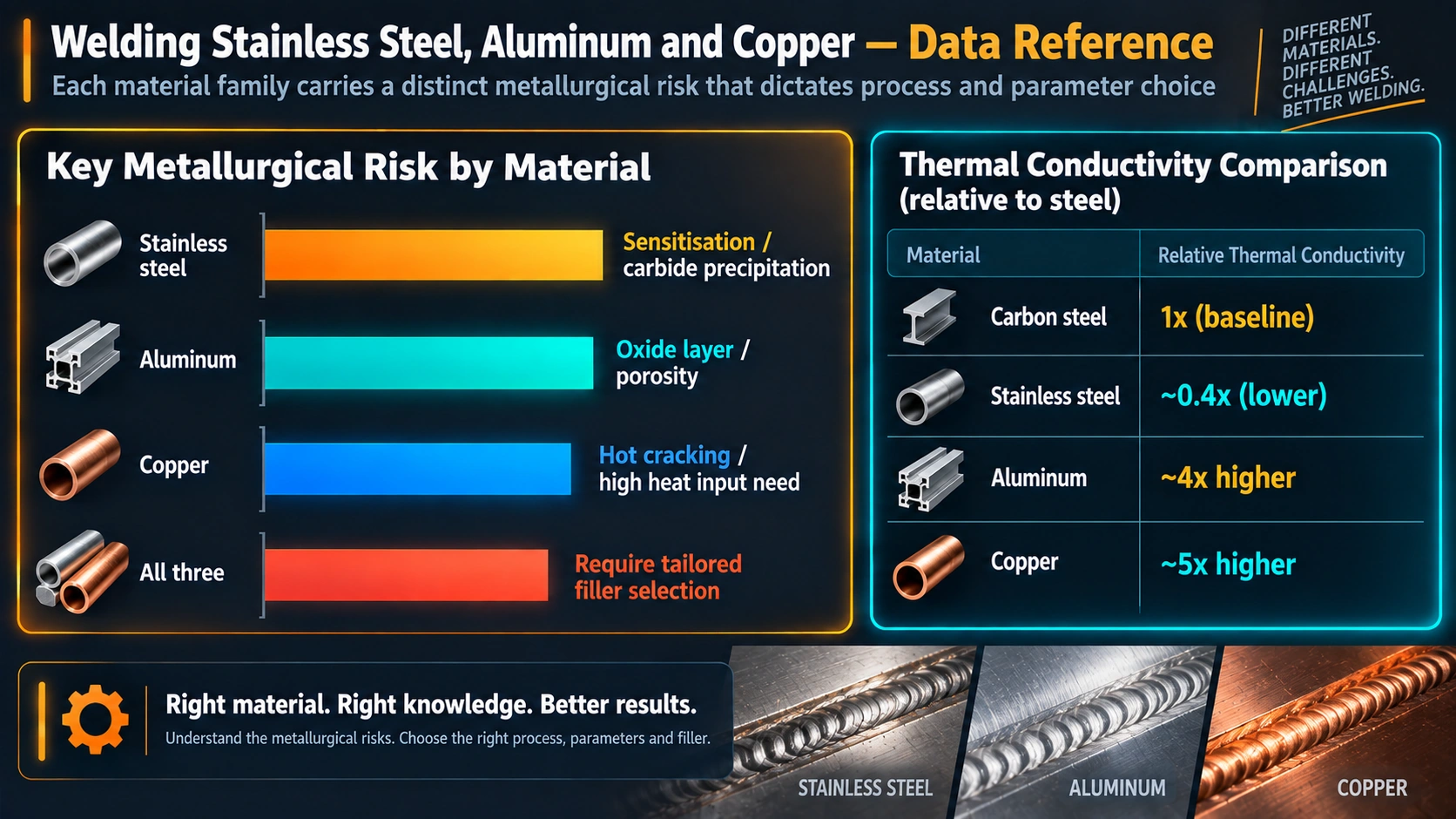
The single most significant practical challenge when welding copper and most copper alloys is their extremely high thermal conductivity. Pure copper conducts heat at approximately 390 W/m·K — roughly 25 times higher than carbon steel (50 W/m·K) and 60 times higher than austenitic stainless steel (16 W/m·K). The engineering consequence for welding is profound: arc energy is conducted away from the weld pool faster than it can build up sufficient local temperature to achieve fusion.
Practical consequences of high thermal conductivity in copper welding include:
- Difficulty establishing the weld pool: Without preheat, the arc energy is dissipated into the surrounding mass, and the weld zone may never reach fusion temperature. Preheat for pure copper sections above 3 mm typically starts at 200 °C and may reach 600 °C for heavy sections.
- Weld pool fluidity: When fusion is achieved, the liquid copper has very low viscosity compared to steel. It tends to flow out of the joint, particularly in overhead or vertical positions, requiring careful technique and joint design (tight root gaps, backing bars).
- HAZ width: The high conductivity means the thermal gradient through the HAZ is shallower — the HAZ is wider, and the softened region extends further from the weld centreline than it would for the same heat input in steel.
- Hydrogen embrittlement (tough-pitch copper): Copper grades containing oxygen (ETP copper — C11000) are susceptible to embrittlement when welded or heated in a reducing atmosphere. Hydrogen from the atmosphere or from the electrode reacts with copper oxide inclusions in the metal to produce steam (H₂O) at grain boundaries, causing intergranular cracking. Always use oxygen-free copper (C10200) or phosphorus-deoxidised copper (C12200) for welded applications, not ETP copper.
Cold-Worked Strength and the Welding Thermal Cycle
Many copper alloys are supplied and used in the cold-worked condition (designations such as 1/4 Hard, 1/2 Hard, Full Hard). Cold working introduces a high density of dislocations into the crystal structure, dramatically increasing strength and hardness above the annealed baseline. A typical 70/30 brass in the full-hard condition has a tensile strength of approximately 600 MPa versus 330 MPa in the fully annealed condition — an 80% increase achieved purely through cold work.
When this material is welded, the HAZ is heated above the recrystallisation temperature of the alloy (typically 250–450 °C for copper alloys depending on composition and degree of cold work). Above this temperature, the cold-worked dislocation structure recovers and the grains recrystallise into a new, coarse-grained, softened structure. This process is irreversible — you cannot restore the cold-worked condition through any post-weld heat treatment short of repeated cold working, which is impossible on a completed weld. The welded joint and adjacent HAZ are permanently at the annealed strength level.
Precipitation-Hardening Copper Alloys (Beryllium Copper, Chromium Copper)
A small but important subset of copper alloys — principally beryllium copper (Cu-Be) and chromium copper (Cu-Cr) — can be strengthened by an aging heat treatment analogous to the precipitation hardening used for PH stainless steels and 2xxx/7xxx aluminum alloys. In these alloys, the welding thermal cycle dissolves the precipitate structure (solution anneals the HAZ), producing a soft, solution-annealed condition in the weld zone. To restore properties, a post-weld aging heat treatment at 315–480 °C for 2–4 hours is required after welding. Welding engineers specifying procedures for beryllium copper must note that beryllium oxide (BeO) dust and fumes are extremely toxic — mandatory respiratory protection, local exhaust ventilation, and specialist safety procedures are non-negotiable.
Summary Comparison: Three Material Families
| Property / Challenge | Austenitic Stainless Steel | Aluminum Alloys | Copper Alloys |
|---|---|---|---|
| Primary HAZ risk | Sensitisation / IGC | Softening (over-aging or recrystallisation) | Softening (recrystallisation) |
| Hot cracking risk | High (control with 4–10 FN) | Moderate (Si or Mg fillers required) | Low–moderate (high-P grades at risk) |
| Preheat required? | No (except martensitic grades) | For sections >6–10 mm typically | Yes — often 200–600 °C for pure Cu |
| PWHT required? | Only martensitic grades (temper) | Re-aging for precipitation-hardened grades | Re-aging for precipitation-hardened grades |
| Surface preparation | Clean; stainless wire brush only | Degrease + SS wire brush; oxide reform in <1 s | Degrease; remove oxide film |
| Standard welding process | GTAW, GMAW, SMAW (low-H) | AC GTAW, GMAW (DCEP) | GTAW (DCEN), GMAW, OFW |
| Key filler standard | AWS A5.4, A5.9, A5.11 | AWS A5.10 / ASME SFA-5.10 | AWS A5.7, A5.6 / ASME SFA-5.7 |
| ASME IX P-Number | P-No. 6, 7, 8, 10H | P-No. 21–26 | P-No. 31–35 |
Frequently Asked Questions
What is sensitization in stainless steel welding and how is it prevented?
What is delta ferrite and why is it important in stainless steel welds?
Why is alternating current (AC) used for TIG welding of aluminum?
What filler metals are used to weld 304 and 316 stainless steel?
What welding challenges are specific to martensitic stainless steels like Grade 410?
Why does welding reduce the strength of work-hardened copper alloys?
What preheat is required for welding copper and why?
How does the PREN number relate to stainless steel weld quality?
Recommended Books on Stainless Steel, Aluminum, and Copper Welding
Disclosure: WeldFabWorld participates in the Amazon Associates programme (StoreID: neha0fe8-21). If you purchase through these links, we may earn a small commission at no extra cost to you. This helps support free technical content on this site.