Thermit Welding — Process, Chemistry, Equipment & Applications: The Complete Guide
Thermit welding is one of the oldest and most elemental welding processes in industrial use — and one of the most misunderstood. Unlike every other major welding process, thermit welding requires no electrical supply, no gas supply, no mechanical equipment, and no external power source of any kind. The heat that melts the base metal and fills the joint comes entirely from a self-sustaining chemical reaction: the reduction of iron oxide by aluminium, releasing energy at temperatures exceeding 2,500°C in a matter of seconds.
This combination of self-contained heat generation, complete portability, and ability to weld very large cross-sections in a single operation has made thermit welding the global standard for railway rail joint welding in the field. Every continuous welded rail track in the world — carrying high-speed trains, freight locomotives, and metro systems — contains thermit welds made exactly as Hans Goldschmidt first described them in 1898. When a rail must be joined in the middle of a track bed, kilometres from the nearest power supply, thermit welding remains unmatched.
Beyond rails, thermit welding is applied to heavy machinery repair, electrical conductor joining, large casting repair, and mining equipment restoration. This guide covers everything: the aluminothermic reaction chemistry, crucible and mold design, the complete step-by-step welding process, kit types, weld metallurgy, a comparison with flash butt welding, and full safety requirements.
What Is Thermit Welding?
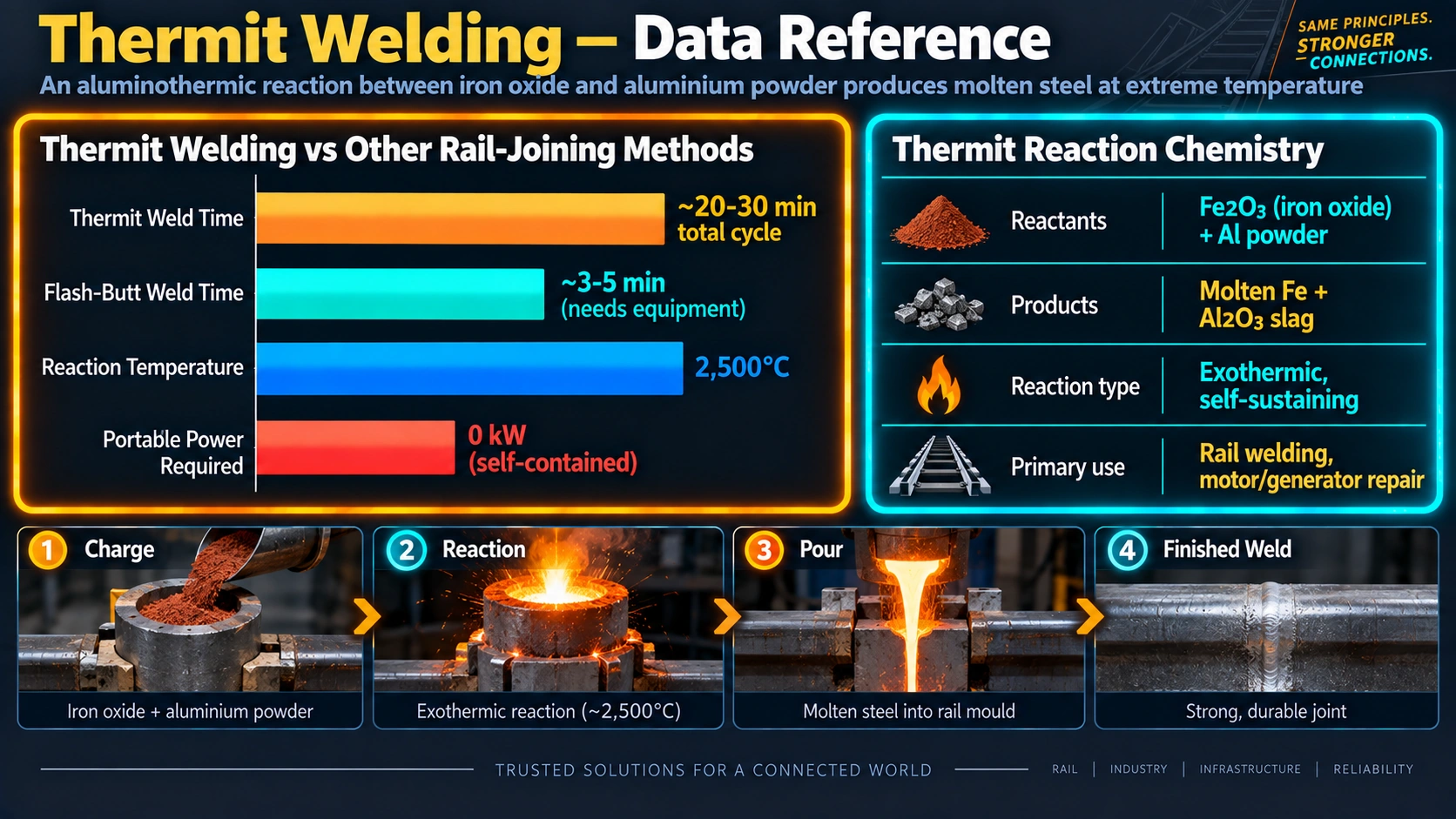
Thermit welding — formally classified as an aluminothermic welding process — is a fusion welding process in which the heat source is the exothermic chemical reaction between powdered aluminium and a metal oxide, typically iron oxide. The reaction produces superheated liquid metal (liquid iron or steel) which serves as the weld metal, flowing into a refractory mold formed around the joint gap and fusing with the preheated base metal faces on both sides of the gap to create a solid fusion weld.
The process can be performed with or without applied pressure, and with or without additional filler metal — though in standard rail welding practice, the thermit reaction product itself is the filler metal. The defining characteristic that sets thermit welding apart from all arc, gas, and resistance welding processes is that it is entirely self-contained: once the thermit mixture is ignited, the reaction proceeds to completion without any further energy input, generating all the heat and weld metal needed from the chemical reaction itself.
According to AWS classification, thermit welding falls under the broader category of chemical welding processes, distinct from arc welding, resistance welding, and gas welding. It is designated TW in the AWS process designation system (AWS A3.0).
History — Hans Goldschmidt, 1898
The thermit welding process was discovered by the German chemist Hans Goldschmidt in 1895, who recognised that the aluminothermic reaction between aluminium powder and metal oxides generated sufficient heat to produce liquid metal. Goldschmidt patented the welding application of this reaction in 1898, founding the company that would become Goldschmidt Thermit Group, now the world’s leading manufacturer of thermit welding products for railway applications.
The first commercial application — predictably — was railway rail welding. The expanding rail networks of the early twentieth century urgently needed a method to eliminate the bolt-hole fish-plate joints that caused the characteristic “clackety-clack” sound of train travel and required constant maintenance. Thermit welding allowed continuous welded rail to be achieved in the field with no external power requirements, and by the 1910s it was in widespread use on European and American rail networks.
Over the following century, thermit welding technology evolved substantially: the basic reaction chemistry was refined to produce specific steel alloy compositions matching different rail grades; preheat methods improved from open flame to purpose-designed propane preheaters; mold systems evolved from hand-rammed sand to precision pre-formed ceramic molds; and the SKV (Short Keyhole Vibratory, a German designation) and wide-gap processes extended the application range. Today, over 25 million thermit rail welds are made globally each year, maintaining and constructing rail networks from suburban metros to 350 km/h high-speed lines.
The Aluminothermic Reaction — Chemistry Explained
The thermit welding reaction is a classic metal oxide reduction reaction — one of the most energetic in practical metallurgy. Understanding the chemistry explains why the process works, what temperatures are achieved, and why the products separate automatically.
Fe₂O₃ + 2Al → Al₂O₃ + 2Fe + Heat
Ferric oxide + Aluminium → Aluminium oxide (slag) + Iron (weld metal) + Energy
Energy Released:
ΔH = −849 kJ/mol Fe₂O₃ reduced (highly exothermic)
This is sufficient to raise both products to approximately 2,500°C
Product Temperatures Achieved:
Liquid iron product: ~2,500–2,800°C
Al₂O₃ slag: ~2,050°C (melting point of corundum)
Iron melting point: 1,538°C
Superheat above Fe melting point: ~1,000–1,200°C — key to fusion penetration
Product Density Separation (gravity separation in crucible):
Liquid iron density: ~7.0 g/cm³ → sinks to bottom of crucible
Al₂O₃ slag density: ~3.0 g/cm³ → floats on top of iron
Automatic gravity separation → iron tapped from crucible base; slag discarded from top
Alloying for Rail Steel Grade Matching:
Standard reaction produces near-pure iron. To match rail steel (typically 0.6–0.8% C, Mn, Si):
→ Steel turnings, ferromanganese, ferrosilicon, and carbon additions included in thermit mix
Final weld metal: composition engineered to match rail steel grade (R260, R350HT etc.)
Why the Reaction Is Self-Sustaining
Once the thermit mixture is ignited, the reaction proceeds to completion without further input because the heat released by the initial ignition is more than sufficient to sustain the reaction through the remaining unreacted mixture. The activation energy — the energy needed to initiate the reaction — is provided by the ignition source (a specialised sparkler-type ignition rod or ignition powder). Once even a small portion of the mixture reacts, the heat released drives the reaction through the remainder in a cascade. The reaction is typically complete within 20 to 45 seconds depending on the charge weight.
Key Definitions
| Term | Definition | Role in the Process |
|---|---|---|
| Thermit (Thermite) Mixture | A mechanical mixture of finely divided aluminium powder, processed iron oxide (typically Fe₂O₃), and any required alloying additions (steel turnings, ferromanganese, ferrosilicon) | The energy source AND the weld metal source — it provides both the heat for fusion and the liquid steel that fills the joint gap |
| Crucible | A refractory-lined vessel (typically magnesite-lined steel) in which the thermit chemical reaction takes place and the liquid iron and slag products are contained before tapping | The reaction chamber. Must withstand temperatures above 2,500°C. Contains a tapping mechanism at the base to release the liquid iron into the mold at the correct moment. |
| Mold | A refractory sand or pre-formed ceramic mold built around the joint to receive the liquid thermit metal and define the geometry of the weld | Shapes the weld geometry. Must be completely dry before pouring. Vented to allow escape of gases. After solidification, removed by striking or mechanical means. |
| Reaction | The exothermic aluminothermic reduction reaction: Fe₂O₃ + 2Al → Al₂O₃ + 2Fe + heat | Generates the superheated liquid steel. Produces Al₂O₃ slag as a by-product that floats on the iron and is separated by density. |
| Slag | The aluminium oxide (Al₂O₃) by-product of the thermit reaction, which floats on top of the liquid iron in the crucible | Must be held back or discarded before the iron is poured into the mold. If slag enters the mold, it creates inclusions in the weld. The tapping design prevents slag entry. |
| Tapping Pin | A steel pin closing the discharge hole at the base of the crucible. Melts or is knocked out after the reaction completes to release the liquid iron. | Controls when liquid iron flows from crucible to mold. Automatic tapping pins melt at a set temperature; manual tapping pins are knocked out by the operator. |
| Preheat | Heating the rail ends (or other joint faces) to a specified minimum temperature before pouring the thermit steel | Ensures good fusion between the thermit weld metal and the base rail. Prevents chilling of the liquid thermit metal on contact with cold rail ends. Required preheat typically 600–900°C for rail welding. |
| Portion | The pre-weighed, pre-mixed quantity of thermit mixture supplied for one specific weld application | Precisely matched to the rail section weight, joint gap, and thermit kit type. Must not be mixed between different portion types or applications. |
Thermit Material Composition
The thermit material used for rail welding is a precisely engineered mechanical mixture — not a chemical compound — of several components that together provide both the reaction energy and the correct final weld metal composition. The composition is specific to the rail grade being welded and the gap size of the joint.
Standard Components of Rail Thermit Mixture
- Iron oxide (Fe₂O₃ — haematite): The oxidant and primary energy source. Processed to a specific particle size to ensure consistent reaction kinetics. Must be free of moisture — any water in the mixture can cause a violent reaction when the mixture is ignited.
- Aluminium powder: The reductant. Particle size is carefully controlled — too coarse gives a slow, incomplete reaction; too fine increases ignition sensitivity and dust explosion risk. Typically in the range of 100 to 500 micrometres.
- Steel turnings and chips: Added to the mixture to increase the volume of liquid steel produced (the raw Fe₂O₃ + Al reaction produces relatively little iron by mass relative to the heat generated). The turnings melt in the superheated iron product.
- Ferromanganese and ferrosilicon: Alloying additions to achieve the correct manganese and silicon content in the weld metal, matching the rail steel specification.
- Carbon additions: To achieve the required carbon content in the weld metal. Standard rail steel (R260 grade) contains approximately 0.62–0.80% carbon — the thermit mixture must be formulated to deliver this in the finished weld metal after dilution with the base rail.
Crucible Lining — Magnesite
The crucible lining is magnesite (magnesium oxide, MgO) — a high-melting-point refractory material that resists both the extreme temperature of the thermit reaction and chemical attack by the aluminium oxide slag. The crucible is typically a pre-formed magnesite pot, either disposable (single-use with the portion) or reusable with a replaceable magnesite thimble at the base. The thimble at the base of the crucible contains the tapping hole through which liquid steel is discharged. The hole is plugged with a tapping pin covered by a refractory washer and packed with fine refractory sand to seal against premature flow.
Crucible and Mold Design
Mold Design and Preparation
The mold must define the precise geometry of the finished weld — the correct head profile, web dimensions, and foot shape of the rail section — so that after demolding and grinding, the weld is flush with the rail profile within the specified tolerances. Two principal mold types are used in modern thermit rail welding:
- Pre-formed ceramic molds (modern standard): Factory-manufactured refractory ceramic mold halves precisely shaped to the rail profile. Delivered as matched pairs for each specific rail section. Clamped around the joint using a mold clamp fixture. No sand mixing required; consistent geometry; significantly faster to use than hand-rammed sand molds. The current standard for production rail welding.
- Hand-rammed sand molds (traditional): A wax pattern is first formed around the joint in the exact shape of the intended weld, then a refractory sand mixture is rammed around the wax. The sand mold is then heated to melt out the wax (“lost wax” or “investment casting” concept applied to welding) and thoroughly dried. More time-consuming but allows custom shapes for non-standard rail profiles or repair welds.
The Thermit Welding Process
The thermit welding process follows a well-defined sequence of preparation, ignition, pouring, and finishing steps. Each step is critical — errors in preparation (especially inadequate drying or misalignment) produce defective welds that may not be detectable until they fail in service under traffic loading.
General Process Sequence
-
Joint Preparation — Clean and Align
The joint faces (rail ends) are cleaned to remove rust, scale, grease, paint, and other contaminants that would prevent fusion. Rail ends are aligned to the specified gap (typically 25 mm for standard SKV process) and height, with any longitudinal, lateral, and twist misalignment corrected to within tolerance. The joint gap must be uniform across the full rail cross-section — non-uniform gaps produce uneven fusion and possible incomplete penetration at narrow-gap locations.
-
Mold Placement and Clamping
The mold halves are fitted around the joint and clamped securely. Mold seals (sand or ceramic paste) are applied at the mold-to-rail interfaces to prevent liquid metal leakage. The crucible support frame is positioned above the mold, centred over the joint. The pouring gate from the crucible base must align precisely with the mold’s inlet gate.
-
Mold and Joint Preheat
The rail ends and mold assembly are preheated using a propane-air or oxyacetylene preheating torch, bringing the rail ends to the specified minimum temperature (typically 600–900°C for standard rail welding, depending on the rail grade and ambient temperature). Preheat serves two critical functions: it dries the mold completely, preventing steam explosions, and it ensures that when the superheated thermit iron contacts the rail ends, there is sufficient thermal energy at the interface for good fusion rather than premature chilling and cold shut.
-
Charge the Crucible
The pre-weighed thermit portion — the precisely measured quantity of thermit mixture for the specific joint — is placed in the magnesite-lined crucible. The portion size is matched exactly to the rail cross-section weight and joint gap. Using an incorrect portion size produces either an underfilled joint (short pour) or an overfilled mold (overflow and possible mold damage). Pre-weighed, pre-packaged portions supplied by the manufacturer eliminate portion weighing errors in the field.
-
Ignite the Thermit Mixture
The thermit mixture is ignited using a purpose-designed ignition rod or ignition powder placed on the surface of the mixture. The igniter produces a high-temperature spark (above the aluminium oxide reaction threshold) to initiate the reaction. Once started, the reaction proceeds to completion in 20 to 45 seconds without further input. The operator should stand clear during the reaction — the crucible will glow intensely and sparks may be ejected.
-
Tap the Crucible — Pour Liquid Iron
After the reaction is complete and the liquid iron has had the minimum separation time (typically 10–15 seconds for automatic tapping systems), the molten iron is released from the crucible base through the tapping hole into the mold below. In automatic tapping systems, the tapping pin melts at the correct temperature, self-tapping without operator action. In manual systems, the operator knocks out the tapping pin at the correct time. The liquid iron fills the mold from bottom to top, rising around the rail ends. Any remaining slag from the crucible must be kept out of the mold — the crucible design and timing ensure the slag remains in the crucible while the iron flows out.
-
Solidification and Demold
The weld metal is allowed to solidify for the specified holding time (typically 3–8 minutes depending on rail section and ambient conditions). Premature demolding while the weld metal is still partially liquid can cause weld deformation or cracking. After the holding time, the mold is removed by knocking away the mold clamp and breaking away the ceramic mold halves. The excess metal — risers, runners, and overflow — is attached to the weld at this stage.
-
Shear the Excess Head Metal
A hydraulic shearing tool (head trimmer) is used to cut the solidified overflow metal flush with the rail head surface while the metal is still hot enough to shear cleanly. This is done immediately after demolding, typically within a minute, while the metal remains above 600°C. Delay allows the metal to harden and makes shearing more difficult and less clean.
-
Rough and Final Grinding
After the weld has cooled sufficiently, the weld area is rough-ground to remove the bulk of the excess metal from the head, web, and foot. Final precision grinding brings the rail running surface (head) to within the specified height tolerance (typically ±0.3 mm) and profile match tolerance of the adjacent rail. The running surface finish and geometry at the weld are critical for ride quality and for preventing dynamic impact loads that accelerate weld fatigue at any surface discontinuity.
Railway Rail Welding — The Primary Application
Rail welding is not merely the largest application of thermit welding — it is the application that thermit welding was invented for and that has driven almost all of the process development over the last 125 years. The global demand for continuous welded rail (CWR) to replace bolted fish-plate joints is the economic foundation of the thermit welding industry.
Why Continuous Welded Rail Requires Thermit Welding
The advantages of continuous welded rail over fish-plate jointed track are decisive: reduced maintenance, better ride quality, lower noise, higher allowable speeds, and reduced longitudinal wave motion in the rails. Long rail is manufactured in lengths up to 120 metres and transported to site, where depot flash butt welding (FBW) creates even longer strings. These strings are then laid and the closure welds between adjacent strings — and the repair welds when defective sections are replaced — are made by thermit welding in the field, where flash butt welding equipment cannot be brought.
Rail Welding Procedure Summary
| Step | Activity | Critical Parameter |
|---|---|---|
| 1 | Prepare rail ends — cut, grind, clean | Rail end squareness: ≤0.5 mm per 100 mm |
| 2 | Set the weld gap | Gap per kit type: standard SKV = 25 mm; 1.5 inch = 38 mm; wide-gap = 70 mm |
| 3 | Align and clamp rail ends | Vertical: ≤0.5 mm; lateral: ≤0.5 mm; twist: ≤0.5 mm |
| 4 | Apply molds and seal | Mold match to rail profile; no gaps at rail-mold interface |
| 5 | Place thermit portion in crucible | Correct portion for rail section. Never mix portions. |
| 6 | Preheat rail ends and mold | Minimum preheat: 600–900°C (10–12 minutes typical with propane torch) |
| 7 | Ignite and allow reaction to complete | Reaction time: 20–45 seconds. Stand clear during reaction. |
| 8 | Tap molten iron into mold | Correct timing to prevent slag entry. Auto-tap or manual per kit design. |
| 9 | Hold for solidification | Minimum hold time: 3–8 minutes (per manufacturer specification) |
| 10 | Demold | Remove mold; check for short pour or visible defects |
| 11 | Shear excess head metal (hot) | Within 1–2 minutes of demolding while still hot |
| 12 | Rough grind | Remove bulk excess metal; cool to below 250°C before final grind |
| 13 | Final grind to profile | Head height ≤±0.3 mm; profile match at gauge face to EN 14587-2 or owner spec |
Thermit Kit Types
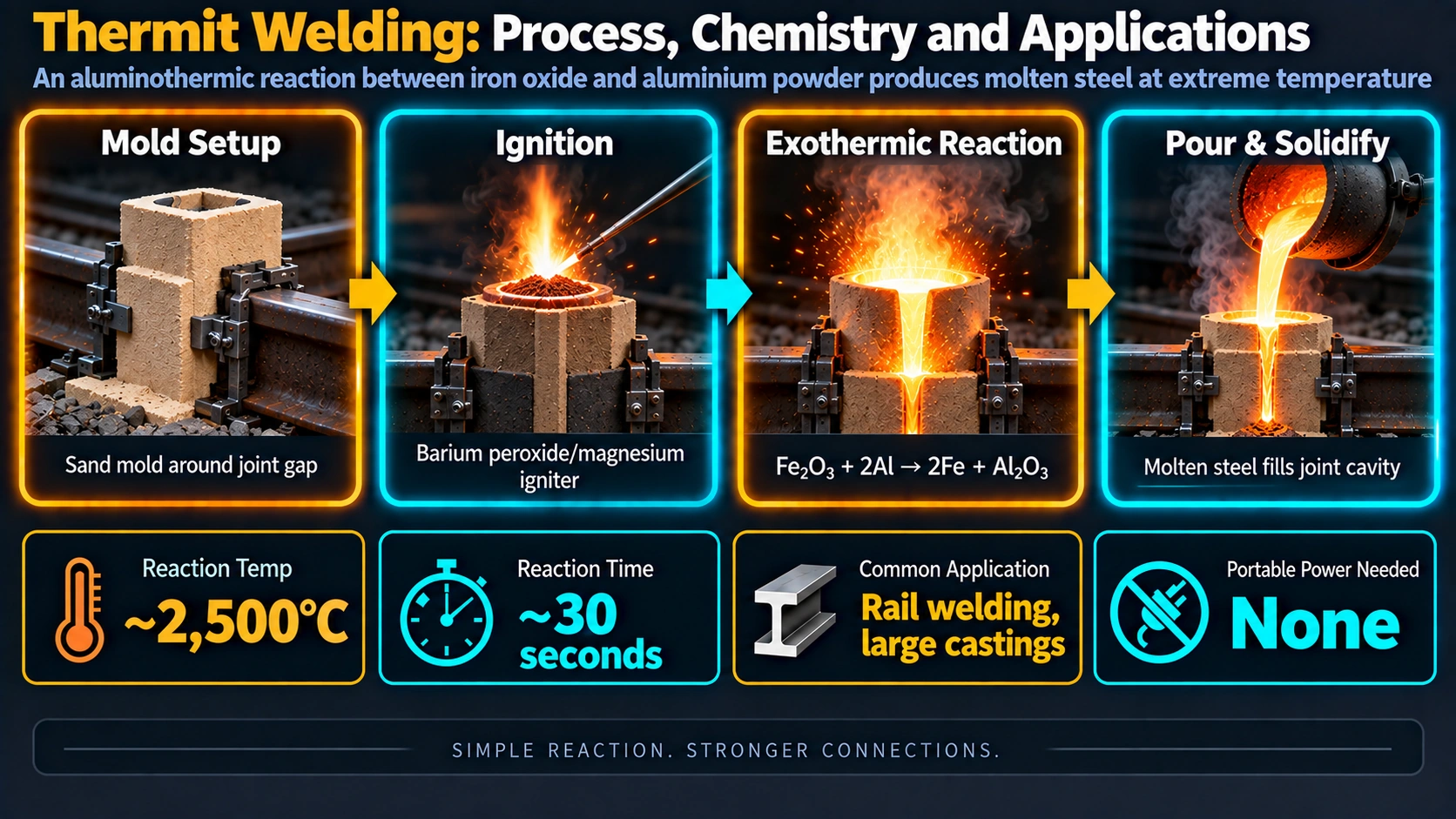
Thermit welding kits are supplied as complete, matched sets of thermit portion, mold, and accessories for specific applications. The kit type determines the joint gap, process variant, and intended service. Using the wrong kit type for a given gap or application will produce a defective weld.
Standard Inch / SKV Process
The most common kit type for joining two standard-condition rail ends. Gap approximately 25 mm (approximately 1 inch). The SKV (Kurzkopf-Vibrationsgiessen = short-tapping pour) process uses a controlled pour sequence. Used for most new CWR construction and standard maintenance welds.
1.5-Inch Process (New SKV-Long)
A newer process variant using a slightly larger gap (approximately 38 mm) which allows better access for the preheat torch and produces a slightly larger weld zone. Designed to reduce the risk of internal inclusions by improving fusion at the rail end faces. Increasingly replacing the standard 1-inch process on high-speed rail networks.
2.75-Inch Wide Gap Weld
Used when a larger gap is present — specifically when replacing a defective flash butt weld or a previously defective thermit weld that has been cut out. The wider gap (approximately 70 mm) accommodates the extra material removed by saw-cutting the defective weld. A single-use specialised mold and a larger thermit portion are required. Not interchangeable with standard kits.
Full Head Repair Weld
Specialised kit for repairing rail head damage — wheel burn, shell formation, or impact damage — where the damaged zone at the rail head surface is machined away and the void is filled with thermit metal to restore the original head profile. Used as an alternative to complete rail replacement when the defect is confined to the running surface.
Weld Quality and Metallurgy
Weld Metal Microstructure
The thermit weld metal solidifies from a large pool of liquid steel into a cast microstructure — columnar austenite grains growing from the fusion boundary inward toward the centre of the weld. This cast structure is fundamentally different from the wrought microstructure of the rolled rail base metal. In service, the weld metal is subjected to rolling contact fatigue under train wheel loads, and the cast microstructure — with its lower toughness compared to wrought material — is the limiting factor in weld fatigue life.
Modern thermit formulations are engineered to produce a fine-grained cast microstructure through controlled solidification and micro-alloying additions. The target hardness range for standard R260 rail welds per EN 14587-2 is 260 to 350 HB in the weld metal, matching the rail hardness to ensure uniform wear at the weld location.
Heat-Affected Zone
The HAZ in a thermit weld is characterised by a coarse-grained region adjacent to the fusion boundary, where the large thermal input from the molten thermit metal has caused austenite grain growth, and a refined grain zone further from the fusion boundary where the temperature was sufficient for normalisation without grain coarsening. The transition from weld metal to HAZ to base rail must be smooth and without abrupt hardness discontinuities that would create stress concentration under rolling contact.
Defects Specific to Thermit Welds
| Defect Type | Cause | Detection Method | Prevention |
|---|---|---|---|
| Slag inclusions | Al₂O₃ slag enters mold when iron is tapped — usually due to incorrect tapping timing, worn tapping mechanism, or overfilling | Ultrasonic testing (UT) of completed weld; visible in radiography | Correct tapping technique; using auto-tap crucibles; correct separation time |
| Porosity | Gas entrapment in weld metal — caused by inadequate mold drying, contaminated thermit portion, or poor venting | UT; radiography | Thorough mold preheat and drying; correct mold venting; dry thermit portions |
| Cold shuts / incomplete fusion | Inadequate rail end preheat — thermit metal chills on contact with cold rail, preventing fusion; also caused by short pour | UT; visual after grinding (unfused line visible at fusion boundary) | Minimum preheat temperature maintained throughout pour; correct portion size |
| Hot tearing / solidification cracking | High restraint, incorrect composition, or rapid cooling of a large weld cross-section with high sulphur or phosphorus content | Visual; UT; magnetic particle (MT) | Correct thermit composition for rail grade; slow cooling; good rail alignment (no high restraint) |
| Running surface geometry defects | Incorrect mold placement (off-centre), inadequate final grinding, or weld metal shrinkage creating a low joint | Profile measurement; straightedge check along running surface | Careful mold alignment; correct rail alignment with reverse camber allowance; thorough final grinding |
Non-Destructive Testing of Thermit Welds
Completed thermit welds in railway track are inspected by ultrasonic testing (UT) using either manual contact probes or automated rail-mounted UT trolleys. The UT examination covers the full weld cross-section — head, web, and foot — scanning for slag inclusions, porosity, cold shuts at the fusion boundary, and internal cracks. EN 14587-2 (European standard for flash butt and thermit welding of rails) specifies the UT examination requirements, acceptance criteria, and testing sequence for thermit welds in new track construction. In-service inspection of thermit welds on operational track is performed by track geometry measurement vehicles and periodic manual UT inspection programmes.
Advantages and Limitations
| Advantages | Limitations |
|---|---|
| Completely portable — no external power required. No electrical supply, no gas cylinders (beyond the preheat torch), no generators. Equipment fits in a van or can be carried to any field location. | Relatively slow process. A complete thermit rail weld takes 30–60 minutes from setup to rough grind, compared to 3–5 minutes for a depot flash butt weld. Not suitable for high-volume production welding. |
| Welds very large cross-sections in a single operation. Full rail cross-section (~140 cm² for heavy rail) is welded in one pour — no multi-pass filling required. | Weld metal is cast structure. The solidified thermit weld has lower toughness and fatigue resistance than the wrought rolled rail base metal. Weld is often the weakest point in a rail under rolling contact fatigue. |
| Simple equipment and low capital cost. Basic thermit welding requires only a crucible stand, clamp, preheat torch, and grinding equipment — available for under USD 5,000 for a complete kit. | Significant skill and attention required. While the basic process is simple, correct preheat, timing, mold placement, and grinding all require trained, experienced operators. Poor technique produces welds with potentially dangerous defects. |
| Works in all weather and field conditions. With appropriate shielding from rain and wind during the reaction, thermit welding can be performed in most field conditions where other processes would require extensive setup. | Limited to butt joints. Thermit welding is practical only for full-section butt joints (rail-to-rail). Not applicable to fillet welds, T-joints, or complex structural connections. |
| Self-contained heat generation. No risk of electrical shock, no shielding gas logistics, no consumable electrode management during welding. | Single-use molds and consumable portions. Each weld requires a complete new kit — mold, thermit portion, and accessories. Higher per-weld consumable cost than continuous arc welding processes. |
| Weld metal composition can be engineered. Thermit portions are available formulated for specific rail grades (R200, R260, R350HT, head-hardened rail) ensuring weld hardness matches the rail. | Significant safety hazards. Liquid metal at 2,500°C, moisture explosion risk, fire risk. Requires proper PPE, trained operators, and careful site management. |
Thermit Welding vs Flash Butt Welding — Comparison
| Parameter | Thermit Welding | Flash Butt Welding (FBW) |
|---|---|---|
| Heat source | Aluminothermic chemical reaction (self-contained) | Electrical resistance heating + mechanical pressure |
| Location | Any field location — no power required | Depot or mobile FBW machine (requires heavy equipment) |
| Weld quality | Good — cast weld metal structure; lower toughness than wrought | Excellent — forged joint, wrought structure throughout |
| Weld speed (per joint) | 30–60 minutes setup-to-grind | 3–8 minutes per joint in depot; mobile FBW ~15 min in-track |
| Joint gap requirement | Precise gap required (25–70 mm depending on kit) | No gap — rails butted end-to-end |
| Applicable to | Field closure welds, repair welds, joints in inaccessible locations | New long-rail production welding, depot repair welding |
| Capital equipment cost | Low (~USD 3,000–10,000 for field kit) | Very high (~USD 500,000–2M for mobile FBW machine) |
| Consumable cost per weld | Moderate (complete kit per weld) | Low (electrical energy only) |
| NDT requirements | UT required per EN 14587-2 / owner specification | UT required; also visual profile check |
| Weld metal HAZ | Larger heat-affected zone from large liquid pool | Narrower HAZ from resistance heating |
Industrial Applications of Thermit Welding
| Application | Why Thermit Welding | Process Notes |
|---|---|---|
| Railway rail — field closure welds | No power required in field; welds full rail cross-section in single pour; portable equipment | Dominant application. EN 14587-2 governs procedure qualification and weld acceptance in Europe. |
| Crane rail joints | Large crane rail cross-sections impractical for multi-pass arc welding; thermit single pour ideal | Crane rail-specific thermit kits required. Section shape differs from railway rail. |
| Heavy steel casting repair | Large casting breaks (crane wheels, mill rolls, gear housings) repaired where arc welding cannot deposit enough metal in a single operation | Custom mold required. Chemistry engineered to match casting composition. |
| Mining equipment repair | Remote mine sites without power; repair of large dragline components, crusher jaws, excavator teeth in situ | Hardfacing variants available for wear-resistant overlay repair. |
| Electrical conductor connections (exothermic) | Permanent, low-resistance connections for copper conductors in grounding systems, cathodic protection, and power distribution | Uses copper oxide + aluminium reaction (not iron oxide). Trade names: Cadweld, Thermoweld, Erico. Not a structural weld — electrical connection only. |
| Anchor chain repair (marine) | Repairing broken anchor chain links in remote coastal or offshore locations without welding equipment | Specialised chain repair kits available. Marine environment requires moisture control. |
| Large shaft repair | Propeller shafts, mill shafts, and pump shafts broken in service repaired in situ where removal is impractical | Custom fixture and mold design required. Preheat and slow cooling critical for large cross-sections. |
Safety Requirements
Thermit welding involves some of the most hazardous conditions in any welding process — superheated liquid metal at 2,500°C, potential steam explosions from moisture, and an exothermic reaction that cannot be stopped once started. These hazards are well understood and entirely manageable with correct procedures and PPE, but they require specific attention that routine arc welding safety protocols do not cover.
Critical Safety Rules
- Absolutely dry mold and joint area: This cannot be overstated. Any moisture — condensation, rainwater, previous preheat steam that did not fully dry — in contact with the liquid thermit metal will flash instantly to steam at extreme pressure. Keep the work area covered if working in rain. Apply full preheat time even if the mold appears dry. Never reduce preheat time for schedule reasons.
- Personnel clearance during reaction: All non-essential personnel must be at a minimum safe distance (typically 3 metres) during ignition and the reaction. The operator who ignites the thermit should retreat to the safe distance immediately after ignition. Flying sparks and minor spatter during the reaction are normal.
- PPE — minimum requirements: Full-face shield (shade 5 or greater lens), leather welding gloves, leather apron or welding jacket, leather or safety boots with steel toecap. Synthetic fabrics should not be worn — they will melt rather than char if struck by molten metal spatter.
- Never look into the crucible during the reaction: The reaction produces intense visible and UV light. Looking directly at the crucible during the reaction without appropriate eye protection causes immediate thermal burn to the retina.
- Thermit mixture storage: Thermit portions are classified as Flammable Solid (UN1309 — aluminium powder, wet; UN3178 — flammable solid, inorganic) for transport. Store in original sealed packaging, dry, away from heat and ignition sources, and segregated from oxidising materials. Opened or contaminated portions should not be returned to storage — use the full portion as supplied or dispose of per manufacturer’s guidance.
- Proper disposal: Never pour water on a thermit reaction or on hot thermit slag. Used crucible slag should be allowed to cool completely before disposal. The Al₂O₃ slag is non-toxic but may be thermally hot for an extended period after the weld.
Recommended References
Disclosure: WeldFabWorld participates in the Amazon Associates programme (StoreID: neha0fe8-21). If you purchase through these links, we may earn a small commission at no extra cost to you. This helps support free technical content on this site.