IQI (Image Quality Indicator) Selection — ASME Section V Article 2 Complete Guide
The Image Quality Indicator — universally known in the field as the IQI, and also called a penetrameter — is the single most important quality control device in industrial radiographic testing. Every radiograph produced under ASME Section V Article 2 must demonstrate that the radiographic technique achieved the minimum required sensitivity, and the IQI is the tool that provides that demonstration. Get IQI selection or placement wrong, and every radiograph taken with that incorrect technique is invalid — requiring re-exposure, re-inspection, and the delays and costs that follow.
Despite its critical importance, IQI selection is one of the topics where radiographers and welding inspectors most frequently make errors in the field. The errors take several forms: selecting the wrong IQI number for the material thickness, placing the IQI on the wrong side of the weld, forgetting the F marker for film-side placements, failing to place IQIs at both ends of long weld exposures, and misidentifying the 2T hole requirement. These errors are not matters of academic principle — they have real consequences: rejected radiograph packages during ASME Code inspection, failed surveillance audits by the Authorised Inspector, and in the worst cases, pressure components in service that have not been adequately examined.
This article provides a complete, code-referenced guide to IQI selection and use under ASME Section V Article 2. Every rule is stated with its paragraph reference, every selection table is explained with practical worked examples, every common error is identified and corrected, and a 30-question timed quiz tests your knowledge across the complete subject.
What is an IQI and Why is it Required? T-260
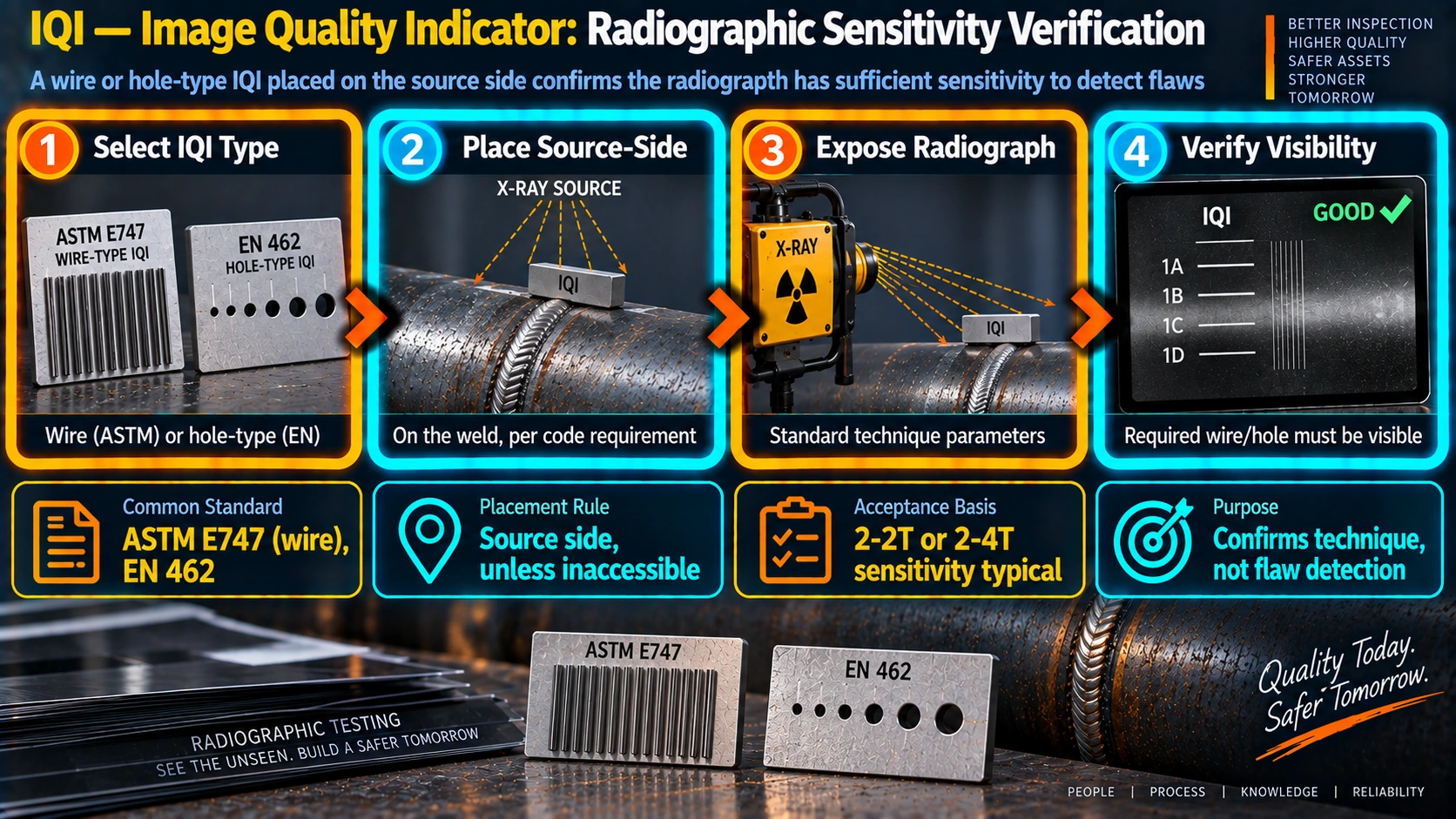
An Image Quality Indicator is a small reference device, made from a material radiographically similar to the object being examined, that is placed on the object during radiographic exposure. When the radiograph is processed, the image of the IQI appears on the film. The analyst examines this IQI image to verify that the radiographic technique produced an image of sufficient quality — that small details of specified size are clearly visible.
What the IQI Does NOT Do
This is the single most important conceptual point about IQIs, and it is frequently misunderstood by trainees and even experienced practitioners:
The IQI as Technique Validation
ASME Section V T-261 states the purpose clearly: IQIs are required to provide visual evidence that the radiographic examination technique produces the required radiographic sensitivity. If the required IQI image is not visible on the radiograph, the technique has not met the code minimum sensitivity requirement and the radiograph is invalid — the examination must be repeated with an improved technique.
Hole-type vs Wire-type IQI T-233, T-276, T-283
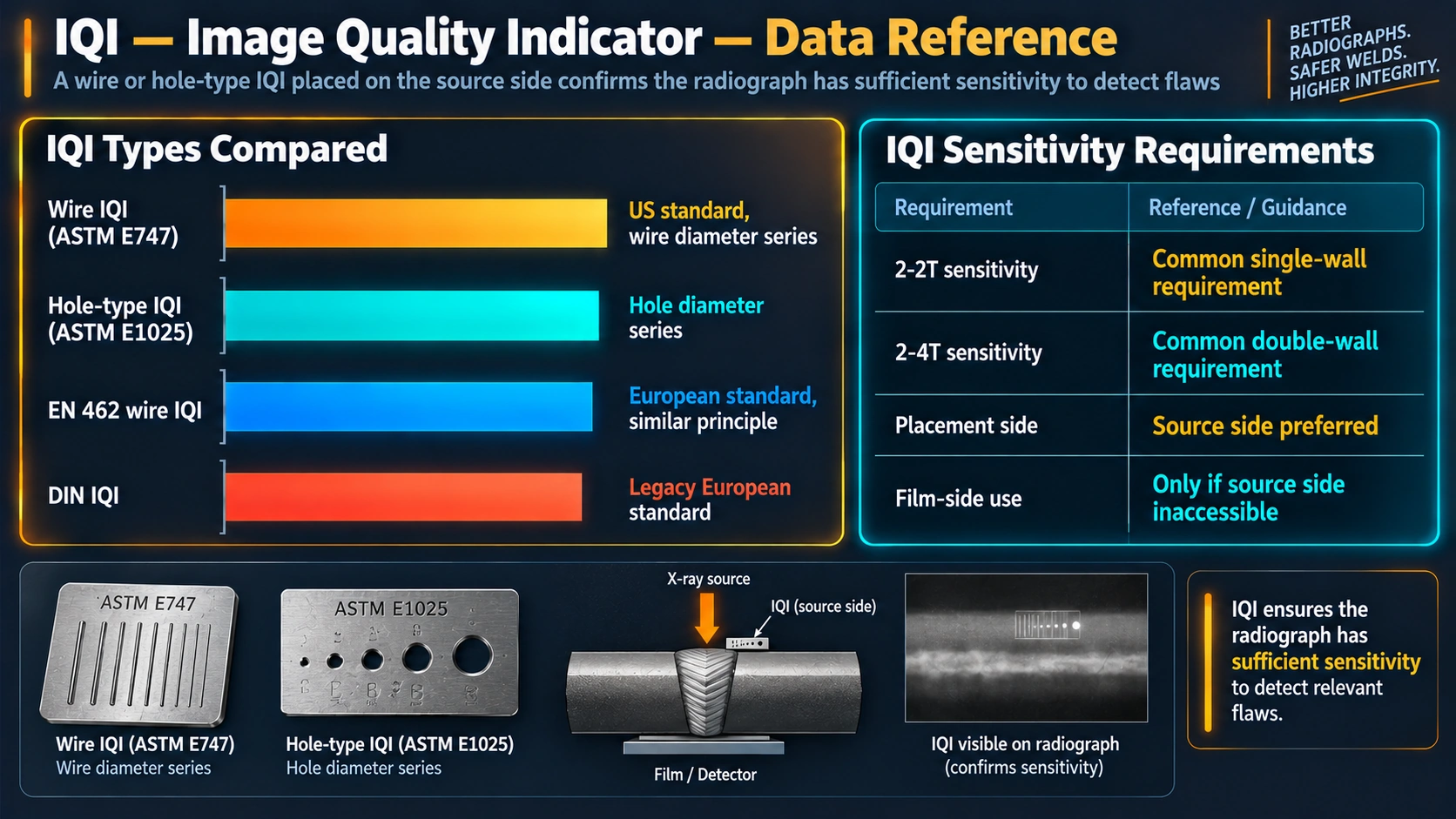
ASME Section V Article 2 recognises two distinct types of IQI, each with its own design standard, selection table, and sensitivity acceptance criterion. Both types are acceptable under the code; the choice is at the discretion of the examination procedure, provided the correct selection table is used for the chosen type.
- Design: Flat rectangular metal plaque of precisely controlled thickness, containing three drilled holes: 1T hole (diameter = IQI thickness), 2T hole (diameter = 2 × IQI thickness), and 4T hole (diameter = 4 × IQI thickness)
- Identification: IQI number stamped on the plaque — designates thickness in thousandths of an inch (e.g. IQI No. 10 = 0.010 inch = 0.25 mm thick)
- Selection table: T-276 — based on nominal single-wall radiographic thickness
- Acceptance criterion: 2T hole visible (standard) — the hole whose diameter equals twice the IQI thickness
- Standard: ASTM E1025 for manufacture
- Common use: USA, ASME-governed projects worldwide
- Design: Set of parallel metal wires of progressively increasing diameter (typically 6 or 7 wires per set) encapsulated in plastic. Wire diameters are standardised in a geometric progression.
- Identification: Wire sets identified by set letter (A, B, C, D) and wire numbers 1–19. Lower numbers = smaller diameter wires.
- Selection table: T-283 — specifies the essential wire number for each nominal radiographic thickness range
- Acceptance criterion: Essential wire visible — the minimum wire diameter corresponding to the nominal radiographic thickness must be clearly visible on the radiograph
- Standard: ASTM E747 (or EN ISO 19232-1) for manufacture
- Common use: Europe, offshore projects, alongside or instead of hole-type IQIs
IQI Selection — Tables T-276 and T-283 T-276, T-283
IQI selection is a code-mandated process, not an engineering judgement call. The applicable ASME Section V table specifies exactly which IQI designation number (for hole-type) or essential wire number (for wire-type) must be used for each range of nominal single-wall radiographic thickness. Using a thinner IQI than required produces an artificially good sensitivity result — the IQI appears on the film more easily than warranted. Using a thicker IQI than required is overly conservative and will cause unnecessarily frequent failed technique validations.
Hole-type IQI — Table T-276 (Representative Values)
| Nominal Single-Wall Radiographic Thickness | IQI Designation (No.) | IQI Thickness (in) | IQI Thickness (mm) | 2T Hole Diameter (mm) |
|---|---|---|---|---|
| Up to 6.4 mm (1/4 in) | 5 | 0.005 in | 0.127 mm | 0.254 mm |
| 6.4 to 9.5 mm (1/4 to 3/8 in) | 7 | 0.007 in | 0.178 mm | 0.356 mm |
| 9.5 to 12.7 mm (3/8 to 1/2 in) | 10 | 0.010 in | 0.254 mm | 0.508 mm |
| 12.7 to 19.0 mm (1/2 to 3/4 in) | 12 | 0.012 in | 0.305 mm | 0.610 mm |
| 19.0 to 25.4 mm (3/4 to 1 in) | 15 | 0.015 in | 0.381 mm | 0.762 mm |
| 25.4 to 50.8 mm (1 to 2 in) | 20 | 0.020 in | 0.508 mm | 1.016 mm |
| 50.8 to 76.2 mm (2 to 3 in) | 25 | 0.025 in | 0.635 mm | 1.270 mm |
| 76.2 to 101.6 mm (3 to 4 in) | 30 | 0.030 in | 0.762 mm | 1.524 mm |
| 101.6 to 127.0 mm (4 to 5 in) | 35 | 0.035 in | 0.889 mm | 1.778 mm |
| 127.0 to 152.4 mm (5 to 6 in) | 40 | 0.040 in | 1.016 mm | 2.032 mm |
Wire-type IQI — Table T-283 (Representative Values)
| Nominal Single-Wall Radiographic Thickness | Essential Wire Number (ASTM E747) | Essential Wire Diameter (in) | Essential Wire Diameter (mm) | Approx. Sensitivity (%) |
|---|---|---|---|---|
| Up to 6.4 mm (1/4 in) | 4 | 0.008 in | 0.203 mm | ~3.2% |
| 6.4 to 9.5 mm | 5 | 0.010 in | 0.254 mm | ~2.7–4% |
| 9.5 to 12.7 mm | 6 | 0.013 in | 0.330 mm | ~2.6–3.5% |
| 12.7 to 25.4 mm | 7 | 0.016 in | 0.406 mm | ~1.6–3.2% |
| 25.4 to 50.8 mm | 9 | 0.025 in | 0.635 mm | ~1.25–2.5% |
| 50.8 to 101.6 mm | 11 | 0.040 in | 1.016 mm | ~1.0–2.0% |
| 101.6 to 152.4 mm | 13 | 0.063 in | 1.600 mm | ~1.05–1.57% |
Radiographic Sensitivity and the 2-2T Rule T-274
The concept of radiographic sensitivity is expressed in terms of the IQI used. The standard ASME Section V sensitivity expression is stated as a ratio: the IQI designation number as a percentage of the nominal radiographic thickness, followed by the hole that must be visible.
Sensitivity = (IQI thickness / Nominal radiographic thickness) × 100%
Standard requirement: 2% sensitivity with 2T hole visible = “2-2T”
This means:
IQI thickness = 2% of nominal single-wall thickness
AND: the 2T hole (diameter = 2 × IQI thickness = 4% of wall) must be visible
Example — 25.4 mm (1 inch) wall, IQI No. 20:
IQI No. 20 = 0.020 in (0.508 mm) = 2% of 1.000 inch → meets 2% requirement
2T hole = 0.040 in (1.016 mm) diameter → must be visible on film
If 2T hole is visible: technique achieves 2-2T sensitivity. Radiograph acceptable.
If 2T hole is NOT visible: technique is inadequate. Re-expose with improved technique.
Better sensitivity levels (achieved by improved technique):
1-1T: IQI No. 10 (1%) with 1T hole visible → better than required
2-1T: IQI No. 20 (2%) with 1T hole visible → higher than standard
The “2-2T” designation is the standard minimum sensitivity requirement for ASME pressure vessel and pressure piping radiography. Better sensitivity than 2-2T is always acceptable and preferred — it means the film quality is better than the minimum required. The code only establishes a minimum floor; better technique that achieves 1-2T or 2-1T sensitivity is entirely acceptable and may be required by some Owner specifications for critical weld examinations.
IQI Placement Rules T-277
ASME Section V T-277 specifies exactly where the IQI must be placed on the part. The placement rules are designed to ensure that the IQI image on the film represents the worst-case image quality that the technique can achieve over the weld area being examined — if the IQI is visible in the worst position, it will also be visible in all better positions within that exposure.
T-277.1 — General Placement Rules
- The IQI shall be placed on the source side of the part being examined — between the radiation source and the part. This is the preferred standard position.
- The IQI shall be placed on the weld or adjacent to the weld within the area of interest being radiographed. The IQI must be within the area of diagnostic interest shown on the radiograph.
- The IQI shall be placed with the body of the IQI (for hole-type) or the wire set (for wire-type) within the area being examined — not on the edge of the film holder or outside the area of interest.
- The lead identification numbers and letters on the IQI must be visible on the radiograph and must not obscure the area being examined for discontinuities.
- For hole-type IQIs, the IQI identification number must be on the end of the IQI away from the weld, so the IQI numbers do not overlap with the weld image.
T-277.1(a) — IQI on Weld vs Adjacent Material
The IQI may be placed directly on the weld surface (if the weld surface condition permits consistent probe coupling) or adjacent to the weld on the base material at the same nominal thickness as the weld being examined. If the weld cap creates a significant thickness variation that would affect the IQI image, the IQI is typically placed on the base metal adjacent to the weld rather than on the weld cap.
T-277.2 — IQI Placement for Welds with Backing Strips
When a weld is made with a permanent backing strip (backing bar), the backing strip thickness must be included in the nominal radiographic thickness used for IQI selection. If the backing strip is present during radiographic examination, it adds to the total material thickness that the radiation must penetrate, which requires a thicker (higher-numbered) IQI than would be needed without the backing strip.
Source-side vs Film-side IQI Placement T-277.1(b)
Source-side placement is the standard and preferred position for all IQIs in ASME Section V radiographic examination. However, there are practical situations — particularly when radiographing the inside of vessels or pipe bends from outside — where access to the source side is restricted and the IQI must be placed on the film side. ASME Section V provides specific rules for both situations.
Film-side Placement Requirements T-277.1(b)
When source-side IQI placement is impractical (documented in the examination record), film-side placement is permitted under the following specific conditions:
- Lead letter F marker: A lead letter “F” must be placed adjacent to the IQI on the part, so that the letter F appears on the radiograph next to the IQI image. This permanently records on the film that a film-side IQI was used.
- One designation number better: For film-side placement, the IQI selected must be one designation number better (thinner) than the table requirement for the nominal radiographic thickness. If the source-side table requires IQI No. 20, film-side placement requires IQI No. 17 (the next thinner standard IQI).
- Justification documented: The examination record must document why source-side placement was impractical — it is not acceptable to use film-side placement simply for convenience.
Number of IQIs Required per Exposure T-277.2
ASME Section V T-277.2 specifies the minimum number of IQIs that must be used based on the length of weld being radiographed in a single exposure:
| Weld Length in Single Exposure | Minimum IQIs Required | IQI Placement | Notes |
|---|---|---|---|
| Up to 250 mm (10 in) | 1 IQI | Near one end of the area being examined | Standard single-IQI exposure; most individual pipe girth weld exposures |
| Greater than 250 mm (10 in) | 2 IQIs | One near each end of the area being examined | Required for long weld exposures such as vessel seam welds and large-diameter pipe panoramic shots |
| Panoramic exposure — full circumference | Minimum 3 IQIs | At equally spaced intervals around the circumference (approximately 120 degrees apart) | For panoramic single-wall exposures using an internal source; placement per T-277.2(b) |
| Multiple welds in a single exposure | One IQI per weld | On each weld or adjacent to each weld within the area of interest | Each weld must be individually qualified even when radiographed simultaneously |
IQI Geometry — Dimensions in Detail T-233, ASTM E1025, E747
Hole-type IQI Dimensional Requirements
Per ASTM E1025 (referenced by ASME Section V), hole-type IQIs must meet precise dimensional requirements:
- Thickness tolerance: ±5% of the designated thickness
- Length and width: Minimum 25 mm (1 in) long and 10 mm (3/8 in) wide for most IQI numbers; larger IQIs have proportionally larger dimensions
- Hole diameters: 1T hole, 2T hole, and 4T hole — each drilled perpendicular to the plaque face with diameter tolerance ±5%
- Identification numbers: Lead numbers (or numbers of the same material as the IQI) that are 1T tall, permanently attached and visible on the radiograph
- Material: Must be radiographically equivalent to or more difficult to penetrate than the material being examined — never use a more penetrable (lighter) material IQI on a denser workpiece
IQI Material Groups T-276.1
ASME Section V Table T-276.1 assigns materials to IQI material groups based on radiographic equivalence. The IQI material must be from the same group as or a more absorbing group than the material being examined:
| IQI Material Group | Materials Included | Notes |
|---|---|---|
| Group 1 — Aluminium | Aluminium and aluminium alloys | Lightest group; use aluminium IQI for aluminium components |
| Group 2 — Titanium / Zirconium | Titanium, titanium alloys, zirconium | Intermediate group; use Ti or Zr IQI |
| Group 3 — Carbon / Low-alloy Steel | Carbon steel, low-alloy steel (P-No. 1–5), cast iron | Most common group for pressure vessel and piping radiography; steel IQI used |
| Group 4 — Stainless / Nickel Alloys | Austenitic SS, nickel alloys, inconel, monel, duplex SS | Steel IQI acceptable — steel is more absorbing than austenitic SS and provides more stringent test |
| Group 5 — Copper alloys | Copper, copper-nickel, brass, bronze | Copper or steel IQI required |
Weld Reinforcement and IQI Selection T-274
The nominal radiographic thickness used for IQI selection is the single-wall thickness of the material being examined. ASME Section V T-274.1 specifies how weld reinforcement affects the IQI selection calculation:
For welds without reinforcement: t_IQI = single-wall base metal thickness
For welds with reinforcement left in place during RT: t_IQI = base metal thickness + weld reinforcement
Example: 25 mm wall pipe, weld cap reinforcement 3 mm (measured or calculated)
t_IQI = 25 + 3 = 28 mm → select IQI for 25.4 to 50.8 mm range → IQI No. 20
vs. without reinforcement: 25 mm → 19.0 to 25.4 mm range → IQI No. 15
Important: Weld reinforcement is included in t_IQI only if it is present during the RT examination.
If the weld cap is ground flush before RT, use only the base metal thickness for IQI selection.
Special Cases and Exceptions
Radiographic Shims T-277.3
When the IQI is placed on a curved surface (such as a pipe curvature) and there is a gap between the IQI and the weld surface that would create a step change in radiographic thickness, a radiographic shim may be placed under the IQI to bring it to the same radiographic level as the weld being examined. The shim material must have the same radiographic equivalence as the weld material and must be sized to ensure the IQI sits at the correct radiographic level.
Single-Film Technique for Double-Wall Exposures
For double-wall radiographic techniques (where the radiation passes through both walls of a pipe and only one wall is being examined on the film), the IQI is placed on the source-side wall adjacent to the weld being examined. The nominal radiographic thickness for IQI selection is based only on the single wall containing the weld being evaluated — not the total double-wall thickness the radiation must penetrate.
Inaccessible Welds — Substrate Technique
When the weld being radiographed is in a location where the IQI cannot physically be placed on the weld itself (such as inside a closed vessel with no internal access), a separate substrate block of the same nominal radiographic thickness as the weld is radiographed simultaneously with the production exposure. The IQI is placed on this substrate, and the IQI image from the substrate exposure demonstrates the technique sensitivity. The examination record must document this alternative placement and reference the substrate qualification radiograph.
Acceptance Criteria for IQI Images T-274.2, T-285
A radiograph meets the IQI sensitivity requirement when the following conditions are all simultaneously satisfied:
- The IQI designation number is clearly visible on the radiograph and matches the required designation from Table T-276 (hole-type) or the required essential wire from Table T-283 (wire-type)
- For hole-type IQIs: the 2T hole is clearly visible (standard 2-2T requirement) — both its outline and its density difference from the background must be discernible
- For wire-type IQIs: the essential wire is clearly visible — its complete image across the width of the IQI must be distinguishable from the background
- The film density in the area of interest is within the specified range (typically 1.8 to 4.0 for X-ray film, or as specified in the applicable code edition)
- For film-side placement: the lead F marker is visible adjacent to the IQI image
- The IQI image does not overlap the weld or any area being examined for discontinuities (IQI identification numbers must be clear of the examination area)
Common Errors in IQI Selection and Use
| Error | Consequence | Correct Practice |
|---|---|---|
| Using wrong IQI number for the thickness | Too thin IQI: technique appears to pass sensitivity when it does not. Too thick IQI: technique appears to fail when it actually passes. | Always read directly from Table T-276 (hole) or T-283 (wire) using the actual nominal single-wall radiographic thickness including reinforcement if applicable |
| Film-side IQI without F marker | Radiograph is non-conforming per T-277.1(b) regardless of IQI image quality; rejected at AI review | Always place lead letter F adjacent to IQI before exposure when film-side placement is used |
| Placing IQI on the film side without applying the one-designation-number-better rule | Apparent compliance — IQI visible — but technique sensitivity is actually lower than required for source-side equivalent | When using film-side IQI, select one designation number thinner than the Table T-276 requirement for that thickness |
| Using only one IQI for a weld longer than 250 mm (10 in) | Film density and sensitivity at the unmonitored end may be outside acceptable limits without detection | Two IQIs — one near each end — for any single exposure covering more than 250 mm of weld |
| IQI placed outside the area of interest (beyond the edge of the diagnostic film) | IQI image may not appear on the film at all, or may not represent the technique quality over the weld | IQI must be within the area of interest on the film — verify IQI image is on film before accepting |
| Not including weld reinforcement in nominal radiographic thickness for IQI selection | IQI selected is too thin — apparent sensitivity is better than the technique can actually achieve through the full weld crown | Measure or calculate weld reinforcement and add to base wall thickness when selecting IQI |
| Using wrong material group IQI (e.g. aluminium IQI on steel) | IQI appears too visible on film — does not represent true sensitivity through the denser steel | Use IQI from the same group as or a more absorbing group than the material being examined (Table T-276.1) |
| Confusing 1T hole with 2T hole — claiming sensitivity when only the 1T hole was visible | Over-claiming sensitivity: only the 2T hole is the standard acceptance criterion, not the 1T hole | Know the dimensional relationship: 2T hole diameter = 2 × IQI thickness; verify which hole is visible by measurement |
IQI Material Groups T-276.1
The IQI must be made from a material radiographically similar to or more dense than the material being examined. ASME Section V Table T-276.1 groups materials by radiographic equivalence. A steel IQI (Group 3) is acceptable for use on austenitic stainless steel (Group 4) because steel is more absorbing than austenitic stainless at typical X-ray energies — if the IQI is visible on the stainless steel radiograph, the sensitivity through the denser IQI material confirms adequate technique. The reverse is not permitted: a lighter material IQI (aluminium) cannot be used on steel because the aluminium IQI would appear too readily on the steel radiograph, creating a false impression of good sensitivity that the technique has not actually achieved through the steel material.
Recommended References and Study Materials
Disclosure: WeldFabWorld participates in the Amazon Associates programme (StoreID: neha0fe8-21). If you purchase through these links, we may earn a small commission at no extra cost to you. This helps support free technical content on this site.
Frequently Asked Questions
What is an IQI and what is its purpose in radiographic examination?
What are the two types of IQI recognised by ASME Section V Article 2?
What is the 2T hole rule for hole-type IQI acceptance under ASME Section V?
How is the correct IQI number selected for a given material thickness?
What is the difference between source-side and film-side IQI placement?
How many IQIs are required for a single radiographic exposure?
What does IQI sensitivity mean in radiography, and what is the standard requirement?
What is the purpose of the lead letter F marker used with film-side IQIs?
Related Technical Guides
IQI Selection Quiz
30 questions — 20 seconds each — ASME Section V Article 2 Level
IQI & Radiography Quiz
30 questions covering IQI purpose, hole-type and wire-type selection, 2T hole rule, placement rules, F marker, sensitivity, film-side placement, number of IQIs, and common errors. For RT Level II/III practitioners and welding inspectors.