ASME B31.3 Process Piping — The Complete Engineer’s Guide
ASME B31.3, Process Piping, is the governing design and construction code for the vast majority of industrial piping systems found in petroleum refineries, petrochemical complexes, chemical plants, pharmaceutical facilities, gas processing plants, LNG terminals, and offshore production platforms worldwide. It establishes the minimum requirements for the design, materials, fabrication, assembly, inspection, testing, and operation of process piping — covering everything from a two-inch stainless instrument impulse line to a forty-eight-inch carbon steel crude oil main header operating at elevated pressure and temperature.
For the practising piping engineer, process designer, welding inspector, QA/QC manager, or NDE technician working in the process industries, B31.3 is not an optional reference document — it is the mandatory technical framework within which all decisions about pressure-containing pipe and its connections must be made. Yet despite its central importance, the code itself is dense, cross-referenced, and assumes a baseline of engineering knowledge that many practitioners — particularly those early in their careers or transitioning from other code disciplines — find difficult to navigate.
This guide provides a systematic, section-by-section walkthrough of the complete ASME B31.3 code framework: its scope, how fluid service classification drives the entire examination and testing matrix, the wall thickness design equation and its variables, material selection rules, welding and PWHT requirements, the examination percentage table by fluid service, hydrostatic and pneumatic pressure testing criteria, and piping flexibility analysis requirements. All key paragraph references are cited so you can locate the exact code clause for any requirement discussed.
Scope and Applicability Para. 300
The scope of ASME B31.3 is defined in Para. 300, and understanding its boundaries is the first mandatory step before applying the code to any piping system. The code covers all pipe, fittings, flanges, valves, bolting, gaskets, expansion joints, pipe supports, and other appurtenances that form part of the pressure boundary of a piping system within the defined facility types.
Included Facility Types
- Petroleum refineries and petroleum product terminals
- Chemical and petrochemical plants
- Pharmaceutical manufacturing facilities
- Natural gas and LNG processing plants (downstream of custody transfer)
- Paper and textile mills, semiconductor fabrication facilities
- Cryogenic processing plants and air separation units
- Offshore production and processing facilities where process piping codes apply
Explicitly Excluded Systems Para. 300.1.3
- Piping systems governed by other B31 sections (B31.1 Power Piping, B31.4 Liquid Pipeline, B31.8 Gas Transmission)
- ASME Section I Boiler and Pressure Vessel Code — boiler external piping (BEP)
- Pressure vessels, heat exchangers, pumps, and compressors (governed by ASME Section VIII and other equipment codes) — B31.3 picks up at the equipment nozzle face
- Plumbing, sanitary sewage, and storm drainage systems
- Fire protection piping (NFPA 13 governs)
- Piping systems operating below 15 psig (103 kPa gauge) when non-flammable, non-toxic, and not damaging to human tissue
- Tubes within heat exchangers (governed by ASME Section VIII Div. 1)
Fluid Service Classifications Para. 300.2
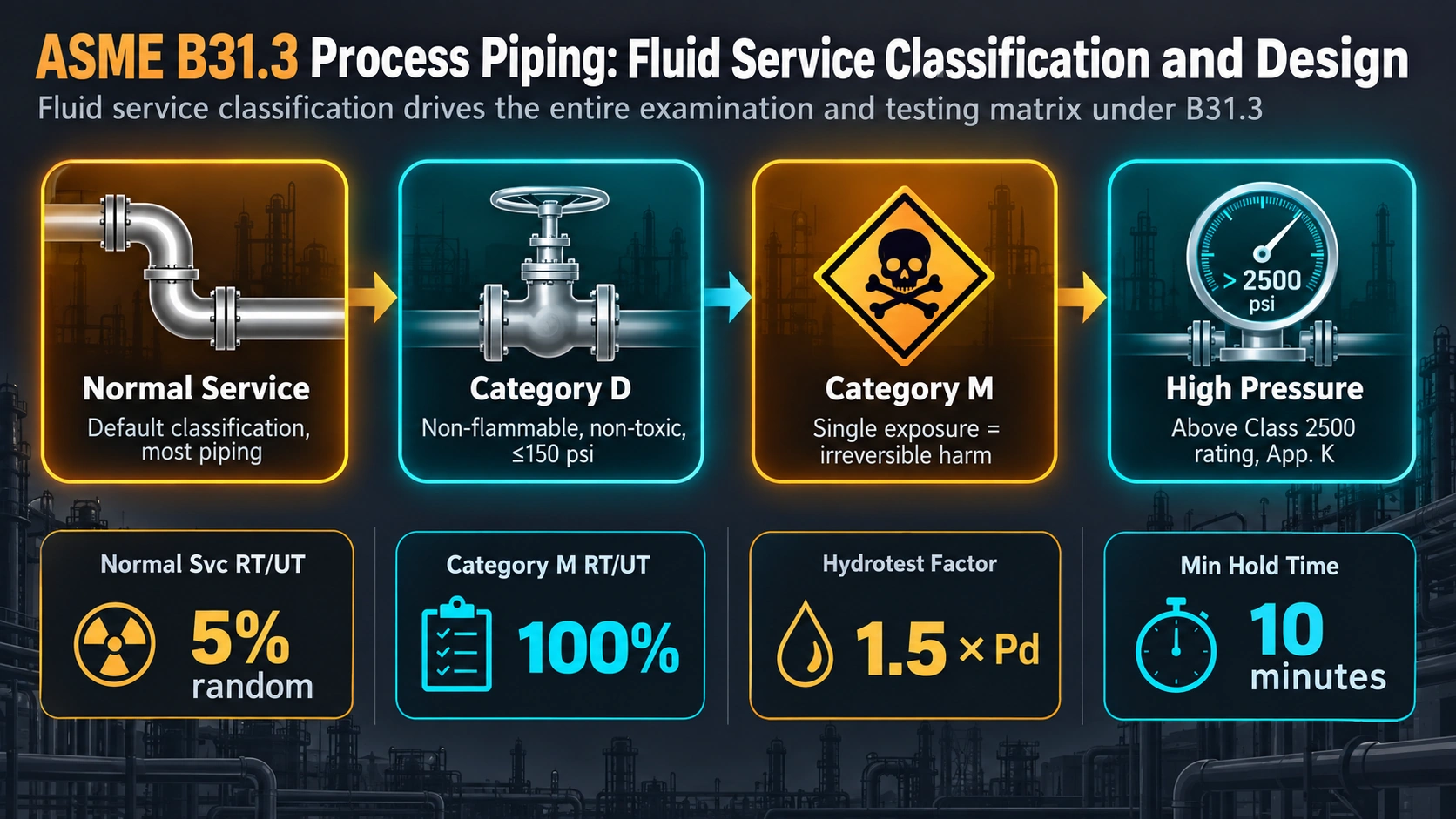
The fluid service classification is the most important single determination made for any piping system under B31.3. It drives the examination percentages, the testing requirements, the fabrication detail standards, and many material restrictions. The Owner is responsible for establishing the fluid service classification and documenting it in the Engineering Design Basis before any engineering or procurement activity begins.
Normal Fluid Service
The default classification for all process piping that does not meet the criteria for any other category. Includes the vast majority of refinery and chemical plant piping. All standard B31.3 requirements apply — 5% random RT/UT, hydrostatic test at 1.5× design pressure × stress ratio.
Category D Fluid Service Para. 300.2
Applies when ALL of: fluid is non-flammable and non-toxic; design pressure ≤150 psi (1,035 kPa); design temperature -29 deg C to 186 deg C (-20 to 366 deg F). Relaxed examination (visual only for welds). Initial service leak test permitted in lieu of hydrostatic test. Common for cooling water, instrument air, and low-pressure steam condensate.
Category M Fluid Service App. M
Applies when a single exposure to even a small quantity of the fluid — by leakage, spillage, or a single gasket or valve seal failure — could cause serious irreversible harm to persons on exposure by inhalation, skin absorption, or contact. 100% RT or UT of all butt welds mandatory. Strictest fabrication and testing requirements in B31.3.
High Pressure Fluid Service App. K
Design pressure exceeds the pressure-temperature rating of ASME Class 2500 flanges for the applicable material group. Appendix K governs with more conservative allowable stresses (2/3 of Normal service values), mandatory 100% volumetric examination of all welds, fatigue analysis, and hardness testing. Common in HP hydraulic test facilities and high-pressure process reactors.
High Purity Fluid Service App. M*
Governed by B31.3 Appendix M. Applies where product purity requirements — not fluid hazard — drive design decisions. Semiconductor ultra-pure water (UPW) systems, pharmaceutical water for injection (WFI), clean steam, and process gas systems where contamination is the critical concern. Special surface finish, orbital welding, and borescope inspection requirements apply.
How Fluid Service Drives the Examination and Testing Matrix
The most significant practical consequence of fluid service classification is its effect on the examination and pressure testing requirements. The following matrix summarises how classification governs these key activities — a piping engineer must understand this table before developing any QA/QC plan or ITP (Inspection and Test Plan):
Design Conditions and Pressure Ratings Para. 301–302
Design Pressure Para. 301.2
The design pressure for any component in a piping system is the maximum sustained internal (or external) pressure the component is required to withstand at the coincident design temperature. B31.3 Para. 301.2.2 requires that the design pressure include consideration of:
- The maximum operating pressure plus an allowance for variations above operating (surges, pump shut-off head, relief valve set pressure tolerance)
- Hydraulic shock (water hammer) where applicable
- Static head of fluid — the design pressure at any point in the system must account for the full liquid column above it when the system is filled
- The most severe coincident combination of pressure and temperature that can occur in normal operation, upset conditions, or start-up/shutdown
Design Temperature Para. 301.3
The design temperature is the temperature at which the allowable stress for the component material is evaluated. It must represent the maximum temperature of the fluid that the pipe wall will sustain. B31.3 Para. 301.3.2 specifies that the design temperature for piping carrying fluid at temperatures above 50 deg C above ambient may be taken as the fluid temperature for uninsulated piping; for insulated piping, the pipe metal temperature is the fluid temperature unless calculations demonstrate a lower value. For piping carrying very cold fluids (cryogenic service), the design temperature is the minimum fluid temperature, and the allowable stress for that low temperature must be verified, including the impact toughness of the material and welds.
Pressure-Temperature (P-T) Ratings of Flanges Para. 302.2.1
For flanged connections, the pressure-temperature rating of the flange is the most common pressure-limiting component in process piping. B31.3 Para. 302.2.1 requires that flanges conform to ASME B16.5 (for NPS 1/2 through 24), ASME B16.47 (for NPS 26 and above), or applicable MSS standards. The P-T rating of a flange is read directly from the tables in ASME B16.5 for the applicable Material Group and flange Class (150, 300, 600, 900, 1500, or 2500). The design pressure of any flanged joint must not exceed the P-T rating of the flange at the coincident design temperature:
P_design ≤ P_T_rating(Class, Material Group, T_design)
Example: ASME Class 300 flange, Group 1.1 (carbon steel A105), at 260 deg C:
P-T rating from B16.5 Table 2-1.1 = 42.1 bar (610 psi)
Design pressure of system must be ≤ 42.1 bar at 260 deg C
Common Material Groups in B16.5:
Group 1.1 — Carbon steel (A105, A106 Gr. B, A53 Gr. B)
Group 1.9 — 1.25Cr-0.5Mo (A182 F11, A335 P11)
Group 1.13 — 2.25Cr-1Mo (A182 F22, A335 P22)
Group 2.2 — 304/316 Austenitic SS (A182 F304/316)
At elevated temperatures, stainless steel flanges have lower ratings than carbon steel of the same class due to lower allowable stresses.
Wall Thickness Calculation Para. 304
The wall thickness calculation is the fundamental sizing step for every pressure-containing pipe in a B31.3 system. Para. 304.1.2 provides the design equation for straight pipe under internal pressure, and the steps to arrive at the specified nominal wall thickness are well defined — but several subtleties in the formula variables are commonly misunderstood.
The B31.3 Pressure Design Equation Para. 304.1.2
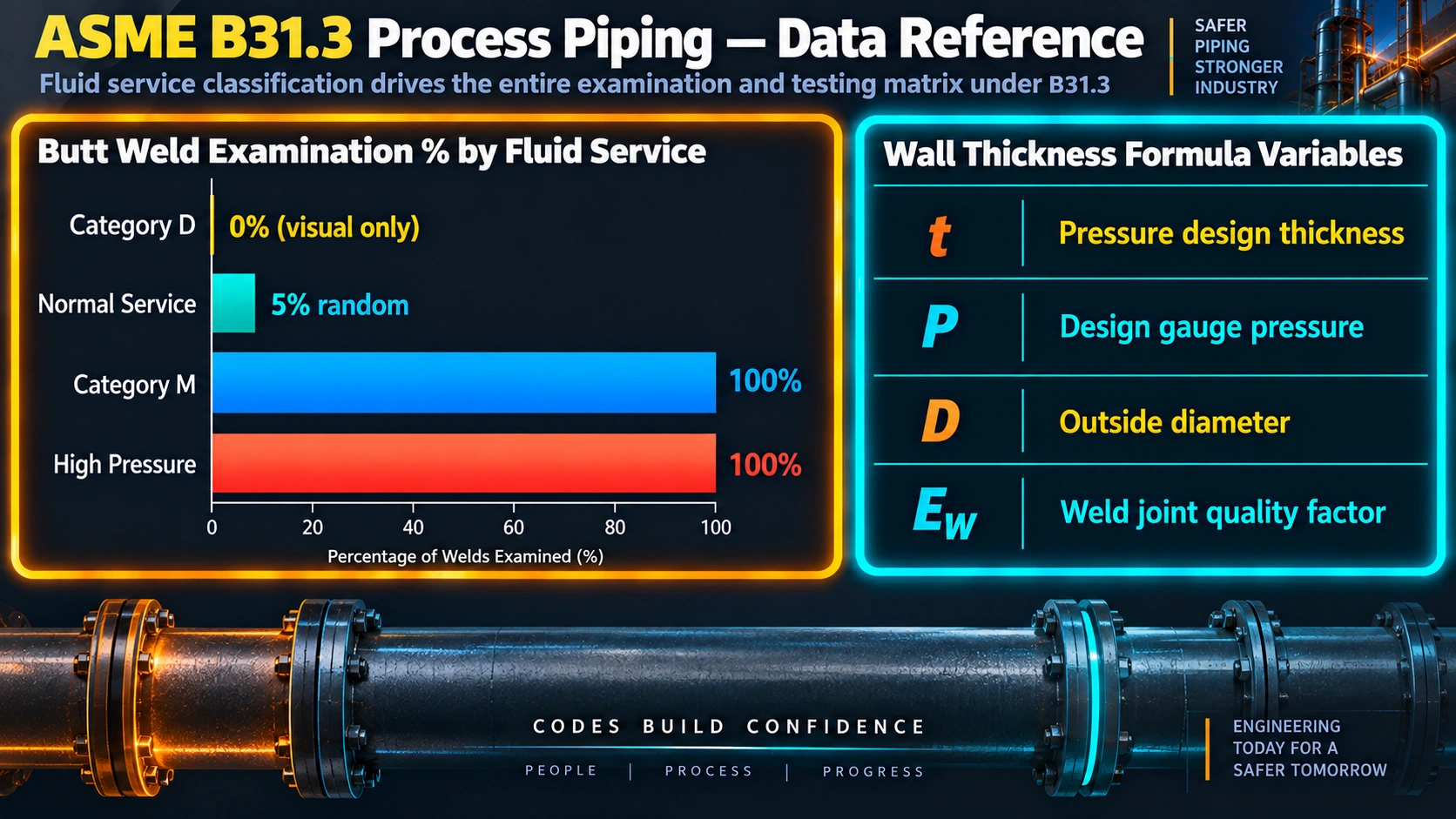
t = (P × D) / [2 × (S × E_W × W + P × Y)]
Where:
t = Pressure design thickness (mm or in) — does not include allowances
P = Internal design gauge pressure (MPa or psi)
D = Outside diameter (mm or in)
S = Allowable stress at design temperature from Table A-1 (MPa or psi)
E_W = Weld joint quality factor (1.0 seamless; 0.85 ERW; 0.80 SAW w/o RT)
W = Weld joint strength reduction factor (1.0 below creep range; may decrease above)
Y = Temperature coefficient from Table 304.1.1
(0.4 for t < D/6; 0.5 for austenitic SS and Ni alloys below 480 deg C)
Minimum required thickness (including all allowances):
t_m = t + c
c = sum of mechanical allowances (thread depth, groove depth) + corrosion/erosion allowance
Nominal wall selection (accounting for mill under-tolerance):
t_nom ≥ t_m / (1 – mill_tolerance_fraction)
Mill tolerance for A106/A53: 12.5% (0.125), so: t_nom ≥ t_m / 0.875
Always select the next heavier standard schedule wall that satisfies this inequality.
Step-by-Step Worked Example
Service: Hydrocarbon gas, 50 bar (5 MPa) design pressure, 300 deg C design temperature
Given:
D = 219.1 mm (8 NPS OD)
P = 5.0 MPa (gauge)
S = 118 MPa (from B31.3 Table A-1 for A106 Gr. B at 300 deg C)
E_W = 1.0 (seamless pipe)
W = 1.0 (below creep range for carbon steel)
Y = 0.4 (for t < D/6)
c = 3.0 mm (2 mm corrosion allowance + 1 mm erosion allowance)
Step 1 — Pressure design thickness:
t = (5.0 × 219.1) / [2 × (118 × 1.0 × 1.0 + 5.0 × 0.4)]
t = 1095.5 / [2 × (118 + 2.0)] = 1095.5 / 240.0 = 4.56 mm
Step 2 — Add allowances:
t_m = 4.56 + 3.0 = 7.56 mm
Step 3 — Account for mill under-tolerance (12.5%):
t_nom ≥ 7.56 / (1 – 0.125) = 7.56 / 0.875 = 8.64 mm minimum
Step 4 — Select standard schedule:
8 NPS Sch 40 = 8.18 mm (insufficient — less than 8.64 mm)
Select: 8 NPS Sch 80 = 12.70 mm — adequate with margin
External Pressure Design Para. 304.1.3
For pipe under external pressure (vacuum service, jacketed piping, submerged lines), B31.3 Para. 304.1.3 references ASME Section VIII Division 1 UG-28 for the external pressure design calculation. Unlike internal pressure design which is governed by the B31.3 formula above, external pressure design is a stability (buckling) calculation, not a hoop stress calculation, and requires determination of the critical buckling pressure using the Section VIII charts as a function of D/t ratio and unsupported length-to-diameter (L/D) ratio.
Weld Joint Quality Factor (E_W) — Common Confusion Points
The E_W factor is applied to the allowable stress S in the denominator of the wall thickness equation, reducing the effective allowable stress for welded pipe products. Key values per B31.3 Table A-1B:
| Pipe Product / Seam Type | ASTM Specification | E_W Value | Notes |
|---|---|---|---|
| Seamless | A106, A335, A312, A53 Gr. S | 1.0 | No longitudinal weld — highest quality factor; preferred for critical service |
| Electric Resistance Welded (ERW) | A53 Gr. E, A135, A178 | 0.85 | Longitudinal ERW seam; not radiographed; 15% allowable stress reduction |
| Electric Fusion Welded (EFW) — no RT | A358 Class 3, A672 Class C | 0.80 | SAW seam without radiographic examination |
| Electric Fusion Welded — 100% RT | A358 Class 1, A672 Class A | 1.0 | Full radiographic examination of longitudinal seam = same credit as seamless |
| Furnace butt-welded | A53 Gr. F | 0.60 | Oldest manufacturing method; severely restricted in B31.3; avoid for new design |
| Double submerged arc welded (DSAW) — spot RT | API 5L with spot RT | 0.90 | Spot RT (10%) of seam; intermediate quality |
Allowable Stresses Para. 302.3, Table A-1
Allowable stresses for all metallic piping materials used in B31.3 systems are tabulated in Table A-1 (for general materials) and Table A-1M (SI units). The allowable stress is the fundamental design parameter that links material selection to wall thickness and pressure capacity.
Basis for Allowable Stress Derivation
B31.3 Para. 302.3.2 defines the allowable stress S as the lowest of the following at the design temperature:
- One-third (1/3) of the specified minimum ultimate tensile strength (UTS) at temperature
- One-third (1/3) of the UTS at room temperature
- Two-thirds (2/3) of the specified minimum yield strength (0.2% proof stress) at temperature
- Two-thirds (2/3) of the yield strength at room temperature
- For austenitic stainless steels and nickel alloys: up to 90% of yield strength at temperature is permitted — allowing higher allowable stresses for these materials compared to the standard 2/3 yield limit
- The average stress to produce a creep rate of 0.01% per 1,000 hours (at the design temperature, for elevated-temperature service)
- The average stress to cause rupture in 100,000 hours, divided by 1.5 (creep rupture criterion)
Temperature Derating — Effect on Allowable Stress
Allowable stresses decrease with increasing temperature as material strength drops and creep becomes a governing consideration. The temperature at which the creep criterion becomes governing — rather than the 1/3 UTS or 2/3 yield criteria — marks the onset of the creep-limited design regime. This crossover typically occurs at:
- Carbon steel (P-No. 1): approximately 370 to 400 deg C (700 to 750 deg F)
- Cr-Mo steels (P-No. 4, 5A): approximately 500 to 540 deg C (930 to 1,000 deg F)
- Austenitic stainless steel (P-No. 8): approximately 600 to 650 deg C (1,100 to 1,200 deg F)
Above these temperatures, the allowable stress drops steeply and the wall thickness required for a given pressure increases rapidly. This is the primary metallurgical driver for transitioning from carbon steel to Cr-Mo steel and then to austenitic stainless steel as temperature increases in process plant design.
Material Requirements Para. 323
ASME B31.3 Chapter III covers material requirements. Para. 323.1 requires that all pressure-containing components conform to standards listed in Table 326.1 — the “Acceptable Materials, Components, and Their Specifications” table. Materials not listed in Table 326.1 require engineering evaluation and Owner approval before use.
Material Selection Logic
B31.3 does not specify which material to use for a given service — that is an engineering design decision. The code establishes the permissibility of a material, its allowable stress, and supplementary requirements (impact testing, heat treatment) through its table system. Material selection in practice is governed by:
- Service temperature: Maximum operating temperature must not exceed the maximum listed temperature in Table A-1 for the material. Below approximately -29 deg C (-20 deg F), impact toughness requirements per Para. 323.2 apply.
- Corrosion and process compatibility: API 571 (Damage Mechanisms Affecting Fixed Equipment in the Refining Industry) and NACE MR0175 govern material selection in corrosive environments — B31.3 defers to these standards for corrosion allowance and wet H2S service requirements.
- Weldability: Carbon equivalent limits for carbon steel, preheat requirements from Table 330.1.1, and the applicable P-Number group from ASME Section IX.
- Impact testing requirements at low temperature per Para. 323.2 and the Charpy impact testing rules in Para. 323.2.2.
Low-Temperature Service and Impact Testing Para. 323.2
For process piping that may experience temperatures below -29 deg C (-20 deg F) in service, start-up, or depressurisation scenarios, B31.3 Para. 323.2 requires that the material demonstrate adequate fracture toughness through Charpy V-notch impact testing at the Minimum Design Metal Temperature (MDMT). The MDMT is the lowest temperature at which the piping system can be operated at full pressure without risk of brittle fracture.
| Material Type | MDMT Limit Without Impact Testing | Impact Test Specimen & Requirement | Common Applications |
|---|---|---|---|
| Carbon steel (A106 Gr. B, A53 Gr. B) | -29 deg C (-20 deg F) minimum — impact tested required below this | CVN at MDMT; 20 J (15 ft-lb) min for 10 mm specimen | General process piping above -29 deg C |
| Carbon steel for low-temp service (A333 Gr. 6) | -46 deg C (-50 deg F) without impact test | As per ASTM A333 supplementary requirement | Refrigeration, LPG, cold utility lines |
| 3.5% Ni steel (A333 Gr. 3) | -101 deg C (-150 deg F) | CVN tested per heat | LNG vapour lines, propane/ethane service |
| 9% Ni steel (A333 Gr. 8) | -196 deg C (-320 deg F) | CVN + CTOD tested per heat | LNG storage/transfer piping |
| 304L / 316L austenitic SS | -254 deg C (-425 deg F) — inherently tough | Impact testing generally not required | Cryogenic service, liquid nitrogen, LNG |
| Aluminium alloys (5083, 6061) | No ductile-brittle transition — inherently tough | Impact testing not typically required | Cryogenic, liquid hydrogen |
Joints, Fittings, and Flanges Para. 306–319
Pipe Joint Types and B31.3 Requirements
B31.3 recognises five principal types of pressure-containing pipe joints, each with specific design, fabrication, and examination requirements:
| Joint Type | B31.3 Reference | Typical Application | Key Requirement |
|---|---|---|---|
| Butt weld | Para. 328.5.1 | Process piping 1/2 inch NPS and above; primary joint type for pressure-critical service | Full penetration weld; weld preparation per WPS; subject to RT/UT per fluid service category |
| Socket weld | Para. 328.5.2 | Small-bore piping ≤2 inch NPS; instrument impulse lines; utility connections | 1/16 inch (1.6 mm) gap between pipe end and socket bottom before welding per Para. 328.5.2(b) |
| Threaded | Para. 314 | Low-pressure utility lines; instrument connections; Category D service | Not permitted for Category M service per App. M; wall thickness must account for thread depth |
| Flanged | Para. 315 | Connections to equipment, valves requiring removal, and piping requiring disassembly | Rating per ASME B16.5 or B16.47; gasket selection governs leak tightness; flange alignment per Para. 335.2.1 |
| Mechanical (compression, grooved) | Para. 318–319 | Fire protection (NFPA 13), HVAC, low-hazard utility service | Not recommended for hydrocarbons or Category M service; pressure-temperature rating per manufacturer listing |
Branch Connections Para. 304.3
Branch connections are one of the most significant design decisions in process piping because they are inherently stress-concentrating features. B31.3 Para. 304.3 governs the reinforcement requirements for branch connections. The design principle is that the material removed from the run pipe header to create the branch opening must be replaced by reinforcement metal within the “reinforcement zone” — a defined area surrounding the branch opening.
A_required = t_h × d_1 × (2 – sin(β))
Where:
A_required = Required reinforcement area (mm² or in²)
t_h = Pressure design thickness of header pipe (mm or in) — from 304.1.2
d_1 = Inside diameter of branch pipe (mm or in)
β = Acute angle between branch axis and run pipe axis (90 deg for normal branch)
Available reinforcement area (excess wall in run and branch + weld metal) must equal or exceed A_required.
Integrally reinforced branch fittings (Weldolets, sockolets, sweepolets) are pre-qualified per MSS SP-97 and do not require area replacement calculation when rated.
Flange Gasket Selection
The gasket is the single most common leak source in process piping systems, yet gasket selection receives far less engineering attention than the pipe wall design. B31.3 does not specify gasket types — this is an engineering decision governed by the fluid service, temperature, pressure, and flange face finish. The principal gasket types and their B31.3-applicable conditions are:
- Ring Type Joint (RTJ): The highest-integrity flange connection for high-pressure, high-temperature service. Required for Class 900 and above per many Owner specifications. Oval or octagonal cross-section steel ring compressed into a matching groove in the flange face.
- Spiral wound gasket (SWG): The most widely used gasket in process plant flanged joints above 150 ANSI Class. Alternating stainless steel winding and soft filler (graphite, PTFE, or ceramic). Inner and outer guide rings per ASME B16.20 prevent over-compression and blow-out.
- Full-face and raised-face soft gaskets: Acceptable for Class 150 and lower-pressure service in non-hazardous service. Flat ring cut from compressed non-asbestos fibre (CNAF) or PTFE sheet. Not recommended for Category M service.
- Kammprofile (serrated-core) gaskets: Corrugated metal core with soft facing layer. Good performance with lower bolt loads than spiral wound — useful on older, lower-rated flanged equipment where bolt spacing is a constraint.
Welding Requirements Para. 328
Chapter VI of ASME B31.3 covers fabrication, assembly, and erection, with Para. 328 specifically addressing welding. The B31.3 welding requirements sit on top of ASME Section IX (Welding and Brazing Qualifications), which provides the qualification framework for all welding procedures and welders.
WPS and Welder Qualification Para. 328.2
B31.3 Para. 328.2.1 requires that all welding be performed in accordance with a qualified Welding Procedure Specification (WPS), with the qualification demonstrated by a Procedure Qualification Record (PQR) tested in accordance with ASME Section IX. Key requirements:
- Each welder must hold a current Welder Performance Qualification (WPQ) covering the applicable welding process, F-Number filler group, and position.
- WPS and WPQ records must be accessible to the Owner’s Inspector at all times during fabrication.
- Welding performed outside the qualified ranges of essential variables in the WPS constitutes a non-conformance requiring corrective action — typically removal and re-welding to a qualified procedure.
- For P-Number combinations, the P-Number, F-Number, and A-Number system from ASME Section IX governs — a single PQR may cover multiple base metal and filler metal combinations within the same P-Number group.
Preheat Requirements Para. 330, Table 330.1.1
B31.3 Table 330.1.1 specifies minimum preheat temperatures for each P-Number group as a function of nominal wall thickness. Preheat serves to slow the cooling rate, preventing martensite formation and hydrogen-assisted cold cracking, and to drive off surface moisture that would introduce hydrogen into the weld pool.
| P-Number (Material) | Wall Thickness ≤25 mm | Wall Thickness >25 mm | Notes |
|---|---|---|---|
| P-No. 1 (Carbon steel, C ≤0.30%) | 10 deg C (50 deg F) — ambient if above this | 95 deg C (200 deg F) | Preheat when ambient <10 deg C; higher for H2S service per NACE MR0175 |
| P-No. 3 (C-0.5Mo, Mn-0.5Mo) | 95 deg C (200 deg F) | 95 deg C (200 deg F) | Increase to 150 deg C for wall >38 mm or if CE >0.45 |
| P-No. 4 (1.25Cr-0.5Mo) | 150 deg C (302 deg F) | 150 deg C (302 deg F) | Maintain throughout; check interpass <250 deg C max |
| P-No. 5A (2.25Cr-1Mo) | 200 deg C (392 deg F) | 200 deg C (392 deg F) | Hydrogen bake-out before PWHT mandatory for thick sections |
| P-No. 5B Gr. 2 (P91, 9Cr-1Mo-V) | 200 deg C (392 deg F) | 200 deg C (392 deg F) | Do not allow to cool below 200 deg C between welding and PWHT |
| P-No. 8 (300-series austenitic SS) | No preheat required if dry | No preheat required if dry | Interpass max 175 deg C to control distortion; 200 deg C max for sensitisation prevention |
| P-No. 10H (duplex SS, 22–25% Cr) | No preheat required | No preheat required | Heat input control critical for phase balance; interpass 150 deg C max |
Specific Welding Requirements in B31.3
Beyond procedure and welder qualification, B31.3 Para. 328 specifies several joint-level fabrication requirements:
- Joint preparation: Para. 328.4 — weld end preparation must conform to the WPS; machined, flame-cut, or ground ends are acceptable when they produce the required geometry and are clean to bright metal.
- Fit-up and alignment: Para. 328.4.3 — the internal misalignment (hi-lo) of butt joints must not exceed specified limits, typically 1.5 mm (1/16 inch) for pipe above 4 mm wall. Measurement must be at the root prior to welding, not after.
- Tack welds: Para. 328.4.4 — tack welds that will be incorporated into the final weld must be made by qualified welders to the same qualified WPS as the production weld.
- Root pass — socket welds: Para. 328.5.2 — a minimum 1/16 inch (1.6 mm) gap must be maintained between the pipe end and the socket bottom before welding to prevent cracking from differential thermal expansion during service.
- Backing rings: Consumable inserts are acceptable; permanent backing rings (steel backing) are permitted only when they will not cause corrosion, crevice attack, or stress corrosion in service — prohibited in many corrosive service applications.
Post-Weld Heat Treatment Para. 331, Table 331.1.1
Post-Weld Heat Treatment (PWHT) in B31.3 serves two primary purposes: relieving residual welding stresses that can contribute to stress corrosion cracking or brittle fracture, and tempering hard heat-affected zones to restore ductility and toughness. The PWHT requirements in B31.3 are minimum code requirements; Owner specifications frequently impose more stringent conditions, particularly for sour service, hydrogen service, or critical high-temperature piping.
Mandatory PWHT Thresholds — Table 331.1.1
B31.3 Table 331.1.1 defines mandatory PWHT conditions by P-Number and nominal weld thickness. “Nominal weld thickness” for PWHT purposes is defined in Para. 331.1.3 as the thicker of the two components being joined — not the weld throat dimension.
| P-Number Group | Material Example | Mandatory PWHT Wall Thickness Threshold | PWHT Temp. Range | Minimum Hold Time |
|---|---|---|---|---|
| P-No. 1 (Gr. 1, 2) | A106 Gr. B, A333 Gr. 6 | >19 mm (3/4 in) — or >38 mm if preheat ≥95 deg C applied | 595–650 deg C (1,100–1,200 deg F) | 1 hr per 25 mm; 15 min minimum |
| P-No. 3 (Gr. 1, 2) | A335 P2, A335 P12 | >13 mm (1/2 in) | 595–650 deg C | 1 hr per 25 mm; 30 min minimum |
| P-No. 4 (Gr. 1) | A335 P11, A182 F11 | >13 mm (1/2 in) | 675–725 deg C (1,247–1,337 deg F) | 1 hr per 25 mm; 30 min minimum |
| P-No. 5A (Gr. 1) | A335 P22, A182 F22 | >13 mm — mandatory at all thicknesses for H2 service per Owner specs | 700–760 deg C (1,292–1,400 deg F) | 1 hr per 25 mm; 30 min minimum |
| P-No. 5B (Gr. 1, 2) | A335 P5, P9, P91 | All thicknesses mandatory | 730–800 deg C (1,346–1,472 deg F) for P91 | 1 hr per 25 mm; 2 hr minimum for P91 |
| P-No. 6 (Gr. 1) | A182 F6a (410 SS) | All thicknesses mandatory | 730–790 deg C | 1 hr per 25 mm; 2 hr minimum |
| P-No. 8 (Gr. 1) | A312 TP304/316 | Not required — stabilised grades (321/347): solution anneal if sensitised | N/A (or solution anneal 1,040–1,100 deg C) | N/A |
| P-No. 10H (duplex SS) | A790 UNS S31803 | Not required unless specific WPS mandates | Solution anneal 1,020–1,080 deg C if required | Per WPS |
PWHT Exemptions Para. 331.1.3
B31.3 Para. 331.1.3 provides specific exemptions from otherwise mandatory PWHT for P-No. 1 materials in certain conditions. These exemptions include:
- When the nominal wall thickness does not exceed the threshold, PWHT is not mandatory (but preheat per Table 330.1.1 is still required)
- Repair welds of limited size on P-No. 1 pipe in non-corrosive service may be exempt with Owner approval
- Field closure welds where PWHT is impractical — requires engineering justification and Owner acceptance
Examination Requirements Para. 341–345
Chapter VI of B31.3 covers examination. The examination requirements define who performs the examination, what methods are used, what percentage of welds are examined, and what the acceptance criteria are. The examination scope scales directly with fluid service category — Category D has the most relaxed requirements; Category M and High Pressure have the most stringent.
Types of Examination Required Para. 341.4
- Visual examination (VT): 100% of all welds in all fluid services. Covers weld profile, surface finish, undercut, weld cap dimensions, back-gouge quality, and presence of visible cracks or porosity. Performed during and after welding per Para. 341.4.1.
- Random radiographic or UT examination: 5% minimum for Normal Fluid Service butt welds. Performed after visual acceptance. Method (RT or UT/PAUT) must be specified in the examination procedure and executed per ASME Section V.
- 100% radiographic or UT examination: Required for Category M service and High Pressure service. Also specified by Owner company standards for critical lines in Normal service (hydrogen, toxic gases, high-pressure steam) regardless of the B31.3 code minimum.
- Magnetic particle testing (MT) or liquid penetrant testing (PT): Surface and near-surface defects in welds. B31.3 does not mandate MT/PT as a minimum requirement for Normal service, but specifies them as the examination method for specific situations — for example, for branch connection fillet welds where RT is geometrically impractical.
- Hardness testing: Required per Para. 331.1.7 when PWHT is performed, to verify that the required hardness range has been achieved and not exceeded. Mandatory for sour service per NACE MR0175 and for Category M service per many Owner specifications.
The 5% Random Examination Rule — How It Works in Practice
The 5% random RT/UT rule for Normal Fluid Service is one of the most frequently misapplied requirements in B31.3. Para. 341.3.4 requires that the 5% be applied per welder or welding operator — not per the total number of welds in the piping system. For each welder, at least one weld in twenty (5%) of their production butt welds must be examined. Furthermore, the selection is intended to be random and representative — not the welder’s easiest or most accessible welds.
Examination Acceptance Criteria Para. 341.3, Table 341.3.2
B31.3 Table 341.3.2 tabulates the acceptance criteria for each type of weld imperfection and each examination method. Key criteria for butt welds in Normal Fluid Service:
| Imperfection Type | Normal Fluid Service — Acceptance | Category M — Acceptance | Examination Method |
|---|---|---|---|
| Cracks (any orientation) | Rejectable — zero tolerance | Rejectable — zero tolerance | VT, RT, UT, MT/PT |
| Lack of fusion / incomplete penetration | Rejectable | Rejectable | RT, UT, VT |
| Porosity — individual rounded indication | ≤ 3 mm diameter; ≤ 20% of any 100 mm weld length | More stringent — ≤ 1.5 mm diameter limit | RT, UT, VT |
| Porosity — cluster | Total area ≤ 0.6 × nominal pipe wall area in any 150 mm length | Stricter per App. M provisions | RT |
| Slag inclusions (individual) | Max length: 2t/3; max width 3 mm; separated by ≥ 6 × length from adjacent slag | Stricter length and width limits | RT, UT |
| Underfill / concavity | ≤ 1 mm below adjacent base material; gradual taper | Same as Normal | VT, RT |
| External undercut | ≤ 1 mm; ≤ 1/8 of nominal wall; max 50 mm length in any 300 mm weld | Same as Normal; more stringent on root side | VT, MT/PT |
Pressure Testing Para. 345
Pressure testing is the final mandatory stage of piping system completion before commissioning. B31.3 Para. 345 defines the test methods, pressures, hold times, and conditions under which testing must be performed. Every completed piping system must receive a pressure test — there is no exemption from pressure testing in B31.3 except where explicitly noted for Category D systems with initial service leak test.
Hydrostatic Test Para. 345.4
The hydrostatic leak test is the standard and preferred test method for process piping. It uses water (or another suitable liquid) as the test medium, providing a safe means of testing to high pressures without the catastrophic energy release risk of a pneumatic test failure.
P_test = 1.5 × P_design × (S_T / S_D)
Where:
P_design = Design pressure of the piping system (gauge)
S_T = Allowable stress at test temperature (ambient, typically)
S_D = Allowable stress at design temperature (from Table A-1)
Example: Carbon steel line, P_design = 10 MPa, T_design = 350 deg C
S_T (at 20 deg C) = 138 MPa | S_D (at 350 deg C) = 103 MPa
P_test = 1.5 × 10 × (138/103) = 1.5 × 10 × 1.34 = 20.1 MPa
(vs. 15 MPa if the simple 1.5× factor had been incorrectly used)
Constraint — must not exceed:
P_test ≤ P that produces stress exceeding yield strength in any component
CRITICAL: The S_T/S_D stress-ratio correction is the most commonly missed item in B31.3 test package preparation.
Hydrostatic Test Procedure Requirements
- System isolation and preparation Isolate all instruments, safety relief valves, expansion joints, and equipment that are not designed for the test pressure. Install temporary blanks, blinds, or plugs at all open ends. Verify all vent points are accessible.
- Slow fill and air venting Fill the system from the lowest point, venting air continuously from all high points. Trapped air causes inaccurate pressure response and can lead to hydraulic shock during test. Verify complete liquid fill before applying pressure.
- Temperature verification Verify that the test medium temperature is at least 10 deg C above the nil-ductility transition temperature of the pipe material. B31.3 Para. 345.4.1 requires the test fluid temperature must be between 0 deg C and 50 deg C for carbon steel unless the Owner establishes a different minimum based on fracture mechanics analysis. For thick-walled high-strength pipe, the minimum test temperature may be higher than 0 deg C.
- Pressurisation to test pressure Apply pressure gradually — typically in increments of 25% of the test pressure — pausing at each step to check for leaks. The final test pressure must meet or exceed P_test = 1.5 × P_design × (S_T/S_D).
- Hold at test pressure Maintain the test pressure for a minimum of 10 minutes with all personnel at a safe distance. Longer hold times (30 to 60 minutes) are commonly specified for large-volume piping systems or where pipe is inaccessible.
- Reduce to examination pressure and inspect After the hold period, reduce the pressure to P_design (or 0.7 × P_test per some Owner specifications) before conducting the leak examination. Examination at full test pressure is prohibited — reducing to examination pressure protects inspection personnel.
- Documentation and sign-off Document the test date, test medium, actual test pressure achieved, hold time, chart recorder trace (if applicable), names of witness and responsible inspector, and test result (pass or fail). The Owner’s Inspector must sign off the test record.
Pneumatic Test Para. 345.5
A pneumatic leak test using gas (air, nitrogen, or inert gas) may be substituted for the hydrostatic test when the system or its supports cannot withstand the weight of a water-filled system, or when the presence of liquid residue in the piping after testing would be dangerous for the intended service (for example, pharmaceutical clean steam systems or some catalyst-sensitive reactor circuits).
Initial Service Leak Test — Category D Only Para. 345.7
For Category D fluid service only, B31.3 Para. 345.7 permits an initial service leak test in lieu of a pre-service hydrostatic or pneumatic test. Under this approach, the piping system is brought to its normal operating conditions under the specified operating fluid, and a careful inspection for leaks is performed while the system is at service pressure and temperature. The initial service leak test is NOT permitted for Normal Fluid Service, Category M, or High Pressure service.
Flexibility and Stress Analysis Para. 319
B31.3 Para. 319 requires that piping systems have sufficient flexibility to prevent thermal expansion from causing failure of piping components or their supports, or from causing unacceptable forces or moments on connected equipment nozzles. This is the subject of pipe stress analysis — a specialised discipline combining the code stress equations with computer-based finite element or beam-element analysis tools (Caesar II, ROHR2, AutoPIPE).
Code Stress Equations
B31.3 Para. 319.4.4 provides the governing stress equations for piping flexibility analysis. Three primary stress categories are assessed:
S_L = (P × D_o) / (4 × t) + (0.75 × i × M_A) / Z ≤ S_h
2. Displacement Stress Range (S_E) — Thermal Expansion Fatigue:
S_E = √[ (i × M_C / Z)² + (M_T / Z_T)² ] ≤ S_A
3. Allowable Expansion Stress Range (S_A):
S_A = f × (1.25 S_c + 0.25 S_h)
Where:
S_h = Allowable stress at maximum (hot) temperature — from Table A-1
S_c = Allowable stress at minimum (cold / ambient) temperature
f = Stress range reduction factor (accounts for cyclic fatigue; 1.0 for ≤7,000 cycles)
i = Stress intensification factor (SIF) — accounts for stress concentration at fittings
M_A = Resultant moment from sustained loads; M_C = resultant from displacement loads
Z = Section modulus of pipe cross-section
If S_L + S_E > S_h + S_A, the piping system is over-stressed and must be redesigned (add loops, expansion joints, or change support locations).
Simplified Flexibility Criterion Para. 319.4.1
For simple piping systems, B31.3 Para. 319.4.1 provides a simplified criterion that permits a formal flexibility analysis to be omitted when the following condition is satisfied:
D × y / (L – U)² ≤ 0.03
Where:
D = outside diameter of pipe (mm or in)
y = resultant total displacement to be absorbed by the piping system (mm or in)
L = developed length of piping between anchors (m or ft)
U = straight-line distance between anchors (m or ft)
If the criterion is NOT satisfied, a formal computer stress analysis is required.
Nozzle Load Assessment
One of the most critical outputs of pipe stress analysis is the verification that thermal expansion loads transmitted through the pipe to rotating equipment nozzles (pumps, compressors, turbines) do not exceed the allowable nozzle loads specified by the equipment manufacturer. Excessive nozzle loads on rotating equipment cause misalignment, premature seal and bearing failure, and shaft vibration. API 610 (centrifugal pumps) and API 617 (compressors) provide standard nozzle load tables. The pipe stress engineer must verify that the sum of forces and moments at each nozzle connection satisfies the equipment manufacturer’s limits.
Owner’s Inspector and Engineering Records Para. 340, 346
Owner’s Inspector Para. 340
B31.3 Para. 340.4 requires that the Owner designate an Inspector who is responsible for ensuring that all B31.3 requirements are met during design, fabrication, assembly, examination, testing, and prior to initial operation. The Inspector may be an employee of the Owner or a delegated representative — such as a third-party inspection company. Key responsibilities of the Owner’s Inspector include:
- Reviewing and accepting all WPS and WPQ documentation before welding commences
- Witnessing or verifying heat treatment records, including thermocouple charts from PWHT
- Reviewing and accepting all examination records (RT films, UT data recordings, MT/PT reports, hardness surveys)
- Witnessing or verifying pressure test performance and records
- Approving all non-conformance reports (NCRs) and verifying adequate corrective action before acceptance
- Signing off the Piping Test Package at completion of construction
Records Required by B31.3 Para. 346
Para. 346 requires the Owner to maintain records sufficient to demonstrate that all B31.3 requirements have been met. Minimum required records for each piping system include:
- Material test certificates (MTCs) — heat number traceable to each pipe, fitting, flange, and weld consumable
- WPS and PQR documents — current edition, signed and stamped
- Welder qualification records (WPQ) — current, with continuity maintained
- Heat treatment records — thermocouple chart traces, temperature records, soak time documentation
- Examination records — RT film interpretation sheets, UT data, MT/PT reports, hardness surveys
- Pressure test records — signed test packages with actual test pressure, hold time, medium, and inspector sign-off
- Non-conformance reports and corrective action documentation
The retention period for B31.3 records is not explicitly defined in the code — it is typically specified by the Owner’s Quality Management System, project contract, or jurisdictional regulatory requirement. For safety-critical process plant piping, record retention for the life of the installation is the industry standard practice.
Special Applications — Appendices and Extensions
Appendix A — Allowable Stresses and Quality Factors
The primary material properties reference for B31.3 design. Tables A-1 (allowable stresses by material and temperature), A-1B (weld joint quality factors), and A-2 (physical properties including thermal expansion coefficients and elastic moduli) are all contained in Appendix A. Every wall thickness calculation, stress analysis, and pressure rating assessment in B31.3 depends on Table A-1 values.
Appendix F — Precautionary Considerations
Appendix F (Non-Mandatory) provides guidance on design and operating considerations beyond the minimum code requirements — particularly relevant for corrosive service, high-cycle fatigue, vibrating piping, and piping subject to external loads. It is a valuable engineering reference even though its provisions are not mandatory.
Appendix K — High Pressure Piping
Appendix K applies when design pressure exceeds the Class 2500 rating for the applicable material group per ASME B16.5. Key differences from Normal service: allowable stresses are reduced to 2/3 of Table A-1 values (equivalent to the B31.1 1/4 UTS basis), 100% volumetric examination of all pressure welds is mandatory, fracture mechanics assessment is required for flaw acceptance, and fatigue analysis is required for cyclic service. High Pressure piping design is a specialised discipline — most experienced practitioners have formal training in API 570 and ASME Section VIII Div. 2 in addition to B31.3.
Appendix M — High Purity Piping
Appendix M governs piping for high-purity fluid service. Contamination prevention — not pressure design — is the overriding engineering concern. Requirements include: electropolished internal surfaces with specified surface roughness (Ra ≤0.8 micron or better); orbital welding using GTAW with automatic arc length control; 100% visual borescope examination of all internal weld root passes; no backing rings, no crevices, and no dead legs; specialised fitting designs (diaphragm valves, sterile designs); and bioburden control procedures for pharmaceutical applications.
Recommended Reference Books
These are the most widely used reference books for engineers working with ASME B31.3 in the process industries.
Disclosure: WeldFabWorld participates in the Amazon Associates programme (StoreID: neha0fe8-21). If you purchase through these links, we may earn a small commission at no extra cost to you. This helps support free technical content on this site.