Hydrostatic vs Pneumatic Pressure Testing: ASME Rules Every Piping Engineer Must Know
1. Why Pressure Testing Matters in Fabrication
Pressure testing is the final gatekeeping activity before a piping system or pressure vessel is placed into service. No matter how well a welder performs, no matter how thoroughly a weld is examined by RT or UT, a pressure test at elevated pressure is the only method that simultaneously verifies the structural integrity of every component, every joint, and every seal in a system under conditions that approach or exceed operating stress levels.
For every newly fabricated, modified, or repaired piping system and pressure vessel, two codes govern pressure testing more than any other:
- ASME B31.3 — Process Piping, covering all process plant piping from refineries to chemical plants.
- ASME Section VIII, Division 1 and Division 2 — Rules for Construction of Pressure Vessels.
The central question engineers face in the field is always the same: Should we hydro-test or pneumatically test this system? The answer is not a matter of preference — it is governed by code clause, engineering analysis, and owner approval. This article gives you the complete, code-referenced answer.
Fig. 1 — Relative stored energy comparison between hydrostatic and pneumatic testing at equivalent test conditions. Gas compressibility results in orders-of-magnitude more energy release on failure.
2. Fundamental Principles: Hydrostatic vs Pneumatic
The physics underlying both test methods are well understood, and they directly drive the code requirements.
Hydrostatic Testing — How It Works
Hydrostatic testing fills the component or system with a liquid — almost always water, unless water causes corrosion or process contamination — and pressurizes it to a level above the design pressure. Because water is effectively incompressible, the elastic energy stored in the pressurized system is extremely small. If a fracture or leak occurs, the water simply flows out with limited explosive energy. This makes hydrostatic testing inherently safer and the preferred method under all ASME codes.
Pneumatic Testing — How It Works
Pneumatic testing uses a compressible fluid — typically dry nitrogen, air, or another inert gas — to pressurize the system. Because gases compress significantly, a large volume of gas at test pressure stores enormous elastic strain energy. A sudden fracture during pneumatic testing releases this energy explosively, producing shrapnel, pressure waves, and debris capable of causing fatalities at considerable distances. This is why ASME codes treat pneumatic testing as an exception, not the norm.
3. ASME B31.3 — Hydrostatic Test Requirements
ASME B31.3 (Process Piping) governs pressure testing of process piping systems in Clause 345. For the standard hydrostatic test, the governing clause is 345.4.
Test Fluid Requirements (Clause 345.4.1)
The test fluid shall be water, unless there is a risk of damage from freezing, or adverse effects of water on the piping or process fluid. When water is not used, the test fluid shall be a liquid that is: non-flammable, non-toxic, not injurious to the piping material, and at a temperature below its flash point.
Test Pressure Calculation (Clause 345.4.2)
The minimum hydrostatic test pressure at any point in the piping system is defined by the following formula:
Note: PT must not exceed the lesser of the yield strength or 90% SMYS of any component.
In most practical cases, the test is performed at ambient temperature, making ST/S = 1.0 and simplifying the formula to PT = 1.5 × P. The stress ratio factor only becomes significant when the system is designed for elevated temperature service.
Hydrostatic Test Hold Time (Clause 345.4.2)
The test pressure must be maintained for a minimum of 10 minutes before examination begins. After this initial hold, the pressure is reduced to the design pressure and the system is examined for leaks, distortion, and abnormal behavior. The examiner should visually inspect all joints, connections, welds, and fittings.
Maximum Allowable Test Pressure
While the code specifies a minimum test pressure, B31.3 also requires that the test pressure shall not exceed a value that would cause any component to yield. Specifically, the pressure must remain below the value that would produce a circumferential or longitudinal stress exceeding 90% of the specified minimum yield strength (SMYS) of any component. Flanges are often the limiting component in this calculation.
4. ASME B31.3 — Pneumatic Test Requirements
Pneumatic testing in B31.3 is governed by Clause 345.5. The code establishes pneumatic testing as an alternative to hydrostatic testing — one that requires additional justification, specific safety precautions, and typically owner approval.
Permissibility (Clause 345.5.1)
A pneumatic test is permitted in lieu of a hydrostatic test in the following circumstances:
- The piping is designed or supported in a manner that would make it unsafe to fill with liquid (e.g., structural loading limitations).
- The piping will be used in a service where traces of the test liquid cannot be tolerated (e.g., oxygen service, concentrated sulfuric acid systems).
- The piping will operate at temperatures below the freezing point of the available test liquid.
Critically, the owner must approve the pneumatic test and a written procedure must be established. This is not optional — it is a code requirement under Clause 345.5.1.
Test Pressure (Clause 345.5.4)
Maximum: PT ≤ lesser of 1.33 × P or the pressure causing any component stress to exceed 90% SMYS
Pressurization Procedure (Clause 345.5.4)
ASME B31.3 mandates a step-wise pressurization sequence for pneumatic testing to allow early detection of gross failures before reaching full test pressure:
Initial Pressure Step
Pressurize to the lesser of 170 kPa (25 psi) or 50% of test pressure. Hold and conduct a preliminary leak check at all joints and connections.
Incremental Pressurization
Increase pressure in increments of approximately 10% of test pressure until test pressure is reached. Hold at each increment to check for abnormal sounds, visible distortion, or pressure drops.
Full Test Pressure Hold
Hold at full test pressure for 10 minutes minimum. Personnel must remain at a safe distance during this hold period.
Reduce to Design Pressure for Examination
Reduce pressure to design pressure and examine all joints. Use approved leak detection methods — typically soapy water solution or equivalent.
Gas Selection for Pneumatic Testing
The most important rule: Never use oxygen or air enriched with oxygen for pneumatic testing of any hydrocarbon-contaminated or oil-wetted system. The preferred gas is dry nitrogen (N₂) for most applications. Dry air is acceptable when the system is clean and not in flammable or oxygen-sensitive service. Helium is used for leak-tightness testing of extremely tight systems.
5. ASME B31.3 — Leak Test (Alternative for Category D)
For Category D fluid service (non-flammable, non-toxic, not damaging to human tissue, design gauge pressure not exceeding 1035 kPa / 150 psi), ASME B31.3 Clause 345.7 permits a leak test as an alternative to the full pressure test. The initial service leak test is performed by gradually increasing pressure to operating conditions using the service fluid itself, then inspecting all joints.
The leak test is not a substitute for a hydrostatic or pneumatic test in normal, severe, or high-pressure fluid services. Attempting to use a leak test for Category M (highly toxic) or high-pressure service is a non-compliance issue.
Fig. 2 — ASME B31.3 pressure test method selection logic per Clauses 345.4, 345.5, and 345.7. Always obtain owner approval before proceeding with pneumatic testing.
6. ASME Section VIII Division 1 — Pressure Testing Rules
For pressure vessels, the primary testing code is ASME Section VIII Division 1, with the pressure test requirements covered in UG-99 (hydrostatic test) and UG-100 (pneumatic test).
UG-99 — Hydrostatic Test
Every pressure vessel constructed to Division 1 must be hydrostatically tested unless a pneumatic test is permitted per UG-100. The standard hydrotest pressure is:
The stress ratio term in the Division 1 formula is the minimum value among all pressure-retaining components — shells, heads, nozzles, flanges — and it must be calculated for each component. This prevents the test from causing permanent deformation in the lowest-rated component.
UG-99 — Test Temperature Requirement
A critical requirement in UG-99 that is frequently overlooked: the metal temperature during hydrostatic testing must be at least 17°C (30°F) above the minimum design metal temperature (MDMT) of the vessel, to avoid the risk of brittle fracture during the test. This is particularly important for vessels in low-temperature service or those made from materials with limited toughness.
UG-100 — Pneumatic Test for Section VIII Vessels
Pneumatic testing of pressure vessels per UG-100 is permitted when:
- The vessel is designed or supported such that it cannot be safely filled with liquid.
- The vessel will be used in service where traces of liquid cannot be tolerated.
- The vessel contains internal components such as refractory linings, glass linings, or packed beds that would be damaged by liquid.
UG-100 — Acoustic Emission and Additional Requirements
When pneumatic testing is used for Division 1 vessels, the code requires a preliminary pressure check at 50% of test pressure (approximately), with all personnel standing clear. The vessel must then be examined for leaks by soap solution or equivalent at design pressure after stepping down from test pressure. Additionally, for vessels in cyclic service or where fracture toughness is a concern, Appendix 8 examination requirements may apply.
7. ASME Section VIII Division 2 — Pressure Testing Rules
Division 2 (Alternative Rules) vessels are designed to more rigorous analysis criteria and generally have thinner walls for equivalent pressure service compared to Division 1. The pressure test requirements are correspondingly more conservative.
Hydrostatic Test — Division 2 (KE-310)
Pneumatic Test — Division 2 (KE-311)
Division 2 permits pneumatic testing under similar conditions as Division 1 — where hydrostatic testing is impractical — but the test pressure is set at 1.15 × MAWP, slightly higher than Division 1’s 1.1× MAWP, reflecting the more exacting analytical basis of Division 2 design.
8. Side-by-Side Comparison Table
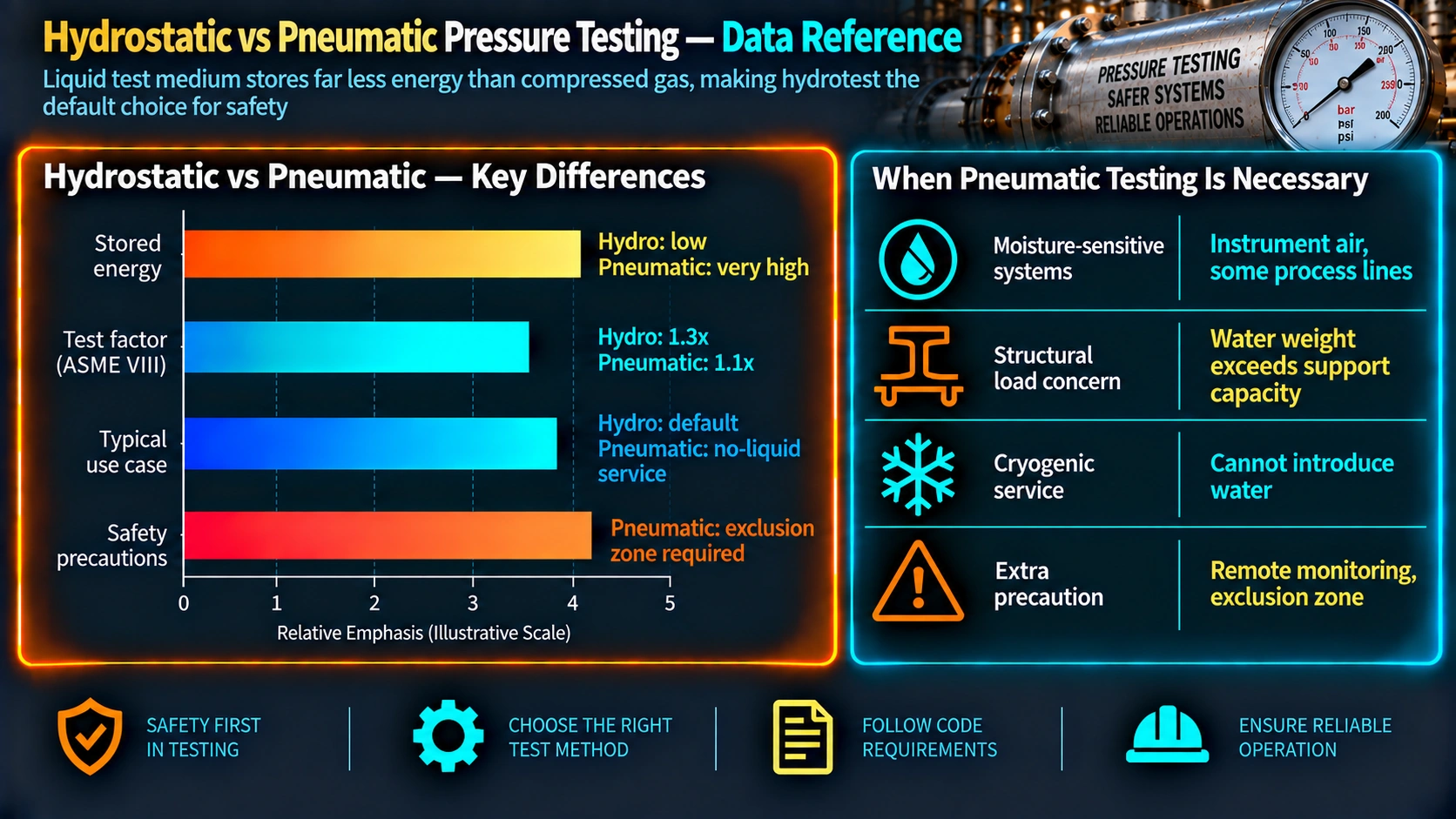
The following table summarizes the critical test parameters across ASME B31.3 and Section VIII Division 1 and Division 2 for quick field reference.
| Parameter | B31.3 Hydrostatic | B31.3 Pneumatic | Sec. VIII Div.1 Hydro (UG-99) | Sec. VIII Div.1 Pneumatic (UG-100) | Sec. VIII Div.2 Hydro |
|---|---|---|---|---|---|
| Governing Clause | 345.4 | 345.5 | UG-99 | UG-100 | KE-310 |
| Test Pressure Multiplier | 1.5 × P × (ST/S) | 1.1 × P (min) to 1.33 × P (max) | 1.3 × MAWP × stress ratio | 1.1 × MAWP | 1.43 × MAWP × stress ratio |
| Test Fluid | Water (preferred) | N₂, dry air, inert gas | Water (preferred) | N₂, dry air, inert gas | Water (preferred) |
| Minimum Hold Time | 10 minutes | 10 minutes | 30 minutes | 10 minutes | 30 minutes |
| Preliminary Check Required | Not specified | YES — at 50% PT | Not specified | YES — at ~50% PT | Not specified |
| PRV Required During Test | No (recommended) | YES — mandatory | No (recommended) | YES — mandatory | No (recommended) |
| Owner Approval Required | No | YES | No | YES | No |
| Examination Method | Visual at design P | Soap solution / detector at design P | Visual at design P | Soap solution / detector at design P | Visual at design P |
| Relative Safety Level | HIGH | LOWER — explosion risk | HIGH | LOWER — explosion risk | HIGH |
| Preferred Method? | YES — default | EXCEPTION only | YES — default | EXCEPTION only | YES — default |
9. When Is Pneumatic Testing Permitted? Engineering Decision Guide
Understanding the conditions for permissibility is only part of the picture. In practice, the decision involves engineering judgment, owner policy, and site-specific risk assessment.
Legitimate Justifications for Pneumatic Testing
- Structural loading: Tall vertical columns or piping on elevated structures where the added weight of water during hydrotest would overstress supports, foundations, or structural steel. The engineer of record must calculate water weight and confirm it exceeds safe loading.
- Process contamination: Systems handling anhydrous hydrogen fluoride (AHF), concentrated sulfuric acid, or ultra-high-purity gas streams where any water ingress would render the system unusable or dangerous.
- Oxygen service: Oxygen piping systems where water residuals cannot be tolerated and where complete drying would be impractical.
- Cryogenic systems: Piping designed for sub-zero service (e.g., −46°C / −50°F) where water would freeze at ambient test conditions.
- Refractory-lined vessels: Vessels with fired refractory linings that would be permanently damaged by water saturation.
- Already-insulated in-service modifications: Where stripping insulation to hydrotest and reapplying would be disproportionately costly and the risk profile justifies pneumatic testing with enhanced examination.
Conditions That Do NOT Justify Pneumatic Testing
- Inconvenience of draining or drying after hydrostatic testing.
- Lack of a water supply or test pump on site (logistical reasons, not engineering reasons).
- Time pressure to complete testing faster (pneumatic pressurization is faster to fill, but risk management takes longer).
- Preference of the contractor — code authority rests with the owner and the authorized inspection agency.
10. Step-by-Step Pressure Test Procedure (Field Guide)
Whether hydrostatic or pneumatic, every pressure test should follow a documented procedure. Here is a generic procedure framework aligned with ASME B31.3 requirements:
Pre-Test Checks
- Confirm all welds are complete and visually examined per the applicable examination requirements.
- Confirm all required NDE (RT, UT, MT, PT) is complete and accepted before pressurization.
- Install all temporary blinds, plugs, test heads. Remove all relief valves or set to above test pressure. Install a certified test gauge (calibrated within 6 months) and a pressure relief device set at or below 1.1× test pressure (mandatory for pneumatic; recommended for hydrostatic).
- Obtain signed Pressure Test Permit / PTW where required by site safety procedures.
- Brief all personnel on test boundaries, exclusion zone, and emergency depressurization procedure.
During Test (Hydrostatic)
- Fill the system slowly from the lowest point, venting at all high points to remove air pockets.
- Raise pressure slowly to test pressure, monitoring for abnormal sounds or pressure drops.
- Hold at test pressure for the required soak time (10 minutes for B31.3, 30 minutes for Section VIII).
- Reduce to design pressure for examination. Check all joints, welds, and fittings. Mark any leaks.
During Test (Pneumatic)
- Isolate all personnel not directly involved in pressurization.
- Raise to 50% test pressure (or 170 kPa / 25 psi, whichever is less). Conduct preliminary soapy-water check.
- Raise in 10% increments to full test pressure. Personnel must remain at exclusion distance.
- Hold at test pressure for 10 minutes. No examination at this pressure — personnel stay clear.
- Reduce to design pressure. Apply soap solution to all joints. Mark any leaks for repair.
Post-Test
- Depressurize fully before removing any blinds, plugs, or flanges.
- Drain and dry as required by the process service.
- Remove temporary test items, reinstall permanent relief valves at their set pressure.
- Complete and sign the Test Record (Pressure Test Certificate) with all required fields: test date, test pressure, test fluid, hold time, inspector signature, and pass/fail status.
11. Safety Requirements & Blast Radius Considerations
Energy Storage and Failure Consequences
The fundamental safety concern with pneumatic testing is the elastic energy stored in the compressed gas. For a given vessel or pipe volume V at gauge pressure P above atmospheric pressure Patm, the stored energy E in an ideal gas can be approximated as:
Minimum Safe Distance (Exclusion Zone)
ASME B31.3 does not specify a numerical exclusion distance — it requires the owner/engineer to establish one based on the stored energy and the consequences of failure. Industry practice typically uses the following as a starting point:
| Stored Energy (Est.) | Suggested Minimum Distance | Notes |
|---|---|---|
| < 0.1 MJ | 3 m (10 ft) | Small bore piping, low pressure |
| 0.1 – 1 MJ | 8 m (25 ft) | Medium process piping |
| 1 – 10 MJ | 15 m (50 ft) | Large bore / high pressure piping |
| > 10 MJ | Project-specific analysis required | Vessel pneumatic test |
These are minimum distances. Physical barriers (blast walls, sandbag rows, earth berms) should supplement distance where practicable. The blast radius analysis should be documented in the test procedure and signed by the responsible engineer.
Pressure Relief Device Requirements
A pressure relief valve or rupture disk must be installed on the test system during pneumatic testing. The relief device set pressure must not exceed the lesser of: (a) 1.1× test pressure, or (b) test pressure + 345 kPa (50 psi). This device prevents overpressure from instrument malfunction, thermal expansion of the gas, or operator error.
12. Acceptance Criteria & Documentation
Pass/Fail Criteria
Both ASME B31.3 and Section VIII define the same basic acceptance criterion: the system or vessel passes the pressure test if, after examination at design pressure, there are no visible leaks. Any visible weeping, seeping, or active leakage at joints, welds, or connections is a failure requiring repair and retest.
Additionally, a pressure drop on the gauge during the hold period at test pressure may indicate a gross leak, even if no weeping is visible during examination. A measurable, unexplained pressure drop is also grounds for rejection pending investigation.
Repairs and Retesting
When a leak is found, the system must be depressurized fully, the leak location identified, repaired, and retested from the beginning of the pressurization sequence — not merely re-pressurized to test pressure from where the pressure left off. The complete test procedure must be repeated on the repaired system.
Required Documentation — Pressure Test Certificate
A compliant Pressure Test Record must capture at minimum:
- System identification (line number, P&ID reference, vessel tag)
- Test date and test pressure (gauge)
- Test fluid type and temperature
- Hold time achieved
- Relief device set pressure (for pneumatic tests)
- Pass / Fail result
- Inspector’s name, signature, and certification number
- Authorized Inspector (AI) signature and stamp (for ASME Code stamped vessels)
🔑 Key Takeaways — Pressure Testing Under ASME
- Hydrostatic is always the preferred method under both B31.3 and Section VIII — it is safer and produces a more rigorous proof of structural integrity.
- Pneumatic testing at 1.1× design pressure stores far more energy than hydrostatic testing at 1.5× design pressure due to gas compressibility — do not equate a lower test pressure multiplier with lower risk.
- Pneumatic testing requires owner approval, a written procedure, a PRV, step pressurization, and an established exclusion zone — these are code requirements, not optional good practices.
- The minimum hold time under B31.3 is 10 minutes; under Section VIII Division 1 it is 30 minutes for hydrostatic tests.
- Examination is always conducted at design pressure, after stepping down from test pressure — not at the elevated test pressure itself.
- All PWHT, NDE, and welding must be completed and accepted before pressure testing begins.
13. Common Mistakes Engineers Make in Pressure Testing
- Testing before all NDE is complete: A pressure test is not a substitute for RT or UT. Both are required. Testing before NDE hides defects that will later cause in-service failure.
- Not accounting for the stress ratio: For high-temperature systems, forgetting the ST/S ratio in the B31.3 formula results in under-testing the system relative to its design conditions.
- Using tap water with high chloride on stainless systems: Even a brief hydrotest with high-chloride water can initiate stress corrosion cracking in 300-series stainless. Always verify water quality.
- Not venting air pockets during hydrostatic testing: Trapped air pockets create a pneumatic zone within the system, negating the safety advantage of hydrostatic testing. Always vent at all high points.
- Treating a hold time as a soak at test pressure + exam time combined: The hold at test pressure and the examination at design pressure are two separate steps. Reducing to design pressure for examination is code-mandated.
- Failing to reinstall relief valves after testing: After test, pressure relief valves removed for testing must be reinstalled, verified for set pressure, and tagged before startup. A vessel entering service without its relief valve is an immediate safety violation.
- Undertaking pneumatic testing of Category M piping with air: An outright code violation. Use only inert gas for Category M service.
14. Recommended Equipment & Reference Books
Having the right tools and references is essential for accurate, code-compliant pressure testing. Below are the most-used resources in the field.
Ashcroft 1005 Test Gauge — 0–400 psi, 4.5″ Dial, ±0.25% Accuracy
ASME B40.100 compliant test gauge. Stainless Bourdon tube. Essential for accurate pressure test readings.
View on Amazon →ASME B31.3 Process Piping Code — Latest Edition
The authoritative code for all process piping design, fabrication, inspection, and testing requirements. Every piping engineer’s desk reference.
View on Amazon →ASME Section VIII Division 1 — Pressure Vessel Code
The mandatory reference for pressure vessel construction, including UG-99 and UG-100 pressure testing requirements.
View on Amazon →Portable Ultrasonic Thickness Gauge — for Pre-Test Wall Verification
Verify minimum wall thickness before pressure testing to prevent failure from thinned pipe. Essential for older or corroded systems.
View on Amazon →15. Frequently Asked Questions
Per ASME B31.3 Clause 345.4.2, the minimum hydrostatic test pressure is 1.5 times the design pressure, multiplied by the ratio of allowable stress at test temperature to allowable stress at design temperature (ST/S). For ambient temperature tests, ST/S = 1.0 and the formula simplifies to 1.5 × P. The test pressure must not exceed a value that causes any component to exceed 90% of its SMYS. The minimum hold time at test pressure is 10 minutes, after which pressure is reduced to design pressure for examination.
Per ASME B31.3 Clause 345.5.4, the minimum pneumatic test pressure is 1.1 × design pressure. The maximum allowable pneumatic test pressure is the lesser of 1.33 × design pressure or the pressure that would cause any component to exceed 90% of its yield strength. A step-wise pressurization procedure is mandatory, starting with a preliminary check at 50% of test pressure or 170 kPa (25 psi), whichever is less.
Per ASME B31.3 Clause 345.5.1, pneumatic testing is permitted when: (1) the piping system cannot be safely filled with liquid due to structural limitations, (2) the process fluid is contaminated by water or the system cannot tolerate liquid residuals, or (3) the system operates at temperatures below the freezing point of the available test liquid. Owner approval and a written pneumatic test procedure with safety precautions are mandatory.
Per ASME Section VIII Division 1 UG-99(b), the hydrostatic test pressure is 1.3 × MAWP, multiplied by the minimum ratio of allowable stress at test temperature to allowable stress at design temperature across all pressure-retaining components. The test temperature must be at least 17°C (30°F) above the MDMT. The minimum hold time is 30 minutes before examination.
Required safety measures for pneumatic testing include: (1) owner approval and a written test procedure, (2) installation of a pressure relief device set at ≤1.1× test pressure, (3) step pressurization starting at 50% of test pressure for preliminary leak check, (4) establishment of an exclusion zone around the pressurized system during the hold at full test pressure, (5) a signed pressure test permit, and (6) use of inert gas (typically nitrogen) rather than air for flammable service systems. Personnel not directly involved in pressurization must remain outside the exclusion zone during the full test pressure hold.
The lower test pressure multiplier for pneumatic testing (1.1× vs. 1.5×) is intentional and reflects the greater danger of higher-pressure pneumatic tests, not a lower rigor requirement. Because compressed gas stores orders-of-magnitude more elastic energy than a liquid at the same pressure, ASME deliberately limits the pneumatic test pressure to reduce the energy available for a catastrophic failure. The 1.5× hydrostatic multiplier provides adequate proof of structural integrity because, even at that pressure, the stored energy in water is relatively low. The pneumatic test sacrifices some proof-of-strength margin in exchange for significantly reduced explosive energy in the event of a failure.
Yes, ASME Section VIII Division 1 UG-100 permits pneumatic testing when the vessel cannot be safely hydrotested due to structural or process reasons, or when hydrostatic testing would damage internals (e.g., refractory linings). The pneumatic test pressure per UG-100 is 1.1 × MAWP. A pressure relief device, step pressurization, and exclusion zone are mandatory. The Authorized Inspector must witness or be present for the test, and full documentation is required.
In ASME B31.3, a pressure test (Clause 345.4 or 345.5) is performed at elevated test pressure (1.5× or 1.1× design pressure) to verify structural integrity and leak-tightness of the assembled system. A leak test (Clause 345.9 / 345.7) is a lower-pressure test performed at or below design pressure, using the service fluid or a compatible fluid, primarily to confirm no leakage at mechanical joints under near-operating conditions. The initial service leak test is only permitted as a substitute for the full pressure test in Category D fluid service (non-flammable, non-toxic, low pressure). For all other fluid services, the full hydrostatic or pneumatic pressure test is mandatory and the leak test is supplementary, not a replacement.