Miter Bend Calculator — Fabricated Pipe Bend Segments, Cut Angles & ASME B31.3 Compliance
- Introduction — Miter Bends in Pipe Fabrication
- Miter Bend Calculator — 2 to 6 Pieces
- Cut Angle Formula — Derivation
- Segment Piece Lengths — Short and Long Side
- Pipe Wrap Template for Miter Cuts
- ASME B31.3 Para 304.2.3 Compliance
- Minimum Piece Count for Compliance
- Weld Joint Preparation for Miter Welds
- Stress Intensification Factor and Pressure Drop
- Practical Notes for Pipe Fabricators
- Frequently Asked Questions
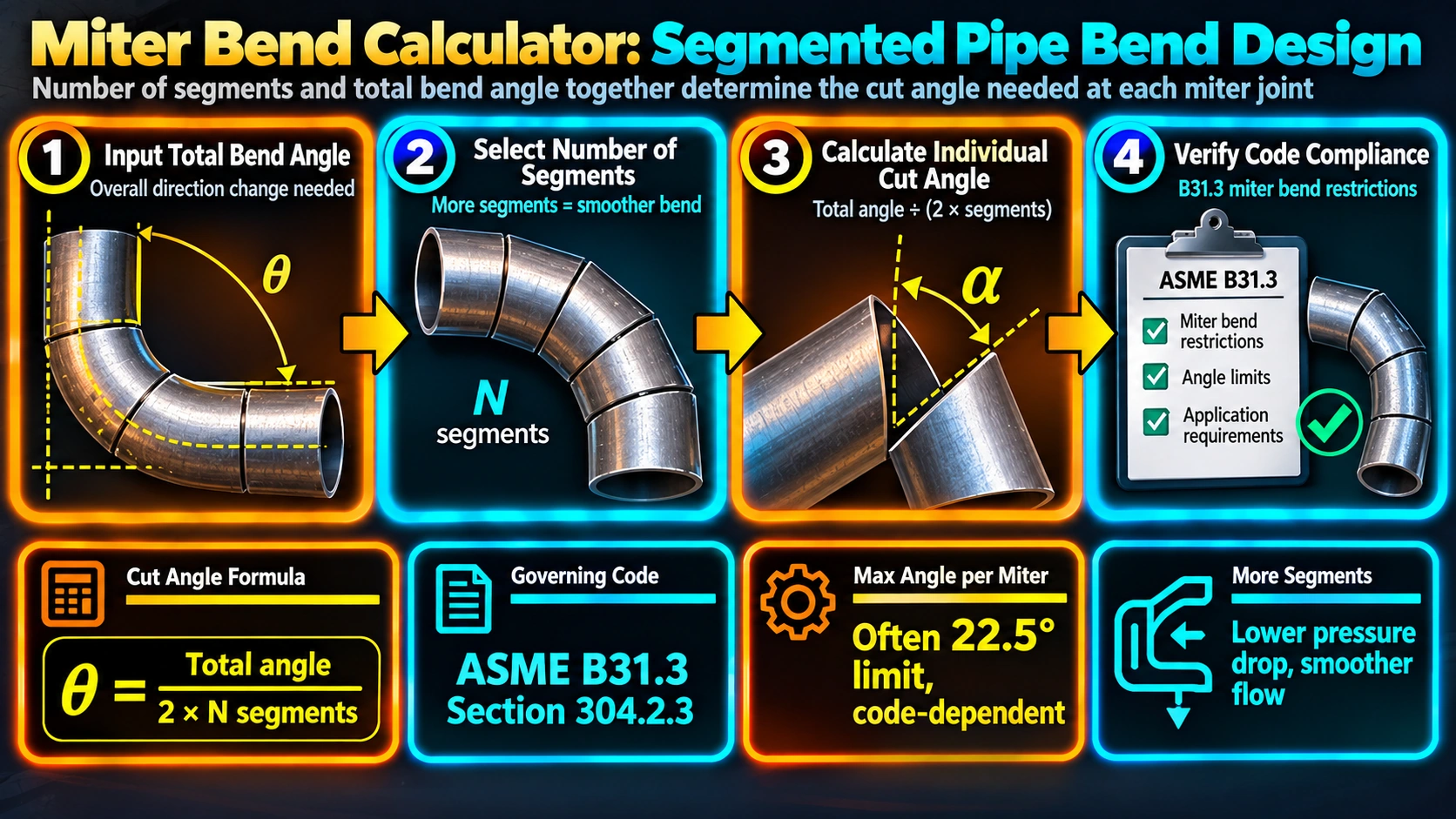
This miter bend calculator computes the cut angle per joint, the short-side and long-side lengths for every segment, template dimensions, and the ASME B31.3 paragraph 304.2.3 miter angle compliance check for fabricated pipe bends with 2 to 6 pieces. The calculator automatically flags bends that exceed the 22.5° per-joint limit and tells the fabricator exactly how many pieces are needed for code compliance.
A miter bend is constructed by cutting straight pipe at an angle and welding the pieces together to form a bend. It is the standard method for making large-bore bends (NPS 24 and above) where fitting elbows are unavailable or prohibitively expensive, and for structural or low-pressure piping at any size. The cut angle and piece lengths are precise geometric calculations — a 1° error in the cut angle accumulates across all joints and leaves the assembled bend either under-angle or over-angle. This page derives the formulas, explains what B31.3 requires, and provides the complete output needed to proceed from drawing to pipe cut.
Miter Bend Calculator
Cut Angle • Short & Long Side Lengths • Template Dimensions • B31.3 Para 304.2.3 Check
| Piece | Type | Short Side (mm) | Long Side (mm) | CL Length (mm) | Cut Angle |
|---|
Cut Angle Formula — Derivation
In a miter bend with N pieces and total bend angle Φ, there are N−1 weld joints. Each joint is a planar cut through the pipe at an angle to the pipe axis. For a symmetrical miter bend, every joint uses the same cut angle θ. The total bend angle is the sum of the angle-change at each joint, and each joint contributes 2θ to the total (because the two adjacent pipe segments each contribute θ to the turn).
Φ = total bend angle (degrees) | N = number of pipe pieces | N−1 = number of weld joints θ = the angle between the cut plane and the plane perpendicular to the pipe centreline
Angle change at each joint: 2θ = Φ / (N − 1) [degrees per joint] Each joint changes the pipe direction by 2θ. Sum of (N−1) joints = Φ total ✓
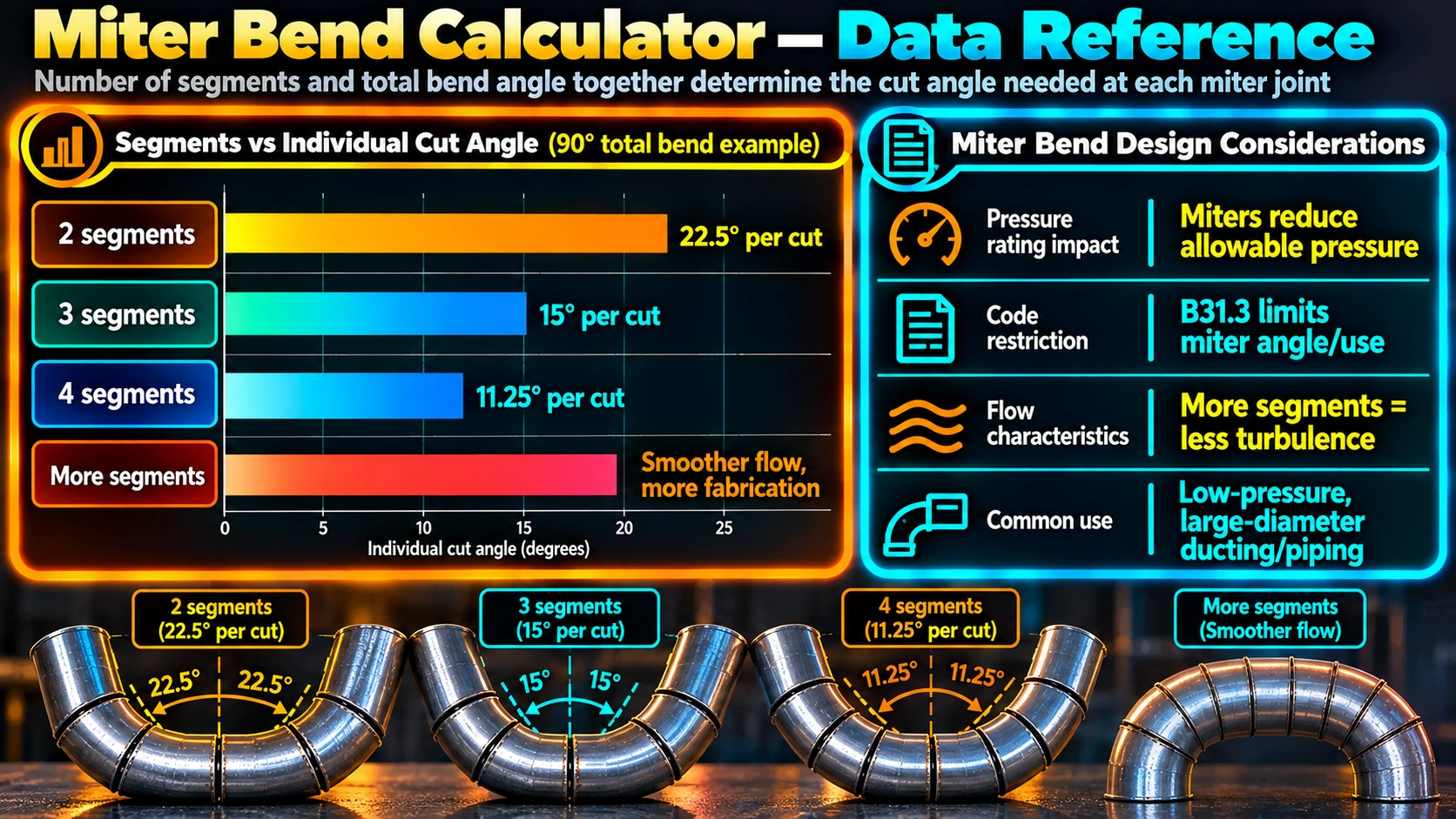
Common configurations: N=2 (1 joint): θ = Φ/2 — e.g. 45° bend: θ=22.5°; 90° bend: θ=45° N=3 (2 joints): θ = Φ/4 — e.g. 90° bend: θ=22.5° N=5 (4 joints): θ = Φ/8 — e.g. 90° bend: θ=11.25°
Segment Piece Lengths — Short and Long Side
When a circular pipe is cut at angle θ to its axis, the cut face is an ellipse. The piece length is not constant around the circumference — it varies from a minimum on the inside of the bend (the short side, or heel side) to a maximum on the outside (the long side, or back side). The difference between the long side and the short side is D×tan(θ).
End Pieces (one miter cut, one square end): CL length = T (from tangent point to miter cut) Short side (inside) = T − (D/2) × tan(θ × π/180) = (R − D/2) × tan(θ × π/180) Long side (outside) = T + (D/2) × tan(θ × π/180) = (R + D/2) × tan(θ × π/180)
Middle Pieces (miter cut on both ends, for N ≥ 3): CL length = 2T = 2 × R × tan(θ × π/180) Short side = 2T − D × tan(θ × π/180) = 2 × (R − D/2) × tan(θ × π/180) Long side = 2T + D × tan(θ × π/180) = 2 × (R + D/2) × tan(θ × π/180)
Minimum Centreline Radius (short side ≥ 0): R_min = D/2 (inside of bend must have positive piece length) Practical minimum: R ≥ D (allows enough material for full-penetration welding)
Pipe Wrap Template for Miter Cuts
A wrap-around template marks the miter cut line on the pipe surface. When the pipe is cut at angle θ, the cut face is an ellipse on the pipe surface. When the pipe surface is unrolled flat, this ellipse becomes a sinusoidal wave of amplitude (D/2)×tan(θ) centred on the mean length.
φ = 0° at short side (inside of bend) | φ = 180° at long side (outside)
y = distance from the square end of the pipe to the cut line
L_CL = centreline length (= T for end pieces, = 2T for middle pieces)
Template strip dimensions: Width = π × D (full pipe circumference) Height ≥ L_long + 20 mm safety margin Plot points at φ = 0, 15, 30, …, 360°, connect with smooth curve
| Configuration | N | θ (°) | T = R×tan(θ) at R=1D | Short Side | Long Side | B31.3 Status |
|---|---|---|---|---|---|---|
| 2-piece 45° | 2 | 22.5 | 0.414×D | -0.086×D | 0.914×D | PASS |
| 2-piece 90° | 2 | 45.0 | 1.000×D | 0.500×D | 1.500×D | FAIL (restricted) |
| 3-piece 90° | 3 | 22.5 | 0.414×D | 0.121×D | 0.707×D | PASS (limit) |
| 4-piece 90° | 4 | 15.0 | 0.268×D | 0.134×D | 0.402×D | PASS |
| 5-piece 90° | 5 | 11.25 | 0.199×D | 0.099×D | 0.299×D | PASS |
| 3-piece 60° | 3 | 15.0 | 0.268×D | 0.018×D | 0.518×D | PASS |
| 4-piece 135° | 4 | 22.5 | 0.414×D | 0.121×D | 0.707×D | PASS (limit) |
ASME B31.3 Para 304.2.3 Compliance
ASME B31.3 paragraph 304.2.3 is the code paragraph that governs fabricated miter bends in process piping. It limits the angle of each individual miter joint and specifies reduced allowable pressure when the limit is exceeded.
B31.3 Allowable Internal Pressure for Miter Bend (Eq. 4b, restricted miter, θ > 22.5°): P_allow = (S × E × t) / (R_m × tan(θ) + 0.643 × t × √(R_m/t))
R_m = mean pipe radius = (D − t) / 2 (mm)
S = allowable stress (MPa) | E = joint efficiency | t = wall thickness (mm) This is the restricted miter equation — applies when 22.5° < θ ≤ 45°
B31.3 Para 304.2.3 Minimum Pieces for Compliance: N_min = ⌈Φ / 45⌉ + 1 (ceiling division) Example: 90° bend → N_min = 90/45 + 1 = 3 pieces Example: 135° bend → N_min = ⌈135/45⌉ + 1 = 3+1 = 4 pieces
Minimum Piece Count for Compliance
| Total Bend Angle Φ | Min Pieces (N) | θ at N_min (°) | Common Usage | B31.3 Status |
|---|---|---|---|---|
| 15° | 2 | 7.5° | Minor offsets | PASS ≤22.5° |
| 22.5° | 2 | 11.25° | Standard offset | PASS |
| 30° | 2 | 15.0° | Lateral turn | PASS |
| 45° | 2 | 22.5° | Common single miter | PASS (exact limit) |
| 60° | 3 | 15.0° | 60° turn | PASS with N=3 |
| 90° | 3 | 22.5° | Standard 90° elbow | PASS (exact limit) |
| 90° | 5 | 11.25° | Smooth 90° bend | PASS — preferred for flow |
| 135° | 4 | 22.5° | Return/reverse bend | PASS with N=4 |
| 180° | 5 | 22.5° | Full reverse / U-bend | PASS with N=5 |
Miter Weld Bevel Specifications by Wall Thickness
| Wall Thickness t | Joint Type | Bevel Angle | Root Gap | Root Face | Typical Process |
|---|---|---|---|---|---|
| < 3 mm | Square butt | 0° | 1.5–2.5 mm | — | GTAW (TIG) only |
| 3–6 mm | Single-V 60° included | 30° each side | 2–3 mm | 0–1 mm | GTAW root + SMAW fill |
| 6–15 mm | Single-V 60° included | 30° each side | 2–4 mm | 1–2 mm | SMAW or GMAW |
| 15–30 mm | Single-V 60° or J-bevel | 30° or J-groove | 3–4 mm | 1.5–2 mm | SMAW or SAW fill |
| > 30 mm | Double-V or double-J | Compound | 3–4 mm | 2–3 mm | SAW or FCAW |
Weld Joint Preparation for Miter Welds
A miter weld joint is a butt weld on an angled cut face. The effective groove angle at any point around the joint varies because the cut angle appears differently in different orientations relative to the joint face. At the short-side (inside of bend), the effective bevel is approximately 37.5° from the pipe axis; at the long-side (outside), the effective bevel is the same in absolute terms but the geometry of approach is different.
Bevel Preparation
For miter welds on pipe with wall thickness ≥ 6 mm, a single-V bevel is prepared on the pipe end before assembly. The bevel angle is typically 30° to 37.5° from the pipe OD surface (giving a 60° to 75° included angle). Some fabricators apply a compound bevel — different bevel angles on the inside and outside of the cut — to achieve a more uniform root gap around the elliptical joint face. The root gap should be 2 to 4 mm for a full-penetration weld per B31.3 Table 328.5.4.
Stress Intensification Factor and Pressure Drop
A miter bend has a higher stress intensification factor (SIF) than a smooth elbow because the flow direction changes abruptly at each joint. The SIF amplifies the pipe bending stresses due to external loads (dead weight, thermal expansion, seismic).
t = pipe wall thickness, r_m = mean pipe radius = (D−t)/2, R = bend CL radius
For restricted miter (θ > 22.5°): substitute 1.52/(θ × h^(2/3)) — see B31.3 App D
Approximate pressure-drop resistance coefficient K (Crane TP-410): 2-piece 45° miter: K ≈ 0.5 3-piece 90° miter: K ≈ 1.3 to 2.0 (vs K≈0.3 for long-radius B16.9 elbow) 5-piece 90° miter: K ≈ 0.8 (approaches smooth elbow performance)
Practical Notes for Pipe Fabricators
Cutting the Miter
After the template is marked, cut the pipe using plasma, oxy-fuel, or mechanical saw. Plasma cutting gives the cleanest cut on carbon steel; mechanical cold-sawing gives the best squareness. After cutting, grind the cut face square to the marked line and bevel to the required angle. Check the cut face squareness with a straight edge across the cut face and a square against the uncut pipe body.
Assembly and Fit-Up
Assemble the miter segments on a flat surface, checking the overall bend angle with a protractor or digital angle gauge. The assembled bend should measure the exact total bend angle (Φ) within ±1°. If the assembled angle is under or over, the error is in the cut angles — verify each segment against the table produced by this calculator before welding the final joint. The cumulative angular error multiplies with each additional segment, so even 0.2° per cut becomes 0.8° error over a 5-piece bend.
Connection to Pipe Wall Thickness and Pressure Design
The miter bend is subject to the same design pressure as the adjoining straight pipe. The required wall thickness from the pipe wall thickness calculator (ASME B31.3 Clause 304.1.2) gives the t_min for the straight pipe sections in the bend. The B31.3 miter check in this calculator verifies the joint angle; the pipe wall provides the actual pressure containment. If the miter check fails (angle too high), add more pieces — do not increase wall thickness as a workaround for a non-compliant cut angle.
Frequently Asked Questions
What is the cut angle formula for a miter bend?
What are the short and long side lengths for a miter segment?
What is the ASME B31.3 paragraph 304.2.3 miter angle limit?
How many pieces are needed to make a code-compliant miter bend?
What is the centreline radius of a miter bend?
How do you make a pipe template for a miter cut?
What is the difference between a miter bend and a fabricated elbow?
What welding position is used for miter bend joints?
How does a miter bend affect pressure drop?
Can miter bends be used on steam and pressure service piping?
Recommended Reference Books
Disclosure: WeldFabWorld participates in the Amazon Associates programme (StoreID: neha0fe8-21). If you purchase through these links, we may earn a small commission at no extra cost to you.