Radiographic Testing Calculator — Film Density, IQI Selection & Geometric Unsharpness per ASME V Article 2
- Introduction — RT Parameters Every Inspector Must Calculate
- RT Film Density / IQI / Ug Calculator
- Film Density Requirements — ASME V T-282
- IQI Selection — ASME V Table T-276
- Geometric Unsharpness (Ug) — ASME V T-285
- IQI Wire Selection Reference Table
- Radiographic Techniques — SWSI, DWSI, DWDI
- Gamma Ray Sources — Ir-192, Co-60, Se-75
- IQI Placement — Source Side vs Film Side
- Practical Notes for RT Inspectors
- Frequently Asked Questions
This radiographic testing (RT) calculator covers the three critical technical parameters that every RT inspector must evaluate before accepting a radiograph under ASME V Article 2: the film density check per T-282, the IQI (penetrameter) selection and sensitivity per Table T-276, and the geometric unsharpness (Ug) calculation with minimum source-to-film distance (SFD) back-calculation per T-285. These three checks together determine whether the radiographic technique is adequate — that the film is properly exposed, that the image quality indicator confirms the technique can detect the required minimum flaw size, and that the geometric blurring from the source-to-object geometry is within the permitted limit.
These calculations appear on every radiographic technique sheet and are checked by both the RT operator and the Level II or Level III interpreter. An error in any one of them can invalidate an entire batch of radiographs, requiring costly retakes on a pressurised vessel or completed weld. This page puts all three calculations — including the complete ASME V Table T-276 wire IQI selection data — in a single, fast-access tool aimed at working inspectors in the field and the quality office.
RT Film Density / IQI Selection / Geometric Unsharpness Calculator
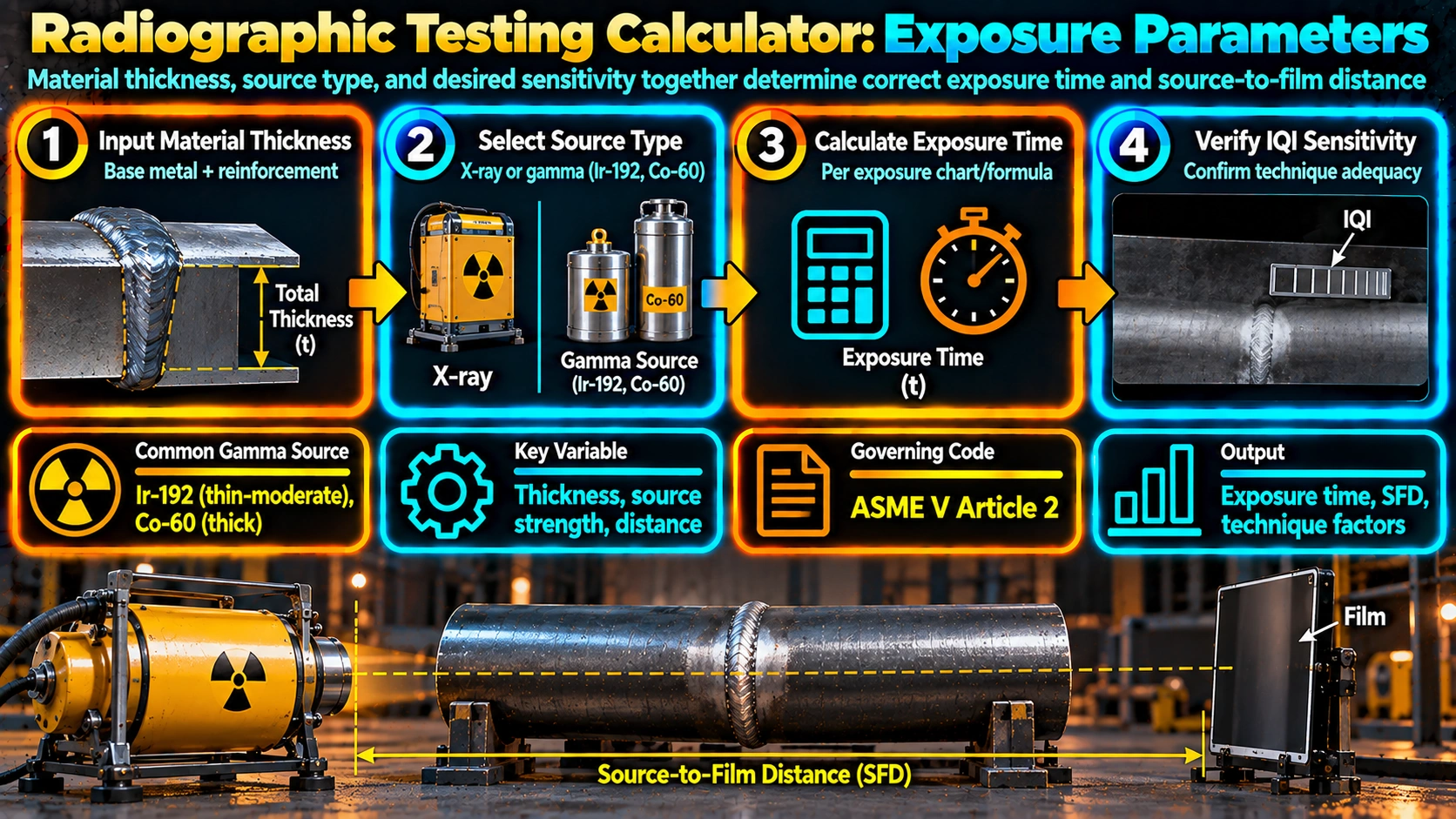
ASME V Article 2 — T-282 (Film Density) • Table T-276 (IQI) • T-285 (Ug)
Film Density Requirements — ASME V T-282
Film density (also called optical density or OD) is the measure of the film’s opacity after exposure and processing. It is defined on a logarithmic scale: a density of 1.0 means 10% of incident light is transmitted; 2.0 means 1%; 3.0 means 0.1%. In radiographic film viewing, a density that is too low (light film) indicates under-exposure — the radiograph lacks the contrast needed to resolve small discontinuities. A density that is too high (dark film) causes over-exposure — the film cannot be interpreted even on a high-intensity viewer.
Composite viewing of two films: each film 1.3 ≤ D ≤ 4.0; composite D = 1.8 to 4.0 Density under IQI: must be within ±15% of density in area of interest per T-282.2 Local variation: adjacent areas must not differ by more than 0.5 D units (per many project specs)
Density is measured with a calibrated densitometer on the processed film. The instrument must be calibrated against a certified step-wedge density tablet traceable to NIST. Density readings must be taken at the most critical location — typically the darkest point within the area of interest — and also directly under the IQI body to confirm that the IQI is being imaged at an adequate exposure level. A film that passes the overall density range but shows that the IQI area is significantly lighter than the area of interest may have the IQI placed outside the primary beam or in an unrepresentative position.
IQI Selection — ASME V Table T-276
An IQI (Image Quality Indicator), also called a penetrameter, is a calibrated device placed on the object being radiographed to give a visible indication on the film that confirms the examination technique has sufficient sensitivity to detect a feature of a defined size. It is not a defect detector — it confirms technique quality. ASME V Article 2 uses two IQI designs:
Wire IQI (ASTM E747)
The wire IQI consists of a series of progressively finer wires of the same material as the object being examined (or a more radiographically transparent material), encapsulated in a plastic holder. The essential wire is the finest wire that must be visible on the radiograph. If the essential wire is visible, the technique is confirmed as having at least 2% sensitivity — meaning discontinuities at least 2% of the nominal wall thickness in height should be detectable.
Hole-Type IQI (ASTM E1025)
The hole-type (plaque) IQI is a flat plate of the same material as the object, containing three holes of diameter 1T, 2T, and 4T (where T is the plaque thickness). The essential hole for ASME V is the 2T hole. If the 2T hole is visible, the technique has 2% sensitivity. Hole-type IQIs are used in some markets and by some owner-operators as an alternative to wire IQIs.
Nominal Thickness for IQI Selection (includes reinforcement): T_iqi = nominal wall thickness + weld reinforcement cap height Weld cap is included because the IQI is imaged through the maximum thickness of the weld
Geometric Unsharpness (Ug) — ASME V T-285
Geometric unsharpness (Ug) is the penumbral blur in a radiographic image caused by the fact that a radiation source has a finite physical size rather than being a perfect point source. If the source were infinitely small, every shadow edge would be perfectly sharp. With a real source, each edge casts a shadow that transitions gradually from full shadow to full illumination over a distance equal to Ug. Discontinuities whose depth dimension is smaller than Ug may not produce detectable density changes on the film.
Where:
f = source size (focal spot or capsule effective diameter, mm)
a = source-to-front-face distance (SOD — source-to-object distance, mm)
b = object-to-film distance (OFD — object thickness for contact technique, mm)
SFD = a + b = total source-to-film distance
Equivalent form using SFD directly (for contact-film technique where b = wall thickness t): Ug = f × t / (SFD − t) Since a = SFD − t when b = t (film is in contact with far surface of object)
Rearranging for Minimum SFD (given f, b, and Ug_max): SFD_min = f × b / Ug_max + b This is the minimum source-to-film distance needed to keep Ug at or below the limit
| Nominal Material Thickness | Max Ug (mm) | Max Ug (in) | ASME V Reference |
|---|---|---|---|
| Up to 50.8 mm (2 in) | 0.51 mm | 0.020 in | T-285 Table |
| Over 50.8 mm to 76.2 mm | 0.76 mm | 0.030 in | T-285 Table |
| Over 76.2 mm to 101.6 mm | 1.02 mm | 0.040 in | T-285 Table |
| Over 101.6 mm | 1.78 mm | 0.070 in | T-285 Table |
IQI Wire Selection Reference Table
The complete ASME V Table T-276 wire IQI selection data is reproduced below for reference. This is the data used by the calculator above. For each nominal thickness range, the required essential wire number and its diameter are given, along with the theoretical 2% sensitivity that would correspond to the midpoint of the thickness range.
| Nominal Thickness Range (mm) | Essential Wire No. | Wire Dia. (mm) | Wire Dia. (in) | Set | Actual Sensitivity (at range min) |
|---|---|---|---|---|---|
| Up to 6.4 | 5 | 0.25 | 0.010 | A | ≤ 3.9% |
| Over 6.4 to 9.5 | 6 | 0.33 | 0.013 | A | 3.5% |
| Over 9.5 to 12.7 | 7 | 0.41 | 0.016 | A | 3.2% |
| Over 12.7 to 19.0 | 8 | 0.51 | 0.020 | A | 2.7% |
| Over 19.0 to 25.4 | 9 | 0.64 | 0.025 | B | 2.5% |
| Over 25.4 to 38.1 | 10 | 0.81 | 0.032 | B | 2.1% |
| Over 38.1 to 50.8 | 11 | 1.02 | 0.040 | B | 2.0% |
| Over 50.8 to 76.2 | 12 | 1.27 | 0.050 | B | 1.7% |
| Over 76.2 to 101.6 | 13 | 1.60 | 0.063 | C | 1.6% |
| Over 101.6 to 127 | 14 | 2.03 | 0.080 | C | 1.6% |
| Over 127 to 152.4 | 15 | 2.54 | 0.100 | C | 1.7% |
| Over 152.4 to 203.2 | 16 | 3.20 | 0.125 | C | 1.6% |
| Over 203.2 to 254 | 17 | 4.06 | 0.160 | D | 1.6% |
| Over 254 to 304.8 | 18 | 5.08 | 0.200 | D | 1.7% |
| Over 304.8 to 381 | 19 | 6.35 | 0.250 | D | 1.7% |
| Over 381 | 20 | 8.13 | 0.320 | D | ≤ 2.1% |
Radiographic Techniques — SWSI, DWSI, DWDI
ASME V Article 2 defines four basic radiographic exposure geometries for cylindrical components (pipes and nozzles). Selecting the correct technique affects IQI placement, the number of exposures required for full weld coverage, and the SFD geometry used in the Ug calculation.
| Technique | Code | Pipe OD Applicability | Min. Exposures for 360° | IQI Placement |
|---|---|---|---|---|
| Single wall / single image | SWSI | Any (source inside or outside) | 1 (panoramic) or multiple | Source side, per image |
| Double wall / single image | DWSI | Typically > 89 mm OD | Minimum 3 (120° apart) | Source side per image |
| Double wall / double image (elliptical) | DWDI-E | ≤ 89 mm OD (NPS 3½ and smaller) | Minimum 2 (90° apart) | Source side or film side |
| Double wall / double image (superimposed) | DWDI-S | ≤ 89 mm OD | Minimum 3 (60° apart) | Source side or film side |
Gamma Ray Sources — Ir-192, Co-60, Se-75
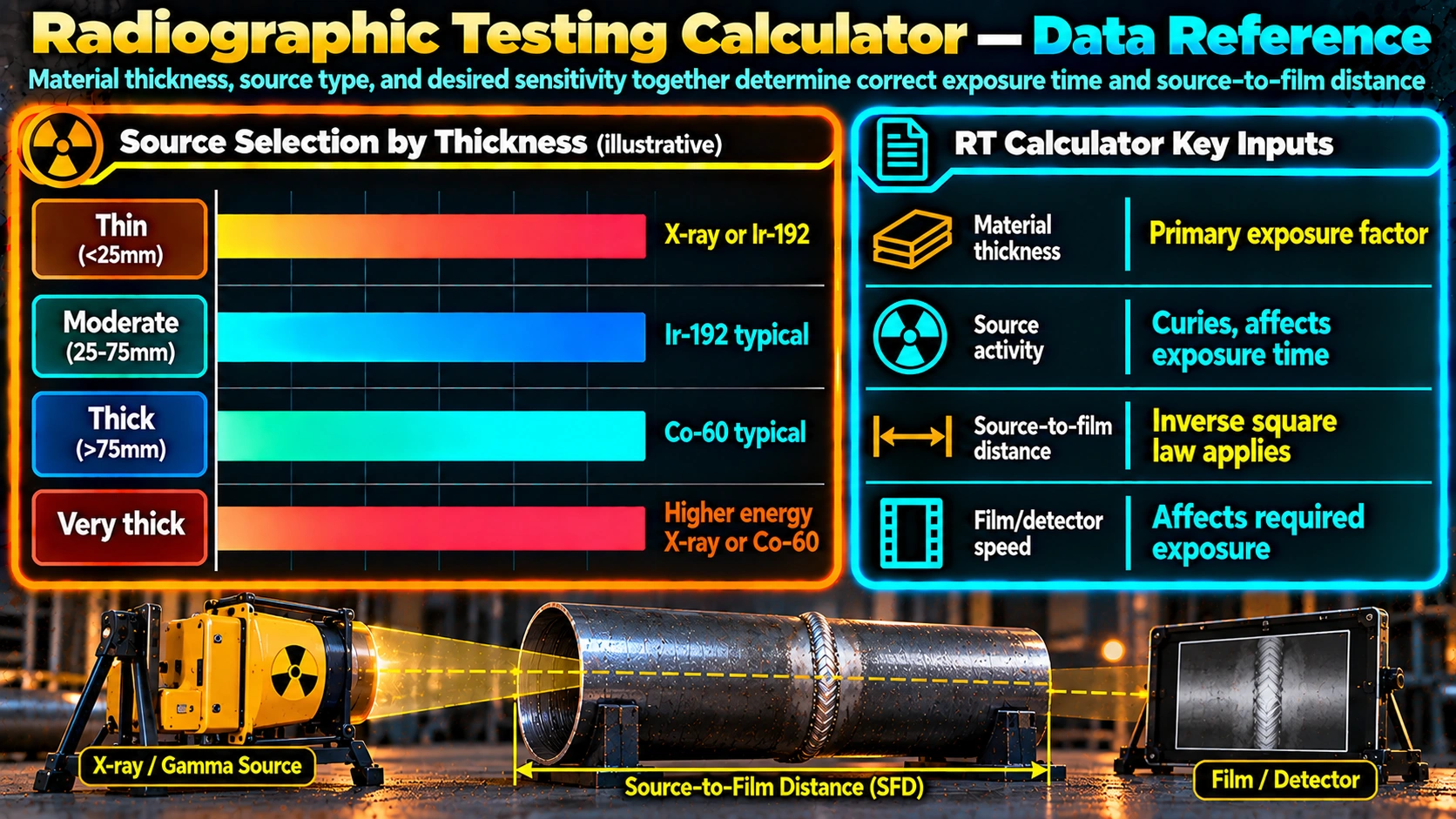
| Source | Energy Range | Typical Steel Thickness Range | Typical Capsule Size | Half-Life | Min Film Density |
|---|---|---|---|---|---|
| Iridium-192 | 0.136–0.612 MeV | 10–80 mm | 1.5–3.0 mm | 73.8 days | 2.0 |
| Cobalt-60 | 1.17 / 1.33 MeV | 50–200 mm | 2.5–6.0 mm | 5.27 years | 2.0 |
| Selenium-75 | 0.066–0.401 MeV | 2–40 mm | 0.8–1.5 mm | 119.8 days | 2.0 |
| Ytterbium-169 | 0.063–0.308 MeV | 1–15 mm | 1.0–2.0 mm | 32.0 days | 2.0 |
| X-ray (any kV) | 50 kV – 25 MeV | 1–600 mm (kV dependent) | 0.3–6.0 mm focal spot | N/A | 1.8 |
IQI Placement — Source Side vs Film Side
IQI Sensitivity after film-side adjustment: Sensitivity_FS = (d_wire_filmside / T_nominal) × 100 Since film-side wire is smaller, sensitivity % appears better — this compensates for the sharper film-side image that would otherwise falsely indicate better technique quality
The IQI must be placed on the source side of the object whenever practical. Source-side placement images the IQI under the same geometric conditions as source-side surface discontinuities — the most critical location for most weld geometries. The IQI should be positioned within the area of interest, adjacent to but not on the weld, with the body end at least 13 mm (½ inch) from the weld edge to avoid obscuring the weld image. Wire IQIs are positioned perpendicular to the weld (wires crossing the weld direction).
When source-side placement is genuinely impractical — for example, on DWDI pipe radiography where the source is on the opposite side of the pipe, or on in-service examinations of insulated pipe — film-side placement is permitted. The radiograph must be marked with an “F” lead letter placed next to the IQI image on the film, and the one-IQI-number-thinner rule of T-277.2 applies. The “F” annotation is a permanent part of the radiographic record and must appear on any film presented for code acceptance.
Practical Notes for RT Inspectors
Technique Sheet (Radiographic Procedure)
Every radiographic examination of a code weld must be performed to a written, approved procedure (technique sheet or procedure record). The technique sheet must state: the base metal material and thickness range, radiation source type and energy, SFD, film type and processing, IQI type and designation, density range, and interpretation criteria. The three calculations on this page — density limits, IQI number, and Ug — must all be documented in the technique sheet before production work begins.
Connection to ASME VIII Examination Requirements
ASME Section VIII Division 1 specifies which welds require radiographic examination (UW-11) and the acceptance criteria for indications found on the radiographs (UW-51 for full radiography, UW-52 for spot radiography). The technique requirements (the how of doing the RT) are governed by ASME V Article 2. A vessel under full radiography (100% RT) achieves the joint efficiency E = 1.0 used in the shell thickness calculation; spot radiography achieves E = 0.85. The RT technique quality confirmed by the density, IQI, and Ug checks described here directly underpins the structural integrity basis of every Code-stamped vessel.
Frequently Asked Questions
What film density is required for ASME V Article 2 radiographic testing?
How do you select the correct IQI for ASME V Article 2 radiography?
What is IQI sensitivity in radiographic testing?
What is geometric unsharpness (Ug) in radiography and why does it matter?
What are the maximum geometric unsharpness limits per ASME V T-285?
How do you calculate the minimum source-to-film distance for ASME V RT?
What is the difference between source-side and film-side IQI placement?
What are the different radiographic techniques for pipe welds per ASME V?
What gamma ray sources are permitted under ASME V Article 2?
Recommended Reference Books
Disclosure: WeldFabWorld participates in the Amazon Associates programme (StoreID: neha0fe8-21). If you purchase through these links, we may earn a small commission at no extra cost to you.