Pipe Coil Length Calculator — Helical Coil, Limpet Coil, and Dish End Spiral Coil
- Introduction — Pipe Coils in Process Vessel Fabrication
- Pipe Coil Length Calculator
- Types of Pipe Coil — Overview and Applications
- Helical Pipe Coil on Cylindrical Shell — Geometry and Formula
- Limpet (Half-Pipe) Coil on Shell — Geometry and Formula
- Dish End Spiral Coil — Archimedean Spiral Formula
- Worked Example — Step by Step
- Heat Transfer Area and Fluid Capacity
- Pitch and Helix Angle Selection
- Fabrication Notes — Bending, Welding, and Inspection
- Standard Pipe Sizes and Materials for Vessel Coils
- Frequently Asked Questions
The pipe coil length calculator on this page computes the total pipe length required for three types of coil used in pressure vessel and reactor fabrication: a helical pipe coil wound around the outside of a cylindrical shell, a limpet (half-pipe) coil welded to the shell surface in a helical path, and a dish end spiral coil arranged concentrically on the outside of a dished end. For each coil type, the calculator returns total pipe length, coil weight, heat transfer area, pipe fluid volume, and the number of turns — along with full step-by-step geometry workings.
Pipe coils are the standard method for heating or cooling the contents of a batch reactor, agitated vessel, or storage tank without a full outer jacket. They are simpler and cheaper to fabricate than a full jacket, allow the vessel to maintain its ASME code certification without the complexity of a full annular jacket, and can be added or modified independently of the vessel shell. Accurate coil length calculation is essential before ordering pipe — an under-estimate means a mid-job procurement delay, and an over-estimate wastes material and drives up cost. This article explains all three coil geometries from first principles and gives the complete calculation procedures used in fabrication shops.
Pipe Coil Length Calculator
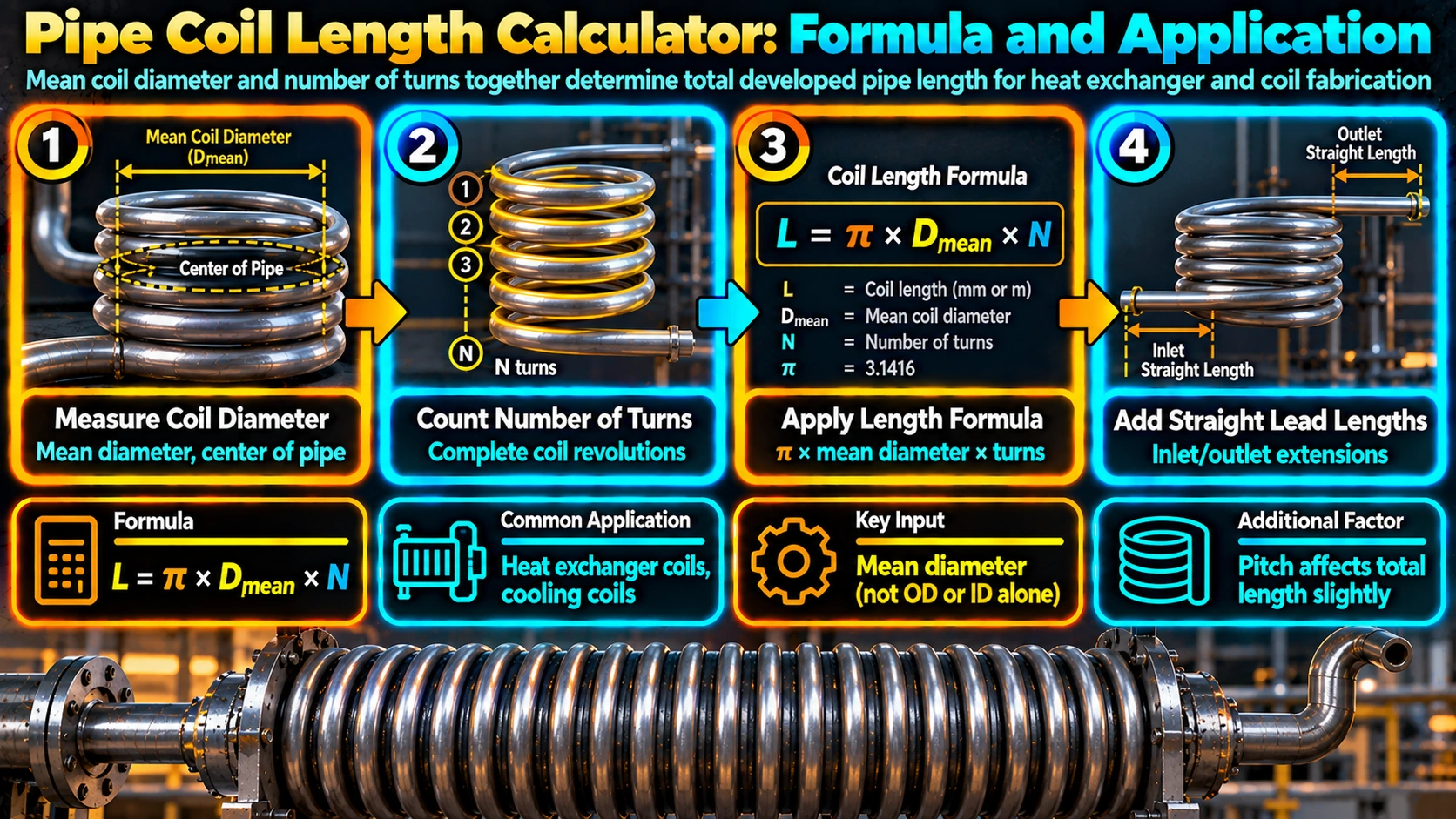
Helical Pipe Coil • Limpet (Half-Pipe) Coil • Dish End Spiral Coil
Types of Pipe Coil — Overview and Applications
Three distinct pipe coil configurations are used in process vessel and reactor fabrication, each suited to different heating/cooling duties, vessel geometries, and fabrication constraints.
Helical Pipe Coil on Cylindrical Shell
The helical pipe coil is the most common configuration for internal vessel heating or cooling coils (immersed in vessel contents) and for external clamp-on coils used in fired heaters and glycol contactors. A standard pipe is wound in a helix around or inside the vessel shell. The coil is supported by brackets or guides welded to the shell at intervals to prevent vibration and thermal movement. Because the coil pipe is a standard circular section, it can be bent on a pipe bending machine, and no special pipe cutting is required. The heat transfer area equals the full pipe OD surface area in contact with the process fluid.
Limpet (Half-Pipe) Coil on Shell
The limpet coil uses a half-pipe section — a full pipe split lengthwise — welded flat-face-down onto the outside surface of the vessel shell. The half-pipe follows a helical path around the shell, and the vessel wall itself forms the fourth side of the coil channel. Heating or cooling medium flows through the channels formed between the half-pipe and the shell OD. Limpet coils provide excellent heat transfer because the medium is in direct contact with the shell plate, and they are the preferred solution when a full outer jacket is not practical. They are especially common on agitated batch reactors in the chemical, pharmaceutical, and food processing industries.
Dish End Spiral Coil
When additional heat transfer area is required beyond what the shell coil can provide — or when the vessel contents must be heated from both ends — a spiral coil is arranged on the outside face of the dished ends. The coil follows an Archimedean spiral from a small inner radius (leaving clearance for the central nozzle or manway) outward to the dish OD. Dish end coils are common on tall reactors and crystallisers where the thermal duty requires maximum available surface area, and on vessels with low liquid levels where the shell coil would be partly uncovered during operation.
Helical Pipe Coil on Cylindrical Shell — Geometry and Formula
A helix is generated when a straight line is wound around a cylinder at a constant angle. If the cylinder is unrolled into a flat surface, each turn of the helix becomes the hypotenuse of a right triangle whose legs are the coil circumference (π × D_coil) and the pitch P. This geometric insight gives the exact helix arc length formula with no approximation.
Number of Turns (from available shell height): N = H_shell / P Where H_shell = available shell height for coiling, P = pitch (centre-to-centre turn spacing) Round down to integer for fabrication
Length of One Turn (helix arc length formula): L_turn = √((π × D_coil)² + P²) Derivation: unroll the cylinder → each turn = hypotenuse of right triangle Legs: circumference π×D_coil (horizontal) and pitch P (vertical)
Total Coil Length: L_coil = N × L_turn = N × √((π × D_coil)² + P²)
Helix Angle: α = arctan(P / (π × D_coil)) [degrees] Typical range for vessel coils: 2° to 8° (small angle → nearly horizontal turns)
Coil Height (axial extent of complete coil): H_coil = N × P + D_pipe (add one pipe diameter for first/last turn)
Limpet (Half-Pipe) Coil on Shell — Geometry and Formula
The limpet coil geometry is essentially identical to the helical coil, with one key difference: the coil mean diameter uses the half-pipe radius rather than the full pipe OD, because the centreline of the half-pipe section sits at only half a pipe diameter above the shell surface.
Pitch for Limpet Coil: P_min = D_pipe + gap (minimum: half-pipe OD plus clear gap between runs) Typical gap: 10–25 mm for welding access and thermal expansion
Length per Turn and Total Length (same formula as helical): L_turn = √((π × D_coil)² + P²) L_coil = N × √((π × D_coil)² + P²)
Limpet Coil Flow Cross-Section Area (inside the half-pipe channel): A_channel = (π/8) × (D_pipe − 2t)² Half the full pipe bore area = effective flow area inside the limpet channel
Dish End Spiral Coil — Archimedean Spiral Formula
The dish end coil follows an Archimedean spiral — a curve where the radius increases by a constant amount (the pitch) for every full revolution. The coil starts at inner radius r1 (cleared from the central nozzle) and spirals outward to outer radius r2 (the dish OD minus an edge margin). The number of turns and coil length are derived from the spiral geometry.
Outer Coil Radius: r2 = D_dish/2 − margin margin = edge clearance from dish OD (typically 40–80 mm)
Number of Turns: N = (r2 − r1) / P
Mean Circumference Approximation (accurate to ±1%): L_coil ≈ π × N × (r1 + r2) Mean radius = (r1 + r2)/2; total length = mean circumference × number of turns
Exact Archimedean Spiral Arc Length (for highest accuracy): Let b = P / (2π) [radial gain per radian] θ1 = r1/b, θ2 = r2/b [start and end angles in radians] L = (b/2) × [θ × √(1+θ²) + ln(θ + √(1+θ²))] evaluated from θ1 to θ2 The calculator uses the mean circumference formula — accuracy is sufficient for pipe procurement
Worked Example — Step by Step
Step 2 — Number of Turns: N = H_shell / P = 1800 / 80 = 22.5 → use N = 22 turns (round down)
Step 3 — Length per Turn (helix arc length): L_turn = √((π × 1260.3)² + 80²) L_turn = √((3960.2)² + (80)²) L_turn = √(15,682,184 + 6,400) = √15,688,584 L_turn = 3961.0 mm per turn
Step 4 — Total Coil Length: L_coil = 22 × 3961.0 = 87,142 mm L_coil = 87.14 m
Step 5 — Helix Angle: α = arctan(80 / (3.1416 × 1260.3)) = arctan(80 / 3960.2) = arctan(0.02020) α = 1.16° (very shallow — nearly horizontal turns)
Step 6 — Coil Weight (pipe weight per metre): Pipe cross-section area: A = π/4 × (OD² − ID²) = π/4 × (60.3² − 52.48²) ID = 60.3 − 2×3.91 = 52.48 mm A = π/4 × (3636.09 − 2754.15) = π/4 × 881.94 = 692.5 mm² = 6.925 cm² Weight/m = 6.925 cm² × 1 m × 7.85 g/cm³ / 1000 = 5.436 kg/m Total weight = 87.14 m × 5.436 kg/m Coil weight = 473.4 kg
Step 7 — Heat Transfer Area (external pipe surface): A_ht = π × D_pipe × L_coil = π × 0.0603 × 87.14 Heat transfer area = 16.49 m²
Step 8 — Pipe Fluid Volume (internal bore volume): ID = 52.48 mm; A_bore = π/4 × 0.05248² = 0.002163 m² V = A_bore × L_coil = 0.002163 × 87.14 Fluid volume = 0.1885 m³ = 188.5 litres
Heat Transfer Area and Fluid Capacity
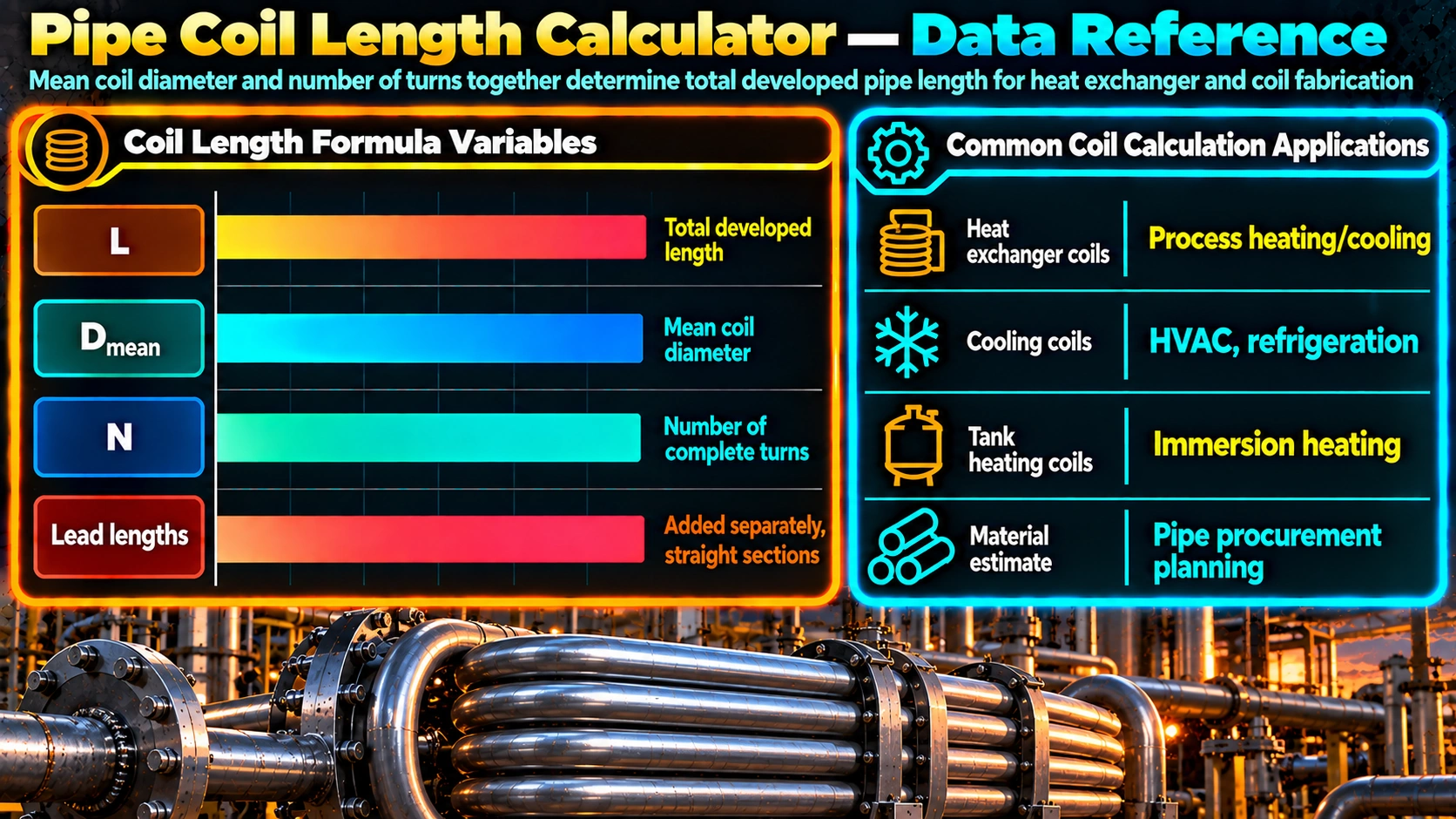
Three secondary outputs are important for the heat exchanger duty calculation: the heat transfer area, the coil fluid volume, and the effective contact area for limpet coils.
Heat Transfer Area — Limpet Coil (contact with shell only): A_contact = (π/2) × D_pipe_OD × L_coil Only the inner-face half of the half-pipe perimeter contacts the shell wall Total outer surface area = same formula as pipe coil, but effective transfer = half that value
Pipe Bore (Internal Fluid) Volume: V = (π/4) × D_pipe_ID² × L_coil Where D_pipe_ID = D_pipe_OD − 2 × wall thickness Result in m³ when L_coil in metres and D_pipe_ID in metres
Pitch and Helix Angle Selection
Pitch selection involves a balance between heat transfer area, fabrication access, and thermal expansion allowance. The table below provides guidance for typical vessel coil designs.
| Coil Type | Pipe OD (mm) | Minimum Pitch (mm) | Typical Pitch (mm) | Minimum Gap | Helix Angle (typical) |
|---|---|---|---|---|---|
| Helical pipe coil | 33.4 (NPS 1) | 33.4 (touching) | 55–65 | 20–30 mm | 1.0–1.5° |
| Helical pipe coil | 48.3 (NPS 1½) | 48.3 | 70–80 | 20–35 mm | 1.2–1.8° |
| Helical pipe coil | 60.3 (NPS 2) | 60.3 | 80–100 | 20–40 mm | 1.5–2.5° |
| Helical pipe coil | 88.9 (NPS 3) | 88.9 | 110–130 | 20–40 mm | 1.5–3.0° |
| Limpet half-pipe | 60.3 (NPS 2) | 70 | 80–90 | 10–20 mm | 1.2–2.0° |
| Limpet half-pipe | 88.9 (NPS 3) | 100 | 110–130 | 15–25 mm | 1.5–2.5° |
| Limpet half-pipe | 114.3 (NPS 4) | 130 | 140–160 | 20–30 mm | 2.0–3.0° |
Fabrication Notes — Bending, Welding, and Inspection
Helical Coil Fabrication
Helical coils are formed by cold or hot bending using a pipe bending machine fitted with a coiling attachment. The pipe is bent to the coil radius (D_coil/2) while being advanced at the pitch angle. For NPS 2 and smaller, cold bending is standard. For NPS 3 and larger, hot bending may be required to avoid wall thinning or ovality beyond the permitted limits. The coil ends are connected to the vessel via nozzles welded to the shell, and the coil itself is supported by guide brackets or saddles welded to the shell at intervals of 500 to 1,000 mm. All weld procedures for coil attachment must be qualified per ASME Section IX.
Limpet Coil Fabrication
Limpet coil fabrication requires first splitting the full pipe into two half-sections by flame or plasma cutting along the pipe centreline. Each half is then bent to follow the helical path on the shell OD surface. The flat (cut) face is placed against the shell, and the half-pipe is tacked and then continuously fillet-welded on both longitudinal edges. The quality of these fillet welds is critical — porosity or lack of fusion creates pockets where corrosion can initiate between the half-pipe and the shell. For high-pressure medium duty (steam above 10 bar), the weld quality should be verified by dye penetrant testing (PT) before the next half-pipe run is placed.
Welding Procedures and Materials
For coils and limpets in the same material as the shell (typical for carbon steel and stainless vessels), the same WPS qualifies both the shell seam welds and the coil attachment welds. Where the coil is a different material (e.g., stainless steel coil in a carbon steel vessel), a dissimilar metal weld procedure is required. The filler metal must be selected to be compatible with both the coil pipe and the shell plate. For stainless-to-carbon-steel joints, an ENiCrFe-3 (Inconel 182) or ER309L filler is typically used, and PWHT of the joint may be restricted or prohibited to avoid sigma phase formation in the stainless HAZ.
Standard Pipe Sizes and Materials for Vessel Coils
| NPS | OD (mm) | Sch 40 Wall (mm) | Pipe Weight (kg/m) | Typical Coil Application | Common Spec |
|---|---|---|---|---|---|
| 1 | 33.4 | 3.38 | 2.50 | Small vessel coils, instrument heating | ASTM A106 Gr B |
| 1¼ | 42.2 | 3.56 | 3.39 | Small to medium vessel coils | ASTM A106 Gr B |
| 1½ | 48.3 | 3.68 | 4.05 | Medium vessel coils, glycol heating | ASTM A106 Gr B |
| 2 | 60.3 | 3.91 | 5.44 | Most common size for reactor coils | ASTM A312 TP316 |
| 3 | 88.9 | 5.49 | 11.29 | Large vessel coils, limpet on reactors | ASTM A106 Gr B |
| 4 | 114.3 | 6.02 | 16.07 | Large limpet coils on agitated vessels | ASTM A106 Gr B |
Frequently Asked Questions
What is the formula for helical pipe coil length on a cylindrical shell?
What is a limpet coil and how does it differ from a helical pipe coil?
How is the limpet coil mean diameter calculated?
What is the pitch of a pipe coil and how is it selected?
How is the number of turns calculated for a helical coil on a vessel shell?
What is the heat transfer area of a pipe coil on a vessel shell?
What pipe sizes and materials are typically used for vessel coils?
How is a dish end coil (spiral coil on dished end) calculated?
What is the helix angle and how does it affect the coil?
Recommended Reference Books
Disclosure: WeldFabWorld participates in the Amazon Associates programme (StoreID: neha0fe8-21). If you purchase through these links, we may earn a small commission at no extra cost to you. This helps support free technical content on this site.