Hardness Conversion Calculator — HV, HB, HRC, HRB with NACE MR0175 and ASME PWHT Limits
- Introduction — Why Hardness Matters in Welding and Fabrication
- Hardness Conversion Calculator
- The Four Main Hardness Scales
- Conversion Method and Accuracy
- NACE MR0175 / ISO 15156 Hardness Limits
- Post-Weld Heat Treatment and Hardness Requirements
- Heat-Affected Zone Hardness — Causes and Control
- Hardness Conversion Reference Table
- Hardness Testing Methods in the Field and Laboratory
- Practical Engineering Notes
- Frequently Asked Questions
The hardness conversion calculator on this page converts between the four hardness scales most commonly used in pressure vessel, piping, and structural welding inspection: Vickers (HV), Brinell (HB), Rockwell C (HRC), and Rockwell B (HRB). Enter a reading on any one scale and the calculator instantly returns the equivalent values on all three others, with automatic compliance checks against the critical industry limits: the NACE MR0175 / ISO 15156 sour service maximum of 22 HRC (250 HV / 237 HB), the general PWHT target of 200 HV, and the typical HAZ acceptable maximum of 350 HV.
Hardness control is one of the most important — and most frequently misunderstood — quality parameters in pressure vessel and piping fabrication. A weld that passes visual inspection, dimensional checks, and even radiographic examination can still fail in service if the HAZ hardness is too high for the intended service. In sour environments containing H2S, hard microstructures (above 22 HRC) are susceptible to sulfide stress cracking (SSC) and hydrogen-induced cracking (HIC), which can cause sudden brittle fracture with no prior visible indication. Hardness measurement and verification is therefore mandatory in any sour service fabrication, and increasingly required as a standard check on all high-integrity pressure equipment.
Hardness Conversion Calculator
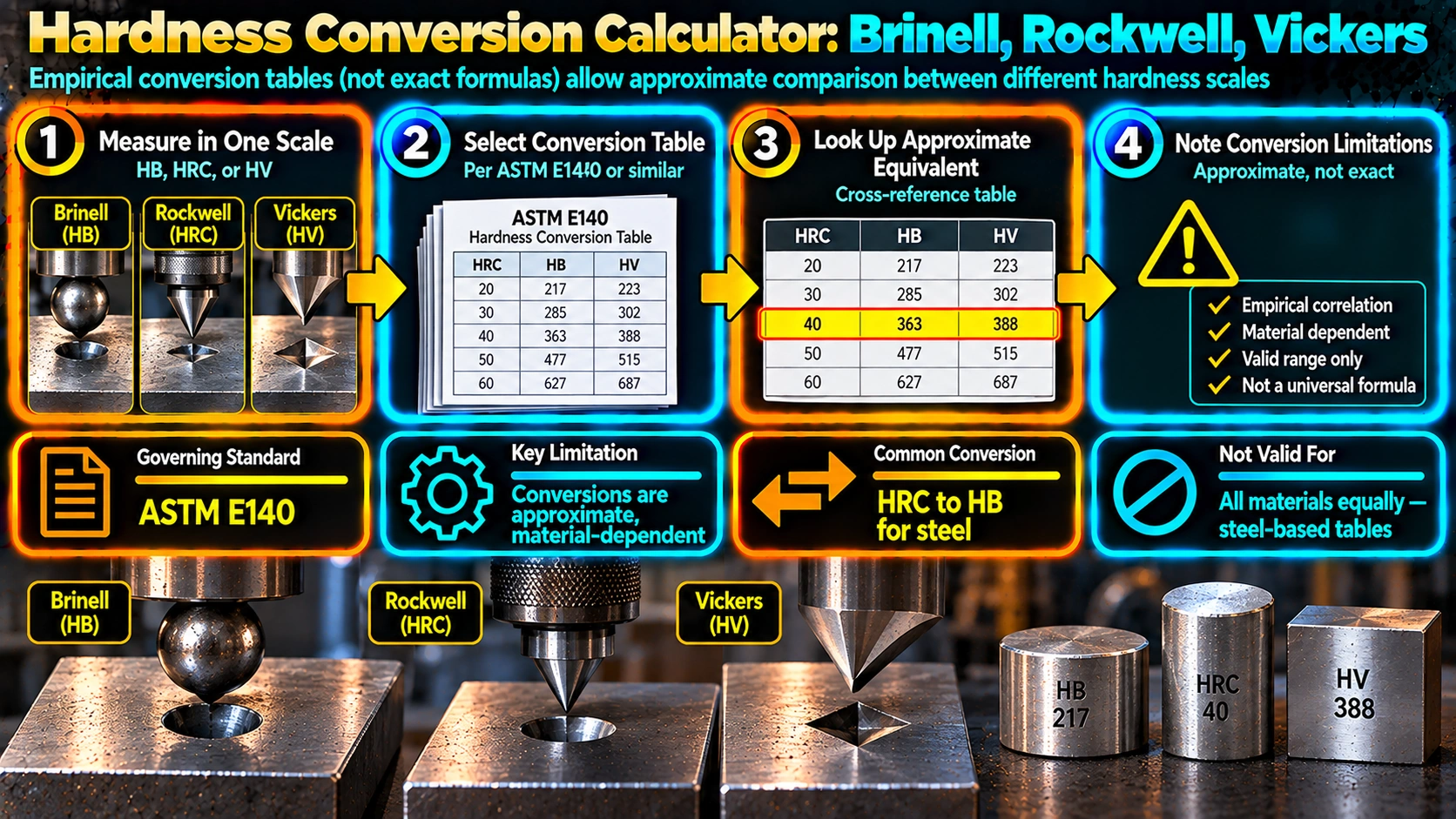
HV ↔ HB ↔ HRC ↔ HRB — with NACE MR0175, ASME PWHT & HAZ compliance checks
The Four Main Hardness Scales
Hardness is a material’s resistance to permanent plastic deformation under an applied load. Four test methods dominate in welding and pressure vessel inspection, each suited to different measurement situations.
Vickers Hardness (HV)
The Vickers test uses a square-based pyramidal diamond indenter applied at a defined load (typically 10 kgf for macro-Vickers, or 0.1 to 1 kgf for micro-Vickers). The hardness is calculated from the diagonal length of the indentation: HV = 1.8544 × F / d², where F is the applied force in kgf and d is the average diagonal in mm. Vickers is the preferred scale for weld inspection because its small indentation size allows precise measurement of narrow zones such as the HAZ (which may be only 0.5 to 2 mm wide), and it covers the full practical hardness range without scale changes.
Brinell Hardness (HB)
The Brinell test uses a hardened steel or tungsten carbide ball of 10 mm diameter under a load of 3,000 kgf for steel. The hardness is: HB = 2F / (πD(D − √(D²−d²))), where F is the load, D is the ball diameter, and d is the indentation diameter. The larger indentation averages hardness over a bigger area, making it suitable for bulk base metal inspection but unsuitable for narrow zones. Brinell is widely used for incoming plate and forgings inspection.
Rockwell C (HRC)
Rockwell C uses a diamond cone (Brale indenter) under a major load of 150 kgf and measures hardness from the depth of penetration. The scale covers approximately 20 to 70 HRC. NACE MR0175 specifies its sour service limit directly in HRC (maximum 22 HRC), making HRC the primary reporting scale for sour service compliance. For readings below approximately 20 HRC, the Rockwell C scale becomes imprecise and conversion to HV or HB is preferred.
Rockwell B (HRB)
Rockwell B uses a 1/16-inch hardened steel ball under a 100 kgf major load and covers the range 0 to 100 HRB, corresponding to softer materials. It is commonly used for annealed stainless steels, copper alloys, and soft carbon steels. The typical range for austenitic stainless steel is 70 to 95 HRB (approximately 130 to 200 HV).
Conversion Method and Accuracy
Hardness conversions are empirically derived correlations — not exact theoretical relationships. The standard reference is ASTM E140 (Standard Hardness Conversion Tables for Metals) and its international equivalent ISO 18265. These standards tabulate conversion values derived from large datasets of simultaneous measurements on well-characterised steel specimens. The calculator on this page uses polynomial regression equations fitted to the ASTM E140 Table 1 data for non-austenitic steels, which is the applicable dataset for carbon and low-alloy pressure vessel steels.
Key Conversion Equations (ASTM E140, non-austenitic steel)
HV to HB (valid for HV ≤ 650): HB ≈ 0.945×HV + 0.65 (for HV 100–400) More precisely: HB = HV × (1 − (HV−100)×0.00036) for the working range
HB to HRC (valid for HB ≥ 225): HRC ≈ 0.1068×HB − 8.38 (ASTM E140 linear fit, HB 225–650)
HRB to HV (valid for HRB 60–100): HV ≈ 0.6243×HRB² − 100.0×HRB + 4370 (quadratic fit, HRB 60–100) Equivalent HB range: approximately 60–190 HB
NACE MR0175 / ISO 15156 Hardness Limits
NACE MR0175 (internationally standardised as ISO 15156) is the governing document for materials used in oil and gas production in H2S-containing environments. It defines hardness limits to prevent sulfide stress cracking (SSC) and hydrogen-induced cracking (HIC) — two failure modes that occur when hard microstructures absorb hydrogen generated by the H2S corrosion reaction.
| Material Category | Component | Max HRC | Max HV | Max HB | NACE Part / Clause |
|---|---|---|---|---|---|
| Carbon & low-alloy steel | Weld metal, HAZ, base metal | 22 HRC | 250 HV | 237 HB | ISO 15156-2, Sect. 7.3 |
| C & LA steel with PWHT | Entire weld zone after PWHT | 22 HRC | 250 HV | 237 HB | PWHT does not raise the limit; it must bring hardness below it |
| 13Cr martensitic SS | All zones | 23 HRC | 255 HV | — | ISO 15156-3, per grade |
| Duplex SS (2205, 2507) | All zones | 28 HRC | 310 HV | — | ISO 15156-3, Table A.3 |
| Austenitic SS (304, 316) | All zones | Not specified | 253 HV | — | ISO 15156-3, solution annealed condition |
| Nickel alloys (625, 825) | All zones | 35 HRC | 330 HV | — | ISO 15156-3, per alloy listing |
Post-Weld Heat Treatment and Hardness Requirements
Post-weld heat treatment (PWHT) is the primary method for reducing weld and HAZ hardness in carbon and low-alloy steels after welding. When steel is welded, rapid thermal cycles create hard microstructures (martensite, bainite) in the HAZ. PWHT applies a controlled soaking cycle at elevated temperature (typically 600 to 750 °C for carbon steel) to temper these microstructures, reducing hardness and restoring toughness.
The connection between PWHT and hardness is direct: the heat treatment must be sufficient to bring the highest hardness reading — which is almost always at the coarse-grained HAZ (CGHAZ) immediately adjacent to the fusion line — down to below the project specification limit. For sour service this is 22 HRC / 250 HV. For general service, a maximum of 200 to 250 HV is typically specified.
| P-Number (ASME IX) | Typical Material | PWHT Temperature (°C) | Typical Post-PWHT Max HV | Sour Service Compliant? |
|---|---|---|---|---|
| P-1 | SA-516 Grade 70 (CS) | 595–650 | ≤ 200 HV | Yes — typically achieves < 220 HV |
| P-4 | SA-335 P11 (1.25Cr-0.5Mo) | 650–700 | ≤ 220 HV | Yes — with adequate PWHT |
| P-5A | SA-335 P22 (2.25Cr-1Mo) | 680–760 | ≤ 230 HV | Yes — PWHT mandatory |
| P-5B | SA-335 P91 (9Cr-1Mo-V) | 730–790 | ≤ 265 HV | Marginal — project limit may be tighter |
| P-8 | SA-312 TP304/316 (Austenitic SS) | Not typically required | ≤ 200 HV (solution annealed) | Governed by ISO 15156-3 |
Heat-Affected Zone Hardness — Causes and Control
The weld HAZ is the zone in the base metal that was not melted but was heated to temperatures sufficient to cause metallurgical changes. In carbon and low-alloy steels, the HAZ sub-zone immediately adjacent to the fusion line — the coarse-grained HAZ (CGHAZ) — is heated above approximately 1,000 °C, where austenite grain growth occurs. Upon rapid cooling, this coarsened austenite transforms to hard martensite or bainite, producing the highest hardness readings in the entire weld zone.
Factors Controlling HAZ Hardness
Three variables primarily control the as-welded HAZ hardness in carbon and low-alloy steels:
Carbon Equivalent (CE): The CE of the steel governs how hardenable it is — how hard the martensite will be when quenched from the austenite. Higher CE produces harder martensite for the same cooling rate. The carbon equivalent calculator on WeldFabWorld derives CE from the alloy chemistry and predicts susceptibility to HAZ hardening and cold cracking.
Heat Input: Higher heat input slows the cooling rate through the martensite-start temperature range, reducing the proportion of martensite formed and lowering HAZ hardness. However, very high heat input may coarsen the HAZ microstructure and reduce toughness, so there is an optimum range. Heat input is controlled through welding current, voltage, and travel speed per the qualified WPS.
Preheat: Preheating the base metal before welding slows the post-weld cooling rate, favouring transformation to softer ferrite-bainite rather than martensite. Preheat is the primary tool for controlling HAZ hardness in the as-welded condition. The required preheat temperature depends on the carbon equivalent, combined thickness, and hydrogen level of the consumable.
Approximate relationship: CE_IIW 0.35 → ~250 HV (at limit); CE 0.45 → ~350 HV (above limit) This is why steels with CE > 0.40 are classified as hardenable and require preheat and/or PWHT.
Typical Traverse Layout for a Butt Weld Cross-Section: Row 1: 2 mm below top surface — covers weld cap, fusion line, CGHAZ, FGHAZ, base metal Row 2: Mid-thickness — through-thickness profile Row 3: 2 mm above root — captures root HAZ (highest hardness for single-pass root runs)
Peak hardness location for most carbon steel butt welds: CGHAZ at fusion line, root pass side (single-sided weld) This is the point to compare against the 250 HV / 22 HRC NACE MR0175 limit
Hardness Conversion Reference Table
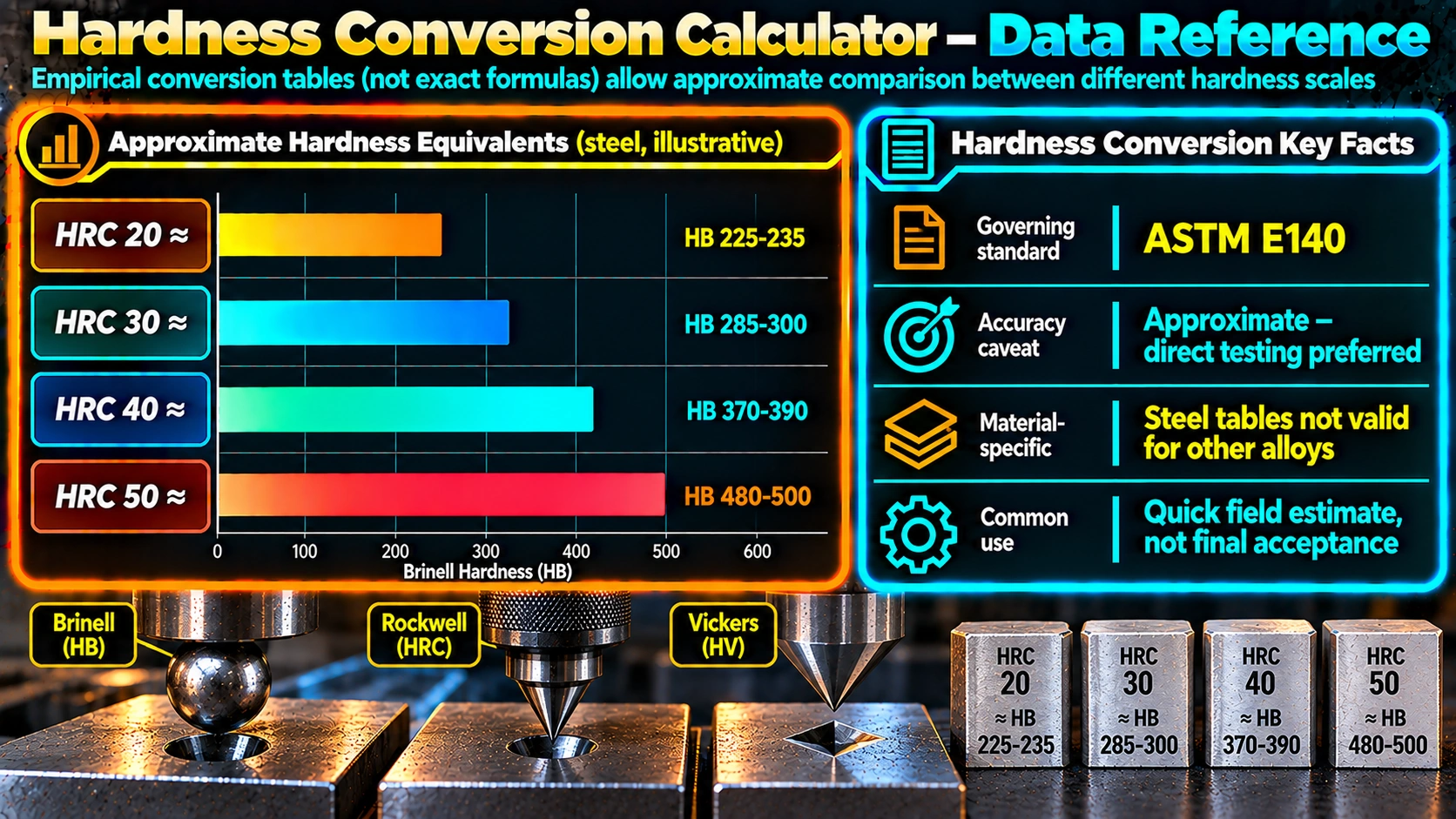
The following table provides representative conversion values for the full practical range of hardness encountered in pressure vessel and piping fabrication, from soft annealed steel through hard as-quenched martensite. Values are from ASTM E140 Table 1 for non-austenitic steels. Shaded rows indicate the region above the NACE MR0175 sour service limit.
| HV | HB (3000 kgf) | HRC | HRB | Approx. UTS (MPa) | Zone / Condition |
|---|---|---|---|---|---|
| 120 | 114 | — | 67 | 400 | Annealed soft steel |
| 150 | 143 | — | 80 | 500 | Normalised carbon steel |
| 175 | 166 | — | 87 | 580 | Post-PWHT HAZ — typical |
| 200 | 190 | — | 92 | 660 | Good PWHT result |
| 225 | 213 | 19 | 97 | 745 | Post-PWHT, near limit |
| 250 | 237 | 22 | >100 | 830 | NACE MR0175 maximum |
| 275 | 261 | 26 | — | 910 | Above NACE — not sour service |
| 300 | 285 | 29 | — | 990 | As-welded HAZ (moderate CE) |
| 350 | 332 | 35 | — | 1160 | As-welded HAZ (higher CE) |
| 400 | 380 | 40 | — | 1310 | Hard bainite / tempered martensite |
| 450 | 425 | 45 | — | 1460 | Martensite — CGHAZ, no preheat |
| 550 | 505 | 53 | — | 1800 | Hard martensite — quenched P91/P22 |
Hardness Testing Methods in the Field and Laboratory
Choosing the correct hardness test method depends on the measurement location (field vs laboratory), the size of the zone to be tested (bulk vs HAZ), and whether portable or bench equipment is available.
| Method | Scale Reported | Location | Indentation Size | Suitable For | Standard |
|---|---|---|---|---|---|
| Vickers macro-HV | HV 5–30 | Lab / bench | 0.5–1.5 mm | Weld cross-section traverses | ASTM E92, ISO 6507 |
| Vickers micro-HV | HV 0.01–1 | Lab only | <0.1 mm | Narrow HAZ sub-zones, phase mapping | ASTM E384, ISO 4516 |
| Brinell (bench) | HB 10/3000 | Lab / shop | 2.5–6 mm | Plate and forging incoming inspection | ASTM E10, ISO 6506 |
| Rockwell C (bench) | HRC | Lab / shop | 0.4 mm deep | Hardened components, NACE compliance | ASTM E18, ISO 6508 |
| Leeb rebound (Equotip) | HV, HB, HRC | Field portable | Point impact | In-situ vessel / piping inspection | ASTM A956, ISO 16859 |
| Portable Brinell (Telebrineller) | HB | Field portable | Ball impression | Field verification of plate hardness | ASTM E110 |
Practical Engineering Notes
Hardness Traverses on Weld Cross-Sections
For procedure qualification (PQR) and production weld monitoring in critical services, a hardness traverse across the full weld cross-section is required. The traverse is performed on a polished and etched metallographic section using Vickers HV 10 or HV 5 at defined intervals (typically every 0.5 to 1.0 mm), covering: base metal far field, outer HAZ, coarse-grained HAZ (CGHAZ), weld metal, and the same zones on the other side of the joint. The traverse maps the full hardness profile and identifies the peak hardness location, which is almost always in the CGHAZ at the fusion line. EN ISO 9015-1 and ASTM E384 govern hardness traverse methodology.
Connection to Carbon Equivalent and Preheat
The hardness observed after welding is directly related to the carbon equivalent of the steel, as computed by the carbon equivalent calculator. Steels with CE above 0.40 (IIW formula) are classified as hardenable and require preheat — the higher the CE, the higher the required preheat to keep HAZ hardness below limits. For sour service projects, the preheat requirement is determined jointly from the CE, the combined thickness at the weld, and the hydrogen level of the consumable, then verified by hardness testing of the procedure qualification test piece before production welding begins.
Delta Ferrite and Stainless Steel Hardness
For austenitic stainless steel welds, hardness is less critical than in carbon steels from a hydrogen cracking perspective, but excessive hardness can indicate sensitisation or work hardening. For duplex stainless steels, weld metal and HAZ hardness above 310 HV (28 HRC per ISO 15156-3) is a concern for sour service, typically caused by excessive sigma phase or martensite formation. The ferrite number guide explains the connection between weld metal composition, ferrite content, and hardness in duplex SS welds.
Frequently Asked Questions
What is the maximum hardness limit for sour service per NACE MR0175?
What are the main hardness scales used in pressure vessel and piping inspection?
Why is hardness control important after post-weld heat treatment?
How accurate are hardness conversion tables?
What is the difference between Vickers HV and Brinell HB for weld inspection?
What hardness is typically required after PWHT of carbon steel pressure vessel welds?
Which portable hardness testers are used in field weld inspection?
Does ASME Section VIII Division 1 specify hardness limits for pressure vessel welds?
What causes high hardness in the heat-affected zone of carbon steel welds?
Recommended Reference Books
Disclosure: WeldFabWorld participates in the Amazon Associates programme (StoreID: neha0fe8-21). If you purchase through these links, we may earn a small commission at no extra cost to you. This helps support free technical content on this site.