Tube Expansion Calculator — Percentage Thinning and Percentage Expansion for Heat Exchanger Tube Rolling
- Introduction — Tube Expansion in Heat Exchanger Fabrication
- Tube Expansion Calculator
- The Roller Expansion Method
- Percentage Thinning and Percentage Expansion Formulas
- Acceptance Limits — TEMA, ASME, and Project Standards
- Worked Example — Step by Step
- Tube Materials and Expansion Considerations
- Tubesheet Hole Grooves
- Roller Expansion Procedure
- Under-Rolling and Over-Rolling
- Welded and Expanded Joints
- Practical Engineering Notes
- Frequently Asked Questions
The tube expansion calculator on this page computes the two critical quality parameters for heat exchanger tube rolling: percentage wall thinning and percentage expansion. These are the standard measurements used to verify that a mechanical tube-to-tubesheet joint has been rolled to the correct degree — tight enough to be leak-proof, but not so heavily rolled that the tube wall is excessively thinned and weakened. Enter the tube dimensions before and after rolling, along with the tubesheet hole diameter; the calculator returns both percentages with automatic comparison against TEMA and ASME acceptance limits, displayed as live status gauges.
Tube rolling is one of the most skill-sensitive operations in heat exchanger fabrication. A roller expansion that is 1 to 2 percent short of target produces a joint that may pass the initial hydrostatic test but leak under thermal cycling. An expansion 3 to 4 percent over target may still hold pressure but has permanently weakened the tube wall at the most critical cross-section. This article explains the physics of roller expansion, the formulas for both quality parameters, the TEMA and ASME acceptance criteria, and the practical procedure for setting up a roller expansion operation in a fabrication shop.
Tube Expansion Calculator
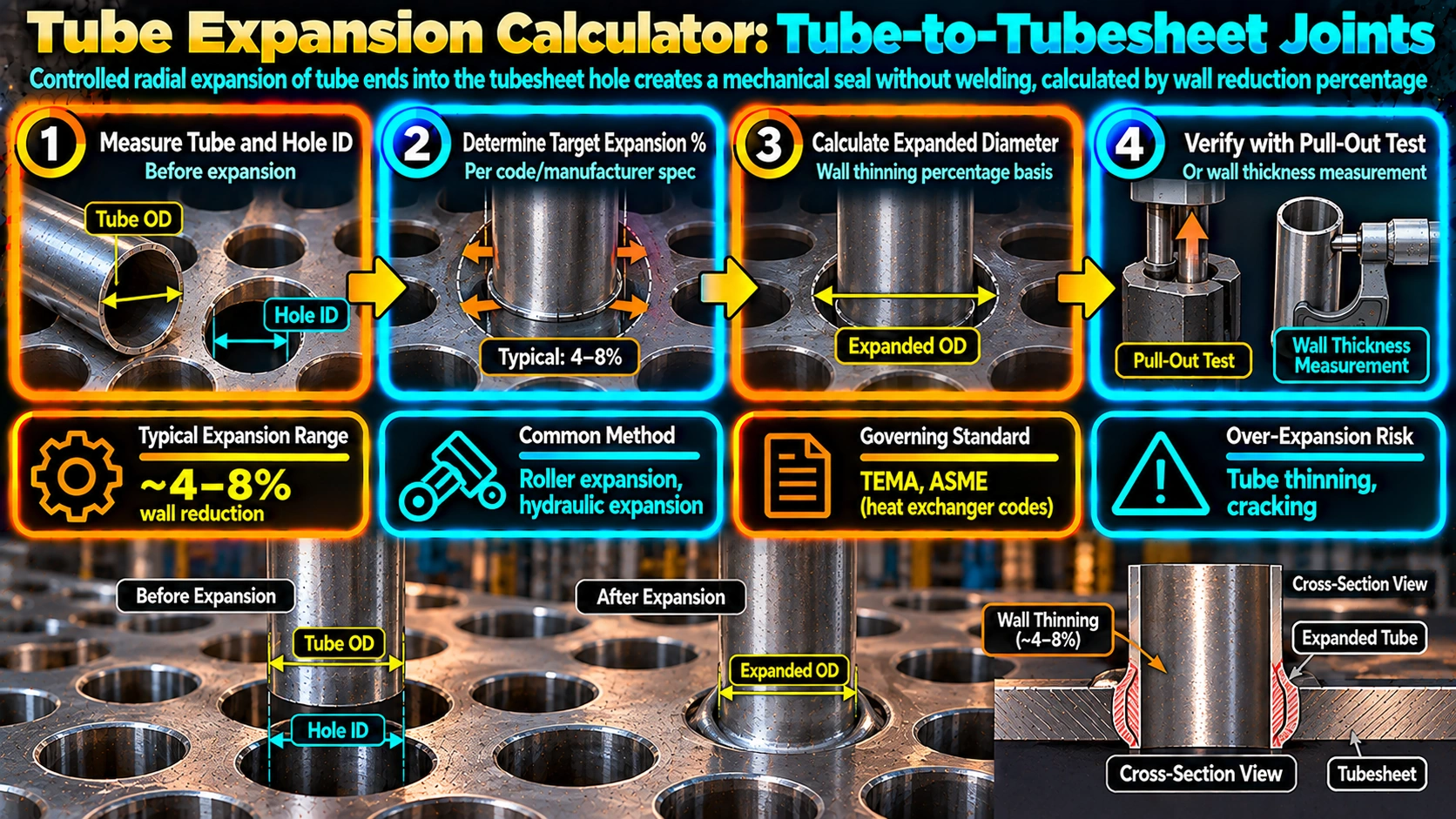
Percentage Thinning & Percentage Expansion — TEMA / ASME VIII Tube-to-Tubesheet Joints
The Roller Expansion Method
Roller expansion is the standard method for creating a mechanical tube-to-tubesheet joint in shell-and-tube heat exchangers. A tube roller (also called a tube expander) is a tool consisting of a tapered mandrel and three to five hardened steel rolls arranged around it. When the mandrel is driven forward by a torque-controlled motor, the tapered profile forces the rolls outward, pressing the tube wall against the tubesheet hole wall. The tube material deforms plastically, filling the hole and creating a tight interference fit between the tube OD and the tubesheet hole wall.
The joint strength depends on the interference fit achieved — the residual compressive stress between the tube OD and tubesheet hole. This is directly related to how far the tube wall has been expanded outward, expressed as the percentage expansion of the tube bore diameter. Simultaneously, the tube wall thins as the material is stretched circumferentially, which is expressed as percentage thinning. Both must be controlled within specified limits to produce a joint that is both leak-tight and mechanically sound.
Percentage Thinning and Percentage Expansion Formulas
Percentage Expansion
Percentage expansion measures the increase in tube inside diameter as a fraction of the original inside diameter:
Where:
ID_before = tube inside diameter before expansion = OD − 2t
ID_after = tube inside diameter after expansion (measured with tube caliper)
Equivalent formula using tubesheet hole diameter: % Expansion = ((ID_after − ID_before) / ID_before) × 100 Note: ID_after is measured, NOT assumed equal to tubesheet hole diameter.
The tube springs back slightly after the roller is withdrawn (elastic springback),
so ID_after < tubesheet hole diameter after expansion is complete.
Percentage Thinning
Percentage thinning measures the reduction in tube wall thickness as a fraction of the original wall thickness:
Where:
t_before = original tube wall thickness (nominal, before expansion)
t_after = tube wall thickness after expansion (calculated or measured)
Calculating t_after from measured ID_after (volume conservation approximation): t_after = (tubesheet_hole_diameter − ID_after) / 2 This assumes the tube OD is pressed hard against the tubesheet hole wall after expansion.
For a first estimate: t_after ≈ t_before × (1 − % Expansion / 100) The exact relationship requires a volume conservation calculation (see below).
Relationship Between Thinning and Expansion
Solving for ID_after (theoretical maximum, ignoring springback): ID_after_max = √(D_hole² − OD² + ID_before²) Actual ID_after is slightly less than this due to elastic springback of both tube and tubesheet.
Acceptance Limits — TEMA, ASME, and Project Standards
Both percentage expansion and percentage thinning must fall within specified acceptance windows for the joint to be accepted. Under-expansion fails to create a reliable leak-tight joint; over-expansion causes excessive thinning that weakens the tube. The following table summarises industry-standard limits:
| Standard | Class / Type | Min % Expansion | Target % Expansion | Max % Expansion | Max % Thinning |
|---|---|---|---|---|---|
| TEMA | Class R (Petrochemical) | 3% | 5–8% | 8% | 8% |
| TEMA | Class C (General commercial) | 3% | 5–8% | 8% | 10% |
| TEMA | Class B (Chemical) | 3% | 5–8% | 8% | 8% |
| ASME VIII | UW-20 expanded-only | 3% | 5–8% | 8% | 8% |
| Common Project Specs | Oil & Gas (typical ITP) | 5% | 6–7% | 8% | 8% |
| Common Project Specs | High alloy / Ti / Cu-Ni | 3% | 4–6% | 6% | 6% |
Worked Example — Step by Step
Step 2 — Percentage Expansion: % Expansion = ((ID_after − ID_before) / ID_before) × 100 % Expansion = ((21.82 − 21.18) / 21.18) × 100 % Expansion = (0.64 / 21.18) × 100 % Expansion = 3.02% Check against limits: min 5% → BELOW MINIMUM — UNDER-ROLLED — re-roll required
Step 3 — Wall Thickness After (from tubesheet hole and measured ID): t_after = (D_hole − ID_after) / 2 = (25.65 − 21.82) / 2 t_after = 3.83 / 2 = 1.915 mm Note: this assumes tube OD is fully seated against tubesheet hole wall
Step 4 — Percentage Thinning: % Thinning = ((t_before − t_after) / t_before) × 100 % Thinning = ((2.11 − 1.915) / 2.11) × 100 % Thinning = (0.195 / 2.11) × 100 % Thinning = 9.24% Check against limit: max 8% → EXCEEDS LIMIT — Review required
Step 5 — Target ID for Correct Expansion (5–8% range): ID_target_min = ID_before × 1.05 = 21.18 × 1.05 = 22.24 mm ID_target_max = ID_before × 1.08 = 21.18 × 1.08 = 22.87 mm Target measured ID after rolling: 22.24 to 22.87 mm Current ID_after (21.82 mm) is below target minimum — tube must be re-rolled
This worked example illustrates a tube that was under-rolled — the expansion of 3.02% falls below the 5% minimum, meaning the joint is not sufficiently tight against the tubesheet hole wall. The tube must be re-rolled to bring the ID into the 22.24 to 22.87 mm range. Note that the percentage thinning calculation showing 9.24% is a consequence of the geometric assumption that the tube is seated against the hole wall — in practice, an under-rolled tube may not be fully seated, and the actual thinning may be less. Once correctly rolled to 5 to 8% expansion, the thinning should be recalculated from the new measured ID.
Tube Materials and Expansion Considerations
| Tube Material | Common Spec | Work Hardening | Typical Expansion Target | Special Precautions |
|---|---|---|---|---|
| Low-carbon steel | ASTM A179 | Low | 5–8% | None — most forgiving material |
| Carbon steel (seamless) | ASTM A214 | Low | 5–8% | Confirm wall thickness before rolling |
| Stainless 304 / 316 | ASTM A213 TP304/316 | Medium | 5–7% | Monitor torque; springback more significant |
| Duplex SS (2205) | ASTM A789 S31803 | Medium | 4–6% | Qualification roll mandatory; harder material |
| Copper-Nickel (90/10) | ASTM B111 C70600 | High | 3–6% | Risk of cracking if over-rolled; use calibrated torque |
| Admiralty Brass | ASTM B111 C44300 | High | 3–5% | Very sensitive to over-rolling; trial rolls essential |
| Titanium Grade 2 | ASTM B338 Gr 2 | Medium | 3–6% | High springback; final ID hard to predict — calibrate carefully |
| Alloy 825 / 625 | ASTM B163 N08825 | Medium-High | 4–6% | High strength; higher rolling force required; qualification mandatory |
Tubesheet Hole Grooves
TEMA requires that tubesheet holes for Class R and Class B exchangers be machined with grooves to increase the mechanical strength of the tube-to-tubesheet joint. Grooves are circumferential channels machined into the tubesheet hole wall, typically 0.4 to 0.8 mm deep and 3 to 5 mm wide, at defined positions along the expansion length. When the tube is rolled, metal flows into the grooves, creating a mechanical interlock that significantly increases pull-out strength and resistance to leakage under pressure cycling.
| TEMA Class | Grooves Required? | Number of Grooves | Groove Depth | Purpose |
|---|---|---|---|---|
| Class R (Petrochemical) | Required | 2 minimum | 0.40 mm (1/64 in) | Pull-out resistance, leak-tightness |
| Class C (General) | Recommended | 1–2 | 0.40 mm | Joint integrity improvement |
| Class B (Chemical) | Required | 2 minimum | 0.40 mm | Pull-out resistance |
Roller Expansion Procedure
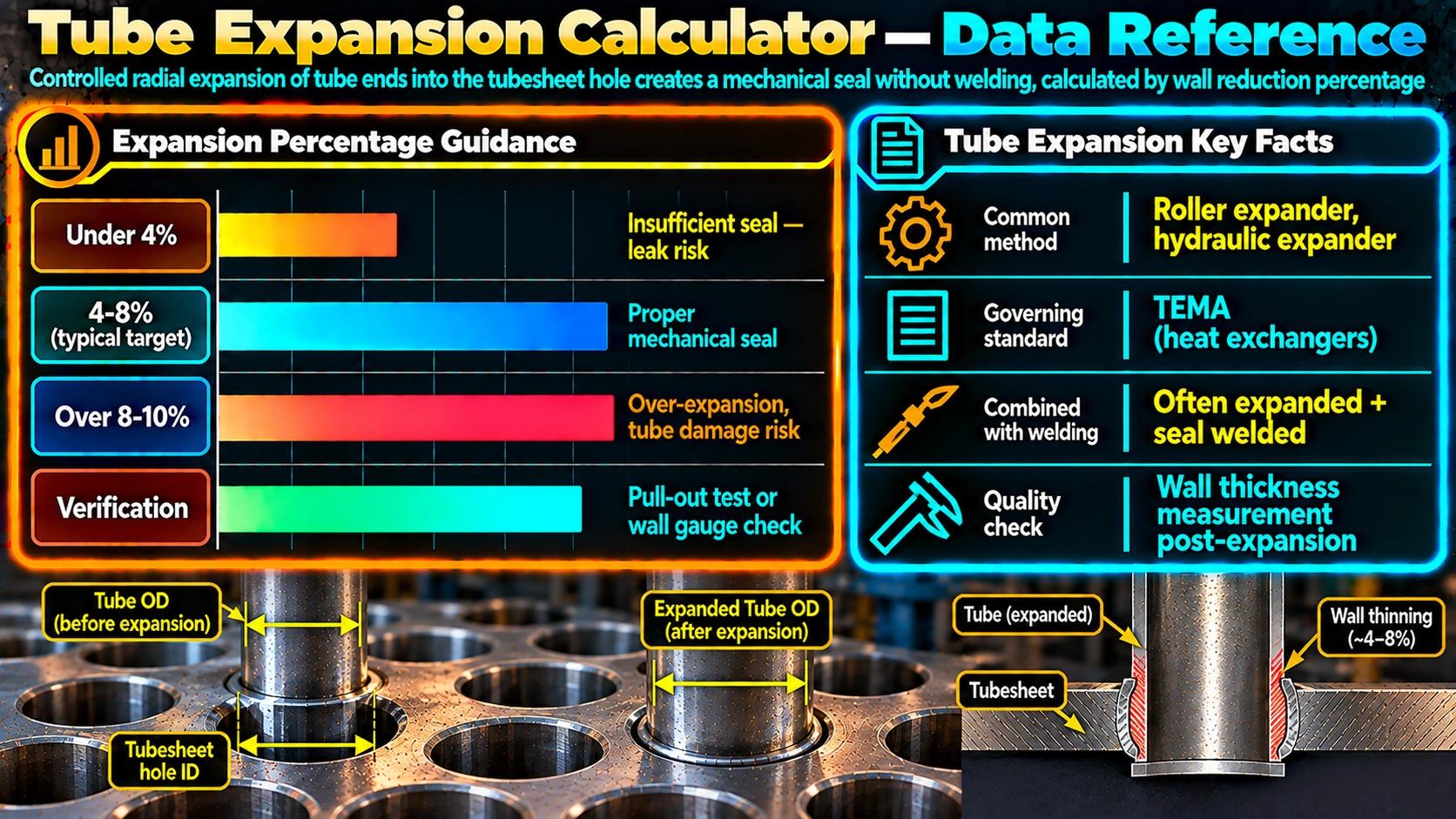
A controlled rolling procedure is essential for consistent, repeatable joint quality. The procedure covers tool selection, torque setting, expansion sequence, and measurement protocol.
Step 1 — Tool Selection
Select a tube roller matched to the tube OD and wall thickness. The roller cage diameter must correspond to the tube ID. Using an undersized cage risks inadequate contact; an oversized cage cannot be inserted. For thin-walled tubes, a cage with more rolls (5-roll) distributes the forming force more evenly and reduces the risk of tube ovality.
Step 2 — Torque Setting Calibration
The torque limit on the roller motor is the primary control parameter. Before production rolling begins, a trial expansion must be performed on a sample tube of the same specification in a mock-up tubesheet of the same material and thickness. The torque is set to achieve the target percentage expansion (typically 5 to 8%), measured after each trial and adjusted until the target is consistently achieved. This calibration torque setting is recorded and used for all production rolling.
Step 3 — Expansion Sequence
In a multi-pass bundle, all tubes in a tubesheet should be expanded in a defined sequence — typically from the centre outward in a spiral or grid pattern — to distribute the tubesheet distortion evenly and avoid locking-up the tubesheet plate. Rolling all tubes on one side before the other can cause tubesheet bowing, which makes insertion of the remaining tubes difficult and can introduce differential stresses into the joint.
Step 4 — Measurement and Acceptance
After rolling, measure the tube ID using a calibrated tube caliper or internal micrometer. Record the measurement in the rolling log. Calculate percentage expansion and percentage thinning using the formulas on this page. Compare against the acceptance limits in the ITP. Any tube outside limits must be investigated — under-rolled tubes may be re-rolled to bring them into range; over-rolled tubes may require replacement depending on the severity and the applicable code.
Under-Rolling and Over-Rolling
Two failure modes are possible in tube rolling, each with different consequences and remedies:
Under-Rolling (Insufficient Expansion)
Under-rolling means the tube has not been expanded enough to seat firmly against the tubesheet hole wall. The residual interference fit is insufficient to develop the full joint strength and seal. The joint may pass the initial hydrostatic test at ambient temperature but fail under thermal cycling as the differential thermal expansion between the tube and tubesheet opens a micro-gap. Under-rolled tubes can be re-rolled by reinserting the roller and increasing the torque setting. However, re-rolling should be done carefully — the tube has already been work-hardened by the first rolling pass, and excessive re-rolling on work-hardening alloys (copper-nickel, admiralty brass) can cause cracking.
Over-Rolling (Excessive Expansion)
Over-rolling means the tube wall has been thinned beyond the acceptable limit. Once a tube is over-rolled, the thinning cannot be reversed. The excess thinning reduces the tube pressure rating at the joint location. Depending on the severity, the remedy may be to accept the tube if the thinned wall still meets the minimum required thickness for the design pressure (verified by calculation), or to replace the tube if the thinning is severe. For work-hardening alloys, over-rolling may have caused microscopic cracking at the knuckle zones — in these cases, PT (liquid penetrant testing) of the expanded zone should be performed before acceptance.
Welded and Expanded Joints
For critical applications — high-pressure, high-temperature, toxic or flammable fluids, or where leak-tightness under cycling loads is essential — ASME VIII and project specifications require a combination of mechanical expansion and welding. The two most common combined joint types are:
Strength weld plus light expansion: A full-penetration or partial-penetration weld is made between the tube end and the tubesheet face, providing the full structural load-carrying capacity. The expansion (typically 3 to 5%) is then performed to eliminate the annular gap between the tube OD and the tubesheet hole, reducing crevice corrosion and providing additional resistance to leakage. In this configuration, the weld carries the pressure load and the expansion is supplementary.
Seal weld plus full expansion: A light fillet seal weld is applied at the tube-tubesheet junction to prevent leakage, while the mechanical expansion carries the structural load. This configuration is less common but used where full-penetration welding is difficult (e.g., very thin tubes, dissimilar metals with problematic metallurgical compatibility).
Practical Engineering Notes
Tubesheet Hole Tolerance and Its Effect on Expansion
The tubesheet hole diameter and its tolerance are specified on the exchanger drawing. TEMA gives standard hole dimensions for each tube OD, with the clearance (gap between tube OD and hole wall before rolling) typically 0.20 to 0.40 mm. A larger clearance requires more rolling to close the gap and seat the tube, increasing the risk of over-thinning before the target percentage expansion is reached. If the tubesheet holes are drilled oversize due to a tooling error, the rolling engineer should be notified before proceeding, as the torque calibration will need to be revised.
Tubesheet Material Effect on Joint Quality
The hardness of the tubesheet material relative to the tube material affects how the tube seats into the hole. For best joint quality, the tubesheet should be harder than the tube so that when the tube is expanded, the tube metal deforms plastically into the grooves rather than the tubesheet deforming. Carbon steel tubesheets with carbon steel tubes, or harder duplex stainless tubesheets with softer austenitic stainless tubes, satisfy this requirement. When soft tubesheet materials (e.g., naval brass tubesheet with copper-nickel tubes) are used, the interference fit may be less reliable and pull-out testing is more important.
Connection to Heat Exchanger Pressure Vessel Design
The tube expansion calculation presented here is specific to the tube-to-tubesheet joint. The broader pressure vessel design of the exchanger — shell thickness, channel covers, flanges, and nozzles — is governed by ASME VIII Div 1 and must be calculated using the tools covered in the rest of this B-series. The pressure vessel shell thickness calculator handles the exchanger shell. For nozzle connections on the channel or shell, the nozzle reinforcement calculator applies UG-37. For the tube material selection and weld procedure, see the welding consumable nomenclature guide and the mechanical testing guide for the applicable qualification tests.
Frequently Asked Questions
What is percentage expansion in heat exchanger tube rolling?
What is percentage thinning and why is it important?
How is percentage thinning related to percentage expansion in tube rolling?
What are the TEMA standard limits for tube expansion?
What is the difference between under-rolling and over-rolling in tube expansion?
Can tube expansion be used as the sole method of tube-to-tubesheet attachment?
What tube materials require special precautions during roller expansion?
How is tube inside diameter after expansion measured in practice?
What is the role of tubesheet hole grooves in tube expansion?
Recommended Reference Books
Disclosure: WeldFabWorld participates in the Amazon Associates programme (StoreID: neha0fe8-21). If you purchase through these links, we may earn a small commission at no extra cost to you. This helps support free technical content on this site.