Pipe Wall Thickness Calculator — ASME B31.3 Process Piping and B31.1 Power Piping
- Introduction — Why Pipe Wall Thickness Matters
- Pipe Wall Thickness Calculator
- The ASME B31.3 Formula — Code Basis and Derivation
- ASME B31.1 Power Piping Formula
- All Input Variables Explained
- Worked Example — Step by Step
- Common Pipe Materials and Allowable Stress
- Longitudinal Joint Quality Factor E
- Y-Coefficient and Temperature Effects
- Standard Pipe Schedule Selection
- Mechanical, Corrosion, and Erosion Allowances
- Practical Engineering Notes
- Frequently Asked Questions
The pipe wall thickness calculator on this page determines the minimum required wall thickness for pressure piping under internal pressure, using the governing formulas in ASME B31.3 (Process Piping) and ASME B31.1 (Power Piping) — the two codes that cover the vast majority of piping systems encountered in oil and gas, petrochemical, refinery, power generation, and offshore platform design. Enter the pipe outside diameter, design pressure, material allowable stress, joint quality factor, and required allowances; the calculator returns the pressure design thickness, total minimum thickness, mill-tolerance-compensated thickness, and the recommended minimum pipe schedule.
Getting pipe wall thickness right is fundamental to both the safety and the economics of a piping system. An undersized wall fails under operating pressure; an oversized wall adds unnecessary weight, increases stress at supports and nozzle connections, and raises procurement cost. Unlike pressure vessel shells, piping must also withstand sustained loads (dead weight, pressure), occasional loads (wind, seismic, PSV reaction), and displacement loads (thermal expansion) — but the wall thickness calculation addresses the pressure design only, and the resulting schedule must then be checked for all other load conditions by the piping stress engineer.
This article explains both the B31.3 and B31.1 thickness formulas in full, covers every input variable in detail, provides a comprehensive worked example with all intermediate steps shown, and gives the reference tables you need to apply the calculation correctly on live projects.
Pipe Wall Thickness Calculator
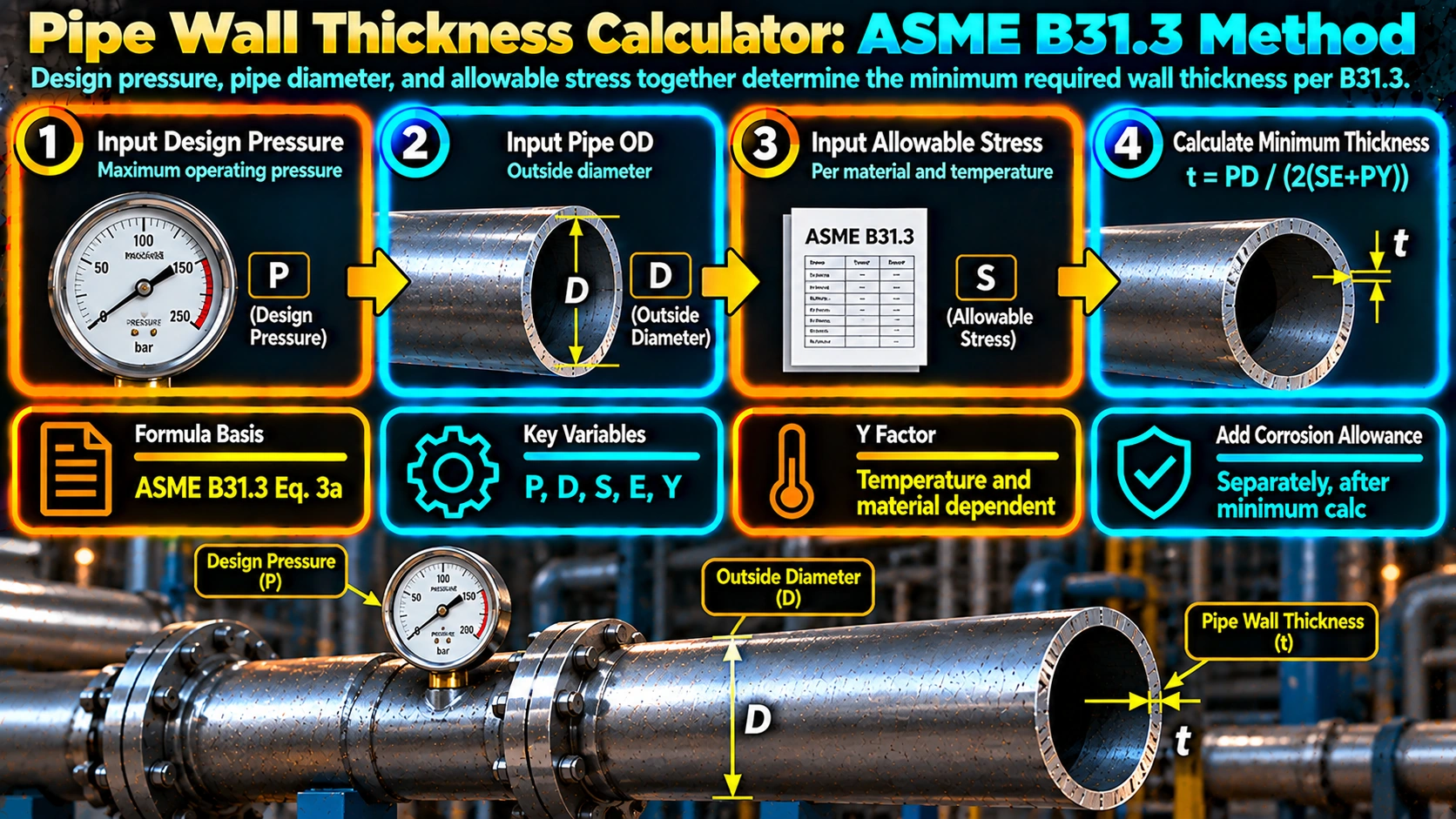
ASME B31.3 Process Piping & B31.1 Power Piping — Pressure Design Thickness
The ASME B31.3 Formula — Code Basis and Derivation
ASME B31.3, paragraph 304.1.2, provides the pressure design thickness formula for straight pipe under internal pressure. It is derived from the same thin-walled hoop stress equation as the ASME VIII shell formula, but expressed in terms of outside diameter and with the Y-coefficient convention rather than the 0.6P correction used in vessel design.
B31.3 Paragraph 304.1.2 — Straight Pipe, Internal Pressure
Rearranged to solve for Maximum Allowable Pressure: P = (2 × S × E × W × t) / (D − 2 × Y × t)
Where:
t = pressure design thickness (mm or in) — does NOT include mechanical/corrosion allowances
P = internal design gauge pressure (MPa or psi)
D = outside diameter of pipe (mm or in)
S = allowable stress at design temperature, from B31.3 Appendix A (MPa or psi)
E = longitudinal joint quality factor (1.0 for seamless; see Table A-1B)
W = weld strength reduction factor (1.0 below creep range)
Y = temperature coefficient per Table 304.1.1 (0.4 for ferrous below 482°C)
Total Minimum Specified Wall Thickness
The pressure design thickness t is only the starting point. The final specified minimum wall thickness t_m must include all necessary allowances:
Where: c = sum of all mechanical allowances + corrosion allowance + erosion allowance
Mill Tolerance Compensation (final specified wall): T_spec = t_m / (1 − mill_tolerance_fraction) → Then round UP to the next heavier standard wall/schedule
Thin-Wall Validity Limit
The B31.3 para 304.1.2 formula is valid when t < D/6. For thicker-walled pipe (t ≥ D/6), the Lame thick-wall equations apply per para 304.1.2(b), identical to the approach used for thick pressure vessel shells. In practice, standard pipe schedules virtually never approach this limit for typical process piping conditions.
ASME B31.1 Power Piping Formula
ASME B31.1, paragraph 104.1.2, governs power piping in boilers, turbines, heat exchangers, and associated utility systems. The formula structure is essentially identical to B31.3 — both derive from the same hoop stress relationship — but the coefficient notation differs slightly.
Where:
t = pressure design thickness (mm or in)
P = internal design pressure (MPa or psi)
D = outside diameter (mm or in)
S = allowable stress at design temperature, from B31.1 Appendix A
E = longitudinal joint efficiency factor (same concept as B31.3)
y = temperature coefficient per Table 104.1.2(A) (0.4 for T < 900°F / 482°C)
Key difference from B31.3: B31.3 uses SEW in the denominator (with separate W factor for welds in creep range)
B31.1 folds this into SE directly. For most practical conditions (below creep range), W=1.0 and the formulas are algebraically identical.
All Input Variables Explained
Outside Diameter (D)
Both B31.3 and B31.1 use the outside diameter of the pipe in the thickness formula. This is a deliberate choice — the OD is fixed by the pipe standard and does not change with wall thickness. For standard ASME/ANSI pipe, the OD is defined by the nominal pipe size (NPS) designation. Note that NPS is not the actual OD — a 4-inch NPS pipe has an OD of 114.3 mm (4.500 inches), not 101.6 mm (4.0 inches). The calculator’s NPS quick-pick dropdown populates the correct OD automatically for all standard sizes.
Design Pressure (P)
The design pressure is the maximum sustained operating pressure to which the piping system may be subjected during normal operation, at the corresponding design temperature. Per B31.3 para 301.2, the design pressure must also consider the effects of surge and water hammer (dynamic pressure transients), pressure relief valve opening pressure, and any accumulation above set point. Design pressure is always gauge pressure — not absolute pressure. Do not use test pressure in the design formula.
Allowable Stress (S)
The allowable stress is taken from ASME B31.3 Appendix A, Table A-1 for the specific pipe material, product form, and design temperature. It represents the minimum of: one-third of the specified minimum tensile strength (SMTS), two-thirds of the specified minimum yield strength (SMYS) at temperature, and for austenitic stainless steels, 90% of the 0.2% offset yield strength. The allowable stress decreases with increasing temperature for most materials and must be evaluated at the design temperature, not at ambient conditions.
Longitudinal Joint Quality Factor (E)
See the Quality Factor section below for full details and a reference table. The key rule is: always confirm the E value from B31.3 Appendix A, Table A-1B for the specific pipe specification. Do not assume E = 1.0 for all pipe — ERW pipe commonly used in process plants has E = 0.85, which increases the required wall thickness by nearly 18% compared to seamless for the same pressure and allowable stress.
Y-Coefficient
The Y-coefficient accounts for the fact that at elevated temperatures (particularly in the creep regime), the effective neutral axis of the pipe wall shifts, changing the relationship between the applied pressure and the resulting hoop stress. At temperatures below 482 °C (900 °F) for ferritic and martensitic steels, and below certain temperature limits for austenitic grades, Y = 0.4 and the formula simplifies to essentially the same form as the basic hoop stress equation. At higher temperatures in the creep range, Y increases toward 0.7, which results in slightly thinner required walls — reflecting the different material behaviour regime where creep governs rather than elastic stress.
Weld Strength Reduction Factor (W)
W = 1.0 for the vast majority of process piping below the creep temperature range. For longitudinal seam welds operating in the creep regime (generally above 425 °C for carbon steel, higher for creep-resistant alloys), W may be reduced to 0.85 per B31.3 para 302.3.5(e). This factor recognises that weld metal and heat-affected zone creep behaviour may differ from base metal, and only applies when the piping is explicitly designed to creep-range stress tables.
Worked Example — Step by Step
The following example demonstrates the complete B31.3 thickness calculation for a typical refinery piping line.
Step 2 — Apply B31.3 Para 304.1.2 Formula t = (P × D) / (2 × (S × E × W + P × Y)) t = (6.0 × 219.1) / (2 × (124 × 1.0 × 1.0 + 6.0 × 0.4)) t = 1314.6 / (2 × (124 + 2.4)) t = 1314.6 / (2 × 126.4) t = 1314.6 / 252.8 t = 5.20 mm (pressure design thickness only)
Step 3 — Add Allowances (para 304.1.1) c = 3.0 mm (corrosion allowance; no other allowances) t_m = t + c = 5.20 + 3.0 = 8.20 mm
Step 4 — Compensate for Mill Tolerance (12.5%) T_spec = t_m / (1 − 0.125) = 8.20 / 0.875 = 9.37 mm
Step 5 — Select Standard Schedule NPS 8 standard schedules (ASME B36.10M): SCH 20: 6.35 mm — too thin (below 9.37 mm) SCH 30: 7.04 mm — too thin SCH 40 (Std): 8.18 mm — too thin SCH 60: 10.31 mm — ACCEPTABLE (10.31 > 9.37) Minimum schedule: SCH 60 (wall = 10.31 mm)
Step 6 — Back-Check MAOP at SCH 60 t_eff = 10.31 − 3.0 = 7.31 mm (corroded condition) P_max = 2 × S × E × W × t_eff / (D − 2 × Y × t_eff) P_max = (2 × 124 × 1.0 × 1.0 × 7.31) / (219.1 − 2 × 0.4 × 7.31) P_max = 1812.9 / (219.1 − 5.85) = 1812.9 / 213.25 MAOP = 8.50 MPa (42% above design pressure of 6.0 MPa)
The NPS 8 SCH 60 line in ASTM A106 Grade B seamless is the minimum acceptable schedule. Depending on stress analysis requirements (sustained + thermal loads), a heavier schedule may be specified by the piping stress engineer, but from a pressure design standpoint SCH 60 satisfies B31.3 at these conditions.
Common Pipe Materials and Allowable Stress
The table below lists the most frequently specified pipe materials in oil and gas, petrochemical, and power generation systems. All values are from ASME B31.3 Appendix A at representative temperatures. The same materials appear in B31.1 Appendix A with near-identical but not always identical stress values — always verify against the applicable code appendix for your project.
| Material Spec | Grade / Type | Pipe Type | S @ 38°C (MPa) | S @ 200°C (MPa) | S @ 300°C (MPa) | S @ 400°C (MPa) | E factor |
|---|---|---|---|---|---|---|---|
| ASTM A106 | Grade B | Seamless | 138 | 130 | 117 | 103 | 1.00 |
| ASTM A53 | Grade B | ERW | 110 | 103 | 93 | — | 0.85 |
| ASTM A335 | P11 (1.25Cr–0.5Mo) | Seamless | 138 | 138 | 131 | 124 | 1.00 |
| ASTM A335 | P22 (2.25Cr–1Mo) | Seamless | 138 | 138 | 131 | 117 | 1.00 |
| ASTM A312 | TP304 | Seamless | 138.9 | 120.7 | 110.3 | 103.4 | 1.00 |
| ASTM A312 | TP316 | Seamless | 115.8 | 110.3 | 103.4 | 96.5 | 1.00 |
| ASTM A312 | TP304 Welded | EFW | 111.1 | 96.5 | 88.3 | 82.7 | 0.80 |
| ASTM A790 | S31803 (Duplex 2205) | Seamless | 172.4 | 172.4 | 158.6 | — | 1.00 |
Longitudinal Joint Quality Factor E
The longitudinal joint quality factor E is one of the most consequential inputs in the B31.3 formula. Selecting the wrong value — particularly assuming E = 1.0 for an ERW pipe that is actually rated at E = 0.85 — results in an unconservative (undersized) wall thickness calculation. Always confirm the E value from B31.3 Table A-1B, which lists factors by pipe specification and weld type.
| Pipe Manufacturing Method | Typical ASTM Specs | E Factor | Notes |
|---|---|---|---|
| Seamless (SMLS) | A106, A335, A312 seamless, A790 | 1.00 | No longitudinal weld; highest confidence |
| Electric Resistance Welded (ERW) — radiographed | A53 Gr B ERW (if spec’d with RT) | 0.95 | Continuous high-frequency weld; RT required for 0.95 |
| Electric Resistance Welded (ERW) — not radiographed | A53 Gr B ERW, A135 | 0.85 | Most common ERW factor in process plants |
| Electric Fusion Welded (EFW) — double butt, RT | A358, A672 (with RT) | 0.90 | Submerged arc welded seam, fully examined |
| Electric Fusion Welded (EFW) — single butt | A358, A672 (without full RT) | 0.80 | Single seam, limited examination |
| Furnace Butt Welded (FBW) | A53 Gr A FBW | 0.60 | Low-pressure utility service only; rarely used in process |
| Spiral Seam Welded | Various large-diameter line pipe | 0.80–0.85 | Depends on examination extent; check spec and Table A-1B |
Y-Coefficient and Temperature Effects
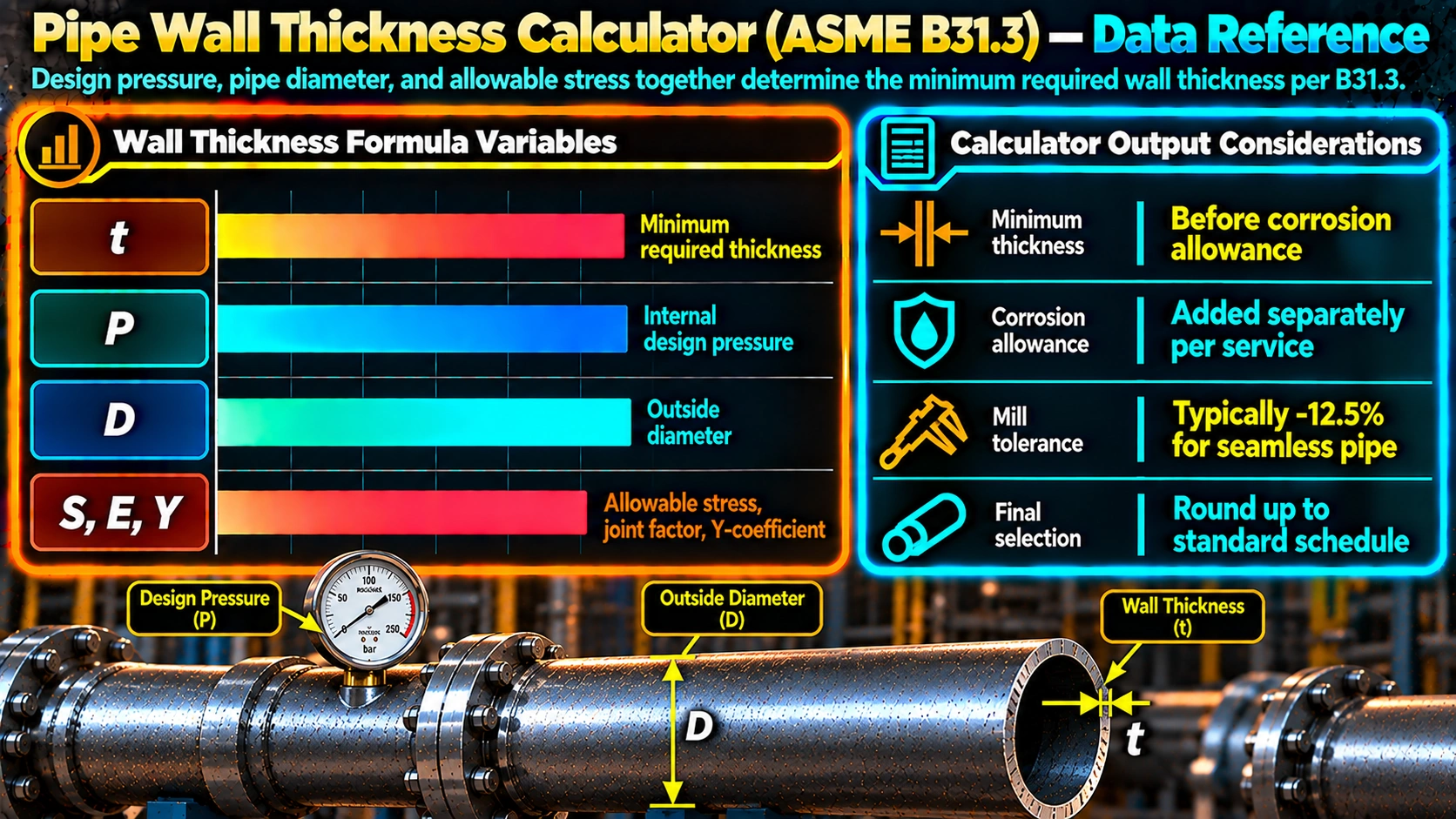
The Y-coefficient in B31.3 Table 304.1.1 captures temperature-dependent behaviour of the pipe material that affects the relationship between applied pressure and wall stress. At typical process temperatures below 482 °C (900 °F) for ferritic steels, Y = 0.4 and the formula behaviour is identical to the classical hoop stress equation. The coefficient becomes significant only when designing for high-temperature service in the creep regime.
| Temperature (°C) | Temperature (°F) | Ferritic & Martensitic | Austenitic SS | Other Ductile Metals |
|---|---|---|---|---|
| ≤ 482 | ≤ 900 | 0.4 | 0.4 | 0.4 |
| 510 | 950 | 0.5 | 0.4 | 0.4 |
| 538 | 1000 | 0.7 | 0.4 | 0.4 |
| 566 | 1050 | 0.7 | 0.5 | 0.5 |
| 593 | 1100 | 0.7 | 0.7 | 0.7 |
| ≥ 621 | ≥ 1150 | 0.7 | 0.7 | 0.7 |
Standard Pipe Schedule Selection
Once the required minimum specified wall thickness T_spec has been calculated, the piping engineer selects the lightest standard schedule whose nominal wall thickness equals or exceeds T_spec. Standard pipe dimensions are defined in ASME B36.10M (carbon and alloy steel welded and seamless pipe) and ASME B36.19M (stainless steel pipe).
| NPS | OD (mm) | SCH 40 / Std (mm) | SCH 80 / XH (mm) | SCH 160 (mm) | XXH (mm) |
|---|---|---|---|---|---|
| 2 | 60.3 | 3.91 | 5.54 | 8.74 | 11.07 |
| 3 | 88.9 | 5.49 | 7.62 | 11.13 | 15.24 |
| 4 | 114.3 | 6.02 | 8.56 | 13.49 | 17.12 |
| 6 | 168.3 | 7.11 | 10.97 | 18.26 | 21.95 |
| 8 | 219.1 | 8.18 | 12.70 | 23.01 | 22.23 |
| 10 | 273.0 | 9.27 | 15.09 | 28.58 | 25.40 |
| 12 | 323.8 | 9.53 | 17.48 | 33.32 | 25.40 |
| 16 | 406.4 | 9.53 | 21.44 | 36.53 | — |
| 20 | 508.0 | 9.53 | 22.23 | — | — |
| 24 | 609.6 | 9.53 | 24.61 | — | — |
Mechanical, Corrosion, and Erosion Allowances
The total allowance c added to the pressure design thickness t in para 304.1.1 encompasses three distinct sources of material loss or reduction:
Corrosion Allowance
Corrosion allowance compensates for the thinning of the pipe bore due to chemical attack by the process fluid over the design life of the system. Typical values for carbon steel in oil and gas service range from 1.5 mm for dry gas to 6 mm for produced water or sour service. For stainless steel in corrosive but within-specification service, a corrosion allowance of zero or 1.5 mm is common — the principal selection basis for stainless is corrosion resistance, not corrosion allowance. For sour service piping, NACE MR0175 / ISO 15156 material requirements apply in addition to the standard B31.3 calculations.
Erosion Allowance
Erosion allowance applies where particulate solids, slurries, or high-velocity two-phase flow are expected to cause physical material removal at the pipe bore. It is determined by the process engineer based on particle size, velocity, and fluid phase. For clean single-phase liquid or gas service, erosion allowance is typically zero. For sand-laden produced fluids, values of 3 mm or more may be specified, particularly at elbows and tees which erode faster than straight pipe.
Mechanical Allowance
Mechanical allowance covers material removed by machining operations such as threading, grooving (for Victaulic or similar couplings), or back-welding recesses. For threaded pipe per ASME B1.20.1, the required thread depth is the mechanical allowance. For grooved couplings, the groove depth per the coupling standard governs. For fully welded piping without threading or grooving, the mechanical allowance is zero.
Practical Engineering Notes
Connection to Pipe Weight and Stress Analysis
The selected pipe schedule feeds directly into the pipe weight calculation, which in turn affects the sustained stress calculation in the piping flexibility analysis. A heavier schedule reduces the carbon equivalent concern for weld preheat (for carbon steel, preheat depends on combined thickness at the joint), but increases the moments and forces at equipment nozzles. The pipe wall thickness calculated here is always the starting point — the final schedule must be confirmed by the piping stress engineer after the complete stress analysis under B31.3 para 302.3.5.
Welding Procedure Requirements
The selected pipe material and schedule also determine the welding procedure requirements. Carbon steel pipe to ASTM A106 Grade B in seamless schedule 40 requires a SMAW or GTAW WPS qualified per ASME Section IX, with the P-number (P-1 for A106 Grade B) matched to the procedure. For heavier schedules above a certain combined thickness threshold, preheat is mandatory per the carbon equivalent of the material. All welding procedures and welder qualifications on B31.3 piping must comply with ASME Section IX.
Pipe Inspection and In-Service Thickness Monitoring
Once the piping is in service, the wall thickness is periodically measured by ultrasonic testing (UT) at corrosion monitoring stations and at known high-corrosion locations (dead legs, low-point drains, elbows in wet service). When measured thickness approaches the retirement thickness — defined as t_required + remaining corrosion allowance for the next inspection interval — the pipe must either be replaced, relined, or the operating conditions reduced. This fitness-for-service assessment is governed by API 570 (Piping Inspection Code) for process piping and parallels the vessel inspection approach under API 510.
Frequently Asked Questions
What is the ASME B31.3 formula for minimum pipe wall thickness?
What is the difference between ASME B31.3 and B31.1 pipe thickness calculations?
What is the longitudinal joint quality factor E in ASME B31.3?
How do I account for mill tolerance in pipe thickness calculations?
What is the Y-coefficient in the ASME B31.3 thickness formula?
What allowances must be added to the B31.3 pressure design thickness?
Does ASME B31.3 have a minimum wall thickness requirement regardless of pressure?
How do I find the allowable stress for my pipe material in ASME B31.3?
Recommended Reference Books
Disclosure: WeldFabWorld participates in the Amazon Associates programme (StoreID: neha0fe8-21). If you purchase through these links, we may earn a small commission at no extra cost to you. This helps support free technical content on this site.