Corrosion Rate & Remaining Life Calculator — API 570 Piping Inspection
- Introduction — Corrosion Rate Calculations in Piping Inspection
- Corrosion Rate & Remaining Life Calculator
- Short-Term and Long-Term Corrosion Rates
- Retirement Thickness — t_ret Calculation
- Remaining Life Formula
- API 570 Half-Life Rule for Inspection Intervals
- API 570 Piping Circuit Classification
- Alert Status — Traffic Light System
- MAWP Reduction Due to Corrosion
- Worked Example — Step by Step
- Practical Notes for Inspection Engineers
- Frequently Asked Questions
This corrosion rate and remaining life calculator performs the three essential calculations required by every inspection engineer working to API 570 (Piping Inspection Code) and API 510 (Pressure Vessel Inspection Code): the corrosion rate from consecutive ultrasonic thickness (UT) readings, the remaining life to the retirement thickness, and the next inspection date per the API 570 half-life rule with maximum interval limits for Class 1, 2, and 3 piping circuits. The calculator also provides a visual timeline bar showing consumed life, remaining life, and where the next inspection date falls within that window.
Every fixed inspection point (FIP) on a process plant requires these calculations at each inspection cycle to update the corrosion rate, reassess the remaining life, and schedule the next inspection within code limits. Getting them wrong — particularly by using an optimistic corrosion rate that understates metal loss — leads to an inspection interval that is too long, allowing the wall thickness to fall below the retirement thickness between inspections. API 570 is explicit: the governing corrosion rate is the greater of the short-term and long-term rates, with no discretionary averaging unless supported by a documented fitness-for-service assessment.
Corrosion Rate & Remaining Life Calculator
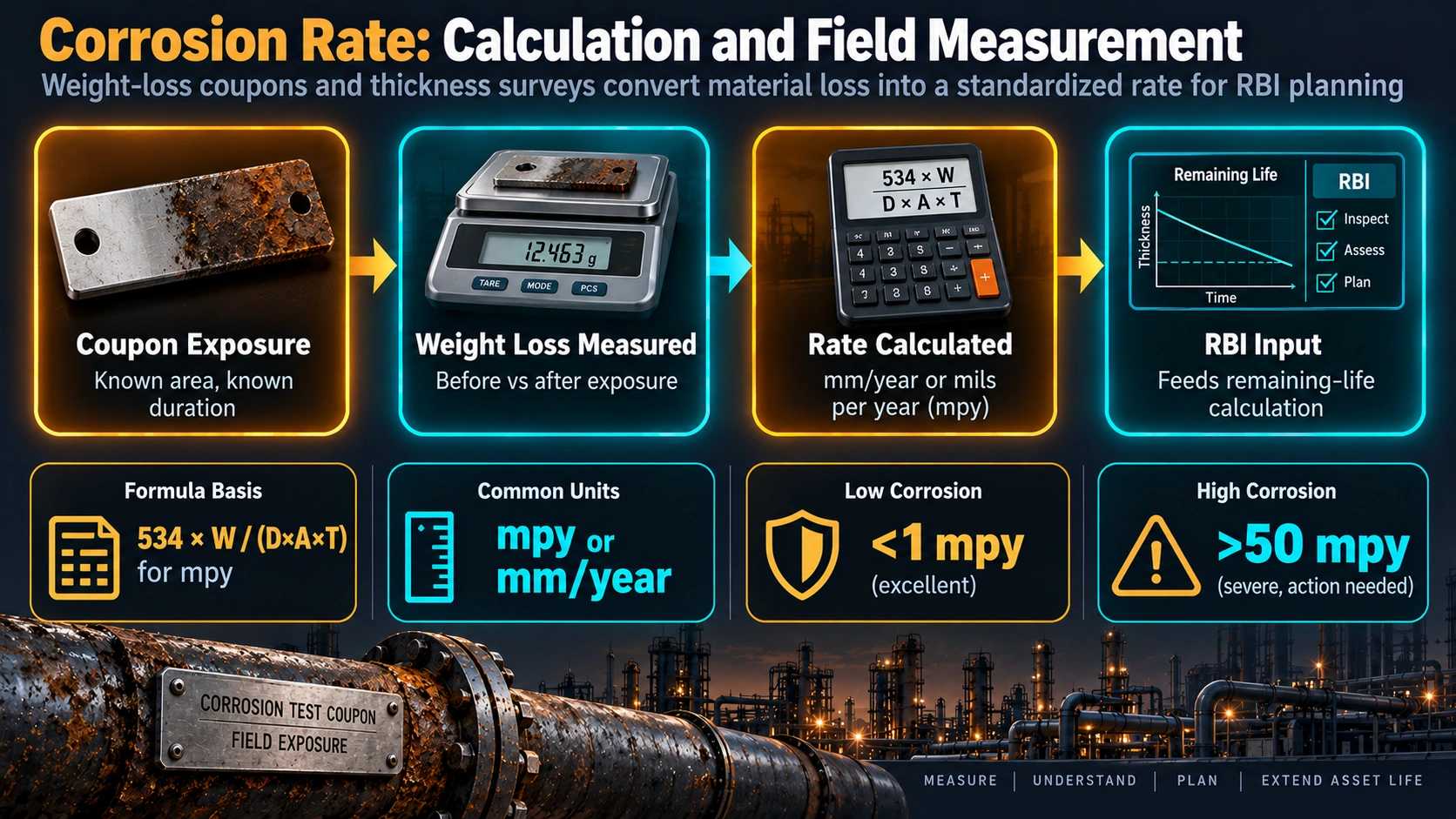
API 570 — Short/Long-Term Corrosion Rate • Remaining Life • Next Inspection Date
Short-Term and Long-Term Corrosion Rates
API 570 Section 7.1.2 defines two corrosion rates that must be calculated from the inspection history and compared to determine which governs:
Short-Term Corrosion Rate (STCR)
The STCR is calculated from the two most recent thickness readings at the same measurement point. It reflects the current corrosion environment and is sensitive to recent changes in process conditions, corrosion inhibitor performance, or fluid composition changes.
Where: t_prev = wall thickness at previous inspection (mm)
t_curr = wall thickness at current inspection (mm)
Δt_years = elapsed time between inspections (years)
Long-Term Corrosion Rate (LTCR): LTCR = (t_initial − t_curr) / t_total_service_years
Where: t_initial = nominal wall thickness at commissioning (or measured at first inspection)
t_total = years from first reading / commissioning to current inspection
Governing Rate per API 570: CR_governing = max(STCR, LTCR) Use the GREATER of short-term and long-term rates for all remaining life calculations Unit conversion: 1 mpy (mil per year) = 0.0254 mm/yr
Retirement Thickness — t_ret Calculation
The retirement thickness (also called minimum required thickness or t_min) is the wall thickness at which a piping component can no longer safely contain the design pressure. Below this thickness, the component must be repaired, replaced, or the system downrated. It is derived from the pressure design formula of the applicable design code.
Where: P = design gauge pressure (MPa)
D = pipe outside diameter (mm)
S = basic allowable stress from App A (MPa) — material and temperature dependent
E = quality factor (1.0 seamless; 0.85 ERW+RT; 0.72 ERW spot)
W = weld joint strength reduction factor (1.0 for ambient temperature)
Y = wall thickness coefficient (0.4 for carbon steel below 480°C)
ASME VIII UG-27 Retirement Thickness (cylindrical pressure vessel shell): t_ret = (P × R) / (S × E − 0.6 × P) Where R = inside radius (mm); compute from pipe wall thickness calculator on WeldFabWorld
Remaining Life Formula
Result in years. CR_governing must be in consistent units with thickness (mm/yr or mpy)
Special cases: If CR = 0.0: RL = ∞ (no measurable corrosion — inspect to maximum class interval) If t_curr ≤ t_ret: RL ≤ 0 → IMMEDIATE ACTION required
Corrosion Allowance Consumed and Remaining: CA_total = t_nom − t_ret (total design corrosion allowance) CA_consumed = t_nom − t_curr (metal lost to date) CA_remaining = t_curr − t_ret = RL × CR (remaining before retirement) CA_consumed_pct = CA_consumed / CA_total × 100
API 570 Half-Life Rule for Inspection Intervals
The half-life rule is the core inspection interval principle in API 570. It ensures that at every inspection, the component still has at least half its remaining life ahead, providing a safety margin against unexpected rate increases between inspections.
Governing Interval (lesser of half-life and class maximum): Interval = min(RL/2, Max_interval_for_class)
Class 1: max 5 years | Class 2: max 10 years | Class 3: max 15 years
Next Inspection Due Date: Year_next = Year_current_insp + Interval
Verification (remaining life at next inspection assuming constant CR): t_at_next_insp = t_curr − CR × Interval RL_at_next_insp = (t_at_next_insp − t_ret) / CR = RL − Interval = RL/2 At the next inspection, RL_remaining ≥ RL/2 (the half-life margin is preserved)
API 570 Piping Circuit Classification
| Class | Fluid / Service Examples | Max UT Interval | Consequence Level |
|---|---|---|---|
| Class 1 | Flammable at >auto-ignition; toxic (TLV <10 ppm); H₂S/HF service; HTHA-susceptible hydrogen; steam >750°F (400°C) or >1025 psig (7.1 MPa) | 5 years max | High — potential fatality or major environmental impact |
| Class 2 | Most process plant piping: hydrocarbons at moderate conditions, most refinery and petrochemical streams, non-lethal toxic service | 10 years max | Moderate — potential injury or significant property damage |
| Class 3 | Non-flammable, non-toxic fluids; cooling water; low-pressure steam; Category D fluid service (B31.3) | 15 years max | Low — minor injury risk, limited property impact |
Alert Status — Traffic Light System
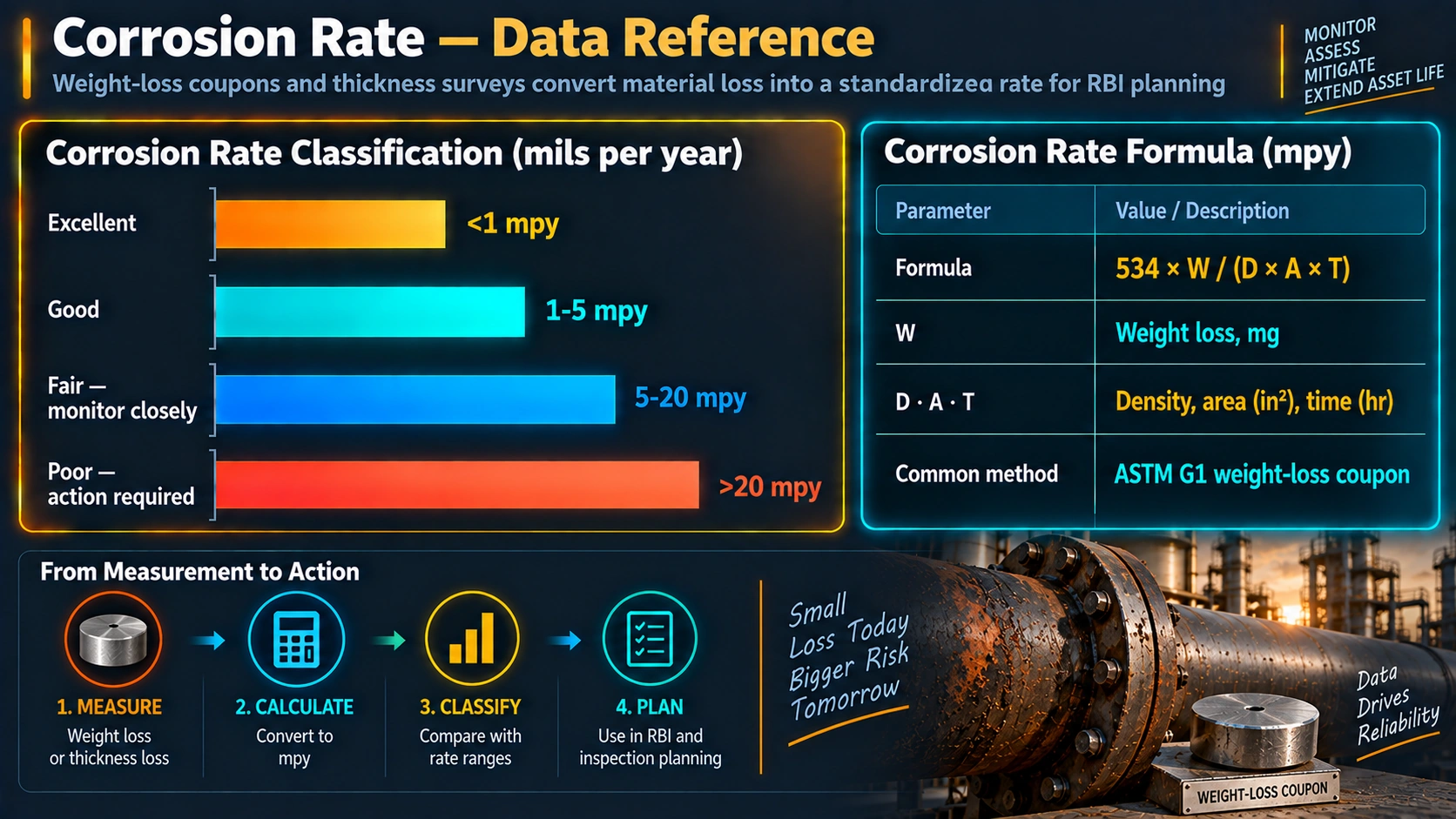
Beyond the formal API 570 remaining life calculation, inspection engineers use a traffic light alert system to communicate the urgency of the situation to plant management and operators:
| Status | Condition | Required Action |
|---|---|---|
| GREEN | t_curr > t_ret + 2 × CR × class_max_interval (adequate corrosion allowance for full class interval) | Schedule inspection per half-life rule. No immediate action. |
| AMBER — Alert | t_curr between t_ret + (0 to 2 years of CR) — within 2 years of retirement thickness | Increase inspection frequency. Engineering review of corrosion cause. Consider downrate or repair. |
| RED — Action Required | t_curr ≤ t_ret — at or below retirement thickness | Immediate removal from service, downrating, or repair. Engineering disposition required before returning to service. |
MAWP Reduction Due to Corrosion
As a pipe or vessel wall corrodes, its pressure-containing capacity decreases. The current MAWP can be re-rated using the corroded wall thickness in the design code formula:
Simplified ratio (approximate — for trend assessment): MAWP_curr / MAWP_original ≈ t_curr / t_nom This approximation is within 5% for most practical cases where t << D
Worked Example — Step by Step
Step 2 — Long-Term Corrosion Rate: LTCR = (t_nom − t_curr) / (year_curr − year_service) LTCR = (10.97 − 9.55) / (2024 − 2012) = 1.42 / 12 = 0.118 mm/yr
Step 3 — Governing Rate: CR = max(STCR, LTCR) = max(0.108, 0.118) = 0.118 mm/yr (LTCR governs)
Step 4 — Retirement Thickness (ASME B31.3): t_ret = (P × D) / (2 × (S × E × W + P × Y)) t_ret = (3.5 × 168.3) / (2 × (138 × 1.0 × 1.0 + 3.5 × 0.4)) t_ret = 589.05 / (2 × 139.4) = 589.05 / 278.8 = 2.11 mm
Step 5 — Remaining Life: RL = (t_curr − t_ret) / CR = (9.55 − 2.11) / 0.118 RL = 7.44 / 0.118 = 63.1 years
Step 6 — Next Inspection Interval (Class 2, max 10 yr): Interval = min(RL/2, 10) = min(63.1/2, 10) = min(31.5, 10) = 10 years Half-life (31.5 yr) > class max (10 yr) → class maximum governs
Step 7 — Next Inspection Due Year: Year_next = 2024 + 10 = 2034
Step 8 — Corrosion Allowance Assessment: CA_total = t_nom − t_ret = 10.97 − 2.11 = 8.86 mm CA_consumed = 10.97 − 9.55 = 1.42 mm (16% of total CA consumed) CA_remaining = 9.55 − 2.11 = 7.44 mm (84% of total CA remaining) Status: GREEN — ample remaining life, class maximum governs interval
Practical Notes for Inspection Engineers
UT Reading Location and Repeatability
Corrosion rate calculations are only valid when successive thickness readings are taken at exactly the same physical location on the pipe or vessel. All fixed inspection points must be permanently marked with a centre punch, paint marker, or stencil, and their coordinates recorded in the inspection database (e.g., the distance from a weld seam or fitting, with a clock-position reference for pipe circumference). A reading taken 20 mm from the marked location may measure a completely different corrosion depth and produce a meaningless calculated rate. The repeatability of the measurement position is more important than the absolute accuracy of the UT instrument for corrosion rate trending.
Corrosion Under Insulation (CUI)
CUI is one of the leading causes of unexpected low thickness readings in process plants, particularly for carbon steel pipe operating between 50°C and 175°C where water accumulates under wet insulation. Because CUI can be localised and patchy, UT readings at the standard fixed inspection points may not detect significant thinning nearby. Supplementary inspection techniques — pulsed eddy current (PEC) screening, profile RT, or partial insulation removal at inspection windows — are used to survey larger areas for CUI. A sudden step-change in UT reading at a fixed inspection point often indicates CUI onset rather than a change in process corrosion rate, and should be investigated before attributing the rate increase to process chemistry.
Common Corrosion Rates by Service Environment
The table below provides typical corrosion rate ranges for common process plant environments as a sanity check when evaluating UT data. If a measured rate falls far outside the typical range for the service, the reading quality and inspection point location should be verified before using it for remaining life calculations.
| Service Environment | Material | Typical CR (mm/yr) | Key Driver |
|---|---|---|---|
| Crude oil — atmospheric | Carbon steel | 0.05–0.15 | Naphthenic acid, water cut |
| Crude oil — high TAN (>0.5) | Carbon steel | 0.3–1.5 | Naphthenic acid corrosion |
| Produced water / brine | Carbon steel | 0.2–2.0 | CO₂, H₂S, chlorides, O₂ |
| Amine (MEA/DEA) service | Carbon steel | 0.1–0.5 | Acid gas loading, velocity |
| Dilute sulfuric acid | Carbon steel | 1.0–5.0+ | Concentration, temperature |
| Cooling water (treated) | Carbon steel | 0.025–0.1 | Biofouling, O₂, inhibitor |
| Steam / condensate | Carbon steel | 0.02–0.08 | CO₂ pick-up, pH |
| Chloride-bearing process | Austenitic SS 316L | <0.02 (pitting risk) | Cl⁻ concentration, temperature |
| Seawater (uncoated) | Carbon steel | 0.1–0.3 | O₂, biofouling, velocity |
Risk-Based Inspection (RBI)
API 570 also permits inspection intervals derived from a risk-based inspection (RBI) assessment per API 580/581. In an RBI approach, the inspection interval is set based on the probability of failure (derived from the corrosion rate and damage mechanism analysis) multiplied by the consequence of failure (derived from fluid toxicity, flammability, inventory, and plant layout). RBI can justify shorter or longer inspection intervals than the half-life rule depending on the risk profile, and is widely used on large oil and gas plants to optimise inspection resources. The corrosion rate calculator on this page provides the UT-data input to the probability side of the RBI risk matrix.
Connection to Pressure Design
The retirement thickness calculated here feeds directly into the pipe wall thickness calculator (ASME B31.3) and the pressure vessel shell thickness calculator (ASME VIII UG-27). Those calculators determine the minimum required thickness for pressure design; the value produced there is the t_ret used in the remaining life formula. For sour service piping where the wall must also satisfy NACE MR0175 hardness limits, the retirement criterion may also include a hardness-based assessment of the residual material at the corroded thickness.
Frequently Asked Questions
How is corrosion rate calculated from UT thickness readings?
What is retirement thickness and how is it determined?
What is the API 570 half-life rule for inspection intervals?
What are the API 570 piping inspection class maximum intervals?
What is the difference between short-term and long-term corrosion rates?
When is immediate action required on a corroded pipe or vessel?
How does corrosion rate affect the MAWP of a pressure vessel or pipe?
What is corrosion allowance and how is it related to retirement thickness?
What UT inspection methods are used to measure pipe and vessel wall thickness?
Recommended Reference Books
Disclosure: WeldFabWorld participates in the Amazon Associates programme (StoreID: neha0fe8-21). If you purchase through these links, we may earn a small commission at no extra cost to you. This helps support free technical content on this site.