This flange bolt circle calculator computes the chord pitch (straight-line distance between adjacent hole centres), the X/Y Cartesian coordinates of every hole for direct CNC entry, and a live bolt circle diagram for any combination of bolt circle diameter (BCD), hole count, and start angle. A second tab handles custom and unequal hole spacing where angles are specified individually. ASME B16.5 Class 150 and Class 300 flange presets are built in. The calculator also runs edge-distance and ligament geometry checks on user-specified flange outer diameter.
Accurate bolt hole layout is fundamental to flange fabrication. A mislocated bolt hole — even by 1 mm — can prevent bolting up, create an unequal load distribution across the gasket, or require scrapping an expensive forging or plate blank. The chord pitch formula is exact for equal spacing; the X/Y coordinates are the unambiguous, measurable reference for every hole in both equal and custom-spaced configurations.
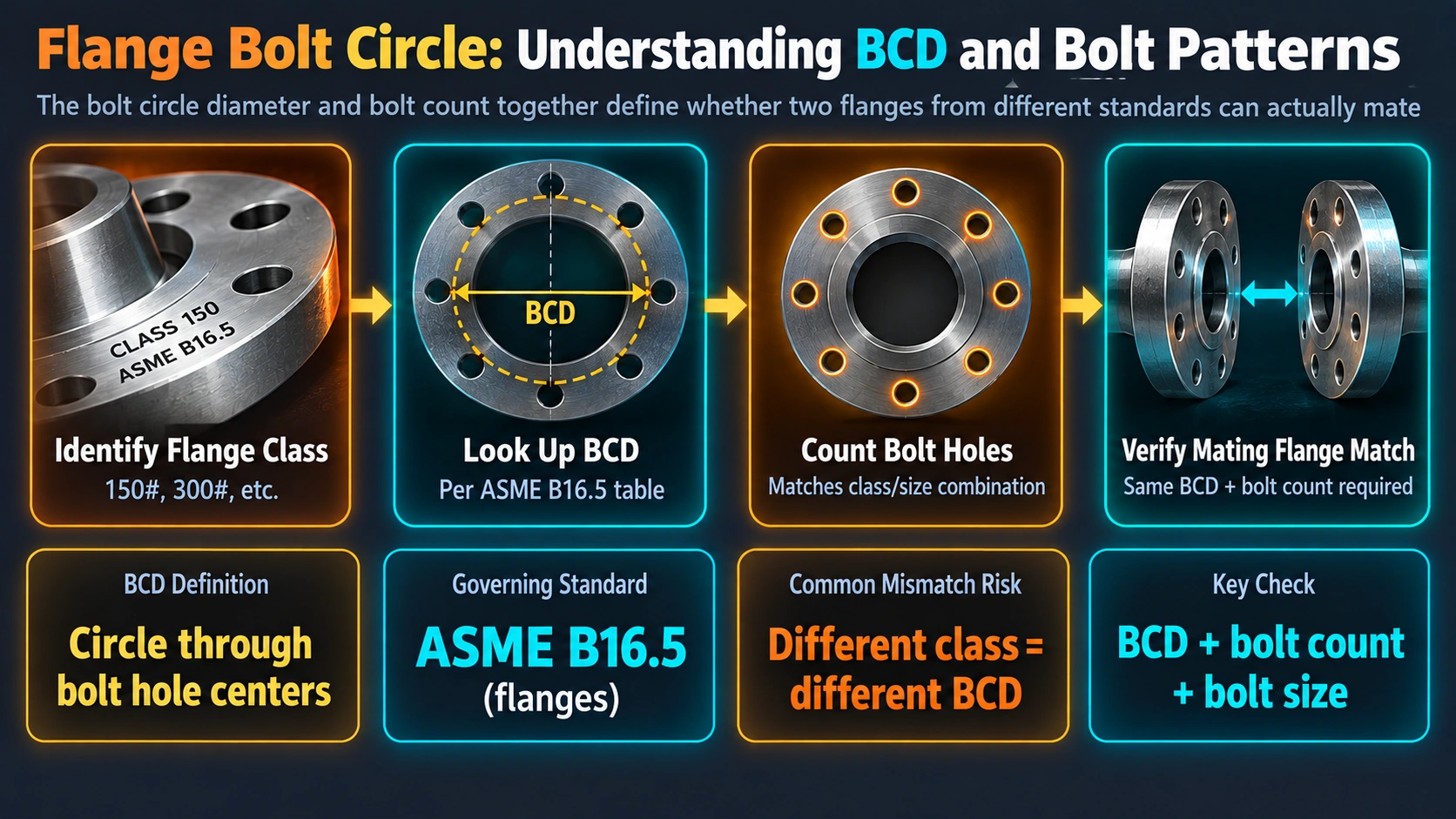
BCD vs PCD: Bolt Circle Diameter (BCD) and Pitch Circle Diameter (PCD) are the same dimension — the diameter of the circle through all hole centres. ASME B16.5 uses the term “bolt circle”; EN 1092-1 uses “bolt hole circle”. All formulas on this page apply regardless of which term your drawing uses.
45° = straddle vertical (standard for even hole counts)
For edge distance check
Bolt Circle Parameters
Optional — for ligament check
Enter the absolute angle of each hole from 0° (3 o’clock position, CCW positive). Example 4-hole straddle: 45, 135, 225, 315
Results
Live Bolt Circle Diagram
Geometry Checks
Hole Coordinates & Chord Distances
Hole
Angle (°)
X (mm)
Y (mm)
Chord to Next (mm)
Formula Workings
Chord Pitch Formula — Derivation from Circle Geometry
The chord between two adjacent holes on a bolt circle is the base of an isosceles triangle whose two equal sides are both radii of the bolt circle (R = BCD/2). The angle at the apex is the angular pitch θ = 360°/n. The chord length formula follows directly from the law of sines applied to this triangle.
Chord Pitch (adjacent hole centre-to-centre distance):Chord = BCD × sin(π/n) = BCD × sin(180°/n) Equivalent derivation: Chord = 2 × (BCD/2) × sin(θ/2) = 2R × sin(θ/2) where θ = 360°/n is the angular pitch between adjacent holes
X/Y Cartesian Coordinates for CNC and Height Gauge Marking
The chord pitch alone is sufficient for compass-and-divider marking, but modern fabrication shops use CNC drilling machines or DRO (digital read-out) mills that require absolute X/Y coordinates for each hole centre relative to the flange centre. The start angle φ₀ positions the first hole; every subsequent hole is offset by θ = 360°/n.
X/Y Coordinates for Hole i (0-indexed, i = 0 to n−1):X_i = (BCD/2) × cos(φ₀ + i × 360°/n)Y_i = (BCD/2) × sin(φ₀ + i × 360°/n) φ₀ = start angle of first hole (degrees) Standard straddle start angle: φ₀ = 45° for 4-hole, 22.5° for 8-hole Convention: 0° = 3 o’clock (positive X axis), angles increase counter-clockwise
Distance verification (all holes should equal BCD/2):√(X_i² + Y_i²) = BCD/2 for all i — use as a self-check
Coordinate System Convention: This calculator uses the mathematical convention — 0° is at the 3 o’clock position (positive X axis) and angles increase counter-clockwise. Some CNC machines use clockwise-positive angles; if your machine uses that convention, negate the Y values (Y_machine = −Y_calc) or enter angles as negative. The chord distances are independent of the angle convention.
Straddling the Centreline — ASME B16.5 Rule
ASME B16.5 and virtually all piping flange standards require bolt holes to straddle the centreline of the pipe. This means no bolt hole is positioned directly on the vertical (12 o’clock/6 o’clock) or horizontal (3 o’clock/9 o’clock) centrelines of the flange. Instead, the symmetry axis of the hole pattern passes between two holes.
Holes (n)
Angular Pitch (θ)
Straddle Start Angle (φ₀)
Hole Positions
First Hole from Vertical
4
90.0°
45°
45°, 135°, 225°, 315°
45°
8
45.0°
22.5°
22.5°, 67.5°, 112.5° …
22.5°
12
30.0°
15°
15°, 45°, 75°, 105° …
15°
16
22.5°
11.25°
11.25°, 33.75°, 56.25° …
11.25°
20
18.0°
9°
9°, 27°, 45°, 63° …
9°
Why Straddle? Straddling ensures the flange can be bolted in any of four orientations (rotated 90° at a time) without a bolt hole conflicting with a pipe hanger, support lug, or instrumentation tapping. It also ensures that the bolt load is distributed symmetrically about the pipe centreline in both the vertical and horizontal planes, preventing unequal gasket compression. All ASME B16.5, EN 1092, DIN, and JIS flange standards specify the straddle requirement explicitly.
Figure 1 — The straddling rule for 8-hole flange bolt circles. Left: incorrect alignment with start angle 0° — holes fall directly on the vertical and horizontal centrelines (red). Right: correct ASME B16.5 straddling alignment with start angle 22.5° (½ of the angular pitch 45°) — all holes are symmetrically positioned between the centrelines. The straddle angle is always half the angular pitch: θ/2 = 180°/n.
ASME B16.5 Class 150 and Class 300 Reference Data
NPS
Class
Flange OD (mm)
BCD (mm)
Holes (n)
Hole ∅ (mm)
Chord Pitch (mm)
Straddle Start
1″
150
108.0
79.4
4
15.9
56.1
45°
2″
150
152.4
120.7
4
19.1
85.4
45°
3″
150
190.5
152.4
4
19.1
107.8
45°
4″
150
228.6
190.5
8
19.1
72.9
22.5°
6″
150
279.4
241.3
8
22.4
92.4
22.5°
8″
150
342.9
298.5
8
22.4
114.2
22.5°
10″
150
406.4
362.0
12
25.4
93.7
15°
12″
150
482.6
431.8
12
25.4
111.8
15°
16″
150
596.9
539.8
16
28.6
105.3
11.25°
20″
150
711.2
635.0
20
28.6
99.3
9°
4″
300
254.0
212.7
8
22.4
81.4
22.5°
6″
300
317.5
269.9
12
22.4
69.9
15°
8″
300
381.0
330.2
12
25.4
85.5
15°
10″
300
444.5
387.4
16
28.6
75.5
11.25°
12″
300
520.7
450.9
16
31.8
87.9
11.25°
Edge Distance and Ligament Geometry Checks
Two geometry checks are required for any bolt hole layout, whether standard or custom. They confirm that the holes are not too close to the flange outer edge (edge distance) and that sufficient material remains between adjacent holes (ligament).
Edge Distance Check (hole edge to flange OD edge):e = (OD_flange − BCD) / 2 − d/2Minimum acceptable: e ≥ 1.5 × d (typical workshop rule)ASME B16.5 standard flanges are designed to satisfy this automatically.For custom flanges: OD_flange ≥ BCD + 5 × d to ensure adequate edge distance.
Ligament Check (material between adjacent holes):Ligament = Chord − dMinimum acceptable: Ligament ≥ d (i.e., Chord ≥ 2 × d)For pressure-retaining flanges, larger ligaments are preferred (Chord ≥ 3 × d recommended).
Practical Marking Methods in the Fabrication Shop
Method 1 — Compass and Divider (Traditional)
Scribe the bolt circle on the flange blank with a compass set to BCD/2 from the scribed centre. Set a divider or trammel to the chord distance from this calculator. Mark the first hole position on the circle at the correct start angle. Step the divider around the circle, pricking each subsequent hole centre. Check: after n steps, the last point should land exactly on the first point. If there is a gap or overlap, the divider setting or the scribed circle is inaccurate — adjust and re-mark.
Method 2 — Height Gauge on Surface Plate (Inspection-Grade)
Mount the flange blank on a precision surface plate, locate and mark the flange centre, then use a Vernier height gauge to scribe lines at Y_i distances above and below centre for each hole. Rotate the flange 90° on a V-block or angle plate to scribe the X_i lines. The intersection of the X_i and Y_i lines gives each hole centre. This method achieves ±0.05 mm accuracy and is used for critical equipment flanges.
Method 3 — CNC Drilling Machine / DRO Mill
Enter the X_i, Y_i coordinates directly into the machine controller or DRO. Zero the machine at the flange centre (use a dial test indicator in the bore). Input each coordinate pair and drill. This is the fastest and most accurate method and produces coordinates directly usable in Fanuc, Siemens, or Heidenhain G-code by using G81 canned drilling cycles at each (X_i, Y_i) position.
Inspection Before Drilling: Always verify the marked hole positions before drilling by measuring the chord between adjacent marks with a caliper or digital vernier. Any deviation greater than ±0.5 mm from the calculated chord on process or pressure flanges should be corrected before drilling. A mis-drilled hole cannot be relocated; the only remedies are sleeving (inserting a bushing and re-drilling), which is restricted by most codes, or scrapping the blank. Checking takes two minutes; scrapping a forged flange blank is an expensive error.
Figure 2 — Three practical methods for bolt hole marking in the fabrication shop. Left: compass and divider — scribe the bolt circle, set the divider to the chord distance, and step around. Centre: Vernier height gauge on a surface plate — scribe X and Y coordinate lines; intersections give exact hole centres. Right: CNC/DRO entry — enter the X/Y coordinate table directly into the machine controller, zeroed at the flange centre.
Verification — Self-Check Formula (all holes must lie on BCD):√(X_i² + Y_i²) = BCD/2 for every hole iUse this as a rapid check: measure from flange centre to each hole centre with a caliper.All readings must equal BCD/2 ± 0.5 mm for process flanges; ± 0.1 mm for precision flanges.
Cross-Check — Diagonally Opposite Holes (even n only):Distance between opposite holes = BCDHoles i and i+n/2 are diametrically opposite; their centre-to-centre distance = BCD exactly.This is easy to measure with a caliper spanning the bore — a fast workshop verification.
Custom and Unequal Bolt Circle Spacing
Some equipment nozzles, special-purpose flanged joints, or adapter plates between different flange standards require unequal angular spacing between bolt holes. Common reasons include avoiding interference with a vessel support lug or clip, accommodating an asymmetric instrument connection, or matching an existing non-standard flange. The custom spacing tab accepts a list of absolute hole angles and returns the X/Y coordinates and individual chord distances for each pair.
Custom Spacing Validation: After entering custom angles, check two things. First, that no two consecutive holes are separated by less than the minimum ligament angle — if the angular spacing is too small, the chord will be less than 2 × hole diameter. Second, that the angles cover the full 360° without any gap larger than approximately twice the normal equal-spacing pitch — a large angular gap creates unequal bolt load distribution around the gasket.
Flange Standards — B16.5, EN 1092, DIN 2501, JIS
The bolt circle geometry formula is universal, but the specific BCD and hole dimensions differ between standards. The table below shows the pressure class equivalency that is most commonly used for selecting the correct BCD to enter in this calculator.
Standard
Scope
Pressure Classes
Straddle Rule
BCD Source
ASME B16.5
NPS ½″ to 24″, steel flanges
150, 300, 600, 900, 1500, 2500
Required
Table in each pressure class, per NPS
EN 1092-1
Steel flanges, European
PN 6, 10, 16, 25, 40, 63, 100, 160, 250, 320, 400
Required
Annex tables per DN and PN
DIN 2501
Steel pipe flanges (now superseded by EN 1092)
PN 6 to PN 100
Required
DIN tables (largely identical to EN 1092)
JIS B2220
Japanese flanges
5K, 10K, 16K, 20K, 30K, 40K, 63K
Required
JIS tables per nominal diameter and K-class
BS 4504
British (largely superseded by EN 1092)
PN 6 to PN 40
Required
Metric dimensions, same concept
Flange Material and Welding: Weld neck flanges are welded to pipe using a full-penetration butt weld at the flange hub. The welding procedure for the flange-to-pipe joint must be qualified per ASME Section IX for the material group combination. For P91 chrome-moly flanges, see the P91 material requirements for preheat, interpass temperature, and PWHT. For duplex stainless flanges, check the duplex stainless steel fabrication guide. Stainless flanges in chloride service should be assessed for pitting resistance using the PREN number.
Frequently Asked Questions
What is bolt circle diameter (BCD) and how is hole pitch calculated?
The bolt circle diameter (BCD) is the diameter of the circle passing through all hole centres. The chord pitch (centre-to-centre distance between adjacent holes) is: Chord = BCD × sin(180°/n), where n is the number of equally spaced holes. For 8 holes on a 298.5 mm BCD: Chord = 298.5 × sin(22.5°) = 298.5 × 0.3827 = 114.2 mm. This is the straight-line distance, not the arc length along the bolt circle.
How do you calculate X/Y coordinates for bolt hole marking?
Hole i coordinates: X_i = (BCD/2) × cos(φ₀ + i × 360°/n) and Y_i = (BCD/2) × sin(φ₀ + i × 360°/n). φ₀ is the start angle of the first hole. For the straddle position: φ₀ = 180°/n (half the angular pitch). Convention: 0° is at 3 o’clock, angles increase counter-clockwise. These coordinates are entered directly into a CNC DRO zeroed at the flange centre, or used with a Vernier height gauge on a surface plate.
What does straddling the centreline mean for flange bolt holes?
Straddling means no bolt hole is on the vertical or horizontal centreline of the flange. Holes are symmetrically placed on both sides of each centreline. For 4 holes: positions are 45°, 135°, 225°, 315°. For 8 holes: 22.5°, 67.5°, 112.5°, 157.5°, and so on. The straddle start angle always equals half the angular pitch (180°/n). ASME B16.5, EN 1092, and all major flange standards require this arrangement for symmetry of bolt loading and to allow four orientations of flange assembly.
What are the ASME B16.5 Class 150 bolt circle diameters and hole counts?
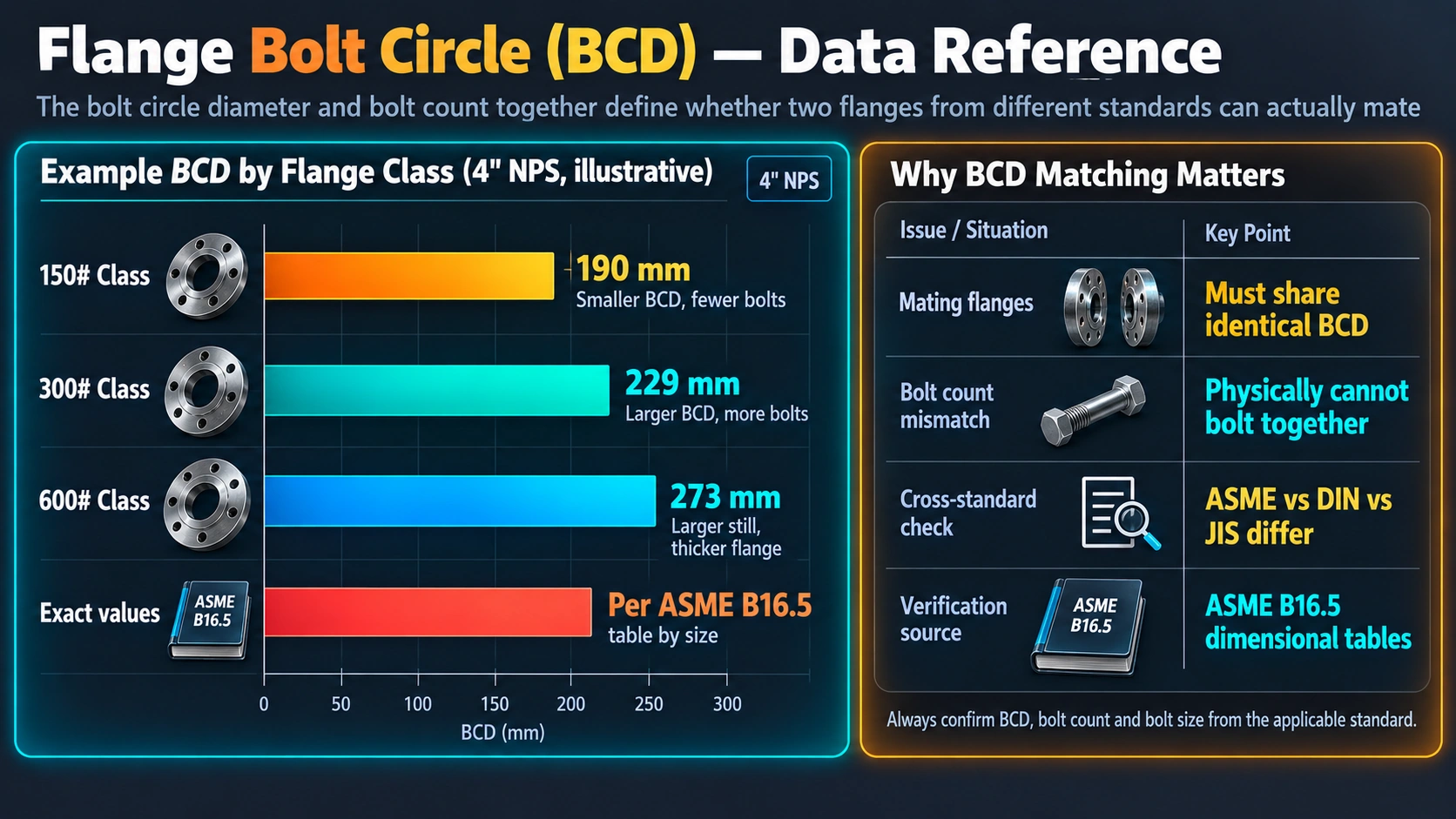
ASME B16.5 Class 150 BCDs: NPS 1 — 79.4 mm, 4 holes; NPS 2 — 120.7 mm, 4 holes; NPS 3 — 152.4 mm, 4 holes; NPS 4 — 190.5 mm, 8 holes; NPS 6 — 241.3 mm, 8 holes; NPS 8 — 298.5 mm, 8 holes; NPS 10 — 362.0 mm, 12 holes; NPS 12 — 431.8 mm, 12 holes; NPS 16 — 539.8 mm, 16 holes; NPS 20 — 635.0 mm, 20 holes; NPS 24 — 749.3 mm, 20 holes. All these values are available as presets in the calculator above.
What is the edge distance and ligament check for flange bolt holes?
Edge distance: e = (Flange OD − BCD)/2 − d/2, where d is hole diameter. Minimum: e ≥ 1.5 × d. This ensures the hole does not break out through the flange edge. Ligament: Chord − d. Minimum: Ligament ≥ d (chord ≥ 2d). For pressure-retaining flanges, Chord ≥ 3d is recommended. Standard ASME B16.5 flanges satisfy both checks automatically; these checks are most critical for custom or non-standard flange designs.
What is the difference between BCD and PCD for flanges?
BCD (bolt circle diameter) and PCD (pitch circle diameter) are identical — both describe the diameter of the circle through all hole centres. BCD is standard in piping and vessel work (ASME, EN 1092); PCD is more common in mechanical engineering. The formula and all calculations are the same regardless of which term the drawing uses.
How do you mark bolt holes on a flange without a CNC machine?
Three practical methods: (1) Compass and divider — scribe the bolt circle with a compass; set divider to chord distance; step around pricking each hole centre. (2) Height gauge on surface plate — scribe Y_i lines with height gauge; rotate 90°; scribe X_i lines; intersections are hole centres; achieves ±0.05 mm. (3) Template — print coordinates at 1:1 scale; align centre to flange; centre-punch through paper at each point. Always verify the chord between marked holes with a caliper before drilling.
Can the same bolt circle calculator be used for EN 1092 and DIN flanges?
Yes. The chord and coordinate formulas are purely geometric and apply to any standard (ASME B16.5, EN 1092-1, DIN 2501, JIS B2220) or custom design. Simply enter the BCD and hole count from the applicable standard’s dimension table. EN 1092 uses DN (nominal diameter) and PN (nominal pressure) to look up the BCD; JIS uses nominal diameter and K-class. The calculator returns correct results for any standard once the BCD, n, and d are entered.
How is the bolt hole chord distance used in fabrication practice?
The chord is used three ways: (1) setting a divider or trammel to step around the bolt circle for manual marking; (2) inspecting a drilled or machined flange by measuring between adjacent hole centres with a caliper — deviation > ±0.5 mm is rejectable on process flanges; (3) verifying a received flange against the drawing dimension before welding it onto a nozzle neck. It is the simplest measurable verification of equal hole spacing without needing to compute or measure angles directly.
What NPS flanges use 4 bolt holes versus 8 or more?
ASME B16.5 Class 150: NPS 1″ to NPS 3″ use 4 holes; NPS 4″ and NPS 6″ use 8 holes; NPS 10″ and NPS 12″ use 12 holes; NPS 16″ uses 16 holes; NPS 20″ and NPS 24″ use 20 holes. In higher pressure classes (Class 300, 600), the same NPS uses more holes to distribute greater bolt preload. Class 300 NPS 6″ has 12 holes vs 8 in Class 150. Class 600 NPS 12″ has 20 holes vs 12 in Class 150.
What is a non-standard or custom bolt circle and when is it used?
Custom bolt circles with unequal spacing occur for pressure vessel nozzles not on standard pipe sizes; heat exchanger channel flanges; adaptor plates between two different flange standards; instrumentation flanges; and any connection where a support lug or structural member prevents a standard hole position. The custom spacing tab accepts comma-separated angles and returns individual chord distances and X/Y coordinates for each, plus a ligament check between every adjacent pair.
Recommended Reference Books
📚
ASME B16.5 — Pipe Flanges and Flanged Fittings
The primary standard for bolt circle, hole count, and hole diameter for all NPS and pressure class combinations. Includes full dimensional tables for Class 150 through Class 2500.
Comprehensive piping engineering reference with full flange dimensional data, bolt sizing, gasket selection, and flange assembly procedures for all major standards worldwide.
PN 6 to PN 400 flange dimensional tables including bolt hole circle, number of bolts, and hole diameter for all DN sizes. Essential for European process plant projects.
Comprehensive machinist reference covering bolt circle geometry, chord calculations, DRO coordinate entry, and all standard flange and fastener data for shop fabrication.
Disclosure: WeldFabWorld participates in the Amazon Associates programme (StoreID: neha0fe8-21). If you purchase through these links, we may earn a small commission at no extra cost to you.