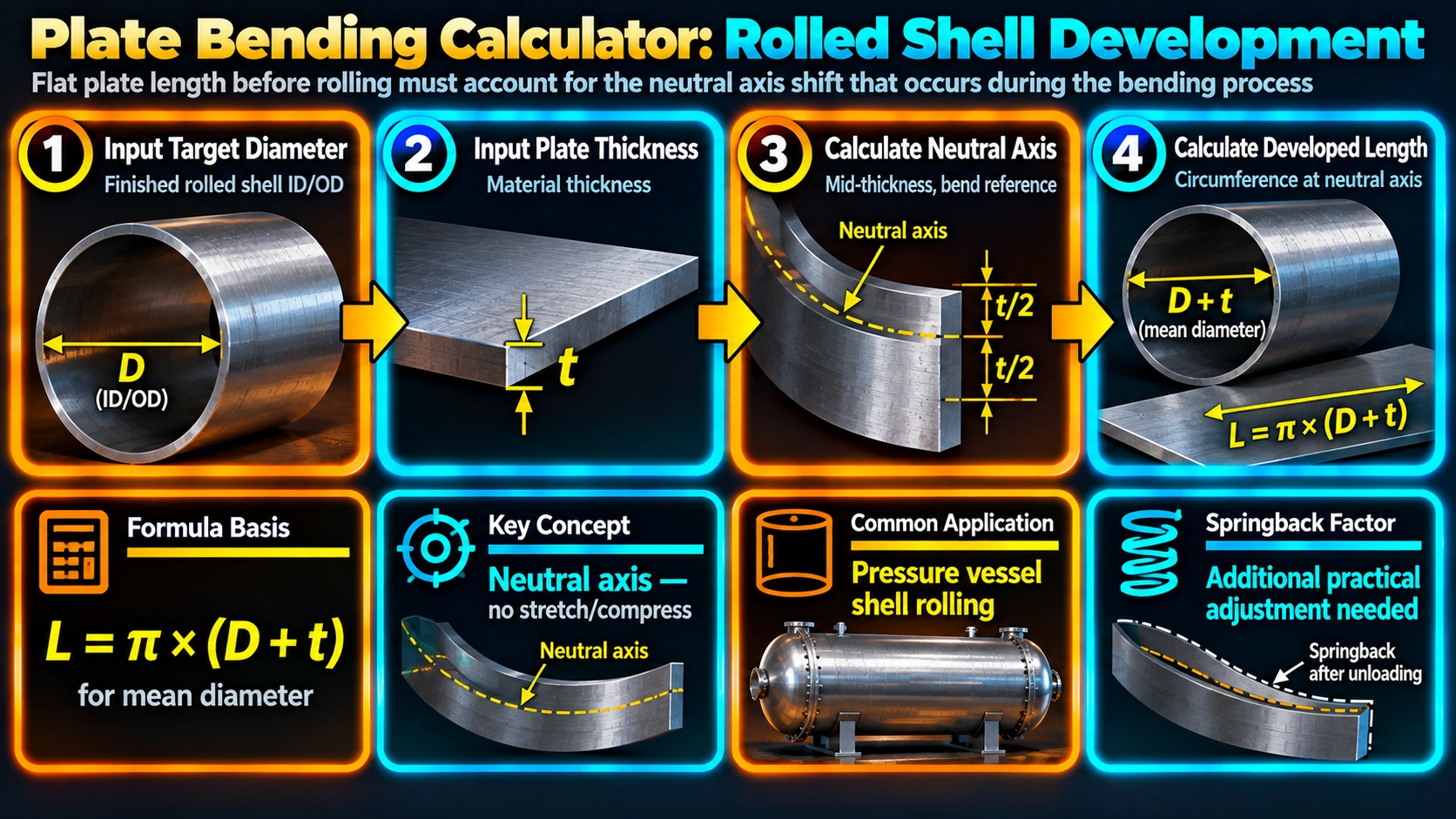
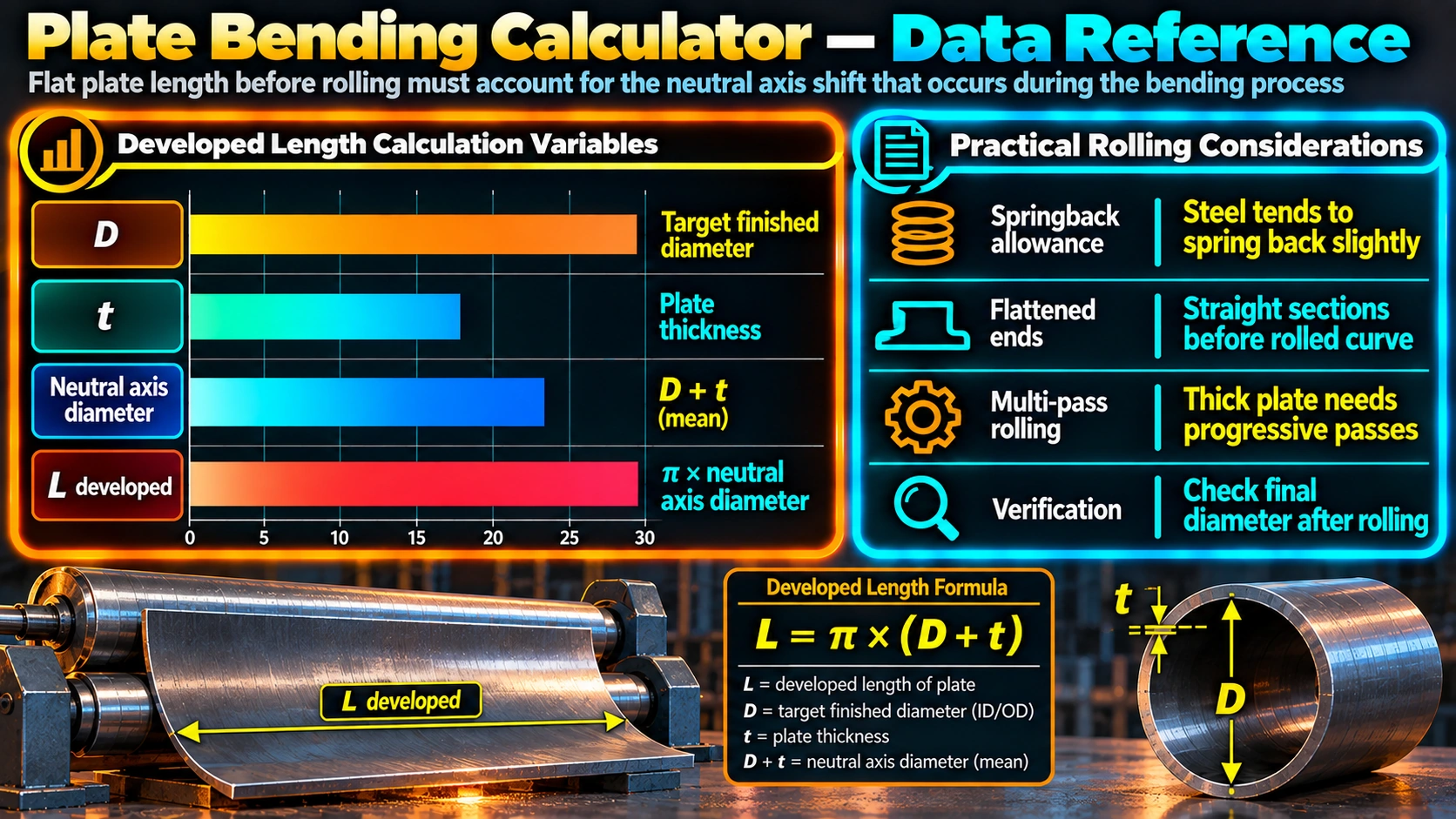
This sheet and plate bending calculator computes the essential parameters for press brake bending: bend allowance (material consumed in the bend), K-factor (neutral axis position, auto-selected from r/t ratio and material), bend deduction, and the developed flat blank length for parts with up to four bends. A second tab calculates the recommended minimum inside bend radius for the selected material, the springback angle to overbend by using the Sachs formula, and the required press brake force per metre of bend length for a given V-die size. All outputs include step-by-step workings and a visual blank length composition bar.
Getting the blank length wrong is one of the most costly errors in a fabrication shop — scrap or a dimensionally short part. Blank length depends on three interacting variables: inside radius, material thickness, and K-factor. Using a K-factor off by 0.05 produces a 0.5 mm blank error per bend on 10 mm plate. On a six-bend bracket that accumulates to 3 mm out of tolerance. This article explains the physics of each variable from first principles, gives complete reference tables for K-factor and minimum radius by material, and provides the production-ready calculator used by fabricators daily.
Scope: This calculator covers V-die air bending on a press brake — the standard method in structural and pressure vessel fabrication shops. The formulas are consistent with DIN 6935 (Forming of Cold-Rolled Steel) and common industry practice. They apply to thicknesses from 0.5 mm to 50 mm in carbon steel, stainless steel, aluminium, and other common structural metals. For roll bending of cylinder shells, use the dishend weight calculator; for pipe bending, different bend allowance conventions apply.
Sheet & Plate Bending Calculator
Bend Allowance • K-Factor • Blank Length • Springback • Min Radius • Press Force
Units:
Material & Thickness
K-Factor
Auto-calculated from r/t ratio of first bend
BENDS (1 to 4) — angle / inside radius / flat leg before / flat leg after
* Leg before Bend 1 = first flat portion; Leg after last bend = final flat portion
Material Properties
Bend Geometry & Tooling
Leave blank to calculate from V-die opening
Typical: 8×t for standard bending
Width of plate being bent (for force calculation)
Rolling Direction
Results
Blank composition (flat legs vs bend allowances):
Flat legsBend allowances
Step-by-Step Workings
Bend Allowance — Theory and Formula
When a flat sheet is bent, the material on the outside of the bend stretches in tension while the material on the inside compresses. Between these zones there exists a curved surface at which strain is zero — the neutral axis. The arc length along the neutral axis through the bend is the bend allowance (BA) — the length of flat material consumed in forming the bend. Total developed blank length equals the sum of all flat portions plus all bend allowances.
Bend Allowance (BA):BA = (π/180) × θ × (r_i + K × t) θ = bend angle (degrees) | r_i = inside bend radius (mm) K = K-factor (neutral axis position as fraction of thickness) t = material thickness (mm)
Neutral axis radius:r_neutral = r_i + K × tAt K = 0.5: r_neutral = r_i + t/2 (large-radius theoretical case)
K-Factor — Neutral Axis Position
The K-factor is the most influential variable in blank length calculation. It depends on the r/t ratio, the material ductility, and the bending method. The table below shows the values used in this calculator:
r/t Ratio
K-Factor
Physical Meaning
Typical Condition
< 1
0.33
Tight bend — inside surface compresses and flows
Coining, very tight radius r < t
= 1
0.38
Material flows, retains some elastic zone
Near-minimum radius bending
1 to 3
0.40
Standard air bending — most common
Typical structural fabrication
3 to 5
0.45
Large radius — less material flow
Gradual bends on heavy plate
> 5
0.50
Very large radius — neutral axis at mid-thickness
Gentle bends, near-elastic deformation
Material-Specific K-Factor Adjustments: Stainless steels (304/316) tend toward K = 0.40 to 0.45 because their high work-hardening rate shifts the neutral axis outward. Aluminium 6061-T6 in hard temper also trends higher. Duplex SS 2205 at K = 0.42 to 0.45. The material presets in this calculator apply these corrections automatically.
Bend Deduction (BD) — subtract from sum of outside dimensions:BD = 2 × OSSB − BA = 2×tan(θ/2)×(r_i+t) − (π/180)×θ×(r_i+K×t)
Blank length using each convention:Using BA: Blank = L1_flat + L2_flat + BAUsing BD: Blank = L1_outside + L2_outside − BDBoth give the same blank length. Choose the convention that matches your drawing.
Developed Blank Length — Single and Multiple Bends
General Developed Blank Length for n Bends:Blank = L1 + BA1 + L2 + BA2 + … + BAn + L(n+1)L values = flat segment lengths between tangent lines | BA values = individual bend allowances
U-Channel / Hat Section (2 equal 90° bends, symmetric):Blank = B (bottom) + 2 × (H − r_i − t) + 2 × BAH = flange height (outside), B = bottom width (outside), inside leg = H − r_i − t
Figure 1 — Bend allowance geometry for a 90-degree press brake bend. Left: the flat blank with bend zone (orange) consumed by bend allowance BA, and flat legs L1 and L2 measured to the tangent lines. Right: the bent part cross-section showing inside radius r_i, plate thickness t, and the neutral axis arc (green, at r_i + K×t). Total blank = L1 + BA + L2.
Minimum Inside Bend Radius by Material
Material
Grade / Condition
r_min (⊥ rolling)
r_min (∥ rolling)
Note
Mild carbon steel
A36 / S235 / S275
0.5×t
1.0×t
Most forgiving
Structural steel
S355 / A572 Gr50
1.0×t
1.5×t
Higher yield — more springback
High-strength steel
S460 / A514
2.0×t
3.0×t
Preheat may be required >25 mm
Austenitic SS
304L / 316L
1.0×t
1.5×t
Work-hardening; higher press capacity
Duplex SS
2205 / 2507
2.0×t
3.0×t
High strength; PT/MT after forming recommended
Aluminium
5052-H32
0.5×t
1.0×t
Ductile; low springback
Aluminium
6061-T6
3.0×t
4.0×t
Brittle temper — cracking risk
Titanium
Grade 2 (CP)
2.0×t
3.0×t
Warm bending reduces r_min
Cracking Risk: Bending tighter than the minimum radius risks microcracks on the outer tension face, detectable by liquid penetrant (PT) or magnetic particle (MT) testing after forming. For pressure vessel components or structural members, inspect formed parts by PT or MT if bending within 20% of the minimum radius. Cracked formed components must be rejected.
Figure 2 — Typical springback at a 90-degree bend by material. Mild steel and 5052 aluminium have low springback (green zone, 2 to 4 degrees) and are compensated by simple overbending. Stainless 304/316 (7 degrees) and duplex SS (10 degrees) require more careful compensation or bottoming. Aluminium 6061-T6 has the highest springback (12 degrees) and requires individual calibration cuts before production bending.
Material
Typical Springback at 90°
E (MPa)
Compensation Method
Mild steel A36/S235
2–3°
200,000
Overbend 2–3°
Structural steel S355
3–5°
200,000
Overbend or bottoming
Stainless 304/316
6–8°
193,000
Overbend; bottoming recommended
Duplex SS 2205
8–12°
200,000
Bottoming or multi-pass
Aluminium 5052-H32
3–4°
69,000
Overbend 3–4°
Aluminium 6061-T6
10–15°
69,000
Calibration cuts essential
Press Brake Force Calculation
V-Die Air Bending Force per metre of bend (kN/m):F = (1.33 × σ_uts × t²) / Wσ_uts in MPa | t in mm | W = V-die opening in mm | 1.33 = constant for 90° V-die air bending
Total force for bend length L (mm):F_total = F × L / 1000 (kN)
Press Capacity Rule: Add 20 to 30% safety margin above the calculated force. If the required force exceeds 80% of the press brake nominal tonnage, consider increasing the V-die opening (produces a larger inside radius, requires less force), splitting the bend into shorter segments, or using a higher-capacity machine. Never exceed the rated tonnage of the press.
Bending Methods — Air Bending, Bottoming, Coining
Method
Contact
Force (relative)
Springback
Accuracy
Best For
Air Bending
Punch tip + 2 die edges
1× (lowest)
High
±1–2°
Structural fabrication, flexible angles
Bottoming
Full die face contact
3–5×
Low
±0.5°
Production runs, precision parts
Coining
Material fully set
5–8×
Near-zero
±0.1°
High-precision sheet metal
Rolling Direction and Grain Orientation
Steel and aluminium plate has elongated grains in the rolling direction. Bending perpendicular to the rolling direction (across the grain) allows tighter minimum radii and reduces cracking risk. Bending parallel to the rolling direction risks outer-face cracking and requires a larger minimum radius by 50 to 100%.
Layout Rule: Mark the rolling direction on blanks at the cutting station. Orient all bends to cross this arrow (perpendicular orientation). When parallel bending is unavoidable, increase minimum inside radius by 50%, use K = 0.42 to 0.45 for blank calculation, and inspect the outer bend surface by PT or MT after forming.
Connection to Welding Fabrication: After press brake forming, bent plate has residual stresses and slightly increased hardness from cold work. For high-strength steels (S355 and above), bends tighter than 2t inside radius should be stress-relieved before welding. The carbon equivalent calculator preheat assessment applies to the combined thickness at the weld near a bend. See the welding joint types guide for fit-up gap tolerances on bent components, and the inspection checklist for pre-weld verification of formed parts.
Practical Notes for Fabricators
Trial Bends and First-Off Verification
Before cutting a production batch, make a trial bend on scrap from the same material specification, thickness, and rolling direction orientation. Measure the achieved angle immediately after bending. Calculate the actual springback and adjust the machine program before running production. Material batches vary in yield strength and ductility — a new plate heat may require re-calibration. Record trial bend parameters in the job card for traceability.
Blank Length Verification
After the first article is bent, measure the final outside dimensions and compare to the drawing. If short, the blank was cut short — check the K-factor and inside radius used. If long, the K-factor was too high — reduce by 0.02 and recalculate. A systematic 0.5 mm error per bend on 10 mm plate indicates a K-factor error of approximately 0.03 to 0.05.
Fit-Up After Bending
Bent components may have slight angular variation over the bend length due to plate flatness, die alignment, and back-gauge accuracy. Check straightness and twist with a straight edge before fitting up for welding. The fillet weld consumable calculator and V-groove consumable calculator can be used to estimate electrode consumption for the welds joining the bent components, once fit-up dimensions are confirmed.
Frequently Asked Questions
What is bend allowance and how is it calculated?
Bend allowance (BA) is the arc length along the neutral axis through the bend — the material consumed in forming. Formula: BA = (π/180) × θ × (r_i + K × t). For a 90° bend in 10 mm mild steel with 10 mm inside radius and K = 0.40: BA = (π/2) × 14 = 21.99 mm. Total blank = sum of all flat leg lengths + sum of all bend allowances.
What is the K-factor in press brake bending?
The K-factor (0 to 1) is the position of the neutral axis as a fraction of material thickness from the inside face. For standard air bending of mild steel with r/t between 1 and 3, K = 0.40. For tight bends (r/t < 1) use K = 0.33. For large-radius bends (r/t > 5) use K = 0.50. Stainless steels trend toward 0.40 to 0.45. An incorrect K-factor shifts the blank length systematically — 0.02 error in K produces approximately 0.28 mm blank error per 90° bend on 10 mm plate.
What is bend deduction and how does it differ from bend allowance?
Bend deduction (BD) is subtracted from the sum of outside dimensions: Blank = L1_outside + L2_outside − BD. Bend allowance adds to flat leg lengths: Blank = L1_flat + L2_flat + BA. Both give the same blank length. BD = 2 × OSSB − BA, where OSSB = tan(θ/2) × (r_inside + t). Use the convention that matches how the drawing dimensions the part — usually outside dimensions use BD, inside flat-leg dimensions use BA.
What is the minimum inside bend radius for steel and stainless steel?
Mild steel A36/S275: 0.5t perpendicular to rolling direction, 1.0t parallel. Structural S355: 1.0t perpendicular, 1.5t parallel. Austenitic stainless 304/316L: 1.0t to 1.5t. Duplex SS 2205: 2.0t minimum. Aluminium 5052-H32: 0.5t. Aluminium 6061-T6: 3.0t (brittle temper). Bending tighter than the minimum risks cracking on the outer tension face, detectable by PT or MT inspection after forming.
What is springback in press brake bending and how is it compensated?
Springback is elastic recovery after the punch retracts, opening the bend angle. Compensation: overbend beyond the target angle by the springback amount. Typical springback at 90°: mild steel 2 to 3 degrees, S355 3 to 5 degrees, stainless 304/316 6 to 8 degrees, duplex SS 8 to 12 degrees. The Sachs formula gives: Ks = 1 − (σ_y × r_neutral) / (E × t); overbend angle = desired angle / Ks. Higher yield strength and higher r/t ratio both increase springback.
How is developed blank length calculated for a part with multiple bends?
Total blank = L1 + BA1 + L2 + BA2 + … + Ln + BAn + L(n+1), where L values are flat segment lengths between tangent lines and BA values are individual bend allowances. Each bend allowance is calculated from its own angle, inside radius, and K-factor. For a symmetric U-channel with two 90° bends: Blank = bottom_width + 2 × (flange_height − r_inside − t) + 2 × BA.
What is the difference between air bending, bottoming, and coining?
Air bending: punch contacts material at tip only; lowest force (1×), highest springback, flexible angles from same tooling. Bottoming: material forced to fully contact die face; 3 to 5× force, low springback, angle-specific tooling. Coining: very high pressure (5 to 8×) permanently sets the material; near-zero springback, highest accuracy, greatest tool wear. Air bending is standard in structural and pressure vessel fabrication.
How do you calculate the required press brake force for bending?
Press force per metre: F = (1.33 × σ_uts × t²) / W, where σ_uts is UTS in MPa, t is thickness in mm, and W is V-die opening in mm. Example: 10 mm mild steel (400 MPa) in 80 mm die: F = 1.33 × 400 × 100 / 80 = 665 kN/m. Total force = F × bend length in metres. Add 20 to 30% safety margin. Standard die width: W = 8 × t for r approximately equal to t.
What is the neutral axis in a bend and why does it matter?
The neutral axis is the curved surface within the material that experiences zero strain during bending — neither tension nor compression. The K-factor expresses its position as a fraction of thickness from the inside face. The arc length along the neutral axis is the bend allowance. An incorrect K-factor shifts this arc length and produces a systematically wrong blank length. Too high a K-factor gives a blank that is too long; too low gives one that is too short — the error scales with thickness and bend angle.
How does rolling direction affect plate bending?
Bending perpendicular to the rolling direction (across the grain) allows tighter minimum radii and reduces cracking risk. Bending parallel to rolling direction risks cracking at the outer tension face. Mark rolling direction on blanks at the cutting station and orient bends to cross this mark. When parallel bending is unavoidable, increase the minimum inside radius by at least 50% and inspect formed surfaces by PT or MT after forming.
Recommended Reference Books
📚
Machinery’s Handbook — Industrial Press
The definitive machinist and fabricator reference. Contains complete bend allowance tables, K-factor data, press brake force formulas, and minimum bend radius tables for all common materials.
The industry standard text on press brake bending: K-factor, bend allowance, springback, tooling selection, and V-die force calculations with extensive practical worked examples.
The German standard governing bend allowance, minimum inside bend radii, and springback for cold-bending of structural steel sheets and plates — the underlying basis for European fabrication practice.
Comprehensive manufacturing text covering bending theory, forming limits, springback mechanics, and material behaviour under plastic deformation with engineering-level derivations.
Disclosure: WeldFabWorld participates in the Amazon Associates programme (StoreID: neha0fe8-21). If you purchase through these links, we may earn a small commission at no extra cost to you.