Branch Pipe Saddle Cut Calculator — Cope Profile, Template & Weld Length
- Introduction — The Branch Pipe Saddle Cut Problem
- Saddle Cut Calculator — Profile, Template & Weld Length
- Saddle Geometry — Why the Cut is a Sinusoid
- 90-Degree Branch Formula
- Angled Branch Formula
- Making the Fabrication Template
- Weld Length Calculation
- Reinforcement Pads and Stress Intensification Factors
- Weld Joint Preparation and Fit-Up
- Practical Notes for Pipe Fabricators
- Frequently Asked Questions
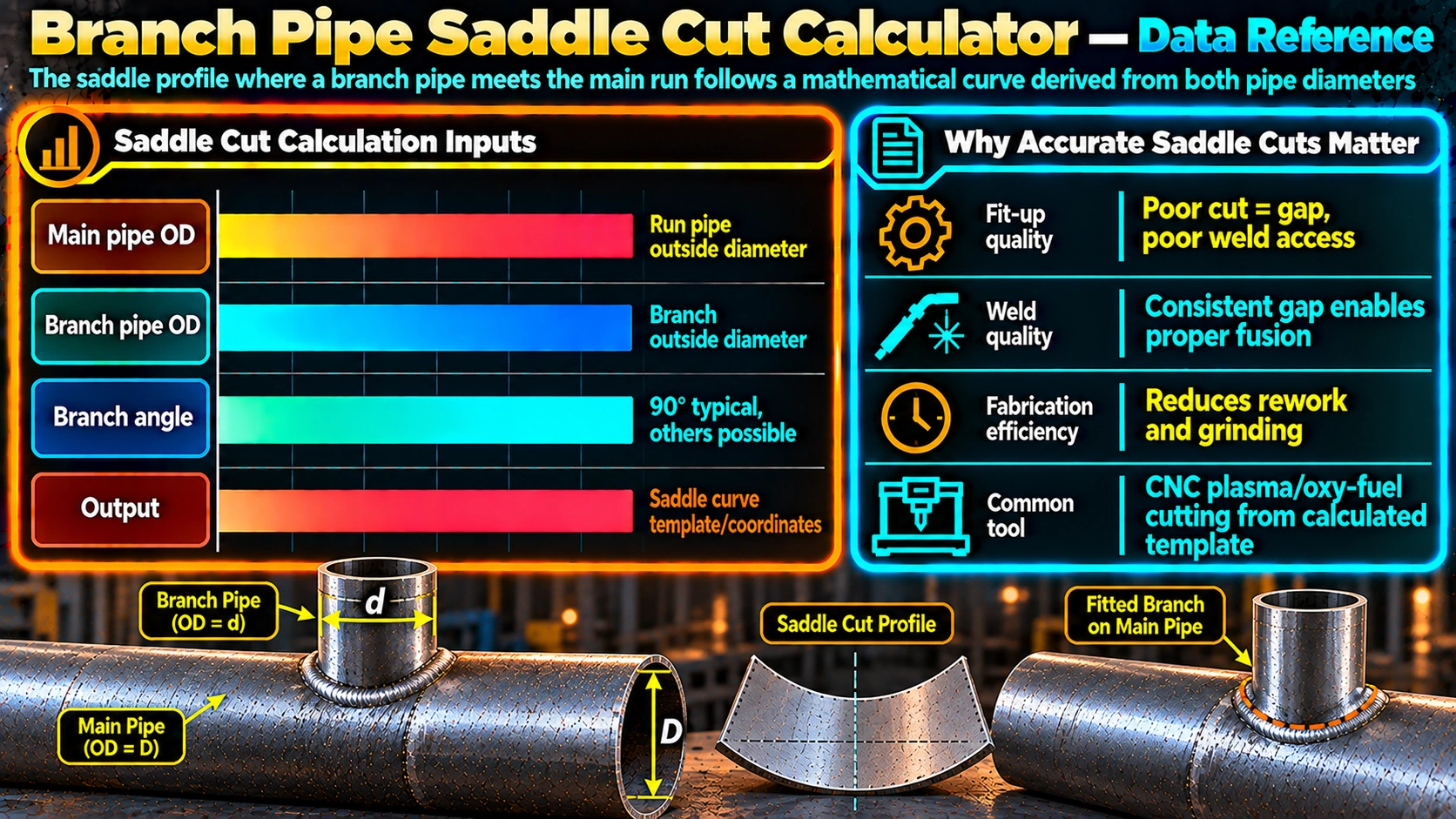
The branch pipe saddle cut calculator computes the cope (saddle) cut profile for a branch pipe connecting to a larger header pipe — giving the cut depth at every 15° around the branch circumference, a live saddle curve preview, template strip dimensions for marking, approximate weld length, and a reinforcement pad check flag. Two calculation modes are available: 90° perpendicular branch (the most common configuration) and angled branch (any angle from 30° to 89° from the header axis). The template data table can be read directly by a fitter to produce a paper or sheet-metal template and scribe the cut line on the branch pipe.
When a pipe branch is cut straight across (no saddle cut), a crescent-shaped gap exists between the branch end and the curved main pipe surface. On a 200 mm branch into a 300 mm header, this gap can be as wide as 18 mm at the heel — far beyond any acceptable root gap for a pressure weld. The saddle cut eliminates this gap by shaping the branch end to exactly follow the main pipe outer cylinder, producing consistent root gap and weld quality around the full circumference. This page derives the formula from first principles and explains every output the calculator produces.
Branch Pipe Saddle Cut Calculator
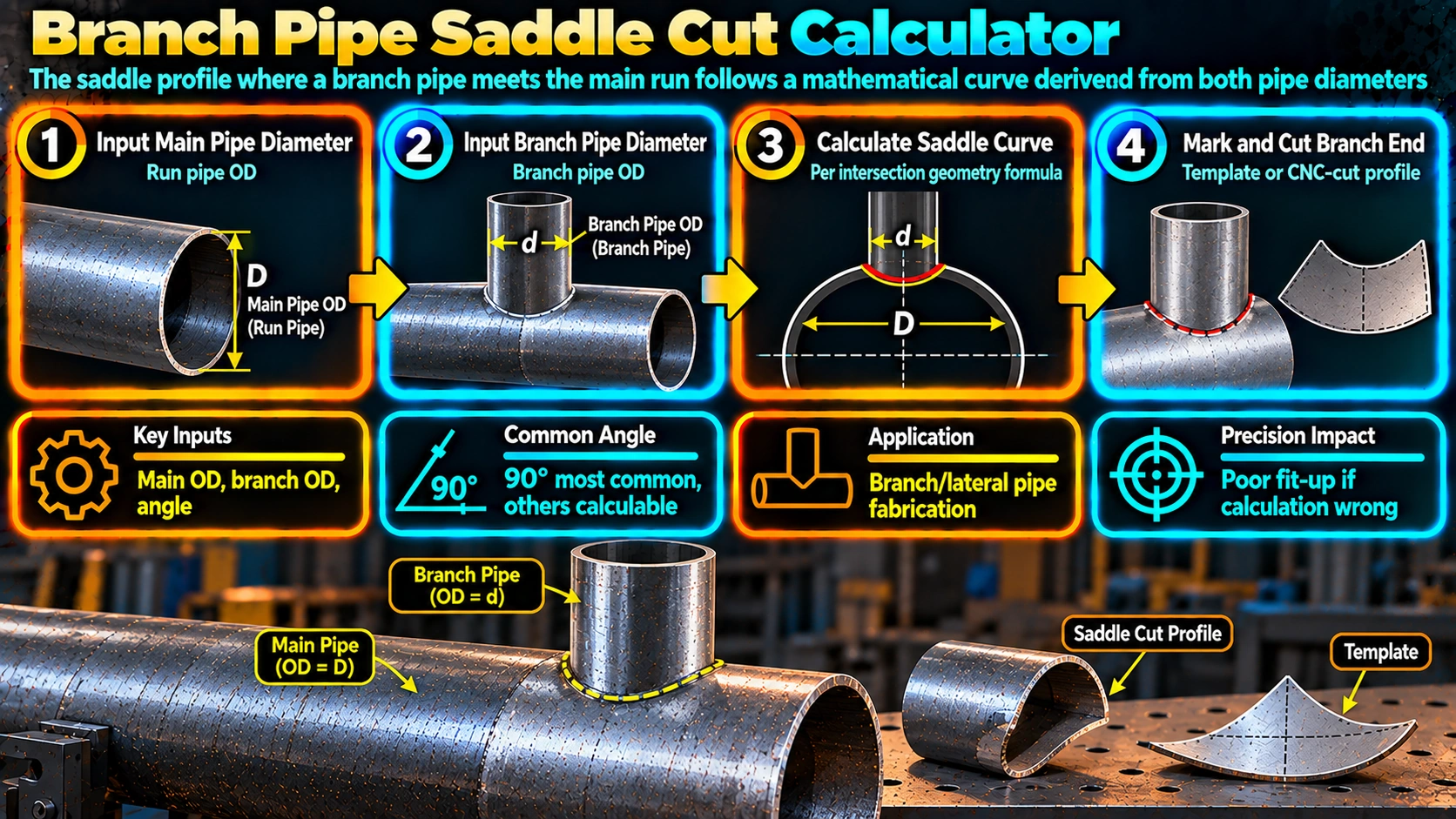
Cope / Saddle Cut Profile • Template Data • Weld Length • Reinforcement Check
| θ (°) | Strip x (mm) | Cut depth y (mm) | Position |
|---|
Saddle Geometry — Why the Cut is a Sinusoid
A cylindrical pipe branch intersecting a cylindrical header creates a three-dimensional intersection curve. To understand its shape, imagine the branch pipe surface being unrolled into a flat rectangle — the cylinder’s circumference becomes the horizontal axis and the pipe’s axial length becomes the vertical axis. On this flat surface, the intersection curve (which is complex in 3D) maps to a smooth, periodic wave that resembles a sinusoid.
The physical explanation is straightforward. At the crown of the branch (the point directly above the header centreline, θ = 0°), the branch pipe meets the very top of the header cylinder — the cut line is closest to the branch end and requires no cut at all for a 90° branch. At the heel (θ = 90°, the side of the branch where it is furthest from the crown), the branch pipe must reach all the way down to where the branch centreline intersects the header surface — the deepest point of the cut. At the invert (θ = 180°), the geometry mirrors the crown.
90-Degree Branch Formula
For a branch pipe whose centreline is perpendicular (90°) to the main pipe axis, the saddle cut geometry is symmetric around both the crown-invert axis and the heel-heel axis. The derivation comes from finding, for each circumferential position θ around the branch, the axial distance along the branch from the nominal cut plane to the point where the branch surface meets the main pipe outer cylinder.
Where:
R_m = D_m / 2 = outside radius of main (header) pipe (mm)
R_b = D_b / 2 = outside radius of branch pipe (mm)
θ = angular position around branch (0° = crown, 90° = heel, 180° = invert)
y = cut depth at that position (mm), measured from the reference plane at the crown
Maximum cut depth (at θ = 90°, the heel): y_max = R_m − √(R_m² − R_b²) Equivalently: y_max = R_m × (1 − √(1 − (D_b/D_m)²))
Validity check: D_b must be ≤ D_m (branch cannot be larger than header) D_b/D_m is the diameter ratio — values above 0.8 produce very deep saddles
Angled Branch Formula
For a branch at angle α to the main pipe axis (α = 90° for perpendicular, α = 45° for a typical lateral), the saddle profile is asymmetric. The heel on the acute side (where the branch makes an acute angle with the header) is deeper than the 90° case; the heel on the obtuse side is shallower. This produces a wave with different amplitudes on the two halves of the template.
First term: perpendicular depth, scaled by 1/sin(α) for the oblique approach angle
Second term: offset from oblique geometry (+ for obtuse side, − for acute side)
Key positions for angled branch: θ = 0° (crown, acute side top): y = R_b × cot(α) = R_b × cos(α)/sin(α)
θ = 90° (heel): y = y_max_perp/sin(α) [deeper than 90° case]
θ = 180° (invert, obtuse side): y = −R_b × cot(α) [negative = measured backwards]
θ = 270° (heel): symmetric to θ = 90°
Acute-side crown height above branch end: y_crown = R_b × cos(α) / sin(α) = R_b × cot(α) This is the additional length needed on the acute side of the branch cut
Making the Fabrication Template
The fabrication template is the practical output of this calculation. It allows a pipe fitter to mark the exact cut line on the branch pipe without needing to perform the calculation themselves. The process has three steps.
Step 1 — Prepare the Template Strip
Cut a strip of thin sheet metal or stiff card whose width equals the full circumference of the branch pipe (π × D_b) and whose height is at least y_max plus a margin of 20 mm. For an angled branch, add the crown offset y_crown to the height on the obtuse side. Draw a straight baseline along the bottom edge of the strip.
Step 2 — Plot the Cut Points
Mark the angular positions along the strip width: at θ = 0°, 15°, 30°, 45°, …, 360°. Each position is located at x = (θ / 360) × π × D_b from the left edge of the strip. At each marked x position, measure the cut depth y(θ) upward from the baseline and mark a point. Connect all the points with a smooth curve (a flexible strip or batten works well for this). The resulting curve is the saddle profile.
Step 3 — Transfer to Pipe
Wrap the template strip tightly around the branch pipe end, aligning the 0° mark (crown) with the top of the pipe (the side that will be closest to the header centreline). Secure with tape. Scribe or mark the cut line on the pipe surface along the template curve. Remove the template and cut along the scribed line using a plasma cutter, angle grinder, or suitable cutting tool. After cutting, check the fit by placing the branch on the header pipe; the root gap should be uniform (typically 2 to 4 mm) around the full circumference.
Weld Length Calculation
The weld length of a branch saddle connection is the arc length of the three-dimensional intersection curve — always longer than the simple branch pipe circumference because the saddle cut adds extra length at the heels. Knowing the weld length is needed to estimate weld electrode and wire consumption, and to plan the welder’s pass sequence for circumferential temperature control.
Where ΔArc = π × D_b / N (circumferential arc element)
and Δy = y(θ + Δθ) − y(θ) (axial height change per increment)
Analytical approximation for 90° branch (Ramanujan ellipse perimeter): L_weld ≈ π × √((D_m² + D_b²) / 2) Accurate to ±3% for D_b/D_m < 0.7; less accurate for large-diameter ratios
Reinforcement Pads and Stress Intensification Factors
A branch pipe connection removes metal from the main pipe wall, creating a structural weakness that must be evaluated against the pressure design code. Two separate considerations apply: the area replacement (reinforcement) requirement for pressure integrity, and the stress intensification factor (SIF) for fatigue and cyclic loading assessment.
Area Replacement per ASME B31.3 / ASME VIII UG-37
When a branch opening is cut in a main pipe, the cross-sectional area of the removed metal must be replaced within a defined reinforcement zone. The required replacement area is A = d × t_r, where d is the branch bore diameter and t_r is the minimum required thickness of the main pipe. The available area comes from excess wall thickness in the main pipe, excess wall in the branch, and any reinforcing pad. If available area is insufficient, a reinforcing pad must be added. The nozzle reinforcement calculator (UG-37 area replacement method) performs this complete calculation for both cylindrical shells and formed heads.
Stress Intensification Factors (SIF) per ASME B31.3
The SIF at a branch connection amplifies the nominal pipe stress under bending loads from piping system thermal expansion, dead weight, and seismic forces. ASME B31.3 Appendix D tabulates SIF equations for common branch configurations. For an unreinforced welded-on branch connection:
Where T_b = branch wall thickness (mm), r_b = branch mean radius (mm) = (D_b − t_b) / 2 Valid for r_b/T_b > 1.5 (thin-wall branches). Minimum SIF = 1.0.
Effect of reinforcing pad on SIF: Adding a reinforcing pad increases the effective wall thickness T_p at the junction. SIF reduces approximately as: i_reinforced = i_unreinforced × (T_b / (T_b + T_pad))^(2/3) Full SIF recalculation using B31.3 App D with T_eff = T_b + T_pad is recommended.
| D_b / D_m Ratio | Typical SIF (unreinforced) | Typical SIF (with pad) | Pad Likely Required? | Action |
|---|---|---|---|---|
| < 0.3 | 2–3 | 1.5–2 | Usually not | Check B31.3 area rules; likely OK without pad |
| 0.3–0.5 | 3–5 | 2–3 | Check calculation | UG-37 area calculation required; pad may be needed |
| 0.5–0.7 | 5–7 | 3–4 | Usually required | Pad typically required; check area replacement fully |
| > 0.7 | 7+ | 4–5 | Required | Pad mandatory; consider integrally reinforced fitting |
Maximum Saddle Cut Depth by Diameter Ratio
The table below shows the maximum cut depth y_max as a percentage of the header pipe radius R_m for common diameter ratios. This helps fabricators quickly assess how deep the saddle cut will be before running the full calculation, and whether the branch is feasible to cut with available tooling.
| D_b / D_m Ratio | y_max / R_m (%) | y_max for 12″ (323.9 mm) Header | Template Strip Height | Cut Difficulty |
|---|---|---|---|---|
| 0.20 | 2.0% | 3.2 mm | ≈ 23 mm | Easy — nearly flat |
| 0.33 | 5.6% | 9.1 mm | ≈ 29 mm | Easy |
| 0.50 | 13.4% | 21.7 mm | ≈ 42 mm | Moderate |
| 0.67 | 25.5% | 41.3 mm | ≈ 61 mm | Significant — deep heel cut |
| 0.75 | 33.9% | 54.9 mm | ≈ 75 mm | Deep cut — multi-pass grinding |
| 0.90 | 56.4% | 91.3 mm | ≈ 111 mm | Very deep — consider swept tee |
Weld Procedure and Common Branch Pipe Sizes
| Header NPS | Header OD (mm) | Branch NPS | Branch OD (mm) | D_b/D_m | y_max (mm) | Weld Length (mm) |
|---|---|---|---|---|---|---|
| 12″ | 323.9 | 6″ | 168.3 | 0.519 | 23.0 | 568 |
| 12″ | 323.9 | 4″ | 114.3 | 0.353 | 10.3 | 453 |
| 12″ | 323.9 | 3″ | 88.9 | 0.274 | 6.2 | 390 |
| 10″ | 273.1 | 6″ | 168.3 | 0.617 | 35.3 | 546 |
| 8″ | 219.1 | 4″ | 114.3 | 0.522 | 18.5 | 396 |
| 8″ | 219.1 | 3″ | 88.9 | 0.406 | 11.0 | 341 |
| 6″ | 168.3 | 3″ | 88.9 | 0.529 | 14.9 | 315 |
| 6″ | 168.3 | 2″ | 60.3 | 0.358 | 6.8 | 252 |
Weld Joint Preparation and Fit-Up
After the saddle cut is made and the branch is positioned on the header, the weld joint preparation and fit-up is critical to weld quality. The intersection weld has a continuously varying groove angle around the circumference, which makes consistent root gap and bevel angle challenging to maintain.
Bevel Angle
For branch wall thickness above approximately 6 mm, a bevel is typically ground on the branch pipe end to prepare the weld groove. The bevel angle should be approximately 37.5° from the branch pipe centreline (a compound bevel for angled branches). At the crown where the branch meets the header at a shallow angle, the effective groove angle becomes shallower and the welder must compensate with adjusted torch/electrode angle. At the heel the groove is more vertical and the effective bevel is closer to the nominal value.
Root Gap Control
The root gap at the saddle weld should be 2 to 4 mm for a full-penetration weld per ASME B31.3. After the saddle cut, position the branch on the header and check the root gap with a welding gauge at intervals of approximately 45° around the circumference. If the gap varies significantly (more than 2 mm variation around the circumference), the saddle cut should be refined by grinding or re-cutting the high spots before welding. Excessive root gap at the heel indicates that the saddle cut is too shallow at that point; excessive gap at the crown indicates the cut is too deep.
Practical Notes for Pipe Fabricators
Plasma Cutting the Saddle
Most modern pipe cutting machines (CNC pipe profile cutters) can cut the saddle profile automatically from the calculated coordinates. For manual cutting, clamp the template to the branch pipe end and scribe the line, then cut with a plasma cutter or angle grinder. For thick-wall pipe (above 20 mm wall), oxy-fuel cutting gives a better surface for subsequent weld bevel grinding. After cutting, dress the saddle edge with an angle grinder and file to remove dross and sharp edges before fitting up.
Checking the Fit with a Flashlight Test
After positioning the branch on the header, hold a flashlight or inspection torch inside the main pipe and look for light leaking through the joint. Any visible gap around the saddle perimeter indicates a poor fit that requires remediation. The flashlight test is a quick, reliable way to verify saddle cut quality before tacking and welding, without needing measuring instruments at every point.
Connection to Pipe Wall Thickness and Pressure Calculations
The branch saddle cut is the geometric step; the pressure integrity of the resulting connection is governed by the pipe wall thickness calculator (ASME B31.3 for the main pipe design thickness t_r) and the nozzle reinforcement calculator (UG-37 area replacement for the opening). Together, these three tools — saddle cut geometry, pipe wall design, and nozzle reinforcement — cover the complete engineering package for a fabricated branch connection.
Frequently Asked Questions
What is a saddle cut (cope cut) on a branch pipe?
What is the formula for a 90-degree branch pipe saddle cut?
How does the saddle cut formula change for an angled branch?
How is the fabrication template strip made from the saddle cut calculation?
When is a reinforcement pad required on a pipe branch connection?
What is the stress intensification factor (SIF) for a branch pipe connection?
What weld joint is used for a branch pipe saddle connection?
How is the weld length of a branch pipe saddle connection calculated?
What is the difference between a cope cut and a miter cut for pipe branches?
Recommended Reference Books
Disclosure: WeldFabWorld participates in the Amazon Associates programme (StoreID: neha0fe8-21). If you purchase through these links, we may earn a small commission at no extra cost to you.