ASME B31.1 vs B31.3 — Power Piping vs Process Piping: Key Differences Every Engineer Must Know
ASME B31.1 (Power Piping) and ASME B31.3 (Process Piping) are the two most widely applied piping codes in industrial engineering worldwide, yet they are frequently misapplied, misquoted in project specifications, and confused with one another — even by experienced engineers. Selecting the wrong code for a piping system is not merely a paperwork error; it directly affects pipe wall thickness calculations, allowable stress values, examination scope, hydrostatic test pressures, and the entire integrity management framework for that system.
This article provides a deep technical comparison of both codes, covering scope of application, design philosophy, allowable stress derivation, wall thickness formulas, welding and examination requirements, pressure testing criteria, and the B31.3 fluid service classification system. Whether you are a piping designer, welding inspector, QA/QC engineer, or certification candidate preparing for ASME-based examinations, this guide will give you the clarity to apply each code correctly and confidently.
Scope and Applicability
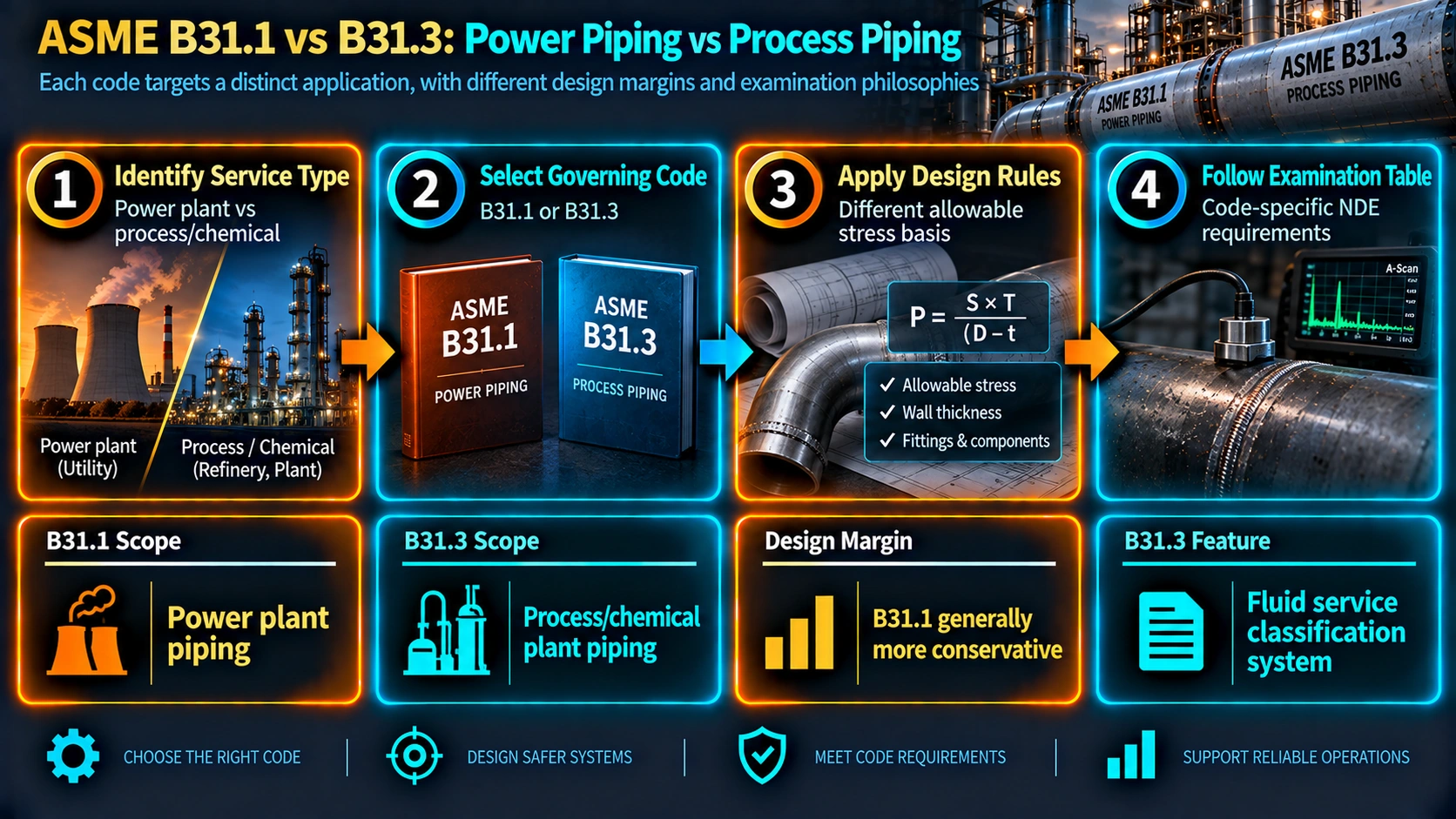
The single most important step in any piping design project is correctly identifying which code governs the system. The choice is determined by the type of facility and service, not by the fluid alone.
ASME B31.1 — Power Piping Scope
ASME B31.1 applies to piping systems typically found in:
- Electric power generating stations
- Industrial and institutional plants (including cogeneration and combined heat and power facilities)
- Central heating and district heating plants
- Geothermal heating systems
Within these facilities, B31.1 covers steam piping, feedwater piping, condensate return, blowdown lines, fuel oil piping, compressed air service, cooling water, and similar utility systems. The code boundary with ASME Section I (Boiler and Pressure Vessel Code) is precisely defined: B31.1 applies from the first circumferential joint beyond the boiler proper, or from the boiler stop valve outlet on steam lines.
ASME B31.3 — Process Piping Scope
ASME B31.3 is intentionally broad in scope. It applies to piping systems at:
- Petroleum refineries and petrochemical complexes
- Chemical plants, polymer plants, and plastics facilities
- Pharmaceutical and biopharmaceutical manufacturing facilities
- Textile, paper, semiconductor, and cryogenic processing plants
- Natural gas processing facilities (upstream of the custody transfer point)
- Terminals, loading/unloading facilities, and tank farms
B31.3 explicitly does not cover piping within the scope of other B31 sections, ASME boiler and pressure vessel codes, or plumbing codes. It also excludes fire protection piping (typically NFPA 13) and systems below 15 psig if non-flammable, non-toxic, and non-damaging to human tissue.
Summary: Scope Comparison
Design Allowable Stresses
The allowable stress is the cornerstone of pressure-containing component design under both codes. It determines the required wall thickness, the fitness of listed materials, and the basis for pressure-temperature ratings. The two codes use different methods to arrive at allowable stress values, resulting in meaningfully different numbers for the same material at the same temperature.
B31.1 Allowable Stress Basis
Under ASME B31.1, the basic allowable stress S for a given material at temperature is the lowest of:
S = min( UTS/4, 0.625 × S_y, UTS_avg_creep/1.5, S_creep_rupture/1.5 )
Where:
UTS = Minimum specified ultimate tensile strength at temperature
S_y = Minimum specified yield strength at temperature (0.2% proof stress)
UTS_avg_creep = Average stress to cause creep rupture in 100,000 h
S_creep_rupture = Minimum stress to cause creep rupture in 100,000 h
The 1/4 UTS criterion makes B31.1 more conservative than B31.3.
B31.3 Allowable Stress Basis
ASME B31.3 uses a 1/3 UTS criterion, which is less conservative and allows higher design stresses for the same material:
S = min( UTS/3, 0.667 × S_y (below creep range) )
At elevated temperatures, creep and rupture criteria apply similarly to B31.1.
Higher S values mean thinner walls are permitted under B31.3 vs B31.1 for identical conditions.
Numeric Example — Carbon Steel A106 Gr. B at 400 deg C
Condition: Service temperature 400 deg C (752 deg F)
Approximate allowable stress from code tables:
B31.1 Allowable (S) ≈ 89 MPa (12,900 psi)
B31.3 Allowable (S) ≈ 103 MPa (14,900 psi)
Difference: ~16% higher allowable stress under B31.3 — resulting in a measurably thinner required wall thickness.
Wall Thickness Calculation
B31.1 Wall Thickness Formula
ASME B31.1 uses the following formula for minimum required wall thickness, as defined in Clause 104.1.2:
t_m = (P × D_o) / (2 × (S × E + P × y)) + A
Where:
t_m = Minimum required wall thickness (mm or in)
P = Internal design gauge pressure (MPa or psi)
D_o = Outside diameter of pipe (mm or in)
S = Allowable stress at design temperature (MPa or psi) from B31.1 Appendix A
E = Longitudinal joint quality factor (1.0 for seamless)
y = Temperature coefficient (varies: 0.4 for ferritic steels below 900 deg F)
A = Additional thickness for threading, grooving, erosion, and corrosion allowance
Select nominal wall: t_nom ≥ t_m / (1 – mill_undertolerance)
B31.3 Wall Thickness Formula
ASME B31.3 uses a similar but not identical formula, defined in Para. 304.1.2:
t = (P × D) / (2 × (S × E_W × W + P × Y))
Where:
t = Pressure design thickness (before corrosion/mechanical allowances)
P = Internal design gauge pressure (MPa or psi)
D = Outside diameter (mm or in)
S = Allowable stress (from B31.3 Table A-1)
E_W = Weld joint quality factor (1.0 seamless; 0.85 ERW; 0.80 SAW)
W = Weld joint strength reduction factor (1.0 below creep range)
Y = Coefficient from B31.3 Table 304.1.1 (0.4 for t < D/6)
t_m = t + c (c = corrosion/erosion/mechanical allowance)
Note: B31.3 introduces E_W × W factor that B31.1 handles differently.
Welding and Procedure Qualification
Both ASME B31.1 and B31.3 mandate that all welding shall be performed in accordance with qualified Welding Procedure Specifications (WPS) and by qualified welders, with qualification conducted under ASME Section IX. This fundamental requirement is identical between the two codes. The differences appear in supplementary requirements, essential variable interpretation, and additional obligations for specific service categories.
WPS and Welder Qualification — Common Requirements
- All welding must be performed to a documented, qualified WPS per ASME Section IX.
- Each welder must hold a current Welder Performance Qualification (WPQ) covering the applicable process, F-number, and position.
- The Owner (or their authorized representative) is responsible for ensuring compliance — typically verified through review of WPS/PQR packages during pre-construction welding audits.
- P-Numbers, F-Numbers, and A-Numbers from Section IX apply directly in both codes. See our P-Number and F-Number guide for a full explanation of material groupings.
Preheat Requirements
ASME B31.1 Table 132 and ASME B31.3 Table 330.1.1 both specify minimum preheat temperatures by material P-Number and wall thickness. The values are generally similar, but B31.1 can be more demanding on certain carbon and low-alloy steel combinations, especially on heavy-walled boiler external piping. For P91 (9Cr-1Mo-V) piping, both codes reference specific preheat and PWHT requirements given the creep-strength properties of this alloy.
Post-Weld Heat Treatment (PWHT)
Both codes require PWHT for carbon steel above certain wall thickness thresholds (typically 19 mm / 3/4 inch for P-No. 1 materials), but the specific temperature ranges, hold times, and exemptions differ:
| PWHT Parameter | ASME B31.1 | ASME B31.3 |
|---|---|---|
| P-No. 1 (Carbon Steel) mandatory thickness | > 19 mm (3/4 in) nominal | > 19 mm (3/4 in) nominal |
| Temperature range (P-No. 1) | 595–650 deg C (1,100–1,200 deg F) | 595–650 deg C (1,100–1,200 deg F) |
| P-No. 4 (1.25Cr-0.5Mo) mandatory thickness | All thicknesses for steam service | > 13 mm (1/2 in) nominal |
| P-No. 5 (Cr-Mo steels) mandatory thickness | All thicknesses | > 13 mm (1/2 in) nominal for most |
| Exemptions available | Limited; more restrictive for boiler ext. piping | Several exemptions for low-pressure / low-temp service |
Examination Requirements
Examination requirements represent one of the most practically significant differences between the two codes, directly impacting fabrication cost, schedule, and project QA/QC planning. Under B31.3, the examination scope scales with fluid service classification, whereas B31.1 applies requirements based on joint category and design conditions.
ASME B31.1 Examination
B31.1 Chapter V specifies examination requirements. Key provisions include:
- Visual examination: Required for all welds as a minimum.
- Random radiographic examination: Required for butt welds at percentages defined by design pressure and temperature — typically a higher percentage than B31.3 Normal Fluid Service for elevated-temperature steam lines.
- 100% radiographic or UT examination: Mandatory for certain weld categories including longitudinal welds in pressure-retaining components above certain pressure-temperature combinations.
- Boiler external piping (BEP): Welds in BEP that interface with ASME Section I must comply with both codes’ examination requirements at the most stringent applicable level.
ASME B31.3 Examination
Examination scope under B31.3 is directly tied to the fluid service category:
| Fluid Service | Min. Examination of Butt Welds | Leak Test |
|---|---|---|
| Normal Normal Fluid Service | 5% radiographic + 100% visual | Hydrostatic or pneumatic |
| Cat. D Category D | 100% visual only | Initial service leak test permitted |
| Cat. M Category M | 100% radiographic or UT | Hydrostatic preferred; pneumatic with written procedure |
| High-P High Pressure | 100% radiographic or UT + hardness testing | Hydrostatic at specified pressure |
Hydrostatic and Pneumatic Testing
Pressure testing is the final stage of piping system verification before commissioning. The test pressure formulae differ meaningfully between the two codes, and applying the wrong formula is one of the most common errors found during commissioning reviews.
B31.1 Hydrostatic Test Pressure
P_test = 1.5 × P_design
With the condition that P_test shall not exceed the lower of:
(a) The pressure that would produce a stress exceeding 90% of SMYS in any component, or
(b) Pressure that would cause visible distortion
B31.1 test pressure = 1.5 × design pressure (straightforward factor)
B31.3 Hydrostatic Test Pressure
B31.3 introduces a temperature correction factor that can result in a test pressure noticeably higher than a simple 1.5x multiple:
P_test = 1.5 × P_design × (S_T / S_D)
Where:
P_design = Design pressure (gauge)
S_T = Allowable stress at test temperature (typically ambient)
S_D = Allowable stress at design temperature (elevated temperature)
Minimum: P_test ≥ 1.5 × P_design (floor applies even if S_T/S_D < 1.0)
Example:
P_design = 10 MPa, S_T (at 20 deg C) = 138 MPa, S_D (at 400 deg C) = 103 MPa
P_test = 1.5 × 10 × (138/103) = 1.5 × 10 × 1.34 = 20.1 MPa
Compared with B31.1 which would give: 1.5 × 10 = 15 MPa
Pneumatic Test
| Parameter | B31.1 | B31.3 |
|---|---|---|
| Pneumatic test factor | 1.2 × P_design | 1.1 × P_design (minimum) |
| When permitted | When hydro test is impractical; requires written justification | When liquid residue in piping is dangerous or when supports cannot handle liquid weight |
| Pressure hold time | No less than 10 minutes at test pressure | At least 10 minutes at test pressure; then reduce to P_design for examination |
| Safety provisions | Pressure relief device required; personnel exclusion zone | Pressure relief device required; written procedure; risk assessment |
B31.3 Fluid Service Classifications
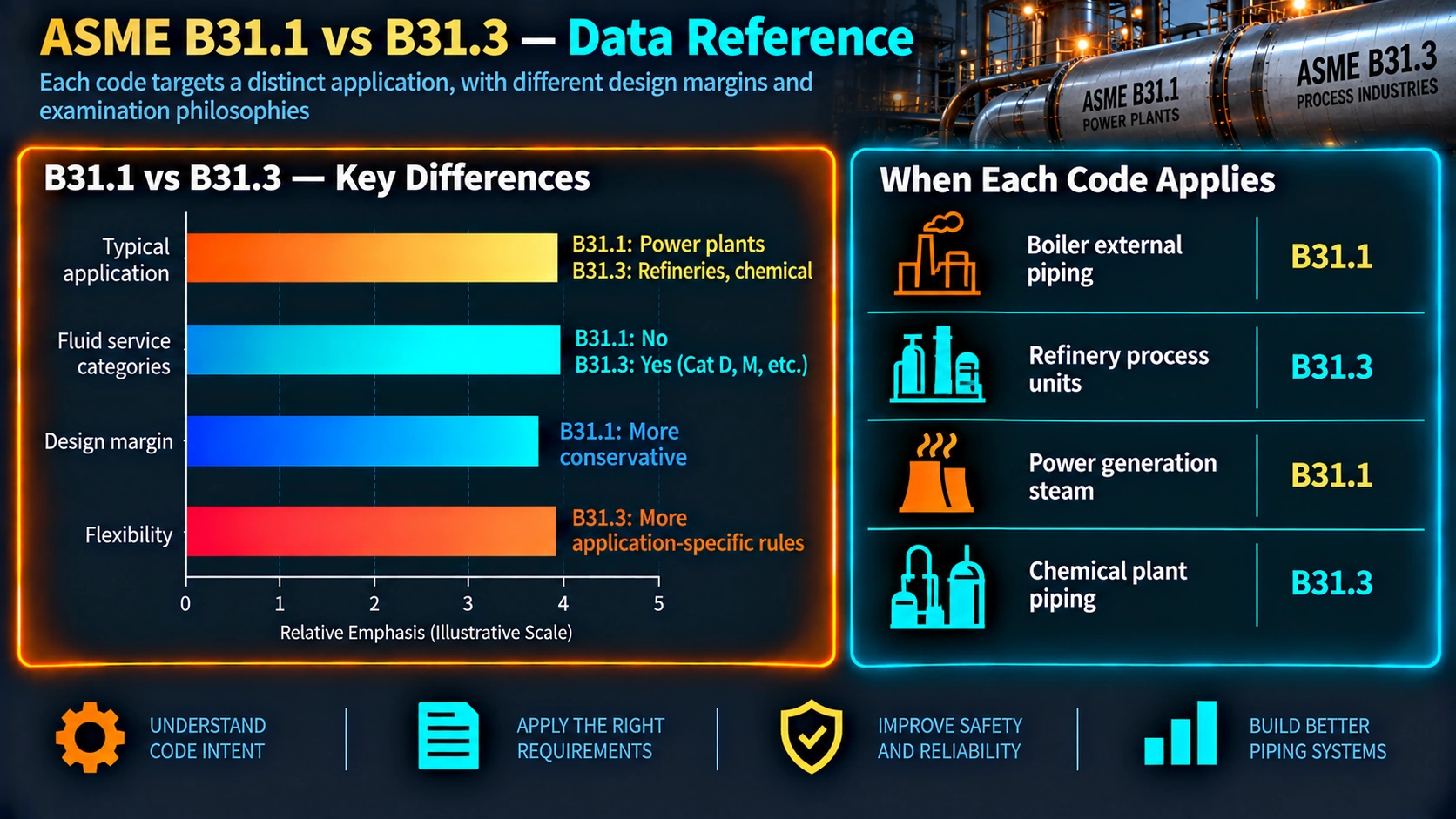
One of the most distinctive features of ASME B31.3 — absent entirely from B31.1 — is its formal fluid service classification system. Understanding these classifications is essential for correctly interpreting examination percentages, testing requirements, and applicable paragraphs within B31.3.
Normal Fluid Service
The default classification for the majority of process piping. Applies to fluids that do not meet the criteria for any of the special categories. Standard design, fabrication, examination, and testing requirements of B31.3 apply in full.
Category D Fluid Service
Applies when all of the following conditions are met:
- The fluid is non-flammable, non-toxic, and not damaging to human tissue
- Design pressure does not exceed 1,035 kPa (150 psi)
- Design temperature is between -29 deg C and +186 deg C (-20 deg F to +366 deg F)
Category D permits relaxed fabrication and examination requirements, including accepting visual examination only for welds and an initial service leak test in lieu of hydrostatic testing. Common examples include cooling water, clean steam (at low pressure), instrument air, and potable water lines.
Category M Fluid Service
Applies when a single exposure to even a small quantity of the fluid — caused by leakage, spillage, or component failure — can cause serious irreversible harm to personnel by inhalation, skin absorption, or contact. Examples include hydrogen chloride (HCl) gas lines, hydrogen cyanide, and highly toxic chemical service. Category M requires 100% radiographic or UT examination of butt welds and the most stringent leak testing provisions within B31.3.
High Pressure Fluid Service
Applies to piping with design pressures exceeding the pressure-temperature ratings of ASME Class 2500 flanges for the applicable material group. This service type requires design in accordance with B31.3 Appendix K, which prescribes more conservative allowable stresses, 100% examination, and special fatigue analysis provisions. This classification is commonly encountered in high-pressure hydraulic testing facilities and very high-pressure chemical processes.
High Purity Fluid Service
Addressed in B31.3 Appendix M, this classification applies to systems where product purity requirements — rather than fluid hazard — drive the design. It encompasses semiconductor ultra-pure water systems, pharmaceutical water-for-injection (WFI) loops, and similar applications where contamination rather than pressure is the primary engineering concern.
Boiler External Piping — The B31.1 and Section I Interface
A particularly important aspect of B31.1 scope is the concept of Boiler External Piping (BEP) — piping that connects directly to the boiler pressure boundary and is therefore jointly governed by ASME Section I and B31.1. This dual jurisdiction is one of the most commonly misunderstood areas in power plant piping design.
Definition and Code Boundary
BEP is defined in B31.1 Para. 100.1.2. Steam supply piping that originates at the boiler drum and terminates at the first stop valve (or first two stop valves in some configurations) is designated BEP. This piping must comply with both ASME Section I (for the pressure-containing components themselves) and B31.1 (for the piping system design, support, examination, and testing). Once beyond the BEP boundary, piping transitions to pure B31.1 jurisdiction.
Full Side-by-Side Comparison Table
The following table consolidates the key technical differences between ASME B31.1 and B31.3 for quick reference.
| Parameter | ASME B31.1 — Power Piping | ASME B31.3 — Process Piping |
|---|---|---|
| Typical facility | Power plants, district heating, geothermal | Refineries, chemical plants, pharma, gas processing |
| Typical fluids | Steam, feedwater, condensate, compressed air, fuel oil | Hydrocarbons, acids, gases, cryogenic fluids, water |
| Allowable stress basis | Lower of 1/4 UTS or 5/8 S_y (below creep) | Lower of 1/3 UTS or 2/3 S_y (below creep) |
| Design conservatism | More conservative | Less conservative (normal service) |
| Fluid service classification | None — requirements by design conditions | Normal, Cat. D, Cat. M, High Pressure, High Purity |
| Wall thickness formula | t_m = PD/(2SE+2Py) + A (Clause 104.1.2) | t = PD/[2(SE_W W + PY)] + c (Para. 304.1.2) |
| Weld joint efficiency | E factor (longitudinal weld quality) | E_W × W (joint quality × strength reduction) |
| Hydrostatic test pressure | 1.5 × P_design | 1.5 × P_design × (S_T/S_D) |
| Pneumatic test pressure | 1.2 × P_design | 1.1 × P_design |
| Min. weld examination (typical) | Random RT/UT by design conditions; higher % than B31.3 for elevated steam | 5% RT (Normal); 100% RT (Cat. M); Visual only (Cat. D) |
| Welding qualification base code | ASME Section IX | ASME Section IX |
| PWHT mandatory thickness (P-No. 1) | > 19 mm (with exceptions) | > 19 mm (with more exemptions available) |
| Interface with other ASME codes | Direct interface with ASME Section I (BEP) | No direct BEP concept; stand-alone jurisdiction in process plant |
| Corrosion allowance | Included in “A” term of wall thickness formula | Separate “c” term; defined by engineering analysis |
| Stress analysis | Flexibility and sustained + occasional load analysis required | Similar requirements; more explicit for displacement stress range |
| Support and restraint | Chapter II — general and specific provisions for steam lines | Para. 321 — similar philosophy but different specific provisions |
| Applicable jurisdiction | Varies by country; often regulated as power-plant equipment | Varies; process plant jurisdiction (e.g., OSHA PSM in the US) |
Practical Engineering Decision Guide
When Scope Is Ambiguous — How to Decide
In real projects, the code boundary is not always immediately obvious. The following principles help engineers make defensible decisions:
- Check the Engineering Design Basis (EDB) first. The EDB is the authoritative project document that specifies which code applies to which system. If no EDB exists, raise a formal technical query before design proceeds.
- Identify the facility type. A power plant — even one that produces steam only for heating, not electricity — falls under B31.1 jurisdiction for its steam systems.
- Identify the process fluid and hazard level. If the fluid is a hazardous hydrocarbon or toxic chemical, B31.3 almost certainly applies, regardless of pressure or temperature.
- Check for jurisdictional regulatory requirements. In many countries, piping in power plants is regulated as part of the pressure equipment regulatory framework, which may mandate B31.1 by law regardless of what a project specification states.
- When in genuine doubt, apply the more conservative code. Between B31.1 and B31.3 Normal Fluid Service, B31.1 is more conservative. Designing to B31.1 when B31.3 would have sufficed costs money; designing to B31.3 when B31.1 was required creates a code non-conformance.
Common Mistakes to Avoid
Cross-Reference with Other Standards
Both B31.1 and B31.3 interface with a range of supporting standards that define material requirements, welding consumables, and mechanical testing. For impact testing (Charpy testing) requirements, refer to UG-84 of ASME Section VIII for the BPV code context, and to B31.3 Para. 323.2 for process piping impact test criteria. For corrosion allowance selection and material selection for sour environments, see our dedicated guides on sour service and pitting corrosion testing per ASTM G48.
Recommended Reference Books
The following reference books are widely used by piping engineers and code qualification candidates working with ASME B31.1 and B31.3.
Disclosure: WeldFabWorld participates in the Amazon Associates programme (StoreID: neha0fe8-21). If you purchase through these links, we may earn a small commission at no extra cost to you. This helps support free technical content on this site.