Dissimilar Metal Welding — P91/P22 to Austenitic Stainless Steel: The Complete Technical Guide
The dissimilar metal weld (DMW) between a ferritic chromium-molybdenum steel — P91 (9Cr-1Mo-V), P22 (2.25Cr-1Mo), or P11 (1.25Cr-0.5Mo) — and an austenitic stainless steel such as 316H, 304H, or 321H is one of the most technically demanding, most closely monitored, and most failure-prone weld joints in the entire power generation industry. Every high-temperature steam plant that transitions from ferritic high-temperature piping to austenitic components — superheater outlet headers, reheater piping, boiler tubing transitions — contains at least one dissimilar metal weld, and many contain hundreds.
These joints fail at service lives far shorter than would be predicted by either parent material’s individual creep properties. Industry data from operating power plants consistently shows that DMW failures occur at 60 to 80 percent of the predicted life of the ferritic component alone, and many joints have failed at less than half their expected creep life. The consequences range from costly forced outages requiring emergency repair, to catastrophic pressure boundary failures with loss of life. The Hinkley Point A, Ferrybridge, and multiple German power station incidents all involved premature DMW failure — driving decades of international research and progressively more stringent design and inspection practice.
This article provides a complete metallurgical and engineering guide to DMW joints between P91/P22 ferritic Cr-Mo steels and austenitic stainless steels: the physical mechanisms responsible for premature failure, the correct filler metal selection logic, the buttering and PWHT strategy that is the industry standard approach, fabrication and welding requirements, ASME code compliance, and the in-service inspection programme necessary to manage these joints safely throughout their service life.
Metallurgical Background — What Makes Dissimilar Welds Different
A homogeneous weld — P91 welded to P91, or 316H to 316H — presents a metallurgical environment that is broadly uniform across the joint. The base material on both sides has similar crystal structure, similar thermal expansion behaviour, similar carbon activity, and similar creep properties. The weld metal and heat-affected zones differ from the parent material in microstructure and strength, but the differences are quantitative rather than qualitative.
A dissimilar metal weld between a ferritic Cr-Mo steel and an austenitic stainless steel presents a set of qualitatively different conditions at the fusion line — the interface between the weld metal and each parent material — that have no equivalent in homogeneous welds:
- Crystal structure discontinuity: The ferritic/martensitic steel has a body-centred cubic (BCC/BCT) crystal structure; the austenitic stainless has a face-centred cubic (FCC) structure. These structures have fundamentally different diffusion characteristics, particularly for carbon and hydrogen.
- Carbon activity gradient: The thermodynamic activity of carbon is very different on either side of the fusion line, creating a strong driving force for carbon to migrate from the ferritic steel (low activity) into the austenitic weld metal or stainless steel (high activity) at elevated temperatures.
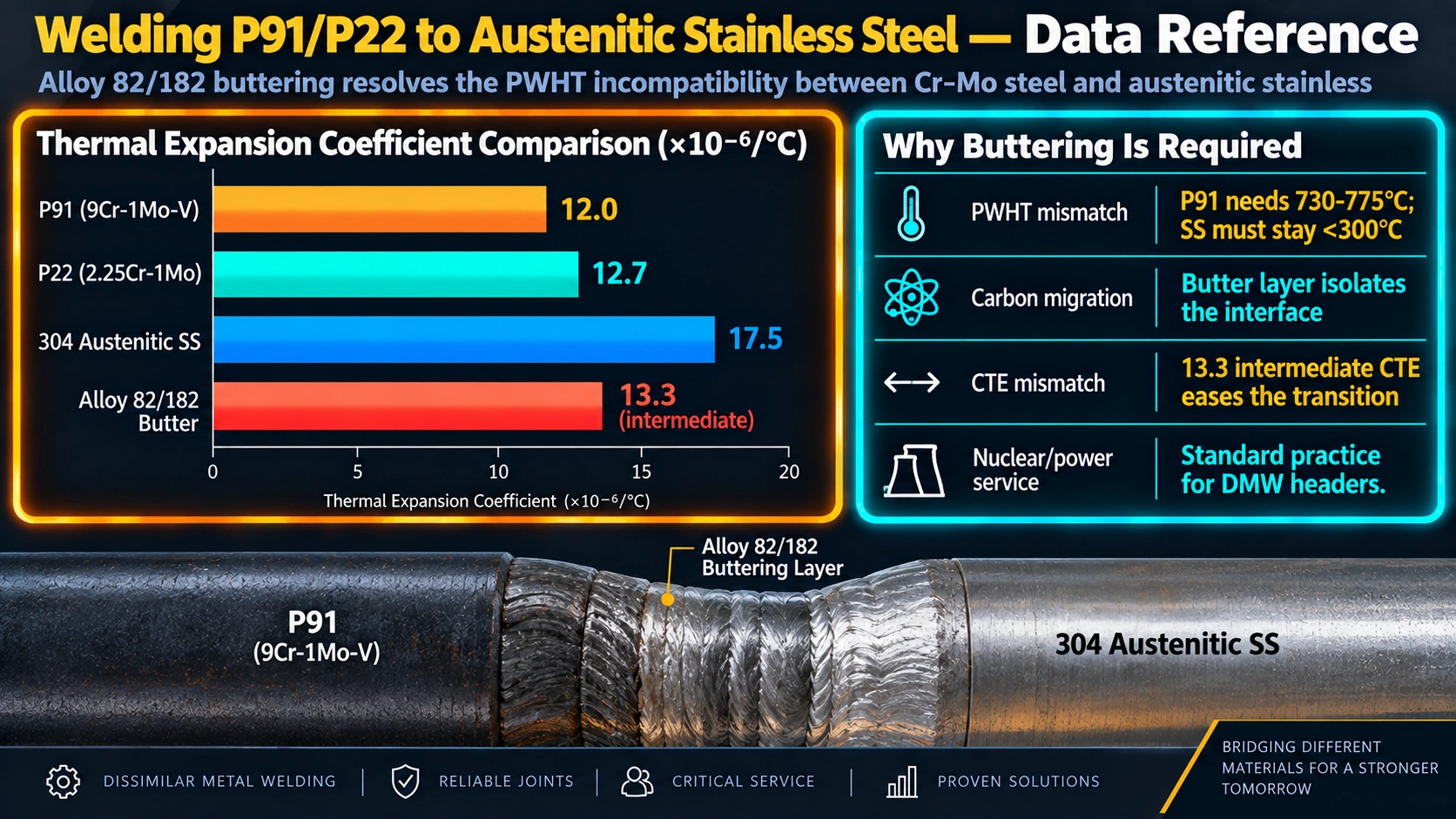
- Coefficient of thermal expansion (CTE) mismatch: Ferritic steels expand at roughly 12 × 10−6 /deg C; austenitic steels at 17 to 18 × 10−6 /deg C. Every temperature cycle generates a differential strain at the interface proportional to this 50% difference in CTE.
- Creep strength mismatch: The creep rupture strength of P91 and 316H differ significantly as a function of temperature; at temperatures above approximately 550 deg C, 316H has higher creep strength, while P91 governs below this crossover temperature. The creep strain localises in the weaker material at any given operating temperature.
- PWHT incompatibility: P91 requires PWHT at 730 to 800 deg C to develop its intended creep-resistant microstructure. Austenitic stainless steels must not be exposed to the sensitisation temperature range (450 to 850 deg C) for extended time. These requirements are mutually exclusive in a single, simultaneous PWHT cycle applied to the whole joint.
Why Dissimilar Metal Welds Fail
Premature DMW failure is not caused by a single mechanism acting in isolation. It results from the simultaneous and synergistic interaction of multiple degradation processes, each of which on its own would be manageable, but together create a joint that is structurally weaker than the sum of its parts. The three primary mechanisms are carbon migration, CTE-driven cyclic thermal fatigue, and oxide notching — with Type IV cracking on the P91 HAZ side acting as a further competing or contributory mechanism.
Failure Modes Catalogue
Carbon Migration (Decarburisation)
Carbon diffuses from the ferritic steel into the nickel-alloy weld metal at elevated temperature, creating a soft, carbon-depleted zone in the ferritic HAZ adjacent to the fusion line. This zone has severely reduced creep strength and is the preferential initiation site for creep cracks.
CTE Thermal Fatigue
The 50% difference in coefficient of thermal expansion between ferritic steel (12 × 10−6 /deg C) and austenitic weld metal / stainless (17–18 × 10−6 /deg C) generates large cyclic stresses at the fusion line during every start-stop cycle. Fatigue damage accumulates progressively.
Oxide Notching
Selective oxidation at the ferritic/nickel-alloy fusion line forms a groove notch when exposed to steam or oxidising gas. This stress concentration accelerates creep crack initiation at the weld outer surface, particularly on the P91 side of the fusion line.
Type IV Cracking
Creep failure initiating in the fine-grained intercritical HAZ (FGHAZ) of P91, a narrow zone of over-tempered martensite with lower creep strength than either the base metal or weld metal. Competes with fusion-line mechanisms in DMWs.
Sensitisation of Austenitic HAZ
If the austenitic stainless steel HAZ is exposed to temperatures between 450 and 850 deg C for extended time during PWHT, chromium carbide precipitates at grain boundaries, depleting adjacent zones in chromium and creating susceptibility to intergranular corrosion and stress corrosion cracking.
Hydrogen Cold Cracking
Atomic hydrogen in the deposited nickel-alloy weld metal can cause delayed cold cracking if preheat is insufficient or post-weld bake-out is not performed. Nickel alloys have lower hydrogen diffusion rates than ferritic steels, making hydrogen removal more difficult and requiring extended bake-out procedures.
Carbon Migration and Decarburisation
Carbon migration is the most insidious of the DMW failure mechanisms because it is invisible during fabrication and early service, progresses slowly over years, and reduces the joint’s creep strength in precisely the location — the fusion-line HAZ — where stress is already elevated by the CTE mismatch. Understanding the thermodynamic driving force for carbon migration is essential for selecting the right filler metal to mitigate it.
Thermodynamic Driving Force
Carbon migration is driven by a difference in carbon chemical activity (thermodynamic carbon activity, a_C) across the fusion line. Carbon activity is governed by the composition of the surrounding matrix. In the ferritic Cr-Mo steel, carbon is held in carbides (M23C6, M6C) that are relatively unstable at high temperature. In the austenitic or nickel-alloy weld metal, the strong carbide-forming elements — particularly chromium, molybdenum, and nickel — have a higher affinity for carbon and lower the effective carbon activity in the weld metal region. The resulting activity gradient drives carbon diffusion from the ferritic steel into the weld metal:
J_C = -D_C(T) × (da_C / dx)
Where:
J_C = Carbon flux (mol/m²/s) — positive value toward weld metal
D_C(T) = Carbon diffusion coefficient at temperature T (m²/s)
da_C/dx = Gradient of carbon activity across the fusion line
D_C is exponentially sensitive to temperature (Arrhenius relationship):
D_C(T) = D_0 × exp(-Q / RT)
D_0 = pre-exponential factor (~2 × 10⁻⁵ m²/s for C in ferrite)
Q = activation energy (~84 kJ/mol for C in ferrite)
R = gas constant (8.314 J/mol/K)
At 565 deg C, D_C is approximately 10 to 100 times higher than at 450 deg C — confirming that carbon migration is negligible below ~400 deg C and accelerates rapidly above 500 deg C.
Consequences of Carbon Migration
The carbon migration process creates two distinct microstructural zones at the P91 fusion line that together constitute the most critical structural weakness in the DMW:
- Carbon-depleted zone (soft zone) in the ferritic HAZ: The near-fusion-line region of the P91 HAZ loses its carbide precipitates as carbon diffuses out. The resulting ferritic structure has minimal carbide strengthening, dramatically lower creep rupture strength, and significantly lower hardness than the bulk P91 base material. This soft zone is typically 0.2 to 1.5 mm wide after extended service. Hardness values of HV 150 to 180 are common in severely decarburised zones, compared to the target HV 200 to 275 for correctly PWHT’d P91.
- Carbon-enriched zone in the weld metal: The inward-diffusing carbon enriches the weld metal within 0.5 to 2 mm of the fusion line. In austenitic stainless weld metal, this precipitation of chromium carbides at grain boundaries constitutes sensitisation — a corrosion risk. In nickel-alloy weld metals such as Alloy 82, the carbon forms chromium-rich carbides (Cr23C6) that accumulate at the fusion line interface, contributing to embrittlement and potentially acting as crack initiation sites.
Mitigating Carbon Migration — Filler Metal Strategy
The most effective metallurgical mitigation for carbon migration is the selection of a filler metal with a carbon activity close to that of the ferritic steel at the service temperature. A filler with matched carbon activity creates no driving force for carbon diffusion. Nickel-base alloys are significantly better than austenitic stainless steel fillers in this regard:
| Filler Type | Carbon Activity Relative to P91 | Carbon Migration Rate | Suitability for High-Temperature DMW |
|---|---|---|---|
| E/ER 309 / 309L (austenitic SS) | Very low — high Cr creates very low a_C | Severe — rapid decarburisation | Not recommended above 400 deg C service |
| E/ER 308L / 316L (austenitic SS) | Low — significant Cr-Mo-Ni effect | Severe | Acceptable only for ambient temperature transitions |
| Alloy 82 / 182 (ERNiCr-3 / ENiCrFe-3) | Moderate — Ni buffers Cr activity effect | Moderate — significantly reduced vs SS filler | Standard choice for conventional power plant DMWs <565 deg C |
| Alloy 617 (ERNiCrCoMo-1) | Close to P91 at high temperature | Low — best available suppression | Preferred for P91 DMWs above 565 deg C; better CTE match |
| Alloy 625 (ERNiCrMo-3) | Moderate-low | Moderate | Used where corrosion resistance is primary concern; good for P22 DMWs |
Coefficient of Thermal Expansion Mismatch
The CTE mismatch between ferritic and austenitic materials is a fundamental physical property difference that cannot be eliminated — only managed by appropriate filler metal selection and joint design. Every heating and cooling cycle at the DMW generates a differential strain at the fusion line that must be accommodated by plastic deformation or elastic stress, both of which accumulate as fatigue damage over the service life.
Δε_thermal = (α_austenitic – α_ferritic) × ΔT
Where:
α_austenitic ≈ 17.5 × 10⁻⁶ /deg C (316H stainless steel)
α_ferritic ≈ 12.0 × 10⁻⁶ /deg C (P91)
ΔT = Temperature range per cycle (e.g. 20 to 565 deg C = 545 deg C)
With Alloy 82 weld metal (α_Alloy82 ≈ 13.0 × 10⁻⁶ /deg C):
P91 / Alloy 82 interface: Δε = (13.0 – 12.0) × 10−6 × 545 = 0.055% per cycle
Alloy 82 / 316H interface: Δε = (17.5 – 13.0) × 10−6 × 545 = 0.245% per cycle
Compare: direct P91-to-316H with E309 filler (α_E309 ≈ 18.0 × 10⁻⁶ /deg C):
P91 / E309 interface: Δε = (18.0 – 12.0) × 10−6 × 545 = 0.327% per cycle — 6× worse at P91 fusion line
This calculation illustrates precisely why nickel-base filler metal (Alloy 82 CTE of approximately 13.0 × 10⁻⁶ /deg C) is chosen in preference to austenitic stainless filler (E309 CTE of approximately 18.0 × 10⁻⁶ /deg C). By positioning the large CTE discontinuity at the alloy/stainless interface (where the austenitic stainless HAZ is relatively resistant to CTE fatigue) rather than at the ferritic fusion line (where carbon migration has already weakened the material), the nickel filler dramatically extends the service life of the joint.
Oxide Notching
Oxide notching is a surface degradation mechanism that creates a geometrical stress concentration at the outer (or inner, in the case of internally exposed tubes) surface of the DMW fusion line. It has been identified as a primary or contributing failure mechanism in numerous power plant DMW service failures, particularly in superheater and reheater tube welds where the outer surface is directly exposed to flue gas at temperatures of 500 to 650 deg C.
Mechanism
At elevated temperatures in the presence of steam or flue gas, the ferritic P91 or P22 steel oxidises at a rate governed by the parabolic oxidation law. The adjacent nickel-alloy weld metal (Alloy 82 contains approximately 72% Ni and 15–17% Cr) forms a much more protective, adherent oxide scale. The differential in oxidation rate between the two materials means that the P91 steel immediately at the fusion line recedes preferentially relative to the nickel-alloy weld metal, forming a notch or groove at the surface that deepens with service time.
The notch has two damaging effects: it reduces the load-bearing cross-section of the ferritic material at the very location where carbon migration has already produced the soft zone, and it creates a stress concentration factor (Kt) that elevates the local stress at the notch tip significantly above the nominal hoop stress. The combination of reduced section, reduced material strength, and stress concentration makes the oxide notch the preferred site for creep crack initiation.
Prevention and Mitigation
- Joint location: Position the DMW away from direct exposure to oxidising atmosphere — on the inner curve of an elbow or in a region protected by cladding where possible.
- Protective sleeve or overlay: Apply a weld overlay of high-chromium alloy (such as a 25Cr-20Ni or Alloy 625 overlay) at the outer surface of the P91 fusion line to provide oxidation protection equivalent to the nickel-alloy weld metal.
- Smooth weld cap profile: A smooth, slightly convex weld cap profile at the DMW minimises condensate retention and reduces the depth of the surface exposure of the fusion line to the atmosphere.
- Inspection: Include surface visual examination and metallographic replication of the fusion line surface at every planned maintenance opportunity. Early detection of oxide notch development allows remaining-life calculation and planned weld replacement before through-wall cracking occurs.
Type IV Cracking — The P91-Specific Threat in DMWs
Type IV cracking is a creep failure mechanism specific to martensitic Cr-Mo steels, including P91 (Grade 91), P92 (Grade 92), and P911. It is distinct from the fusion-line mechanisms described above and occurs in the intercritical heat-affected zone (IC-HAZ) of P91 — also called the fine-grained HAZ (FGHAZ) — located a few millimetres away from the fusion line on the P91 side.
Why the FGHAZ Is Weakest
During welding, the P91 base metal immediately adjacent to the fusion line is heated above the upper critical temperature (Ac3, approximately 900 deg C) and transforms to austenite with partial dissolution of the strengthening precipitates (M23C6, MX carbonitrides). This region re-transforms to fresh martensite on cooling and is fully healed by PWHT. However, material slightly further from the fusion line — heated to between Ac1 (approximately 800 deg C) and Ac3 — only partially transforms during welding, and the partial transformation produces a narrow zone of over-tempered martensite or fine-grained ferrite with significantly coarser prior austenite grains. This zone does not respond to PWHT in the same way as the coarser HAZ closer to the fusion line.
The result is a narrow band — typically 0.5 to 2 mm wide — of material with creep strength 30 to 50% lower than the P91 base metal. Under service loading, creep strains localise in this band, creep voids nucleate and grow, and Type IV cracks propagate transversely across the HAZ until the joint fails.
Type IV vs Fusion-Line Failure — Competition in DMWs
In a P91 DMW, both Type IV cracking (in the FGHAZ, a few mm from the fusion line) and carbon-migration-driven fusion-line failure (immediately at the P91/Alloy 82 interface) are active. Which mode governs depends on several factors:
- At higher temperatures (above approximately 600 deg C), carbon migration is accelerated and fusion-line failure tends to dominate.
- At moderate temperatures (550 to 600 deg C), Type IV cracking and fusion-line cracking are competitive, and inspection must cover both zones.
- High bending stresses (from inadequate piping flexibility design) tend to favour Type IV cracking, as creep strain localisation in the soft zone is amplified by the additional bending component.
- Poor PWHT of the P91 HAZ (undertempered or overtempered) disproportionately worsens Type IV susceptibility, as the narrow FGHAZ is particularly sensitive to PWHT temperature accuracy.
Filler Metal Selection
The selection of the correct filler metal is the single most consequential design decision in dissimilar metal weld fabrication. The filler determines the CTE at both fusion interfaces, the carbon activity gradient, and the susceptibility to hydrogen cold cracking. The industry consensus filler metal choices are summarised below.
| Joint Combination | Recommended Filler — GTAW | Recommended Filler — SMAW | Avoid | Application |
|---|---|---|---|---|
| P91 to 316H / 304H (high temp steam >565 deg C) | ERNiCrCoMo-1 (Alloy 617) | ENiCrCoMo-1 (Alloy 617) | ER309 / E309; Alloy 82 | Ultra-supercritical boilers, advanced USC plants |
| P91 to 316H / 304H (conventional steam <565 deg C) | ERNiCr-3 (Alloy 82) | ENiCrFe-3 (Alloy 182) | ER309 / E309; self-shielded FCAW | Standard subcritical and supercritical power plant |
| P22 to 316H / 304H | ERNiCr-3 (Alloy 82) | ENiCrFe-3 (Alloy 182) | ER309 / E309 (for >400 deg C service) | Conventional power plant, process plant high-temp piping |
| P11 to 316H (lower-temp transition) | ERNiCr-3 (Alloy 82) or ER309L | ENiCrFe-3 or E309L-16 | Cellulosic SMAW | Lower-temperature steam and process piping transitions |
| P91 to 316H — nuclear (PWR) | ERNiCrFe-7A (Alloy 52M) | ENiCrFe-7A (Alloy 152M) | Alloy 182 (SCC susceptible in PWR water) | Nuclear PWR primary circuit; mandatory per EPRI / NRC guidance |
| Carbon steel to 304 / 316 (ambient temperature) | ER309L or ER309LSi | E309L-16 | High-carbon E309 in corrosive service | Low-temperature transitions; no creep concern |
Why Alloy 82/182 Is Still Used Despite Known Issues
Alloy 182 (ENiCrFe-3) was the standard SMAW filler for DMWs for decades. It has documented susceptibility to primary water stress corrosion cracking (PWSCC) in nuclear PWR environments — a discovery made in the 1980s and confirmed by multiple incidents including the V.C. Summer and Davis-Besse cases in the USA. For nuclear PWR applications, Alloy 182 has now been replaced by low-iron nickel alloys (Alloy 52/152 and Alloy 52M/152M) for new construction, and mitigation programmes (weld overlay, stress improvement) are applied to existing Alloy 182 welds.
For conventional fossil power plant steam service (non-nuclear, non-water environments), Alloy 82/182 does not experience PWSCC, and its use remains acceptable. However, the shift to Alloy 617 for the highest-temperature applications and Alloy 52M for nuclear has reduced the market share of Alloy 182 in new construction significantly.
Buttering — The Standard Industry Approach
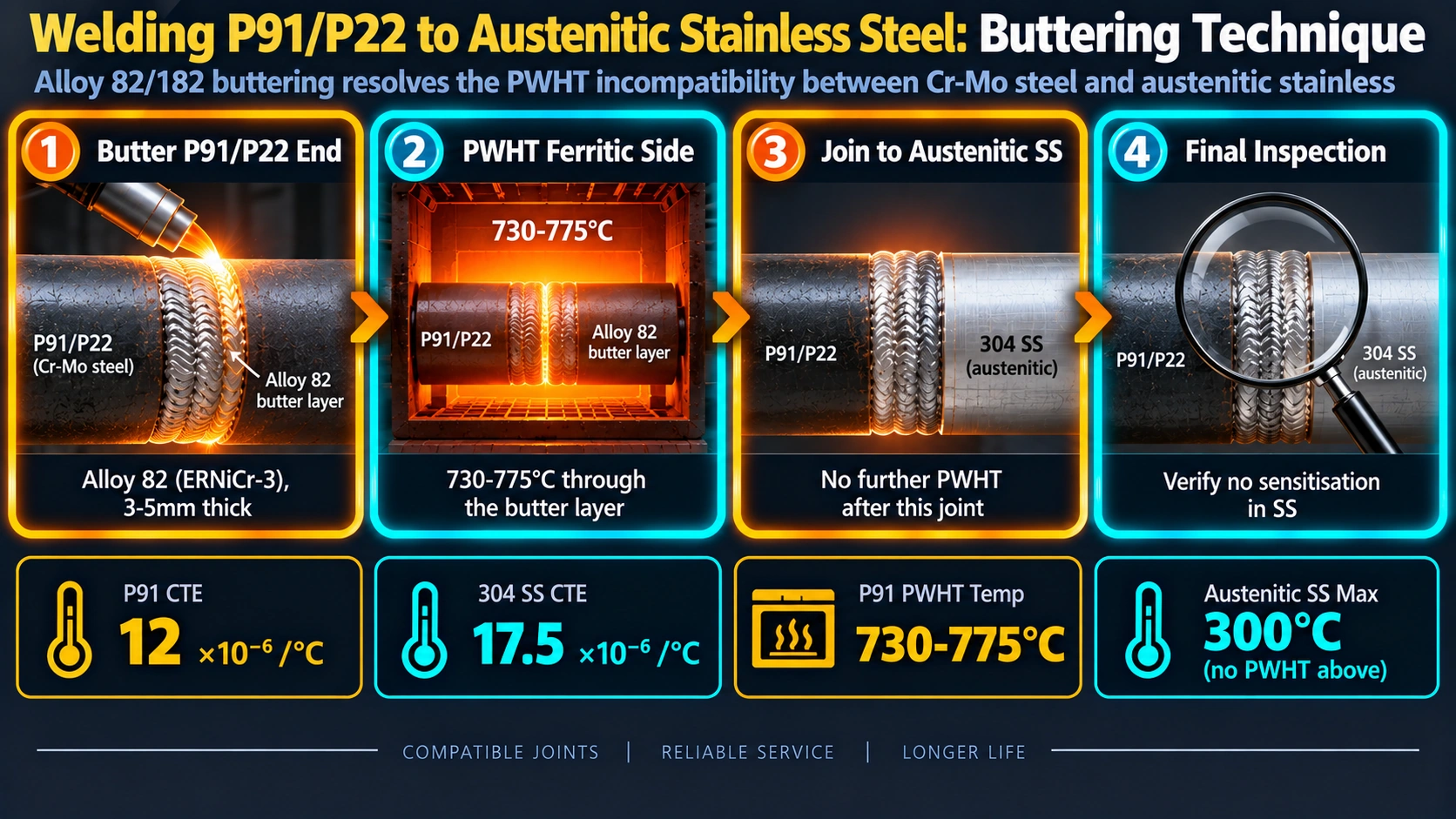
Buttering is the application of one or more layers of weld metal (the butter layer) to the prepared end of one component, followed by a full PWHT of the buttered end, before the component is joined to its dissimilar metal counterpart. Buttering is the universally adopted solution to the PWHT incompatibility problem in P91 to stainless DMWs, and it is the only approach that allows the P91 side of the joint to receive a full, correct PWHT without simultaneously sensitising the austenitic stainless steel.
Buttering Procedure — Step by Step
- P91 End Preparation Machine the P91 pipe or component end to the required weld bevel geometry. Degrease and clean to bare metal. Perform pre-butter MT or PT to confirm the base metal is free of cracks or laminations. Confirm preheat thermocouples are attached and calibrated.
- Preheat Application Preheat the P91 end to a minimum of 200 deg C (392 deg F) using resistance heating, induction heating, or propane burners with ceramic wool insulation wrap. Verify temperature at minimum 75 mm on each side of the intended butter zone. Maintain preheat throughout butter deposition.
- First Butter Layer — GTAW (TIG) with Alloy 82 Deposit the first butter layer using GTAW (GTAW process preferred for root/first layer — best control, lowest heat input, lowest diffusible hydrogen). Use ERNiCr-3 (Alloy 82) filler wire. Maintain interpass temperature below 300 deg C. Typically 1 to 2 mm thick per layer.
- Subsequent Butter Layers Continue depositing butter layers until a minimum total butter thickness of 6 to 10 mm is achieved (sufficient to allow machining back to a clean, sound surface after PWHT). SMAW (Alloy 182) or GTAW (Alloy 82) may be used for fill layers. Monitor and record interpass temperature continuously.
- Hydrogen Bake-Out Immediately after completing the butter layer deposition and before allowing the assembly to cool below preheat temperature, raise the preheat to approximately 300 to 350 deg C and hold for 1 to 2 hours to remove diffusible hydrogen from the deposited nickel-alloy butter. This step is mandatory for thick sections or where SMAW with Alloy 182 is used.
- Slow Controlled Cooling After hydrogen bake-out, cool the assembly slowly under insulation at a controlled rate (typically 50 to 100 deg C/hour maximum) to ambient temperature. Rapid cooling risks thermal shock cracking in the P91 HAZ before PWHT has been applied.
- NDE of Buttered Assembly Perform PAUT or RT of the buttered layer and the P91 HAZ. Perform MT or PT of the butter surface. Perform hardness survey on the P91 base metal and HAZ. All results must meet the acceptance criteria specified in the WPS and ITP before PWHT is commenced.
- PWHT of Buttered P91 End Apply PWHT to the buttered P91 assembly at 730 to 800 deg C (770 to 790 deg C optimal for most P91 applications) for the required hold time — minimum 1 hour per 25 mm of P91 wall thickness, minimum 2 hours total. Thermocouple directly attached to the weld. Temperature uniformity within ±15 deg C across the weld zone. Heating and cooling rates as per WPS (typically 100 to 150 deg C/hour through the martensitic transformation range 200 to 600 deg C).
- Post-PWHT Inspection After PWHT and cooling, perform hardness survey to confirm P91 HAZ hardness is HV10 200 to 275. Perform PAUT or RT of the buttered zone. Perform MT of butter surface. If hardness is outside the acceptable range, perform an additional PWHT cycle. Document all results. This is a mandatory hold point for the Authorised Inspector.
- Final Joint Welding — No PWHT After This Step Machine the buttered face to the final weld bevel geometry, removing any surface oxidation from PWHT. Fit up to the 316H component. Weld the joint using the qualified DMW WPS — GTAW root with Alloy 82, followed by GTAW or SMAW fill and cap with Alloy 82 / 182. No PWHT after this weld. Preheat of the P91 side to 150 to 200 deg C still required for the final weld; the 316H side requires no preheat but must be at ambient or above.
PWHT Strategy for DMW Joints
The PWHT requirements for a P91 to stainless DMW can only be fulfilled correctly by the buttering approach described above. However, there are several variations and special cases that require additional engineering judgement:
Field Repair Welds — PWHT Constraints
During field repair of an existing DMW in a power plant, it is rarely practical to remove the P91 component to a workshop for buttering and PWHT before re-welding. Field PWHT of a DMW where the stainless steel side is already connected to the larger system presents a sensitisation risk. The accepted field approaches are:
- Local PWHT with insulated 316H side: Apply resistance or induction heating locally to the P91 side and P91 HAZ only, with careful insulation of the 316H side to prevent it reaching the sensitisation temperature range. Thermocouple verification of 316H temperature is mandatory. The 316H must not exceed 400 deg C during the P91 PWHT cycle.
- Low-temperature bake-out only: In cases where local PWHT cannot be performed without risk to the austenitic component, a low-temperature hydrogen bake-out (300 to 350 deg C) is performed as a minimum. This is not a substitute for full PWHT and does not achieve the required HAZ tempering; it is a compromise accepted only where full PWHT is impractical and the residual risk is accepted by the Owner’s engineering authority.
- Full replacement with new buttered spool: The technically correct but most costly approach — replace the entire DMW spool with a new factory-buttered and PWHT-qualified assembly. This is the approach specified by most power plant owner-operators for any repair involving a through-wall failure of a primary steam DMW.
PWHT Temperature Monitoring Requirements
Target PWHT temperature: 760–790 deg C (preferred within 730–800 deg C envelope)
Temperature uniformity: ±15 deg C across weld zone minimum
Soak time: 1 hr/25 mm P91 wall thickness; 2 hr minimum total
Heating rate: ≤200 deg C/hr above 300 deg C
Cooling rate: ≤150 deg C/hr from soak to 300 deg C; free cool below 300 deg C
Thermocouple requirements:
– Minimum 4 thermocouples per weld: 2 on weld body, 2 on HAZ at 3 and 9 o’clock positions
– Type K (NiCr-NiAl) or Type N (NiCrSi-NiSi) with current calibration certificate
– Thermocouple attachment: capacitor discharge (CD) welded — not clamped — to ensure thermal contact
All thermocouple readings and time-temperature records must be archived as part of the weld documentation package.
Welding and Fabrication Requirements
Welding Process Selection
GTAW (TIG) is the strongly preferred process for all passes in P91 to stainless DMW fabrication, particularly for the root pass and butter layers. GTAW offers the lowest heat input per unit volume deposited, the highest metallurgical control, the lowest diffusible hydrogen content, and the best fusion-line penetration control. SMAW with low-hydrogen nickel-alloy electrodes (Alloy 182, ENiCrFe-3) is acceptable for fill and cap passes on larger-diameter pipe.
| Pass Location | Preferred Process | Filler / Electrode | Key Controls |
|---|---|---|---|
| Butter first layer (P91 end) | GTAW mandatory | ERNiCr-3 (Alloy 82), 2.4 mm dia | Preheat 200 deg C; low heat input; no weave bead; ID bead if tube |
| Butter fill layers | GTAW preferred; SMAW acceptable | ERNiCr-3 / ENiCrFe-3 | Interpass max 300 deg C; minimum two layers before PWHT |
| Final weld root (post-PWHT butter) | GTAW mandatory | ERNiCr-3 (Alloy 82) | Preheat P91 butter side 150 deg C min; inert gas back-purge; visual |
| Final weld fill and cap | GTAW or SMAW | ERNiCr-3 / ENiCrFe-3; Alloy 617 per WPS | Interpass 300 deg C max; smooth weld cap profile (no undercut at P91 fusion line) |
| Weld overlay (oxide protection) | GTAW or SMAW | ERNiCrMo-3 (Alloy 625) or ER25Cr-20Ni | Applied after final weld; covers P91 fusion line outer surface; min 2 mm cover |
Key Fabrication Controls
- Inter-run cleaning: Remove all slag and oxide film between passes using stainless steel wire brushes (not carbon steel brushes, which contaminate nickel-alloy deposits with iron). Clean each pass with acetone before the next pass in critical applications.
- Ferrite number control in 316H weld metal: If any 316H filler is used (for example on the 316H side of the joint), the ferrite number (FN) of deposited weld metal must be 3 to 8 FN to prevent hot cracking. Verify using a ferritescope or WRC-1992 diagram on the WPS qualification test.
- Heat input limitation: Maximum recommended heat input for Alloy 82 nickel-alloy deposits is 1.5 kJ/mm for pipe wall less than 25 mm, and 2.5 kJ/mm for heavier sections. Excessive heat input in nickel alloys causes liquation cracking in the HAZ.
- Back-purging for tube and pipe root passes: For pipe bores where the ID surface quality is critical (particularly boiler tubes), maintain an argon or argon/helium back-purge at the ID to prevent oxidation of the root bead. This is especially important for the 316H side of the joint where oxide films reduce corrosion resistance.
ASME Code Requirements for DMW Joints
Welding Procedure Qualification (ASME Section IX)
DMW joints involving a change in P-Number constitute a separate, independent WPS qualification from either of the homogeneous welds. ASME Section IX QW-420 defines the essential variables for procedure qualification. The key qualification requirements for a P91 to 316H dissimilar weld using Alloy 82 filler are:
- The WPS must list both base metals by P-Number: P-No. 5B Group 2 (P91) and P-No. 8 (316H austenitic stainless). The PQR must test the actual combination welded — a PQR for P-No. 5B to P-No. 5B does not qualify the DMW.
- The F-Number of the filler metal must be qualified in the PQR. Alloy 82 (ERNiCr-3) is AWS F-Number 43; Alloy 182 (ENiCrFe-3) is F-Number 42. Changes in F-Number are essential variables requiring re-qualification.
- The A-Number (analysis number) of the deposited weld metal is an essential variable. The A-Number for nickel-alloy deposited weld metal is typically A-No. 10 (high alloy).
- PWHT conditions (temperature, time, heating and cooling rates) are essential variables for P91. Any change outside the qualified range requires a new PQR.
- Impact testing per QW-171 is required for DMW PQRs intended for ASME B31.3 Category M service or ASME Section VIII applications where impact testing is mandatory for either base metal at the design temperature.
ASME B31.3 — Dissimilar Metal Welds in Process Piping
ASME B31.3 Para. 323.2.3 specifically addresses base metal combinations in dissimilar welds. The key requirements are:
- The filler metal must be qualified to bridge the two base metals. The allowable stress of the DMW is governed by the weaker of the two base metals or the filler metal at the design temperature, whichever is lowest.
- PWHT requirements are determined by the more stringent requirements of either base material. Where one material requires PWHT and the other prohibits it (as in P91-to-stainless), the buttering approach is the accepted engineering solution, and the WPS must explicitly document the buttering and sequential PWHT procedure.
- For Category M fluid service, 100% radiographic or PAUT examination of DMW butt welds is required per Para. 344.7.
ASME Section VIII — Pressure Vessels
Dissimilar metal welds in pressure vessels fabricated to ASME Section VIII Division 1 are qualified per Section IX and must satisfy the applicable UCS, UHA, or UNF requirements for each base material. For vessels with a P91 shell welded to a 316H nozzle or head, the PWHT requirement of UCS-56 for the P91 shell applies to the complete assembly unless the buttering approach is documented in the vessel design package and the AI confirms the PWHT sequence as applied to only the ferritic component. The vessel Code Data Report (Form U-1) must document all base material and filler metal specifications for DMW joints.
In-Service Inspection of DMW Joints
Every P91 and P22 DMW joint in a power plant should be registered in the plant’s pressure part register and subjected to a dedicated inspection programme. The frequency and methods are determined by the RBI (Risk-Based Inspection) assessment for that specific joint, based on its calculated remaining creep life, service history, and consequence of failure.
Inspection Hierarchy — From Least to Most Invasive
| Method | What It Detects | When Applied | Limitation |
|---|---|---|---|
| Visual inspection with dye or fluorescent penetrant (PT) | Surface-breaking cracks, oxide notch depth, weld cap condition | Every planned outage; easily performed | Surface only; does not detect sub-surface damage |
| Hardness survey (Vickers portable) | Hardness changes indicating carbon depletion (soft zone) or re-hardening | Every major overhaul (typically every 4–6 years) | Only gives hardness at surface; no through-wall information |
| Metallographic replication | Creep void density and distribution (Neubauer damage stages A–E); carbide coarsening; grain boundary oxidation | Major overhaul; when PT or hardness anomaly found | Surface preparation required; small area sample; needs experienced metallurgist interpretation |
| PAUT (S-scan) | Creep cracks, lack of fusion, Type IV cracks; sizing ≥2 mm height | Baseline at commissioning; every 2–5 years for high-risk DMWs | Near-surface dead zone; requires qualified procedure and calibration block |
| TOFD | Defect height sizing for creep cracks found by PAUT; ±1 mm accuracy | When PAUT detects a relevant indication requiring sizing | Near-surface dead zone (lateral wave); requires experienced interpreter |
| Small-bore sampling (ex-service metallurgy) | Direct microstructural assessment of carbon depleted zone; creep void density; precipitate distribution; time-to-failure life fraction | When replication shows Stage C damage or above; planned remaining-life study | Destructive; requires repair weld after sampling; component must be shut down |
Neubauer-Wedel Creep Damage Assessment Scale
The Neubauer-Wedel scale provides a standardised framework for classifying creep damage observed in metallographic replicas taken from DMW fusion line surfaces:
| Stage | Microstructural Observation | Recommended Action |
|---|---|---|
| A | Isolated creep voids; no orientation; random distribution | Continue operation; increase inspection frequency |
| B | Oriented creep voids; aligned in direction of maximum principal stress | Continue operation; perform remaining life calculation; increase frequency |
| C | Macro-creep cracks (linked voids forming micro-cracks) | Remaining life assessment; plan replacement; consider interim inspection every 6 months |
| D | Macro-cracks (visible grain boundary cracking >1 mm) | Replace at next opportunity; consider immediate shutdown if primary steam line |
| E | Through-thickness cracking; component near failure | Immediate shutdown; emergency replacement required |
Life Extension and Remnant Life Assessment
For power plants approaching or past the original design life of their DMW joints (typically 100,000 to 200,000 hours of operation), a formal remaining creep life assessment is required before authorising continued operation. This assessment combines:
- Operating history review: Total operating hours, number of start-stop cycles, actual operating temperature profile (from plant historian data), and incident history (overpressure events, temperature excursions, rapid cool-down).
- Life fraction consumed: Using the linear damage rule (Miner’s Rule applied to creep) and the Larson-Miller parameter to estimate the fraction of creep life consumed based on the actual temperature-time-stress history.
- Physical condition assessment: Neubauer stage from replication, hardness survey results, PAUT/TOFD data, and any ex-service metallurgy from small-bore samples.
- Remaining life calculation: Using combined creep-fatigue interaction models or the Omega creep damage parameter (for advanced assessments per API 579 Part 10 / ASME FFS-1).
Recommended Reference Books
The following references are used by power plant materials engineers, welding engineers, and inspection specialists working with dissimilar metal welds in high-temperature service.
Disclosure: WeldFabWorld participates in the Amazon Associates programme (StoreID: neha0fe8-21). If you purchase through these links, we may earn a small commission at no extra cost to you. This helps support free technical content on this site.