Eddy Current Testing (ECT) for Weld Inspection — The Complete Technical Guide
Eddy Current Testing (ECT) is one of the oldest and most versatile electromagnetic nondestructive testing techniques in industrial use — yet its application to weld and fabrication inspection is consistently under-represented in welding-specific technical literature. While ECT’s role in heat exchanger tube inspection is well established and widely practised, its applications to surface crack detection in austenitic stainless steel weld toes, corrosion mapping in non-ferrous components, and the detection of stress corrosion cracking in nuclear pressure boundaries represent a significant and growing body of inspection capability that every qualified NDT Level II practitioner and welding inspector should understand.
ECT operates without a couplant, without radiation, and without requiring surface preparation beyond basic cleaning. It can detect surface-breaking and near-surface defects at scan speeds far exceeding those of magnetic particle testing or dye penetrant testing. At its most sophisticated — in remote field ECT (RFT), alternating current field measurement (ACFM), and pulsed eddy current (PEC) variants — it can inspect through thick coatings and insulation, quantify remaining wall thickness in insulated pipework, and detect surface-breaking cracks in ferritic steel structures that standard ECT cannot reach.
This guide provides a complete technical reference: the physics of electromagnetic induction and eddy current generation, the skin depth equation and frequency selection strategy, the impedance plane as the central signal interpretation tool, the full range of probe types from simple surface probes to multi-coil rotating array probes for heat exchanger inspection, calibration requirements, ASME Section V and ASTM code compliance, and a critical comparison of ECT against MT and PT for surface discontinuity detection. The guide closes with a 30-question timed quiz covering all major topics.
Electromagnetic Induction Principle
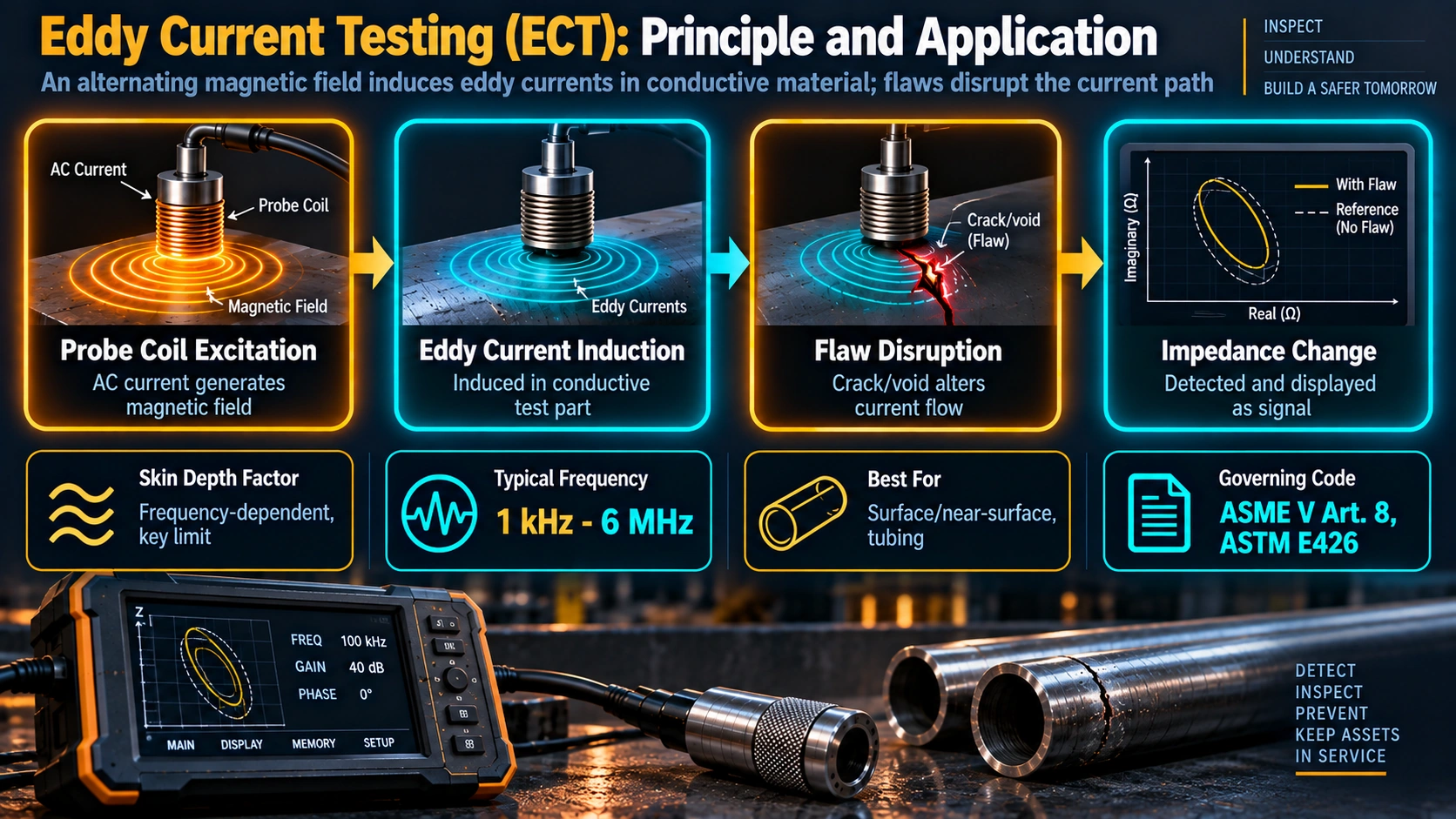
The physical foundation of ECT is Faraday’s Law of Electromagnetic Induction, combined with Lenz’s Law. Understanding these two principles explains everything about how eddy current signals are generated and why they change in the presence of a defect.
Faraday’s Law and Eddy Current Generation
When an alternating current (AC) flows through the test coil of an ECT probe, it generates an alternating magnetic field (primary field) around the coil. When this primary magnetic field passes through an electrically conductive material, it induces an electromotive force (EMF) in the material by Faraday’s Law. This EMF drives circular electrical currents — eddy currents — within the material in planes perpendicular to the magnetic flux lines. The eddy currents are called “eddy” currents because they circulate in closed loops, similar to eddies in a flowing stream.
Secondary Field and Impedance Loading
By Lenz’s Law, the eddy currents generate their own magnetic field (secondary field) that opposes the primary field. This secondary field interacts back with the test coil, reducing the effective inductance of the coil and increasing its effective resistance — a phenomenon called impedance loading. The magnitude and phase of this impedance loading depend on the electrical conductivity, magnetic permeability, and geometry of the test material. Any discontinuity (crack, void, corrosion, dimensional change) that interrupts or distorts the eddy current flow causes a measurable change in the coil’s complex impedance:
Z = R + jX_L = R + j(2πfL)
Where:
Z = Complex impedance of the probe coil (Ω)
R = Effective resistance (real part) — affected by eddy current losses
X_L = Inductive reactance (imaginary part) = 2πfL
f = Test frequency (Hz)
L = Effective inductance of the coil (H) — reduced by secondary field
Effect of a surface crack on impedance:
A crack interrupts eddy current flow paths → reduces eddy current magnitude
→ reduces secondary opposing field → allows L to increase and R to decrease
ΔZ_crack = ΔR + jΔX_L
The direction and magnitude of ΔZ in the impedance plane identifies the defect type.
Skin Depth and Frequency Selection
The skin depth (also called standard depth of penetration, δ) is the most fundamental physical parameter governing ECT sensitivity distribution in the test material. It defines the depth at which eddy current density has decreased to 1/e (≈37%) of its surface value. Defects must be within the zone of significant eddy current activity to produce detectable signals.
δ = 1 / √(π × f × μ × σ)
Where:
δ = Skin depth (m)
f = Test frequency (Hz)
μ = Absolute magnetic permeability = μ_0 × μ_r (H/m)
μ_0 = 4π×10⁻&sup7; H/m ; μ_r = 1.0 for non-ferromagnetic materials
σ = Electrical conductivity (S/m)
Practical form for non-ferromagnetic materials (mm):
δ (mm) ≈ 50 / √(f × σ_IACS)
where f is in Hz and σ_IACS is conductivity as % of copper (IACS)
Reference skin depths at 100 kHz for common materials:
Copper (σ_IACS = 100%): δ ≈ 0.21 mm
Aluminium (σ_IACS = 61%): δ ≈ 0.27 mm
304 Stainless (σ_IACS = 2.5%): δ ≈ 1.34 mm
Carbon steel (μ_r ≈ 200): δ ≈ 0.04 mm ← very shallow — ferromagnetism problem
Useful inspection depth is approximately 3δ (eddy current density ~5% of surface value)
Frequency Selection Strategy
| Inspection Goal | Frequency Strategy | Typical Range | Trade-off |
|---|---|---|---|
| Surface crack detection (austenitic SS) | High frequency — maximise surface sensitivity | 100 kHz – 2 MHz | Excellent surface sensitivity; poor subsurface penetration |
| Near-surface defect detection (2–5 mm depth) | Medium frequency | 10–100 kHz | Balanced surface/subsurface; moderate spatial resolution |
| Heat exchanger tube wall inspection | Optimised to give 3δ = tube wall thickness | 10–300 kHz (depends on material and wall) | Full wall penetration; surface resolution reduced |
| Corrosion mapping through coating | Low frequency — penetrate coating + reach substrate | 1–50 kHz | Deep penetration; reduced defect resolution |
| Carbon steel (ferromagnetic) | Saturation field required to reduce μ_r to ~1; or use ACFM/MFL | N/A for standard ECT | ECT not reliable without saturation or ACFM |
The Impedance Plane — Signal Interpretation
The impedance plane (also called the Lissajous display in some instrument conventions) is the two-dimensional signal display on which all ECT signal interpretation is performed. The horizontal axis represents resistance (R) and the vertical axis represents inductive reactance (X_L). The probe coil’s normalised impedance appears as a point on this plane that moves in characteristic directions when the probe encounters different material conditions.
Signal Phase Angle — The Key Interpretation Tool
The phase angle of an ECT signal is the angle between the signal direction on the impedance plane and a reference direction (typically the lift-off direction, which is set horizontal by phase rotation). Different signal sources produce characteristic phase angles that allow the trained analyst to distinguish defect types:
| Signal Source | Characteristic Phase Angle | Display Appearance | Interpretation |
|---|---|---|---|
| Lift-off variation | 0° (set horizontal by phase rotation) | Horizontal excursion from null | Reference direction; all other signals identified relative to this |
| Surface-breaking crack | ~70–90° from lift-off (upward) | Near-vertical signal from null | Depth increases as phase angle increases toward 90° |
| Subsurface crack (below 1 mm) | ~30–70° from lift-off | Diagonal signal, partly upward | Shallower phase angle than surface crack at same amplitude |
| Conductivity change (alloy variation) | ~90–120° (opposite direction to crack) | Signal moves to left and upward | Typical of weld HAZ microstructure changes; not a defect signal |
| Wall thinning (OD corrosion) | ~160–180° from surface crack | Signal moves roughly horizontal-left | Gradual wall loss; phase angle helps differentiate from crack |
| Permeability variation (ferromagnetic) | Variable — large amplitude random signals | Large loop signals, unpredictable direction | Dominates impedance plane for ferritic steel — masks defect signals |
Probe Types and Configurations
ECT probe design is as varied as the inspection applications it serves. The choice of probe type fundamentally determines which defect orientations are detectable, what surface geometries can be inspected, and what balance is struck between sensitivity and noise rejection.
Absolute Probe
Single coil configuration measuring absolute impedance. Responds to gradual changes in material properties (conductivity, permeability, wall thickness). Best for detecting gradual wall loss, corrosion, and material property variations. Less sensitive to small, localised defects. Used for general purpose surface scanning and heat exchanger wall thinning detection.
Differential Probe
Two identical coils wound in opposition, comparing two adjacent inspection zones. Responds strongly to rapid impedance changes (localised defects, sharp edges) but suppresses gradual changes. Excellent for detecting tight cracks and small pits. The differential configuration largely cancels lift-off noise, temperature drift, and gradual material variations — making it the preferred choice for surface crack detection in welds.
Bobbin (ID) Probe
Cylindrical probe with circumferential winding, pulled through the bore of a tube. Inspects the full tube circumference in a single pass. Standard probe for heat exchanger tube inspection. Sensitive to general wall thinning, pitting, and circumferential defects. Has reduced sensitivity to axially oriented defects (parallel to tube axis) because axial cracks do not significantly interrupt the circumferential eddy current flow paths.
Rotating Probe (RPC)
A small pancake coil that rotates at high speed (typically 600–1,800 RPM) as it is pulled through the tube, producing a helical scan path. Detects defects in all orientations including axial cracks that bobbin probes may miss. Provides high-resolution C-scan imaging of tube wall. Slower than bobbin scanning and requires precise mechanical stability. Standard for detecting stress corrosion cracking in nuclear steam generator tubes.
Surface Probe (Pancake Coil)
Flat or slightly concave coil for scanning flat or curved surfaces. Used for weld toe crack detection, corrosion mapping, and general surface inspection on non-ferromagnetic materials. Spring-loaded designs maintain consistent lift-off. For weld inspection, the probe is scanned parallel to and across the weld in a grid pattern to detect both transverse and longitudinal surface cracks.
Array Probe
Multiple coil elements arranged in a linear or matrix configuration, operating simultaneously or in multiplexed sequence. Covers wider inspection area per pass than single-element probes, significantly reducing inspection time. Used in aerospace fastener hole inspection, large-area corrosion mapping, and advanced heat exchanger tube inspection. Data displayed as 2D amplitude or phase map.
Lift-off and Fill Factor
Lift-off — Surface Probe Applications
Lift-off is the separation distance between the ECT probe coil and the inspection surface. For surface probes, even a small change in lift-off produces a characteristic impedance signal that can mask defect signals or be misinterpreted as a defect. Because lift-off changes commonly occur on real inspection surfaces — from surface roughness, paint films, weld cap geometry, and probe wobble — lift-off noise management is critical to reliable surface ECT.
The impedance plane behaviour of lift-off at a given frequency defines the lift-off direction, which is typically near-horizontal on a properly normalised impedance plane. By adjusting the instrument phase rotation so that the lift-off signal is exactly horizontal, defect signals (which appear at angles of 60° to 90° from lift-off) can be distinguished from probe positioning noise. This phase-based separation is the primary advantage of the impedance plane display over simple amplitude meters.
Fill Factor — Tube Probe Applications
For bobbin probes inspecting tubes, the equivalent of lift-off is the fill factor (η), defined as the ratio of the probe outer diameter to the tube inner diameter squared:
η = (D_probe / D_tube_ID)²
Where D_probe = outer diameter of probe and D_tube_ID = inner diameter of tube
Fill factor ranges from 0 (probe much smaller than tube) to 1.0 (perfect fit)
For standard heat exchanger tube inspection:
Target fill factor: η ≥ 0.90 (probe diameter ≥ 95% of tube ID)
Low fill factor increases lift-off noise and reduces defect sensitivity uniformly around tube circumference.
Limitations on Ferromagnetic Steel — Why Standard ECT Does Not Work
Ferritic carbon and low-alloy steels are ferromagnetic — they have relative magnetic permeabilities (μ_r) of 100 to several thousand, compared to 1.0 for austenitic stainless steel, aluminium, titanium, and other non-ferromagnetic materials. This high permeability creates two fundamental problems for standard ECT:
- Drastically reduced skin depth: From the skin depth equation, δ is inversely proportional to √(μ_r). For carbon steel with μ_r = 200, the skin depth at 100 kHz is approximately 0.04 mm — the eddy currents are confined to a superficial skin less than 0.1 mm thick. Only defects that break the surface within this extremely thin zone would generate detectable signals, and even these are overwhelmed by noise from permeability variations.
- Permeability noise dominates the signal: Microstructural variations in ferritic steel — HAZ grain structure changes, martensite/bainite distributions, carbide precipitates, weld pool solidification zones — all produce local permeability variations that generate large, random impedance signals on the ECT display. These permeability noise signals are orders of magnitude larger than the defect signals, making reliable defect detection essentially impossible.
Magnetic Saturation — Overcoming Ferromagnetism
By applying a sufficiently strong DC magnetic field to the inspection area simultaneously with the ECT technique, the steel can be magnetically saturated — driven to the point where the relative permeability approaches 1.0. In a saturated state, ferritic steel behaves electromagnetically like a non-ferromagnetic material, and standard ECT becomes effective. Magnetic saturation probes incorporate permanent magnets or DC electromagnets integrated with the ECT coil assembly. Saturation-based ECT is used for ferritic steel tube inspection (ASTM E309) in applications such as feedwater heater tubes, condenser tubes, and carbon steel heat exchanger tubes.
Heat Exchanger Tube Inspection
Heat exchanger tube ECT is the largest single application of eddy current testing in the process industries. Every refinery, power plant, and chemical facility operates heat exchangers containing thousands of individual tubes — and the structural integrity of those tubes is critical to both plant reliability and safety. A tube-side fluid leak into the shell-side fluid (or vice versa) can cause process contamination, loss of containment, or uncontrolled chemical reactions.
Inspection Objectives
Heat exchanger tube ECT inspections are designed to quantify:
- Wall thinning from internal corrosion, erosion, or external pitting (expressed as percentage wall loss)
- Pitting (localised corrosion attacks causing small-diameter but deep penetrations)
- Stress corrosion cracking (SCC) — particularly in austenitic stainless steel and brass/copper-nickel alloys
- Intergranular attack (IGA) and intergranular stress corrosion cracking (IGSCC) in sensitised austenitic stainless tubes
- Tube end cracking from tube-to-tubesheet weld region
- Manufacturing defects such as seam weld flaws in welded tubes
Standard Bobbin Probe Inspection Protocol
A standard heat exchanger tube ECT inspection follows these phases: instrument setup and calibration using a calibration standard tube (same material, OD, and wall thickness as the production tubes, containing reference notches and drilled holes); probe selection for correct fill factor (≥0.90); inspection of 100% of tubes in the pass (or a statistical sample in accordance with the maintenance programme); signal analysis and sizing; and report generation documenting all indications above the recording threshold.
Calibration Reference Standard — ASTM Requirements
Per ASTM E243 and ASME Section V Article 8, the calibration reference standard for heat exchanger tube ECT must contain:
- A through-wall hole — 3.2 mm (1/8 inch) diameter for tubes up to 25.4 mm OD
- Flat-bottomed holes (FBHs) at 20%, 40%, 60%, and 80% wall depth for the test tube wall thickness
- A circumferential OD groove — 10% depth of wall thickness, 3.2 mm width
- Material identical to the tubes being inspected — same nominal composition, temper, and processing condition
- A certified tube with no extraneous signals from the manufacturing process
Tube Wall Loss Assessment and Plugging Criteria
The primary output of heat exchanger tube ECT is the percentage wall loss at each detected indication. Plugging criteria — the wall loss threshold above which a tube is removed from service by installing a tube plug — are defined in the facility’s equipment maintenance programme, typically informed by the relevant design code and risk tolerance:
ASME Section XI (Nuclear): Plug at ≥ 40% wall loss (for steam generator tubes)
TEMA / HTRI (Non-nuclear): Plug at ≥ 75% wall loss (typical owner standard)
API RP 571 / RBI basis: Plug threshold set by remaining life calculation
Signal amplitude from calibration FBH at known depth is used to correlate to % wall loss.
Through-wall hole signal = 100% reference. FBH at 20%, 40%, 60%, 80% provide calibration curve.
All indications above 20% wall loss should be sized and recorded. Plugging at specified threshold.
Weld Surface Crack Detection by ECT
Surface ECT for weld crack detection is applicable to non-ferromagnetic weld materials — principally austenitic stainless steel welds, nickel alloy welds, titanium welds, and aluminium welds. In these materials, ECT offers scanning speed and automation advantages over PT, and does not require the surface preparation that PT demands. ECT is particularly valuable for weld toe crack detection, where stress concentrations from the geometric notch of the weld toe make this location the most likely fatigue crack initiation site.
Scan Pattern for Weld Inspection
For a complete weld surface examination, the ECT surface probe is scanned in two directions:
- Parallel to the weld axis — to detect transverse (transverse-to-weld) surface cracks originating from thermal stress or hydrogen cracking
- Perpendicular to the weld axis (across the weld) — to detect longitudinal cracks in the weld metal and HAZ, and weld toe cracking
The scan increment (distance between adjacent scan passes) must be less than or equal to the minimum detectable crack length divided by two, to ensure that no defect is missed between scan lines. For high-frequency surface ECT on polished austenitic stainless weld surfaces, scan increments of 2 to 5 mm are typical. On rough as-welded surfaces, the larger lift-off variations require either a lower-frequency probe with greater depth penetration or post-weld surface preparation by grinding to achieve consistent probe coupling.
ECT vs MT and PT for Surface Crack Detection
The choice between ECT, MT, and PT for surface discontinuity detection in welds is determined by the material, surface condition, inspection speed requirement, and code requirements. See the full comparison in the ECT vs MT vs PT section below.
Calibration Standards and Procedures
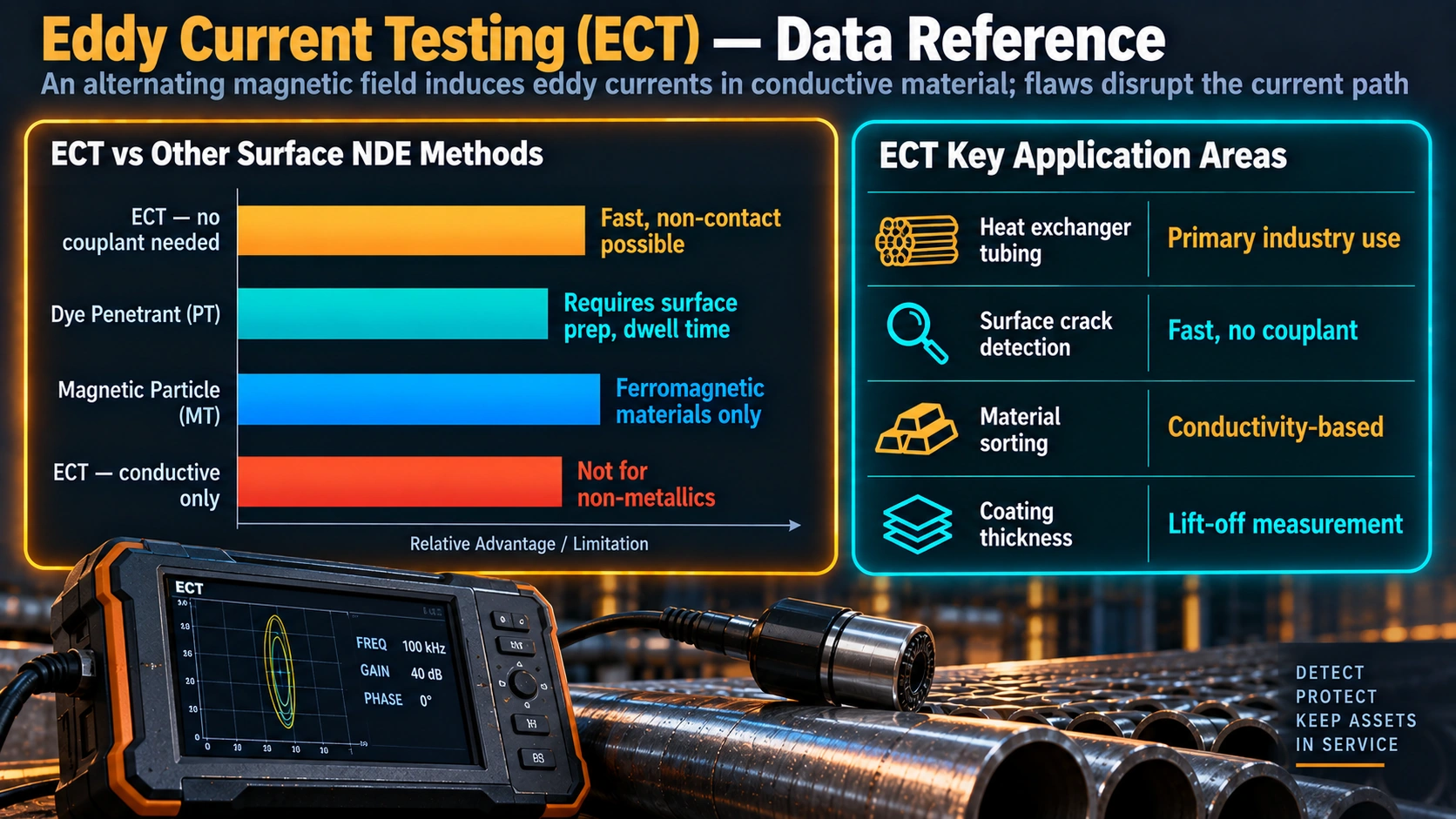
ECT calibration establishes the sensitivity, phase response, and signal-amplitude-to-defect-size relationship for each inspection configuration. Because ECT is a relative measurement technique — comparing the impedance response from the inspection object to that from known reference standards — calibration quality directly determines inspection reliability.
Reference Standard Requirements
ASME Section V Article 8 and ASTM standards specify the following requirements for ECT reference standards:
- Same material specification (alloy, temper, form) as the component being inspected — conductivity and permeability variations between alloys are significant and will produce wrong calibration results if a non-representative standard is used
- Same nominal geometry (OD, wall thickness) as the inspection component for tube applications
- Reference reflectors machined to known dimensions: notches (EDM or mechanically cut), flat-bottom holes, and through-holes as required by the applicable standard
- Calibration standard must be traceable and documented with dimensional verification of all reference reflectors
- No extraneous signals from manufacturing processes that would interfere with calibration
Calibration Frequency
Calibration must be verified:
- At the start of each inspection period (shift, day, or tube bundle, depending on the inspection scope)
- After any probe, cable, or instrument change
- When ambient or material temperature changes by more than 10 deg C — temperature affects both material conductivity and probe coil parameters
- After any interruption of the inspection that could affect equipment performance
- At the end of each inspection period — if calibration has drifted beyond tolerance, all inspections performed since the last valid calibration must be re-evaluated
Code and Standard Acceptance for ECT Multiple codes
| Code / Standard | ECT Application | Key Requirements | Acceptance Basis |
|---|---|---|---|
| ASME Section V Article 8 | ECT of tubular products and materials; surface ECT of welds | Written procedure; Level II personnel per SNT-TC-1A; calibration standard per Article 8; procedure demonstration | Amplitude-based; signal exceeding calibration reference triggers evaluation and disposition |
| ASME Section XI IWA-2223 | In-service inspection of nuclear steam generator and heat exchanger tubes; surface ECT of welds | Most stringent requirements; performance demonstration mandatory; personnel qualified per ASME Section XI | For steam generator tubes: plug at ≥40% wall loss; for surface cracks: length and depth limits per IWB/IWC tables |
| ASTM E426 | ECT of seamless and welded tubular products; quality acceptance at mill | Probe type, frequency, calibration notch specifications; comparison to reference standard | Amplitude comparison to reference notch; reject if signal exceeds reference |
| ASTM E309 | ECT of steel tubular products using magnetic saturation | Saturation field requirements; calibration standard; frequency and probe specs for ferromagnetic tubes | Amplitude-based rejection criteria per applicable procurement specification |
| ASTM E243 | ECT of copper and copper alloy tubes (heat exchangers) | Calibration reference standard with FBHs at 20%, 40%, 60%, 80% depth; bobbin probe specifications | Percentage wall loss; plugging threshold per maintenance programme |
| AWS D1.1 Annex | Surface ECT as alternative to MT/PT for non-ferromagnetic weld metals | Procedure per ASME Section V; personnel qualification; calibration on representative reference standard | No relevant indication of surface breaking defects exceeding the applicable dimensional limits |
| EN ISO 15549 | ECT of metallic materials — European standard | Five examination levels (1A to 1E) with progressively stringent requirements; personnel per EN ISO 9712 | Amplitude and phase-based; signal level above reference level requires evaluation and dispositioning |
| API 570 / API RP 583 | In-service inspection of process plant piping and heat exchangers; corrosion under insulation (with PEC) | Inspection interval based on RBI; ECT for tube inspection; PEC for CUI screening | Remaining life calculation based on measured wall loss and corrosion rate |
Advanced ECT Variants: ACFM, RFT, and Pulsed Eddy Current
Alternating Current Field Measurement (ACFM)
ACFM was developed specifically to address the limitation of conventional ECT on ferromagnetic steel surfaces. Instead of measuring coil impedance, ACFM introduces a uniform alternating current into the inspection surface via an electromagnetic induction field and then measures the resulting surface magnetic field components using separate pick-up coils. A surface-breaking crack disrupts the induced current flow, producing characteristic changes in the Bx (parallel to crack) and Bz (perpendicular to surface) magnetic field components that allow both detection and depth sizing of the crack without requiring magnetic saturation.
ACFM’s key advantages in weld inspection are:
- Works through paint, coatings, and marine growth — coating removal not required
- Applicable to ferritic steel without magnetic saturation
- Provides crack depth sizing in addition to detection — a major advantage over MT which detects but cannot size
- Operable at elevated temperatures (above 200 deg C with specialised probes)
- Widely used for subsea structural welds, offshore jacket inspections, and topside steel where coating removal for MT/PT is impractical
Remote Field Eddy Current Testing (RFT)
Remote Field Technique (RFT) is used for inspection of ferromagnetic tubes (carbon steel, low alloy steel, ferritic stainless steel) where standard ECT is ineffective due to the high permeability. In RFT, the exciter coil and receiver coil are separated by a distance of approximately two to three tube diameters. The magnetic field energy from the exciter travels through the tube wall into the remote field outside the tube, propagates along the tube, and re-enters the tube wall to reach the receiver. This double-wall transmission path gives RFT roughly equal sensitivity to OD and ID defects — a significant advantage over conventional ECT which predominantly detects ID defects. RFT is the standard technique for carbon steel heat exchanger tubes in refinery and power plant applications.
Pulsed Eddy Current (PEC)
Pulsed Eddy Current uses a broad-band pulse rather than a single-frequency sinusoidal signal. The pulse contains a wide spectrum of frequencies simultaneously, meaning each frequency component penetrates to a different depth in the material. By analysing the time-domain decay of the received pulse, PEC can measure through-wall thickness even through insulation, fireproofing, and other non-conductive coatings up to 100 mm thick. PEC is the primary technique for Corrosion Under Insulation (CUI) screening on insulated pipework, performing wall thickness mapping without removing insulation. It does not require a couplant, and the large probe footprint allows rapid coverage of large pipe areas.
ECT vs MT vs PT — Surface Discontinuity Detection Comparison
| Parameter | ECT | MT | PT |
|---|---|---|---|
| Applicable materials | Non-ferromagnetic conductive materials (austenitic SS, Ni alloys, Al, Ti, Cu alloys). Ferromagnetic with saturation or ACFM. | Ferromagnetic materials only (carbon steel, low alloy steel, ferritic SS) | Any non-porous material — ferromagnetic and non-ferromagnetic |
| Defect types detected | Surface and near-surface (up to 3δ); subsurface pores/cracks; wall thickness loss | Surface-breaking and very near-surface (<3 mm) defects; excellent for cracks | Surface-breaking defects only; very high sensitivity to fine cracks |
| Surface preparation required | Minimal — clean to bare metal or through thin coating; probe must make reliable contact | Moderate — remove loose scale, heavy paint; substrate must be accessible | Extensive — clean, dry, free of contaminants; coating removal mandatory |
| Inspection speed | Very fast — automated scanning at 100–500 mm/s | Moderate — AC yoke or prod technique; application and developer time | Slow — dwell time for penetrant (10–30 min) plus developer time |
| Depth sizing capability | Limited — phase angle gives qualitative depth indication; ACFM gives sizing | None — MT detects only; cannot size crack depth | None — PT detects only; cannot size crack depth |
| Record keeping | Full digital record — impedance plane traces, amplitude maps permanently stored | Photographic or sketch only unless digital imaging added | Photographic or sketch; no quantitative record without additional measurement |
| Temperature limitations | Standard probes to ~200 deg C; specialised ACFM probes to 300+ deg C | Limited by developer and ink flashpoint; standard to ~300 deg C with dry technique | Standard PT: ~10–50 deg C; high-temp PT available to ~300 deg C |
| Health and safety | No hazardous materials; no radiation; no chemicals | Requires magnetic ink (oil or water based); yoke requires electrical safety | Penetrant and developer chemicals — VOC and flammability hazards; skin/respiratory protection required |
| Code acceptance for welds | ASME V Art. 8; AWS D1.1 (non-ferromagnetic); ASME XI nuclear; EN ISO 15549 | ASME V Art. 7; AWS D1.1 mandatory for ferritic structural steel; ASME VIII; ASME IX | ASME V Art. 6; AWS D1.1; ASME VIII; ASME IX; B31.3 |
| Best application | Austenitic SS weld cracks; heat exchanger tubes; automated high-speed scanning; CUI (PEC) | Ferritic steel welds; HAZ cracks; magnetic yoke quick check; weld root MT on pipe | All materials where surface cleaning is feasible; tight cracks; non-ferromagnetic material surface defects |
Personnel Qualification
| Scheme | Certification | Region | ECT-Specific Notes |
|---|---|---|---|
| ASNT SNT-TC-1A | ET Level II / Level III | USA; ASME codes | Employer Written Practice must specify ET training hours; heat exchanger tube ECT requires documented tube-specific training |
| ASNT CP-189 | ET Level II / Level III (central exam) | USA; ASME codes | Third-party examination more rigorous than SNT-TC-1A; increasingly specified for critical ECT applications |
| PCN (BINDT) | ET Level 2 + sector endorsement | UK; Europe; offshore | ACFM has a separate qualification route; heat exchanger tube ECT requires industrial sector qualification |
| EN ISO 9712 | ET Level 2 (central exam) | Europe; EN-governed projects | Method ET + sector code (manufacturing or in-service); practical exam includes tube ECT and surface ECT |
| ASME Section XI | UT/ET Level II per PDI | Nuclear USA | Performance Demonstration Initiative (PDI) qualification required for nuclear steam generator tube ECT; blind round-robin on flawed qualification set |
Recommended ECT Equipment and References
Disclosure: WeldFabWorld participates in the Amazon Associates programme (StoreID: neha0fe8-21). If you purchase through these links, we may earn a small commission at no extra cost to you. This helps support free technical content on this site.
Frequently Asked Questions
What is eddy current testing and how does it work?
What is the standard depth of penetration (skin depth) in eddy current testing?
Why is eddy current testing not directly applicable to ferritic carbon steel weld inspection?
What is the impedance plane in ECT and why is it important?
What probe types are used in eddy current testing of heat exchanger tubes?
What codes and standards govern eddy current testing in industrial applications?
What is lift-off in ECT and how is it managed?
What is ACFM and how does it differ from conventional ECT?
Related Technical Guides
Eddy Current Testing Quiz
30 questions — 20 seconds per question — ECT Level II/III standard
ECT Knowledge Quiz
30 questions covering ECT principles, skin depth, impedance plane, probe types, heat exchanger tube inspection, calibration, code requirements, ACFM, RFT, and PEC. Designed for NDT Level II/III practitioners.