Weld Joint Efficiency Factor — ASME B31.3 Table 302.3.4: The Complete Engineer’s Reference
If you have ever worked through an ASME B31.3 pipe wall thickness calculation and found yourself wondering what the E_W term in the denominator actually means, why it is 0.85 for one pipe specification and 1.00 for another, or whether upgrading it by radiographic examination is allowed — this article is your complete reference. The weld joint efficiency factor is one of the most consequential yet least-explained variables in the B31.3 design equation. Getting it wrong by even one tier — using E_W = 1.00 when the correct value is 0.85 — overestimates the allowable working pressure of the installed pipe by more than 17 percent, a potentially unsafe miscalculation that could have serious integrity consequences.
This guide covers everything: the physical meaning of E_W, the complete B31.3 Table 302.3.4 values for all common pipe specifications, how E_W interacts with the wall thickness formula, how it differs from the W weld joint strength reduction factor, when and how E_W can be upgraded through radiographic examination of the seam, and a set of fully worked calculation examples comparing seamless and welded pipe for the same design conditions. Every calculation step is shown, every code clause is cited, and every common field and design-office error is highlighted.
What is the Weld Joint Efficiency Factor? Para. 302.3.5
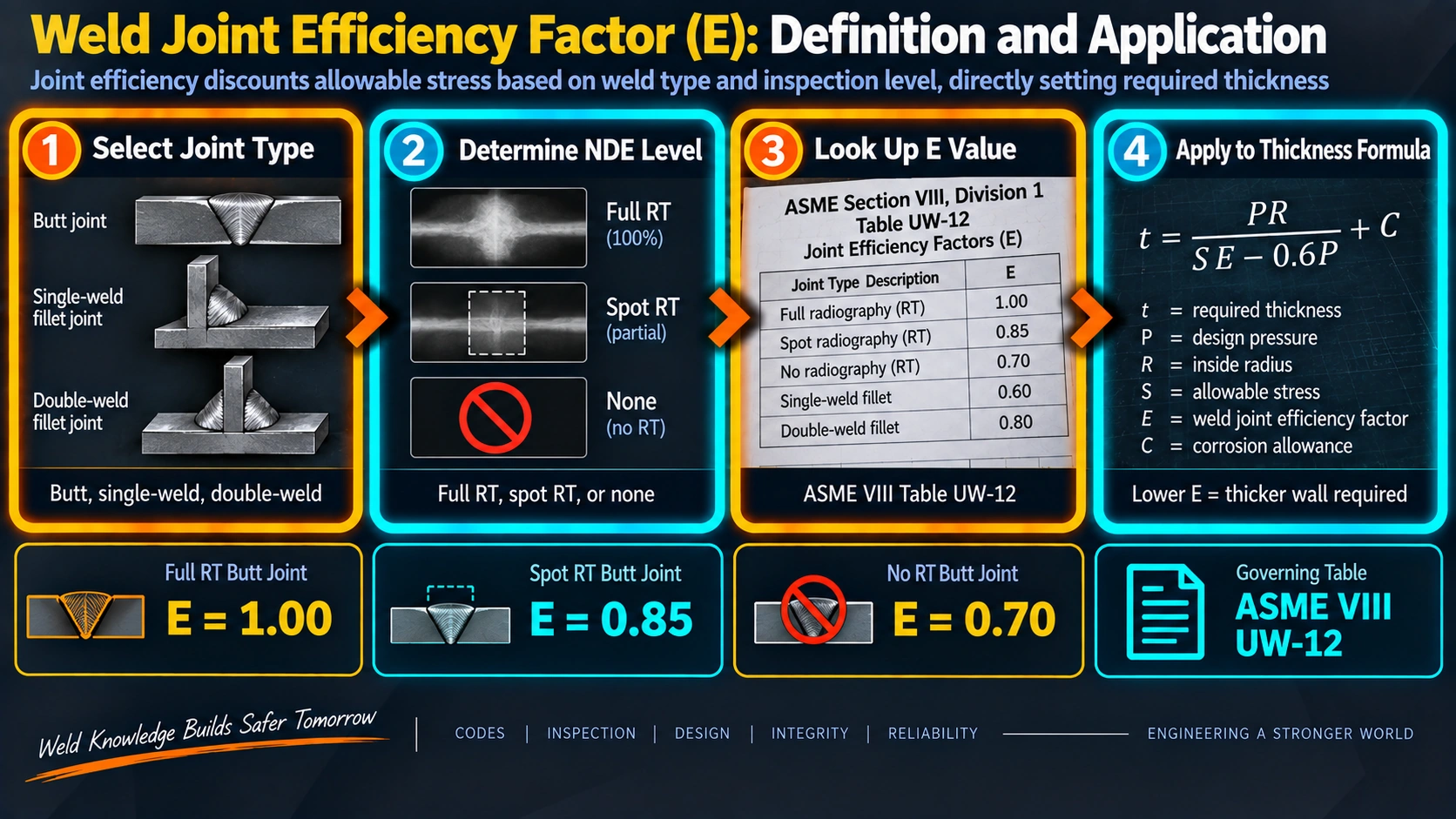
The weld joint efficiency factor — designated E_W in ASME B31.3 Para. 302.3.5 and tabulated in Table 302.3.4 — is a dimensionless number between 0.60 and 1.00 that represents the fractional credit given to the allowable stress of a pipe material when that pipe contains a longitudinal seam weld. It is also called the weld joint quality factor.
The underlying physical concept is straightforward: a pipe containing a longitudinal seam weld is not as reliable under hoop stress as a seamless pipe made from the same base material. The seam weld may contain HAZ microstructure, residual stress, geometric imperfections, and weld metal that collectively reduce the probability that the pipe wall will achieve the full theoretical hoop stress capacity of the base material. The degree of this reduction depends on how the seam was welded and how thoroughly it was examined.
E_W = 1.00 means the pipe seam is as reliable as seamless — full credit for base material allowable stress. E_W = 0.60 (furnace butt-welded pipe) means only 60 percent of the allowable stress may be used — the pipe effectively behaves as if it were made of a material with allowable stress equal to 60 percent of its listed value.
Why It Matters in Every Wall Thickness Calculation
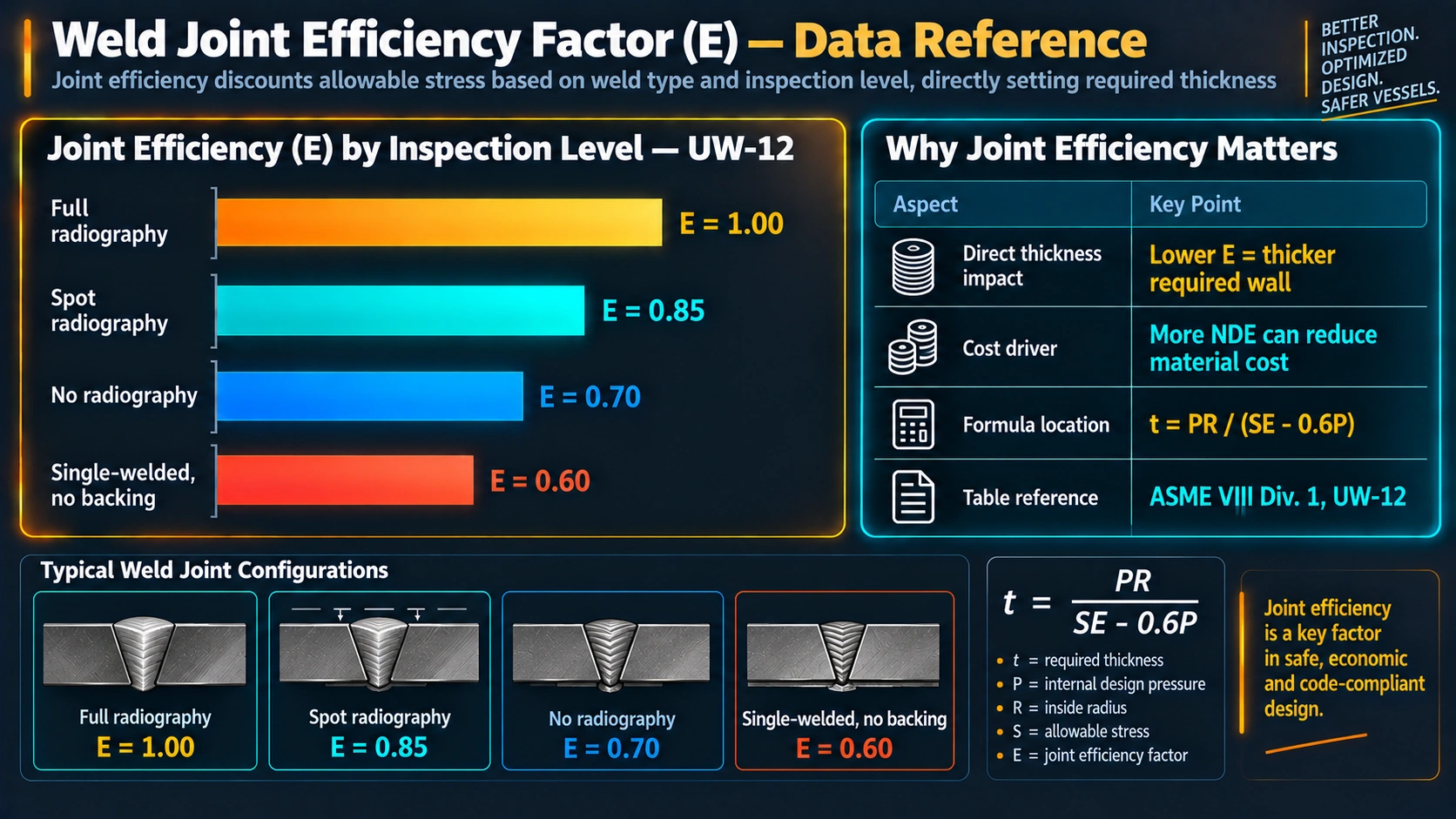
The hoop stress in a pressurised thin-walled cylinder is proportional to (P × D) / (2t). In the B31.3 pressure design equation, the allowable hoop stress is S × E_W × W. A reduction in E_W is therefore equivalent to a reduction in allowable stress — and the only way to compensate is to increase t. This means that for a given design pressure and pipe diameter, using welded pipe with a lower E_W demands a heavier wall than seamless pipe of the same material.
In a real plant design — a refinery crude unit, an LNG terminal, a pharmaceutical plant — there are typically hundreds of wall thickness calculations, one per pipe segment with its own material, size, design pressure, temperature, and fluid service. Every one of those calculations requires a correct E_W value. An incorrect E_W can result in:
- An under-thickness pipe wall that does not meet the code minimum — discovered during pre-commissioning inspection and requiring costly re-work, or worse, not discovered until a pressure boundary failure in service
- An over-designed pipe wall resulting from over-conservatively applying E_W = 0.80 when E_W = 1.00 was appropriate for the specified seamless pipe — wasting material and installation cost across a large piping system
- A non-conformance against the project specification if the wrong pipe specification (ERW vs seamless) is procured and the E_W difference is not caught in material receiving inspection
Complete E_W Table — All Common Pipe Specifications Table 302.3.4
The following table consolidates the E_W values from ASME B31.3 Table 302.3.4 for the pipe and tube specifications most commonly encountered in process plant piping. The table is organised by manufacturing method from highest to lowest E_W.
| Manufacturing Method | ASTM / API Specification | Product Description | Seam Examination | E_W Value |
|---|---|---|---|---|
| Seamless | ASTM A106 Gr. A, B, C | Seamless CS pipe for high-temp service | None (no seam) | 1.00 |
| Seamless | ASTM A335 P1–P91 (all grades) | Seamless Cr-Mo alloy pipe | None (no seam) | 1.00 |
| Seamless | ASTM A312 TP304/316/321/347 (seamless) | Seamless austenitic SS pipe | None (no seam) | 1.00 |
| Seamless | ASTM A53 Gr. A, B (Type S) | Seamless CS pipe, standard weight | None (no seam) | 1.00 |
| Seamless | API 5L (seamless) | Seamless line pipe, all grades | None (no seam) | 1.00 |
| Electric Fusion Welded (EFW) 100% RT or UT | ASTM A358 Class 1 | EFW austenitic SS pipe, 100% RT | 100% RT of seam | 1.00 |
| Electric Fusion Welded (EFW) 100% RT or UT | ASTM A671 Class A | EFW CS pipe for atmospheric service, 100% RT | 100% RT of seam | 1.00 |
| Electric Fusion Welded (EFW) 100% RT or UT | ASTM A672 Class A | EFW CS pipe for high-pressure/temp service, 100% RT | 100% RT of seam | 1.00 |
| SAW / DSAW — spot RT | API 5L (SAW) with spot RT | Submerged arc welded line pipe, spot-radiographed seam | Spot RT (10% min) | 0.90 |
| Electric Fusion Welded (EFW) spot RT | ASTM A671 Class B; ASTM A672 Class B | EFW pipe with spot radiographic examination of seam | Spot RT | 0.90 |
| Electric Fusion Welded (EFW) spot RT | ASTM A358 Class 2 | EFW austenitic SS, spot RT of seam | Spot RT | 0.90 |
| Electric Resistance Welded (ERW) | ASTM A53 Gr. E (Type E) | ERW carbon steel pipe — most common welded pipe in utility service | Hydrostatic test of seam only | 0.85 |
| Electric Resistance Welded (ERW) | ASTM A135 Gr. A, B | ERW CS pipe for ordinary use | Hydrostatic seam test | 0.85 |
| Electric Resistance Welded (ERW) | ASTM A178 (tube) | ERW CS and CS-alloy boiler tubes | Hydrostatic test | 0.85 |
| Electric Resistance Welded (ERW) | API 5L ERW (standard) | ERW line pipe | Hydrostatic / UT spot | 0.85 |
| API 5L ERW — 100% UT seam | API 5L ERW with PSL2 / 100% UT | ERW line pipe with 100% UT of weld seam per API 5L PSL2 | 100% UT of seam | 1.00 |
| Electric Fusion Welded — no RT | ASTM A671 Class C; ASTM A672 Class C | EFW pipe, no radiographic examination of seam | No RT of seam | 0.80 |
| Electric Fusion Welded — no RT | ASTM A358 Class 3 | EFW austenitic SS pipe, no seam RT | No RT of seam | 0.80 |
| Furnace Butt-Welded (FBW) | ASTM A53 Gr. F (Type F) | Furnace butt-welded CS pipe — lowest quality factor | Hydrostatic test only | 0.60 |
E_W in the B31.3 Wall Thickness Formula Para. 304.1.2
E_W appears in the denominator of the B31.3 pressure design equation, directly scaling the effective allowable stress. Understanding its position in the equation is essential for correctly applying it and for understanding why a lower E_W demands a thicker wall.
t = (P × D) / [2 × (S × E_W × W + P × Y)]
Where every variable has a specific code source:
t = Pressure design thickness (mm or in) ← what we are solving for
P = Internal design gauge pressure (MPa or psi) ← Para. 301.2
D = Outside diameter (mm or in) ← pipe OD from ASME B36.10M
S = Allowable stress at design temp (MPa or psi) ← Table A-1
E_W = Weld joint quality factor ← Table 302.3.4 — the subject of this article
W = Weld joint strength reduction factor ← Table 302.3.5E (= 1.0 below creep range)
Y = Temperature coefficient ← Table 304.1.1 (typically 0.4)
Rearranging to show E_W effect explicitly on effective allowable stress:
t = (P × D) / [2 × (S_eff + P × Y)]
where S_eff = S × E_W × W = effective allowable stress after seam quality derating
Minimum required thickness (adding all mechanical and corrosion allowances):
t_m = t + c
Nominal wall selection (accounting for mill under-tolerance):
t_nom ≥ t_m / (1 – mill_tolerance) [mill tolerance = 0.125 for A53/A106]
Dissecting the Denominator — Why E_W Is Multiplied by S
The product S × E_W × W can be understood as the effective maximum hoop stress that the pipe wall is allowed to carry. When E_W = 1.0, the full allowable stress S is available and the pipe behaves as a perfect homogeneous cylinder. When E_W = 0.85 (ERW pipe), the effective allowable stress is only 0.85 × S — the designer credits only 85 percent of the material’s theoretical allowable stress because the ERW seam is a weaker link.
The denominator is the total hoop stress resistance per unit area of pipe wall: (2 × t × S_eff) for the thin-wall portion plus the (2 × t × P × Y) correction for thick-wall pipe where the Y coefficient accounts for the difference between mean-diameter and outside-diameter pressure design. For most practical thin-walled pipe (t < D/6), the Y correction is small and the denominator is dominated by 2 × S × E_W × W.
Difference Between E_W and the Weld Joint Strength Reduction Factor W Table 302.3.5E
One of the most common sources of confusion in B31.3 wall thickness calculations is the difference between E_W and W. They both appear in the same formula position, they are both weld-related factors, and they both reduce the effective allowable stress — but they address fundamentally different phenomena at different service conditions.
E_W — Weld Joint Quality Factor
- Source: B31.3 Table 302.3.4
- What it addresses: The relative quality and integrity of the longitudinal seam weld in the pipe as manufactured — a fabrication quality factor
- Governed by: Manufacturing method (seamless vs ERW vs EFW) and extent of seam examination (no RT, spot RT, 100% RT)
- Temperature dependence: None — E_W is constant regardless of service temperature
- Typical range: 0.60 to 1.00
- Applies to: All welded pipe products; E_W = 1.0 for seamless
W — Weld Joint Strength Reduction Factor
- Source: B31.3 Table 302.3.5E
- What it addresses: The reduction in creep rupture strength of welded joints compared to base metal at elevated temperatures in the creep regime — a service temperature factor
- Governed by: Material type and service temperature — applies when the pipe is operating in the creep temperature range
- Temperature dependence: Strongly dependent — W = 1.0 below the creep range; decreases above it
- Typical range: 0.50 to 1.00 at creep temperatures for Cr-Mo steels
- Applies to: All welded pipe (including seam-welded and girth-welded pipe) operating above the creep threshold
W = 1.0 for carbon steel below ~370 deg C, for all austenitic SS below ~600 deg C
Effective allowable stress = S × E_W × 1.0 = S × E_W
Combined Effect at Elevated Temperature (in creep range):
Example: 2.25Cr-1Mo (P22) EFW pipe at 510 deg C — W may be 0.85, E_W = 0.90 (spot RT)
Effective allowable stress = S × E_W × W = S × 0.90 × 0.85 = S × 0.765
The combined product of both factors is applied simultaneously in the formula denominator.
Warning: Never apply W without also verifying the correct E_W — they are independent factors.
Upgrading E_W Through Radiographic Examination of the Seam Table 302.3.4, Note 3
For certain pipe specifications, ASME B31.3 Table 302.3.4 and its associated notes permit the E_W value to be increased — upgraded — through supplementary radiographic or ultrasonic examination of the longitudinal seam, above and beyond what the base specification requires. This is one of the most practically useful provisions in the table, allowing the designer or procurement engineer to obtain a higher pressure rating from welded pipe without switching to the more expensive seamless alternative.
Which Specifications Can Be Upgraded?
| Specification | Base E_W (No Supplementary Exam) | Upgraded E_W (With 100% Seam RT/UT) | Examination Standard | Can Be Upgraded? |
|---|---|---|---|---|
| ASTM A671 Class B (EFW, spot RT) | 0.90 | 1.00 | 100% RT per ASME Section V | Yes |
| ASTM A671 Class C (EFW, no RT) | 0.80 | 1.00 | 100% RT per ASME Section V | Yes |
| ASTM A672 Class B (EFW, spot RT) | 0.90 | 1.00 | 100% RT per ASME Section V | Yes |
| ASTM A358 Class 2 (EFW SS, spot RT) | 0.90 | 1.00 | 100% RT per ASME Section V | Yes |
| API 5L SAW (spot RT) | 0.90 | 1.00 | 100% RT per ASME Section V | Yes |
| API 5L ERW (PSL2 / 100% UT of seam) | 0.85 | 1.00 | 100% UT per API 5L PSL2 requirements | Yes (per B31.3 Note) |
| ASTM A53 Gr. E (ERW) | 0.85 | 0.85 (no upgrade path) | N/A — process limitation, not just examination | No |
| ASTM A135 (ERW) | 0.85 | 0.85 (no upgrade path) | N/A | No |
| ASTM A53 Gr. F (furnace BW) | 0.60 | 0.60 (no upgrade path) | N/A — process fundamentally limits integrity | No |
Procedure for Claiming an Upgraded E_W
When specifying or accepting pipe with an upgraded E_W claim, the following must be verified and documented:
- The pipe specification and class that allows upgrading (e.g. A672 Class A — from Class C by adding 100% RT) must be identified and specified in the purchase order.
- The supplementary radiographic examination must be performed at the mill on the longitudinal seam during manufacture, not after delivery. Post-delivery RT of the seam does not qualify for E_W upgrade — the examination must be integral to the manufacturing quality control.
- The MTC must explicitly state the class, grade, and that the seam was 100% radiographically examined per the applicable standard.
- The examination standard and acceptance criteria used for the seam RT must be confirmed as meeting ASME Section V Article 2 (or the equivalent cited in the pipe specification).
- The upgraded E_W value must be documented in the piping design calculation package, with the MTC reference cited as evidence.
Worked Calculation Examples
Example 1 — Seamless vs ERW Carbon Steel: Same Design Conditions
This example directly compares the wall thickness required for a 6-inch NPS carbon steel line at the same design conditions using seamless pipe (E_W = 1.00) and ERW pipe (E_W = 0.85).
Pipe size: 6 NPS (OD = 168.3 mm)
Material: ASTM A106 Gr. B (seamless) / ASTM A53 Gr. E (ERW)
Design pressure P: 4.0 MPa (gauge)
Design temperature: 200 deg C
S (at 200 deg C): 118 MPa (from B31.3 Table A-1 for both specifications)
W: 1.0 (below creep range)
Y: 0.4 (for t < D/6)
Corrosion allowance c: 2.0 mm
Mill tolerance: 12.5%
CASE A — Seamless pipe (E_W = 1.00):
t = (4.0 × 168.3) / [2 × (118 × 1.00 × 1.0 + 4.0 × 0.4)]
t = 673.2 / [2 × (118.0 + 1.6)] = 673.2 / 239.2 = 2.81 mm
t_m = 2.81 + 2.0 = 4.81 mm
t_nom ≥ 4.81 / 0.875 = 5.50 mm minimum
Select: 6 NPS Sch 40 = 7.11 mm wall — adequate.
CASE B — ERW pipe (E_W = 0.85):
t = (4.0 × 168.3) / [2 × (118 × 0.85 × 1.0 + 4.0 × 0.4)]
t = 673.2 / [2 × (100.3 + 1.6)] = 673.2 / 203.8 = 3.30 mm
t_m = 3.30 + 2.0 = 5.30 mm
t_nom ≥ 5.30 / 0.875 = 6.06 mm minimum
6 NPS Sch 40 = 7.11 mm wall — still adequate, but with less margin than seamless.
Result summary:
Both select Sch 40 in this example — but at higher pressures, the difference will force
ERW to the next heavier schedule when seamless Sch 40 would still pass.
The ERW pipe requires 17.6% more pressure design thickness than seamless at identical conditions.
Example 2 — Higher Pressure: Seamless Sch 40 Passes, ERW Must Upsize to Sch 80
CASE A — Seamless (E_W = 1.00):
t = (7.5 × 168.3) / [2 × (118 + 3.0)] = 1262.25 / 242.0 = 5.21 mm
t_m = 5.21 + 2.0 = 7.21 mm | t_nom ≥ 7.21 / 0.875 = 8.24 mm
6 NPS Sch 40 = 7.11 mm → FAILS | 6 NPS Sch 80 = 10.97 mm → PASSES
CASE B — ERW (E_W = 0.85):
t = (7.5 × 168.3) / [2 × (100.3 + 3.0)] = 1262.25 / 206.6 = 6.11 mm
t_m = 6.11 + 2.0 = 8.11 mm | t_nom ≥ 8.11 / 0.875 = 9.27 mm
6 NPS Sch 40 = 7.11 mm → FAILS | 6 NPS Sch 80 = 10.97 mm → PASSES
CASE C — ERW with 100% seam UT (API 5L PSL2, E_W upgraded to 1.00):
Identical to Case A — passes at Sch 80 with same margin as seamless.
Cost decision:
In this example: at 7.5 MPa, both seamless and standard ERW require Sch 80.
The E_W difference results in no schedule change here — but the ERW has less margin.
At P = 8.5 MPa, seamless can use Sch 80 while ERW would need Sch 120 — a major cost difference.
Example 3 — EFW Pipe Upgrade: Justifying 100% Seam RT to Avoid Thicker Schedule
D = 406.4 mm (16 NPS OD) | S at 260 deg C = 121 MPa | c = 3.0 mm | Y = 0.4
Option 1 — A672 Class C (no RT, E_W = 0.80):
t = (8.0 × 406.4) / [2 × (121 × 0.80 + 8.0 × 0.4)] = 3251.2 / 197.6 = 16.45 mm
t_m = 16.45 + 3.0 = 19.45 mm | t_nom ≥ 19.45 / 0.875 = 22.23 mm min.
Option 2 — A672 Class A (100% seam RT, E_W = 1.00):
t = (8.0 × 406.4) / [2 × (121 × 1.00 + 8.0 × 0.4)] = 3251.2 / 245.6 = 13.24 mm
t_m = 13.24 + 3.0 = 16.24 mm | t_nom ≥ 16.24 / 0.875 = 18.56 mm min.
Class C requires t_nom ≥ 22.23 mm — needs a heavier custom wall or heavy-duty schedule.
Class A (with 100% seam RT) requires t_nom ≥ 18.56 mm — fits within a standard wall.
The 100% seam RT premium at the mill (typically 3–8% cost adder) is often far less expensive
than the additional steel weight and fabrication cost of the heavier schedule throughout the line.
Effect on Maximum Allowable Working Pressure (MAWP)
When the pipe schedule is already fixed — either by existing inventory, a previously purchased spool, or an installed pipe — E_W determines the maximum allowable working pressure (MAWP) of that component. The MAWP formula is derived by rearranging the B31.3 pressure design equation to solve for P rather than t:
MAWP = 2 × t_min × S × E_W × W / (D – 2 × t_min × Y)
t_min = nominal wall thickness × (1 – mill_tolerance) = minimum available wall
For A106/A53 pipe: t_min = t_nom × (1 – 0.125) = t_nom × 0.875
Example: 6 NPS Sch 40, A106 Gr. B seamless vs A53 Gr. E ERW at 200 deg C:
t_nom = 7.11 mm | t_min = 7.11 × 0.875 = 6.22 mm | S = 118 MPa | D = 168.3 mm | Y = 0.4
MAWP (seamless, E_W = 1.00) = 2 × 6.22 × 118 × 1.00 / (168.3 – 2 × 6.22 × 0.4)
= 1467.9 / (168.3 – 4.98) = 1467.9 / 163.3 = 8.99 MPa
MAWP (ERW, E_W = 0.85) = 2 × 6.22 × 118 × 0.85 / 163.3
= 1247.7 / 163.3 = 7.64 MPa
Same pipe schedule, same material, same temperature — but ERW pipe has 15% lower MAWP than seamless.
This quantified difference in MAWP has direct consequences in operations. If an existing process unit is debottlenecked or repurposed to a higher operating pressure, the first check must be whether the installed pipe is seamless or ERW. If it is ERW, the allowable operating pressure is 15 percent lower than if the same schedule had been installed in seamless, and the system may require deration or re-piping to operate safely at the higher pressure.
Pipe Selection Guidance — When to Specify Seamless vs Welded
The choice between seamless and welded pipe is simultaneously an engineering, procurement, and commercial decision. The following guidance reflects the industry consensus for process piping governed by ASME B31.3:
| Application | Recommended Pipe Type | Typical E_W | Rationale |
|---|---|---|---|
| Category M — highly hazardous fluid (H2, Cl2, HF, toxic gases) | Seamless mandatory in most Owner specs | 1.00 | Maximum pressure rating, no seam quality risk in safety-critical service |
| High-pressure service (>100 bar / 1,500 psi) | Seamless preferred | 1.00 | Higher MAWP from E_W = 1.00 reduces required wall thickness; thick ERW seams have poorer penetration quality |
| High-temperature service (Cr-Mo steel, creep range) | Seamless preferred; EFW Class A acceptable | 1.00 | W factor further reduces effective stress for welded pipe at high temperature; seamless avoids combined E_W × W penalty |
| Sour service (H2S — NACE MR0175) | Seamless preferred; EFW Class A acceptable | 1.00 | ERW seam HAZ hardness can exceed NACE HRC 22 limit; seamless avoids seam hardness control issue |
| Normal fluid service, moderate pressure (<50 bar) | Seamless or ERW per design calculation | 0.85–1.00 | If wall thickness calculation passes at E_W = 0.85, ERW is acceptable and typically less expensive for carbon steel in small-to-medium NPS |
| Low-pressure utility service (Category D) — cooling water, instrument air | ERW acceptable | 0.85 | Relaxed examination requirements; pressure design governs easily at E_W = 0.85; cost saving significant on large quantities |
| Large-diameter (>24 NPS) carbon steel | SAW / EFW Class A (100% seam RT) | 1.00 | Seamless pipe not manufactured above ~24 NPS; EFW with 100% seam RT achieves E_W = 1.00 and is the standard for large-bore process piping |
| Cryogenic service (below -29 deg C) | Seamless preferred; A333 Gr. 6 / A312 304L | 1.00 | Impact toughness requirements complicate ERW seam qualification; seamless avoids seam-related toughness uncertainty |
Common Errors in Applying E_W — And How to Avoid Them
Error 1 — Assuming All Pipe is Seamless Without Checking the MTC
A surprisingly common error in field fabrication and inspection is assuming that all carbon steel pipe installed in a project is seamless when some of it is ERW — particularly when both A106 Gr. B (seamless) and A53 Gr. E (ERW) are delivered to site simultaneously for different line classes. The pipe OD and wall thickness are identical for the same schedule in both specifications; the only physical difference is the presence of a weld seam flash mark on the ERW pipe. If ERW pipe is mistakenly installed in a line class that requires seamless, the MAWP of the installed system is 15 percent lower than designed — a potentially unsafe condition that requires immediate corrective action. Always verify the specification and grade from the pipe heat stamp or MTC before installation.
Error 2 — Applying E_W to Circumferential (Girth) Welds
E_W applies only to longitudinal seam welds and spiral seam welds in the pipe or fitting body — not to circumferential girth welds in the field or fabrication shop. The quality of circumferential welds is controlled by the WPS and welder qualification (ASME Section IX) and the examination requirements of B31.3 Chapter VI. Applying the E_W table to field girth welds — for example, reducing the MAWP of a seamless pipe because it has a girth weld — is incorrect and overly conservative. Girth welds carry longitudinal stress (approximately half the hoop stress in a thin-walled cylinder under internal pressure), and their acceptance is governed by examination acceptance criteria, not the E_W factor.
Error 3 — Confusing E_W with E (Longitudinal Weld Joint Factor in B31.1)
ASME B31.1 (Power Piping) uses a factor called E (no subscript) in its wall thickness formula, which is also a longitudinal weld joint quality factor. The values in B31.1 Table 104.1.2(A) are similar but not identical to B31.3 Table 302.3.4. The two code tables should not be cross-applied — always use the table from the code that governs the piping system. If you are working in B31.3, use Table 302.3.4. If you are working in B31.1, use Table 104.1.2(A). The distinction matters because the allowable stress S values also differ between the two codes (B31.1 uses 1/4 UTS; B31.3 uses 1/3 UTS), and mixing factors from one code with stress values from another produces an incorrect result in either direction.
Error 4 — Forgetting E_W When Calculating MAWP for Re-Rating
When re-rating an existing installed piping system to a higher operating pressure — for plant capacity expansion, changed service, or formal MAWP documentation — the E_W of the installed pipe must be confirmed from the original material records, not assumed to be 1.00. For older plants where original MTCs are unavailable, E_W should be conservatively assumed at 0.85 (ERW) unless the pipe can be positively identified as seamless from heat stamps or retained records. Using E_W = 1.00 in a re-rating calculation for a pipe that turns out to be ERW overestimates the MAWP by 17.6 percent — a serious risk if the re-rated system is subsequently operated at the calculated maximum.
Error 5 — Specifying Pipe Without Stating the Examination Class for EFW Products
When purchasing large-bore EFW pipe (ASTM A671, A672) without explicitly specifying the examination class, the supplier will typically supply the lowest class (Class C — no radiographic examination, E_W = 0.80) unless otherwise specified. A purchase order that says only “ASTM A672 Grade B75” without stating “Class A” or “Class B” is ambiguous and creates a risk that Class C pipe (E_W = 0.80) is supplied when Class A (E_W = 1.00) was assumed in the design calculation. Always state the required class explicitly in the material specification and verify on the MTC at goods receipt.
Recommended Reference Books
Disclosure: WeldFabWorld participates in the Amazon Associates programme (StoreID: neha0fe8-21). If you purchase through these links, we may earn a small commission at no extra cost to you. This helps support free technical content on this site.