Plasma Arc Welding (PAW) vs TIG — Principles, Key Differences, and When to Use Each
Plasma Arc Welding and Gas Tungsten Arc Welding share a common ancestor — both use a non-consumable tungsten electrode, both produce high-quality welds with excellent metallurgical control, and both are suited to precision applications where weld integrity and appearance are paramount. Yet despite this shared lineage, the two processes are fundamentally different in their arc physics, their heat distribution characteristics, and the operational envelope in which each excels. Understanding these differences is what separates an engineer who specifies the right process from one who defaults to TIG because it is familiar, or specifies PAW because it sounds advanced, without understanding when each genuinely earns its place.
The case for PAW is growing. In aerospace fabrication of titanium and nickel superalloy structures, in precision medical device tubing, in thin-wall stainless pressure vessels, and in automated pipeline root pass welding, PAW is progressively displacing TIG where its superior arc energy concentration, keyhole penetration capability, and high-speed automated performance deliver real productivity and quality advantages. The global plasma welding market is projected to grow at over 6% annually through 2030, driven principally by aerospace manufacturing expansion and the growth of precision automated fabrication in electronics and medical device manufacturing.
This guide provides the complete technical comparison between PAW and TIG: the physics of plasma arc generation, the keyhole mode that is PAW’s most distinctive capability, the dual-gas system that separates PAW from TIG, quantified differences in power density and heat input, material and thickness-specific application guidance, micro-plasma for ultra-thin materials, ASME Section IX qualification requirements, and a practical decision guide for choosing between the processes.
Plasma Arc Welding — Operating Principle
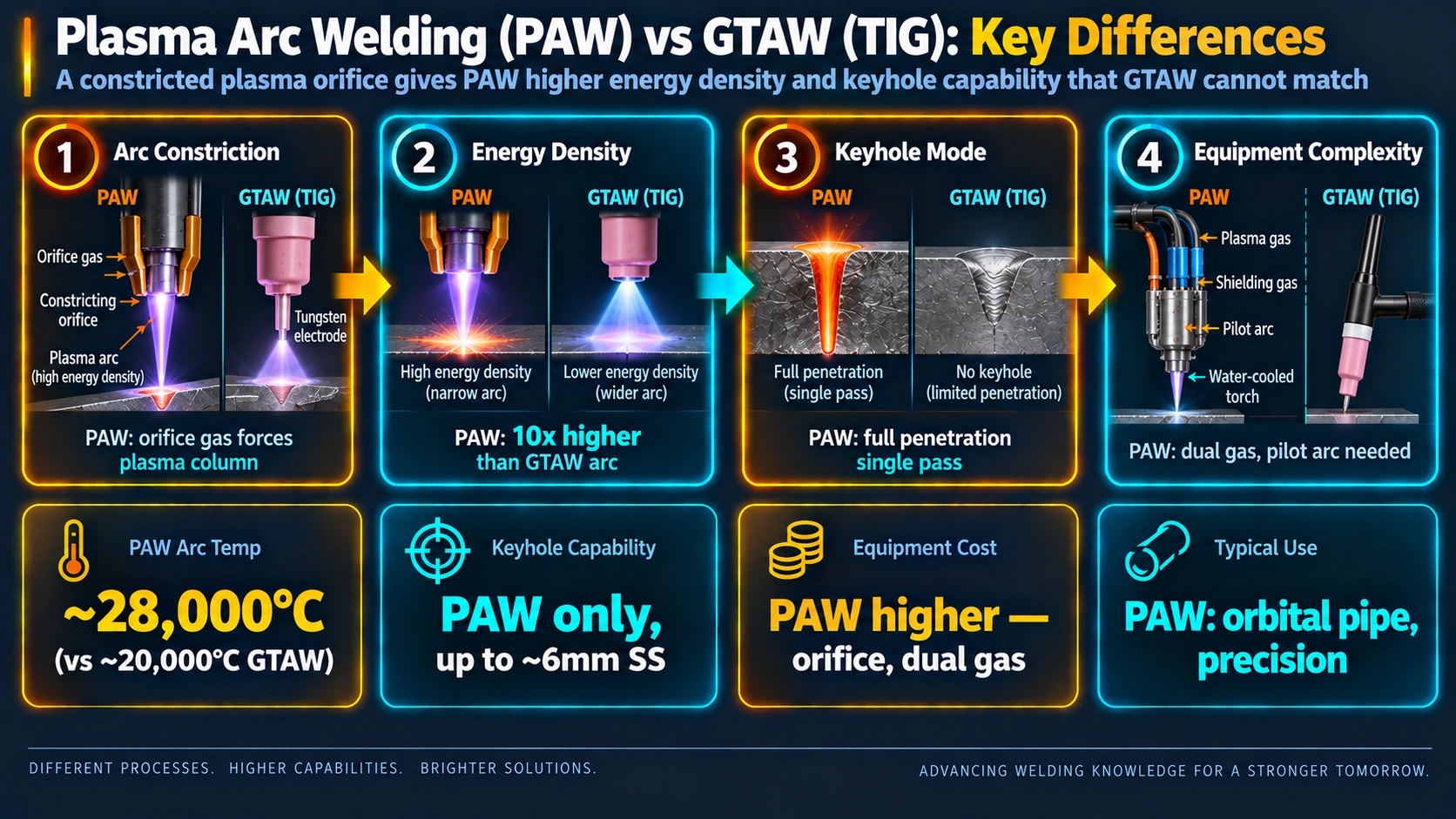
In a conventional TIG torch, the arc spreads conically from the tip of the tungsten electrode to the workpiece, distributing its energy over a relatively wide cone-shaped zone. The arc column is essentially unconstrained — it expands to fill the space between electrode and work. Plasma Arc Welding disrupts this by forcing the arc through a small-diameter orifice in the copper plasma nozzle, which sits between the tungsten electrode and the workpiece.
The Constriction Effect — How Plasma Is Formed
As the arc column is forced through the constricting nozzle orifice, three simultaneous effects occur that transform the electrical arc into a plasma jet:
- Thermal pinch (ohmic constriction): The copper nozzle walls are water-cooled. The outer annular region of the arc column adjacent to the nozzle wall is chilled, increasing its electrical resistance relative to the hot core. Current density concentrates in the hot central core — this is the thermal pinch effect. The arc core temperature rises to 10,000–24,000 K, compared to 6,000–10,000 K for an unconstrained TIG arc.
- Magnetic pinch (Lorentz force): The high current density in the arc core creates a strong self-induced magnetic field that exerts an inward Lorentz force on the current-carrying plasma, further compressing the arc column — the magnetic or electromagnetic pinch effect.
- Plasma gas jet: The plasma gas (typically argon) flowing through the nozzle bore is heated by the constricted arc to plasma temperatures, converting it from a neutral gas to a partially ionised plasma. The heated plasma expands rapidly and exits the nozzle as a high-velocity, high-temperature plasma jet — the plasma column — which strikes the workpiece with far greater energy density than an equivalent unconstrained TIG arc.
The Plasma Column — Temperature and Velocity
The PAW plasma column exhibits physical properties that are qualitatively different from a TIG arc, not merely quantitatively better. The constricted plasma reaches temperatures of 10,000 to 24,000 K at its core — hotter than the surface of the sun (approximately 5,778 K). At these temperatures, the argon plasma gas is fully ionised and carries current as an electrically conductive fluid. The plasma exits the nozzle orifice at velocities of 300 to 600 m/s — compared to velocities of 50 to 100 m/s for an equivalent TIG arc column. This combination of extreme temperature and high velocity produces the plasma’s characteristic stiffness: it is resistant to deflection by magnetic fields, crosswinds, and component geometry changes that cause arc wander in TIG.
Transferred vs Non-Transferred Arc
PAW torches can operate in two distinct electrical circuit configurations, each suited to different applications.
Transferred Arc
The main welding arc is established between the tungsten electrode (cathode) and the workpiece (anode). The workpiece is part of the electrical circuit. The plasma column carries current from electrode to work. This is the mode used for all plasma arc welding, plasma arc cutting, and plasma transferred arc (PTA) surfacing on conductive materials. Maximum energy transfer to the workpiece. Requires the workpiece to be electrically conductive.
Non-Transferred Arc
The arc is established between the tungsten electrode and the plasma nozzle itself — the workpiece is not in the electrical circuit. The plasma jet exits the nozzle as a hot gas stream but carries no current to the workpiece. Used for plasma spraying of both conductive and non-conductive surfaces, heat treatment of non-conducting materials, and brazing. Less efficient energy transfer to workpiece. Can process non-conductive ceramics and polymers.
Pilot Arc (Starting Mode)
A low-current pilot arc is maintained between the tungsten electrode and the plasma nozzle to keep the plasma ionised and ready for transfer. When the torch approaches the workpiece, the main transferred arc is initiated from this pre-ionised plasma without high-voltage arc striking. The pilot arc eliminates the arc instability and electrode contamination risk associated with high-frequency arc starting in TIG, making PAW particularly suited to automated and robotic welding applications.
Combined Mode
Some PAW systems operate with a combined transferred and non-transferred arc configuration, particularly at very low currents in micro-plasma welding. A small continuous pilot arc provides arc stability while the main transferred arc delivers the welding energy. This combined mode enables stable operation at currents as low as 0.1 A — far below the minimum stable arc current achievable in conventional TIG (typically 5–10 A minimum for reliable arc stability).
TIG/GTAW — Key Characteristics for Comparison
Gas Tungsten Arc Welding is the established benchmark against which PAW is most frequently compared, because both processes use a non-consumable tungsten electrode, both produce welds of similar metallurgical quality when correctly applied, and both are used for precision and critical service applications. The essential TIG characteristics relevant to the PAW comparison are:
- Arc spreading: The TIG arc is unconstrained, spreading conically from the electrode tip with an included angle of approximately 30 to 45 degrees. At a typical arc length of 3 to 6 mm, the arc root diameter on the workpiece is 5 to 14 mm — widely distributing heat input.
- Single gas system: TIG uses only a shielding gas (argon, helium, or argon/helium mix) flowing through the gas cup. There is no plasma gas circuit. The shielding gas flow rate affects coverage and arc behaviour but does not contribute to the arc energy in the same way as the plasma gas in PAW.
- Current range: Conventional TIG operates reliably from approximately 5 to 600 A. Below 5 A, arc stability becomes problematic — the arc tends to wander and extinguish, making consistent thin-section welding difficult without specialised equipment.
- Tungsten electrode exposure: The TIG electrode extends beyond the gas cup, making it vulnerable to contamination from accidental contact with the weld pool (which causes tungsten inclusion in the weld) and from crosswind disturbance. PAW’s recessed electrode inside the plasma nozzle provides significantly better electrode protection.
- Penetration profile: TIG produces a relatively shallow, wide bead profile — typical depth-to-width ratio of approximately 0.5:1 or less. PAW in keyhole mode achieves depth-to-width ratios of 2:1 or greater for the same travel speed — a qualitatively different penetration geometry.
For detailed GTAW process parameters, electrode types, shielding gas selection, and application guidance, see our comprehensive GTAW/TIG welding guide.
Keyhole Mode — PAW’s Most Distinctive Capability
Keyhole welding is the operating mode that most clearly differentiates PAW from all other arc welding processes and represents the primary reason for specifying PAW over TIG for medium-thickness materials. Understanding the physics of keyhole formation is essential for appreciating both the capabilities and the limitations of keyhole PAW.
How the Keyhole Forms
As PAW current and plasma gas flow are increased to keyhole levels, the plasma column power density at the workpiece surface reaches the point where the plasma pressure exceeds the combined hydrostatic pressure of the molten metal and surface tension forces. The plasma jet physically displaces the molten metal sideways, forming a small through-hole — the keyhole — at the leading edge of the weld pool. The keyhole diameter is typically 1 to 4 mm, depending on material thickness, current, travel speed, and plasma gas flow rate.
As the torch advances, the keyhole travels through the workpiece. Molten metal flows around the keyhole under surface tension and solidifies behind it. When the process parameters are correctly set, the keyhole closes smoothly behind the torch, forming a full-penetration weld bead on the underside without any backing strip or root support. The entire process requires no joint preparation beyond a simple square butt fit-up — the plasma arc provides its own groove.
Keyhole Stability — The Critical Parameter
The keyhole is a dynamic equilibrium between the plasma jet’s opening force and the liquid metal’s closing force from surface tension. For stable keyhole welding, these forces must be precisely balanced. Deviations in any key parameter can cause keyhole collapse (resulting in incomplete penetration or a concave root) or keyhole collapse failure (the keyhole grows too large and causes a burn-through). The critical parameters for keyhole stability are:
Opening force: F_plasma = plasma jet stagnation pressure × keyhole area
Closing force: F_surface = 2πr × γ × cos(θ) + ρgh (surface tension + hydrostatic)
Stable keyhole: F_plasma ≈ F_closing
F_plasma controlled by: current (I), plasma gas flow rate (Q_p), nozzle orifice diameter (d_o)
F_closing controlled by: material (surface tension γ, density ρ), wall thickness (h), temperature
Practical keyhole stability window:
Material thickness: 2.5 mm to 12 mm (single-pass keyhole)
Plasma gas flow: 0.5 to 4.0 L/min (argon) — tight control required
Current tolerance: ±2–5 A from set point — automated control preferred
Travel speed is the primary operator control for real-time keyhole stability adjustment.
Power Density and Heat Input
Power Density Comparison
Power density — the welding power per unit area of the arc root on the workpiece — is the single most fundamental parameter differentiating the two processes. Power density governs penetration depth, bead width, travel speed capability, and HAZ width.
Q = P / A_arc = (V × I) / (π × r_arc²)
TIG at 150 A, 12V, arc root radius ~5 mm:
P = 1,800 W | A = π × 0.005² = 7.85 × 10⁻&sup5; m²
Q_TIG ≈ 1,800 / 7.85×10⁻&sup5; = 23 MW/m² = 2.3 kW/cm²
PAW at 150 A, 28V, plasma column radius ~1.5 mm:
P = 4,200 W | A = π × 0.0015² = 7.07 × 10⁻&sup6; m²
Q_PAW ≈ 4,200 / 7.07×10⁻&sup6; = 594 MW/m² = 59 kW/cm²
PAW achieves ~25× higher power density than TIG at the same current.
This is why PAW penetrates deeper and faster with less total heat input into the joint.
Heat Input and HAZ Width
Heat input is calculated per unit length of weld: H = (V × I × 60) / (1,000 × v), where V is arc voltage (volts), I is current (A), and v is travel speed (mm/min). Despite PAW’s higher power, its faster travel speed capability means the heat input per unit length is often lower than equivalent TIG — producing a narrower HAZ.
| Parameter | TIG (100A, 10V, 100mm/min) | PAW Melt-in (100A, 25V, 200mm/min) | PAW Keyhole (180A, 28V, 350mm/min) |
|---|---|---|---|
| Arc power (W) | 1,000 W | 2,500 W | 5,040 W |
| Heat input (kJ/mm) | 0.60 kJ/mm | 0.75 kJ/mm | 0.86 kJ/mm |
| Penetration depth (approx.) | ~1.5 mm | ~3.5 mm | ~7–8 mm (full penetration) |
| Bead width (approx.) | ~6 mm | ~4 mm | ~5 mm (crown) / ~3 mm (root) |
| HAZ width (approx.) | ~4–6 mm each side | ~2–3 mm each side | ~1–2 mm each side |
| Passes required (6mm wall) | 3–4 passes | 2 passes | 1 pass |
Gas Systems — Plasma Gas and Shielding Gas
The dual-gas system is one of the most important operational differences between PAW and TIG, and understanding the role of each gas is essential for optimising PAW parameters.
Plasma Gas (Orifice Gas)
The plasma gas flows through the plasma nozzle bore and is heated by the arc to form the plasma column. Its composition and flow rate directly affect the plasma arc energy, the keyhole stability, and the weld pool behaviour:
| Plasma Gas | Composition | Effect on Arc | Typical Application |
|---|---|---|---|
| Argon (standard) | 100% Ar | Good arc stability, moderate energy density, easy keyhole control | General purpose; most materials; standard PAW applications |
| Argon/Hydrogen | Ar + 2–8% H2 | Higher enthalpy due to H2 dissociation; increased arc energy; improves weld pool fluidity; narrower bead on stainless | Austenitic stainless steel, nickel alloys — increased travel speed, better root penetration, cleaner weld pool |
| Argon/Helium | Ar + 25–75% He | He increases thermal conductivity of plasma, widening bead profile and increasing penetration depth | Aluminium, copper, thick stainless — where wider bead and deeper penetration are needed |
| Nitrogen (specialist) | 100% N2 or Ar/N2 | Very high energy density from N2 dissociation; aggressive keyhole; used in plasma cutting | Plasma cutting only; not recommended for welding due to weld metal nitriding |
Shielding Gas
The shielding gas flows through the outer cup surrounding the plasma nozzle and protects the weld pool and hot metal from atmospheric contamination. For most PAW applications on steel and stainless steel, the shielding gas is argon or argon/helium. For reactive materials (titanium, zirconium), a trailing shield or gas trailing cup extending behind the torch may be required to protect the solidifying weld metal until it cools below the oxidation threshold.
Equipment Differences
PAW System Components vs TIG
| Component | PAW System | TIG System |
|---|---|---|
| Power supply | Constant-current DCEN power supply with pilot arc circuit; higher open-circuit voltage than TIG (65–80V OCV); water cooling for high-current units | Constant-current DCEN/AC power supply; lower OCV (60–70V typical); air-cooled or water-cooled for high current |
| Torch | Complex dual-gas torch with recessed electrode, plasma nozzle, and outer shielding cup; water-cooled mandatory above ~100A; plasma nozzle is a wear consumable | Single-gas torch with exposed electrode; air-cooled to approximately 200A; water-cooled above 200A; simpler construction |
| Gas supply | Two separate gas circuits: plasma gas (precision flow control 0.1–4 L/min) and shielding gas (standard flow 8–20 L/min); dual-circuit flow controller mandatory | Single gas circuit: shielding gas (flow 8–15 L/min); standard single-circuit flow controller |
| Cooling system | Water cooling mandatory for all but micro-plasma applications; recirculating chiller unit required; adds system complexity and maintenance requirements | Air cooling for lower currents; water cooling only above 200–250A; simpler cooling system |
| Consumables | Plasma nozzle (orifice), nozzle retaining cap, collet, tungsten electrode; nozzle service life 8–40 hours depending on application and current | Tungsten electrode, collet, collet body, gas lens (optional); tungsten service life very long if contamination avoided |
| System cost | Approximately 3–5× higher than equivalent TIG system; typical installed PAW system: USD 15,000–50,000+ | Lower cost; typical TIG system: USD 1,500–8,000 for professional units |
| Setup complexity | High — plasma gas flow, nozzle orifice size, standoff distance, and current all interact; requires systematic parameter optimisation | Moderate — standard parameters available from codes and manufacturer data; simpler to set up for new applications |
PAW vs TIG — Full Technical Comparison
Applications by Industry
Where PAW Is the Superior Choice
| Industry | Application | Why PAW Over TIG | Typical Material |
|---|---|---|---|
| Aerospace | Structural titanium frames, engine nacelle components, satellite structures | Narrow HAZ critical for titanium toughness; keyhole single-pass reduces distortion; consistent automated quality | Ti-6Al-4V, Ti-3Al-2.5V, Inconel 625/718 |
| Aerospace — pressure vessels | Hydraulic accumulators, fuel tanks, pressurised manifolds | Keyhole full penetration without backing strip; single-pass reduces residual stress; high-speed automated welding | Ti alloys, 15-5PH, 17-4PH, Inconel |
| Nuclear | Fuel rod end caps, cladding tubes, pressure boundary components | Micro-plasma for Zircaloy tubing; consistent penetration; clean weld metallurgy; remote operation capability | Zircaloy, 304L/316L SS, Inconel 600/690 |
| Medical devices | Surgical instrument tubing, implantable device housings, catheter fittings | Micro-plasma at 0.1–5A for 0.1–0.5mm wall tubing; arc stability TIG cannot achieve at these currents | 316L SS, Ti-6Al-4V, Nitinol |
| Process plant | Thin-wall austenitic SS pressure vessels, heat exchanger channels | Keyhole single-pass on 3–8mm SS; reduced distortion; faster production vs multi-pass TIG | 304L, 316L, 321, 347 austenitic SS |
| Electronics / sensors | Hermetic sealing of electronic housings, sensor probe welding | Micro-plasma on 0.1–0.8 mm wall components; controlled heat input prevents damage to internal components | Kovar, 316L SS, titanium |
| Shipbuilding / offshore | Pipeline root passes, high-alloy steel plate butt joints | Keyhole root pass on square butt; eliminates backing strip requirement; high production rate | Carbon steel, DSS 2205, 6Mo SS |
Where TIG Remains the Better Choice
| Application | Why TIG Over PAW |
|---|---|
| On-site repair welding in varied positions | TIG is far more flexible for out-of-position work; PAW keyhole mode is position-sensitive; TIG equipment is simpler to transport and set up on-site |
| Thick-section multi-pass filling (above 15 mm) | Above the keyhole range, PAW loses its advantage; TIG is more controllable for multi-pass fill and cap passes with filler additions |
| Root-to-cap multi-pass pipe welding on complex geometries | TIG orbital welding is established standard for ASME B31.3 process piping; orbital TIG qualification is more widely available and accepted |
| General fabrication shop environments without automated systems | TIG equipment is robust, widely understood, easily maintained, and far less expensive; PAW’s advantages do not materialise without automated travel speed control |
| Budget-constrained projects | PAW equipment, consumable, and training costs are 3–5× higher than TIG; unless the productivity gain from keyhole single-pass or micro-plasma capability justifies the capital, TIG gives better overall economics |
| Aluminium alloys (manual) | AC TIG with its cleaning action is the established method for aluminium; PAW on aluminium requires specialised parameters and equipment and offers less practical advantage than on ferrous and titanium materials |
Micro-Plasma Welding — The Ultra-Thin Material Advantage
Micro-plasma welding is PAW operating at currents between 0.1 and 15 A — a range that is essentially inaccessible to conventional TIG. The minimum stable operating current for a conventional TIG arc is approximately 5 A for very short arc lengths, and reliable stable arcs are generally not achievable below 10 A without specially designed low-current TIG power supplies. Even with specialised TIG equipment, arc wander and instability at very low currents produce inconsistent welds on thin-wall components.
How Micro-Plasma Achieves Ultra-Low-Current Stability
In micro-plasma, the pilot arc circuit continuously maintains a low-current (approximately 1–5 A) non-transferred arc between the tungsten electrode and the plasma nozzle, keeping the plasma column pre-ionised at all times. When the main arc is triggered, it initiates from this pre-ionised plasma rather than from a cold-start spark. This eliminates the arc instability associated with cold arc initiation and allows the main transferred arc to operate stably at currents as low as 0.1 A. The constricted plasma column remains stiff and directional even at these minimal currents, providing the precise heat placement that makes micro-plasma the process of choice for surgical instrument welding, thermocouple fabrication, fine wire joining, and miniature sensor assembly.
| Application | Wall Thickness | Current (A) | Travel Speed | Material |
|---|---|---|---|---|
| Cardiac catheter tip welding | 0.05–0.10 mm | 0.5–2 A | 10–30 mm/min | 316L SS, Nitinol |
| Surgical probe housing | 0.10–0.25 mm | 1–5 A | 20–60 mm/min | 316L SS |
| Thermocouple junction welding | Wire 0.2–0.5 mm | 2–8 A | N/A (spot weld) | Chromel/Alumel, Pt/Pt-Rh |
| Nuclear fuel rod end caps | 0.3–0.8 mm | 5–15 A | 50–150 mm/min | Zircaloy-2, Zircaloy-4 |
| Bellows welding | 0.1–0.3 mm (corrugated) | 2–8 A | 30–80 mm/min | Inconel 625, 316L |
| Implant component sealing | 0.2–0.5 mm | 3–10 A | 40–100 mm/min | Ti-6Al-4V, 316L SS |
Typical Operating Parameters
| Material & Thickness | Process / Mode | Current (A) | Plasma Gas / Flow | Shield Gas / Flow | Travel Speed |
|---|---|---|---|---|---|
| 304L SS, 3 mm | PAW keyhole | 120–140 A DCEN | Ar/2%H2, 1.5 L/min | Ar, 15 L/min | 300–400 mm/min |
| 304L SS, 3 mm | TIG (GTAW) | 110–130 A DCEN | — (no plasma gas) | Ar, 10 L/min | 100–150 mm/min (2 passes) |
| 316L SS, 6 mm | PAW keyhole | 180–220 A DCEN | Ar/3%H2, 2.5 L/min | Ar, 18 L/min | 200–350 mm/min |
| 316L SS, 6 mm | TIG multi-pass | 130–160 A DCEN | — (no plasma gas) | Ar, 12 L/min | 80–120 mm/min (3–4 passes) |
| Ti-6Al-4V, 3 mm | PAW keyhole | 100–130 A DCEN | Ar, 1.5 L/min | Ar, 20 L/min + trailing shield | 200–400 mm/min |
| Ti-6Al-4V, 3 mm | TIG (GTAW) | 90–120 A DCEN | — (no plasma gas) | Ar, 15 L/min + trailing | 80–130 mm/min (1–2 passes) |
| 316L SS, 0.2 mm tube | PAW micro-plasma | 3–8 A DCEN | Ar, 0.3 L/min | Ar, 5 L/min | 20–80 mm/min |
| Carbon steel, 8 mm | PAW keyhole | 260–320 A DCEN | Ar, 3.0 L/min | Ar/5%H2, 15 L/min | 150–250 mm/min |
ASME Section IX and Code Qualification
Plasma Arc Welding is recognised as a distinct welding process (process designation PAW) in ASME Section IX and requires its own independent WPS and PQR qualification. A GTAW (TIG) WPS does not qualify PAW, and vice versa — they are different processes with different essential variables.
Essential Variables Unique to PAW
In addition to the standard welding essential variables (base material P-Number, filler metal F-Number, thickness range, position), PAW qualification under ASME Section IX must address:
- Plasma gas composition and flow rate: A change in plasma gas composition (e.g. from argon to argon/hydrogen) or a significant change in flow rate is an essential variable requiring re-qualification, because it changes the plasma arc energy and the weld pool characteristics.
- Plasma nozzle orifice diameter: The orifice diameter determines the plasma column diameter, power density, and keyhole characteristics. A change in orifice size beyond the tolerance range established in the PQR requires re-qualification.
- Welding mode (keyhole vs melt-in): Qualifying a keyhole PAW procedure qualifies keyhole mode only; melt-in mode requires a separate qualification because the thermal cycle, penetration profile, and microstructure produced are fundamentally different.
- Electrode type and diameter: Changes in tungsten electrode composition (pure tungsten, 2% thoriated, 2% ceriated, lanthanated) and diameter are essential variables for PAW as they affect arc starting characteristics, arc shape, and current-carrying capacity.
For complete details on ASME Section IX essential variables, P-Numbers, F-Numbers, and WPS/PQR qualification requirements applicable to both PAW and TIG procedures, see our comprehensive P-Number, F-Number, and A-Number guide and the mechanical testing requirements article.
Weld Quality Characteristics
PAW Weld Quality — Advantages
- Narrow HAZ and low distortion: The concentrated plasma column deposits energy in a small zone, producing a narrow HAZ and minimal distortion — critical for precision aerospace assemblies where dimensional tolerances after welding are tight.
- Consistent penetration in automated operation: The stiff plasma column is less sensitive to arc length variations than TIG. In orbital welding, small changes in torch-to-workpiece distance that would cause TIG penetration variation have minimal effect on PAW, improving consistency in production.
- Single-side welding without backing: Keyhole mode produces a full-penetration weld from one side without a backing strip or backing gas — reducing fixturing complexity and enabling access to locations where a backing strip cannot be installed.
- Lower tungsten inclusion risk: The recessed electrode virtually eliminates the risk of tungsten pool contact (a frequent cause of tungsten inclusions in manual TIG). This is particularly important for nuclear and medical device applications where internal contamination is unacceptable.
Potential PAW Weld Defects — What to Watch For
- Incomplete keyhole collapse (root concavity or incomplete fusion): If travel speed is too high or plasma gas flow too low, the keyhole does not fully close, leaving a root concave or unfused zone. Detected by radiography or PAUT. Prevented by careful parameter control and end-of-weld slope-down procedures.
- Keyhole spatter and undercut: Excessive plasma gas flow or current creates an over-aggressive keyhole that spatters molten metal and causes undercut on the weld cap. Corrected by reducing plasma gas flow and adjusting current.
- Porosity in keyhole welds: Keyhole mode can trap gas at the keyhole root, particularly on restart after an interruption. Mandatory slope-down and slope-up procedures at start and stop positions minimise this risk.
- Nozzle erosion effects: As the plasma nozzle orifice erodes with use, the plasma column diameter increases, changing the power density and keyhole characteristics. Regular nozzle inspection and replacement at defined service intervals is mandatory for consistent production quality.
Process Selection Decision Guide
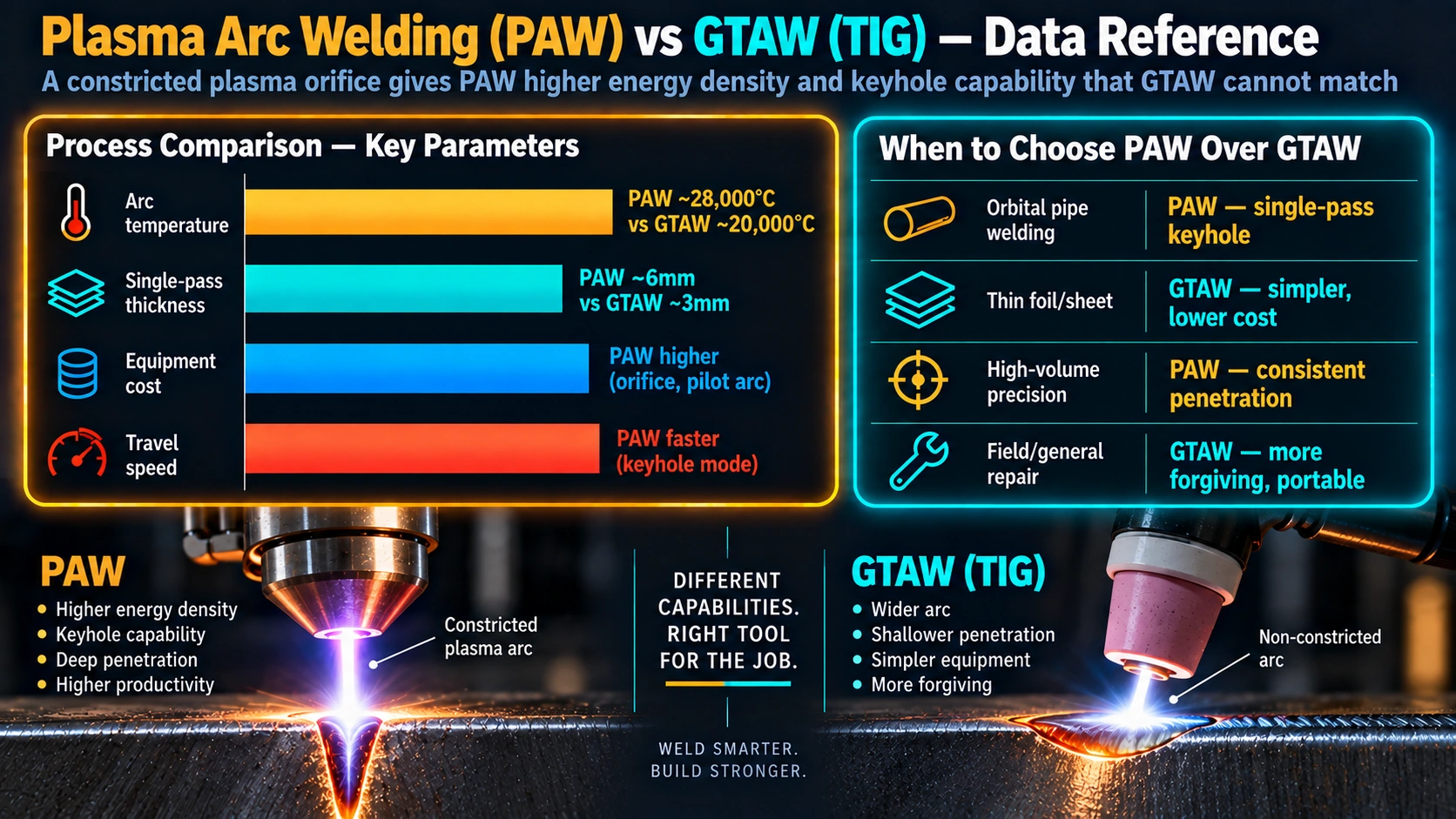
Choose PAW When:
- Material thickness is 2.5 to 12 mm and single-pass full penetration is required without joint preparation — keyhole mode delivers significant productivity and quality advantages
- Material is very thin (0.1 to 1.0 mm) and micro-plasma arc stability at low currents (<10 A) is needed
- HAZ must be minimised — heat-sensitive alloys (Ti-6Al-4V, precipitation hardening stainless, Inconel), distortion-critical assemblies
- Automated or orbital welding — PAW’s arc stiffness and pilot arc make it ideal for CNC, robotic, and orbital head applications
- Consistent penetration in production is required without operator-dependent arc length management
- No backing strip is possible or desirable — keyhole provides one-side full penetration without backing
- Welding titanium, zirconium, or reactive alloys in precision components where minimal heat input and consistent metallurgy are critical
Choose TIG (GTAW) When:
- Equipment budget is constrained — TIG system cost is 3–5× lower than equivalent PAW; choose TIG unless PAW’s specific advantages justify the capital
- Multi-pass welding of thick sections (>12 mm) where groove preparation and filler addition are required — TIG is more controllable and economical
- On-site field welding or repair work — TIG equipment is simpler, more portable, and more robust; PAW keyhole mode is unsuited to field repair conditions
- Wide range of positions including overhead — TIG is more flexible for all-position manual welding
- Aluminium welding — AC TIG with its cleaning action remains the established method; PAW on aluminium requires more specialised equipment and offers less clear advantage
- Operator training investment is limited — TIG training is more widely available, standardised, and less technically demanding than PAW
- Project specification or code requires GTAW (many ASME process piping projects specify GTAW for root and hot passes by Owner specification)
Recommended References
Disclosure: WeldFabWorld participates in the Amazon Associates programme (StoreID: neha0fe8-21). If you purchase through these links, we may earn a small commission at no extra cost to you. This helps support free technical content on this site.