Slot & Plug Weld Symbols — Complete Guide with AWS A2.4 Diagrams
When you need to join two overlapping plates together without making a weld along their exposed edges — or when you need additional intermediate attachment points between two lapped members — plug welds and slot welds are the solution. Both are deposited inside holes or elongated openings made in the top member of a lap joint, fusing the top member to the bottom member through the filled hole or slot.
Reading and interpreting plug and slot weld symbols correctly is a daily requirement for welders, fabricators, welding inspectors, and structural engineers working from engineering drawings. A plug weld symbol misread as a fillet weld, or a depth-of-fill callout overlooked, produces a structurally different weld from what was designed — and in pressure vessel, structural, or aerospace fabrication, that difference matters.
What Are Plug and Slot Welds?
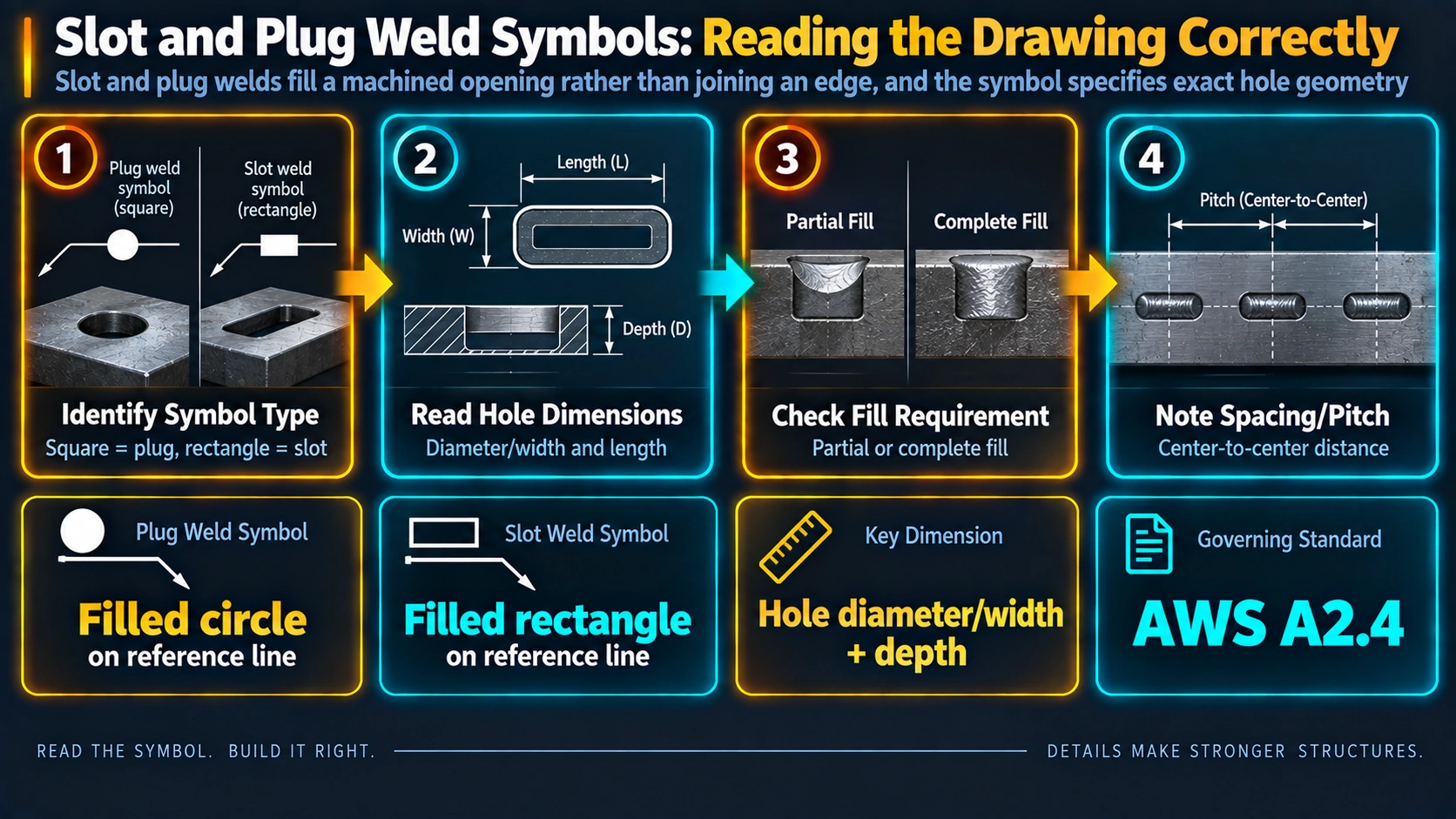
A plug weld is a circular weld made through a hole in one member of a lapped joint. The hole is drilled or punched in the top plate; the weld is deposited inside the hole, filling it completely or to a specified depth, and fusing the bottom of the hole to the underlying plate. The result is a cylindrical or partially filled weld that mechanically pins the two plates together at that location.
A slot weld follows the same principle but uses an elongated slot rather than a circular hole. The slot may be rectangular, oval, or have rounded ends. Slot welds can carry more load than a single plug weld because of their greater weld area, and they allow more design flexibility in narrow plate sections where a large-diameter plug hole might compromise the base metal.
The Basic Plug and Slot Weld Symbol
The plug weld symbol is a filled circle placed on the reference line. The slot weld symbol is a rectangle placed on the reference line. Both are placed either below (arrow side) or above (other side) the reference line depending on which member contains the hole or slot.
Arrow-Side vs Other-Side Placement AWS A2.4 §3
The position of the plug or slot weld symbol relative to the reference line tells you which member of the joint contains the hole or slot. This is one of the most fundamental rules in all weld symbol interpretation, and it applies to plug and slot welds exactly as it does to all other weld types.
- Arrow-side: The hole or slot is in the member that the arrow points to. The symbol is placed on the side of the reference line toward the reader — conventionally below the reference line in standard orientation. The welder fills the hole from the arrow side.
- Other-side: The hole or slot is in the member opposite to the one the arrow points to. The symbol is placed on the side of the reference line away from the reader — above the reference line. The welder fills the hole from the other side, which may require turning the assembly or working from below.
Plug Weld Dimension Callouts AWS A2.4 §3-34
All dimensions for plug welds are shown on the same side of the reference line as the weld symbol. Four specific dimension positions are defined by AWS A2.4, each encoding a different piece of information about the plug weld geometry. All four can appear simultaneously on a fully dimensioned plug weld symbol.
Depth of Filling — Complete vs Partial AWS A2.4 §3
AWS A2.4 states clearly: depth of filling of plug and slot welds shall be complete unless otherwise indicated. This means if the plug weld symbol has nothing written inside the circle, the welder is required to fill the hole completely flush to the top surface of the top member.
When the depth of filling is to be less than complete, the required depth in millimetres (or inches) must be written inside the weld symbol circle. The depth is measured from the base of the hole upward — so a depth callout of 10 mm in a 20 mm thick plate means the hole is filled to 10 mm above the bottom interface, leaving 10 mm of unfilled depth at the top.
Included Angle of Countersink AWS A2.4 §3-34
Plug weld holes may be drilled straight-sided (cylindrical) or countersunk at the top. A countersink makes it easier to achieve good fusion at the surface of the top plate and can produce a flush weld surface without mechanical finishing. When a countersink is specified, its included angle — the full angle of the cone at the top of the hole — is shown on the weld symbol.
The countersink angle is positioned above the symbol for other-side plug welds, and below the symbol for arrow-side plug welds. This position mirrors the general AWS A2.4 convention that dimensions for arrow-side features appear below the reference line and other-side features appear above it.
If no countersink angle is shown on the symbol, the user’s standard angle applies — meaning the angle specified in the manufacturer’s or organisation’s standard practice. This “user’s standard” provision is AWS A2.4’s way of saying: if everyone in your shop uses a 60-degree countersink for plug welds, you do not need to callout the angle on every symbol, as long as that standard is documented and understood.
Pitch — Centre-to-Centre Spacing AWS A2.4 §3
When a row of multiple plug welds is required along a joint, the centre-to-centre spacing between them — the pitch — is shown to the right of the plug weld symbol. This is identical in concept to the pitch callout for fillet welds in a series.
The pitch value is the distance from the centre of one plug weld to the centre of the next plug weld in the series, measured along the joint axis. If no pitch is shown to the right of the symbol, only a single plug weld at the arrow location is indicated — not a series.
Surface Contour of Plug and Slot Welds AWS A2.4 §3-35, §3-36
The surface contour of a completed plug weld — whether it is flush, convex, or concave — may be specified using standard finish contour symbols added to the weld symbol. AWS A2.4 defines two specific scenarios for plug weld surface finish:
Flush by Welding Technique (No Mechanical Finishing)
When the plug weld is to be welded approximately flush — that is, the welder uses technique alone to produce a surface that is level with the surrounding plate, without any grinding, machining, or other mechanical finishing — the flush contour symbol (a straight line) is added to the weld symbol. No finish method letter is added, because no mechanical finishing is involved. This tells the welder: fill the hole and produce a flat surface using your welding technique; no grinding required.
Flush by Mechanical Finishing
When the plug weld must be finished flush by mechanical means — grinding, machining, or another finishing method — both the flush contour symbol (straight line) AND the user’s standard finish symbol letter are added to the weld symbol. The finish symbol letter is typically G (grinding), M (machining), C (chipping), or another letter from the user’s established convention. This tells the welder and inspector: weld the hole approximately full and then grind or machine flush — the surface must be mechanically flat, not just visually approximate.
| Surface Condition Required | Contour Symbol Added | Finish Letter Added | Meaning |
|---|---|---|---|
| Flush — welding technique only | Straight line (flush contour) | None | Welder produces flat surface by technique; no grinding |
| Flush — mechanical finishing (grinding) | Straight line (flush contour) | G (grinding) or user standard | Weld full, then grind mechanically flat. Surface must be truly flush. |
| Convex surface (no finishing) | Convex arc symbol | None | Weld to produce a slightly raised convex crown — acceptable without finishing |
| No contour specified | None | None | Surface condition left to welder’s judgement — as welded finish acceptable |
Slot Weld Dimension Callouts AWS A2.4 §3-37
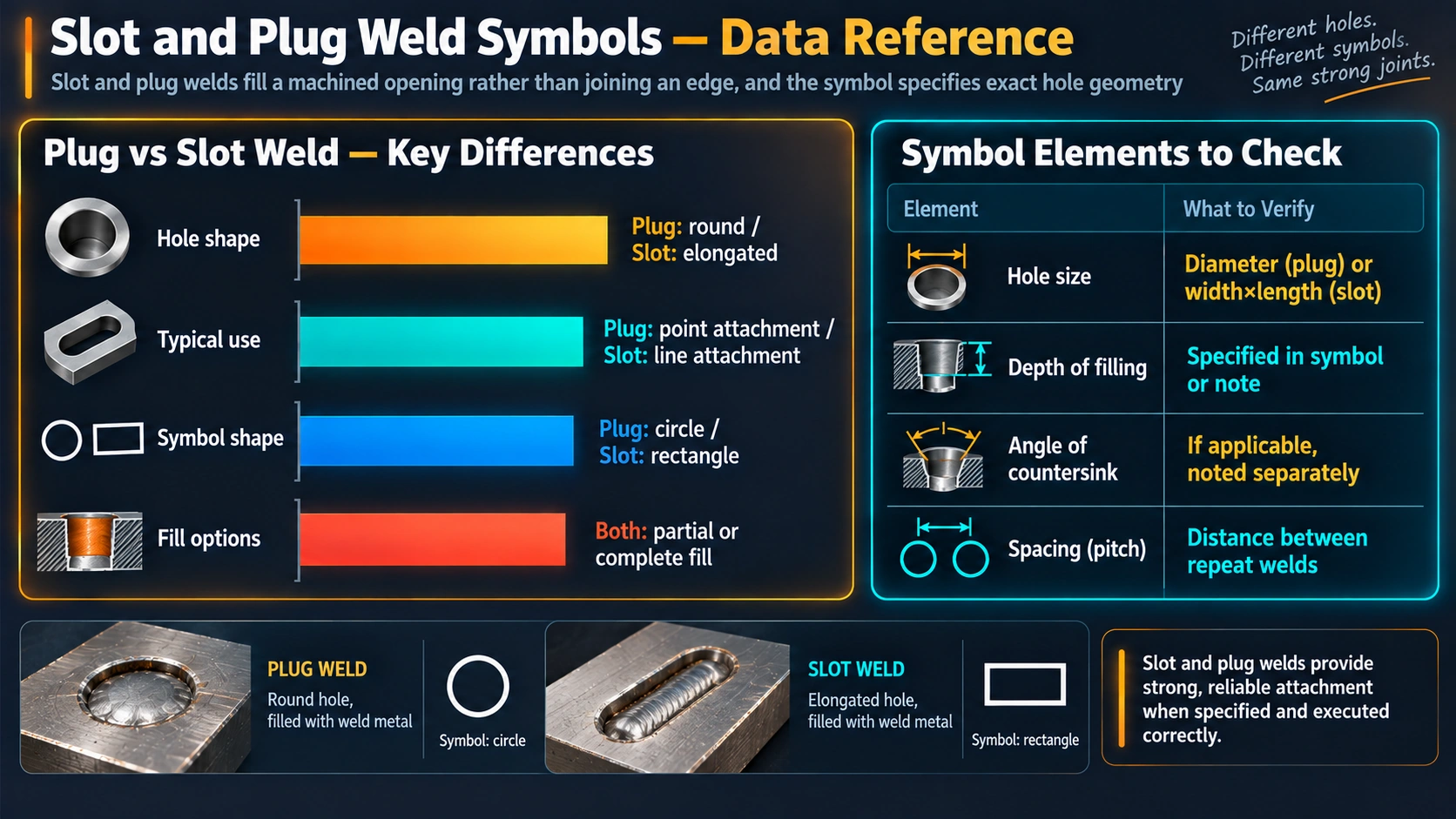
Dimensions of slot welds must be shown on the same side of the reference line as the weld symbol — the same rule as for plug welds. However, what can actually be shown on the slot weld symbol is more limited than for plug welds, for an important reason explained in the next section.
The slot weld symbol (a rectangle on the reference line) can show:
- Depth of filling — shown inside the rectangle symbol, in the same way as the plug weld. If empty: complete fill required. If a number is shown inside: partial fill to that depth.
- Pitch — shown to the right of the symbol, the centre-to-centre spacing of multiple slot welds in a series, measured along the joint axis.
Unlike plug welds, the width and length of the slot cannot be meaningfully shown on the symbol itself — a rectangular symbol on a reference line cannot convey the exact proportions of an elongated slot with rounded ends. This is why AWS A2.4 requires that slot dimensions be shown on the drawing rather than on the symbol.
Details of Slot Welds — What Must Go on the Drawing AWS A2.4 §3, §3-33
AWS A2.4 is explicit about what cannot be communicated by the slot weld symbol alone: length, width, spacing, included angle of countersink, orientation, and location of slot welds cannot be shown on the welding symbol.
All of these details must be provided in one of two ways:
- On the engineering drawing itself — shown in a plan view, section view, or elevation that includes the slot geometry with dimensioned width, length, and angular orientation relative to the joint axis.
- By a detail drawing — a separate detail figure that shows the slot geometry, with a reference from the weld symbol back to that detail (using a reference tail notation on the weld symbol: a forked tail at the right end of the reference line with a code such as “Detail A” or a drawing note number).
How to Read Complete Plug and Slot Weld Symbol Examples
Working through complete symbol readings is the fastest way to solidify understanding. The following examples cover the most common combinations encountered in structural and pressure vessel fabrication drawings.
| Symbol Description | What It Means — Full Reading | Notes |
|---|---|---|
| Filled circle below reference line; 20 to left; nothing inside; 75 to right | Arrow-side plug weld. Hole diameter 20 mm. Fill completely (no partial fill callout). Plug welds at 75 mm pitch. User’s standard countersink angle applies. | Most common basic plug weld specification. Arrow-side placement, complete fill, series at 75 mm centres. |
| Filled circle below reference line; 20 to left; 10 inside; 45° below symbol; 75 to right | Arrow-side plug weld. Hole diameter 20 mm. Fill to 10 mm depth (partial fill). Countersink angle 45 degrees. Pitch 75 mm. | Partial fill with countersink specified. The hole is countersunk to 45°; filled only 10 mm up from the bottom. Useful where weight saving or heat input reduction is specified. |
| Filled circle above reference line; 16 to left; nothing inside; no pitch shown | Other-side plug weld. Hole diameter 16 mm. Fill completely. Single plug weld at this location (no pitch = no series). | Other-side placement — hole is in the member opposite to the arrow. Single plug weld location only. |
| Rectangle below reference line; 8 inside; 100 to right; reference tail notation “See Detail A” | Arrow-side slot weld. Fill to 8 mm depth. Slot welds at 100 mm pitch. Slot dimensions (width, length, orientation) per Detail A on drawing. | Complete reading requires consulting Detail A for slot geometry. The symbol alone is insufficient to fully define the weld without the drawing detail. |
| Filled circle below reference line; 18 to left; nothing inside; flush contour symbol (straight line on top of circle); G finish letter | Arrow-side plug weld. Hole 18 mm. Fill completely. Finish flush by grinding (mechanical finishing required). | The combination of flush contour + G means: weld the hole full, then grind the surface mechanically flat. Typical for structural applications where the surface will be painted and flush appearance is required. |
Plug Weld vs Fillet Weld in a Hole — A Critical Distinction
This is a mistake that has real structural consequences. A plug weld and a fillet weld in a hole look superficially similar on a drawing — both involve welding inside a hole in a plate — but they are completely different joints both structurally and in terms of the symbol used.
| Feature | Plug Weld | Fillet Weld in Hole |
|---|---|---|
| Weld metal location | Fills the entire hole (or to specified depth) from base to top | Deposited only around the perimeter of the hole, at the bottom edge — a circular fillet, not a fill |
| Symbol used | Plug weld symbol (filled circle on reference line) | Fillet weld symbol with supplementary notation indicating a hole — must NOT use the plug weld symbol |
| Structural behaviour | Weld carries shear through the full cross-sectional area of the filled hole | Weld carries shear around the circular fillet throat at the hole perimeter only — smaller effective area |
| AWS A2.4 prohibition | AWS A2.4 explicitly prohibits using the plug weld symbol for fillet welds in holes | Requires its own symbol notation — cannot borrow the plug weld symbol |
| Common error | Calling out a fillet-in-hole as a plug weld results in a fully filled hole — stronger joint than intended, with excess weld metal, heat, and cost | Calling out a plug weld as a fillet-in-hole results in an under-welded joint — much weaker than the design intent, potentially unsafe |
Typical Applications of Plug and Slot Welds
| Application | Type | Why Plug/Slot Instead of Fillet or Butt |
|---|---|---|
| Steel floor deck attachment to structural beams | Plug weld | Edge of deck is rolled and not accessible for a continuous edge fillet; plug welds through pre-punched holes in the deck sheet provide the required attachment without needing access to the deck edge |
| Overlapping plate reinforcement on crane girder webs | Slot weld | Reinforcing plates cover the web faces; slot welds through the reinforcing plate attach it to the web at intermediate points, preventing buckling and ensuring composite action without visible edge welds |
| Box section fabrication — internal diaphragm attachment | Plug weld | Once a box section is closed, access to internal diaphragm edge welds is impossible; plug welds from outside through the box plate to the internal diaphragm edge provide post-closure attachment |
| Thin sheet metal automotive body assembly | Plug weld | Simulates the resistance spot weld appearance and function with GMAW instead of dedicated spot welding equipment; common in repair and low-volume fabrication |
| Structural steel shear connection — end plate to web | Slot weld | Where a continuous fillet along the connection plate edge would cause distortion, intermediate slot welds at designed spacing provide the required shear capacity with lower heat input and distortion |
| Pressure vessel nozzle reinforcing pad attachment | Plug weld | Reinforcing pads overlaying pressure vessel nozzle areas are attached around their perimeter with fillet welds; additional plug welds through the pad body ensure full contact and prevent pad lifting under pressure cycles |
Common Symbol Reading and Drafting Errors
| Error | Consequence | Correct Practice |
|---|---|---|
| Using plug weld symbol for a fillet weld in a hole | Fabricator fills the hole (plug weld) when only a perimeter fillet was needed — over-welded, costly, excessive heat input | Use fillet weld symbol with drawing notation for fillet-in-hole applications. AWS A2.4 is explicit: plug symbol is prohibited for fillets in holes. |
| Leaving the inside of the symbol blank when partial fill is intended | Fabricator fills the hole completely (the default) instead of to the specified partial depth | Always write the required partial fill depth inside the symbol when the hole is not to be completely filled. |
| Placing countersink angle on the wrong side of the symbol (above for arrow-side, below for other-side) | Countersink is applied to the wrong face of the joint — the machinist countersinks the opposite plate from intended | Arrow-side features (including countersink angle for arrow-side welds) are annotated below the reference line. Other-side features are annotated above. |
| Not providing slot dimensions on the drawing for slot welds | Fabricator cannot cut the correct slot — dimension not available from the symbol; job stops pending clarification | Always provide slot width, length, and orientation in a plan view or detail drawing referenced from the weld symbol. The slot weld symbol alone is never sufficient. |
| Confusing pitch (centre-to-centre) with spacing (edge-to-edge) | Plug welds placed at wrong intervals — too close (overlap HAZ, distortion) or too far apart (insufficient joint strength) | Pitch is always centre-to-centre distance. To find hole edge-to-edge spacing: subtract the hole diameter from the pitch value. |
Recommended References
Disclosure: WeldFabWorld participates in the Amazon Associates programme (StoreID: neha0fe8-21). If you purchase through these links, we may earn a small commission at no extra cost to you. This helps support free technical content on this site.