Martensite, Bainite and Pearlite: How Cooling Rate Shapes Steel Microstructure
The mechanical properties of a steel weld and its heat-affected zone (HAZ) are not determined solely by chemical composition. They are equally — and in many cases more decisively — controlled by the rate at which the steel cools from the austenite temperature range back to room temperature. Martensite, bainite, and pearlite are the three principal transformation products of austenite in carbon and low-alloy steel, and each is produced under a different thermal history. Understanding these microstructures and the cooling conditions that create them is one of the most practically important areas of knowledge for any welding engineer, inspector, or metallurgist.
When a weld is deposited, the adjacent base metal is rapidly heated above the A3 temperature, forming austenite in the HAZ, and then cools at a rate determined by heat input, preheat, section thickness, and joint geometry. That cooling rate determines whether the HAZ transforms to soft, machinable pearlite or to hard, crack-susceptible martensite — a distinction that can be the difference between a serviceable weld and a catastrophic failure. This article explains the transformation sequence in detail, interprets the TTT and CCT diagrams used to predict microstructure, and connects these metallurgical principles to the practical decisions made when writing and qualifying a welding procedure specification (WPS).
The article is part of the WeldFabWorld Welding Metallurgy Series, which covers the full range of metallurgical topics relevant to welding professionals — from crystal structures and the iron-carbon phase diagram through to hydrogen cracking and residual stresses.
The Starting Point: Austenite
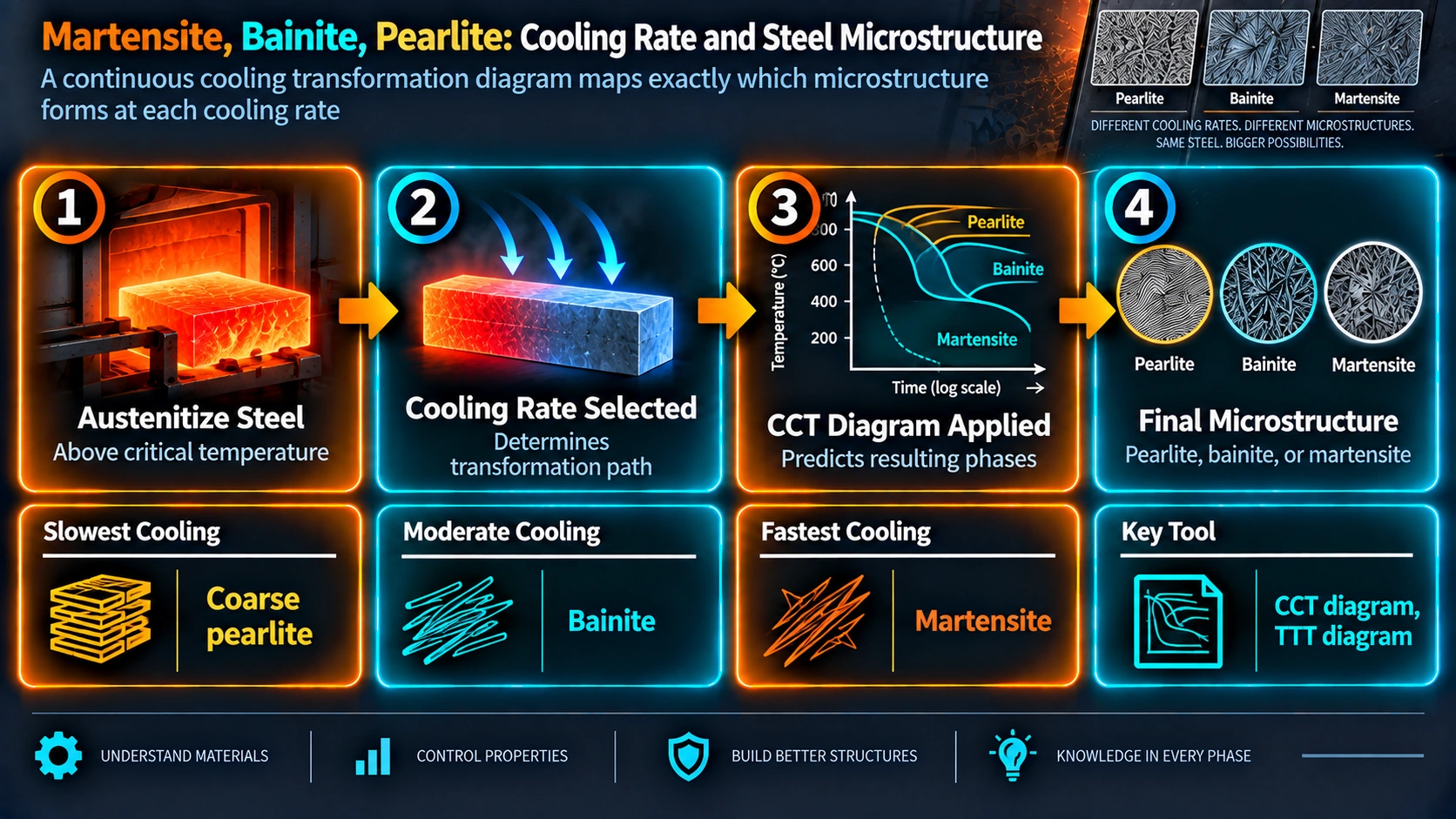
All three transformation products begin from the same starting microstructure: austenite — a face-centred cubic (FCC) solid solution of carbon dissolved interstitially in gamma iron. Austenite is stable above the A3 temperature in hypoeutectoid steels (above Acm in hypereutectoid steels). To understand the significance of this, it is helpful to refer to the iron-carbon phase diagram, which defines the temperature ranges over which each phase is stable.
The FCC structure of austenite can dissolve significantly more carbon than the BCC ferrite that replaces it on cooling — up to approximately 2.14 wt% C at 1148°C versus only 0.022 wt% C in ferrite at 727°C. This large difference in solubility means that when austenite cools, carbon must either diffuse to form carbide phases or — if cooling is too fast for diffusion — become trapped in the crystal lattice, producing the highly strained martensite structure.
The key variable that determines which transformation product forms is the cooling rate, and more specifically, the temperature range over which the austenite is cooled at each rate. The TTT and CCT diagrams discussed later in this article map out these relationships precisely.
Pearlite: The Equilibrium Transformation Product
When austenite is cooled very slowly — at or near equilibrium conditions such as occur during furnace annealing — carbon atoms have sufficient thermal energy and time to diffuse to preferred locations as the FCC austenite attempts to transform into BCC ferrite. The result is pearlite: a two-phase lamellar mixture of alternating plates (lamellae) of:
- Ferrite — BCC iron containing very little dissolved carbon (approximately 0.022 wt% C at 727°C). Soft, ductile, and with low tensile strength.
- Cementite (Fe3C) — Iron carbide containing approximately 6.67 wt% C. Hard and brittle, but when present as thin lamellae interspersed with ferrite, it provides strength reinforcement without excessive brittleness.
Pearlite takes its name from the mother-of-pearl appearance it exhibits under a light optical microscope — the fine lamellae diffract light to produce an iridescent effect. Its characteristic striated appearance under higher magnification makes it one of the most readily identifiable microstructures in steel metallography.
Coarse Pearlite vs. Fine Pearlite
The interlamellar spacing of pearlite — the distance between adjacent cementite plates — is directly controlled by the transformation temperature. Because transformation temperature is tied to cooling rate, the microstructural scale of pearlite is an indirect function of cooling speed:
- Coarse pearlite forms at temperatures close to the A1 (approximately 650–700°C for a 0.8 wt% C steel) during very slow cooling. The lamellae are widely spaced. The steel is softer, more ductile, and easier to machine — typical of fully annealed condition.
- Fine pearlite forms at somewhat lower temperatures (approximately 550–650°C) when the cooling rate is faster, but still in the pearlite transformation window. The lamellae are closely spaced. Fine pearlite is harder and stronger than coarse pearlite, though with somewhat reduced ductility.
Steels in a normalised condition typically contain fine pearlite plus a pro-eutectoid ferrite phase at grain boundaries, giving them a useful combination of strength, toughness, and weldability. Plain carbon structural steels in grades equivalent to ASTM A36 or S275 are primarily ferritic-pearlitic in the normalised condition.
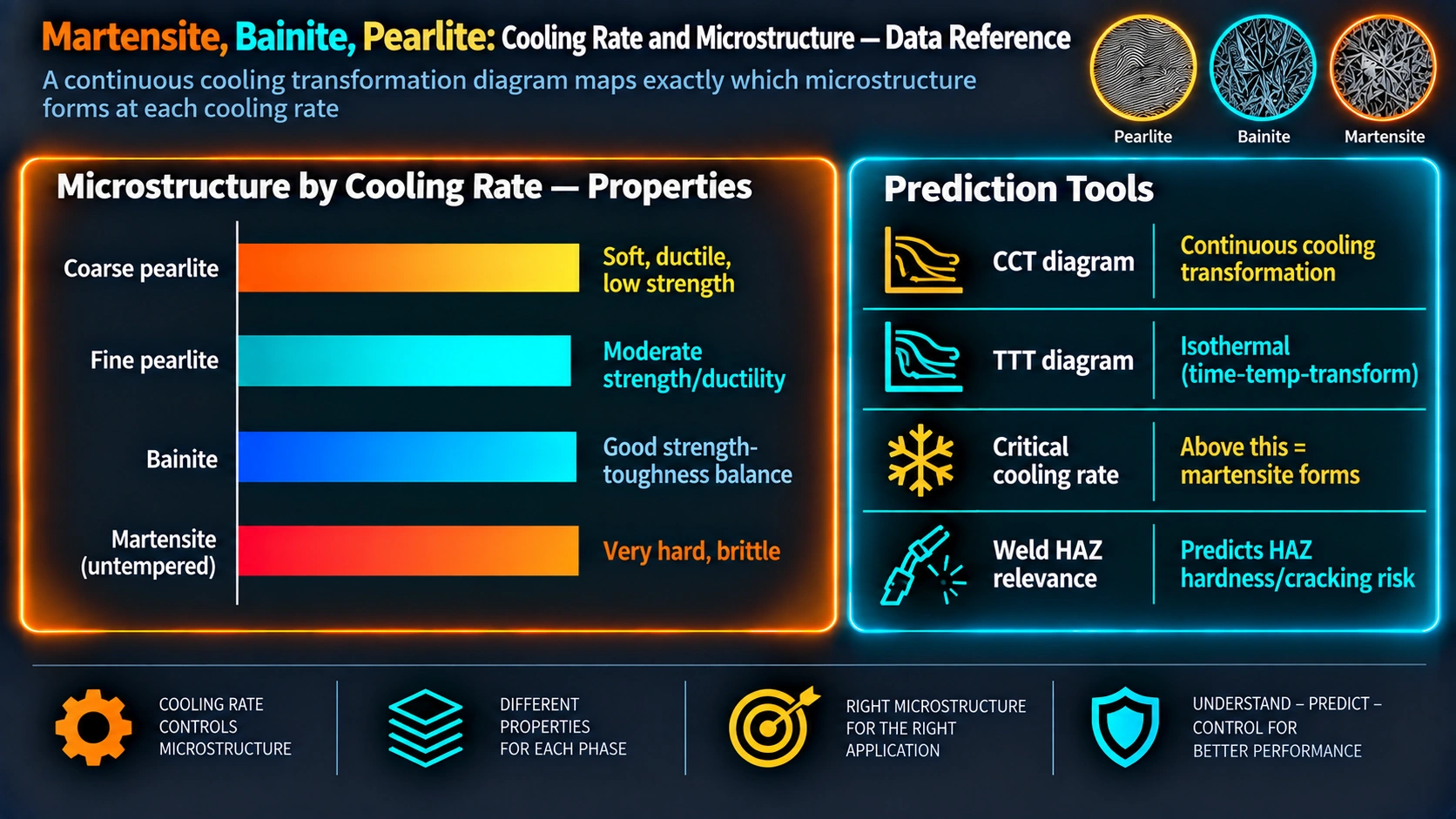
| Transformation Product | Approximate Hardness (HV) | Tensile Strength (MPa) | Toughness | Weldability |
|---|---|---|---|---|
| Coarse Pearlite | 160–200 | 550–700 | High | Excellent |
| Fine Pearlite | 200–280 | 700–900 | Good | Good |
| Upper Bainite | 280–400 | 900–1200 | Moderate | Fair |
| Lower Bainite | 350–500 | 1100–1500 | Good | Requires preheat |
| As-quenched Martensite | 500–900 | 1500–2500+ | Very Low | Poor — requires preheat and PWHT |
| Tempered Martensite | 250–450 | 800–1400 | Good–Excellent | Moderate (PWHT required) |
Table 1 — Approximate mechanical property ranges for austenite transformation products in medium-carbon and low-alloy steel. Values are indicative; exact properties depend on carbon content, alloying, and prior austenite grain size.
Bainite: The Intermediate Transformation Product
At cooling rates faster than those that produce fine pearlite — but not fast enough to produce martensite — bainite forms. Bainite is named after Edgar Bain, who together with Davenport first described it in 1930. It occupies an intermediate temperature range in the TTT diagram, typically between approximately 250°C and 550°C depending on steel composition.
Bainite is a two-phase mixture like pearlite, consisting of a ferrite matrix containing fine carbide precipitates, but it forms by a partially diffusion-controlled mechanism under conditions where diffusion is kinetically limited by the lower transformation temperature. The result is a far finer microstructure than pearlite — so fine that it cannot be fully resolved under a conventional optical microscope and requires scanning electron microscopy (SEM) or transmission electron microscopy (TEM) for detailed characterisation.
Upper Bainite vs. Lower Bainite
Bainite is further subdivided based on the temperature at which it forms:
- Upper bainite forms in the higher temperature portion of the bainite range (approximately 400–550°C). It has a feathery appearance under the optical microscope, with relatively coarser carbide films along ferrite lath boundaries. Upper bainite generally has lower toughness than lower bainite.
- Lower bainite forms at lower temperatures (approximately 250–400°C), where diffusion is more severely limited. Carbides precipitate within the ferrite plates rather than at their boundaries, giving a finer, more homogeneous distribution. Lower bainite typically has higher strength and better toughness than upper bainite.
In engineering practice, bainite is a desirable microstructure in many high-strength low-alloy (HSLA) steels, quenched-and-tempered pressure vessel steels such as ASTM A517 or P91 Cr-Mo alloy steels, and in the HAZ of modern fine-grained structural steels that have been designed to produce bainite under air-cooling conditions on normalising.
Martensite: The Rapid Quench Transformation Product
When austenite is cooled extremely rapidly — by quenching in water, brine, or oil — there is insufficient time for carbon atoms to diffuse to their equilibrium positions. The transformation from FCC austenite to BCC ferrite, which normally occurs by diffusion, cannot proceed in the usual way. Instead, a diffusionless (displacive or shear-type) transformation occurs in which large numbers of atoms move cooperatively by a shear mechanism, instantaneously converting the FCC structure into a body-centred tetragonal (BCT) structure.
The tetragonal distortion arises because the carbon atoms, which were dissolved interstitially in the austenite, cannot escape during the rapid transformation. They become trapped in supersaturated interstitial positions within the BCT lattice, creating severe lattice strain and very high internal stress. This is the origin of martensite’s exceptional hardness: the trapped carbon creates so many obstacles to dislocation movement that plastic deformation is extremely difficult.
Characteristics of As-Quenched Martensite
- Extremely high hardness and tensile strength — hardness typically 500–900 HV depending on carbon content
- Very low ductility and impact toughness — essentially brittle in the as-quenched state at carbon contents above approximately 0.3 wt% C
- Characteristic acicular (needle-like) or lath morphology — lath martensite predominates in low-to-medium carbon steels; plate (acicular) martensite predominates in high-carbon steels
- High susceptibility to hydrogen-assisted cold cracking — the combination of high hardness, high internal stress, and a BCT structure with numerous trapping sites makes martensite by far the most susceptible microstructure to hydrogen-induced cracking
- Start and finish temperatures — the martensite start temperature (Ms) is approximately 500°C minus contributions from alloying elements; the martensite finish temperature (Mf) is where transformation is complete
Martensite Hardness vs. Carbon Content
The hardness of as-quenched martensite is primarily a function of carbon content. The relationship is approximately linear up to about 0.6 wt% C, beyond which the rate of increase diminishes:
Example at C=0.2: HV ≈ 884 × 0.2 × (1 − 0.3 × 0.04) + 294
Result: HV ≈ 462 (at 0.20 wt% C)
Example at C=0.4: HV ≈ 884 × 0.4 × (1 − 0.3 × 0.16) + 294
Result: HV ≈ 616 (at 0.40 wt% C)
This is why the carbon equivalent (CE) calculation — which estimates the susceptibility to HAZ hardness and cold cracking — places the highest weighting on carbon content. Even small increases in carbon content produce significant increases in martensite hardness. The IIW carbon equivalent formula:
All elements in wt%. Carbon term dominates because it appears with a coefficient of 1.0
Threshold: CE < 0.35 — generally no preheat required for typical applications
CE > 0.45 — preheat required; risk of HAZ hardness and cold cracking
The Critical Cooling Rate and Hardenability
For each steel composition, there is a critical cooling rate — the minimum rate above which 100% martensite is produced without any pearlite or bainite. Steels differ enormously in their critical cooling rate, and this difference is described by the concept of hardenability: the ability of a steel to form martensite when cooled from the austenitising temperature.
Alloying elements increase hardenability by shifting the pearlite and bainite transformation curves in the TTT/CCT diagrams to longer times (further to the right). This means the steel can be cooled more slowly and still form martensite. Key alloying elements that increase hardenability include: Mn, Cr, Mo, Ni, B, and V. Carbon itself also increases hardenability, but it simultaneously raises the martensite hardness and brittleness.
Factors Controlling HAZ Cooling Rate in Welding
In welding, the HAZ does not have a single uniform cooling rate — it varies with distance from the fusion line and with time. However, the cooling rate at 800–500°C (the Δt8/5 interval) is the most commonly used engineering parameter for characterising HAZ thermal cycles, because this is the temperature range over which the austenite transformation products form. The following welding variables control Δt8/5:
- Heat input — higher heat input (higher amperage, lower travel speed) produces slower cooling and reduces martensite risk
- Preheat and interpass temperature — higher preheat reduces the temperature gradient and slows the HAZ cooling rate
- Base metal thickness — thicker sections conduct heat away more rapidly, increasing the cooling rate
- Joint geometry — fillet welds on thick plate cool faster than butt welds on the same plate, due to the three-dimensional heat sink effect
- Number of welding passes — in multi-pass welding, subsequent passes re-heat the HAZ of previous passes, acting as a form of tempering
TTT and CCT Diagrams Explained
To predict what microstructure will form for a given cooling rate and steel composition, metallurgists use two complementary types of transformation diagrams. Both plot temperature (y-axis) against time (x-axis, typically on a logarithmic scale), and both show the boundaries between transformed and untransformed regions as curves — but they represent different thermal conditions.
TTT Diagram (Time-Temperature-Transformation)
The TTT diagram, also called an isothermal transformation (IT) diagram, shows how long austenite takes to begin and complete transformation at constant temperatures. The characteristic “C-curve” shape arises because the transformation rate depends on two competing factors:
- Driving force — increases as temperature falls further below the A1 (greater undercooling means higher thermodynamic driving force for transformation)
- Diffusion rate — decreases exponentially as temperature falls
At temperatures just below A1, the driving force is small — transformation is slow. At very low temperatures, the driving force is large but diffusion is almost negligible — transformation is again slow. The fastest transformation occurs at the “nose” of the C-curve, where both driving force and diffusion are sufficient for rapid transformation.
CCT Diagram (Continuous Cooling Transformation)
The CCT diagram shows the same transformation information but for continuous cooling conditions — more representative of real-world welding and heat treatment. On a CCT diagram:
- The C-curves are shifted to slightly longer times and lower temperatures compared to the TTT diagram
- Different cooling rates are represented by diagonal lines passing through the diagram
- The microstructure produced is determined by which transformation regions each cooling curve passes through
- Faster cooling curves (steeper lines) pass through the bainite or martensite regions rather than the pearlite region
For welding HAZ analysis, CCT diagrams derived for the specific base material composition are the most directly applicable tool. Many steel manufacturers publish CCT diagrams for their products. The ASME specification steels used in pressure vessel fabrication — such as SA-516, SA-387, and SA-333 grades — each have characteristic CCT curves that determine the minimum heat input and preheat temperature required to avoid HAZ martensite.
Tempering: Recovering Toughness from Martensite
As-quenched martensite is too brittle for most engineering applications. The process used to restore ductility and toughness while retaining the strength advantage is called tempering. Tempering involves reheating the quenched (martensitic) steel to a temperature below A1, holding for a sufficient time, then cooling to room temperature.
During tempering, several microstructural changes occur in sequence as the temperature increases:
- Stage 1 (80–200°C) — Fine transition carbides (ε-carbide) precipitate from the supersaturated martensite; some carbon segregates to dislocations. Hardness decreases slightly.
- Stage 2 (200–300°C) — Retained austenite (if present) decomposes to bainite-like mixture. Relevant in high-carbon and highly alloyed steels.
- Stage 3 (300–400°C) — Transition carbides dissolve and cementite (Fe3C) precipitates as spheroids. Significant softening occurs. Temper embrittlement risk zone for some alloy steels.
- Stage 4 (400–700°C) — Cementite particles coarsen and spheroidise further; dislocation density decreases; martensite laths polygonise. Substantial softening but excellent toughness recovery.
The product — tempered martensite — is one of the most engineering-useful microstructures available in steel, combining the high dislocation density (strength) of martensite with the improved toughness provided by relieved lattice distortion and precipitated carbides.
Post-Weld Heat Treatment (PWHT) as Tempering
In welded fabrications, post-weld heat treatment (PWHT) serves an analogous function to tempering. When HAZ martensite forms during welding, PWHT at temperatures in the range 580–760°C (depending on the steel type and code requirements) allows the martensite to temper, reducing hardness, relieving residual stresses, and reducing the risk of hydrogen-assisted cold cracking.
ASME Section VIII Division 1 mandates PWHT for carbon steel when wall thickness exceeds 38 mm (1.5 inches), and at lower thicknesses for alloy steels such as Cr-Mo grades. The specific temperature and holding time are specified in UCS-56 of the code. For P91 (9Cr-1Mo-V) steels, PWHT requirements are particularly stringent because the tempering response of the complex martensitic microstructure is critical to achieving the specified creep properties at elevated temperatures — see the detailed discussion in the P91 welding article.
| Tempering Temperature Range | Effect on Hardness | Effect on Toughness | Typical Application |
|---|---|---|---|
| 150–250°C | Minimal reduction | Small improvement | Cutting tools, case-hardened components |
| 300–450°C | Moderate reduction | Moderate — risk of temper embrittlement in alloy steels | Springs, high-strength bolts |
| 500–600°C | Significant reduction | Good improvement | Structural and pressure vessel steels (Q&T) |
| 580–760°C (PWHT range) | Substantial — approaches normalised strength | Excellent — stress relieved | Welded pressure vessels (ASME UCS-56), HAZ tempering |
Table 2 — Tempering temperature ranges and their effects on martensite properties.
Practical Implications for Welding Engineers
The transformation behaviour of austenite on cooling is directly relevant to every stage of welding procedure development and qualification. The following practical points summarise the key engineering decisions informed by an understanding of martensite, bainite, and pearlite formation:
Selecting Preheat Temperature
Preheat temperature should be calculated using a recognised method such as the Graville-recommended carbon equivalent approach, the CEN (carbon equivalent for cracking) formula, or more detailed thermal modelling. A higher preheat reduces the HAZ cooling rate, shifting the transformation from martensite toward bainite or pearlite — reducing HAZ hardness and hydrogen cracking risk. The carbon equivalent calculator on WeldFabWorld provides IIW and Pcm values for your material composition.
Setting Heat Input Limits
For hardenable steels, a minimum heat input is often specified to prevent excessively fast HAZ cooling and martensite formation. For materials where HAZ toughness is critical — such as fine-grained HSLA steels and normalised-condition pressure vessel plates — a maximum heat input is also often specified to prevent grain coarsening in the HAZ and excessive softening of the base metal. Both limits are driven by the CCT behaviour of the specific material.
Hardness Testing of the HAZ
Post-weld hardness testing (using Vickers or Rockwell methods) is used to verify that the HAZ microstructure is acceptable. ASME Section VIII and structural welding codes typically limit HAZ hardness to 248 HV10 (approximately 22 HRC or 240 HB) for carbon and carbon-manganese steels — equivalent to a hardness that indicates limited martensite content. If hardness exceeds this limit, the welding procedure must be modified (higher heat input, higher preheat, or PWHT) to soften the HAZ. The mechanical testing article covers hardness testing methods in detail.
Interpreting Impact Test Results
Charpy impact test results from HAZ specimens provide a direct measure of the toughness of the transformation product present. Martensitic HAZ microstructures show very low absorbed energy values at sub-zero test temperatures, often failing the ASME UG-84 minimum impact requirements. Bainitic and tempered martensitic microstructures generally meet impact requirements if the tempering or PWHT has been correctly applied. Understanding the relationship between microstructure and toughness allows the engineer to diagnose why an impact test failed and what welding parameter change is needed to remedy it.
Frequently Asked Questions
What is the difference between martensite, bainite, and pearlite in steel?
All three are transformation products of austenite in carbon steel, formed under different cooling rates. Pearlite forms at slow cooling rates and consists of alternating layers of ferrite and cementite (Fe3C) — it is soft, ductile, and easy to machine. Bainite forms at intermediate cooling rates as fine carbide needles in a ferrite matrix — harder and stronger than pearlite, but tougher than martensite. Martensite forms at rapid quench rates via a diffusionless shear transformation, producing a body-centred tetragonal (BCT) structure with trapped carbon that is extremely hard, strong, but brittle in the as-quenched state.
Why is martensite hard and brittle?
Martensite hardness arises from carbon atoms being trapped in supersaturated interstitial positions within the body-centred tetragonal (BCT) lattice during the diffusionless quench transformation. This trapped carbon creates severe lattice distortion and very high internal strain, which strongly resists dislocation movement — the atomic mechanism of plastic deformation. Because dislocation movement is so strongly inhibited, the material is hard but has almost no capacity for plastic strain before fracture, making it brittle. Both hardness and brittleness increase with carbon content.
What is the critical cooling rate in steel?
The critical cooling rate is the minimum rate at which austenite must be cooled to produce 100% martensite, without any diffusion-controlled transformation products such as pearlite or bainite. Steels with higher carbon content or greater alloy additions — which increase hardenability — have lower critical cooling rates, meaning martensite can form even at relatively moderate cooling speeds. This is directly relevant to welding: the HAZ of a high-carbon or alloy steel can form martensite even at air-cooling rates that would produce pearlite in a plain low-carbon steel. The carbon equivalent is used to estimate susceptibility.
What is the difference between a TTT diagram and a CCT diagram?
A TTT (Time-Temperature-Transformation) diagram shows how long austenite takes to transform at various constant (isothermal) temperatures — it is used for understanding the theoretical kinetics of transformation. A CCT (Continuous Cooling Transformation) diagram shows the same information for conditions where the steel is continuously cooling through a range of temperatures, which more closely matches real-world welding and heat treatment. For welding HAZ analysis, the CCT diagram is more directly applicable because the HAZ is always undergoing continuous cooling rather than isothermal holding. CCT curves are shifted to longer times and lower temperatures compared to the TTT for the same steel.
How does preheat reduce martensite formation in the HAZ?
Preheat raises the starting temperature of the base metal before welding. Because the temperature gradient between the weld pool and the surrounding base metal is reduced, the rate at which heat flows out of the HAZ is slower. This slower cooling rate gives carbon atoms more time to diffuse during the austenite-to-ferrite transformation, favouring the formation of pearlite or bainite rather than martensite. Preheat also reduces thermal shock and the risk of hydrogen-assisted cold cracking, to which martensite is particularly susceptible. Preheat requirements are specified in ASME Section VIII, ASME B31.3, and AWS D1.1, and are calculated from the steel’s carbon equivalent and section thickness.
What does tempering do to martensite?
Tempering is a post-quench heat treatment that reheats martensitic steel to a temperature below A1 (typically 150–700°C depending on the target properties) and holds it before cooling. This allows the trapped carbon to partially diffuse and precipitate as fine carbide particles, relieving lattice distortion and internal stress. The result — tempered martensite — is substantially tougher and more ductile than as-quenched martensite, while retaining much of its strength advantage over pearlite. Post-weld heat treatment (PWHT) as required by ASME Section VIII UCS-56 achieves a similar tempering effect on HAZ martensite in welded pressure vessels.
Why is bainite considered a desirable microstructure in pressure vessel steels?
Bainite offers a combination of properties that make it attractive for engineering applications: it is significantly stronger and harder than pearlite, yet tougher and more ductile than as-quenched martensite. In pressure vessel and structural steels such as ASTM A387 Cr-Mo grades or P91 alloy steel, controlled heat treatment cycles are often designed to produce a predominantly bainitic microstructure in the normalised-and-tempered or quenched-and-tempered condition. This gives the steel adequate yield strength for pressure containment while maintaining the low-temperature toughness required by codes such as ASME Section VIII Division 1 UG-84.
How does carbon content affect the hardness of martensite?
Martensite hardness increases approximately linearly with carbon content up to around 0.6 wt% C, after which the rate of increase diminishes. A low-carbon steel (0.10–0.20 wt% C) produces martensite of approximately 350–470 HV, whereas a medium-carbon steel (0.40 wt% C) can produce martensite of 600 HV or above. This is why the carbon equivalent (CE) formula — used in welding to assess susceptibility to HAZ hardness — is heavily weighted toward carbon content. High-carbon martensite is far more susceptible to hydrogen-assisted cold cracking than low-carbon martensite, and requires lower diffusible hydrogen levels and higher preheat.
Recommended Technical References
Disclosure: WeldFabWorld participates in the Amazon Associates programme (StoreID: neha0fe8-21). If you purchase through these links, we may earn a small commission at no extra cost to you. This helps support free technical content on this site.