Iron-Carbon Phase Diagram Explained for Welding Professionals
The iron-carbon phase diagram is the single most important reference tool in steel metallurgy, and every welding engineer, CWI inspector, and fabrication professional who works with carbon or low-alloy steels needs to be able to read and interpret it. The diagram maps the microstructural phases that exist across a range of temperatures and carbon contents under near-equilibrium conditions — giving you a visual framework for understanding exactly what happens to steel when you heat it with an arc, quench it with preheat, or subject it to post-weld heat treatment.
Reading the phase diagram is not an academic exercise. It directly explains why a P91 chrome-moly weld must be held above 200°C until PWHT, why stress relief must always stay below the A1 temperature, why the coarse-grain HAZ adjacent to a fusion line has the poorest toughness, and why carbon content is the dominant variable in determining whether a steel will crack during welding. This article covers the diagram’s structure, every key phase and transformation temperature, the four HAZ sub-zones it defines, and the practical welding decisions that flow from understanding it.
The Iron-Carbon Phase Diagram — Annotated
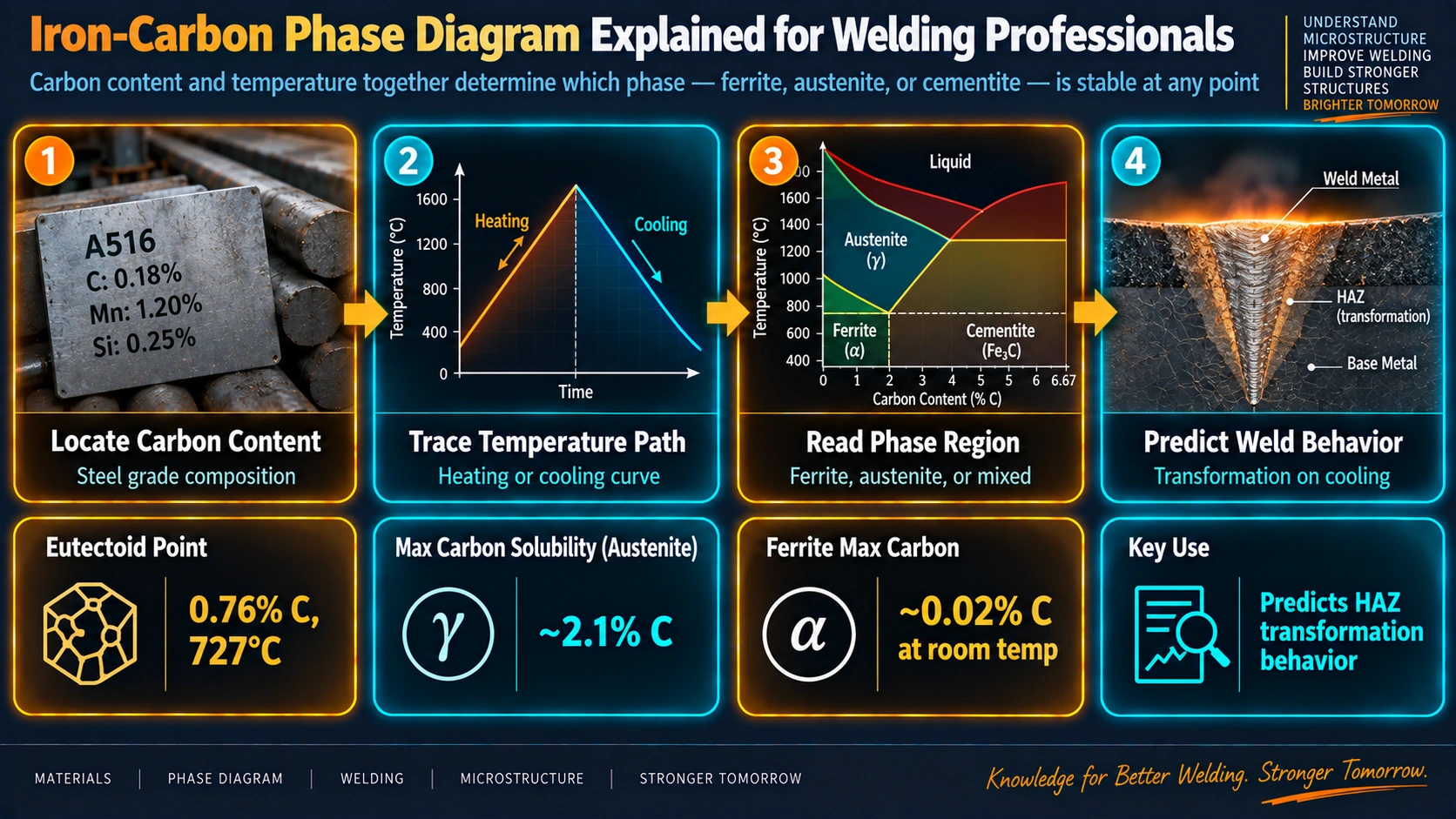
The diagram below is a technically accurate schematic of the iron-carbon equilibrium diagram for the steel range (0 to 2.14 wt% C). Key phase boundaries, critical temperatures, and named phases are all labelled.
Structure of the Diagram
The iron-carbon phase diagram uses two axes to define the state of any iron-carbon alloy:
- Vertical axis: Temperature (°C or °F). Moving upward means heating the material.
- Horizontal axis: Carbon content (wt%). Moving to the right means increasing the carbon concentration.
By locating a point on the diagram that corresponds to a given steel’s carbon content and temperature, you can immediately read off which phase or phases are present under near-equilibrium conditions. Drawing a vertical line at a specific carbon content — say 0.2 wt% for a typical structural steel — and moving up and down that line shows the complete phase sequence that steel passes through from room temperature to the liquid state.
For practical welding work, the horizontal axis of interest runs from approximately 0.008 wt% C (essentially pure iron) to 2.0 wt% C (the boundary between steel and cast iron, though some definitions extend to 2.14 wt%). Beyond 2.14 wt% C lies cast iron territory, where the eutectic reaction becomes relevant — but cast iron welding is a separate subject handled in the context of SMAW welding with specialised electrodes.
Key Phases and What They Mean in Welding
| Phase Name | Also Known As | Crystal Structure | Conditions | Hardness (Approx.) | Relevance to Welding |
|---|---|---|---|---|---|
| Alpha (α) iron | Ferrite | BCC | Below A1, low-C side | ~80–120 HV | Soft, ductile matrix of most structural steels; desired in HAZ |
| Gamma (γ) iron | Austenite | FCC | Between A1 and ~1394°C | ~200 HV | High-temperature phase during welding; parent of all transformation products |
| Delta (δ) iron | Delta ferrite | BCC | Above ~1394°C, low-C | ~90 HV | Present in weld pool; residual delta ferrite in stainless steels affects toughness |
| Iron carbide | Cementite (Fe3C) | Orthorhombic | Stable at any temp below Acm | ~800 HV | Extremely hard and brittle; improves wear resistance but reduces toughness |
| Ferrite + Cementite mix | Pearlite | Lamellar composite | Below A1, equilibrium cooling | ~200–300 HV | Equilibrium room-temperature product; fine pearlite has higher strength |
| Supersaturated BCT | Martensite | BCT | Non-equilibrium, rapid cooling | 400–900 HV | Primary cracking risk in HAZ; requires preheat and PWHT to temper |
Critical Transformation Temperatures: A1 and A3
The two most important temperatures on the phase diagram for welding engineers are the A1 and A3 lines. Both are referenced constantly in welding procedure specifications, heat treatment procedures, and ASME code requirements.
A1 Temperature: The Lower Critical Temperature
The A1 temperature is a horizontal line at 723°C (1333°F) that extends across the full width of the diagram. It marks the temperature at which:
- On heating: austenite begins to nucleate from ferrite and cementite. Below A1, no austenite exists at equilibrium.
- On cooling: austenite begins to decompose back to ferrite and cementite (as pearlite for most steels).
A3 Temperature: The Upper Critical Temperature
The A3 line is not horizontal — it slopes downward from approximately 910°C at 0% carbon to 723°C at 0.8% carbon (the eutectoid point). Above the A3 line, steel is 100% austenitic — all ferrite and cementite have dissolved into the FCC structure.
The A3 line is critical for two welding applications:
- Normalising and annealing: The steel must be heated above A3 to fully austenitise before controlled cooling produces the desired microstructure. Heating only to between A1 and A3 results in incomplete austenitisation and a mixed microstructure.
- HAZ boundary definition: The position of A3 defines which part of the HAZ has been fully austenitised by the welding heat input — and therefore which zone is susceptible to martensite formation upon rapid cooling.
A3 (°C) = 910 – 203*sqrt(C) – 15.2*Ni + 44.7*Si + 104*V + 31.5*Mo
(Andrews, 1965 — empirical formula for hypoeutectoid steels)
C, Ni, Si, V, Mo = element concentrations in wt%
Worked Example — A516 Gr.70 (C=0.28, Si=0.25, Mn=1.0, no significant Ni/V/Mo):
A3 = 910 – 203*sqrt(0.28) – 0 + 44.7*0.25 + 0 + 0
A3 = 910 – 107.4 + 11.2
A3 ≈ 814°C — normalise above this temperature (typically 880-920°C)
The Acm Line
For hypereutectoid steels (carbon content above 0.8 wt%), a third important boundary exists: the Acm line. This marks the temperature above which all cementite dissolves into austenite. Between the Acm and A1, both austenite and cementite coexist. Above Acm, pure austenite is stable. The Acm line is relevant primarily for tool steels, high-carbon steels, and cast iron — not for typical structural or pressure vessel steels.
Steel Classification by Carbon Content
The horizontal axis of the iron-carbon diagram defines a natural classification system for steels based on their room-temperature equilibrium microstructure. Understanding where a steel falls in this classification immediately tells you something about its weldability, hardness, and heat treatment requirements.
| Classification | Carbon Range (wt%) | Room-Temp Microstructure | Weldability | Typical Examples |
|---|---|---|---|---|
| Hypoeutectoid | 0.008 – 0.8% | Ferrite + Pearlite | Good to excellent | A36, A572, S355, A516, API 5L X65 |
| Eutectoid | Exactly 0.8% | 100% Pearlite | Moderate — preheat needed | Rail steel, some spring steels |
| Hypereutectoid | 0.8 – 2.14% | Pearlite + Cementite | Poor — rarely welded | Tool steels, high-carbon springs |
| Cast iron (white) | 2.14 – 4.3% | Pearlite + Cementite (massive) | Very poor — specialist only | White cast iron |
Hypoeutectoid Steels: The Welding Engineer’s Domain
The overwhelming majority of steels encountered in welded construction are hypoeutectoid — carbon content below 0.8 wt%. Within this category, a further practical subdivision is commonly used:
- Low carbon (<0.15 wt% C): Essentially all ferrite at room temperature. Excellent weldability. No preheat required for most thicknesses. Examples: S235, A36.
- Mild steel (0.15–0.30 wt% C): Ferrite plus pearlite. Good weldability. Preheat may be needed for thick sections or high-restraint joints. Examples: A572 Gr.50, API 5L X52.
- Medium carbon (0.30–0.60 wt% C): Higher pearlite content, increasing hardenability. Preheat of 100–250°C typically required. Examples: 4140, C45.
- High carbon (0.60–0.8 wt% C): Predominantly pearlitic. Poor weldability without strict procedural controls. Preheat of 250–400°C.
The Four HAZ Sub-Zones Defined by the Phase Diagram
The iron-carbon phase diagram provides the theoretical basis for understanding the distinct sub-zones of the heat-affected zone (HAZ) in a steel weld. As the welding arc passes, each location in the HAZ is heated to a different peak temperature and then cooled at a rate determined by heat input, preheat, and base metal thermal mass. The peak temperature reached at each location, relative to A1 and A3, determines the microstructural outcome.
Zone 1 — CGHAZ
Peak temp >1100°C
Coarse-grain austenite
Martensite risk highest
Poorest toughness
Zone 2 — FGHAZ
Peak temp A3–1100°C
Fine-grain austenite
Better toughness
Moderate martensite risk
Zone 3 — ICHAZ
Peak temp A1–A3
Partial austenitisation
Mixed microstructure
Intercritical region
Zone 4 — SCHAZ
Peak temp <A1
No phase change
Tempering only
Sensitisation risk (SS)
Zone 1: Coarse-Grain HAZ (CGHAZ)
The region immediately adjacent to the fusion line is heated to very high temperatures — often 1200°C or above. At these temperatures, austenite grains grow rapidly and without restraint (grain boundary energy is the driving force for growth, and diffusion rates are high). The resulting coarse-grained austenite has fewer grain boundaries per unit volume, and grain boundaries are the preferred nucleation sites for soft, tough transformation products like ferrite. On rapid cooling, the coarse-grained austenite therefore preferentially transforms to martensite rather than ferrite — producing the hardest, most brittle part of the HAZ. The CGHAZ is the primary target of preheat, interpass temperature control, and PWHT.
Zone 2: Fine-Grain HAZ (FGHAZ)
Between approximately A3 and 1100°C, the steel is fully austenitised but not sufficiently hot for extensive grain growth. The resulting fine-grained austenite transforms much more readily to fine pearlite, bainite, or fine-grained martensite on cooling — all of which have better toughness than the coarse martensite of the CGHAZ. The FGHAZ typically has mechanical properties close to or slightly better than the original base metal, which is why modern high-strength steels are designed to be thermo-mechanically controlled (TMCP) and thus the FGHAZ replicates the base metal’s fine grain size.
Zone 3: Intercritical HAZ (ICHAZ)
In the region heated between A1 and A3, the steel is only partially austenitised. Austenite nucleates preferentially at pearlite colonies, while ferritic regions remain untransformed. On rapid cooling, the austenite regions transform to martensite while the ferrite regions remain soft. The resulting mixed microstructure — called an intercritical microstructure — can have localised stress concentrations at the hard martensite islands surrounded by soft ferrite. This zone can also be prone to temper embrittlement if it contains alloying elements such as P, Sb, Sn, or As at grain boundaries.
Zone 4: Subcritical HAZ (SCHAZ)
Below the A1 temperature, no phase transformation occurs. The steel remains as ferrite and pearlite (or whatever microstructure was present before welding). However, thermal effects still occur: pre-existing martensite or bainite from a previous weld pass may be tempered (softened) in this zone, which can be beneficial. In stainless steels, the SCHAZ in the 450–850°C range is the sensitisation zone — where chromium carbides precipitate at grain boundaries, depleting the adjacent metal of corrosion-protecting chromium. This is the mechanism behind stainless steel weld decay.
Near-Equilibrium Conditions vs. Real Welding Thermal Cycles
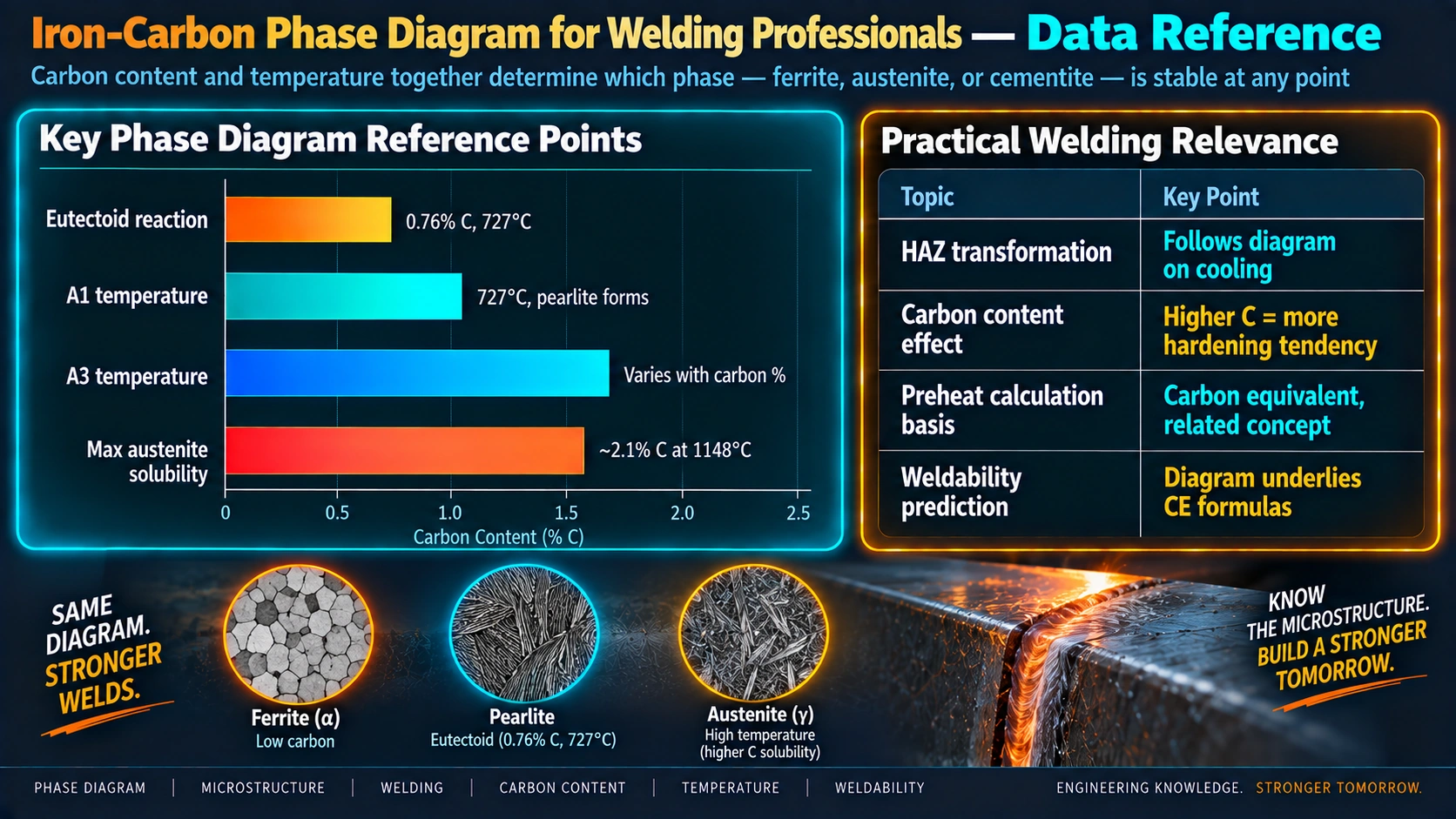
The iron-carbon phase diagram is built on thermodynamic equilibrium data — it describes what phases are present after infinitely slow heating or cooling, giving each transformation complete time to occur. Welding is the antithesis of equilibrium: it involves peak heating rates of 500°C per second or more, and HAZ cooling rates of 5–100°C per second. Several important consequences follow:
Transformation Temperature Shifts
- On heating: Actual transformation temperatures are higher than the equilibrium A1 and A3 values. The transformation requires a driving force (undercooling or overheating) to proceed at practical rates. At high heating rates (as in the HAZ close to the fusion line), A1 may be shifted up by 50°C or more.
- On cooling: Transformation temperatures are depressed below equilibrium values. The faster the cooling, the more the temperatures are depressed — and at sufficiently fast cooling rates, austenite does not have time to decompose into the equilibrium products (ferrite + pearlite) and instead transforms to bainite or martensite.
TTT and CCT Diagrams: The Phase Diagram’s Practical Partners
Because the iron-carbon phase diagram cannot predict what actually happens under non-equilibrium cooling conditions, two supplementary diagram types are used:
- TTT (Time-Temperature-Transformation) diagrams: Show when (at what time) austenite begins and ends transforming to each product (ferrite, pearlite, bainite, martensite) when held at a constant temperature below A1. The characteristic “C-curve” shape tells you how much time is available before transformation begins at any given temperature.
- CCT (Continuous Cooling Transformation) diagrams: More directly applicable to welding — show the microstructural products formed when austenite is cooled continuously at different rates. By superimposing the HAZ cooling curve onto a CCT diagram for the specific steel, the metallurgist can predict whether the HAZ will contain martensite, bainite, pearlite, or a mixture.
Phase Diagram Basis for PWHT and Heat Treatment Temperatures
The specific heat treatment temperatures specified in ASME, AWS, and EN standards are not arbitrary — they are derived directly from the phase diagram and from knowledge of diffusion kinetics in specific alloy systems.
| Heat Treatment | Temperature Range | Phase Diagram Region | Purpose | Key Constraint |
|---|---|---|---|---|
| Stress Relief PWHT | 595–760°C | Below A1 | Reduce residual stress, temper martensite | Must not exceed A1 (723°C for C-Mn steel) |
| Normalising | A3 + 30–50°C | Fully austenitic (above A3) | Refine grain size, homogenise microstructure | Must be above A3 for full austenitisation |
| Annealing (Full) | A3 + 30–50°C, furnace cool | Fully austenitic, slow cool | Maximum softening — coarse pearlite product | Very slow cooling rate required |
| Quench & Temper | Above A3, then temper below A1 | Full austenitise, then martensite, then temper | Optimum strength-toughness combination | Requires adequate hardenability (CE) |
| Intercritical anneal | A1 to A3 | Partial austenitisation | Controlled dual-phase microstructure | Temperature controls ferrite/martensite ratio |
| Subcritical anneal | 550–700°C (below A1) | Entirely below A1 | Spheroidise cementite, improve machinability | Long hold times required (hours) |
Applying the Phase Diagram: Practical Decision Points
Here is how the phase diagram’s key features translate into everyday engineering and inspection decisions in the fabrication shop or field:
Preheat Temperature Selection
Preheat slows the cooling rate of the HAZ, reducing the risk of martensite formation. The required preheat is determined by the carbon equivalent of the steel — but the underlying reason preheat works is phase-diagram based: slowing the cooling rate keeps the HAZ in the temperature range where diffusion can occur, allowing the austenite to transform to softer, tougher products (bainite or fine pearlite) rather than martensite.
Minimum Interpass Temperature
For alloy steels that transform martensitically (P91, P22, 4130, 4140), a minimum interpass temperature ensures that the previously deposited pass is not cooled below the martensite finish temperature (Mf) before the next pass is laid. If the weld cools to below Mf before the next pass provides a tempering thermal cycle, the untempered martensite can crack — particularly in the presence of diffusible hydrogen.
Hardness Limits in the HAZ
Maximum HAZ hardness limits (e.g., 350 HV per NACE MR0175 for sour service, 248 HV for some sour service applications, or 300 HV per ASME B31.3) are fundamentally limits on the amount of martensite in the HAZ. Since hardness is a proxy for martensite content, and martensite content is controlled by cooling rate (relative to the CCT diagram), the phase diagram — through the cooling rate connection — underpins these requirements.
Sensitisation Temperature Range
In austenitic stainless steels, the sensitisation zone (450–850°C) corresponds directly to the subcritical HAZ — below A1. The phase diagram shows that in this range, the steel remains austenitic (for stainless compositions), but the kinetics favour precipitation of chromium carbide (Cr23C6) at austenite grain boundaries. The fix — using low-carbon grades (304L, 316L) or stabilised grades (321, 347) — is also explainable in phase diagram terms: lower carbon reduces the driving force for carbide precipitation; stabilising elements (Ti, Nb) are stronger carbide formers than chromium and capture the carbon in benign TiC or NbC precipitates instead.