Welding Engineer Career Guide 2026 — Roles, Salary & Certifications
A career in welding engineering sits at the intersection of materials science, mechanical design, quality systems, and production engineering — and in 2026 it remains one of the most in-demand specialisms in the global engineering workforce. Every kilometre of pipeline, every pressure vessel in a refinery, every structural weld in a bridge or offshore platform, and every critical joint in a nuclear or aerospace component requires the work of qualified welding engineers and inspectors to design, qualify, execute, and verify. Yet the profession is chronically undersupplied: experienced welding engineers are retiring faster than the industry is producing qualified replacements, creating a sustained and growing skills gap across every major industrial geography.
This guide is written for three audiences: early-career engineers deciding whether to specialise in welding; experienced welding technicians and inspectors considering how to advance their qualifications; and experienced professionals evaluating their market position and certification strategy. It covers the full landscape of roles — from entry-level welding inspector to senior welding engineer and beyond — explains the salary data honestly by region and industry, maps the certification pathways from AWS CWI to IIW IWE and CSWIP, and provides a realistic picture of the 2026 job market and where opportunities are growing fastest.
The Core Roles: WE, WI, CWI, IWE, and SCWI Explained
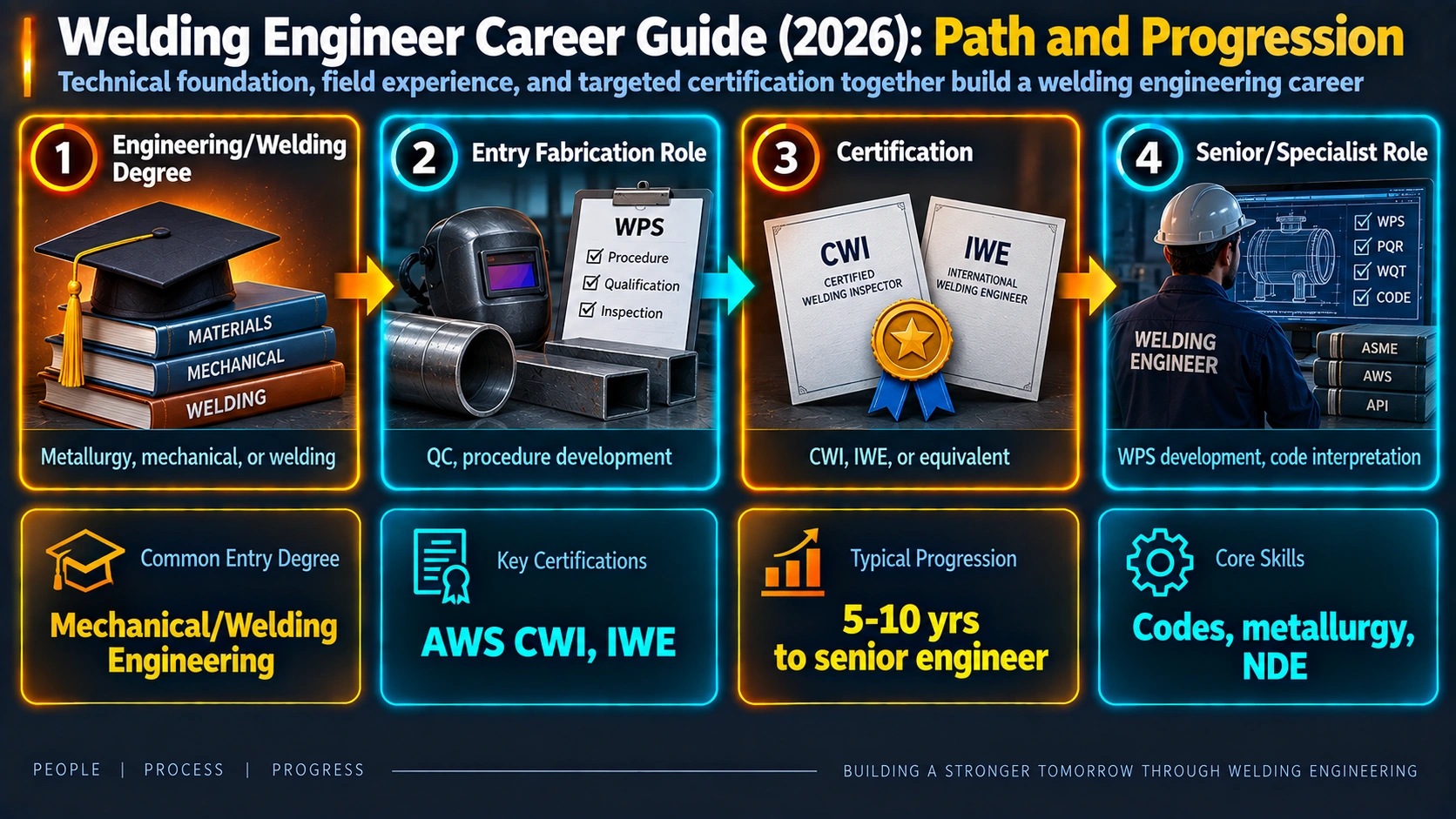
The welding profession has a more complex role taxonomy than most engineering disciplines, partly because it spans the boundary between craft, technical, and professional engineering, and partly because different certification bodies in different regions have created overlapping credential frameworks. Before choosing a career direction or certification pathway, it is essential to understand what each role actually does day to day and what decisions it owns.
- Writing and qualifying Welding Procedure Specifications (WPS) and Procedure Qualification Records (PQR)
- Material and filler metal selection and compatibility assessment
- Preheat, PWHT, and hydrogen cracking risk assessment
- Resolving non-conformances and weld defect root cause analysis
- Supporting procurement and vendor qualification for weld-critical components
- Technical authority signatory on inspection and quality plans
- Pre-weld inspection: joint preparation, preheat, consumable compliance, welder qualification check
- In-process inspection: interpass temperature, technique compliance, pass sequence
- Post-weld inspection: visual examination, dimensional check, NDE witness and review
- Completing inspection records and weld maps
- Issuing accept/reject decisions within their authorised scope
- All standard WI responsibilities, plus legally recognised certification status
- Authority to sign inspection reports on AWS D1.1, D1.5, API 1104, and other referenced code documents
- Scope limited to the code used in Part C of the examination taken
- Renewal by work history every 3 years; re-examination every 9 years
- Design and calculate welded structures per EN/ISO codes
- Specify and qualify welding procedures to ISO 15614 series
- Take full technical responsibility for welding in EN 1090, EN 13480, and EN 13445 fabrication
- Act as Responsible Welding Coordinator (RWC) per ISO 3834
- Provide welding engineering authority for EN and ISO governed projects globally
Welding Engineer vs Welding Inspector — Key Differences
The most common career question received by WeldFabWorld readers is some variation of: “Should I pursue a welding engineering degree or work my way up through inspection?” The honest answer is that both are valid and both lead to well-compensated, secure careers — but they are different careers with different day-to-day work, different knowledge requirements, and different ceilings.
| Dimension | Welding Engineer (WE) | Welding Inspector (WI / CWI) |
|---|---|---|
| Primary question answered | “How should this weld be designed and qualified?” | “Does this weld meet the specification?” |
| Entry route | Engineering degree (BEng or MEng in mechanical, materials, manufacturing, or welding engineering) | Trade qualification / HNC / HND or equivalent practical experience; no degree typically required |
| Day-to-day work | Writing WPSs, qualifying procedures, solving metallurgical problems, reviewing designs, supporting procurement | Pre-weld, in-process, and post-weld visual inspection; NDE witnessing; documentation; accept/reject decisions |
| Key certification | IIW IWE (international), CWEng (UK/Australia), PE in Welding Engineering (North America) | CSWIP 3.1 / 3.2 (international), AWS CWI / SCWI (North America), PCN WT (UK) |
| Typical salary range (UK) | GBP 45,000 – GBP 95,000+ | GBP 32,000 – GBP 65,000 (site/inspection roles) |
| Typical salary range (US) | USD 75,000 – USD 140,000+ | USD 55,000 – USD 100,000 |
| Offshore / rotational premium | Yes — significant premium for offshore and remote project roles | Yes — CSWIP 3.1 inspectors on offshore rotations often earn total packages equivalent to or exceeding staff WE salaries |
| Convergence at senior level | Senior welding engineers and SCWI / CSWIP 3.2 inspectors often perform overlapping functions; many hold credentials from both tracks | |
Salary Ranges by Region — 2026 Data
Salary data for welding professionals varies significantly by region, industry, experience level, and certification status. The figures below represent 2026 benchmark ranges based on advertised positions, industry salary surveys, and recruiter data. All figures represent base salary excluding bonuses, overtime, and offshore/rotation allowances unless stated.
Salary by Industry Sector
Industry sector is one of the strongest determinants of welding engineer compensation, more so than geography for internationally mobile professionals. The sectors below are ranked broadly by total compensation opportunity in mature markets.
Certification Landscape Overview
Welding certifications fall into two distinct categories: personnel qualification certifications that attest to an individual’s competence (CWI, CSWIP, IWE, PCN), and procedure qualification records that certify a specific welding process to a specific code (WPS/PQR under ASME Section IX or ISO 15614). Career-focused certifications are the former category — they travel with the individual and differentiate them in the labour market. The map below organises the major certification frameworks by their geographic dominance and applicability.
| Certification | Issuing Body | Primary Geography | Career Level | Cost & Time Investment |
|---|---|---|---|---|
| AWS CWI | American Welding Society (AWS) | North America, global (ASME/AWS projects) | Inspector | USD 1,000–1,500 exam fees; 1–3 months study |
| AWS SCWI | American Welding Society (AWS) | North America | Senior Inspector | USD 1,500–2,000; requires CWI tenure + education |
| CSWIP 3.1 | TWI Certification (CSWIP) | UK, Europe, Middle East, SE Asia, Australasia | Inspector | GBP 800–1,200 exam; typically 2–3 month prep course |
| CSWIP 3.2 | TWI Certification (CSWIP) | UK, Middle East, international O&G | Senior Inspector | GBP 1,000–1,500; requires 3.1 + 5 years experience |
| IIW IWE | IIW (via national ANB) | Global — particularly Europe, Middle East, Asia | Engineer | GBP 3,000–8,000 training + exams; 6–18 months part-time |
| IIW IWT | IIW (via national ANB) | Global | Technologist | Intermediate level between IWS and IWE; HND/HNC level entry |
| IIW IWS | IIW (via national ANB) | Global | Specialist | Entry level of the IIW framework; vocational qualification |
| PCN WT (Welding Tech.) | BINDT / Certification body | UK, nuclear and aerospace sectors | Inspector / Technologist | Examination-based; tiered Levels 1–3 |
| API 510 Inspector | American Petroleum Institute | Global — petroleum & petrochemical | Pressure Vessel Inspector | USD 800–1,200; open-book examination; requires relevant experience |
| API 570 Inspector | American Petroleum Institute | Global — petroleum & petrochemical piping | Piping Inspector | USD 800–1,200; open-book examination; requires relevant experience |
AWS CWI and SCWI — North American Standard
The AWS Certified Welding Inspector (CWI) credential is the most widely recognised welding inspection qualification in North America and commands significant recognition on international projects governed by ASME and AWS codes. It is an examination-based credential — not a course completion award — and the examination is genuinely challenging, with an industry-reported pass rate typically below 50% on first attempt for unprepared candidates.
CWI Eligibility Requirements
To sit the AWS CWI examination, candidates must meet one of the following education-plus-experience combinations:
| Education Level | Required Work Experience |
|---|---|
| High school diploma or equivalent | 5 years welding-related work experience |
| Associate degree (engineering or related) | 4 years welding-related work experience |
| Bachelor’s degree (non-engineering) | 2 years welding-related work experience |
| Bachelor’s degree in engineering or physical science | 1 year welding-related work experience |
| Bachelor’s degree in welding engineering | No additional experience required |
| AWS-accredited welding training programme (specific) | Reduced experience per AWS table |
The CWI Examination
The AWS CWI examination consists of three independently scored parts, all of which must be passed (72% minimum each) in the same examination sitting or within a defined retake period:
IIW International Welding Engineer (IWE) — Global Standard
The IIW International Welding Engineer qualification is the internationally recognised engineering-level credential for welding professionals. Structured as a postgraduate-equivalent training and examination programme, the IWE curriculum covers the full technical scope of welding engineering at an engineering degree level. It is the definitive credential for engineers who need to act as Responsible Welding Coordinator (RWC) under ISO 3834 or take full technical authority for welding under EN fabrication codes.
The IIW Personnel Framework
| Level | Title | Entry Requirement | Scope of Responsibility |
|---|---|---|---|
| IWP | International Welding Practitioner | Trade / vocational qualification | Practical welding operations under supervision |
| IWS | International Welding Specialist | Technical school or equivalent; 2 years experience | Routine welding activities; no design responsibility |
| IWT | International Welding Technologist | HND / associate degree level; 3 years experience | Welding coordination for standard work; limited design responsibility |
| IWE | International Welding Engineer | Engineering degree (BEng or MEng); completion of IWE programme | Full welding engineering responsibility; RWC per ISO 3834; EN fabrication code authority |
IWE Programme Content
The IWE training programme is structured into four modules and must total a minimum number of training hours as specified by the IIW. The modules are:
- Module 1 — Welding Processes and Equipment: Arc, gas, beam, resistance, and special welding processes; process physics and metallurgy; power sources; automation and robotics
- Module 2 — Materials and their Behaviour During Welding: Ferrous and non-ferrous metallurgy; HAZ microstructure; hydrogen cracking; hot cracking; corrosion; material specification and selection
- Module 3 — Construction and Design: Structural design of welded joints; fatigue of welds; fracture mechanics; EN 1993 and EN 13445 design calculation; joint efficiency and safety factors
- Module 4 — Fabrication, Quality Management, and Application: ISO 3834 quality requirements; welding procedure qualification (ISO 15614); welder qualification (ISO 9606); NDT; destructive testing; quality control; health and safety; economics of welding
CSWIP 3.1 and 3.2 — UK and International Standard
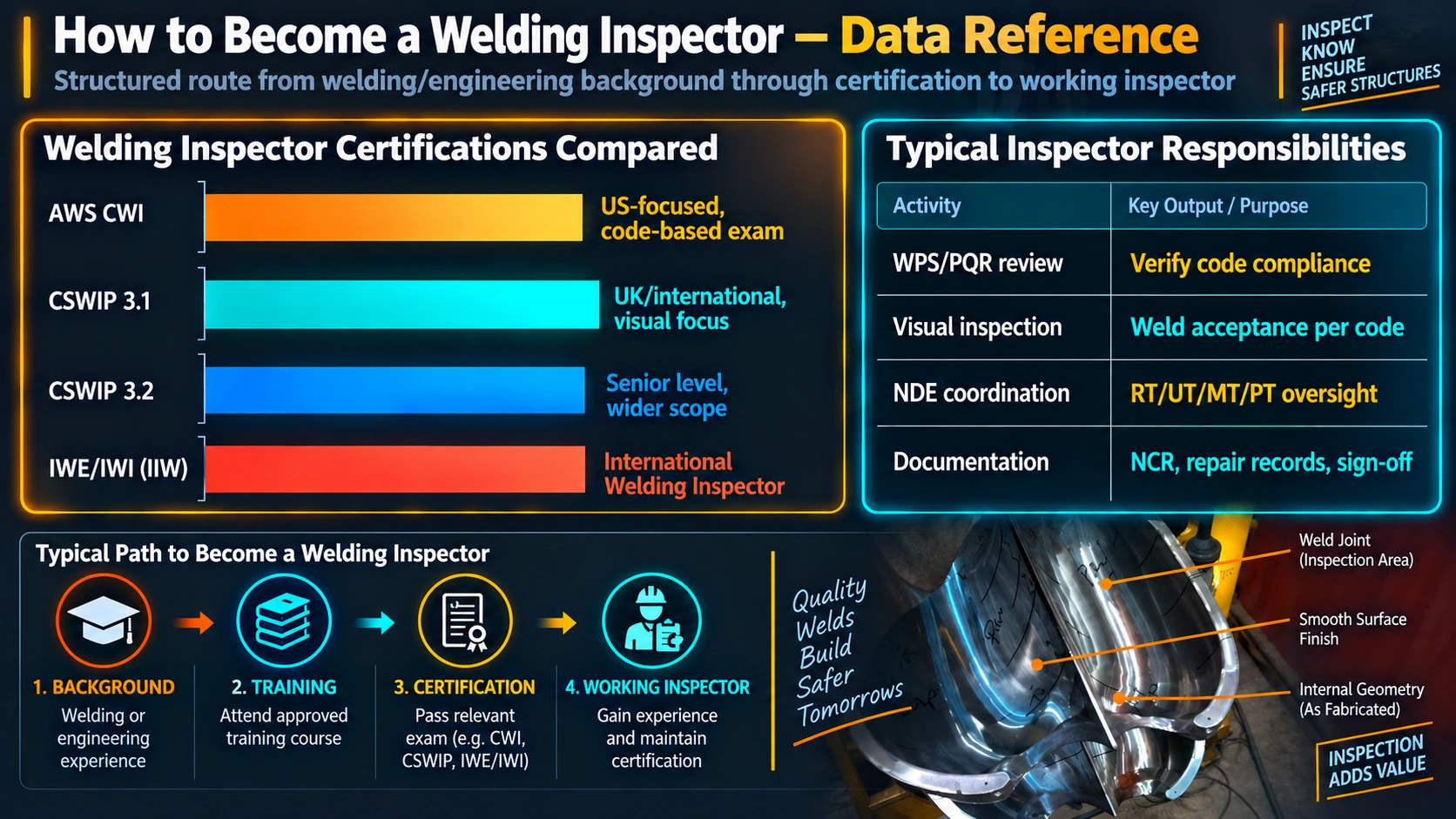
The CSWIP (Certification Scheme for Welding and Inspection Personnel) framework, administered by TWI Certification Ltd, is the dominant inspection certification in the UK, Europe, Middle East, Southeast Asia, and Australasia. CSWIP certifications are accepted by virtually every major EPC contractor, oil and gas operator, and inspection company operating in international markets. The scheme covers welding inspectors, visual inspectors, NDT inspectors, and welding supervisors across multiple levels.
CSWIP 3.1 — Welding Inspector
CSWIP 3.1 is the entry-level welding inspector certification and the most widely held and sought welding inspection credential in international markets. The examination consists of a written theory paper, a practical visual inspection test (examining provided weld samples), and a drawing interpretation exercise. Candidates must hold a minimum of two years of relevant welding-related work experience and pass a medical eye test (near and distance vision to minimum standards).
CSWIP 3.1 examination topics include: weld inspection and testing procedures, NDT methods and applications, weld symbols and drawing interpretation, welding processes and equipment, materials and metallurgy, codes and standards (BS EN and AWS), defect identification and acceptance criteria, and safety. Preparation typically requires 3 to 6 months of dedicated study alongside a formal prep course — first-attempt pass rates are approximately 50 to 60% across the general candidate population.
CSWIP 3.2 — Senior Welding Inspector
CSWIP 3.2 is the senior qualification in the inspection pathway and is the credential that most closely approaches welding engineering responsibilities within the inspection framework. Candidates must hold a current CSWIP 3.1 certificate and a minimum of five years of welding inspection experience. The 3.2 examination is more demanding than 3.1, with greater emphasis on welding metallurgy, procedure qualification, code interpretation, and engineering judgement. CSWIP 3.2 holders can take on the role of Inspection Authority and are often trusted with procedure review and quality system responsibilities that would otherwise require an IWE or welding engineer.
| Parameter | CSWIP 3.1 | CSWIP 3.2 |
|---|---|---|
| Prerequisites | 2 years relevant experience; eye test | CSWIP 3.1 + 5 years inspection experience |
| Examination | Theory + practical weld inspection + drawing interpretation | Advanced theory + practical + procedure review + metallurgy |
| Knowledge depth | Inspection procedures, defect identification, code basics | Welding metallurgy, procedure qualification, advanced code, engineering judgement |
| Validity | 5 years; renewal by CPD and employer endorsement | 5 years; renewal by CPD and employer endorsement |
| Salary premium vs 3.1 | Baseline | Approximately 15–25% higher across all markets |
| Job titles typically requiring | Welding Inspector, QC Inspector, Inspection Supervisor | Senior WI, Lead Inspector, Inspection Engineer, Welding Coordinator |
Other Certifications: PCN, NACE, API 510/570
Beyond the primary welding-specific credentials, several complementary certifications significantly enhance a welding professional’s market value, particularly in the oil and gas and process industries.
| Certification | Body | Value to Welding Professional | Typical Combined Salary Premium |
|---|---|---|---|
| API 510 (Pressure Vessel Inspector) | API | Authorises in-service inspection of pressure vessels per API 510; combined with CWI or CSWIP dramatically broadens oil & gas scope | +15–25% |
| API 570 (Piping Inspector) | API | Authorises piping inspection per API 570; frequently held alongside API 510 | +10–20% |
| PCN (UT / MT / PT Levels 2–3) | BINDT / TUV / equivalent ANB | NDE certification per ISO 9712; Level 2 qualification required to perform and evaluate NDE; Level 3 to authorise methods | +10–30% (Level 3) |
| NACE CIP / Corrosion Technician | AMPP (formerly NACE) | Corrosion inspection and coating inspection; relevant for pipeline and structural inspection roles | +5–15% |
| Chartered Engineer (CEng / PE) | IMechE, IOM3 (UK) / NSPE (US) | Professional registration as Chartered or Licensed Engineer; required for signatory authority on engineering designs in many jurisdictions | +10–25% at senior level |
Career Progression Pathways
Two primary career pathways exist in welding — the inspection track and the engineering track — though experienced professionals frequently hold credentials from both simultaneously. The timeline below illustrates a realistic progression for each, including recommended certification milestones at each stage.
Build practical welding and NDE exposure. Consider CSWIP Visual Weld Inspector (level below 3.1) or AWS entry study.
Core inspection credential. Begin accumulating documented experience in your specialisation (piping, structural, pressure vessels).
NDE qualification adds significant value. Begin preparing for CSWIP 3.2 or SCWI. Consider API 510/570 if in oil & gas.
Senior inspection credential. Combine with site engineering responsibilities. Consider IIW IWT or even IWE route if engineering degree obtained.
Technical authority and management. CEng registration where applicable. Day-rate contracting may offer superior total compensation at this stage.
BEng or MEng in hand. Begin IIW IWE training. Gain hands-on welding and inspection exposure — essential for credibility in the role.
Complete accredited training programme and examinations. This is the primary credential differentiator for engineering roles in EN/ISO markets.
WPS/PQR ownership, procedure qualification, defect root cause analysis. AWS CWI or CSWIP 3.1 adds inspection credibility. Begin API 510/570 study if in process industries.
Technical authority on major projects. Principal engineer responsibilities. Consider IIW EWE (European Welding Engineer) if primarily European market.
Technical leadership, standard-setting, major project authority. Day-rate consulting at this level: GBP 600–1,200/day in mature markets.
Technical Skills Every Welding Engineer Needs in 2026
The technical skills expected of a welding engineer have evolved significantly in the past decade, driven by new materials, automated processes, digital quality systems, and emerging sectors like hydrogen and offshore wind. The following skills matrix reflects what forward-thinking employers are looking for in 2026.
| Skill Area | Why It Matters in 2026 | How to Build It |
|---|---|---|
| WPS/PQR writing and qualification | Core competency — non-negotiable for any WE role. ASME Section IX for pressure applications; ISO 15614 for EN-governed projects. | ASME Section IX study; practical procedure qualification projects; IWE Module 4 |
| Welding metallurgy and HAZ analysis | Drives HIC risk assessment, PWHT specification, P91/duplex/nickel alloy qualification decisions. HIC prevention is critical in O&G. | IWE Module 2; academic metallurgy texts; WeldFabWorld technical guides |
| ISO 3834 quality system management | Mandatory for EN 1090, EN 13480, and EN 13445 fabrication. Increasingly specified in LNG, offshore wind, and infrastructure contracts globally. | IWE Module 4; ISO 3834-2 study; audit experience as internal auditor |
| Advanced NDE method interpretation | PAUT, TOFD, and phased array are replacing radiography on most new-build pipelines and pressure vessels. WEs must understand what NDE can and cannot detect. | PCN Level 2 qualification (UT/PAUT); CSWIP TOFD or PAUT operator; third-party training courses |
| Fitness-for-service assessment (API 579) | API 579/ASME FFS-1 is the code for evaluating in-service damage. Increasingly required for extending equipment life rather than replacement in downstream and power sectors. | API 510/570 certification; API 579 self-study; FFS software training (Fitness Inspector, PVI) |
| Robotic and automated welding process control | Robotic GMAW, laser-hybrid, and friction stir welding are growing in offshore, automotive, and defence. WEs must specify and qualify automated processes. | Manufacturer training (Fronius, Lincoln, ESAB); ISO 14732 (qualification of welding operators); hands-on project experience |
| Hydrogen service materials knowledge | The energy transition is the fastest-growing employer of welding engineers. ASME B31.12, ISO/TS 15366, and emerging H2 material specifications are rapidly becoming essential knowledge. | ASME B31.12 study; H2 industry technical conferences; WeldFabWorld sour/hydrogen content |
Job Market Outlook 2026
The welding engineering job market in 2026 is characterised by structural undersupply against sustained and growing demand. Three converging forces are creating exceptional opportunities for qualified professionals:
1. The Workforce Demographics Crisis
The most experienced generation of welding engineers — those who joined the industry during the 1980s and 1990s North Sea oil boom, the construction of major LNG infrastructure, and the nuclear power build cycles — are retiring at an accelerating rate. Industry bodies consistently report that retirements are outpacing new entrants by a factor of two to three in most mature markets. This creates not just vacancies but an experience gap at the senior level that takes 10 to 15 years to fill even if graduate intake increases immediately.
2. The Energy Transition and New Build Wave
The global energy transition is generating enormous new demand for welding engineers across multiple sectors simultaneously. Offshore wind foundations and monopiles require structural welding engineering on an unprecedented scale. Green hydrogen production requires electrolysers, high-pressure storage vessels, and specialised hydrogen-service piping. LNG remains in global demand with multiple new liquefaction and regasification terminals under construction or planned in the Middle East, Africa, and Southeast Asia. Nuclear new-build programmes in the UK, France, Poland, and the Middle East are creating specific demand for N-stamp qualified welding engineering capability.
3. Automation Complementing Rather Than Replacing Engineers
Contrary to fears common in the early 2010s, the automation of welding processes has not reduced demand for welding engineers — it has changed and expanded it. Robotic welding cells, orbital welding systems, and automated narrow-gap TIG processes all require welding engineers to specify, qualify, programme, and maintain them. Automated processes introduce new quality challenges — arc stability monitoring, adaptive control systems, and the qualification of welding operators rather than welders — that require deeper, not shallower, engineering involvement.
Salary and Contracting Trends
Day-rate contracting for experienced welding engineers and senior inspectors remains buoyant. Experienced CSWIP 3.2 holders on Middle East petrochemical projects are achieving all-in packages equivalent to GBP 100,000 to GBP 130,000 per year. Senior IWE-qualified engineers on UK and European offshore wind projects are achieving day rates of GBP 600 to GBP 900 on contract. The critical lesson for career planning is that the certification and experience investment made at age 25 to 35 returns compounding dividends from age 40 onward, when the combination of credentials, codes knowledge, and project track record commands a genuine premium in both permanent and contract markets.
Frequently Asked Questions — Welding Engineer Career
What is the difference between a welding engineer and a welding inspector?
A welding engineer (WE) is responsible for the design, development, and qualification of welding processes, procedures, and materials selection — they work at the engineering level, writing WPSs, qualifying procedures to ASME or ISO standards, solving complex metallurgical problems, and providing technical authority on weld quality and integrity decisions. A welding inspector (WI or CWI) performs the practical examination and verification that welds meet the requirements of an approved WPS and the applicable code — they measure, test, document, and accept or reject work but generally do not design the procedures themselves. In practice, experienced welding inspectors often take on engineering responsibilities, and the boundary between the roles depends heavily on the employer and industry sector.
What is the AWS CWI certification and how do I qualify?
The AWS Certified Welding Inspector (CWI) is the most widely recognised welding inspection certification in North America and internationally. To qualify, you must meet one of AWS’s education and experience combinations — for example, a high school diploma with 5 years of welding-related experience, an associate degree with 4 years experience, or a bachelor’s degree in welding engineering with no additional experience. The examination has three parts: Part A (fundamentals, open book), Part B (practical examination of weld specimens), and Part C (code book examination using a single specified code such as AWS D1.1). A score of 72% or higher in each part is required to pass. The certification is valid for 3 years and renewed by work history documentation; re-examination is required every 9 years.
What is the IIW International Welding Engineer (IWE) qualification?
The IIW International Welding Engineer (IWE) is the highest level of the IIW personnel qualification framework — equivalent to a postgraduate qualification in welding engineering. It is the internationally recognised credential for engineers who design, specify, and qualify welding processes in fabrication. The IWE curriculum covers welding processes, materials and metallurgy, design calculations, quality management, and health and safety across four structured modules. Candidates must complete an accredited training programme and pass examinations in all modules. An IWE qualification significantly enhances employability in Europe, the Middle East, and Asia where EN/ISO codes govern fabrication, and is typically required for Responsible Welding Coordinator roles under ISO 3834.
What does a welding engineer earn in oil and gas vs structural steel?
Welding engineers in oil and gas typically earn the highest salaries in the industry. In the UK and Middle East, senior welding engineers on offshore or downstream projects typically earn GBP 65,000 to GBP 95,000 per year, or USD 80,000 to USD 130,000 in North American LNG and refinery projects. In structural steel fabrication, salaries are generally lower — typically GBP 40,000 to GBP 65,000 in the UK or USD 60,000 to USD 90,000 in the US. The oil and gas premium reflects the higher consequence of failure, the more demanding code environment, and the greater depth of metallurgical and code knowledge required. Offshore and rotational roles in the Middle East and Australia command further premiums due to remote work allowances and tax advantages.
Is CSWIP 3.1 or AWS CWI better for an international welding career?
CSWIP 3.1 is the dominant certification in the UK, Europe, Middle East, Southeast Asia, and Australasia — particularly in offshore oil and gas, power generation, and pipeline fabrication. AWS CWI is dominant in North America and widely recognised on projects using ASME and AWS codes globally. For most international careers in oil and gas outside North America, CSWIP 3.1 is the more immediately useful starting qualification. For North America and for work on ASME-governed pressure vessel and piping projects anywhere in the world, AWS CWI provides the clearest credential. Many senior inspectors hold both to maximise their market coverage.
What is the job outlook for welding engineers in 2026?
The job market for welding engineers and inspectors in 2026 is strong, driven by three converging forces: the global energy transition requiring massive new infrastructure in LNG, hydrogen, offshore wind, and nuclear power; the ongoing shortage of experienced welding engineers as the workforce ages; and the increasing technical complexity of materials and processes requiring higher-level engineering competence. Demand for CSWIP 3.1 and 3.2 inspectors and IWE-qualified engineers is at multi-year highs in the UK and Middle East. Automation and robotic welding are creating new specialist roles rather than eliminating existing ones, as human engineering oversight of automated processes remains essential.