API 510 Pressure Vessel Inspection Code: Complete In-Service Guide
API 510 pressure vessel inspection is one of the most sought-after certification programmes in the global inspection and integrity industry. Issued by the American Petroleum Institute, API 510 governs the in-service inspection, corrosion monitoring, fitness-for-service assessment, repair, and re-rating of pressure vessels operating in petroleum refineries, petrochemical plants, and related process facilities. For practising inspectors and aspiring certified individuals alike, a thorough command of this code is the foundation of competent pressure vessel integrity management.
This guide covers the complete technical scope of API 510: how inspection intervals are established and justified, how minimum required wall thickness is calculated from first principles using ASME Section VIII Division 1, how maximum allowable working pressure (MAWP) is re-rated when corrosion reduces available wall, how corrosion rates drive remaining life calculations, and when fitness-for-service assessment under API 579-1/ASME FFS-1 can justify continued operation of degraded equipment. The guide also contains a detailed API 510 exam preparation section and a 20-question practice quiz with full explanations for every answer.
API 510 is inseparable from its companion documents. You must treat ASME Section VIII Division 1 (design and construction), ASME Section V (NDE), ASME Section IX (welding procedure and welder qualification), API 576 (inspection of pressure-relieving devices), and API 579-1 (fitness-for-service) as integrated parts of the same inspection framework. Knowing where information lives across all these codes — and how to navigate them quickly — is the single most important examination skill you can develop.
Scope and Applicability of API 510
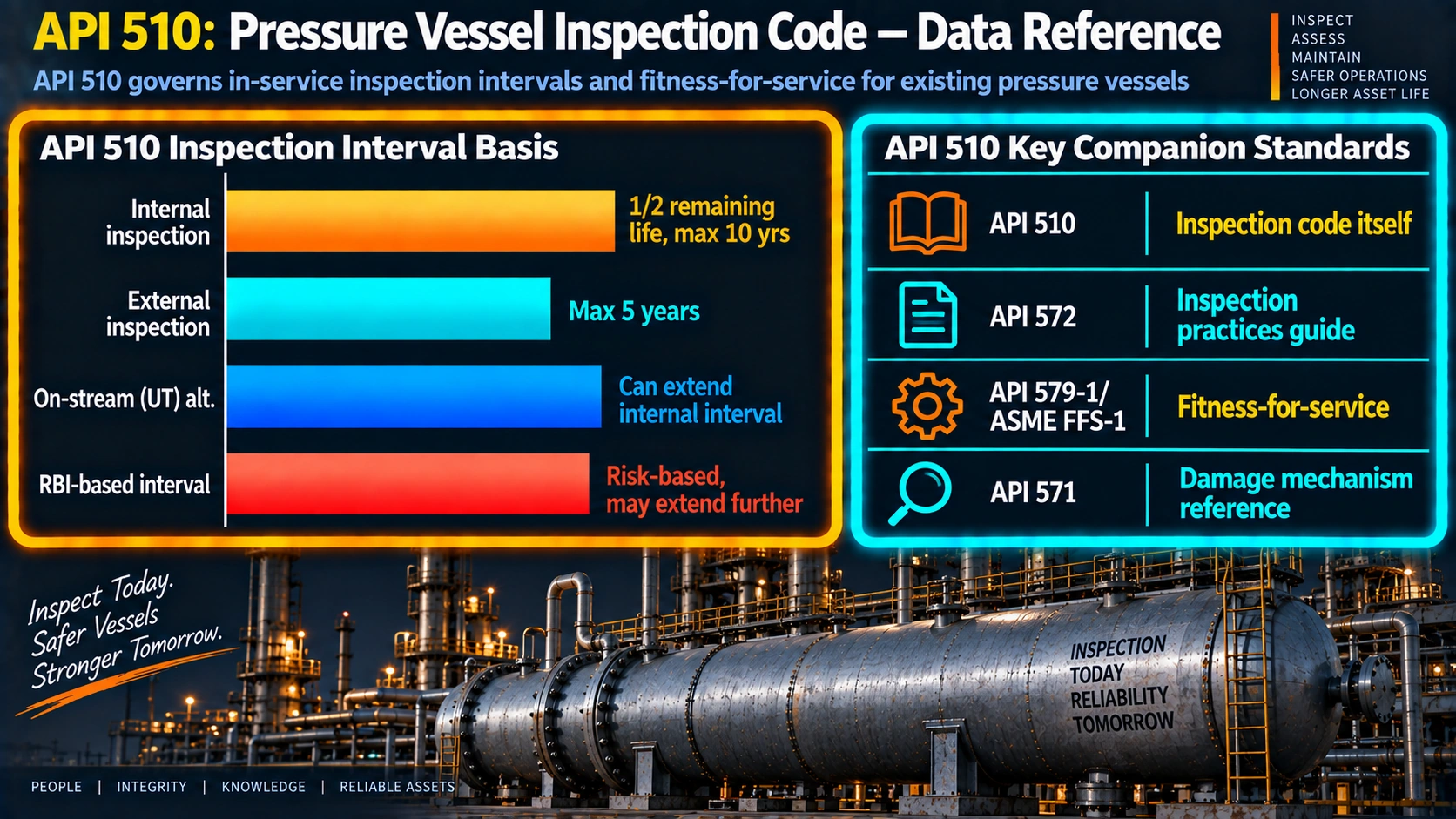
API 510 applies to pressure vessels that have been placed in service in petroleum refineries, chemical plants, natural gas processing plants, and other related processing industries. The code covers vessels constructed to ASME Section VIII (Division 1 or Division 2), as well as vessels constructed to other recognised standards where the owner/operator elects to apply API 510 principles. Its provisions govern all aspects of in-service integrity management: periodic inspection, corrosion rate monitoring, remaining life assessment, repairs, alterations, and re-rating.
Relationship to ASME Section VIII
ASME Section VIII Division 1 remains the primary design and construction code for most pressure vessels within API 510 scope. When API 510 refers to minimum thickness calculations, allowable stress values, weld joint efficiency, or pressure design formulas, it directs the inspector and engineer back to ASME Section VIII. Understanding API 510 therefore requires a working knowledge of ASME VIII Div 1 — particularly Part UG (general requirements), Appendix A (allowable stress tables), and UW (welded construction requirements).
Key Personnel: Authorised Inspector and Pressure Vessel Engineer
API 510 assigns specific, non-interchangeable roles to two categories of qualified personnel. Understanding these roles is examined directly in the API 510 certification examination.
Authorised Inspector (AI)
The authorised inspector is an individual who holds a valid API 510 certification and is employed by an owner/operator or an authorised inspection agency (AIA). The AI is responsible for: planning and executing or directly supervising all required inspections, reviewing and accepting repairs and alterations, maintaining inspection records, and setting the next inspection date. The AI does not necessarily perform the NDE personally but must directly supervise the examination activities and evaluate the results.
Pressure Vessel Engineer (PVE)
The pressure vessel engineer provides engineering judgment on matters beyond the inspection scope — specifically: fitness-for-service assessments, repair and alteration design, MAWP re-rating calculations, and evaluation of unusual or complex damage. The PVE must be a licensed professional engineer (PE) experienced in pressure vessel design in jurisdictions where such licensing applies, or otherwise qualified by experience and training. Not every inspection decision requires PVE involvement, but any FFS assessment, re-rating, or significant alteration does.
Inspection Intervals — Internal, External, and On-Stream
API 510 defines three primary types of inspection for pressure vessels, each with its own maximum interval and purpose. Together, they form a complementary programme that characterises both internal and external degradation without necessarily requiring the vessel to be taken out of service for every inspection cycle.
Internal Inspection
Internal inspection requires physical entry into the vessel or indirect examination of internal surfaces from the outside (via radiography, UT, or other volumetric NDE) when direct entry is impractical. The purpose is to evaluate internal corrosion, erosion, cracking, blistering, fouling, and the condition of internal components such as trays, baffles, and linings. The maximum internal inspection interval is 10 years, subject to the half-remaining-life rule.
External Inspection
External inspection is performed visually while the vessel is in service. It covers the condition of external surfaces, insulation integrity, CUI (corrosion under insulation) susceptibility, coating condition, structural supports, nozzle conditions, pressure relief valve status, and any visible leaks or hot spots. The maximum external inspection interval is 5 years. External inspection is typically performed by the authorised inspector and requires no shutdown.
On-Stream Inspection
On-stream inspection uses NDE methods — primarily ultrasonic thickness measurement — to obtain internal condition data while the vessel remains in operation. It can substitute for internal inspection in many cases, provided the corrosion mechanism is one that can be reliably characterised by external UT measurement (i.e., general uniform corrosion rather than localised pitting on the internal surface). The decision to allow on-stream inspection to replace internal inspection must be documented and justified by the AI and PVE.
| Inspection Type | Maximum Interval | Can Substitute For | Key Requirement |
|---|---|---|---|
| Internal | 10 years (or RL/2 if less) | — | Physical entry or equivalent volumetric NDE |
| External | 5 years (or RL/2 if less) | — | Visual inspection while in service; may include UT for CUI |
| On-Stream | Same as internal interval | Internal inspection (with justification) | Documented basis; corrosion mechanism must be UT-detectable |
| RBI-extended | Beyond class max (with RBI) | Standard intervals | Full RBI study per API 580; documented and approved |
Minimum Thickness Calculation and MAWP Re-Rating
Minimum Required Thickness — Cylindrical Shell
The minimum required thickness for a cylindrical pressure vessel shell under internal pressure is calculated using the ASME Section VIII Division 1 formula from paragraph UG-27. This is one of the most frequently tested calculations on the API 510 examination.
MAWP Re-Rating — Worked Example
Corrosion Rate, Remaining Life, and Next Inspection Date
The corrosion rate and remaining life calculation is the numerical heart of API 510 — and the most reliably tested calculation type in the API 510 exam. The methodology exactly mirrors the approach used in API 570 for piping, which makes studying both codes simultaneously efficient.
Worked Corrosion Rate Example
Condition Monitoring Locations — Selection and Strategy
A Condition Monitoring Location (CML) in API 510 is a defined area on the vessel where periodic thickness measurements or other NDE examinations are taken to track the rate of degradation. The objective is to establish a representative picture of the corrosion rate acting on the vessel — not simply to document that a measurement was taken.
| Vessel Zone | Reason for CML Priority | Recommended NDE Approach |
|---|---|---|
| Shell courses (cylindrical) | General corrosion; highest-stress zone | Grid of UT points at 4 orientations per course |
| Heads (hemispherical, ellipsoidal, dished) | General corrosion; geometric stress concentration at knuckle | UT at crown and knuckle radius; minimum 4 points per head |
| Nozzle necks and reinforcement pads | Local turbulence; stress concentration; erosion at inlet | UT sweep around nozzle neck; profile RT for complex geometry |
| Shell-to-head welds | Weld-related corrosion, selective attack, residual stress cracking | UT at weld and HAZ either side; MT/PT if cracking suspected |
| Boot / sump (low point) | Water and solids accumulation; underdeposit and MIC attack | UT sweep and internal visual at each opportunity |
| Vapour-liquid interface zone | Accelerated corrosion at fluctuating phase boundary | UT at normal and maximum operating liquid levels |
| Lining / cladding disbondment zones | Corrosion of base metal under failed lining | UT, holiday testing, hammer survey, or TOFD on cladding welds |
| Under insulation (CUI zones) | Corrosion under insulation, especially at 60°C–150°C (140°F–300°F) | PEC, profile RT, GWUT screening; targeted UT after removal |
Fitness-for-Service (FFS) Assessment Under API 579
Fitness-for-service assessment is the structured engineering process of determining whether a pressure vessel containing a known or suspected flaw, area of degradation, or structural anomaly is suitable for continued safe operation. API 510 explicitly incorporates API 579-1/ASME FFS-1 as the governing FFS methodology. When conventional code minimum thickness calculations alone would require a vessel to be repaired or taken out of service, a properly conducted FFS assessment may demonstrate that the vessel can continue to operate safely — often at the original MAWP, sometimes at a reduced pressure.
API 579 Assessment Parts Relevant to Pressure Vessels
| API 579 Part | Damage Mechanism Addressed | Typical Application |
|---|---|---|
| Part 4 | General metal loss (uniform thinning) | Vessel shell corroded below t_min over large area |
| Part 5 | Local metal loss (pitting, grooves) | Localised corrosion or erosion at inlet nozzles, trays |
| Part 6 | Pitting corrosion | Random or localised pitting map assessment |
| Part 7 | HIC / SOHIC / blistering | Hydrogen-induced cracking in wet H2S service |
| Part 8 | Weld misalignment and shell distortion | Peaking, banding, or out-of-roundness after fabrication or service damage |
| Part 9 | Crack-like flaws | Stress corrosion cracking, fatigue cracks, weld flaws found in service |
| Part 10 | Component operating in creep range | High-temperature vessels approaching or exceeding creep threshold |
| Part 11 | Fire damage | Assessment of vessel exposed to fire or overheating incident |
An FFS acceptance under API 510 is not a permanent waiver. The pressure vessel engineer must specify: the monitoring conditions required (enhanced inspection frequency, reduced MAWP if applicable), the damage-specific indicators that would trigger an earlier re-assessment, and a mandatory re-assessment date. These conditions become part of the vessel’s inspection record and must be communicated to the operations team. For vessels with wet H2S damage (HIC/SOHIC), also refer to the WeldFabWorld Sour Service Guide for the underlying damage mechanism context.
Repair and Alteration Requirements
Defining Repair and Alteration
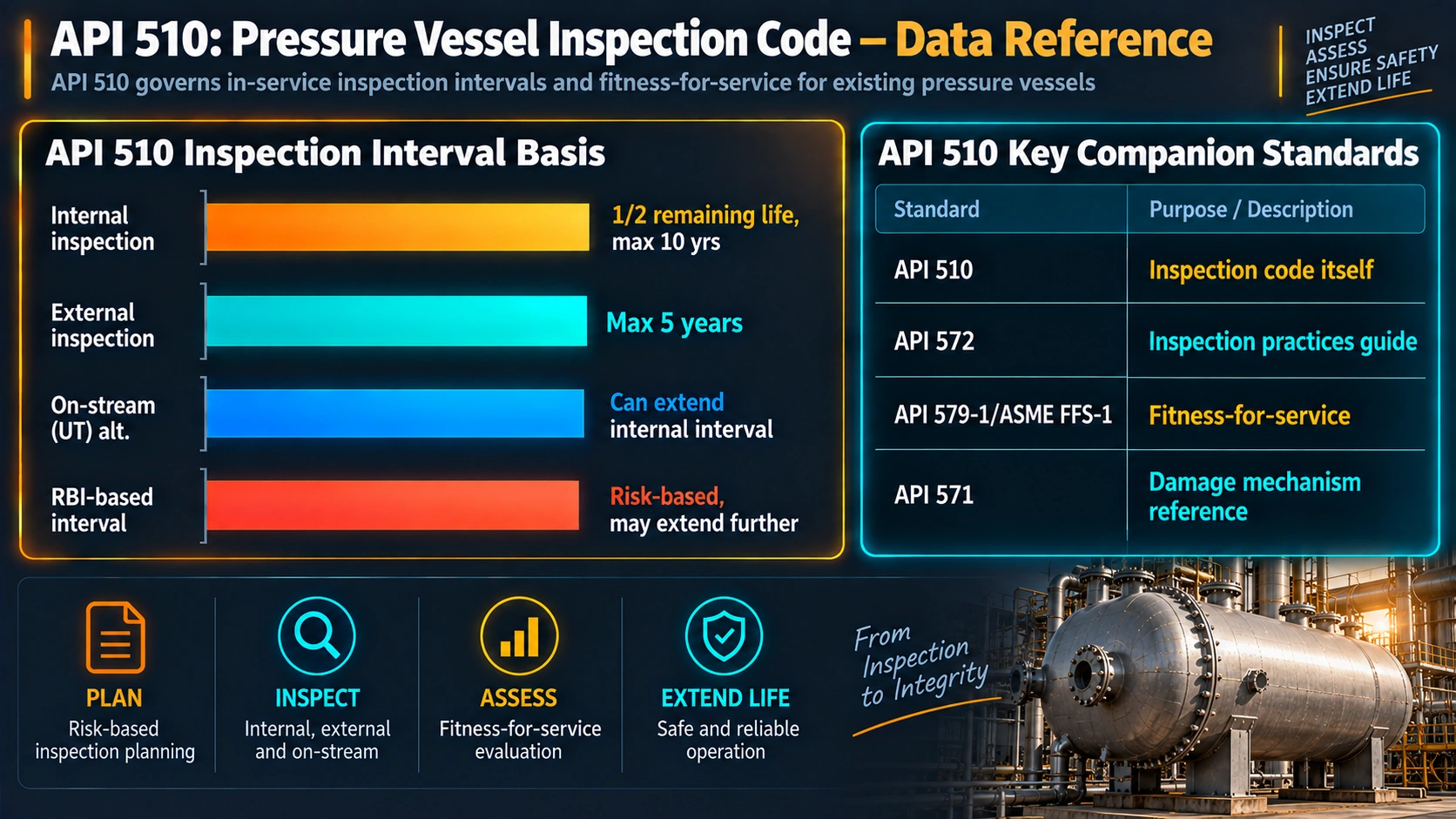
API 510 is explicit and precise about the distinction between a repair and an alteration — and this distinction carries significant procedural consequences. A repair is work performed to restore a pressure vessel to a condition suitable for safe operation without changing its pressure-temperature design rating or design basis. An alteration is any physical change to the pressure-containing components of the vessel that alters its pressure-temperature capability — for example, adding a new nozzle connection, changing the design pressure or temperature, replacing a shell section with a different material specification, or modifying the weld joint category.
| Activity | Classification | Additional Requirements vs Repair |
|---|---|---|
| Weld-deposited buildup of corroded area | Repair | Qualified procedure and welder; AI review; PWHT if required |
| Shell plate replacement (same material, same geometry) | Repair | Full NDE of new welds; PWHT; NB Form R-1 |
| Adding a new nozzle to the shell | Alteration | Engineering review; reinforcement calc; Form R-2; re-rating if needed |
| Changing design pressure from 250 to 300 psi | Alteration | Engineering review; new thickness calc; new MAWP stamping; Form R-2 |
| Replacing shell section with higher-strength material | Alteration | Engineering review; re-rating calculation; PWHT per new material requirements |
| Installing composite patch over pitted area | Repair (temporary) | Engineering approval; time limit; monitoring condition; per ASME PCC-2 |
PWHT Requirements in Weld Repairs
Post-weld heat treatment (PWHT) is one of the most complex and examined aspects of pressure vessel repair under API 510. The requirement for PWHT on a repair weld is governed by the original code of construction (ASME Section VIII Division 1, paragraph UCS-56 for carbon and low-alloy steels), the P-number of the base material, the weld thickness, and the service conditions. PWHT requirements in API 510 repair welding are not discretionary — if the original construction required PWHT or if the weld repair thickness exceeds the ASME threshold for the material P-number, PWHT must be applied. See the P-Number Guide and Mechanical Testing Guide for detailed qualification requirements.
Pressure Testing After Repair or Alteration
API 510 requires that a pressure test be conducted after any repair or alteration unless the AI — in consultation with the PVE — determines that a pressure test is impractical or would not improve the vessel’s integrity assurance, and an alternative examination programme is substituted. When a pressure test is performed, the test pressure is typically 1.3 times the MAWP (for hydrostatic test with ASME Section VIII stress ratio adjustment) or 1.1 times the MAWP for pneumatic test, subject to jurisdictional requirements. The test must be witnessed and documented by the authorised inspector.
NDE Methods in Pressure Vessel Inspection
API 510 requires that NDE activities be performed by personnel qualified to the applicable ASME Section V and SNT-TC-1A (or equivalent) requirements. The selection of the appropriate NDE method is determined by the damage mechanism being assessed, the vessel geometry, accessibility, and the required detection sensitivity.
| NDE Method | Primary Application | Key Limitation |
|---|---|---|
| UT Thickness (contact) | CML thickness measurement, remaining life data | Point measurement; insulation removal required at point |
| Phased Array UT (PAUT) | Weld inspection, crack sizing, corrosion mapping | Higher cost; surface prep required; specialist interpretation |
| TOFD (Time-of-Flight Diffraction) | Weld flaw detection and crack sizing (length and depth) | Near-surface dead zone; may miss short surface-breaking flaws |
| Radiographic Testing (RT) | Weld quality, internal pitting, wall profile through insulation | Radiation safety zone; 2D projection only |
| Magnetic Particle Testing (MT) | Surface and near-surface cracks in ferritic steel welds and HAZ | Ferromagnetic materials only; direct surface access required |
| Liquid Penetrant Testing (PT) | Surface-breaking cracks on any material including stainless and nickel alloys | Surface must be clean and accessible; subsurface flaws not detected |
| Acoustic Emission (AE) | Global monitoring during hydrostatic pressure testing; crack detection | Source location accuracy limited; background noise sensitivity |
| Pulsed Eddy Current (PEC) | Wall thickness screening through insulation; CUI assessment | Lower precision than contact UT; footprint averaging effect |
| Infrared Thermography (IRT) | Refractory lining integrity; hot spot detection; CUI screening | Qualitative screening tool; results affected by emissivity and environment |
API 510 Inspector Exam — What You Need to Know
The API 510 Pressure Vessel Inspector certification examination tests both technical competence in pressure vessel inspection and the ability to navigate the referenced codes quickly under timed conditions. The examination is open-book but demanding — candidates who have not methodically tabbed and indexed their code books will struggle to complete all questions within the allotted time.
Examination Format
| Parameter | Detail |
|---|---|
| Format | Multiple choice, 150 questions |
| Duration | 3 hours (open book) |
| Primary reference | API 510 (current edition) |
| Supporting references | ASME Section VIII Div 1, ASME Section V, ASME Section IX, API 576, API 579-1 |
| Eligibility | Minimum education and experience requirements per API 510 Section 3.3 |
| Re-certification | Every 3 years by work experience record; every 6 years by re-examination |
Topic Weighting
| Topic Area | Approx. Weight | Critical Sub-Topics |
|---|---|---|
| Inspection, examination, and testing | ~30% | Inspection types and intervals, CML selection, NDE method selection, pressure testing |
| Corrosion and damage mechanisms | ~20% | CUI, HIC, SCC, wet H2S damage, high-temperature damage, erosion-corrosion |
| Design and engineering (ASME VIII) | ~20% | Minimum thickness (UG-27), MAWP calculation, weld joint efficiency, nozzle reinforcement |
| Repair, alteration, and re-rating | ~18% | Repair vs alteration definition, PWHT requirements, NDE of repairs, Form R-1/R-2, pressure testing |
| Records, documentation, and FFS | ~12% | Inspection records, RBI concepts, API 579 FFS overview, MAWP re-rating documentation |
API 510 Practice Quiz — 20 Questions
Frequently Asked Questions — API 510
What is the scope of API 510?
API 510 covers the inspection, rating, repair, and alteration of pressure vessels that have been placed in service in petroleum refineries, chemical plants, and related industries. It applies to vessels constructed to ASME Section VIII or equivalent recognised standards. It does not cover new construction, pressure vessels in non-process service such as domestic water heaters, or specifically excluded equipment such as fired vessels covered by ASME Section I, heat exchanger tube bundles, or vessels with an internal diameter of 6 inches or less (unless the owner elects to include them).
What are the maximum inspection intervals under API 510?
API 510 sets a maximum internal inspection interval of 10 years and a maximum external inspection interval of 5 years. However, the actual interval must not exceed one-half of the calculated remaining corrosion life in either case. If the remaining life calculation gives a half-life shorter than the class maximum, the half-life governs. Risk-based inspection programmes conducted per API 580 may justify intervals beyond the default maximums where probability and consequence of failure are well characterised and acceptable.
How is the minimum required thickness calculated under API 510?
The minimum required thickness for a cylindrical shell under internal pressure uses the ASME Section VIII Division 1 formula from UG-27: t = PR / (SE − 0.6P), where P is the design internal pressure, R is the inside radius, S is the allowable stress at design temperature from ASME Section II Part D Appendix A, and E is the weld joint efficiency from Table UW-12. This formula gives the minimum required thickness excluding corrosion allowance. During inspection, the measured thickness is compared against this calculated minimum to determine remaining life.
What is MAWP re-rating in API 510?
MAWP re-rating is the engineering process of recalculating the Maximum Allowable Working Pressure of a pressure vessel based on its current measured (corroded) thickness rather than the original nominal design thickness. When corrosion reduces the vessel wall below the original design corrosion allowance, the MAWP formula is rearranged to solve for pressure given the actual remaining thickness. If the resulting MAWP remains above the operating pressure, the vessel can continue in service at the formally documented re-rated value. Re-rating requires pressure vessel engineer review and documentation, and in many jurisdictions requires updated stamping and form submission.
What is the difference between a repair and an alteration under API 510?
A repair restores a pressure vessel to a condition suitable for continued safe operation without changing its pressure-temperature design basis. An alteration physically changes the pressure-containing components in a way that affects the pressure-temperature design rating — such as adding a new nozzle, changing the material, modifying the design pressure, or changing the weld joint category. Alterations require formal engineering review, updated design calculations, National Board Form R-2, and jurisdictional approval where required. Repairs require Form R-1, qualified welding procedures and welders, AI acceptance, and PWHT where mandated by the construction code.
When can fitness-for-service (FFS) be used instead of repair or retirement under API 510?
API 510 permits fitness-for-service assessments under API 579-1/ASME FFS-1 when a vessel has deterioration that causes the measured thickness to fall below the ASME Section VIII minimum but where engineering analysis demonstrates the vessel remains structurally adequate. FFS can address general thinning (Part 4), local metal loss (Part 5), pitting (Part 6), HIC and blistering (Part 7), weld misalignment (Part 8), crack-like flaws (Part 9), and other damage types. The assessment must be performed by the pressure vessel engineer, documented formally, and accompanied by defined monitoring conditions and a re-assessment schedule.
What documentation does API 510 require for each pressure vessel?
API 510 requires that each pressure vessel have a complete, maintained inspection record including: vessel identification and description, original design data (design pressure, temperature, material, MAWP, weld joint efficiency), all inspection reports with measured thickness data at each CML, corrosion rate and remaining life calculations, the established next inspection date, records of all repairs and alterations with applicable Form R numbers, pressure test records, and any fitness-for-service assessments. These records must be maintained for the life of the vessel and be available to the authorised inspector at all times.
What topics are most important for the API 510 inspector certification exam?
The API 510 exam heavily tests: inspection interval rules and the half-remaining-life calculation, minimum thickness and MAWP calculations using ASME Section VIII UG-27, corrosion rate determination (STCR vs LTCR — always use the greater), repair vs alteration classification and the additional requirements for each, PWHT requirements by material P-number and thickness, NDE method selection for specific damage mechanisms, and fitness-for-service concepts under API 579. Supporting codes you must navigate quickly include ASME Section VIII Div 1, ASME Section V, ASME Section IX, and API 576. Since the exam is open-book, systematic tabbing and indexing of all code books is as important as technical knowledge.
Recommended Resources for API 510 Study
These references are widely used by API 510 exam candidates and practising pressure vessel inspectors.