API 570 Piping Inspection Code: Complete In-Service Inspection Guide
API 570 piping inspection is the backbone of integrity management in petroleum refineries, chemical plants, and process facilities worldwide. Originally published by the American Petroleum Institute (API), this code governs how in-service metallic and non-metallic piping systems are inspected, rated, repaired, altered, and re-rated throughout their operational life. Whether you are an experienced inspection engineer, a plant integrity manager, or a candidate preparing for the API 570 Inspector certification exam, understanding this code in depth is not optional — it is foundational.
This guide covers the full scope of API 570: how piping circuits are classified by risk, how Condition Monitoring Locations (CMLs) are selected and managed, how inspection intervals are calculated from corrosion rates and remaining life, how injection points and deadlegs receive elevated scrutiny, and when a fitness-for-service (FFS) assessment under API 579-1/ASME FFS-1 can justify continued operation of degraded piping. A dedicated exam preparation section and a timed practice quiz are also included to help candidates prepare for the API 570 certification examination.
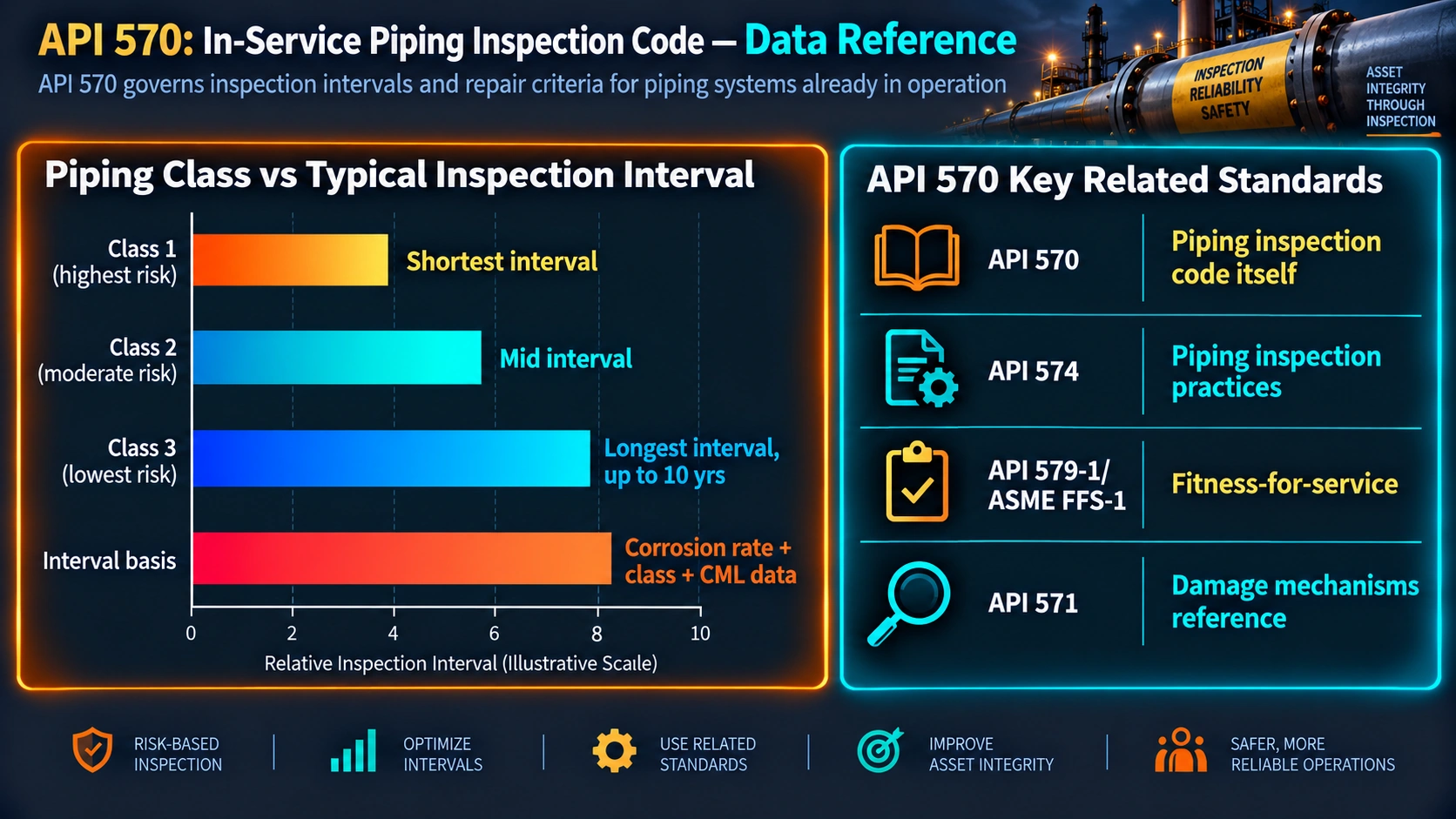
API 570 works in close coordination with ASME B31.3 (Process Piping), API 574 (Inspection Practices for Piping System Components), API 577 (Welding Inspection and Metallurgy), and API 578 (Material Verification Program for Alloy Piping Systems). Together, these documents form a complete framework for piping integrity throughout a facility’s operational life.
Scope and Applicability of API 570
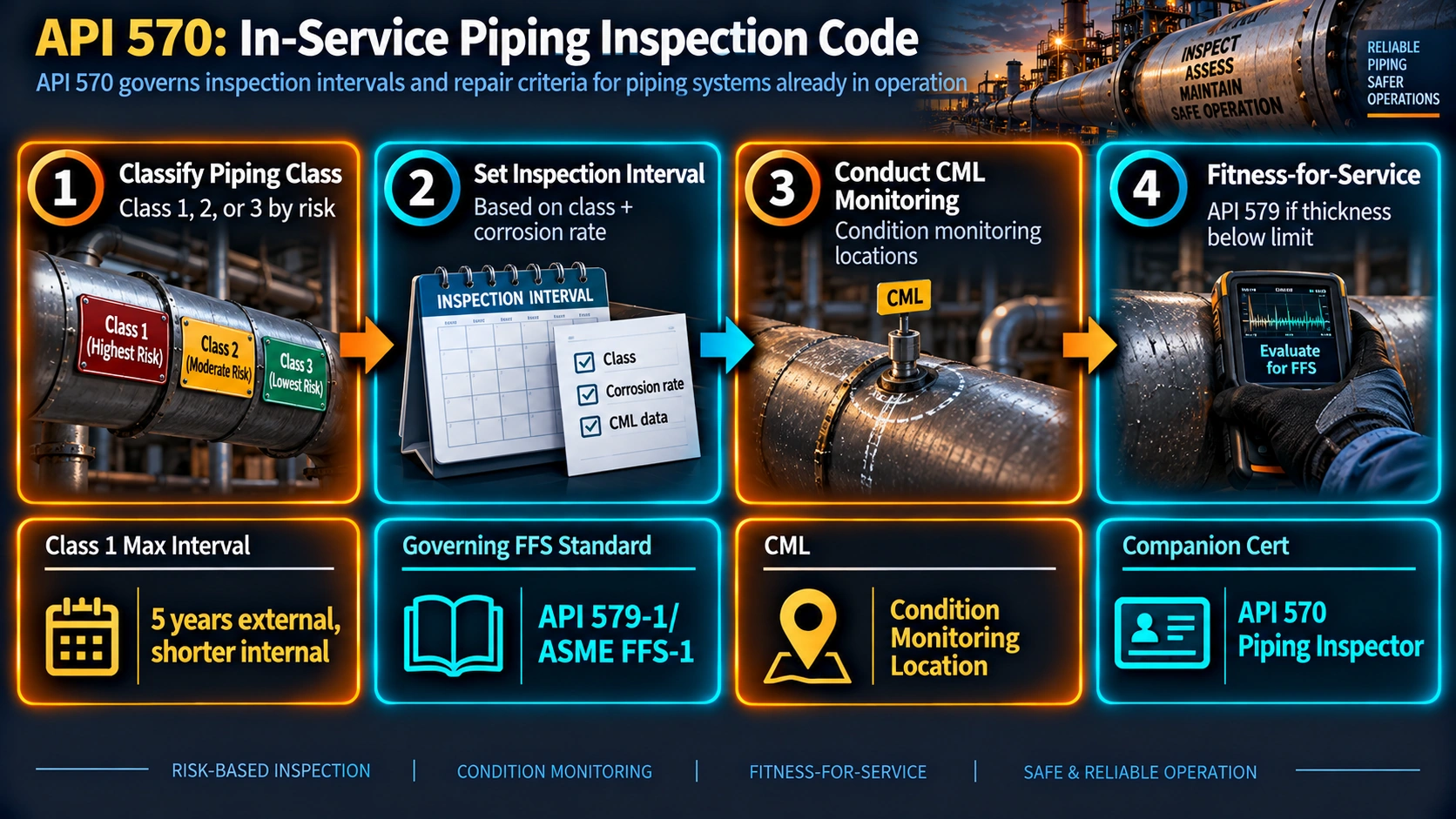
API 570 applies to piping systems that have already been placed in service. The code covers metallic and non-metallic piping used in petroleum refineries, chemical plants, natural gas processing plants, and related industries. Its provisions govern periodic inspection, corrosion rate determination, remaining life calculation, fitness-for-service assessment, temporary repairs, permanent repairs, alterations, and re-rating of existing piping.
The code establishes requirements for authorised piping inspectors — individuals who must be qualified and certified under API 570 to perform or directly supervise inspections. These inspectors work alongside piping engineers who provide engineering judgement on integrity decisions, fitness-for-service assessments, and repair designs.
What API 570 Does NOT Cover
It is equally important to know where API 570’s authority ends. The code explicitly excludes: piping systems designed and constructed for future use (new construction), fired heater tubing, heat exchanger tube bundles, pressure vessel nozzles within the vessel itself, and non-metallic piping (although owners can apply API 570 principles to such systems by agreement). Piping NPS 1 and smaller is excluded by default, though owners may include it. Understanding these exclusions is critical in the API 570 exam.
Piping Classification — Class 1, 2, and 3
API 570 requires that all piping circuits within its scope be assigned to one of three service classes. The class assignment determines the maximum permissible inspection interval and the level of scrutiny applied. Classification is typically performed by the piping engineer in consultation with the authorised inspector, the process engineer, and the safety function.
| Class | Risk Level | Typical Service Examples | Max External Interval | Max Internal / CML Interval |
|---|---|---|---|---|
| Class 1 | Highest | HF acid, H2 service, flammables above AIT, lethal fluids, lines in hydrogen service, injection points, deadlegs in high-risk service | 5 years | 10 years (or 1/2 RL) |
| Class 2 | Moderate | Most hydrocarbon process lines, steam, boiler feed water, condensate, process gases, amine, caustic | 5 years | 10 years (or 1/2 RL) |
| Class 3 | Lower | Low-vapour-pressure hydrocarbons, lube oil, non-flammable non-toxic low-hazard fluids | 10 years | 10 years (or 1/2 RL) |
Note that Classes 1 and 2 share the same maximum intervals in current editions of API 570. The key differentiator is the consequence of failure: Class 1 circuits represent conditions where failure could cause immediate danger to life, significant environmental impact, or uncontrolled release of toxic or flammable material above its auto-ignition temperature. Risk-based inspection (RBI) programmes conducted under API 580 methodology can be used to justify extended intervals beyond the class maxima where corrosion rates and failure consequences are well characterised and low.
Condition Monitoring Locations (CML) — Selection and Strategy
A Condition Monitoring Location (CML) is a specific point — or a small area — on a piping circuit where periodic non-destructive examination (NDE) measurements are taken to track the rate of wall thickness loss due to corrosion, erosion, or other degradation mechanisms. The CML is the fundamental building block of the API 570 inspection programme. Selecting CMLs correctly determines whether the programme will catch dangerous thinning before it reaches the minimum required thickness.
Principles of CML Selection
API 570 does not prescribe a fixed number of CMLs per circuit. Instead, it requires that enough CMLs be established to characterise the corrosion rate and extent of corrosion across the circuit reliably. The following locations receive priority consideration:
| Location Type | Reason for Priority | Recommended CML Approach |
|---|---|---|
| Elbows and bends | Erosion-corrosion on extrados; flow turbulence | 4-point UT grid (12, 3, 6, 9 o’clock positions) |
| Injection points | Severe localised attack downstream of chemical injection | Multiple CMLs from nozzle to 12 in / 3D downstream |
| Deadlegs | Stagnant fluid, accelerated localised corrosion | Top and bottom of deadleg; near flow junction |
| Tees and reducers | Turbulence and impingement at flow direction change | CMLs at impingement face and downstream |
| Pipe-to-soil transitions | Accelerated external corrosion at grade level | External UT or guided wave at grade and 6 in below |
| Supports and saddles | CUI risk; contact corrosion | External UT either side of support; profile radiography |
| Weld heat-affected zones | Selective corrosion (weld decay in SS, graphitisation in CS) | CMLs at weld and 1-2 in from weld on both sides |
| Low-point drains and high-point vents | Water accumulation, underdeposit corrosion | UT sweep around connection and adjacent pipe |
CML Reduction Programmes
API 570 permits the number of CMLs to be reduced over time once sufficient data has been gathered to establish a reliable corrosion rate and confirm that corrosion is uniform and predictable. Reduction decisions require engineering review and must not eliminate coverage of known high-risk locations. Conversely, when a new damage mechanism is discovered — such as hydrogen-induced cracking (HIC) or stress corrosion cracking (SCC) in an unexpected location — new CMLs must be added immediately and the inspection interval reassessed.
Inspection Intervals and Scheduling
API 570 defines two primary types of inspection that together form the complete inspection programme for each piping circuit: external visual inspection and internal (or thickness measurement) inspection. These are supported by on-stream inspections, pressure testing when required, and supplemental NDE for specific damage mechanisms.
External Visual Inspection
External visual inspection is typically performed by the authorised inspector while the piping is in service and online. It covers corrosion under insulation (CUI) risk assessment, surface condition of coating and insulation, mechanical condition (supports, anchors, expansion loops), leaks, hot spots, vibration indicators, and visible external corrosion. The class maximum intervals are 5 years (Class 1 and 2) and 10 years (Class 3), but the actual interval must not exceed one-half the calculated remaining life based on external corrosion data.
On-Stream Inspection
On-stream inspection uses UT thickness measurements at established CMLs while the piping remains in operation. This is the primary tool for tracking internal corrosion rates and updating remaining life calculations without the need for plant shutdown. On-stream inspection can substitute for internal inspection (entering the pipe) in most circumstances.
Internal Inspection
Internal inspection — physical entry into the piping — is required when the internal condition cannot be adequately evaluated from external measurements. It is also required when the piping has not been inspected for an interval exceeding the maximum allowed for its class. Internal inspection is more common for large-diameter piping (NPS 12 and larger) and for conditions such as microbiologically influenced corrosion (MIC) where surface evaluation is necessary.
Corrosion Rate, Remaining Life, and Next Inspection Date
The calculation of corrosion rate, remaining life, and the next inspection date is one of the most fundamental and most frequently examined aspects of API 570. The methodology requires actual measured thickness data from at least two inspections separated by a known time interval.
Corrosion Rate Calculation
Remaining Corrosion Life
Worked Example
Injection Points and Deadlegs
Injection Points
An injection point is defined in API 570 as a location where a chemical or process stream is introduced into a flowing piping circuit. Injection points are among the highest-risk locations in any process facility because they create zones of severe localised turbulence, incomplete mixing, and accelerated corrosion or erosion-corrosion. The corrosion mechanism at an injection point can be fundamentally different from — and far more aggressive than — the corrosion operating in the main circuit.
API 570 requires that injection point inspection areas be defined as extending from the injection nozzle to a minimum of 12 inches (300 mm) or 3 pipe diameters downstream (whichever is greater), and a minimum of one pipe diameter upstream of the injection nozzle. All piping within this defined zone must be assigned CMLs at both the upstream and downstream extents and at the maximum anticipated corrosion location — typically the first elbow or change in direction downstream of the injection nozzle.
Deadlegs
A deadleg is a section of piping that has no or minimal flow under normal operating conditions. Common examples include blanked-off branch connections, bypass lines out of service, standby pump suction lines, drain connections, and instrument tappings. Because fluid in a deadleg is essentially stagnant, it may accumulate water, corrosive species, or solids that are flushed away in flowing sections. This creates conditions for accelerated underdeposit corrosion, microbiologically influenced corrosion (MIC), and accelerated generalised attack at the deadleg-to-flowing-circuit interface.
Deadlegs require dedicated CMLs at the connection point to the live circuit, at the closed end, and at representative intermediate points. The inspection interval for deadlegs is generally set more conservatively than for the rest of the circuit, and deadlegs should be considered for elimination from the system wherever process requirements permit — a permanently removed deadleg eliminates the corrosion risk entirely.
Fitness-for-Service (FFS) Assessment
Fitness-for-service (FFS) assessment is the structured engineering process of evaluating whether a component with a known or suspected flaw or area of degradation is suitable for continued service under the existing or modified operating conditions. API 570 explicitly permits — and in some cases requires — FFS assessments when conventional code minimum thickness calculations alone would indicate the piping must be repaired or retired. The governing standard for FFS assessment in API 570 context is API 579-1/ASME FFS-1.
When is FFS Required or Beneficial?
FFS assessment is appropriate when measured thickness falls below the ASME B31.3 minimum allowable but the piping engineer believes the component remains structurally adequate. Common situations include: general corrosion leaving residual thickness above the Level 1 FFS screening threshold, localised pitting (Part 5 of API 579), blistering or HIC damage (Part 7), weld misalignment (Part 8), and in-service cracking (Part 9). An FFS assessment for generalised thinning (Part 4) can demonstrate that a pipe with sub-minimum thickness at a localised area remains fit for service at reduced maximum allowable operating pressure (MAOP) or full pressure, depending on the extent of thinning.
When a piping circuit is accepted for continued service through an FFS assessment, the piping engineer must define specific monitoring conditions: reduced MAOP, enhanced inspection frequency at the assessed location, and a defined re-assessment date. These conditions must be formally documented and entered into the piping inspection record. FFS cannot be used to defer inspection indefinitely — it is a tool for informed, documented, engineering-justified decision-making.
Repair and Alteration Requirements
Defining Repair vs Alteration
API 570 draws a clear distinction between a repair and an alteration. A repair restores the piping to a condition suitable for continued service without changing the design intent. An alteration physically changes any pressure-containing component in a way that affects the pressure or temperature design rating — for example, replacing a section of pipe with a material of different grade, adding a branch connection, or changing the MAOP. Alterations require formal engineering review, revised design calculations, and in many cases post-weld heat treatment (PWHT) if the original code of construction required it.
Temporary Repairs
API 570 permits certain temporary repairs to remain in service until the next turnaround or a defined time limit, subject to engineering approval and monitoring. Acceptable temporary repair methods include:
| Temporary Repair Method | Applicability | Limitations |
|---|---|---|
| Leak clamps (pipe clamps) | Pinhole leaks, small cracks in straight runs | Must not be used on welds without engineering approval; time-limited |
| Composite wrap repair | General thinning, localised external corrosion | Requires design per ISO 24817 or ASME PCC-2; not for welds through-cracks |
| Weld overlay / flush patch | Internal pitting or erosion | Requires PWHT if needed; weld procedures per ASME IX |
| Hot bolting / injection fitting | Flange or valve packing leaks | Hazard assessment required; specialised procedure |
Permanent Repairs
Permanent repairs must restore the piping to a condition that meets the original code of construction (typically ASME B31.3) or a recognised equivalent. Permanent weld repairs require qualified welders and qualified welding procedures in accordance with ASME Section IX. PWHT must be applied if required by the material P-number, wall thickness, and original construction code. Radiography or UT examination of completed weld repairs is typically required for Class 1 and Class 2 piping.
NDE Methods Used in Piping Inspection
API 570 does not restrict inspectors to any single NDE technique. The choice of method is driven by the damage mechanism anticipated, the pipe geometry, and the accessibility of the measurement location. The following NDE methods are most commonly applied in API 570 piping inspection programmes:
| NDE Method | Primary Use in API 570 | Limitations |
|---|---|---|
| Ultrasonic Testing — Manual (UT) | CML thickness measurement, laminations, HIC | Point measurement only; insulation must be removed at measurement point |
| Automated UT (AUT / TOFD / Phased Array) | Weld inspection, mapping corrosion profiles | Higher cost; surface preparation required |
| Radiographic Testing (RT) | Weld quality, pitting profiles, CUI screening | Radiation safety zone; insulation may stay for profile RT |
| Guided Wave UT (GWUT / LRUT) | Long-range screening for CUI, corrosion under supports | Screening tool only; anomalies must be confirmed by UT |
| Pulsed Eddy Current (PEC) | Thickness screening through insulation and cladding | Lower accuracy than contact UT; not suitable for thin-wall pipe |
| Magnetic Particle Testing (MT) | Surface-breaking cracks on ferritic materials | Ferromagnetic materials only; surface must be accessible |
| Liquid Penetrant Testing (PT) | Surface-breaking cracks on any material including SS and alloys | Surface only; no subsurface detection |
| Acoustic Emission (AE) | Pressure test monitoring for crack growth | Requires process fluid or pressurisation; specialist interpretation |
A robust API 570 inspection programme combines multiple NDE methods. For example, GWUT screening might identify a suspect area under insulation on a long buried or insulated run, which is then confirmed with a targeted local UT measurement or profile radiography. For suspected stress corrosion cracking in stainless steel piping, TOFD or phased array UT is often preferred over RT because it can detect tight axially-oriented cracks more reliably. Learn more about corrosion mechanisms in our Corrosion Guide and ASTM G48 testing.
API 570 Inspector Exam — What You Need to Know
The API 570 Piping Inspector certification examination is administered by the American Petroleum Institute and is taken by inspection engineers and senior technicians who inspect in-service piping systems in the petrochemical and refining industries. The exam is open-book, but the volume of referenced documents and the time pressure mean that candidates who have not thoroughly prepared will struggle to locate answers quickly enough. Success requires both genuine code comprehension and examination technique.
Examination Format and Referenced Documents
| Item | Detail |
|---|---|
| Format | Multiple-choice, 170 questions |
| Duration | 3.5 hours |
| Pass mark | Approximately 70% (API does not publish the exact cut score) |
| Open book | Yes — paper copies of all referenced codes permitted in the exam room |
| Primary reference | API 570 (current edition) |
| Supporting references | ASME B31.3, ASME Section V, ASME Section IX, API 574, API 577, API 578 |
Key Topic Areas by Weight
| Topic Area | Approximate Exam Weight | Critical Sub-topics |
|---|---|---|
| Inspection and testing | ~35% | CML selection, inspection types, intervals, NDE methods, pressure testing |
| Corrosion, materials, and damage mechanisms | ~20% | HIC, SSC, SCC, CUI, erosion-corrosion, high-temperature damage, material selection |
| Design and engineering | ~20% | Minimum thickness calc (B31.3), branch reinforcement, pressure relief, MAOP |
| Repair and alteration | ~15% | Weld repair, PWHT, temporary repairs, alteration requirements, re-rating |
| Records and documentation | ~10% | Inspection records, risk-based inspection integration, piping isometrics |
Top 10 Exam Preparation Tips
API 570 Practice Quiz
Test your API 570 knowledge with these exam-style questions. Submit all answers at once to see your score.
Frequently Asked Questions — API 570
What is the scope of API 570?
API 570 covers the in-service inspection, rating, repair, alteration, and re-rating of metallic and non-metallic piping systems that have been placed in service. It applies to piping in petroleum refineries, chemical plants, and related industries. It does not cover new construction (which falls under ASME B31.3) or piping systems inside rotating equipment, nor does it automatically cover piping with a nominal pipe size of NPS 1 or smaller, though owners may elect to include such piping in their programme.
What are the inspection classes in API 570 and their intervals?
API 570 classifies piping into three classes. Class 1 (highest risk — flammable, toxic, high-pressure lines) has a maximum 5-year external and 10-year internal inspection interval. Class 2 (moderate risk — most hydrocarbon and utility lines) also has 5-year external and 10-year internal maximum intervals. Class 3 (low risk — flammables with low vapour pressure, lube oil) has a 10-year maximum for both external and internal inspections. In all cases, the actual inspection interval must not exceed one-half of the calculated remaining corrosion life, regardless of the class maximum.
What is a Condition Monitoring Location (CML) in API 570?
A CML is a designated point on a piping circuit where periodic examinations are carried out to monitor the rate and extent of corrosion or other degradation. CMLs are selected to represent the worst-case locations in the circuit — typically at changes of direction (elbows, tees), injection points, deadlegs, areas of known turbulence, and corrosion-prone geometries such as low-point drains and pipe-to-soil transitions. API 570 requires that sufficient CMLs be established to characterise the corrosion rate of the circuit reliably, without prescribing a specific minimum number.
How is the remaining life and next inspection date calculated under API 570?
Remaining life (RL) is calculated as: RL = (current measured thickness − minimum required thickness) / corrosion rate. The corrosion rate used is the greater of the short-term rate (STCR) and the long-term rate (LTCR). The next inspection interval is then set at the lesser of one-half the remaining life or the applicable class maximum interval. For example, if RL = 12 years and the class maximum is 10 years, the next inspection is due in 6 years (RL/2 governs). If RL = 22 years, RL/2 = 11 years, but the class 2 maximum is 10 years, so 10 years governs.
What makes an injection point a high-priority inspection location under API 570?
Injection points introduce a chemical stream into a flowing process line, creating zones of severe localised turbulence, incomplete mixing, and accelerated corrosion or erosion-corrosion. The attack at injection points can be far more aggressive than in the main circuit and can act by a completely different mechanism. API 570 requires that the inspection zone extend from the injection nozzle to at least 12 inches or three pipe diameters downstream (whichever is greater), and one pipe diameter upstream. All piping within this zone must be classified as Class 1 by default, and CMLs must cover both the upstream and downstream extents as well as the point of maximum anticipated attack.
What is the difference between an alteration and a repair under API 570?
A repair is any work done to restore a piping system to a condition suitable for continued safe operation without changing the design intent or pressure-temperature rating. An alteration is a physical change to the pressure-containing components that affects the pressure-containing capability or the design temperature or pressure — such as changing pipe diameter, material specification, or adding a branch connection. Alterations require formal engineering review, a revised design calculation, and post-weld heat treatment if originally required. Repairs require a qualified welder and inspector but do not necessarily require a full engineering re-evaluation unless the repair method or scope is unusual.
Can fitness-for-service (FFS) assessment be used to keep a degraded pipe in service under API 570?
Yes. API 570 explicitly permits fitness-for-service assessments conducted under API 579-1/ASME FFS-1 to evaluate whether degraded piping can continue in service safely. FFS addresses general corrosion, localised metal loss, pitting, blistering, cracking, dents, and other damage mechanisms through three progressively rigorous assessment levels. When FFS confirms acceptability, the pipe may remain in service with defined monitoring conditions, a potentially reduced MAOP, and a documented re-assessment schedule. FFS is an engineering tool, not a mechanism to indefinitely defer integrity action.
What topics are most important for the API 570 inspector certification exam?
The API 570 exam focuses heavily on inspection planning and classification, corrosion rate calculation and remaining life (these calculation questions are guaranteed to appear), CML selection rationale, inspection methods and their appropriate applications, pressure testing requirements, repair and alteration requirements and their distinction, and record-keeping obligations. Supporting codes you must know include ASME B31.3 (pressure design formula and appendix A allowable stresses), ASME Section V (NDE qualification), ASME Section IX (welding qualifications), API 574, API 577, and API 578. Since the exam is open-book, practise indexing and tabbing these documents so you can locate specific clauses and tables quickly under exam conditions.
Recommended References for API 570 Study
These resources are widely used by practising inspectors and API 570 exam candidates.